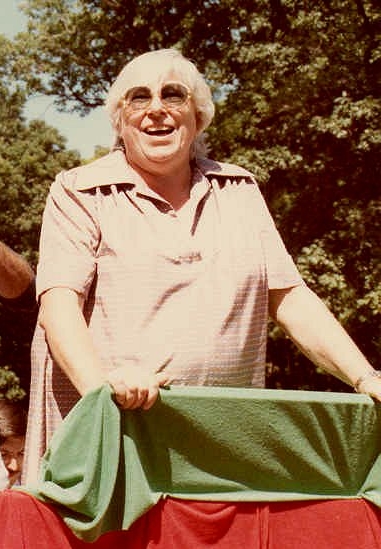
O’Hair was murdered in 1995 by a typesetter who worked for American Atheists. (Image by Alan Light.)
From the 1965 Playboy interview with Madalyn Murray O’Hair, the arch-atheist who sued to get prayer out of public schools and was dubbed “The Most Hated Woman in America” during her lifetime:
Playboy:
What led you to become an atheist?
Madalyn Murray O’Hair:
Well, it started when I was very young. People attain the age of intellectual discretion at different times in their lives — sometimes a little early and sometimes a little late. I was about 12 or 13 years old when I reached this period. It was then that I was introduced to the Bible. We were living in Akron and I wasn’t able to get to the library, so I had two things to read at home: a dictionary and a Bible. Well, I picked up the Bible and read it from cover to cover one weekend — just as if it were a novel — very rapidly, and I’ve never gotten over the shock of it. The miracles, the inconsistencies, the improbabilities, the impossibilities, the wretched history, the sordid sex, the sadism in it — the whole thing shocked me profoundly. I remember l looked in the kitchen at my mother and father and I thought: Can they really believe in all that? Of course, this was a superficial survey by a very young girl, but it left a traumatic impression. Later, when I started going to church, my first memories are of the minister getting up and accusing us of being full of sin, though he didn’t say why; then they would pass the collection plate, and I got it in my mind that this had to do with purification of the soul, that we were being invited to buy expiation from our sins. So I gave it all up. It was too nonsensical.•
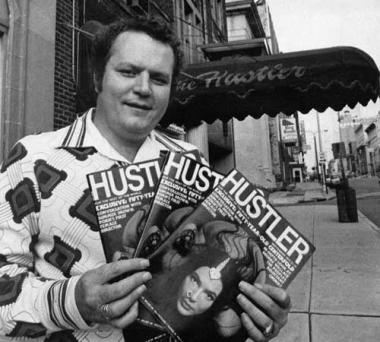
From “Larry Flynt at Home,” Jean Stein’s Los Angeles Review of Books recollection of the puke-inducing pornographer/Constitutional rights champion at the height of his powers in 1983, as he was planning a Presidential run. In this segment, screenwriter and novelist Terry Southern has been summoned to Flynt’s Los Angeles lair, by a wired Dennis Hopper, to work on a dubious film project about Jim Morrison:
“The next guy to arrive was Marjoe — you know, that guy who used to be a child evangelist. And the other person who was a permanent guest for the moment was Madalyn Murray. Madalyn Murray has devoted her entire life to trying to get the Bible outlawed in school. She’s a professional atheist, very courageous. For some reason Larry Flynt was interested in her cause. I think he wanted to fuck her … mind-fuck her I mean.
About 4:00 P.M. Larry Flynt comes in and says, ‘Sundowner time. Time for a sundowner.’ He’s in a wh
eelchair. His wheelchair is motorized and gold-plated, and it has little American flags like on an ambassador’s car. He’s wearing this big diaper he had made up from an American flag.‘They treat me like a baby,’ he said, ‘so I’m going to behave like one. And if I poo-poo in my diaper, I’ll be poo-pooing on the American flag.’ He’s trying to explain this to this huge Indian — what the hell is his name? He’s a great Indian guy who’s about seven feet tall … Means, Russell Means. He’s there, and meanwhile I hear this shouting, and it sounds like a big argument, but it’s just Liddy and Tim Leary rehearsing their act, I mean their ‘debate.’ About time for dinner, Frank Zappa arrives, you know him. Quite a grand zany. So there’s this very long table of odd people.
After dinner Larry said, ‘Come into my study, Terry, you’re going to need some money for the weekend.’ We went into his office and he said, ‘There’s a briefcase by the couch where you’re sitting. Put it on your lap and open it.’ So I did. It was full of packs of hundred-dollar bills. Larry said, ‘It’s a million dollars. I have this on hand to give validity to the offer.’ And he showed me this circular: A standing offer from Larry Flynt to the following women who are prepared to show gyno-pink. One million cash to Barbara Bach, Cathy Bach, Barbi Benton, Cheryl Tiegs … They were mostly kind of obscure, but there were one or two that were totally out of place, like Gloria Steinem and Jane Fonda. He was offering them a million dollars if they’d pose and do a gyno spread, what he called ‘flashing pink.’ And so he said, ‘Take whatever you think you’ll need for the weekend,” and he made a point of turning around to use the phone so I could take what I wanted. When he finished his call, he asked, ‘How much did you take?’
‘Two hundred dollars.’
‘You must be a fool — you could have taken more.’
I said, “I don’t think I need any more than that.’
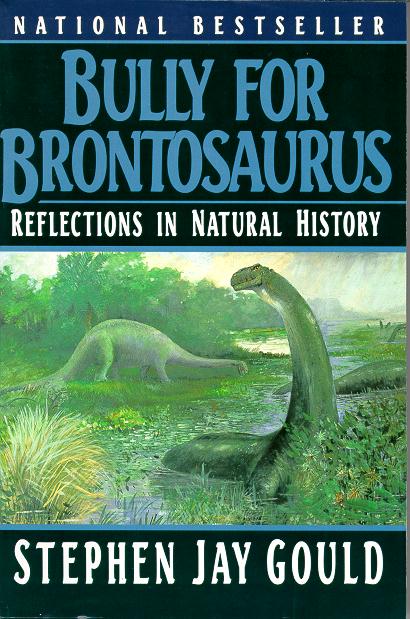
No too many paleontologists make the pages of People magazine, but the late Stephen Jay Gould was a serious academic who crossed over into the mainstream. The Queens-born Harvard professor was a lightning rod for others who disagreed with his theories, but Gould was someone who continually questioned himself, often revising beliefs from early essays in subsequent ones. An excerpt fromMichelle Green’s 1986 People profile:
“It is an inviting, vaguely antic enclave that suggests a 19th-century natural history museum turned into a bookish boys’ club. Faded lettering on the drab green walls announces ‘Synopsis of the Animal Kingdom’ and ‘Sponges and Protozoa,’ and in the room’s cluttered depths are a wealth of musty treasures: tall glass cases filled with drawers of trilobites, a towering painting of a tyrannosaurus, hundreds of leather-bound volumes and boxes of snail shells. A worn rattan chair has been pulled up to a worktable that holds fossils, microscopes and a supply of Pepperidge Farm cookies.
Stephen Jay Gould—evolutionary biologist, prolific writer and die-hard Yankees fan—has worked in this office at Harvard’s Museum of Comparative Zoology for 17 years, and many of his books have been spawned here: Ever Since Darwin, The Panda’s Thumb, Hen’s Teeth and Horse’s Toes and now The Flamingo’s Smile (Norton, $17.95). When he arrived with his freshly minted Ph.D. from Columbia, the rumpled, kinetic Gould was an exceptionally promising paleontologist; in the years since, he has become a popular symbol of erudition and scholarship. At 44, he recently completed the final year of a MacArthur Foundation grant that has paid him $38,400 a year since 1981. He was the recipient of an American Book Award in 1981, a National Magazine Award in 1980 and once made the cover of Newsweek. He has done battle with creationists, testified before congressional committees concerning nuclear winter and lectured in South Africa on the history of racism. Students fight to get into his classroom, and assorted crazies send tirades addressed to Mr. Illustrious Historical Professor Jay Gould, University of Harvard.
On this stone-gray afternoon, the illustrious historical professor is finding all the attention a bit of a problem. His secretary is putting through calls approximately every two minutes, and Gould—an ebullient man with a near-perpetual smile—is simultaneously trying to discuss his life’s work and fend off a flood of petitioners. On his desk is the latest batch of correspondence, including a letter from a man who suggests a connection between AIDS and aspirin, and a plea from the husband of a woman who is addicted to Gould’s columns in Discover:: Will the author please send birthday greetings to the following address? This nets the correspondent a hastily scrawled turndown: ‘I am not public property, but a man!'”
Premiere magazine, which published from 1987-2007, offered first-rate reporting about the movie industry for a good, long time, until corporate interference reduced it and destroyed it. One of its last gasps of greatness was “David Lynch Keeps His Head,” David Foster Wallace’s 1996 on set-reportage about the mystifying filmmaker as he made the equally inscrutable Lost Highway. An excerpt:
“The first time I lay actual eyes on the real David Lynch on the set of his movie, he’s peeing on a tree. This is on 8 January in L.A.’s Griffith Park, where some of Lost Highway’s exteriors and driving scenes are being shot. He is standing in the bristly underbrush off the dirt road between the base camp’s trailers and the set, peeing on a stunted pine. Mr. David Lynch, a prodigious coffee drinker, apparently pees hard and often, and neither he nor the production can afford the time it’d take to run down the base camp’s long line of trailers to the trailer where the bathrooms are every time he needs to pee. So my first (and generally representative) sight of Lynch is from the back, and (understandably) from a distance. Lost Highway’s cast and crew pretty much ignore Lynch’s urinating in public, (though I never did see anybody else relieving themselves on the set again, Lynch really was exponentially busier than everybody else.) and they ignore it in a relaxed rather than a tense or uncomfortable way, sort of the way you’d ignore a child’s alfresco peeing.”
John DeLorean remade the automotive industry, remade himself and eventually made a mess.
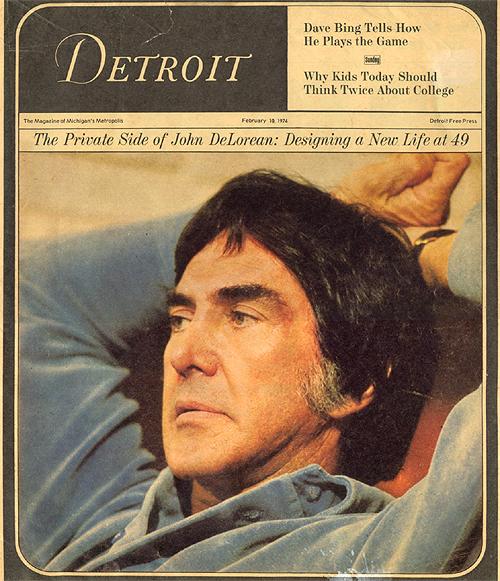
The opening of “The Private Side of John DeLorean: A New life at 49,” a great 1974 Detroit magazine cover story written by Paul Hendrickson, which profiled the legendary automaker after he exited the corporate car culture to blaze his own trail but before his head-on collision with hubris:
It begins like a parable. A skinny kid from inner-city Detroit grows up in the ’40s playing Slide the Rock and sandlot baseball and sometimes the clarinet. His father is a set-up man at the Ford foundry. His mother, separated from her husband, lives in California.
The boy is crazy for cars, dreaming of them every day as he rides a trolley down Woodward on his way to Cass Tech. Growing like a weed, he enters Lawrence Institute of Technology, graduates in engineering and, in 1948, begins a 25-year career in the automobile industry. Along the way, he picks up two master’s degrees, a wife from northern Michigan and 200 patents, including the recessed windshield wiper, the hidden radio antenna and the overhead-cam engine.
His rise at General Motors in meteoric. In 1965, at age 40, he is made general manager at Pontaic and a vice president. At 44, he becomes the youngest man ever to direct Chevrolet. Three years later, in October, 1972, he is named head of all GM’s car and truck production. His salary, including bonuses, is said to be $650,000. He is most everybody’s odds-on favorite to one day become president.
But here, the story takes a swerve. For by 1972, John Zachary DeLorean was a different breed of cat than the naive, callow youth who entered the business with the conviction that making cars was his calling to help Americans preserve their fifth freedom, mobility. For one thing, he had drastically changed his lifestyle.
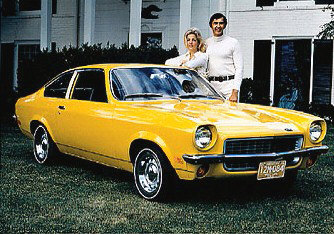
He had taken to turtlenecks and tie-dyed blue jeans by then. His weight was down from 235 to just over 170. His hair was long and sculptured and dyed coal-black. There were well-founded stories that he had undergone a face lift. His three-to-four-pack-a-day cigarette habit was gone, as were the suits that came off the rack, as was the first wife. He had also married and divorced actress-model Kelly Harmon, 24 years his junior, and had popped up around the country in the company of Ursula Andress, Nancy Sinatra and Candice Bergen. When in Detroit, he had been known to roar around in such non-GM models as a Lamborghini and a $19,000 Maserati Ghibli. On occasion, he shocked everybody at the office cold by coming to work in a pickup.
He was playing golf with Arnold Palmer and Gary Player, riding motorcycles in the Mojave Desert, chasing girls with one-time auto racer Roger Penske and collecting real estate as if America were his Monopoly board.
In short as Time magazine put it, by 1972 John DeLorean was standing out from his colleagues at GM like a Corvette Stingray or a showroom full of trucks.
But more than any of that, DeLorean by then was just plain disenchanted with his job. He had said at a press conference two years earlier that he did not intend to spend the rest of his life at GM; few believed him.•
John DeLorean’s combustible 1980s, in four videos.
Mesmerizing 17-minute DeLorean DMC-12 prospectus film that was shown to dealers and investors ahead of the automobile reaching the market in 1981.
From Pennebaker and Hegedus in 1981: “John Zachary DeLorean doesn’t smile very much.”
A 1983 California ad offering DeLoreans at the closeout price of $18,895. “This may be your last chance to live the dream.”
In 1988, his dreams dashed and reputation destroyed, DeLorean was living in Manhattan, now a born-again Christian, still believing he would get another chance. He granted a rare interview to a local TV station from his old stomping grounds in Detroit.
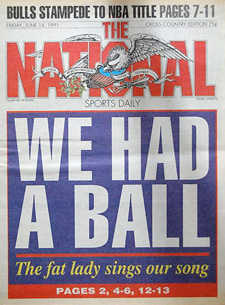
Grantland, Bill Simmons’ new online venture, has a fun oral history about the The National Sports Daily, a star-making and star-crossed newspaper edited by Frank Deford that burned brightly and burned out too soon in the early ’90s. An excerpt about how a Mexican billionaire started the paper on a whim:
“Frank Deford(Editor-in-Chief): I had never heard of Emilio Azcárraga. Very few people had, despite that he was the richest man south of the Rio Grande.
Thom Potraz(Marketing Director): If you went to central casting and asked for a “Mexican Billionaire,” they’d give you Azcárraga.
Dave Kindred(Associate Editor; National Columnist): They called him … El Tigre.
Peter Price(Publisher): It all started in the spring of 1989. Azcárraga wanted to have lunch. I’d heard about Emilio from Televisa, the Mexican media conglomerate, because I was in the media business, as well. I’d become publisher of the New York Post when Peter Kalikow bought the paper from Rupert Murdoch for $37 million. When I took over in 1988, there was a strike going, the circulation had plummeted, and the advertising had disappeared. We had the challenge of rebuilding. At lunch, Azcárraga started one of the strangest conversations of my life.
Emilio Azcárraga(Died in 1997. Lunch conversation recalled by Price): I read a comment of yours that the Post is unique among all American dailies in that it has many more male readers than female readers. You attributed that to the fact that the Post was a newspaper for women and a sports paper for men.
Price: The ladies like our gossip; the guys read it backwards and hardly ever get to the front of the newspaper.
Azcárraga: That’s what I want to talk to you about! Why is it that the most developed country in the world doesn’t have a daily sports newspaper? We’ve got one in Mexico. The Italians have two. The Brits have tabloid sports papers. L’equipe in France is reigning strong, and Japan has a sports paper.
Price: There are only three national newspapers in the United States, and only one is a purely national paper with genuinely national distribution. But USA Today is going on almost a decade, a billion dollars in losses, and it’s supported by a major publishing company. To do a national sports paper from scratch without the backing of a major publishing enterprise, without having a delivery system, without having regional printing plants, without having a brand name, and without any staff is not for the fainthearted.
Azcárraga: I think it’s a good idea. What would it take? Why don’t you give that some thought and come down and visit me? I’ll send my plane.”
••••••••••
Deford, Roger Angell and George Will discuss baseball’s home-run explosion in 1998 with Charlie Rose, whose head resembles a catcher’s mitt:
An uneasy synthesis of first and third worlds, Gurgaon, India, is a city with a booming economy and almost no basic services. Lacking both the benefits and encumbrances of central government, Gurgaon is a place with a couple dozen gleaming shopping malls and also one where citizens have to improvise their own means of trash disposal. It’s laissez-faire taken to its fullest expression. Jim Yardley has a great new article in the New York Times about the city where everyone is on their own. The opening:
“In this city that barely existed two decades ago, there are 26 shopping malls, seven golf courses and luxury shops selling Chanel and Louis Vuitton. Mercedes-Benzes and BMWs shimmer in automobile showrooms. Apartment towers are sprouting like concrete weeds, and a futuristic commercial hub called Cyber City houses many of the world’s most respected corporations.
Gurgaon, located about 15 miles south of the national capital, New Delhi, would seem to have everything, except consider what it does not have: a functioning citywide sewer or drainage system; reliable electricity or water; and public sidewalks, adequate parking, decent roads or any citywide system of public transportation. Garbage is still regularly tossed in empty lots by the side of the road.
With its shiny buildings and galloping economy, Gurgaon is often portrayed as a symbol of a rising ‘new’ India, yet it also represents a riddle at the heart of India’s rapid growth: how can a new city become an international economic engine without basic public services? How can a huge country flirt with double-digit growth despite widespread corruption, inefficiency and governmental dysfunction?”
R. Luke Dubois posted “The First Computer Musician,” an excellent piece about Max Mathews, for the Opinionator on the New York Times site a couple days ago. Mathews, a pioneer of wired music, passed away in April. The opening:
“In 1957 a 30-year-old engineer named Max Mathews got an I.B.M. 704 mainframe computer at the Bell Telephone Laboratories in Murray Hill, N. J., to generate 17 seconds of music, then recorded the result for posterity. While not the first person to make sound with a computer, Max was the first one to do so with a replicable combination of hardware and software that allowed the user to specify what tones he wanted to hear. This piece of music, called “The Silver Scale” and composed by a colleague at Bell Labs named Newman Guttman, was never intended to be a masterpiece. It was a proof-of-concept, and it laid the groundwork for a revolutionary advancement in music, the reverberations of which are felt everywhere today.
When Max died in April at the age of 84 he left a world where the idea that computers make sound is noncontroversial; even banal. In 2011, musicians make their recordings using digital audio workstations, and perform with synthesizers, drum machines and laptop computers. As listeners, we tune in to digital broadcasts from satellite radio or the Internet, and as consumers, we download small digital files of music and experience them on portable music players that are, in essence, small computers. Sound recording, developed as a practical invention by Edison in the 1870s, was a technological revolution that forever transformed our relationship to music.”
From “6 Products That Became Technology Roadkill“: “Back in 1987, GO Corporation was on the vanguard of pen-based computing, and investors handed the enterprise $75 million to make the world eschew the keyboard and mouse. In 1991, GO released its OS, PenPoint, designed specifically for the new market and it included gesture recognition. Not only was GO’s technology well received, but also it was implemented in several IBM computers, including the first ThinkPad.”
The perfect opening of “Shipping Out,” David Foster Wallace’s 2004 Harper’s reportage about the enforced happiness of the luxury-cruise industry, which was subsequently retitled, “A Supposedly Fun Thing I’ll Never Do Again”:
“I have now seen sucrose beaches and water a very bright blue. I have seen an all-red leisure suit with flared lapels. I have smelled suntan lotion spread over 2,100 pounds of hot flesh. I have been addressed as ‘Mon’ in three different nations. I have seen 500 upscale Americans dancing the Electric Slide. I have seen sunsets that looked computer-enhanced. I have (very briefly) joined a conga line.
I have seen a lot of really big white ships. I have seen schools of little fish with fins that glow. I have seen and smelled all 145 cats inside the Ernest Hemingway residence in Key west, Florida. I now know the difference between straight bingo and Prize-O. I have seen fluorescent luggage and fluorescent sunglasses and fluorescent pince-nez and over twenty different makes of rubber thong. I have heard steel drums and eaten conch fritters and watched a woman in silver lamé projectile-vomit inside a glass elevator. I have pointed rhythmically at the ceiling to the two-four beat of the same disco music I hated pointing to the ceiling to in 1977.
I have learned that there are actually intensities of blue beyond very bright blue. I have eaten more and classier food than I’ve ever eaten, and done this during a week when I’ve also learned the difference between ‘rolling’ in heavy seas and ‘pitching’ in heavy seas. I have heard a professional cruise-ship comedian tell folks, without irony, ‘But seriously.’ I have seen fuchsia pantsuits and pink sport coats and maroon-and-purple warm-ups and white loafers worn without socks. I have seen professional blackjack dealers so lovely they make you want to clutch your chest. I have heard upscale adult U.S. citizens ask the ship’s Guest Relations Desk whether snorkeling necessitates getting wet, whether the trapshooting will be held outside, whether the crew sleeps on board, and what time the Midnight Buffet is.”
••••••••••
In 1986, Wallace, Jonathan Franzen and Mark Leyner discuss literature in the Information Age with that handsome, world-weary robot Charlie Rose:
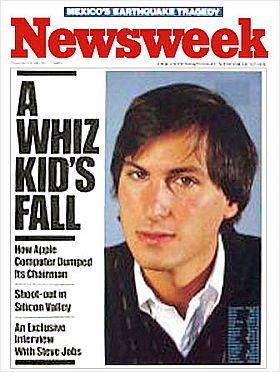
Two excerpts from Steve Jobs’ 1985 Playboy interview, including one in which the Apple visionary predicts his leaving the company and returning to it even stronger, without realizing his departure would be involuntary.
••••••••••
“Playboy: Obviously you believe that computers are going to change our personal lives, but how could you persuade a skeptic? A holdout?
Steve Jobs: A computer is the most incredible tool we’ve ever seen. It can be a writing tool, a communications center, a supercalculator, a planner, a filer and an artistic instrument all in one, just by being given new instructions, or software, to work from. There are no other tools that have the power and the versatility of a computer. We have no idea how far it’s going to go. Right now, computers make our lives easier. They do work for us in fractions of a second that would take us hours. They increase the quality of life, some of that simply by automating drudgery and some of that by broadening our possibilities. As things progress, they’ll be doing more and more for us.”
••••••••••
“Jobs: I’ll always stay connected with Apple. I hope that throughout my life I’ll sort have the thread of my life and the thread of Apple weave in and out of each other like tapestry. There may be a few years when I’m not there, but I’ll always come back. And that’s what I may try to do. The key thing to remember about me is that I’m still a student. I’m still in boot camp. If anyone is reading any of my thoughts, I’d keep that in mind. Don’t take it all too seriously. If you want to live your life in a creative way, as an artist, you have to not look back too much. You have to be willing to take whatever you’ve done and whoever you were and throw it away, What are we anyway? Most of what we think we are is just a collection of likes and dislikes, habits, patterns. At the core of what we are is our values, and what decisions and actions we make reflect those values. That is why it’s hard doing interviews and being visible. As you are growing and changing, the more the outside world tries to reinforce an image of you that it thinks you are, the harder it is to continue to be an artist, which is why a lot of times artists have to go, ‘Bye, I have to go. I’m going crazy and I’m getting out of here.’ And they go and hibernate somewhere. Maybe later they re-emerge a little differently.”
••••••••••
Before Hodgman vs. Long, Dick Cavett was the Apple pitchman. From 1981:
If your family isn’t of the extended variety, there is an answer for your needs at the Rent-a-Grandma site:
“Rent-A-Grandma is your one stop agency for all your quality domestic staffing needs. Our Grandmas are carefully screened mature (age 50+) women who are only the most professional, experienced staff and meet the standards you will demand for own ‘Grandma.’ Rent-A-Grandma sets a standard unequaled in the industry. Our agency carefully screens and background checks each applicant.
You can trust our Grandmas. Plus, our Grandmas don’t text or tweet while they are watching your kids!
Our Rent-A-Grandmas are:
Carefully screened
English speaking
Most have decades of experience in childcare and providing household services
Loyal & committed
Why hire a teenage nanny when you can have a Grandma?”
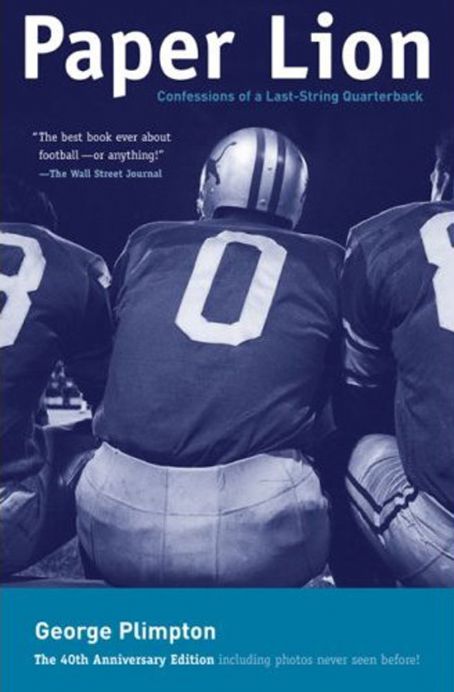
I interviewed George Plimpton shortly before his death, though I accept no blame for his demise. In 1966, the journalist, editor, party maven and prankster scored one of his greatest successes with Paper Lion, a sports book about trying out for third-string quarterback for the Detroit Lions. The other players weren’t in on the lark, though they soon came to realize the 36-year-old rookie was better at throwing back martinis than throwing tight spirals. The book grew out of “Zero of the Lions,” the author’s famous 1964 Sports Illustrated article. An excerpt from that piece:
“I looked for my helmet, relieved to see it lying in the grass a few yards away. My impulse was to put it on. From the beginning I’d had trouble getting into the helmet. The procedure was to stick the thumbs in the helmet’s ear holes and stretch the helmet out as it came down over the head—a matter of lateral pull, and easy enough if you practiced isometrics, but I never had the strength to get my ears quite clear, so they were bent double inside the helmet once it was on. I would work a finger up inside to get the cars upright again, a painful procedure, and noisy, the sounds sharp in the confines of the hard shell of the helmet as I twisted and murmured until it was done, the ears ringing softly. Then quiet would settle in the helmet, and I would look out beyond the bars of the nose guard—the ‘cage,’ the players call it—to see what was going on outside, my eyes still watering slightly. It was even more difficult to get the helmet off. The first helmet Friday Macklem had given me was too small—a helmet is supposed to fit snugly to afford the best protection—and when I tried it on in front of my locker I yelled as it came down over my ears. Wayne Walker, the big linebacker, happened to be chatting with me at the time.
‘How’d she feel?’
‘Feels fine. Snug,’ I said. ‘Once you get the thing on.’
I tried to take it off. I got my thumbs in the ear holes and tried to budge the helmet loose.
‘I’m stuck in here,’ I said, simply.
Walker began to grin. He looked down the locker room aisle for other players who would have enjoyed the dilemma. Mercifully, none were on hand.
‘Damn!’ I said. ‘I can’t budge this thing.'”
••••••••••
Plimpton parlayed his Paper Lion success into Oldsmobile Vista Cruiser ads:
An excerpt (via Wired) from The Red Market, Scott Carney’s horrifying account of contemporary flesh peddlers of all sorts, including an Indian farmer who holds people captive and “milks” them for blood which is sold for profit:
“For the last three years the man had been held captive in a brick-and-tin shed just a few minutes’ walk from where the farmers were drinking tea. The marks on his arms weren’t the tell-tale signs of heroin addiction; they came from where his captor, a ruthless modern-day vampire and also a local dairy farmer and respected landowner named Papu Yadhav, punctured his skin with a hollow syringe. He had kept the man captive so he could drain his blood and sell it to blood banks. The man had managed to slip out when Yadhav had forgotten to lock the door behind him.
The emaciated man brought the officers to his prison of the last three years: a hastily constructed shack sandwiched between Papu Yadhav’s concrete home and a cowshed. A brass padlock hung from the iron door’s solid latch. The officers could hear the muffled sounds of humanity through the quarter inch of metal.
They sprung the lock and revealed a medical ward fit for a horror movie. IV drips hung from makeshift poles and patients moaned as if they were recovering from a delirium. Five emaciated men lying on small woven cots could barely lift their heads to acknowledge the visitors. The sticky air inside was far from sterile. The sun beating down on the tin roof above their heads magnified the heat like a tandoor oven. One man stared at the ceiling with glassy eyes as his blood snaked through a tube and slowly drained into a plastic blood bag on the floor. He was too weak to protest.”
“The task of holding the house together fell on the super, a man named Zygmunt, whom everyone called George. He lived in the first apartment on the right as you came in, was usually available—except on Sunday mornings, when his hangover took precedence—and was a dab hand with a pipe wrench. He did commendable work under the circumstances, although he never was able to fix the bathtub of Rose and Simon, my neighbors across the hall, with the result that they came over to use mine a few times a week for the entire term of my residence.
By and large, I loved my neighbors, although I worried constantly, owing to the presence of so many loose cannons in a single fragile container. One afternoon I took myself out to the movies. Film Forum was showing the last picture directed by Erich von Stroheim, which he called Walking Down Broadway although it ended up as Hello, Sister! It contained a subplot about a construction worker who, after getting plowed at the saloon across the street from his work site every night, would sneak back in and steal a few sticks of dynamite, which he’d throw under his bed when he got home. In the third act, naturally, nature took its course. I walked home thinking about how such a character would not be out of place in my building. Then when I opened the door I beheld my neighbors, all of them, out in the halls, rushing around with buckets of water. We had very narrowly escaped a conflagration.
It seemed that the art critic on the fourth floor had become immersed in crack to the extent that he had neglected to pay his Con Ed bill. His service cut off, he had been lighting his way with candles, although he was perhaps not as attentive as the situation might warrant. Furthermore, his apartment contained several years’ worth of newspapers, as well as a small fortune in contemporary oil paintings. Nature had taken its course.”
“PLAYBOY: You’ve said that the famous opening sequence, in which the bone thrown into the air by the prehistoric man-apes becomes the space vehicle Discovery, came about by accident.
CLARKE: Yes, Stanley and I were trying to figure out that crucial transition. We were walking back to the studio in London and, for some reason, Stanley had a broomstick in his hand. He threw it up into the air, in a playful way, and he kept doing it, and it was at that moment that the idea of making the broomstick into the bone that gets turned into Discovery came about. I was afraid it was going to hit me in the head. [Laughs] So later we filmed it with some sort of bone. That shot was the only one in the movie done on location. It was shot just outside the studio. There was a platform built and, just beneath it, all the London buses were going by.”
••••••••••
“PLAYBOY: In the postscript to your book Ascent to Orbit, you talk about technology quite a bit. You have a lot of technology in your own home—your John Deere computer “Archie,” your satellite dish, your Kaypro-II computer. Yet you write, “This power over time and space still seems a marvel to me, even though I have been preaching its advent for decades. But the next generation will take it completely for granted and wonder how we ever managed to run the world without it … which we never did. May these new tools help them to succeed where we failed so badly.” Do you still think that way?
CLARKE: [Pauses] Absolutely. That’s why I’m so delighted that kids these days are not using their computers strictly to play games but are using them to process information. Knowledge really is power, and computer technology has increased an individual’s potential for power considerably. I still think it’s one’s duty to be optimistic about the possibilities of that power, without being unrealistic. It’s just that if one radiates doom and gloom about the possibilities of technology, one is in danger of creating a self-fulfilling prophecy about self-destruction.”
The shit-kicking (and shit-eating!) Divine visited that bombastic chucklehead Tom Snyder in 1979. Also on hand: Warhol superstar Holly Woodlawn.
From Divine’s 1988 obituary in the Times of London: “Divine, the 21-stone drag artist who has died in Los Angeles at the age of 42, won a cult following through his appearances in American underground films.
Once voted ‘the filthiest person alive,’ Divine built his reputation on the ability to shock. But it was, he claimed, part of a calculated assault on what he saw as American materalism and hypocrisy.
He always disliked being labelled a transvestite and insisted that cha-cha heels and thigh-splitting spandex dresses were purely ‘work clothes’ designed to make people laugh.
He was born Harris Glen Milstead and started his career as a hairdresser in Baltimore, Maryland. The film director John Waters, who had been at school with him, devised his professional name.
Made during the 1970s, the Waters/Divine films were deliberately raucous, crudely made and sexually explicit but achieved a critical respectability as a searing portrait of a sick society. They included Desperate Living, a tale of rape, murder and cannibalism, and Female Trouble, in which Divine played a delinquent schoolgirl who is violated by a struck driver and ends up in the electric chair.”
Single-file lines that snake around–like at airports or banks–haven’t always been the way people queued up. According to “Mr. Next,” Ian Parker’s fun 2003 “Talk” piece in the New Yorker, the practice only began in America in the 1980s. It seems so simple and obvious, but someone had to come up with it. An except:
“The history of American queuing has a simple outline. First there were hordes with sticks, then there were lines, and then, in the early nineteen-eighties, thanks in part to visionary thinking at the Columbus, Ohio, headquarters of Wendy’s (and initiatives at American Airlines and Chemical Bank, among others), customers began to be asked to form lines that the trade usually describes as ‘serpentine’: they snaked back on themselves, and the person at the head of the snake stepped up to the next available cashier or teller. This system was plainly fairer: no one who arrived after you would be served before you. It removed most fear and doubt from the queue calculus, leaving only impatience and anger; and in almost every place where it could be adopted it was.”
Some people can sense earlier than others that something is being done incorrectly, that methods are amiss, that the whole thing is a sham. Brooklyn baseball fan Walter Lappe was just such a person. I knew about Bill James and Eric Walker and the Moneyball era of advanced baseball statistics that their number-crunching ushered in, but I had never heard of Lappe, who was on the same path years earlier, trying to instill science and objective reasoning into baseball. He teamed with renegade ex-pitcher Jim Bouton to publish something called The Baseball Brain, which was the first attempt by “barbarians” to crash the gate. Lappe and his stats don’t seem to have arrived at a lot of correct answers, but he was asking the right questions before others were. An excerpt from a July 1, 1974 New York magazine articlethat Bouton penned about their attempt to reinvent baseball:
“If I told you that some nutty baseball fan from Brooklyn held the secret for getting the Mets and Yankees into the World Series, you wouldn’t believe me. It sounds like something from Damn Yankees or like that old movie It Happens Every Spring, where Fred MacMurray or Ray Milland or somebody invents a magic substance which repels wood and when you rub it on baseballs they become unhittable. Our fan from Brooklyn doesn’t have anything that sneaky, but what he does have could be just as revolutionary. I’ve seen his stuff, and I believe. Now, if only Yogi Berra and Bill Virdon (Mets and Yankees managers as of this writing) will read this, we’ll all be rolling in champagne and ticker tape this fall.
The fan from Brooklyn who could cause baseball’s first intra-stadium World Series is Walter Lappe (pronounced ‘Lap’), who believes that big-league managers rarely use the best strategy and players don’t seem to know what they’re doing out there. For the last 20 of his 49 years, Walter as a hobby, has been keeping his own statistics on the New York ball teams. He listens to games on the radio and writes down where each batter hits the ball, who’s pitching, balls and strikes, runners on base, weather conditions, phases of the moon, etc. Now that’s pretty nutty, but so is flying a kite in a rainstorm.
I don’t know if Benjamin Franklin has a brother, but Walter has one named Henry who is always saying, ‘Walter, why don’t you stop wasting your time listening to baseball games and go get a job, Walter?’ But how can someone get a job when you’re unlocking the secrets of the universe?”
_________________________
A 1970s ESPN Sportscenter report on Bouton’s controversial book, Ball Four. What mutton chops, what suits!
Carl Van Vechten took this classic 1936 photograph of Argentine surrealist painter Leonor Fini, she of the experimental hats and ever-present cats. From Fini’s1996 obituaryin the Independent: “In the 17th century Leonor Fini would have been burnt as a witch. Surrounded by cats, and with feline eyes herself, she exuded what her one-time lover Max Ernst described as ‘Italian fury, scandalous elegance, caprice and passion.’ In photographs you would take her for beautiful in the manner of Bianca Jagger but, according to the American art dealer Julian Levy, she was not a beauty as such, in that ‘Her parts did not fit well together: head of a lioness, mind of a man, bust of a woman, torso of a child, grace of an angel, discourse of the Devil . . .’
Levy confirms my belief that if she had been born in the age of the extra teat and the familiar, this lady was for burning. “Her allure,” he says, “was an ability to dominate her misfitted parts so that they merged into whatever shape her fantasy wished to present from one moment to the next.” You can almost hear the faggots crackle.
Leonor Fini was of mixed Spanish, Italian, Argentinian, and Slavic blood, a formidable genetic cocktail. She was born in Buenos Aires in 1908 but grew up in Trieste. Her formal education was, as might be imagined given her independent and imperious temperament, fragmentary, but she had the run of her uncle’s large library in Milan and also travelled widely in Italy and Europe visiting all the museums and taking in such then unfashionable painters as the Mannerists, a school later reflected in her own work. In reproduction she was to add Beardsley, the German Romantics and the British Pre-Raphaelites – all evidence of a Surrealist eye.
Her facility was precocious. By the time she was 17 she was already painting commissioned portraits. It was however in 1936 when she moved to Paris and became friendly with Ernst, the Eluards, Brauner and others, that she began to paint Surrealist images and to draw close to the movement. Close but not of. Like her greater contemporary Frida Kahlo, Fini refused to bend her knee before Andre Breton, and declined to accept the iconic role of child-woman or to accept his belief in l’amour fou, the monogamist obsession with one person as opposed to bisexual narcissism. She did however exhibit with the group as a kind of fellow traveller.”
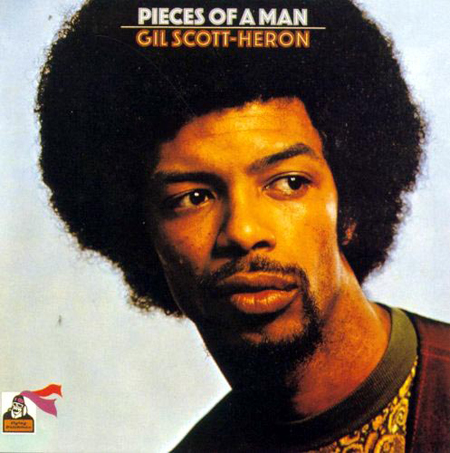
From “New York Is Killing Me,” Alec Wilkinson’s smart and sad 2010 New Yorker profile of Gil Scott-Heron:
“Sometimes when I spoke to people who used to know Scott-Heron, they told me that they preferred to remember him as he had been. They meant before he had begun avidly smoking crack, which is a withering drug. As a young man, he had a long, narrow, slightly curved face, which seemed framed by hair that bloomed above his forehead like a hedge. The expression in his eyes was baleful, aloof, and slightly suspicious. He was thin then, but now he seems strung together from wires and sinews—he looks like bones wearing clothes. He is bald on top, and his hair, which is like cotton candy, sticks out in several directions. His cheeks are sunken and deeply lined. Dismayed by his appearance, he doesn’t like to look in mirrors. He likes to sit on the floor, with his legs crossed and his propane torch within reach, his cigarettes and something to drink or eat beside him. Nearly his entire diet consists of fruit and juice. Crack makes a user anxious and uncomfortable and, trying to relieve the tension, Scott-Heron would sometimes lean to one side or reach one hand across himself to grab his opposite ankle, then perhaps lean an elbow on one knee, then maybe press the soles of his feet together, so that he looked like a swami.” (Thanks Longform.)
••••••••••
“Should’ve been asleep when I turned the stack of records over and over / So I wouldn’t be up by myself / Where did the night go? / Should go to sleep now.”
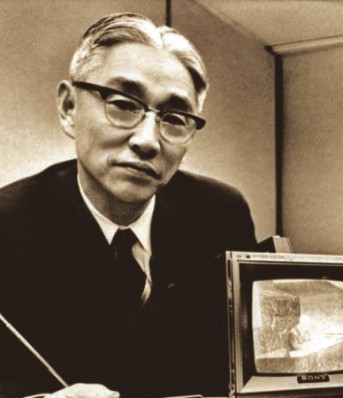
Legendary Sony founder Akio Morita was reputedly the tech titan that Steve Jobs studied most closely. In the 1950s, Morita opened a start-up in the basement of a bombed-out department store and created the world’s first transistor radio. He was more responsible than anyone for Japan emerging as a world leader in consumer electronics. In 1980, he visited Tom Snyder to unveil a line of new products.
From “Akio Morita: Guru of Gadgets,” Kenichi Ohmae’s 1998 Time articleabout the late-life Morita: “Almost exactly five years ago, Akio Morita–Mr. Sony–fell to the ground during a game of tennis. The co-founder and chairman of the board had suffered a stroke. He has since been in a wheelchair. This is particularly sad, as Morita had never been able to sit still and relax. At 72, he was playing tennis at 7 a.m. each Tuesday. I know this well because I would practice on the court next to him. My tennis, however, was very different from his. I played with an instructor, and if I was tired, I would just take a break. Not him. He challenged everybody, including young athletes.
This was in keeping with a man who created one of the first global corporations. He saw long before his contemporaries that a shrinking world could present enormous opportunities for a company that could think beyond its own borders, both physically and psychologically. And he pursued that strategy with his relentless brand of energy in every market, particularly the U.S. It is notable that this year, according to a Harris survey, Sony is rated the No. 1 brand name by American consumers, ahead of Coca-Cola and General Electric.”
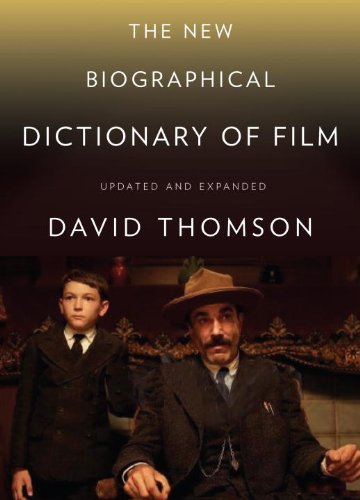
“After five editions in 35 years, Thomson’s famous compendium of biographical sketches about the movie people—hey, it’s read by the movie people, the movie people are fighting to get into it, male stars measure their manhood by the length of their entry—is still a shantytown with the ambitions of a capital city. It gets bigger all the time without ever becoming more coherent. But with more than a thousand pages of print to wander in, only the most churlish visitor would complain about lack of cogency. Better to rejoice at the number of opportunities to scream in protest at what the author has left out, put in, skimmed over, or gone on about with untoward zeal. As a book meant to be argued with, it’s a triumph.
Also, there is the frustrating consideration that Thomson is often right. Most people of his generation who have spent their lives seeing every properly released movie even if it stars Steven Seagal are incapable of judging them. The reason is simple: those people are monomaniacs. Thompson has found time to do other things: read books, breathe clean air, cook and eat real food.”
This stuff is crazy. Henrik Ehrsson at Sweden’s Karolinska Institute is able to make people believe that they are giants or barbie dolls with the aid of a virtual reality headset. It’s creepy and odd and sort of spectacular.
From an article about the research in Discover: “In Alice’s Adventures in Wonderland, the titular heroine quaffs a potion that shrinks her down to the size of a doll, and eats a cake that makes her grow to gigantic proportions. Such magic doesn’t exist outside of Lewis Carroll’s imagination, but there are certainly ways of making people thinkthat they have changed in size.
There’s nowhere in the world that’s better at creating such illusions than the lab of Henrik Ehrsson in Sweden’s Karolinska Institute. In a typical experiment, a volunteer is being stroked while wearing a virtual reality headset. She’s lyng down and looking at her feet, but she doesn’t see them. Instead, the headset shows her the legs of a mannequin lying next to her.
As she watches, Bjorn van der Hoort, one of Ehrsson’s former interns,uses two rods to stroke her leg, and the leg of the mannequin, at the same time. This simple trick creates an overwhelming feeling that the mannequin’s legs are her own. If the legs belong to a Barbie, she feels like she’s the size of a doll. If the legs are huge, she feels like a 13-foot giant.”
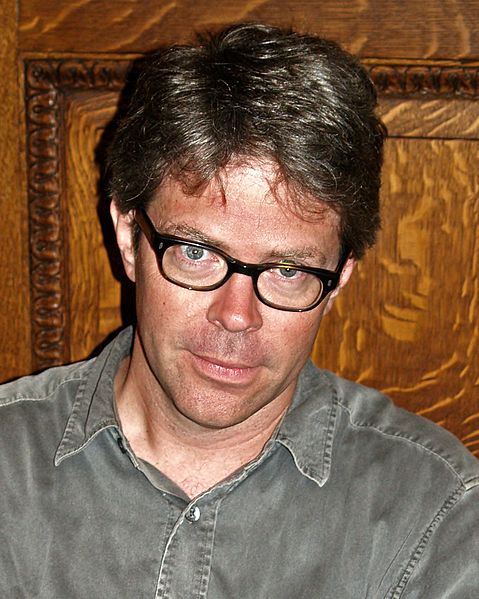
Jonathan Franzen: Loves birds, iffy on Oprah. (Image by David Shankbone.)
Jonathan Franzen has an excellent essay, “Liking Is For Cowards, Go For What Hurts,” in the New York Times, which makes many salient points about the pleasing, dishonest mirror that is consumer electronics:
“Consumer technology products would never do anything this unattractive, because they aren’t people. They are, however, great allies and enablers of narcissism. Alongside their built-in eagerness to be liked is a built-in eagerness to reflect well on us. Our lives look a lot more interesting when they’re filtered through the sexy Facebook interface. We star in our own movies, we photograph ourselves incessantly, we click the mouse and a machine confirms our sense of mastery.
And, since our technology is really just an extension of ourselves, we don’t have to have contempt for its manipulability in the way we might with actual people. It’s all one big endless loop. We like the mirror and the mirror likes us. To friend a person is merely to include the person in our private hall of flattering mirrors.”
••••••••••
Franzen discusses some lesser-known books he loves: