Excerpts

You are currently browsing the archive for the Excerpts category.

FromHow to Stop Worrying and Learn to Love the Internet,” Douglas Adams’ perceptive 1999 piece about Web 1.0 and where it was all headed:

“But the biggest problem is that we are still the first generation of users, and for all that we may have invented the net, we still don’t really get it. In The Language Instinct, Stephen Pinker explains the generational difference between pidgin and creole languages. A pidgin language is what you get when you put together a bunch of people – typically slaves – who have already grown up with their own language but don’t know each others’. They manage to cobble together a rough and ready lingo made up of bits of each. It lets them get on with things, but has almost no grammatical structure at all.

However, the first generation of children born to the community takes these fractured lumps of language and transforms them into something new, with a rich and organic grammar and vocabulary, which is what we call a Creole. Grammar is just a natural function of children’s brains, and they apply it to whatever they find.

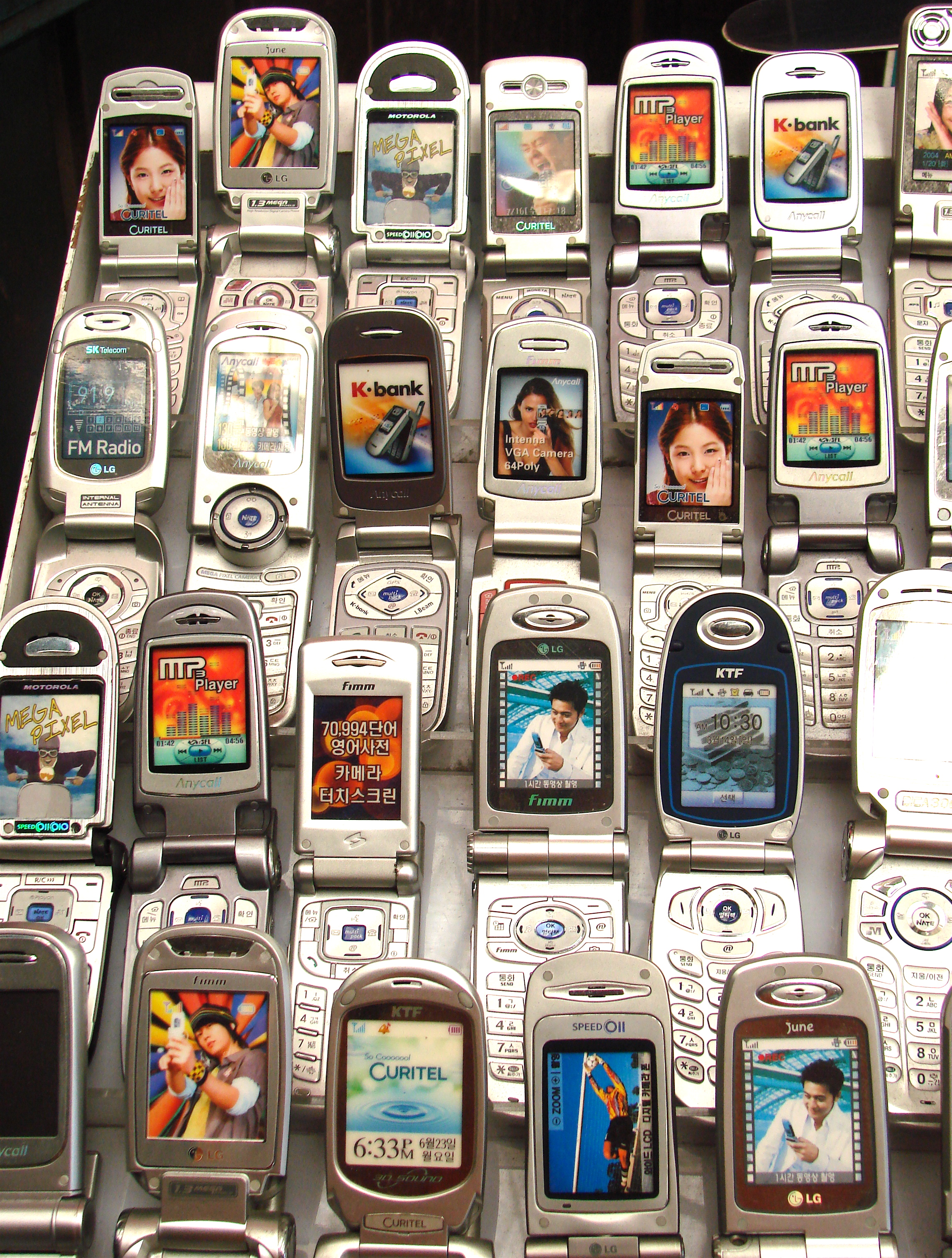
The same thing is happening in communication technology. Most of us are stumbling along in a kind of pidgin version of it, squinting myopically at things the size of fridges on our desks, not quite understanding where email goes, and cursing at the beeps of mobile phones. Our children, however, are doing something completely different. Risto Linturi, research fellow of the Helsinki Telephone Corporation, quoted in Wired magazine, describes the extraordinary behaviour kids in the streets of Helsinki, all carrying cellphones with messaging capabilities. They are not exchanging important business information, they’re just chattering, staying in touch. ‘We are herd animals,’ he says. ‘These kids are connected to their herd – they always know where it’s moving.’ Pervasive wireless communication, he believes will ‘bring us back to behaviour patterns that were natural to us and destroy behaviour patterns that were brought about by the limitations of technology.’

We are natural villagers. For most of mankind’s history we have lived in very small communities in which we knew everybody and everybody knew us. But gradually there grew to be far too many of us, and our communities became too large and disparate for us to be able to feel a part of them, and our technologies were unequal to the task of drawing us together. But that is changing.

Interactivity. Many-to-many communications. Pervasive networking. These are cumbersome new terms for elements in our lives so fundamental that, before we lost them, we didn’t even know to have names for them.”

Tags:

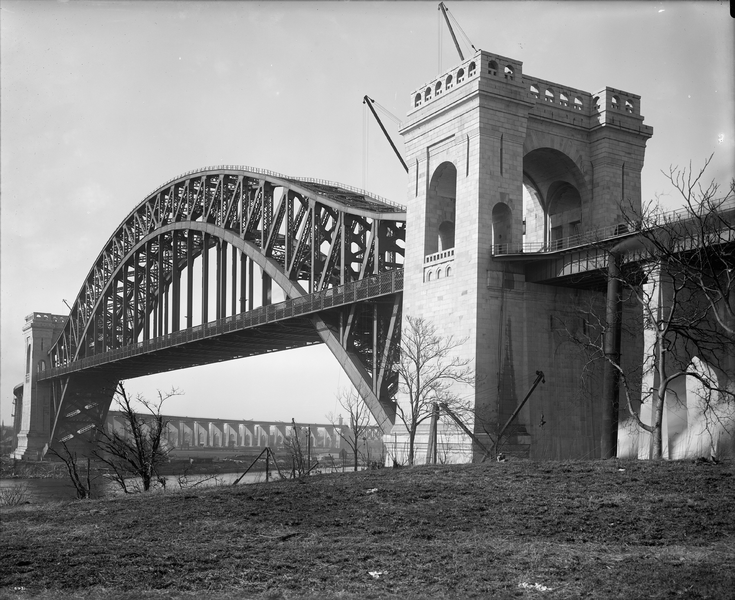
"In 1926, attracted by the building boom, three or four Caughnawaga, gangs came down." (Image by Detroit Publishing Co.)

From “The Mohawks in High Steel,” Joseph Mitchell’s 1949 New Yorker story about a Native American tribe’s contributions to NYC bridges and skyscrapers:

“Sometime in 1915 or 1916, a Caughnawaga bridgeman named John Diabo came down to New York City and got a job on Hell Gate Bridge. He was a curiosity and was called Indian Joe; two old foremen still remember him. After he had worked for some months as bucker‑up in an Irish gang, three other Caughnawagas joined him and they formed a gang of their own. They had worked together only a few weeks when Diabo stepped off a scaffold and dropped into the river and was drowned. He was highly skilled and his misstep was freakish; recently, in trying to explain it, a Caughnawaga said, ‘It must’ve been one of those cases, he got in the way of himself ‘ The other Caughnawagas went back to the reservation with his body and did not return. As well as the old men in the band can recollect, no other Caughnawagas worked here until the twenties. In 1926, attracted by the building boom, three or four Caughnawaga, gangs came down. The old men say that these gangs worked first on the Fred F. French Building, the Graybar Building, and One Fifth Avenue. In 1928, three more gangs came down. They worked first on the George Washington Bridge. In the thirties, when Rockefeller Center was the biggest steel job in the country, at least seven additional Caughnawaga gangs came down. Upon arriving here, the men in all these gangs enrolled in the Brooklyn local of the high-steel union, the International Association of Bridge, Structural, and Ornamental Iron Workers, American Federation of Labor. Why they enrolled in the Brooklyn instead of the Manhattan local, no one now seems able to remember. The hall of the Brooklyn local is on Atlantic Avenue, in the block between Times Plaza and Third Avenue, and the Caughnawagas got lodgings in furnished‑room houses and cheap hotels in the North Gowanus neighborhood, a couple of blocks up Atlantic from the hall. In the early thirties, they began sending for their families and moving into tenements and apartment houses in the same neighborhood. During the war, Caugh nawagas continued to come down. Many of these enrolled in the Manhattan local, but all of them settled in North Gowanus.”

Tags: ,

From a post on i09 about pigeons and their fierce, unforgiving memeories for humans who’ve mistreated them:

“It turns out crows aren’t the only birds with fiendishly powerful memories. Pigeons are also capable of spontaneously remembering which humans mistreated them, and even an attempt to disguise the identity of their one-time abuser can’t fool them.

Thankfully, pigeons aren’t as mean about all this as crows, who are known to hold five-year grudges. But once a pigeon recognizes a human as a threat, it appears there’s no way of convincing them otherwise. That’s the takeaway from experiments conducted by researchers at the University of Paris. The team worked not with laboratory-bred captive pigeons, but instead with feral birds who had received no special training or instructions. Despite this, the pigeons displayed an amazing aptitude for recognizing human faces.”

Information is free yet tracked and monetized. (Image by LeaW.)

From a report about augmented reality on The Next Web:

“Another company that is doing pretty groundbreaking stuff in the AR sphere is CrowdOptic, a real-time crowd behavior monitoring tool underpinned by augmented reality technology.

CrowdOptic lets fans at events such as concerts and sporting fixtures point their smartphones at an athlete or performer and view real-time information about the target, such as coaching insights and stats, and also receive exclusive invitations, ticket discounts, marketing promotions and more.

For example, if you’re at a concert or football match you might point your phone’s camera at the action. If a few hundred other spectators do the same thing, using triangulation and GPS data, CrowdOptic detects where the crowd’s attention is at any given moment, relaying the data back to the event’s organizers.

By knowing what is being photographed or videoed, this gives the organizers a mechanism for monetizing these insights in real-time during the live event.”

From “Hacking,” a 1996 Wired article by the excellent reporter Ted Conover about Roy Eric Wahlberg, a Minnesota drug dealer who surreptitiously became a tech millionaire while spending 17 years in prison for a vicious murder:

“The year was 1975 and the place was Ely, Minnesota, near the Canadian border in the region known as the Iron Range. Cold and insular, the range is a land of deep woods and open-air mines, brought down from boom times by the decline of American steel. Wahlberg, 23, sold milk during the day for his parents’ dairy distribution company and at night sold drugs: LSD, speed, cocaine, PCP, tranquilizers. ‘I celebrate every Saturday night,’ he told the court during his trial; that Saturday in March he celebrated with beer, rum and Coke, speed, marijuana, and, right before attending a party in a trailer home with his girlfriend, Roxanne Ahlstrand, some LSD.

The LSD annoyed Roxanne, who said it left Wahlberg ‘hard to get along with … hard to communicate with.’ His drug use occasionally led to rages-smashed windshields (usually his own) and trashed apartments (sometimes Roxanne’s). Roy and Roxanne argued at the party, and after several mixed drinks, he left with her younger sister. Fights between them were common, in part because Wahlberg fooled around on the side-often with underage girls. Once, caught naked in the back of a car with a minor, he had been thrown into jail.

At one point that evening Wahlberg passed through a local bar at the same time as a recent high school graduate named Jeff Goedderz (pronounced GED-derz). It was Goedderz’s 19th birthday, and he, too, had been drinking, beginning with a celebration before dinner at his sister’s house in nearby Babbitt. Trial testimony indicated that Goedderz had made a date that night with an Ely woman but it skipped his mind; at the jukebox in the bar he was soon making time with a college student home for the weekend from Duluth. When they and another couple went for pizza down the street at 1 a.m., Goedderz offered her his class ring.

No one remembers whether Goedderz and Wahlberg spoke at the bar; it is uncertain whether they even knew each other. But sometime after 2:30 a.m. they met up on the streets of Ely, two of the last people still awake on a cold night in winter. Goedderz, in poor condition to drive with a blood alcohol level later measured at 0.17 percent (almost twice the limit allowed by many states), let Wahlberg take the wheel of his Plymouth Gold Duster and climbed in back to sleep. They were joined by Wahlberg’s friend Red Nelson, a shoplifter and vandal who sold drugs to kids. The police theory was that Wahlberg murmured to Nelson his suspicion that Goedderz, who declined to take drugs besides alcohol, was a narc. (Nelson also suggested, years later, that Wahlberg was jealous of Goedderz, the outsider who was starting to date local girls.) As Goedderz slept, the two friends picked up a hatchet at Wahlberg’s truck and a stolen bowie knife at Nelson’s house. They drove to a remote logging road 8 miles north of town; the killing began when Goedderz stepped out of the car to pee. His last words, according to Nelson, were ‘Oh, no! Don’t do that!’

Goedderz’s car was found six days later under melting snow in the parking lot of the Ely Co-Op. Police noticed blood dripping into a puddle beneath the car and popped open the trunk to find Jeff Goedderz. Almost no blood remained in his body. According to officials, Goedderz died of loss of blood from multiple wounds. There were two long gashes to the head, both of which penetrated the brain, made by a hatchet. There were knife wounds to the face, arm, and neck. A knife blow to the left cheek had entered in front of the ear, broken the jaw, and knocked out two front teeth. And, in what the pathologist called a ‘defensive wound,’ Goedderz’s left thumb was missing: hair stuck to the hand indicated that Goedderz had probably had his hand to his head, trying to ward off blows. He said Goedderz had been alive when placed in the trunk.

As the people last seen with Goedderz, Wahlberg and Nelson were prime suspects in the murder, but it took 17 months of investigation before the case went to a grand jury. During those months Wahlberg freely talked with the lead investigator; parrying with the police as they tried to trip him up was like playing ‘mental chess,’ he later said. But Wahlberg lost the game when things he told the investigator confiicted with statements he made to others. Based on strong circumstantial evidence, Wahlberg was convicted of first-degree murder and sentenced to life in prison.”

••••••••••

In 2000, Conover discussed working as a Sing Sing prison guard with that kindly warden Charlie Rose:

Tags: , ,

One literary outlaw opined on another in Terry Southern’s 1964 piece about William S. Burroughs’ Naked Lunch. An excerpt:

“The element of humor in Naked Lunch is one of the book’s great moral strengths, whereby the existentialist sense of the absurd is taken towards an informal conclusion. It is an absolutely devastating ridicule of all that is false, primitive, and vicious in current American life: the abuses of power, hero worship, aimless violence, materialistic obsession, intolerance, and every form of hypocrisy. No one, for example, has written with such eloquent disgust about capital punishment; throughout Naked Lunch recur sequences to portray the unfathomable barbarity of a “civilization” which can countenance this ritual. There is only one way, of course, to ridicule capital punishment—and that is by exaggerating its circumstances, increasing its horror, accentuating the animal irresponsibility of those involved, insisting that the monstrous deed be witnessed (and in Technicolor, so to speak) by all concerned. Burroughs is perhaps the first modern writer to seriously attempt this; he is certainly the first to have done so with such startling effectiveness. Social analogy and parallels of this sort abound in Naked Lunch, but one must never mistake this author’s work for political comment, which, as in all genuine art, is more instinctive than deliberate—for Burroughs is first and foremost a poet. His attunement to contemporary language is probably unequaled in American writing. Anyone with a feeling for English phrase at its most balanced, concise, and arresting cannot fail to see this excellence.”

Another Terry Southern post:

Tags: ,

I’m happy people use cell phones and BlackBerrys non-stop. It distracts them the way shiny necklaces distract monkeys, and they have less time to try to stab me in the head with a box cutter. But Jonathan Franzen isn’t so sanguine about the intrusion of cell phones into public space. From his new essay (free registration required) on the topic in Technology Review:

“The technological development that has done lasting harm of real social significance–the development that, despite the continuing harm it does, you risk ridicule if you publicly complain about today–is the cell phone.

Just 10 years ago, New York City (where I live) still abounded with collectively maintained public spaces in which citizens demonstrated respect for their community by not inflicting their banal bedroom lives on it. The world 10 years ago was not yet fully conquered by yak. It was still possible to see the use of Nokias as an ostentation or an affectation of the affluent. Or, more generously, as an affliction or a disability or a crutch. There was unfolding, after all, in New York in the late 1990s, a seamless citywide transition from nicotine culture to cellular culture. One day the lump in the shirt pocket was Marlboros, the next day it was Motorola. One day the vulnerably unaccompanied pretty girl was occupying her hands and mouth and attention with a cigarette, the next day she was occupying them with a very important conversation with a person who wasn’t you. One day a crowd gathered around the first kid on the playground with a pack of Kools, the next day around the first kid with a color screen. One day travelers were clicking lighters the second they were off an airplane, the next day they were speed-dialing. Pack-a-day habits became hundred-dollar monthly Verizon bills. Smoke pollution became sonic pollution. Although the irritant changed overnight, the suffering of a self-restrained majority at the hands of a compulsive minority, in restaurants and airports and other public spaces, remained eerily constant. Back in 1998, not long after I’d quit cigarettes, I would sit on the subway and watch other riders nervously folding and unfolding phones, or nibbling on the teatlike antennae that all the phones then had, or just quietly clutching their devices like a mother’s hand, and I would feel something close to sorry for them. It still seemed to me an open question how far the trend would go: whether New York truly wanted to become a city of phone addicts sleepwalking down the sidewalks in icky little clouds of private life, or whether the notion of a more restrained public self might somehow prevail.

Needless to say, there wasn’t any contest. The cell phone wasn’t one of those modern developments, like Ritalin or oversized umbrellas, for which significant pockets of civilian resistance hearteningly persist. Its triumph was swift and total. Its abuses were lamented and bitched about in essays and columns and letters to various editors, and then lamented and bitched about more trenchantly when the abuses seemed only to be getting worse, but that was the end of it. The complaints had been registered, some small token adjustments had been made (the ‘quiet car’ on Amtrak trains; discreet little signs poignantly pleading for restraint in restaurants and gyms), and cellular technology was then free to continue doing its damage without fear of further criticism, because further criticism would be unfresh and uncool.”

Tags:

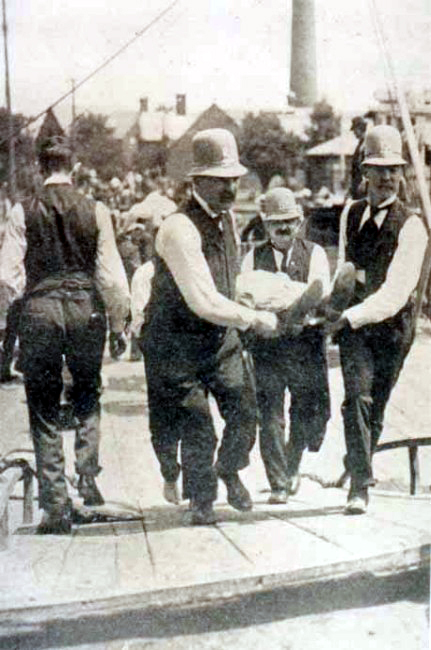
The greatest loss of life in the New York City area prior to September 11th was caused by the 1906 disaster of the General Slocum, a steamer carrying approximately 1400 souls to a Sunday school picnic on Long Island. The classic photo above shows the aftermath of a fire, which began somehow in the Lamp Room, creating a conflagration which soon engulfed the ship. More than 1000 people perished. The last survivor of the calamity was Adella Wotherspoon, a baby at the time who lived to see her hundredth birthday. An excerpt from her 2004 New York Times obituary:

“On June 15, 1904, a sunny Wednesday morning, Mrs. Wotherspoon, then the 6-month-old called Adele Liebenow, was part of the 17th annual Sunday school picnic of St. Mark’s Evangelical Lutheran Church, on the heavily German Lower East Side. The church had chartered a paddle-wheel, 264-foot-long steamboat, for $350 from the Knickerbocker Steamboat Company to go to Locust Grove Picnic Ground at Eaton’s Neck on Long Island.

The Liebenow party included Adele’s parents, her two sisters, three aunts, an uncle and two cousins. When the boat left the East River pier at Third Street at 9:40 a.m., a church band on board played, ‘A Mighty Fortress Is Our God.’

Forty minutes later, the joy turned to abject terror. Smoke started billowing from a forward storage room. A spark, most likely from a carelessly tossed match, had ignited some straw. Soon, the boat was an inferno. The captain ignored cries to steam for shore and proceeded at top speed through the perilous waters known as Hell Gate to North Brother Island, a mile ahead.

The inexperienced crew, which had not had a single fire drill, provided scant help. Lifeboats were wired or glued to the deck with layers of paint, cork in the life jackets had turned to dust with age and fire hoses broke under water pressure.

By the time the General Slocum reached the island, it was too late. The death toll among the estimated 1,331 passengers was 1,021, according to most sources. The dead included Adele’s sisters, Anna, 3, and Helen, 6. Munsey’s Magazine, a periodical of the time, wrote, ‘Children whom the flames had caught on the forward decks rushed, blazing like torches to their mothers.'”

Tags: ,

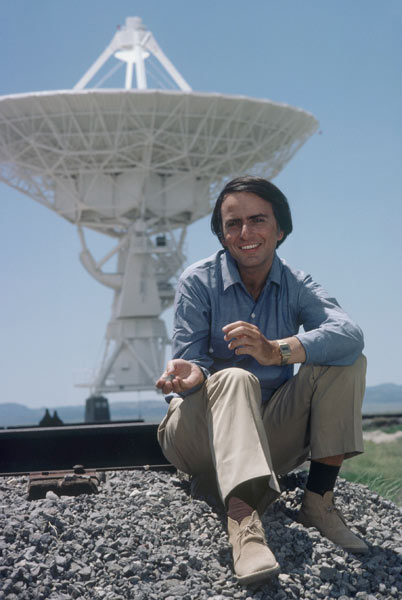
In “Mr. X,” an article written in 1969 and published two years later, Carl Sagan wrote about his use of marijuana, which apparently was a part of his life for more than four decades. The opening:

It all began about ten years ago. I had reached a considerably more relaxed period in my life – a time when I had come to feel that there was more to living than science, a time of awakening of my social consciousness and amiability, a time when I was open to new experiences. I had become friendly with a group of people who occasionally smoked cannabis, irregularly, but with evident pleasure. Initially I was unwilling to partake, but the apparent euphoria that cannabis produced and the fact that there was no physiological addiction to the plant eventually persuaded me to try. My initial experiences were entirely disappointing; there was no effect at all, and I began to entertain a variety of hypotheses about cannabis being a placebo which worked by expectation and hyperventilation rather than by chemistry. After about five or six unsuccessful attempts, however, it happened. I was lying on my back in a friend’s living room idly examining the pattern of shadows on the ceiling cast by a potted plant (not cannabis!). I suddenly realized that I was examining an intricately detailed miniature Volkswagen, distinctly outlined by the shadows. I was very skeptical at this perception, and tried to find inconsistencies between Volkswagens and what I viewed on the ceiling. But it was all there, down to hubcaps, license plate, chrome, and even the small handle used for opening the trunk. When I closed my eyes, I was stunned to find that there was a movie going on the inside of my eyelids. Flash . . . a simple country scene with red farmhouse, a blue sky, white clouds, yellow path meandering over green hills to the horizon. . . Flash . . . same scene, orange house, brown sky, red clouds, yellow path, violet fields . . . Flash . . . Flash . . . Flash. The flashes came about once a heartbeat. Each flash brought the same simple scene into view, but each time with a different set of colors . . . exquisitely deep hues, and astonishingly harmonious in their juxtaposition. Since then I have smoked occasionally and enjoyed it thoroughly. It amplifies torpid sensibilities and produces what to me are even more interesting effects, as I will explain shortly.•

Tags:

Let’s hope the following statement about TV from the 1993 David Foster Wallace essay, “E Unibus Pluram: Television and U.S. Fiction,” isn’t true anymore. Perhaps the marginalization of TV in a multi-platform media world has made programmers more desperate, more willing to give us bread and circuses in a desperate attempt to attract viewers. But what if it still is true? What then?

••••••••••

“If we want to know what American normality is – what Americans want to regard as normal – we can trust television. For television’s whole raison is reflecting what people want to see. It’s a mirror. Not the Stendhalian mirror reflecting the blue sky and mud puddle. More like the overlit bathroom mirror before which the teenager monitors his biceps and determines his better profile. This kind of window on nervous American self-perception is just invaluable, fictionwise. And writers can have faith in television. There is a lot of money at stake, after all; and television retains the best demographers applied social science has to offer, and these researchers can determine precisely what Americans in 1990 are, want, see: what we as Audience want to see ourselves as. Television, from the surface on down, is about desire. Fictionally speaking, desire is the sugar in human food.”

••••••••••

Tags:

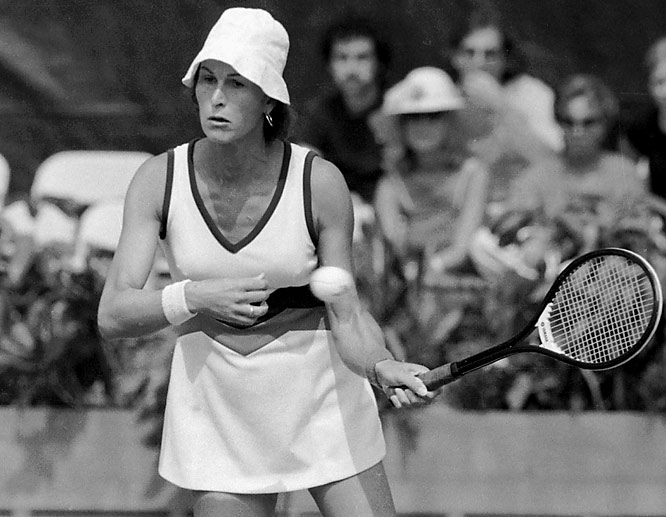
The tennis player Renée Richards caused a sensation in 1976 when she revealed that she had been born a man and undergone a sex-change operation. She was quickly lambasted by critics who thought she had an unfair advantage over her female opponents, but it seemed like an excuse to unload on someone who made much of America uncomfortable. Michael Weinreb of Grantland has a smart new interview with Richards, who is today a septuagenarian Manhattan opthamologist conflicted about being a public figure. An excerpt:

“‘No, no, no, no,’ she says now, at age 76, sitting in her cozy examining room. Her voice is a rasp; her sweater is pink. She is surrounded by autographed photos of Martina Navratilova and Virginia Wade. ‘That was not my intention. It’s not so much the idea that I wanted to be a pioneer and a standard-bearer. It was a much more selfish reason. I’d gone through such an upheaval in my life, and they’re telling me I can’t play tennis? Suddenly I said to myself, ‘I can do anything any other woman is entitled to do. How dare they?’

‘I was a quiet person. I mean, I’m not a shrinking violet, but I was a very private person. I was very well-liked, and I was very well-respected. And a lot of that was thrown away because I became a caricature, a public notorious figure. I was undressed in front of the world.'”

••••••••••

A new documentary about Richards:

The opening of the September 6, 1976 Sports Illustrated article about the Richards revelation: “At first, it seemed like a put-on. A transsexual tennis player? A 6’2” former football end in frilly panties and gold hoop earrings pounding serves past defenseless girls? A 42-year-old Yale graduate, Navy veteran, devoted father and respected eye surgeon reaching the semifinals of the $60,000 Tennis Week Open in South Orange, N.J. and demanding to play in the U.S. Open at Forest Hills? In women’s singles? Who ever heard of such a thing?

In the past month, practically everyone. And certainly last week there was no escaping the extraordinary spectacle of Renee Richards, nee Richard Raskind, and her assertion that ‘anatomically, functionally, socially, emotionally and legally I am a female.’ While conceding that her action might be ‘mind-boggling,’ Richards proclaims that she is embarked on a crusade for human rights, a quest ‘to prove that transsexuals as well as other persons who are fighting social stigmas can hold their heads up high.’

If tennis seems a rather fragile or inappropriate vehicle for carrying such a weighty message, it nonetheless provides, as Richards is well aware, the kind of exposure that attracts disciples. After one match last week, Dr. Roberto Granato, the urologist who performed the ‘sex-reassignment operation’ on Richards a year ago, rushed onto the court, embraced his former patient and exclaimed, ‘Oh, Renee, this is going to help so many people!’

Not everyone is so enthralled.”

Tags: ,

In addition to the elimination of late fees and a long-tail inventory, Netflix was a category killer for video stores because it offered a flat-fee buffet-style arrangement. Yes, there was “toggling” that delayed the heaviest users from seeing the most desirable movies first, but you got quantity and quality for your money. In a new Wired.com article, Angela Watercutter looks at how theater chains are introducing a similar model to try to increase profits:

“MoviePass, a new $50-per-month service for film fans, will let subscribers watch unlimited movies in theaters using their smartphones as tickets.

Using an HTML5 application (native smartphone apps coming soon), MoviePass will let users search for a film, find a local show time, check in to the theater and go straight to the ticket-taker.

The all-you-can-watch service, announced Monday with a private beta starting in the San Francisco Bay Area just in time for the Fourth of July blockbuster weekend, is looking to shake up the theater business in much the same way Netflix has changed the DVD-rental game.

‘Even with online ticketing, this side of the business is still a 75-year-old business and there’s not a lot of innovation,’ MoviePass co-founder Stacy Spikes said in an interview with Wired.com. ‘Getting your tickets, how you do that, how you interact with the theater, how you interact with the studio, none of that has really changed. We’re giving the viewer a lot more power and also allowing [studios and moviegoers] to speak with each other.'”

Tags:

From Winthrop Sargeant’s 1958 New Yorker profile of a young Richard Avedon, who used his camera to reimagine the fashion photograph, which lacked blithe spirit before he enlivened the scene:

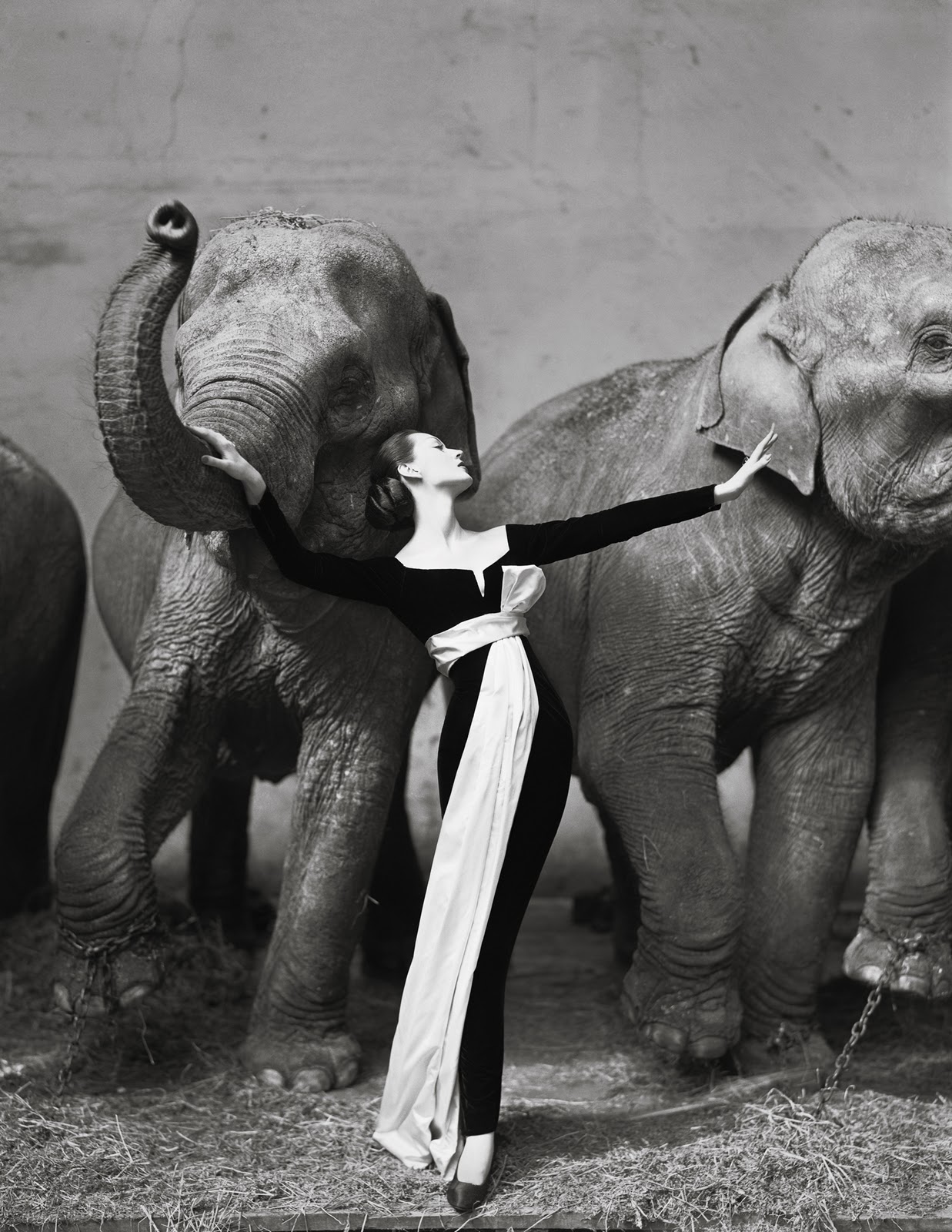
About twelve years ago, this approach to fashion photography began to be subtly undermined by a sprightly and ingenious photographer for Harpers Bazaar named Richard Avedon. As far as he was concerned, the statues and mummies went out the window. The model became pretty, rather than austerely aloof. She laughed, danced, skated, gambolled among herds of elephants, sang in the rain, ran breathlessly down the Champs-Elysées, smiled and sipped cognac at café tables, and otherwise gave evidence of being human. Whether she thereby sold more clothes is open to question. But the new trend certainly brightened the page of Harpers Bazaar, and Avedon was widely conceded to have reached a previously unattained artistic level in fashion photography. A good deal of this accomplishment can be attributed to his imagination and resourcefulness in handling a camera, but some of it undoubtedly stems from the fact that his primary interest is not in fashion but in women.

The Avedon photograph—or, more broadly, the Avedon photographic style—has by now become a lively contribution to the visual poetry of sophisticated urban life. Nearly everybody is familiar with it, for it has long since overflowed the pages of Harpers Bazaar and influenced the advertising in most of the slick-paper periodicals. It has been imitated by other photographers, but the imitations have seldom approached the animation of the originals; in any case, as soon as the imitators have mastered at least the surface elements of one of Avedon’s innovations, he has always popped up with some entirely new departure, for he has never been one to stand still. The world he depicts is an artificial one; his polished and rather romantic art flatly contradicts the bromide that the camera never lies. Avedon’s camera unquestionably lies, but it does so in such a poetic and ingratiating manner that the photographic fiction it produces has become a sort of folklore of the world in which fashionable elegance counts. The characters in this fiction are women of unbelievable beauty and grace, moving about in an environment that exists largely in the imagination. This is a composite of mists, glowing lights, the moods of nocturnal revellers, nostalgic memories of bars and gaming tables and theatres, and such ephemeral minutiae as the feeling of enchantment at the sight of a taxi in the rain whose door is opened to receive a suave and mysterious beauty, or the moment of gaiety when some lovely girl decides to throw dignity aside, or the magical second in which the casual motions of a beautiful woman are observed secretly across a restaurant table—all fragments of a metropolitan fairyland, glimpsed by ordinary mortals only at times of heightened illusion.•

_______________________________

In 1999, Avedon is interviewed by that agreeable robot Charlie Rose.

Tags: ,

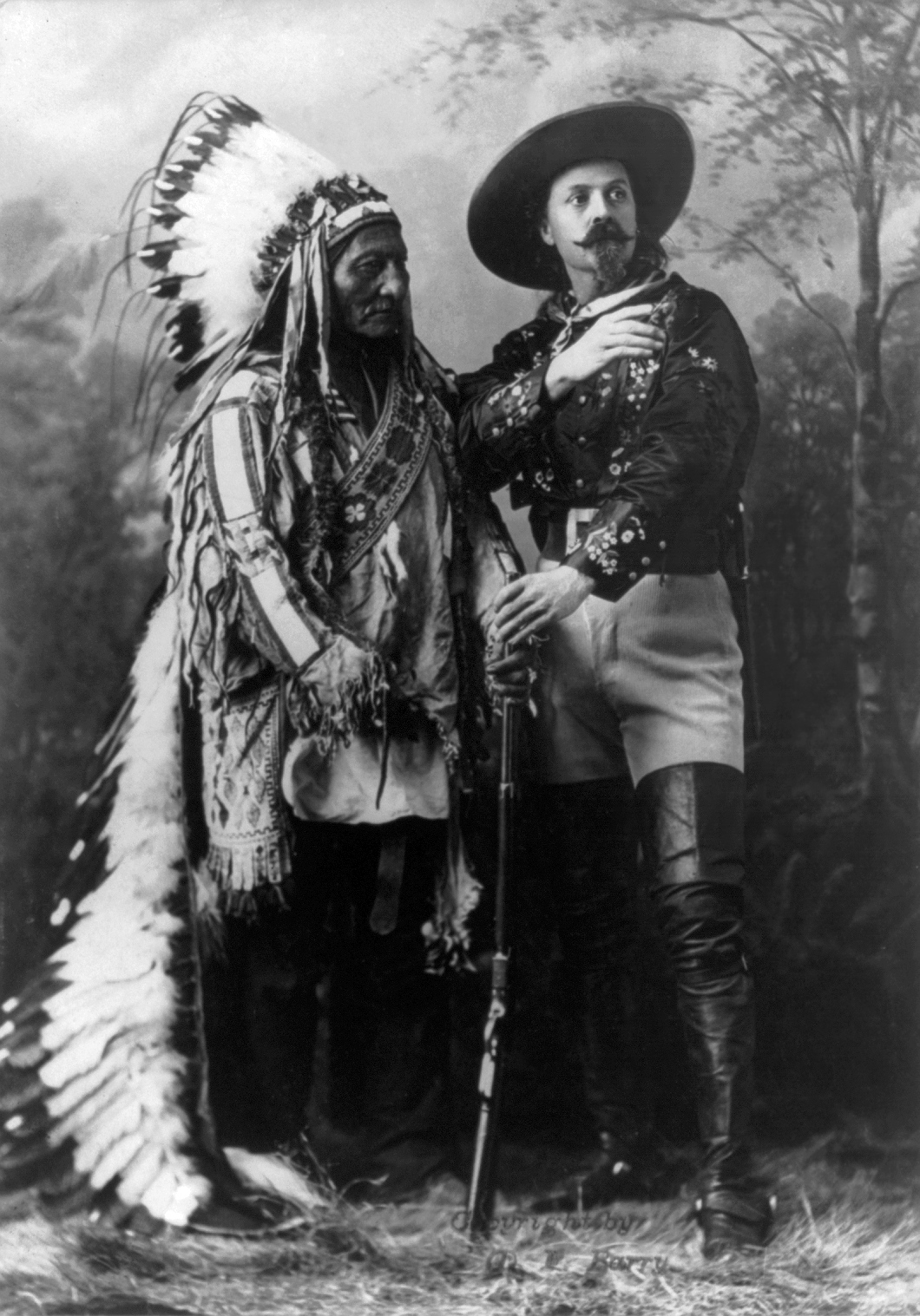
Sitting Bull and Buffalo Bill sell the drama in 1895.

The aura of the American West was created and commodified long before there was a Hollywood, as traveling stage shows brought an appealing version of gunslinging to the masses. From Rob Walker’s 2007 Sunday Times Magazine article about how Buffalo Bill Cody packaged himself for the millions:

“While still a scout for the United States Army, Cody managed to hire himself out as a sort of celebrity hunting guide for well-to-do visitors to the American West. In 1869, when he was about 25, he impressed a writer calling himself Ned Buntline, who began a series of dime novels starring Buffalo Bill. These inspired a play, with Cody himself in the lead role. For the next several years, Cody switched off between actual scouting work in campaigns against Plains Indians — and appearing in plays with names like Scouts of the Plains.

But the great branding event of his career came in 1876, in the wake of George Custer’s disastrous defeat by Sioux Indians at Little Big Horn. Weeks later, Cody’s regiment engaged in a battle against a group of Cheyenne Indians, and Cody — there’s some disagreement on this — apparently killed one, obtaining what he pronounced ‘the first scalp for Custer.’ That fall, Cody starred in the play based on the incident. And by 1883, he and a couple of key collaborators — notably Nate Salsbury, a manager with wonderful showbiz instincts — had invented a show that ‘provided the template . . . for the early film western,’ Joy S. Kasson argues in her 2000 book Buffalo Bill’s Wild West: Celebrity, Memory and Popular History. In the process, she writes, his Wild West ‘became America’s Wild West.’ Indeed, thanks to Salsbury, they actually copyrighted the phrase ‘Wild West’ (after a lengthy legal battle with rivals).

Live animals and blazing guns made the show more of a spectacle than a mere stage play. But a loose narrative and the vaguely educational content made it more respectable than a circus or a medicine show, and Salsbury kept gambling and drinking off the premises to attract the family demographic. At its height, the show included the sharpshooting of Annie Oakley, dramatic re-enactments of an Indian attack on the Deadwood stagecoach and a version of Little Big Horn. The organizers managed to include many actual Native Americans in the cast, including the Sioux chief Sitting Bull himself for part of its 1885 season.

Still, the authenticity was always balanced against affirmation: Cody’s arrival on the scene in the immediate aftermath of the re-enacted version of Little Big Horn converted a debacle into what felt like a victory. ‘It’s not really wild — that’s why it can be entertaining,’ Kasson, a professor of American studies at the University of North Carolina, Chapel Hill, told me. ‘That’s where it leads to Hollywood: the idea that you can give people the feeling of danger, but it’s got to be basically tame.’ In several tours of Europe, the general theme of civilization triumphing over savagery went over well. (Indeed, Kasson cites the historian Richard White’s point that the Wild West shows essentially recast encroaching settlers as victims.) By the time Frederick Jackson Turner momentously declared that ‘the frontier has gone’ at the Columbian Exposition in 1893, Buffalo Bill’s Wild West was in the midst of a monthslong stint right across the street; it was seen by an estimated six million people.”

••••••••••

Edison captured the pageantry of the Buffalo Bill’s Wild West Show parade:

Another Buffalo Bill Cody post:

Tags: ,

Sea-Monkeys don’t actually play volleyball, not even a little, but Evan Hughes of the Awl has an excellent post about the Insta-Pet’s late creator Harold von Braunhut, a Jewish man who had surprising ties to Aryan supremacists. An excerpt:

“An Assistant U.S. Attorney, Thomas M. Bauer, told the Washington Post that in a 1985 weapons case against a member of the Ku Klux Klan, Grand Dragon Dale R. Reusch, von Braunhut was prepared to testify that he had lent Reusch about $12,000 so he could buy 83 firearms. Bauer told the reporter that von Braunhut was ‘very pleasant and cooperative’ and ‘brought some of his little toys along,’ including Sea-Monkeys.

The general Aryan Nations view holds that Jewish people are directly descended from the devil. It seems clear that von Braunhut, who owned Nazi memorabilia and once said Hitler ‘just got bad press,’ signed on to these beliefs. But one has to wonder what brought him to the point of nodding along when his friend Butler, for instance, described Jews as ‘the bacillus of the decomposition of our society.’ Aryan Nations members might have been dismayed to hear that von Braunhut engaged a law firm called Friedman and Goodman early in his career. They might also have been puzzled that his name was listed on early patents as Harold N. Braunhut. The middle initial stands for Nathan. Harold von Braunhut was born and raised Jewish.”

•••••••••••

Tags: ,

There’s apparently a controversy over whether the sound of money being dispensed at ATM machines–the pleasing noise of bills being distributed rapidly one after another–is merely a sound effect. Brad Tuttle looks at the dispute in a Time post:

“The assumption most people jump to is that the sound is produced by rollers delivering the notes to the collection slot. In fact, the sound is an entirely artificial addition to the process.

The noise is produced by a speaker and purely included in the transaction to reassure you that your money is on its way. Without the added noise, the ATM would be practically silent with its moving parts on the other side of a brick wall.” (Thanks to Marginal Revolution.)

••••••••••

First ATM in America that dispenses gold:

Tags:

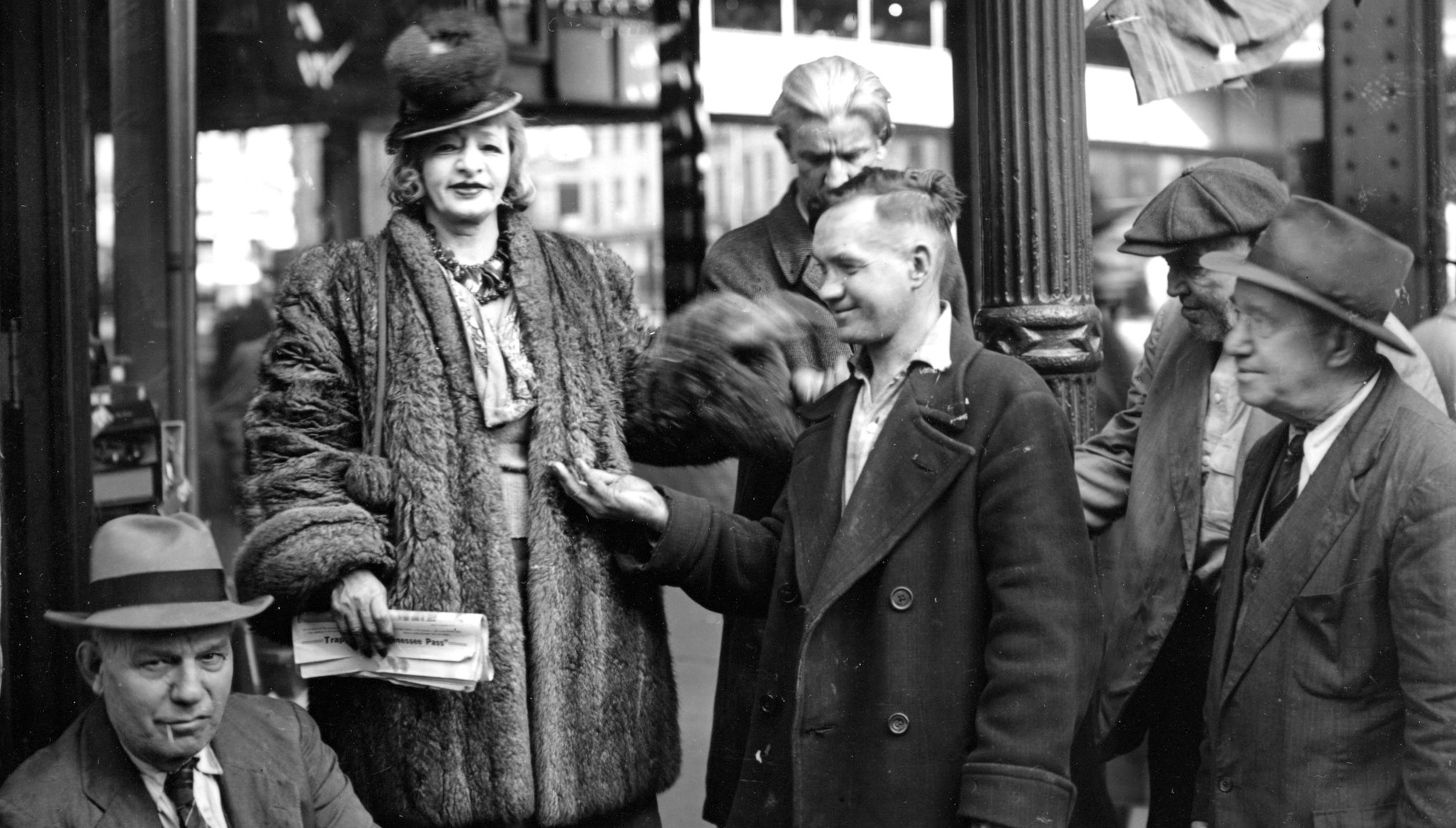
One of my favorite Joseph Mitchell New Yorker pieces is the 1940 article, “Mazie” (subscription required), which profiles a doyenne of the Bowery, a movie-theater ticket seller who treated the riff-raff of the downtrodden strip with a mix of tough love and kid gloves. I recently found her 1961 obituary on the New York Times site. The opening:

Bowery Mourns Mazie Phillips, Faithful Friend of Derelicts–She Was “Over 21”–Mazie Phillips known as the “Queen of the Bowery,” died Monday in Lenox Hill Hospital after a long illness. She lived at 18 Monroe Street on the Lower East Side with her sister, Mrs. Jean Hallen, a widow, and always gave her age as ‘over 21.”

For more than 65 years, Mazie, a platinum blonde with a husky voice, passed out advice (“Go take a bath, you bum”) money (“That’s a real quarter now”) and sympathy (“You got the makins of a great man”) to every Bowery derelict who would pause and listen.

Mazie dispensed the advice, money and cheer day and night on the streets of the Bowery, and most particularly from behind a cashier’s cage at the theater on Park Row.

She was known and liked in the Bowery and yesterday, Harry Baronian of the Bowery News said there were men sitting on doorsteps, ignoring their tattered clothes and other discomforts and lamenting her death. Some drank to her memory, he added, as she had often done for others.

The “Gentlest Heart”

The children of the Bowery will miss her, too, in their own way. They looked for the lollipops she carried in her pockets and she looked for the children, enjoying the jest of first saying she had no more.

But why did she help those in the Bowery? Her sister said yesterday that there was no real reason, “she just had the gentlest, kindest heart of anyone.”

Mazie did not believe, however, that the men of the Bowery could be helped by organized charity.

“I’m not out to knock missions or such,” she once said, “but you aint goin’ to get a bum in a mission if there’s a gutter to sleep in.” But she denied a report that she had once lured some men out of a mission by waving a bottle of whisky outside.

Mazie Was Buying

“All I did,” she remarked, “was to go in the King Kong Saloon and pass out the word that the drinks was on me.”

It is not clear just when Mazie arrived in New York, but it was probably around 1890. She was born in Boston, and her sister recalled that Mazie was a “quiet, very demure little girl” when she left for New York.

Shortly after, she became a familiar, friendly face in the ticket-seller’s cage in front of the old Venice Theater at 207 Park Row, where the Bowery and Chinatown meet.•

Tags: , ,

A passage from the April 3, 1995 edition of Time magazine about the scary rise to prominence of Shoko Asahara, the nearly blind cult leader who poisoned Tokyo subways with Sarin gas in 1995 and currently awaits execution:

“By 1984, though, the future ‘savior’ began to find his niche. He set up a yoga school that proved to be quite successful. Even if a former student recalls that in those days ‘we were not followers but members,” the time was ripe for gurus. Japan’s galloping economic miracle in the 1970s and ’80s also spawned a boom in ‘new religions’ offering spiritual refuge to Japanese alienated by materialism. Asahara’s messianic self-image expanded to help fill this void. After a visit to a Himalayan retreat, he boasted of having achieved satori, the Japanese term for nirvana or enlightenment. At this point he also claimed his first success at self-levitation.

Asahara established his Aum Shinrikyo religion in 1987, and the movement even put up a number of candidates in the 1990 Lower House Diet elections; all of them lost. Not much later he began conferring on himself such titles as ‘Today’s Christ’ and ‘the Savior of This Century.’ His community branched out rapidly in Japan. Soon it had established some beachheads overseas–including the U.S. and Germany but notably Russia. Asahara once preached before a crowd of 15,000 in a Moscow sports stadium.

As his fortunes prospered, Asahara seems to have grown more reclusive and obsessed with danger. The religion, nominally Buddhist but really a hodgepodge of ascetic disciplines and New Age occultism, focused on supposed threats from the U.S., which he portrayed as a creature of Freemasons and Jews bent on destroying Japan. The conspiracy’s weapons: sex and junk food. The guru’s sermons predicted the end of the world sometime between 1997 and 2000, and began citing the specific peril of poison-gas attacks.”

••••••••••

“Someone or some group mounted a devastating posion gas attack this morning”:

Aum Shinrikyo anime:

Tags:

The Library of Congress has received the only copy extant of Orlando Ferguson’s 1893 Map of a Square and Stationary Earth, which was based on the Bible and envisioned our planet as a fixed and flat thing. You know, it attacked the “globe theory.” Click on the map below to see the large-scale-version. From The History Blog: “Don Homuth, a former North Dakota state senator and current resident of Salem, Oregon, will donate the sole complete copy of the Map of a Square and Stationary Earth by Orlando Ferguson to theLibrary of Congress. Homuth was given the map by his eighth-grade English teacher John Hildreth who had received it from his grandfather.”

Tags:

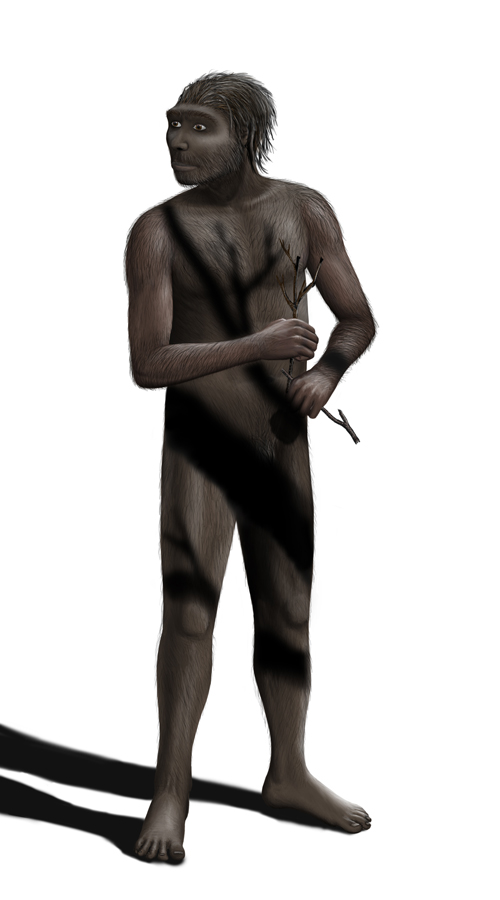
Homo Erectus: Fucking idiots. (Image by Steveoc 86.)

Why is Homo Sapiens the only human species on Earth? Why did other species, Homo Erectus for istance, not make it? The BBC provides some answers:

“Yet Homo erectus was slightly bigger and more powerful than Homo sapiens, so why did we thrive when they did not? The most obvious answer is that we had bigger brains – but it turns out that what matters is not overall brain size but the areas where the brain is larger.

“The Homo erectus brain did not devote a lot of space to the part of the brain that controls language and speech,” said John Shea, professor of palaeoanthropology at Stony Brook University in New York.

‘One of the crucial elements of Homo sapiens’ adaptations is that it combines complex planning, developed in the front of the brain, with language and the ability to spread new ideas from one individual to another.’

Planning, communication and even trade led, among other things, to the development of better tools and weapons which spread rapidly across the population.

The fossil records suggest that H. erectus went on making the same basic hand axe for more than a million years.

Our ancestors, by contrast, created smaller, more sophisticated weapons, like a spear, which can be thrown, with obvious advantages when it comes to hunting and to fighting.”

From a 1982 Robert Reinhold article in the New York Times, which predicted with stunning accuracy how technology has subsequently transformed our lives, connecting us and allowing for a decentralized flow of information:

“A report commissioned by the National Science Foundation and made public today speculates that by the end of this century electronic information technology will have transformed American home, business, manufacturing, school, family and political life.

The report suggests that one-way and two-way home information systems, called teletext and videotex, will penetrate deeply into daily life, with an effect on society as profound as those of the automobile and commercial television earlier in this century.

It conjured a vision, at once appealing and threatening, of a style of life defined and controlled by videotex terminals throughout the house.” (Thanks Reddit.)

Tags:

A Chuck Close interview from 1978, a decade before a spinal artery collapse left him severely paralyzed but no less brilliant an artist. I went to the press event when he had his major retrospective at MoMA some years back and came away as impressed with him as his work, which is amazing. I believe I referred to his portraiture as “pointillism for the computer age” in a subsequent article, but it’s much more complex than that description.

Chuck Close describing his arrival in NYC in 1967, to New York magazine: “I paid $150 a month for a raw loft on Greene Street, and all my friends who were already living here laughed, thinking it was outrageous to pay that much. The loft had no heat. I painted for an entire year with gloves on and just my trigger finger sticking out to the button on the airbrush. Literally, the coffee would freeze in its mug; the toilet would freeze overnight. We slept under a pile of blankets.

Soho was rats and rags and garbage trucks: There were occasional wars between one Mafia-owned waste-management company and another, during which one would burn the other’s trucks. There might have been twenty artists—or people of any kind—living between Houston and Canal; you could have shot a cannon down Greene Street and never hit anybody. But we all lived within a few blocks of each other: Brice Marden, Richard Serra, Nancy Graves, Phil Glass. We were in someone’s loft every night, either listening to a composer like Steve Reich or watching dancers like Yvonne Rainer and Trisha Brown. A lot of us helped Richard make his lead prop pieces, because he needed muscle and brawn to roll the lead and stack it up. Phil was his only paid assistant, and the rest of us were this interesting group of writers, filmmakers, even Spalding Gray. After work we’d go over to this cafeteria in what is now the Odeon, and we’d sit around and dream up ideas on the back of napkins.”

Tags:

Dick Cavett conducted a 1970 interview with a very drunk John Cassavetes, Ben Gazzara and Peter Falk, the latter of whom just passed away. Best known as Colombo, but much more diverse than that, Falk played a special role in the work of Cassavetes and Wim Wenders.

The first graph of Richard Brody’s smart Falk post at the New Yorker blog: “It’s surprising to learn, from reading biographical sketches of Peter Falk on the occasion of his death, at the age of eighty-three, that he got a master’s degree in public administration and was working in Connecticut as an efficiency expert when, in his mid-twenties, he decided to take a chance on an acting career. It’s equally odd to note that he had two Oscar nominations for Best Supporting Actor in consecutive years—1960 and 1961—for his roles in Murder, Inc. and A Pocketful of Miracles. They hardly helped. He was working mainly on television, doing some movies but not getting plum roles, when, in 1967, he met John Cassavetes at a Lakers game and then had lunch with him at the Paramount commissary. As Marshall Fine writes in his biography of Cassavetes, Accidental Genius, ‘Falk had a script by Elaine May, Mikey and Nicky, that he thought Cassavetes would be perfect for.’ At the same time, Cassavetes pitched Husbands to Falk. Each actor thought the other had agreed to the projects, and each had misunderstood.'”

Tags: , , , ,

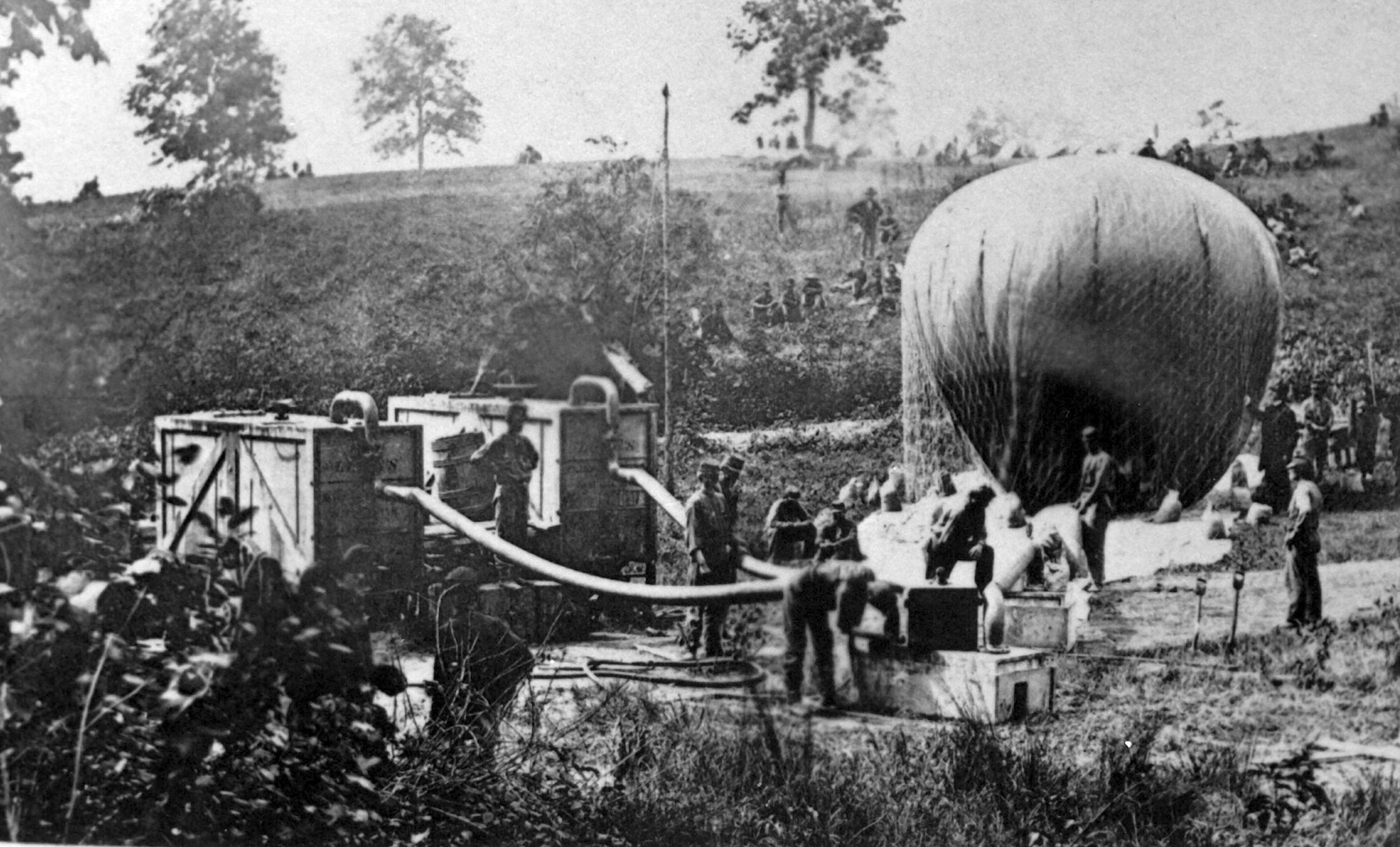
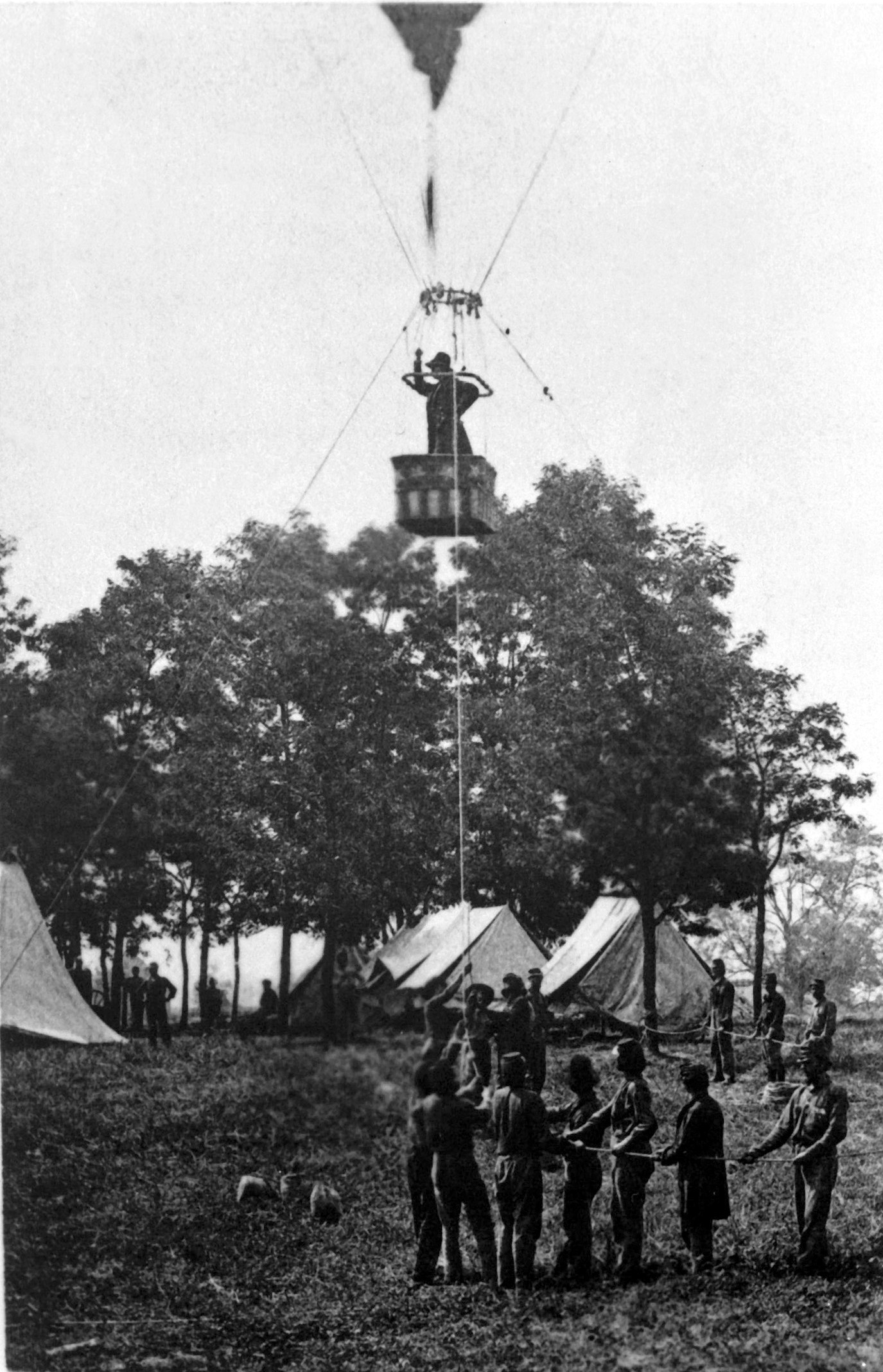
These classic 1862 Civil War photographs of Thaddeus Lowe’s balloons were taken in Virginia by Mathew Brady. Lowe, the father of American military aerial reconnaissance who had been designated Chief Aeronaut of the United States Balloon Corps by President Lincoln, deployed his crafts to gather information about the number and positioning of Confederate troops. Oh, and Lowe was also the first American to figure out how to make artificial ice, which is the odd choice for the lead of his 1913 New York Times obituary:

“Pasadena, Cal., Jan. 16–Dr. Thaddeus S.C. Lowe, scientist and experimenter, who invented an ice compressing machine in 1865, making the first artificial ice in the United States, died to-day at the home of his daughter in this place. Dr. Lowe was born in Jefferson, N. H., in 1832, of Pilgrim ancestry. He was educated in the common schools, and specialized in the study of chemistry. From 1856 to 1859 he was engaged in constructing balloons for the study of atmospheric conditions.

Dr. Lowe built the largest aerostat of his day, and in 1861 made a 900-mile trip in it from Cincinnati to the South Carolina coast in nine hours. Later he entered the Government services as Chief of the Aeronautics Corp, which he organized, rendering valuable service to the Army of the Potomac, from Bull Run to Gettysburg, by observations and timely warnings. Next he invented a system of signaling to field batteries from high altitudes. Other devices invented by him practically revolutionized the gas industry. He built the Mount Lowe Railway, 1891-1904, and established the Lowe Observatory in the Sierra Madre Mountains.

Tags: , ,

"He requested in his suicide note that an autopsy be performed to determine if something had changed in his brain—because he suspected it had."

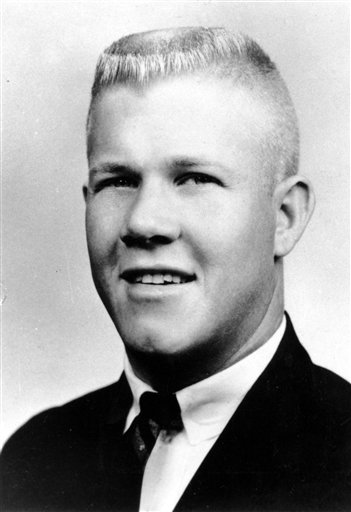
In his provocative new Atlantic article, The Brain on Trial,” David Eagleman investigates whether brain injuries and illnesses are sometimes the driving force behind criminality. In the piece, Eagleman raises the case of Charles Whitman, a heavily armed 25-year-old student who killed 16 people from his vantage point on a University of Texas observation tower on a blistering August day in 1966. Whitman, who kept killing until he himself was killed by police, left a note revealing his suspicions that his brain had somehow changed, causing his violent impulses–and he may have been right. An excerpt:

“Along with the shock of the murders lay another, more hidden, surprise: the juxtaposition of his aberrant actions with his unremarkable personal life. Whitman was an Eagle Scout and a former marine, studied architectural engineering at the University of Texas, and briefly worked as a bank teller and volunteered as a scoutmaster for Austin’s Boy Scout Troop 5. As a child, he’d scored 138 on the Stanford-Binet IQ test, placing in the 99th percentile. So after his shooting spree from the University of Texas Tower, everyone wanted answers.

For that matter, so did Whitman. He requested in his suicide note that an autopsy be performed to determine if something had changed in his brain—because he suspected it had.

I talked with a Doctor once for about two hours and tried to convey to him my fears that I felt [overcome by] overwhelming violent impulses. After one session I never saw the Doctor again, and since then I have been fighting my mental turmoil alone, and seemingly to no avail.

Whitman’s body was taken to the morgue, his skull was put under the bone saw, and the medical examiner lifted the brain from its vault. He discovered that Whitman’s brain harbored a tumor the diameter of a nickel. This tumor, called a glioblastoma, had blossomed from beneath a structure called the thalamus, impinged on the hypothalamus, and compressed a third region called the amygdala. The amygdala is involved in emotional regulation, especially of fear and aggression. By the late 1800s, researchers had discovered that damage to the amygdala caused emotional and social disturbances. In the 1930s, the researchers Heinrich Klüver and Paul Bucy demonstrated that damage to the amygdala in monkeys led to a constellation of symptoms, including lack of fear, blunting of emotion, and overreaction. Female monkeys with amygdala damage often neglected or physically abused their infants. In humans, activity in the amygdala increases when people are shown threatening faces, are put into frightening situations, or experience social phobias. Whitman’s intuition about himself—that something in his brain was changing his behavior—was spot-on.”

••••••••••

“The typed letter related Whitman’s headaches.”

Tags: , ,

« Older entries § Newer entries »