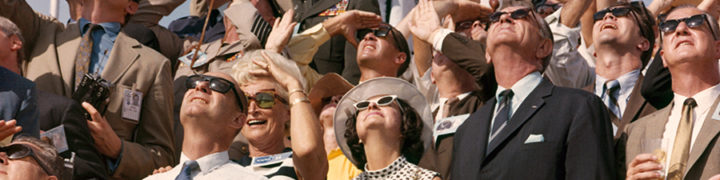
Forget Purell dispensers, this hospital needs condom machines and gun racks.

As America fiddles, China continues to move into a more sustainable future, this time with a solar-powered train station in Nanjing that will allow for clean and efficient rail travel. (Thanks Reddit.) An excerpt from a post by Tracy McGill on the Metaefficient blog:
“Efficiency abounds in China as the world’s largest building integrated photovoltaic project prepares to power the railway station where some of the world’s fastest high speed trains pass through. China Sunergy, a solar cell and module manufacturer based in Nanjing, China, has recently signed a deal with CEEG (Nanjing) Solar Energy Research Institute to supply the 7MW solar modules for the Nanjing South Railway Station. When it’s finished, the Nanjing South Railway Station will be one of the most energy efficient public buildings in China.”

“Dear Sarah, Beverly and All, I am enjoying the trip and safe so far. I slept all night at Snyder, Texas, at the Strayhorn Motel and feel rested. I sure wish you were with me. Today I went to Carlsbad Caverns. Love, Bill. P.S. I am sending you and Beverly a package from a souvenir store near here.”
During a 1958 visit to New Mexico, Bill Bragg sent a postcard to his wife at their home in Macon, Georgia. It just recently arrived after being lost for 52 years. Thankfully, the Braggs had never moved. Ed Grisamore of the Macon Telegraph has a story about the long-delayed card. An excerpt:
“The 5-cent postcard — with a few bumps, bruises, blue-ink smears and a 3-cent stamp barely hanging on — somehow reached its final destination.
The postmark was Nov. 10, 1958. It had been mailed from Whites City, N.M.
Oh, well. Better late than never.
A lot of things have changed, though.
Wilmer ‘Bill’ Bragg Jr. was a 30-year-old Marine when he penned those words. He’s now an 82-year-old great-grandfather and needs a magnifying glass to read them.
The Braggs still live on the same property along Liberty Church Road. It has been in Sarah’s family since 1943.
‘This incident is extremely rare and, over the course of postal history, it is always a great moment when we are able to deliver the mail no matter what condition it is in,’ said Nancy Ross, a spokeswoman for the U.S. Postal Service in the South Georgia District.”
Tags: Bill Bragg, Ed Grisamore, Nancy Ross, Sarah Btagg
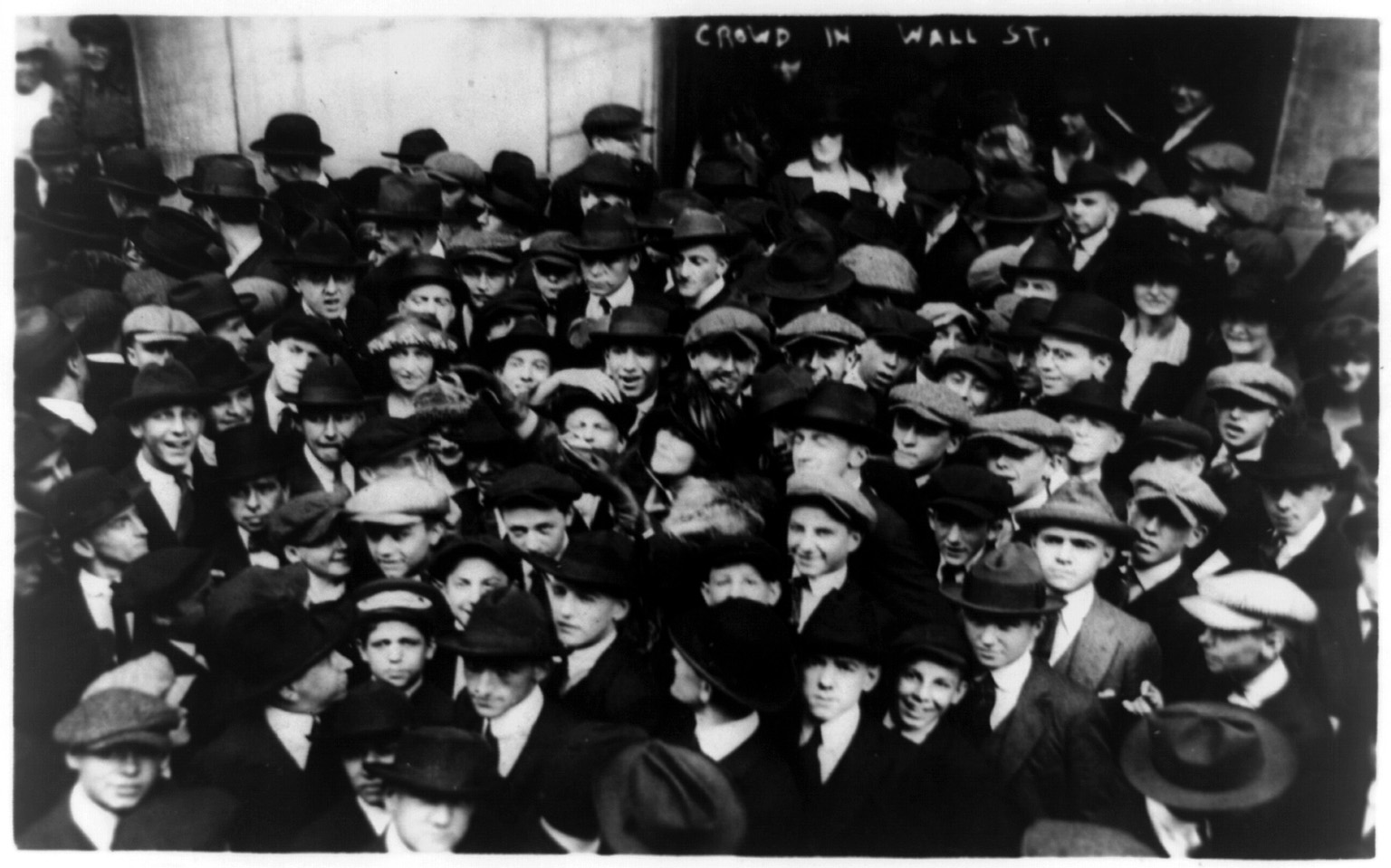
Stock being sold al fresco on Wall Street on October 2, 1920.
Not so long ago, the New York Curb Exchange was a place where small companies could literally sell stock on the street with the aid of what were called curbside brokers. The above 1920 photo from Bain News Service captures the mad scene. More about the Curb Exchange from Inside the Apple: A Streetwise History of New York City:
“Until 1921, the New York Stock Exchange–the largest trading floor in the city–was accompanied on Broad Street by the Curb Market, where outdoor brokers gathered around lampposts and mailboxes to transact business. In many ways, this was the outgrowth of the fact that some traders had not signed the Buttonwood Agreement in 1792, and thus had not been invited into the circle of brokers who moved into Tontine’s Coffee House as part of the official exchange. After the California gold rush brought more capital into New York, the Curb Market expanded to handle more transactions, often for companies deemed too small or too new to gain entrance to the New York Stock Exchange. (Many of these companies–like General Motors–did eventually graduate indoors.) In boom years, the Curb Market was sometimes trading 10 times the number of shares that were being sold on the Stock Exchange’s floor.”

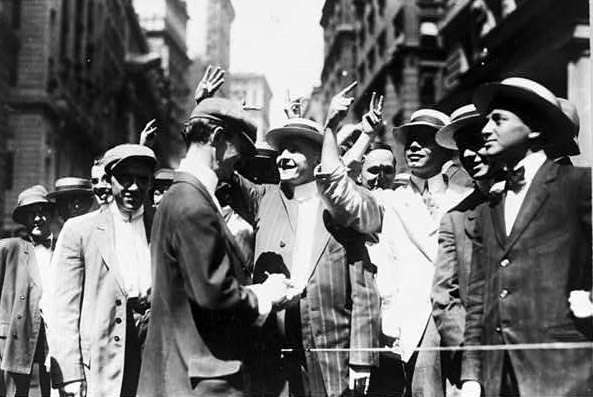
(Image by George Grantham Bain Collection.)

McCracken discovered that "pitchers have very little control over what happens on balls hit into the field of play." (Image by schwenkenstein01.)
Arizona baseball stats geek Robert “Vörös” McCracken had the kind of idea that can make a career, but he instead watched his life come undone. McCracken was the wunderkind sabermetrician lauded in Moneyball for figuring out a radically different and improved way of ranking pitchers. It made him the next big thing in baseball numbers circles, the heir apparent to Bill James, and landed him a job with the Boston Red Sox. But bipolar disorder and a number of other setbacks led to unemployment, poverty and depression. Jeff Passan profiles McCracken and his current between-innings life in “Sabremetrician in Exile” for The Post Game on Yahoo! Sports. An excerpt:
“He visited a doctor, was diagnosed with a mild case of bipolar disorder and received a prescription for Seroquel, a popular antipsychotic drug that would help him sleep and prevent the ruminations.
‘At some point, if you’re not mentally well, nothing else matters,’ McCracken says. ‘Nothing good happens. You’re forced to make decisions. And because you’re forced, there’s no guarantee they’re the right ones. But they’re decisions you’ve got to make. I can either spend the rest of my life in an institution, or I can change the way I think about what I’m doing with the rest of my life. I can continue to ratchet up the stress levels and be the supergenius who makes millions of dollars, or I can calm down and be satisfied with my lot.’
Satisfaction is an ongoing battle. McCracken gave up baseball for a few years before he starting blogging about it again. The frequency of the posts petered out as his attention moved to soccer, and the demand for employment there exceeded any bites he got in baseball.
McCracken tried. He spoke with Cleveland and San Diego. Nothing materialized. Last year, he was hoping to get a job with the Diamondbacks, whose stadium is less than 30 miles from his home in Surprise, Ariz. Then GM Josh Byrnes was fired, and McCracken never heard from the organization again. He tries to understand why, whether his time with Boston hurt him or his mental illness scares teams off or his appearance — McCracken is significantly overweight – hinders his reputation.
All cop-outs, McCracken says.”
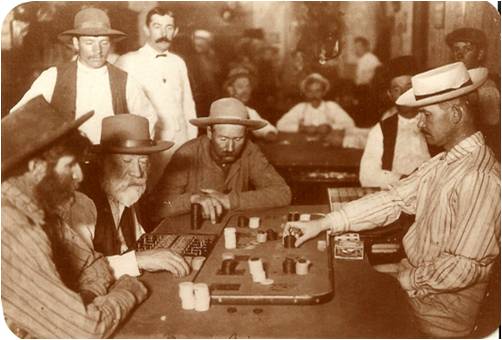
"Some of the tenements managed to boast a saloon, brothel, or dance hall on every floor."
An excerpt about raffish pre-Civil War New York saloons from Luc Sante’s great book Low Life:
“The low-class Bowery dives just emerging featured a novelty: no glasses. Drinks, at three cents per, were served from barrels stacked behind the bar via thin rubber tubes, the stipulation being that the customer would drink all he wanted until he had to stop for a breath. Needless to say, there were many who developed deep lung capacity and tricks of circular respiration in order to outwit the system. In the decades before the Civil War the worst dives were located on the waterfront, and they traded with a highly elastic clientele of sailors. Sailors were free spenders, rootless, and halfway untraceable; they were marks of the first order. The street most overrun by sailors was Water Street, and there some of the tenements managed to boast a saloon, brothel, or dance hall on every floor. Notable were John Allen’s saloon-cum-whorehouse and Kit Burns’ Sportsmen Hall, which was an entire three-story building in which every variety of vice was pursued, but none so famous as its matches to the death between terriers and rats, held in a pit in its first-floor amphitheater, hence the resort’s more common name, the Rat Pit. Commerce was aided by the fact that, whether through fluke or graft, Kit Burns’s was the terminus for one of the early stage transit lines.”
Tags: John Allen', Kit Burns, Luc Sante
Reddit pointed me to this 1987 commercial for what was a really cool and inexpensive black-and-white camcorder for kids, the Fisher-Price PXL 2000. It was a handheld camera that recorded footage using audio cassettes. Intended as a toy, the lo-res pixelvision product was a flop with kids but became a popular, artsy cult item with adults, especially indie filmmakers and graphic designers. It was created by Andrew Bergman, who passed away in 2007 at the young age of 57. An excerpt from a remembrance of the ecelctic inventor from a Stickley Museum newsletter:
“Andy was born in Appleton, Wisconsin, and schooled at Carnegie Mellon and Southern Illinois University, where he taught with prolific innovator Buckminster Fuller. In 1992, he formed the Bergman Design Consortium, a force in the toy design industry. As a self-taught sculptor and furniture designer, Andy spent many summers at Haystack Mountain School of Crafts in Deer Island, Maine. Andy’s zest for life was abundant and was evident in his joyous creations.”
Tags: Andrew Bergman, Buckminster Fuller
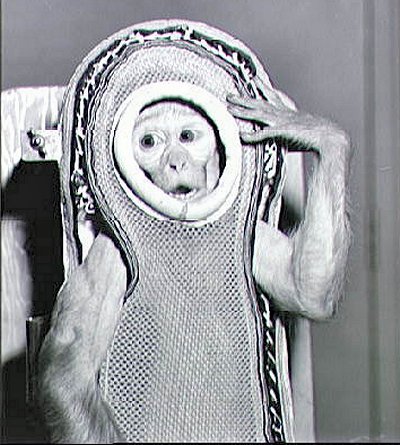
"A delicate monkey fur trim around each tier."
RARE 1920’s Silk & Monkey Fur Cape, MUST SEE – $99 (East Village)
I have this really beautiful 1920’s Silk and monkey fur cape.
It has multiple tiers of silk cascading around the entire cape, with a delicate monkey fur trim around each tier.
It has a lining of 100% silk also.
Considering its age it’s in quite good condition, with some minimal marks that aren’t noticeable when worn.
This looks very dramatic when worn and would be a great addition to any vintage clothing collection.
31″ long, one size fits all (0-16)
Asking $99 which is MUCH less than what I bought it for. This is a steal!
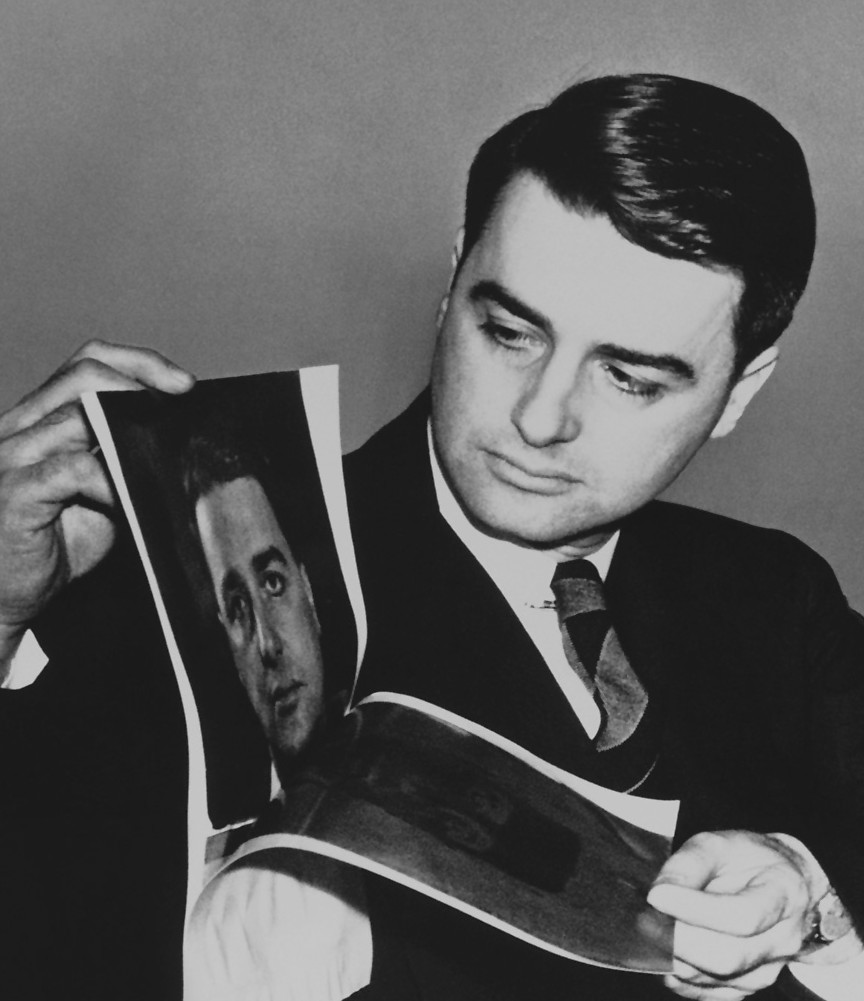
In 1972, scientist and Polaroid co-founder Dr. Edwin H. Land released the SX-70 collapsible instant camera, which featured a new type of self-developing film that required nothing of a photographer beyond a point and a click. In the October 27 issue of Life that year, Land unveiled his new invention and opined on the nature of creativity. In his description of the birth of the first Polaroid camera in the 1940s, he offers a pretty great explanation about the creative process in general. An excerpt:
Many people are creative but use their competence in ways so trivial that it takes them nowhere. Their kind of creativity is not cumulative. True creativity is characterized by a succession of acts each depending on the one before and suggesting the one after. This kind of cumulative creativity led to the development of Polaroid photography.
One day when we were vacationing in Santa Fe in 1943 my daughter, Jennifer, who was then 3, asked me why she could not see the picture we had just taken of her. As I walked around that charming town, I undertook the task of solving the puzzle she had set for me.
Within the hour, the camera, the film and the physical chemistry became so clear that with a great sense of excitement I hurried to the place where a friend was staying, to describe to him in detail a dry camera which would give a picture immediately after exposure. In my mind it was so real that I spent several hours on this description.
Four years later we demonstrated the working system to the Optical Society of America. All that we at Polaroid had learned about making polarizers and plastics, and the properties of the viscous liquids, and the preparation of the microscopic crystals smaller than the wavelengths of light was preparation for that day in which I suddenly knew how to make a one-step photographic process. I learned enough about what would work in different fields to be able to design the camera and film in the space of that walk.•
___________________________
In 1970, Edwin H. Land gave a tour of the Polaroid company.
Tags: Edwin H. Land
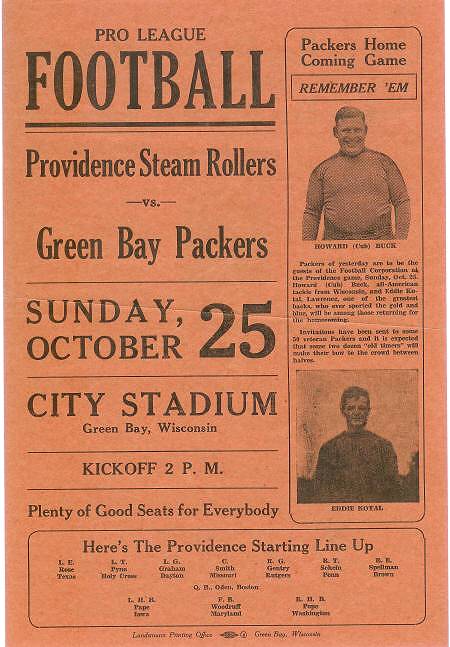
1931 poster advertising Green Bay Packers vs. Providence Steam Rollers.
The Green Bay Packers, headed to the Super Bowl, are the only non-profit, publicly owned major-league American sports team. In a post for the New Yorker‘s News Desk blog, Dave Zirin explains how this unique arrangement came to be. An excerpt:
“In 1923, the Packers were just another hardscrabble team on the brink of bankruptcy. Rather than fold they decided to sell shares to the community, with fans each throwing down a couple of dollars to keep the team afloat. That humble frozen seed has since blossomed into a situation wherein more than a hundred thousand stockholders own more than four million shares of a perennial playoff contender. Those holding Packers stock are limited to no more than two hundred thousand shares, keeping any individual from gaining control over the club. Shareholders receive no dividend check and no free tickets to Lambeau Field. They don’t even get a foam cheesehead. All they get is a piece of paper that says they are part-owners of the Green Bay Packers. They don’t even get a green and gold frame for display purposes.”
Tags: Dave Zirin
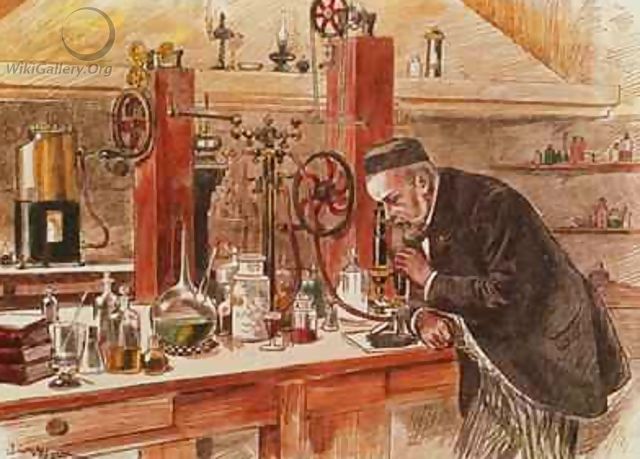
"He was universally advised to take the boy at once to Paris and place him under the advisement of Pasteur."
Legendary French chemist and bacteriologist Louis Pasteur treated his first human patient for rabies, or “hydrophobia,” in 1885 after testing his vaccine on fewer than ten dogs. It was a bold move that proved successful in defeating what had been a killer virus. But his treatment hadn’t yet become widespread in the U.S. by the following year when four people were bitten by a rabid dog in Chicago. The only answer was to send them to France and Dr. Pasteur for treatment. The Brooklyn Daily Eagle reported the story on April 28, 1886. An excerpt:
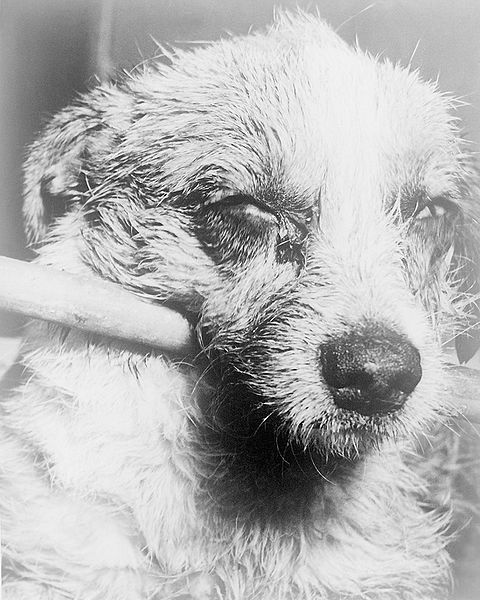
“A big white dog, mad with rabies, appeared on Fulton street, in Pullman, yesterday afternoon. He was heated, but his tongue did not protrude. His jaws were covered with thick foam. The dog went along the street quietly until opposite the house of Al Klingel, a railroad switchman. There the brute turned, dashed across the street, seized Johnnie Klingel, aged 8, by the cheek. The animal then started down the street and meeting a little boy named Connors bit him severely in the hand. Then the dog retraced his way on the street, attacking everything that confronted him, but never turning aside. Meeting another boy, he seized him by the seat of the trousers and nearly tore the garment from the lad, but his teeth did not touch the flesh. A moment later an adventurous dog tried to make the acquaintance of his mad brother. A short fight ensued and the mad dog proceeded. Within a block he attacked another dog and sent the unfortunate away howling. By this time the street was aroused and Police Officer Kane and Cassenbrot pursued the dog to Kensington, where he ran into a saloon.
 The officers took refuge on a card table and tried to shoot the dog but failed. The dog escaped from the saloon, followed by the officers. In the street a bold boy attacked the dog with a ball bat. He gave the animal one blow and then climbed the fence. Here the policeman overtook the brute, and Officer Kane fired. The ball struck in back of the dog’s head and he fell. Kane approached him and fired another ball into the dog’s body, thinking to make the killing sure, but the animal struggled up and attempted to escape. Again Kane fired, the shot breaking the dog’s leg. He fell, but once got to his feet and rushed upon Officer Cassenbrot. With a savage crunch he set his teeth in the man’s wrist, lacerating it terribly. Yelling like mad the officer shook him off, and as the dog gathered himself for another attack. Officer Kane fired a bullet into the brute’s mouth by killing him. A search was made for the two dogs bitten by the mad one. They were found and killed. Physicians were at once called to attend the two boys who were bitten. Their wounds were burned with caustic, but the physicians gave no hope of preventing hydrophobia. It was soon learned that the mad dog had been in Wildwood last Saturday. On that day he bit Percy Perkins, son of the Superintendent of the Pullman Iron and Steel Works. The boy is 12 years old. He was bitten on the end of the finger, and yesterday his hand and arm were much swollen and he was suffering great pain.
Mr. Perkins consulted with several physicians yesterday and he was universally advised to take the boy at once to Paris and place him under the advisement of Pasteur. Acting under this advice he made arrangements to start the boy with his mother for Paris to-day. The sympathy expressed in the village last night resulted in the circulation of a subscription paper to raise sufficient funds to send all the bitten children to Paris. A considerable amount of money was subscribed. Mr. Perkins had decided not to send his boy away until this evening, and it is probable the three wounded children will go together. Officer Cassenbrot’s wound is the most severe of any. What treatment he will receive has not been determined upon.”
Tags: Al Klingel, Johnnie Klingel, Little Boy Connors, Louis Pasteur, Percy Perkins, Police Officer Cassenbrot, Police Officer Kane
The Buffalo Beast has put the 2010 version of its annual “50 Most Loathsome Americans” online. As always, it’s an entertaining read. Three excerpts follow.
••••••••••
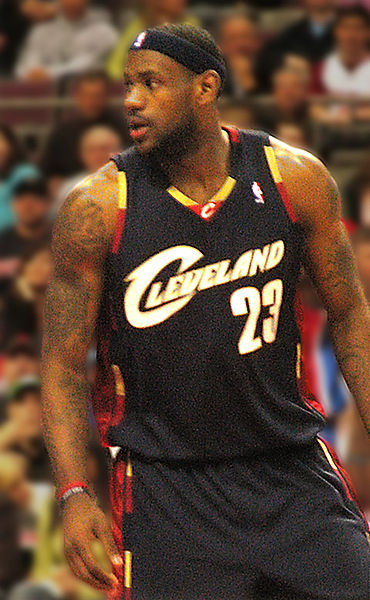
"Cleveland, with no reason left to exist, has slid into Lake Erie." (Image by Dave Hogg.)
LeBron James
Aside from indirectly employing hundreds of Chinese kids in sweatshops, his sole contribution to society is tossing a ball through a hole. A genetic-lottery-winning monstrosity, he demonstrates the sort of unbridled ego deserving of the NBA’s first all-star midget. (Now that little dude can talk all the smack he wants.) Last year, ‘King’ James actually had Nike goons confiscate video of Jordan Crawford dunking on him during his clinic. This year, he imbued his free agency announcement with the import normally reserved for declarations of war. For a full half hour of his torturous hour-long ESPN special The Decision, he waxed smugly on topics unrelated, as the sad city of Cleveland nervously awaited the ultimately crushing news that he was going to South Beach. Cleveland, left with no reason to exist, has since slid into Lake Erie. Totally true.
••••••••••

"Owes his emotional instability to legendary Merlot consumption and his radioactive Naugahyde complexion to innumerable special interest golf junkets." (Image by Keith Allison.)
John Boehner
Cries so often he embarrasses Glenn Beck’s family. An incorrigibly lazy corporate puppet who owes his emotional instability to legendary Merlot consumption and his radioactive Naugahyde complexion to innumerable special interest golf junkets. His first notable act in Congress was to hand out tobacco lobby checks on the House floor before a vote on anti-smoking legislation; his PAC received $30K from Abramoff-affiliated tribes; he lived in an apartment owned by lobbyist John Milne; he knew about Mark Foley’s page perversion and sat on it. More recently, he compared the financial crisis to an ant and the weak Dodd-Frank bill to a nuke—while concurrently trying to block unemployment benefits. And the most egregious aspect of his drunken weeping on 60 Minutes, about kids having the same education opportunities he did, is that he’s scored hundreds of thousands from for-profit schools and the student loan industry—even sponsoring legislation that would slash public loan funding and redirect it to his golf buddy’s company Sallie Mae. He’s the kind of amoral opportunist who would campaign for Nazi reenactor Rich Iott in secret, not because there is any chance in hell of winning, but because Iott’s stinking rich and bound to repay the favor.
••••••••••

"Lambasted as the Himmler of the Southwest." (Image by Pete Souza.)
Jan Brewer
Gila Monster eugenics gone horrible awry. Killed two people, and another ninety-six languish, unable to afford the life-saving transplants for which she slashed state funding. Cut health care for kids too. Hates health care. Horny for the NRA; signed law nixing concealed carry permits, which had no ill effects in 2010. None. Don’t worry about it. Not a problem. Seriously. It’s totally cool. Attempted to justify the draconian racial profiling law SB 1070 by repeatedly citing fictional desert decapitations. Lambasted as the Himmler of the Southwest, she protested, saying her father died fighting the Nazis. He was never in the military. He died in ‘51. From lung cancer.
Tags: Jan Brewer, John Boehner, Lebron James
Footage of the old-school MacLevy Slenderizing Salon health-club chain for women. An excerpt from “Machines Attack the Solid Flesh,” a deeply insulting 1940 Life article about the gyms:
“These pictures were not taken in the torture chamber of a medieval dungeon. They were taken in one of the 200 MacLevy ‘slenderizing salons’ in the U.S. Here massive machines of steel, heavy coil springs and wooden rollers now replace masseuse’s hands in rubbing the fat from lazy female bodies.
To demonstrate these reducing machines Life picked pretty model Pat Ogden, who is placidly letting herself be electrically rolled in the Slendro Massager. With many other New York models, Pat goes to a salon occasionally to keep her figure trim.
Along with Pat, Life sent its fattest researcher to play guinea pig for fat Life readers. She found the machines pleasant and generally painless. The Slendro Massager made her fell ‘like a piece of dough being rolled,’ but like a biscuit she felt no pain. ‘This is like a silent movie where you see yourself being spanked and await with dread the stinging of pain which never arrives,’ she reported.”
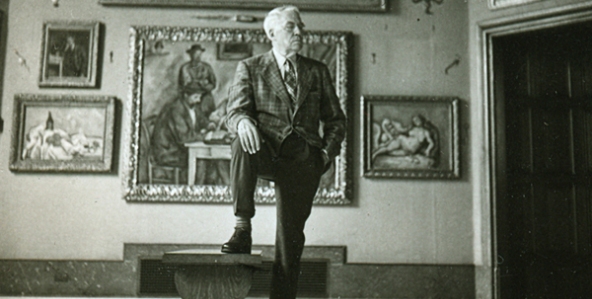
Dr. Albert C. Barnes was a working-class boy who made his money by inventing an antiseptic drug that is placed on the eyes of newborn babies.
Lacking all interest in false equivalency, Don Argott’s absorbing documentary takes sides in the battle for the legacy of an astounding art collection, points fingers, names names and seemingly gets it all right. The trove in question is $25 billion dollars of Post-Impressionistic art known as the Barnes Collection, which fell into the greedy hands of a dizzying array of politicians, power brokers and self-promoters after the deaths of collector Dr. Albert C. Barnes and the curator who succeeded him.
Barnes made his fortune in pharmaceuticals and decided to invest a good portion of the proceeds in art, after spending a couple of years educating himself on the topic. He had amazing taste, not only choosing Renoirs and Picassos but the best of them. Barnes built his treasures a gorgeous home in a suburban Philadelphia township and meticulously arranged the works so that they commented on each other. He decided to make the foundation largely an educational institution that was only open to the public a couple days a week. Matisse called the building “the only sane place to see art in America.”
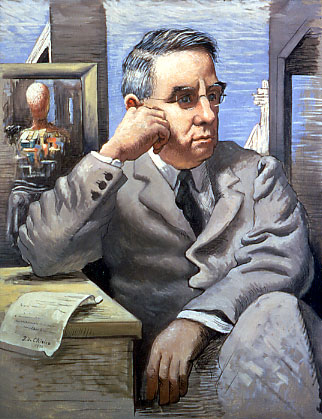
Portrait of Barnes by Giorgio de Chirico.
From his perch in Lower Merion Township, Barnes carried on a war of words with the Philadelphia art, media and business elite, who had panned his collection after an early showing. He relished referring to the City of Brotherly love as an “‘intellectual slum.” He especially enjoyed jousting with Walter Annenberg, the right-wing publisher of the Philadelphia Inquirer who long sought to wrest the collection from his nemesis. When he died in a car accident in 1951, Barnes left an iron-clad will stating he never wanted his collection sold, broken up, moved, taken on tour or, god forbid, relocated to Philadelphia. His successor in running the foundation followed his wishes even as she allowed the building to pass into gentle disrepair. But eventually the foundation’s finances needed work, and the collection became a pawn for people who had their own agendas, especially those who desired to break Barnes’ will and move the art to Philadelphia rather than merely raising some money to preserve the collection as it was, which probably wouldn’t have been difficult to do.
What followed was similar to the legal shenanigans that went on after Mark Rothko’s death, except much more was at stake in this case, so everyone got lawyered up and brazenly attempted to get a piece of the legacy. Here’s a thorny thing: Because of all of this underhanded, illicit behavior, more people will get to see this incredible collection in its new location, even if it is going to be shown in a blockbuster fashion rather than the intimate way Barnes intended. But no amount of eyeballs getting to see this Matisse or that Van Gogh can make up for what went on. Figuratively if not necessarily literally, it was a crime.
Recent Film Posts:
- Classic DVD: The Man Who Fell to Earth (1976)
- Classic DVD: Fast, Cheap & Out of Control (1997)
- Classic DVD: Umberto D. (1952)
- Classic DVD: The Wicker Man (1973)
- Classic DVD: Blow-Up (1966)
- Classic DVD: Invasion of the Bodysnatchers (1978)
- Classic DVD: The Stepford Wives (1975)
- Classic DVD: Rollerball (1975)
- New DVD: Exit Through the Gift Shop
- Strange, Small & Forgotten Films: Stay Hungry (1976)
- Classic DVD: Westworld (1973)
- Classic DVD: Slacker (1991)
- Strange, Small & Forgotten Films: Decasia: The State of Decay (2002)
- Classic DVD: 32 Short Films About Glenn Gould (1993)
Tags: Dr. Albert C. Barnes
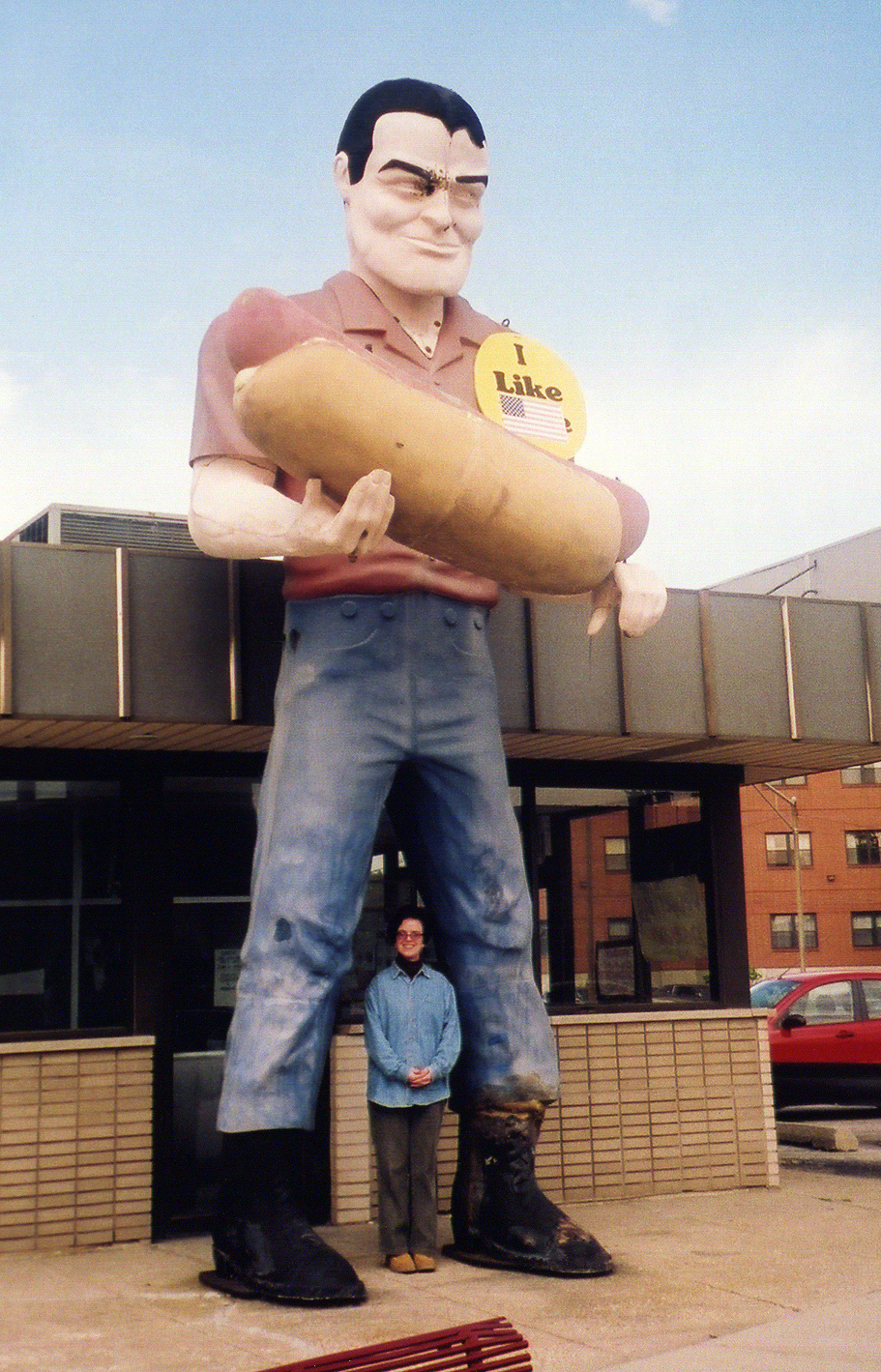
"With shoulder straps." (Image by Mykl Roventine.)
Hot Dog Cooker with Shoulder Straps – $50 (Midtown)
I’d like to start selling hot dogs and a hot dog cooker is the first step! I don’t care if it’s gas or electric. I can pick it up anywhere, even Jersey.
Also, I’d take any Jets crap you want to get rid of since they lost.
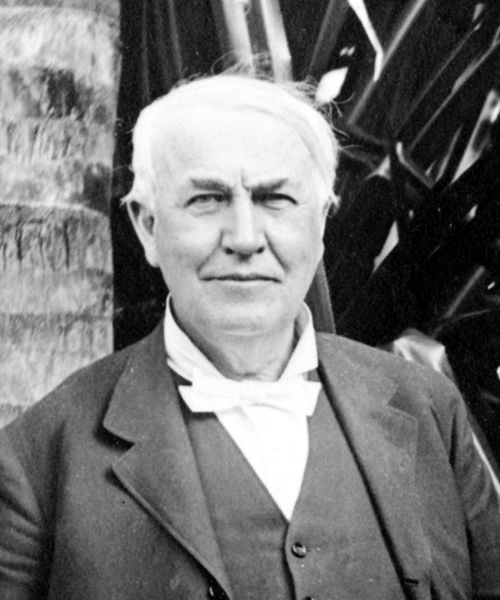
"Books of the coming century will all be printed leaves of nickel, so light to hold that the reader can enjoy a small library in a single volume."
A fun post on John Boitnott’s blog recalls predictions for 2011 that Thomas Edison made 100 years ago. He was asked to prognosticate about the future on June 23, 1911 by the Miami Metropolis. Some hits, some misses, of course. (Thanks Reddit.) An excerpt:
“Already, Mr. Edison tells us, the steam engine is emitting its last gasps. A century hence it will be as remote as antiquity as the lumbering coach of Tudor days, which took a week to travel from Yorkshire to London. In the year 2011 such railway trains as survive will be driven at incredible speed by electricity (which will also be the motive force of all the world’s machinery), generated by ‘hydraulic’ wheels.
But the traveler of the future, says a writer in Answers, will largely scorn such earth crawling. He will fly through the air, swifter than any swallow, at a speed of two hundred miles an hour, in colossal machines, which will enable him to breakfast in London, transact business in Paris and eat his luncheon in Cheapside.”
Tags: John Boitnott, Thomas Edison

A friction match, invented by John Walker, was originally called a "lucifer match." (Image by Sebastian Ritter.)
- The first horse railroad was built in 1826-27.
- The first lucifer match was made in 1829.
- The first iron steamship was built in 1830.
- The first steel pen was made in 1830.
- Omnibuses were introduced in New York in 1830.
(Taken fron the 1893 Brooklyn Daily Eagle Almanac. Some dates seem questionable.)
Tags: John Walker
“Once we have computer outlets in every home, each of them hooked up to enormous libraries, where anyone can ask any question…everyone will enjoy learning.”
Tags: Isaac Asimov

"Woolworth tower in clouds, New York City," is credited to Fairchild Aerial Surveys.
This gorgeous 1928 aerial image of the peak of the Woolworth Building provides an unusual perspective of what was the tallest building in the world when it was completed in 1913, soaring to 792 feet. Paid for with cash by discount king Frank W. Woolworth for what was then a staggering sum of $13 million, the landmarked building’s grandeur outlived the stores that financed its construction, as five-and-dimes were replaced by big-boxes. A few excerpts about the Woolworth Tower from a post on New York Architecture Images.
••••••••••
Frank W. Woolworth, the five-and-dime store king, commissioned architect Cass Gilbert to design a Gothic-style skyscraper on a full-block front on Broadway between Park Place and Barclay Street. When the building was erected it rose across the street from the main downtown Post Office by Alfred Mullett. This massive mansarded structure of 1875 was later demolished and the site reclaimed as part of City Hall Park. Woolworth wanted his building to become the tallest in New York, and in the world, which meant that it needed to rise more than 700 feet– the height of the Metropolitan Life Tower. As the height escalated from a projected 625 feet to 792 feet, the cost grew from an estimated $5 million to the final cost of $13.5 million. Extensive foundations and wind bracing necessary for the tall tower as well as the ornate terra-cotta cladding and sumptuous interior fittings both inflated costs and created one of the masterpieces of early skyscraper design.
••••••••••
The sumptuous lobby features marble, fine mosaics and a rich program of sculpture, including brackets with medieval-style caricatures, including Mr. Woolworth counting his dimes and Gilbert cradling a model of the building. Allegorical murals of Commerce and Labor and ceiling vaults accented with thousands of gold tesserae make the lobby seem like a church. Indeed, the gothic tower was nicknamed ‘The Cathedral of Commerce.’
••••••••••
Mr. Woolworth financed the skyscraper in cash, which was unusual for a project of this size and cost, and he noted that the tower would be a valuable generator of publicity for the company. Still, through the 1910s, the Woolworth Company only occupied one and a half stories of the building. The rest of the building was occupied by more than 1,000 tenants. For most of the twentieth century the building never had a mortgage — something almost unheard of for such a large commercial structure. In 1998 the Woolworth Company’s successor, the Venator Group, sold the tower for $155 million: this was the first time the property changed hands in its 85-year history.

A more conventional view of the Woolworth Building. (Image by Jonathan71.)
Tags: Frank W. Woolworth

(Image by Infrogmation.)
Quality massage for gas
i’m willin to barter a one hour massage for half its value to fill my gas tank either on a weekly basis or biweekly, i own my own private practice and do great bodywork-if ur body can appreciate 5 star quality for half the price contact me via email located on the north shore between commack and smithtown
Architect Gary Chang transforms his micro-apartment in Hong Kong so that it can quickly become 24 different rooms. Meanwhile, I’ve been planning to tighten the towel rack in my bathroom for seven weeks.
Tags: Gary Chang

Some of Clarridge's "agents" attempted to get Hamid Karzai's beard clippings, so the hair could be tested for heroin traces. (Image by Cpl Matthew Roberson.)
It’s stunning to realize that there are American citizens running their own shadow versions of the C.I.A., but that’s a reality in the murky era of military outsourcing. Duane R. Clarridge, a former C.I.A. agent and a staunch right-wing interventionist, operates a network of spies from his home base in San Diego who often work in opposition to American foreign policy–and it’s apparently legal. An excerpt from Mark Mazzetti’s eye-popping article on Clarridge in the New York Times:
“Mr. Clarridge — known to virtually everyone by his childhood nickname, Dewey — was born into a staunchly Republican family in New Hampshire, attended Brown Universityand joined the spy agency during its freewheeling early years. He eventually became head of the agency’s Latin America division in 1981 and helped found the C.I.A.’s Counterterrorism Center five years later.
In postings in India, Turkey, Italy and elsewhere, Mr. Clarridge, using pseudonyms that included Dewey Marone and Dax Preston LeBaron, made a career of testing boundaries in the dark space of American foreign policy. In his 1997 memoir, he wrote about trying to engineer pro-American governments in Italy in the late 1970s (the former American ambassador to Rome, Richard N. Gardner, called him ‘shallow and devious”), and helping run the Reagan administration’s covert wars against Marxist guerrillas in Central America during the 1980s.
He was indicted in 1991 on charges of lying to Congress about his role in the Iran-contra scandal; he had testified that he was unaware of arms shipments to Iran. But he was pardoned the next year by the first President George Bush.
Now, more than two decades after Mr. Clarridge was forced to resign from the intelligence agency, he tries to run his group of spies as a C.I.A. in miniature. Working from his house in a San Diego suburb, he uses e-mail to stay in contact with his ‘agents’ — their code names include Willi and Waco — in Afghanistan and Pakistan, writing up intelligence summaries based on their reports, according to associates.”
Tags: Duane R. Clarridge, Mark Mazzetti, President George Bush, Richard N. Gardner
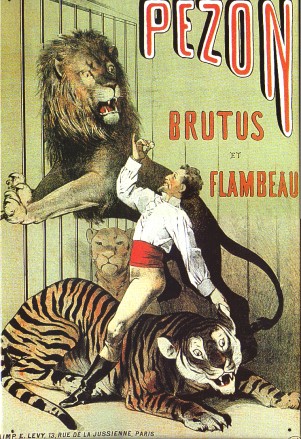
"Pezon, the great French lion tamer, owed his success to the use of electricity in taming his beasts."
Not everyone in fin de siècle France had the best of sense when it came to behavior within a lion cage. Great lion tamer Jean-Baptiste Pezon had his wits about him, but others were not so wise. That’s proven in three short articles that follow, which were published in the Brooklyn Daily Eagle between 1892 and 1900.
••••••••••
“Lion Attacks Man” (October 4, 1900): “There was a serious accident to-day in the menagerie of the country fair near Privas, in the Department of Ardeche. A large audience gathered to witness a local butcher enter the lion’s cage, play a game of cards with the lion tamer and drink a bottle of champagne. The performance was successful until the butcher foolishly and without warning the trainer, approached the lion and held a glass of champagne under his nose, whereupon the lion bounded upon the butcher, ground his shoulder within his jaws and mauled his body dreadfully.
When the butcher was removed he was almost dead. In the meanwhile the audience was panic stricken, and in the stampede to escape from the menagerie many persons were trampled upon and badly injured.”
••••••••••
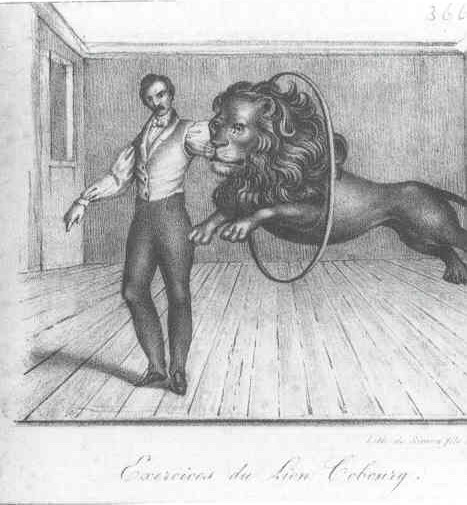 “He Was Awake: A Lion Would Not Submit to Hypnotism” (November 30, 1892): “A Miss Sterling entered the lion’s cage at Bezier’s last evening, accompanied by the lion tamer, a professor of hypnotism having already attempted to hypnotize the fierce animals. In the case of one of them, however, he seems not to have been successful, as no sooner was Miss Sterling well within the cage when the powerful brute threw himself upon her and terribly lacerated her limbs. She was barely saved from being torn to pieces by the prompt interference of the lion tamer, who courageously attacked the animal and thus gave the wounded woman time to crawl out of the cage.”
••••••••••
“Electric Lion Taming” (March 20, 1898): “Pezon, the great French lion tamer, owed his success to the use of electricity in taming his beasts. When a wild lion or tiger was to be tamed live wires were first rigged up in the cage between the tamer and the animal. After a time Pezon would turn his back, and the wild creature would invariably make a leap at him, but encountering the charged wires would receive a paralyzing shock sufficient to terrorize it forever.”
Tags: Jean-Baptiste Pezon
A few search-engine keyphrases bringing traffic to Afflictor this week:

Afflictor: Regretting our laser eye surgery since 2009. (Image by Trekphiler.)
- Classic DVD: Fast, Cheap & Out of Control (1997).
- Old Print Articles: Cowboy gets into knife fight with Italian peanut vendor (1902) + Gravedigger steals potatoes (1900) + Sitting Bull accused of cowardice and self-promotion (1889).
- Featured Videos: Housewife drops acid (1950s) + Night of the Lepus trailer (1972) + Astronauts toss weightless cats + Gigantic drunk puppet in Ireland+ Woolworth Halloween costumes(1978) + Romanian jetpack inventor+ Clothes in the year 2000(1930s) + Guy eats spaghetti, climbs stuff (1930).
- Classic Photos: Massive crowd gathers in Times Square for World Series updates (1920) + Titanic survivors get warm clothes in NYC (1912).
- Recently Posted on NYC’s Craigslist: I’ll give your ventriloquist dummy a good home + Animal bones and skulls wanted + Selling an Egyptian dagger from 600 B.C.+ I’ll give you $25 if you give me something awesome+Teach me how to fight + Selling newspaper article about Michael Jackson and monkey.
- Terrible California earthquake prediction (1867).
- Chariot races in Manhattan in the 1850s.
- Donald Bean builds his Dinosaur Gardens.
- MIT professor Sherry Turkle falls out of love with robots.
- John Hersey profiles an illiterate soldier who learns to read in 1945.
- Tom Junod profiles Steve Jobs.
- Martin Luther King discusses violent revolution (1965).
- John and Yoko discuss violent revolution (1971).
- Jerzy Kosinski mourns the printed word (1972).
- Ray Kurzweil on the benefits of evolving robots.
- Why focus groups and market research are enemies of greatness.
- Why do the ruins of Detroit capture our fancy?
- Guy bowls on gigantic billiards table.
- Golf tournament to be held in North Korea.
- Old Print Ad: Astraltune Cassette Stereo for Skiers (1975).
- Listeria: Leading industries in NYC in 1890.
- This week’s Afflictor keyphrase searches.