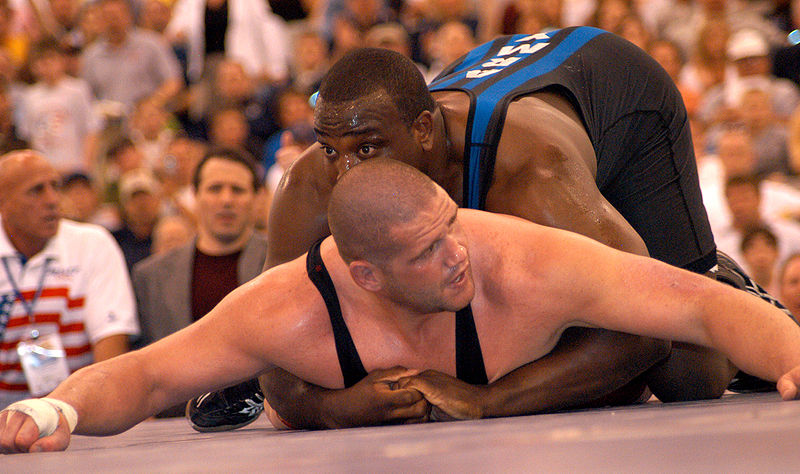
"There was no way for Ru to moderate his frenetic relentlessness. He pushed everything to the max." (Image by Tim Hipps.)

From frostbite to a broken neck to a plane crash to morbid obesity, Greco-Roman wrestler Rulon Gardner has famously cheated death so many times it’s difficult to remember that the farmboy scored one of the greatest upsets in Olympic history just a little more than a decade ago. From a 2007 GQ profile by Michael Paterniti:

“After defeating Karelin—in a match that became known as Miracle on the Mat—Ru appeared on Leno, Oprah, Letterman. He showed up at the Espy Awards and was photographed with Tiger Woods and Lara Flynn Boyle. He befriended heroes like Garth Brooks and Jason Giambi. He won the prestigious Sullivan Award, given to the country’s best amateur athlete. There were parades and city keys, more awards and gifts, including a waverunner from Rosie. He showed up in a ‘Got Milk?’ ad, hoisting buckets of milk while wearing a creamy white mustache. He went on tour, giving inspirational speeches to corporate clients willing to pay up to $15,000 a speech. He wrote his autobiography, titled Never Stop Pushing.

If he didn’t entirely believe his own legend yet, if he approached everyone as if he were still the old affectless Rulon Gardner, the farm boy from Star Valley seeking a little love and approval, he had seen through to a life beyond the Valley. And that life included proving he was no fluke by winning World Championships the following year and then preparing to defend his gold medal at the 2004 Games.

Where he once clandestinely sold the Cuban cigars he’d collected at an international meet in Havana in order to support himself, his new-won fame now turned on a spigot of income flow. His father had once lived over him, always on the verge of bankruptcy, and here he was, Rulon Gardner, a national treasure having made $250,000 the year after he won his gold—and the number was climbing. (‘He spent nine minutes on the mat with that ugly man from Russia,’ Reed Gardner jokingly told a reporter. ‘I spent fifty to sixty years on the farm, and I don’t have nothin’.’) So, he’d begun to accumulate toys, to live a grown-up version of the childhood he’d missed, with motorcycles and guns and a shiny snowmobile he took into the mountains near Star Valley. Of course there was no way for Ru to moderate his frenetic relentlessness. He pushed everything to the max.

Extreme snowmobiling can be as harrowing as any sport invented, man and machine against the mountain, finding aggressive routes up pitched faces, jumping rivers, riding into deep powder, and searching for perfect isolation. There are breakdowns and strandings, sudden submersions in icy water and the constant challenge of righting a 500-pound machine after having fallen chest-deep in snow—all in quest of some banana-cream vision out there through the trees, up on the ridge, gazing all those silver miles over Wyoming. In other words, it combines all the ingredients that make someone like Rulon Gardner tick: high-octane risk-taking, brute physicality, farm-boy ingenuity, nimble coordination, and conflict reduced to its simplest denominator, survival.

In February 2002, Ru went out snowmobiling with two friends in the Bridger-Teton National Forest, in Wyoming, thirty minutes from his home. They cruised the high peaks and winding valleys for a couple of hours until Ru peeled off, alone, into a gully of virgin snow near the head of the Salt River, ‘to play a little,’ as he put it. Shooshing down into the gully, he had no inkling that he wouldn’t be able to get out for seventeen hours. He was wearing a T-shirt, sweatshirt, and fleece pullover, having left his jacket behind. The sun had begun to dip in the sky; the temperature, which had been twenty-five degrees, began to plummet. Over the course of the next hours, Rulon tried to work his way out of the gully. His machine didn’t have the power necessary to take him back up the route he’d just dropped down. Worse, as he crisscrossed the Salt River in an increasing panic, occasionally submerging his sled, he found himself in a narrow gully where, ultimately, his machine became stuck between two boulders. During the journey, he had to repair a belt and fell four times into the river, soaking his clothes. (‘Once I got wet, I knew I had about an hour before frostbite and hypothermia,’ he said.) Finally, as night fell, he dug out a spot among the trees and waited for his own inevitable death. Sometime around 2 a.m., he heard the roar of snowmobiles, but then the sound faded. ‘I thought I was rescued,’ he said. ‘They came within 200 yards, and I was yelling, but they couldn’t hear me over their engines—and then they just turned away.’ He slipped in and out of consciousness, having visions: first of Jesus and then of his brother Ronald, who died at the age of 14 of a rare blood disease. (When his leg had to be amputated because of gangrene, Ronald said, ‘It’s okay, Dad, I can wrestle with one leg.’) Time crawled. What helped keep him alive was the thought of his family and friends finding him frozen there, a lifeless face with eyes open like Jack Nicholson in The Shining.

The next morning he was spotted by a search plane, and two hours later a helicopter landed, and he was able to crawl across the snow and climb in. His core body temperature had dropped into the 80s, and both his feet were so badly frostbit it would take four surgeries and three months before he could walk.” (Thanks TETW.)

••••••••••

The Biggest Winner:

The Biggest Loser:

Tags:

"Did anyone see the UFO hovering over NY harbor?"

JJ69 UFO sighting over governor’s Isl (NY harbor)

Did anyone see the ufo hovering over NY harbor near the statue of liberty and governor’s Isl. The thing stood there about 40 seconds then shot straight up like a rocket faster than anything I’ve ever seen before. about a hour ago

••••••••••

Friend, foe or fantasy?

Lie:

Die:

Cry:

During the 1970s, the golden era of the airline industry.

At the New York Times, David Plotz, a really talented writer and editor, weighs in on the positive side of the utter lack of regulations overseeing America’s fertility business. An excerpt:

“The American fertility business has long been a cowboy enterprise — cavalier about rules, casual about paperwork, irritated by government interference. Its strange place on the political spectrum shielded it from the regulation that guides other kinds of medicine, or real estate, or even used car sales. Conservatives, skeptical of regulation, were glad to leave fertility alone, and let it grow into a profitable marketplace. Liberals, normally fond of regulation, were leery of doing anything to dictate women’s reproductive choices. The result was an open field.

And there’s no doubt that the American fertility business has been way too chaotic: Sperm banks run by unqualified cranks, unscrupulous egg donation schemes, and practically no way to keep track of who’s fathering whom. (In my reporting, I’ve met numerous sperm donors who travel from bank to bank to bank, spawning uncounted numbers of kids, and leaving virtually no paper trail.) It’s certain that more regulation, and an end to donor anonymity, would clean up the industry, soothe customers, and help donor offspring.

Still, we’ll miss the lawless fertility business when it’s gone. Its lack of rules spurred innovation, and transformed fertility from a prudish, conservative corner of medicine into a consumer-driven business.”

Tags:

About 5% of Americans believe that they are “allergic” to the electromagnetic waves that allow our seemingly endless communications connectivity. Some have begun taking refuge in a Radio Quiet Zone in West Virginia. From a BBC report:

“Diane Schou is unable to hold back the tears as she describes how she once lived in a shielded cage to protect her from the electromagnetic radiation caused by waves from wireless communication.

‘It’s a horrible thing to have to be a prisoner,’ she says. ‘You become a technological leper because you can’t be around people.

‘It’s not that you would be contagious to them – it’s what they’re carrying that is harmful to you.’

Ms Schou is one of an estimated 5% of Americans who believe they suffer from Electromagnetic Hypersensitivity (EHS), which they say is caused by exposure to electromagnetic fields typically created by mobile phones, wi-fi and other electronic equipment.”

Tags:

David Packard's garage, Palo Alto, the birthplace of Silican Valley.

America’s Dream Factory used to be Hollywood, but it’s Silicon Valley now, a place where science and tech push furiously toward the future, untouched even by severe global economic woes. From “Bubble Boys,” Christopher Beam’s smart New York magazine article about a world of big ideas and even bigger money:

“Right this minute, Silicon Valley is America’s opposite: House prices are soaring and demand for young talent far outstrips supply. The ongoing cyberspace race between Facebook, Apple, and Google, among others, means computer engineers enjoy more freedom—and power—than ever before. The barriers to entry for web programming are almost nonexistent. Angel investors are blessing start-ups left and right, and launching a software company is cheaper than ever. Do I take the offer from Google, or take the venture capital to start my own thing? Only in this one little quadrant do people have the luxury to ask such questions. For ­Feross [Aboukhadijeh], the son of a schoolteacher and a Syrian-born electrical engineer, the forecast is bright, though indistinct. He may become the next Mark Zuckerberg or Steve Jobs; he may not. But while most of the country is in economic darkness, the American Dream is beaming bright in Palo Alto.”

Tags: ,

The Cornell Creative Machines Lab is trying to popularize 3D food printers. From a Lakshmi Sandhana article in Fast Company:

“The newest 3-D food printer, now being honed at CCML, can produce: tiny space shuttle-shaped scallop nuggets (image above); and cakes or cookies that, when you slice into them, reveal a special message buried within, like a wedding date, initials (image below) or a corporate logo. They can also make a solid hamburger patty, with liquid layers of ketchup and mustard, or a hamburger substitute that’s made from vegan or raw foods.

The CCML food printers require edible inks and electronic blueprints called FabApps. This machine prints food using multiple cartridges, going line by line until the desired shape is extruded. ‘The electronic blueprint specifies exactly which materials go where–it is essentially a blueprint of the food item,’ says Hod Lipson, the head of the lab.”

Tags: ,

Trains that look like rockets will, perhaps, take China to the moon or the future or something, even as concerns about corruption and safety linger. InHow Fast Can China Go?in the new Vanity Fair, Simon Winchester writes about riding the recent inaugural CRH380A bullet between Shanghai and Beijing. An excerpt:

“Shanghai’s Rainbow Bridge Station is sited next to the city’s old (but newly rebuilt) domestic airport and in a fast-growing nexus of skyscrapers, restaurants, and subway lines (the city had no subway lines until 1995 and now has 11, each one built deeper than the last). The station is run by a woman, Bao Zhenghong. She is a little under 40, pretty, brisk, friendly, with a blue diamond-shaped badge of authority (over dozens of men, at least) on the sleeve of her no-nonsense uniform blouse. As she paced down the concourse marble she remarked, between shy grins and blushes, that she had started work as a menial at a suburban station 20 years ago, on graduation from technical school. She could not in her wildest dreams, she said, have imagined being so swiftly promoted to take total control of this $2.3 billion glass monument (built in only two years) to China’s newness. Hers is the largest station in Asia, with 60 platforms: it sees 250,000 passengers a day, is made of 80,000 tons of steel, is home to countless stores and restaurants and viewing galleries, and is powered by the biggest solar-panel array in creation.

Miss Bao earns only $900 a month, hardly within a whisper of her country’s growing battalions of millionaires, but she’s proud nonetheless: A young woman like me, she gestured at the echoing immensity, standing under a football-field-size electronic display flickering with train information. Who could have believed it?

But behind her was a red silk banner, which was half the station’s width, and which probably granted her all the credibility she needed. It was a banner displaying a 100-yard-long sentence in large Chinese characters, a reminder of the underpinning ethos of a country that to many seems merely—but probably wrongly—a capitalist juggernaut, spinning wildly toward an improbable future. The sign was old-school politburo propaganda, the kind of rhetoric that once blared interminably down from loudspeakers in every factory and village commune in the country. It displayed for the ideological benefit of everyone in her station a sober exhortation, one that most station workers know by heart: LET US ALL WORK HARD TO HARNESS THE GOOD OF TECHNOLOGICAL ACHIEVEMENT TO CREATE THE FINEST RAILWAY IN THE WORLD FOR THE ULTIMATE BETTERMENT OF THE CHINESE PEOPLE. Miss Bao grinned. Perhaps that is why an achievement like hers is more believable.”

••••••••••

Zooooom…

Tags:

From a Steve Lohr New York Times article about computer-written articles proliferating online thanks to new software, like that created by the good people at Narrative Science:

“The company’s software takes data, like that from sports statistics, company financial reports and housing starts and sales, and turns it into articles. For years, programmers have experimented with software that wrote such articles, typically for sports events, but these efforts had a formulaic, fill-in-the-blank style. They read as if a machine wrote them.

But Narrative Science is based on more than a decade of research, led by two of the company’s founders, Kris Hammond and Larry Birnbaum, co-directors of theIntelligent Information Laboratory at Northwestern University, which holds a stake in the company. And the articles produced by Narrative Science are different.

‘I thought it was magic,’ says Roger Lee, a general partner of Battery Ventures, which led a $6 million investment in the company earlier this year. ‘It’s as if a human wrote it.'”

Tags:

About the engineering of self-destroying species, from New Scientist:

“IN THE urban jungle of Juazeiro in Brazil, an army is being unleashed. It is an army like no other: the soldiers’ mission is to copulate rather than fight. But they are harbingers of death, not love. Their children appear healthy at first but die just before they reach adulthood, struck down by the killer genes their fathers passed on to them.

These soldiers are the first of a new kind of creature – ‘autocidal’ maniacs genetically modified to wipe out their own kind without harming other creatures. The first animals being targeted with these ‘living pesticides’ are disease-carrying mosquitoes and crop-munching caterpillars, but the approach should work with just about any animal – from invasive fish and frogs to rats and rabbits. If it is successful, it could transform the way we think about genetically engineered animals.”

"Keep it up ladies!!" (Image by Stu pendousmat.)

Costco – Camel Toe Convention (couldnt believe my eyes)

Do you women look in the mirror before you step out in stretch pants?

Are you trying to give the men a show?

My god, I was in heaven. 

Keep it up ladies!!

John Lennon dropped by the Today Show in 1974, the same year he paid a visit to Monday Night Football.

Tags:

Kleenex was apparently not originally intended for nose-blowing. From “It’s Spreading,” Jill Lepore’s excellent 2009 New Yorker article about the media feeding frenzy that created the Parrot Flu scare of the 1929-30:

“By the twenties, Americans, and especially housewives, lived in fear of germs. Not only did newspapers and magazines run almost daily stories about newly discovered germs like undulant fever but their pages were filled with advertisements for hygiene products, like Listerine (first sold over the counter in 1914 and, in many ways, the granddaddy of Purell), Lysol (marketed, in 1918, as an anti-flu measure), Kotex (‘feminine hygiene,’ the first menstrual pad, introduced in 1920, a postwar conversion of a surgical dressing developed by Kimberly-Clark), Cellophane (1923), and Kleenex (1924; another Kimberly-Clark product, sold as a towel for removing makeup until a consumer survey revealed that people were using it to blow their noses).” (Thanks Longform.)

••••••••••

Baby ogre sells Kleenex in Japan, 1986:

Tags:

Why build a skyscraper or shopping mall in a developing country when you can put up a small private city? That’s the thinking of Russia’s Renaissance Partners, which is currently building an insta-city in Kenya and has announced plans for another in the Congo. A note about the massive projects from the Moscow Times:

“The investment unit of Renaissance Group plans to build a 2,600-hectare city in the Democratic Republic of Congo as it seeks to benefit from Africa’s urbanization.

Renaissance Partners is working on a master plan for the new urban center after securing land outside Lubumbashi, the country’s second-largest city, Arnold Meyer, Renaissance Partners’ managing director for real estate in Africa, said in London.

‘The West has peaked in terms of economic growth and the new markets are in Africa,’ Meyer said. ‘And the main drivers of this growth in Africa are going to be cities.

Renaissance’s Lubumbashi project will be more than double the size of Tatu City, the $5 billion center that the firm is building from scratch outside the Kenyan capital of Nairobi.” (Thanks Marginal Revolution.)

••••••••••

“The city will be called Tatu”:

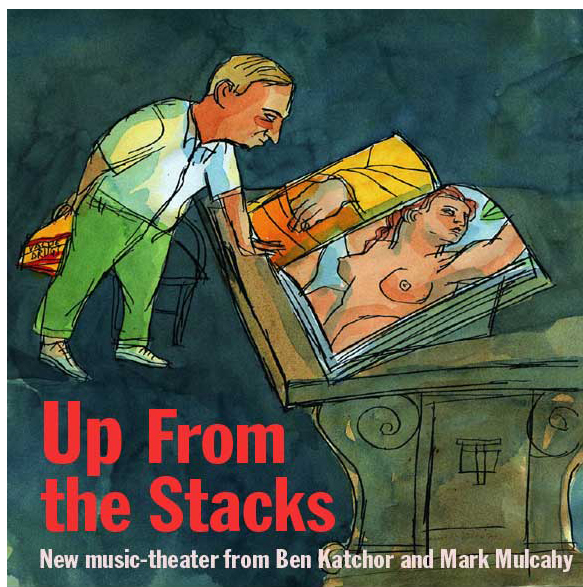
If you’re in NYC in early October, looking for smart entertainment and poor–or perhaps just incredibly cheap–there are going to be free performances of Up From the Stacks, a new musical by Ben Katchor and Mark Mulcahy. I’m a really big fan of Katchor, who sifts through the remnants of cities, finds value in the wreckage and uses it to construct something that isn’t exactly factual but seems truer than what once was. The info:

Set in The New York Public Library at Fifth Avenue and 42nd Street and in the environs of Times Square circa 1970, Up From the Stacks is the story of Lincoln Cabinée, a college student working part-time as a page, retrieving books for readers from the Library’s collection of 43 million items. This routine evening job inadvertently thrusts young Cabinée into the treacherous crossroads of scholarly obsession and the businesses of amusement and vice that then flourished in the 42nd Street area. The intellectual life of the city and the happiness of a young man hang in the balance.

Co-commissioned by the Dorothy and Lewis B. Cullman Center for Scholars and Writers at The New York Public Library, and Lincoln Center for the Performing Arts for Target Free Thursdays at the David Rubenstein Atrium.

Four performances:

Monday, October 3, 2011 at 6pm at The New York Public LIbrary for the Performing Arts at Lincoln Center, 40 Lincoln Center Plaza, Bruno Walter Auditorium

http://www.nypl.org/locations/tid/55/node/129318?lref=55%2Fcalendar

Tuesday, October 4 and Wednesday, October 5, 2011 both at 7pm at The New York Public Library, Fifth Ave. and 42nd St. (Stephen A. Schwarzman Building) South Court Auditorium

Register here for free seats:

http://www.nypl.org/events/programs/2011/10/04/stacks-musical-theater-piece-ben-katchor-and-mark-mulcahy-0

Thursday, October 6, 2011 at 8:30 at The David Rubinstein Atrium at Lincoln Center (Broadway at 62nd St.)

http://new.lincolncenter.org/live/index.php/atrium-up-from-the-stacks-oct-6-2011

All performances are free.

••••••••••

From Pleasures of Urban Decay, a documentary about Katchor by Sam Ball:

Tags: , ,

This is the 3,000th post in Afflictor history. To put that into perspective, 3,000 posts is a slow morning for Andrew Sullivan. Then again, I didn’t think invading Iraq was a good idea, so maybe slow and steady wins the race. Wow, I really deserve congratulations, or maybe just pity, lots and lots of pity. Thank all of you for reading!

Electricians in the 19th century didn’t always display the best decision-making abilities, as evidenced by the following trio of articles published in the Brooklyn Daily Eagle.

••••••••••

“Tested Currents With His Tongue” (June 26, 1892): “The death of Arthur J. Yeo, an electrician, 27 years old, of 2,181 Eight-Avenue, New York, was reported at the health department of that city yesterday. The cause of death was given as nervous apoplexy. Yeo died yesterday morning. The undertaker who filed the certificate said that Yeo had been killed by electricity. He was in the habit of testing currents by applying the wires to his tongue, and the electricity taken into his system by this means resulted in the nervous apoplexy which caused his death.”

••••••••••

“Quinine Had No Effect On Him” (March 28, 1888): “Paul Grieshnber, a barber and electrician, of Stapleton, S.I., was arrested yesterday in New York, for being drunk and disorderly. He said he was sick and took twenty grains of quinine, but without effect. Then he took schnapps, which had too much effect upon him. Grieshnber had a copy of the Anarchists’ paper, the Freiheil, and Most’s “On the Art of Making Bombs.” In the Essex Market Police Court to-day he was fined $10.”

••••••••••

“Gibson May Live To Get Married” (June 22, 1888): “George H. Gibson, the electrician who shot himself night before last, just before his marriage was to take place, because his tailor disappointed him, is not dead, as reported, and may recover.”

Tags: , ,

"Tell your friends & family."

BACK TO SCHOOL SPECIAL $50 TATTOO’S – $50 (BROOKLYN)

come get your back to school special tattoo for $50 tell your friends & family

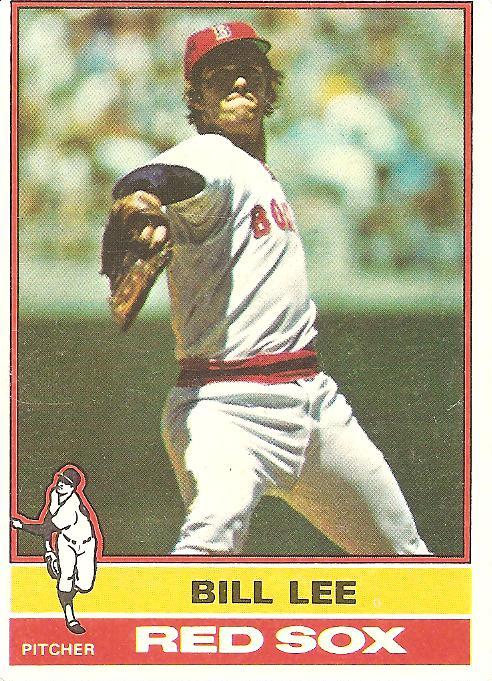
Bill “Spaceman” Lee, a true countculture character who starred in the very button-down sport of baseball from 1969-1982, was an outspoken eccentric who bragged about sprinkling marijuana on his pancakes. In the years before he was blackballed from the sport, Lee was profiled in all his mad glory in a 1978 Sports Illustrated article by Curry Kirkpatrick. An excerpt:

“Much of Lee’s rambling over the years has been about such terrific subjects as pyramid power, zero population growth, the goodness of soyburgers, the badness of sugar, interplanetary creative Zen Buddhism and heavy, heavy, zapped-out karma. But Lee’s philosophy is more out of comic books—to be specific, The Fabulous Furry Freak Brothers, which his 8-year-old son Michael shares with his dad—than Nietzsche or Vonnegut or even Paramahansa Yogananda…

The Boston-area public always has been divided along geographical as well as generational lines in its feelings toward Lee. In the blue-collar Irish bars of Southie, Lee was anathema after he defended Judge Arthur Garrity Jr., who ordered the desegregation of Boston schools by busing, as ‘the only guy in this town with any guts.’ On the other hand, the Spaceman was a prince to the city’s hip-liberal college population—largely based in Cambridge—which was thrilled by his outspoken lobbying for decriminalization of marijuana and his open defiance of pot laws.

The Red Sox were left in a quandary as to just what to do with Lee. Possibly the most straitlaced organization in all of pro sports, Boston was one of the first teams to impose a no-liquor rule on team flights and one of the last to dress out in form-fitting knit uniforms. In the matter of race, the Sox signed their first black player—Pumpsie Green—long after every other team in the majors had blacks. Even today only two U.S.-born blacks are on theRed Sox’ roster, Jim Rice and George Scott.

In Lee, team officials saw a flaming radical, junkballing journeyman lefthander with no fastball, no loyalty and no moral values. Yet they also saw a media hero who visited all the sick children, kept the sports talk shows in clover and drew crowds to Fenway Park.”

••••••••••

The Spaceman as an Expo:

A Fabulous Furry Freak Brothers strip:

Tags: ,

Good time-warp documentary about feminism, 1974.

Tags:

Hart, left, 2006 (Image by Marcello.)

E-books pioneer Michael Hart, who began Project Gutenberg back in 1971, just passed away. From his New York Times obituary:

“Michael Hart, who was widely credited with creating the first e-book when he typed the Declaration of Independence into a computer on July 4, 1971, and in so doing laid the foundations for Project Gutenberg, the oldest and largest digital library, was found dead on Tuesday at his home in Urbana, Ill. He was 64

His death was confirmed by Gregory B. Newby, the chief executive and director of Project Gutenberg, who said that the cause had not yet been determined.

Mr. Hart found his life’s mission when the University of Illinois, where he was a student, gave him a user’s account on a Xerox Sigma V mainframe computerat the school’s Materials Research Lab.

Estimating that the computer time in his possession was worth $100 million, Mr. Hart began thinking of a project that might justify that figure. Data processing, the principal application of computers at the time, did not capture his imagination. Information sharing did.”

Tags:

From the Bulletin of Atonmic Scientists, about one of the lesser costs, the financial one, of the wars in Iraq and Afghanistan:

“If the newspapers periodically remind us of these slain American soldiers by showing us the ‘faces of the fallen,’ the injured are less visible, but the cost of caring for them will only increase. Nearly 100,000 American soldiers have been officially wounded in Iraq and Afghanistan, but many injuries, such as post-traumatic-stress disorder, may not manifest until after deployment. More than 522,000 veterans of our Middle Eastern wars have now filed disability claims. Based on prior experience in World War II, Korea, and Vietnam, we know that the health care costs of such veterans do not peak until 30 to 40 years after the wars are over. In other words, we could pull every last soldier out of Iraq and Afghanistan tomorrow, but the costs of caring for them will keep climbing until at least 2040. These costs are expected to total between $600 billion and $1 trillion.”

The Morning Show on CBS on early September 11, 2001, right before the attacks began:

Some search-engine keyphrases bringing traffic to Afflictor this week:

« Older entries § Newer entries »