
Will the 2012 Presidential election be an opportunity for the GOP to take back the White House or for centrist members to take back their own party? From Matt Bai’s New York Times Magazine piece,  “Does Anyone Have a Grip on the G.O.P.?“:

“It’s worth pointing out that when Republicans express concern about the anti-government militancy in their midst, it has a ring of serious denial. After all, generations of Republican candidates have now echoed the theme of Ronald Reagan in his 1981 inaugural address: ‘In this present crisis, government is not the solution to our problem. Government is the problem.’ And a progression of ideological uprisings inside the party — the Reagan revolutionaries, Pat Buchanan’s pitchfork brigades, Newt Gingrich’s band of guerrilla lawmakers and now the Tea Partiers — have only pushed the anti-Washington argument closer to its illogical extreme. Thus could a smiling Michele Bachmann stand on a debate stage last month and declare that no one should pay the federal government a penny of taxes, for anything — a statement that didn’t even draw a follow-up question from the panel of Fox News journalists arrayed before her.

Longtime Republicans have been satisfied enough to have their candidates run down activist government as a campaign tactic, even as they themselves retained a more nuanced view of the federal government’s role (which is why a Republican Congress, working with a Republican president, managed to pass a Medicare prescription-drug bill in 2003). But when you talk to them now, these same Republicans seem positively baffled that anyone could have actually internalized, so literally, all the scorching resentment for government that has come to define the modern conservative campaign.”

Tags:

"Sarcastic, opinionated and bitter."

My life sucks! (NY)

Lets see: My parents were well-off by the age of 35. They owned 4 homes and retired early.

Me: 41, have roommates to afford this city. dead-end job I recently lost, no 401K left. No girlfriend, never even close to being married, out of shape, miserable, on Cymbalta for depression. No group of friends and nothing great in my life.

Sarcastic, opinionated and bitter.

Knees hurt walking 2 blocks, angry, broke and mean to just about everyone I meet as a result.

The closet thing I ever get to feeling good about myself is day-dreaming that I’m special, talented or handsome. I’m a total certified LOSER. 

Baby confused by print magazine not having a touchpad. Adorable yet terrifying. (Thanks Mediabistro.)

In the “Ethics of Voting,” philosopher Jason Brennan argues that people shouldn’t vote if they’re not sufficiently educated about the issues and shouldn’t vote for self-interest. I actually would be more than happy with people voting for self-interest. When you see union members supporting candidates openly hostile to unions or senior citizens who need Social Security to survive voting for candidates who detest that safety net, there is definitely a dangerous disconnect. But, yes, democracy without an informed public is a bad thing. An excerpt from Brennan’s piece:

“Imagine a jury is about to decide a murder case. The jury’s decision will be imposed involuntarily (through violence or threats of violence) upon a potentially innocent person. The decision is high stakes. The jury has a clear obligation to try the case competently. They should not decide the case selfishly, capriciously, irrationally, or from ignorance. They should take proper care, weigh the evidence carefully, overcome their biases, and decide the case from a concern for justice.

What’s true of juries is also true of the electorate. An electorate’s decision is imposed involuntarily upon the innocent. The decision is high stakes. The electorate should also take proper care.” (Thanks Marginal Revolution.)

••••••••••

“A vote for Popeye means free ice cream for all the kiddies,” 1956:

Tags:

While I’m posting clips of McLuhan, here’s the Canadian seer discussing books “taking on a totally different meaning” in the age of microfilm. From the 1960s.

Tags:

More about tools. From Bloomberg Businessweek‘sSteve Jobs: The Beginning, 1955-1985“:

“In the late 1970s, computer makers were popping up much the way car companies did in Detroit at the turn of the 20th century. Osborne, Commodore, and RadioShack were all selling what were becoming known as ‘personal computers.’ Like the Apple I, they were made for hobbyists. They were hard to use and didn’t really do much. The Altair, the earliest, pretty much just lit up little lights once you laboriously connected a bunch of switches on the logic board.

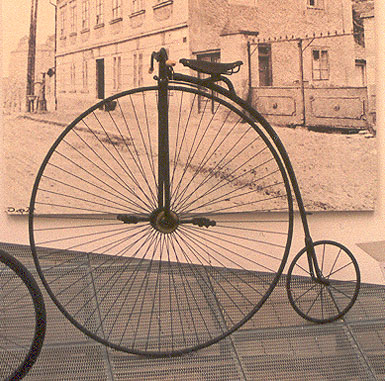
Jobs wanted the next computer to be something different—an appliance, something anyone could use. That was the Apple II, which came out a year after the Apple I. He hammered at his message as the company grew: Computers should be tools. Trip Hawkins, one of Apple’s first 50 employees, remembers Jobs obsessing over an article he’d read in a science magazine about the locomotive efficiency of animal species. ‘The most efficient species was the condor, which could fly for miles on only a few calories,’ Hawkins says. ‘Humans were way down the list. But then if you put a man on a bicycle, he was instantly twice as efficient as the condor.’ The computer, Jobs said, was a ‘bicycle for the mind.'”

••••••••••

Trick riding, 1899:

Tags:

Marshall McLuhan fearing the Global Village, 1977. On the hopeful side: He wasn’t always right.

Tags:

The tools we use are only as good as those of us using them. There’s no denying that tablet computers and smart phones are among the greatest tools ever invented. They connect us to a dramatically large number of people and an astonishing amount of information–potentially. But I don’t think I’ve ever been sitting next to someone using a tablet when they weren’t watching some cruddy sitcom, updating their Facebook page or reading a dopey magazine. And considering the screens keep getting smaller and print books scarcer, where are we headed? If these new gadgets are just about ease of function and not introducing ourselves to better content, we’re talking more about a mirror–and not even an honest one–than a looking glass. Will it just be the same crap on a different screen? But others are more sanguine. From Kevin Kelly’sTools Are the Revolution,” in 2000’s Whole Earth Catalog: 

“Tools make revolutions. ‘When we make a new tool, we see a new cosmos,’ says physicist Freeman Dyson. He was probably thinking of microscopes, telescopes, and atomic particle accelerators. But even the workaday tools reviewed in this issue can alter our perspective. A tool—any tool—is possibility at one end and a handle at the other. Because tools open up options, they remake us. A really fantastic atlas of the world  is literally a new world. A whisper-quiet ultra-efficient electricity generator and a wireless Internet let us see ourselves as more nomadic than perhaps we have seen ourselves lately.

There are many ways to change the world, but I think the most direct way, the way being pioneered by artists, hackers, and scientists—third-culture citizens—is to adopt new tools.”

Tags:

"He will remain on your shoulder as long as long as nothing strange comes too close to him."

AFRiCAN GREY CONGO PARROT (Lower East Side)

My african grey congo parrot is in need of a new home. I do not want to let him go at all but due to my pregnancy I can not afford to care for him the way he deserves. It breaks my heart but it would make me happy to know I can save him from bordom and depression. He has been vaccinated against polyomavirus with AP vaccine. His name is Ruby. Like all other parrots, it will take a little while for him to adapt to his new environment but with the TLC and attention he needs, he will be fine and friendly. He speaks and whistles very clearly and understands the command “STEP UP”. I use to have his wings clipped monthly to assure he will never fly away from me while I took him for his walks outside. He will remain on your shoulder as long as long as nothing strange comes too close to him. Very good and beautiful bird. I am asking of $2,000. to assure a safe home with people who care. I am completely against animal abuse and will request pictures and videos to be sent to my email as the months pass to keep updated on his health, activity, etc.

Tags:

Ed Bradley profiles Joan Baez on 60 Minutes, 1987:

Tags: ,

From a Cory Doctorow-Ray Kurzweil discussion about the Singularity in Asimov’s in 1995;

“‘Progress is exponential–not just a measure of power of computation, number of Internet nodes, and magnetic spots on a hard disk–the rate of paradigm shift is itself accelerating, doubling every decade. Scientists look at a problem and they intuitively conclude that since we’ve solved 1 percent over the last year, it’ll therefore be one hundred years until the problem is exhausted: but the rate of progress doubles every decade, and the power of the information tools (in price-performance, resolution, bandwidth, and so on) doubles every year. People, even scientists, don’t grasp exponential growth. During the first decade of the human genome project, we only solved 2 percent of the problem, but we solved the remaining 98 percent in five years.’

But Kurzweil doesn’t think that the future will arrive in a rush. As William Gibson observed, ‘The future is here, it’s just not evenly distributed.'” (Thanks Longform.)

•••••••

Kurzweil sits for an interview with that dashing cyborg Charlie Rose, 2007:

Tags: ,

Did Steve Jobs being a jerk to underlings help make his products great, or was the meanness something that was withstood because of his genius but unnecessary? Is greatness and kindness a zero-sum game? Can a perfectionist be a nice person? D.B. Grady votes “no” to the latter question withIn Praise of Bad Steve in the Atlantic. An excerpt:

“Steve Jobs was a genius, and one of the most important businessmen and inventors of our time. But he was not a kindly, soft-spoken sage who might otherwise live atop a mountain in India, dispatching wisdom to pilgrims. He was a taskmaster who knew how to get things done. ‘Real artists ship’ was an Apple battle cry from the earliest days. Everyone, by now, knows about the Steve Jobs ‘reality distortion field’ — the charismatic Care Bear Stare that compels otherwise reasonable people to spend weeks in line for a slightly faster telephone. In his biography of Jobs, journalist Alan Deutschman described the Apple co-founder’s lesser-known hero-shithead roller coaster. ‘He could be Good Steve or he could be Bad Steve. When he was Bad Steve, he didn’t seem to care about the severe damage he caused to egos or emotions so long as he pushed for greatness.’ When confronted with the full ‘terrifying’ wrath of Bad Steve (even over the slightest of details), the brains at Apple would push themselves beyond all personal limits to find a way to meet Jobs’s exacting demands, and somehow return to his good graces. And the process would repeat itself. ‘Steve was willing to be loved or feared, whatever worked.’ As Bud Tribble, Vice President of Software Technology at Apple explained. ‘It let the engineers know that it wasn’t OK to be sloppy in anything they did, even the 99 percent that Steve would never look at.'”

Tags: ,

“Oh, that’s wonderful.'” Yes, it is. (Thanks Physorg.)

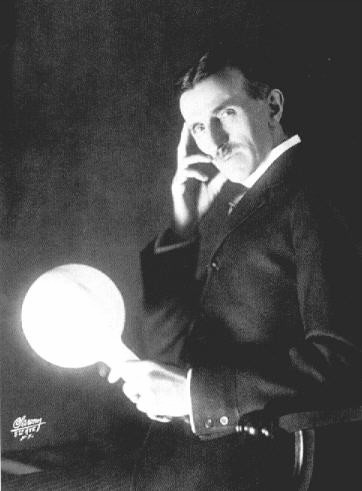
A tidy encapsulation of the what caused the rift between Edison and Tesla, courtesy of Smithsonian:

‘After Edison developed the first practical incandescent light bulb in 1879, supported by his own direct current electrical system, the rush to build hydroelectric plants to generate DC power in cities across the United States practically guaranteed Edison a fortune in patent royalties. But early on, Edison recognized the limitations of DC power. It was very difficult to transmit over distances without a significant loss of energy, and the inventor turned to a 28-year-old Serbian mathematician and engineer whom he’d recently hired at Edison Machine Works to help solve the problem. Nikola Tesla claimed that Edison even offered him significant compensation if he could design a more practical form of power transmission. Tesla accepted the challenge. With a background in mathematics that his inventor boss did not have, he set out to redesign Edison’s DC generators. The future of electric distribution, Tesla told Edison, was in alternating current—where high-voltage energy could be transmitted over long distances using lower current—miles beyond generating plants, allowing a much more efficient delivery system. Edison dismissed Tesla’s ideas as ‘splendid’ but ‘utterly impractical.’ Tesla was crushed and claimed that Edison not only refused to consider AC power, but also declined to compensate him properly for his work. Tesla left Edison in 1885 and set out to raise capital on his own for Tesla Electric Light & Manufacturing, even digging ditches for the Edison Company to pay his bills in the interim, until the industrialist George Westinghouse at Westinghouse Electric & Manufacturing Company, a believer in AC power, bought some of Tesla’s patents and set about commercializing the system so as to take electric light to something more than an urban luxury service. While Tesla’s ideas and ambitions might be brushed aside, Westinghouse had both ambition and capital, and Edison immediately recognized the threat to his business.”

••••••••••

Bowie as Tesla, The Prestige:

Tags: ,

Walter Cronkite reports on the Three Mile Island accident–March 30, 1979.

Tags:

"The murder stirred up a tremendous excitement among the McCoys and Hatfields."

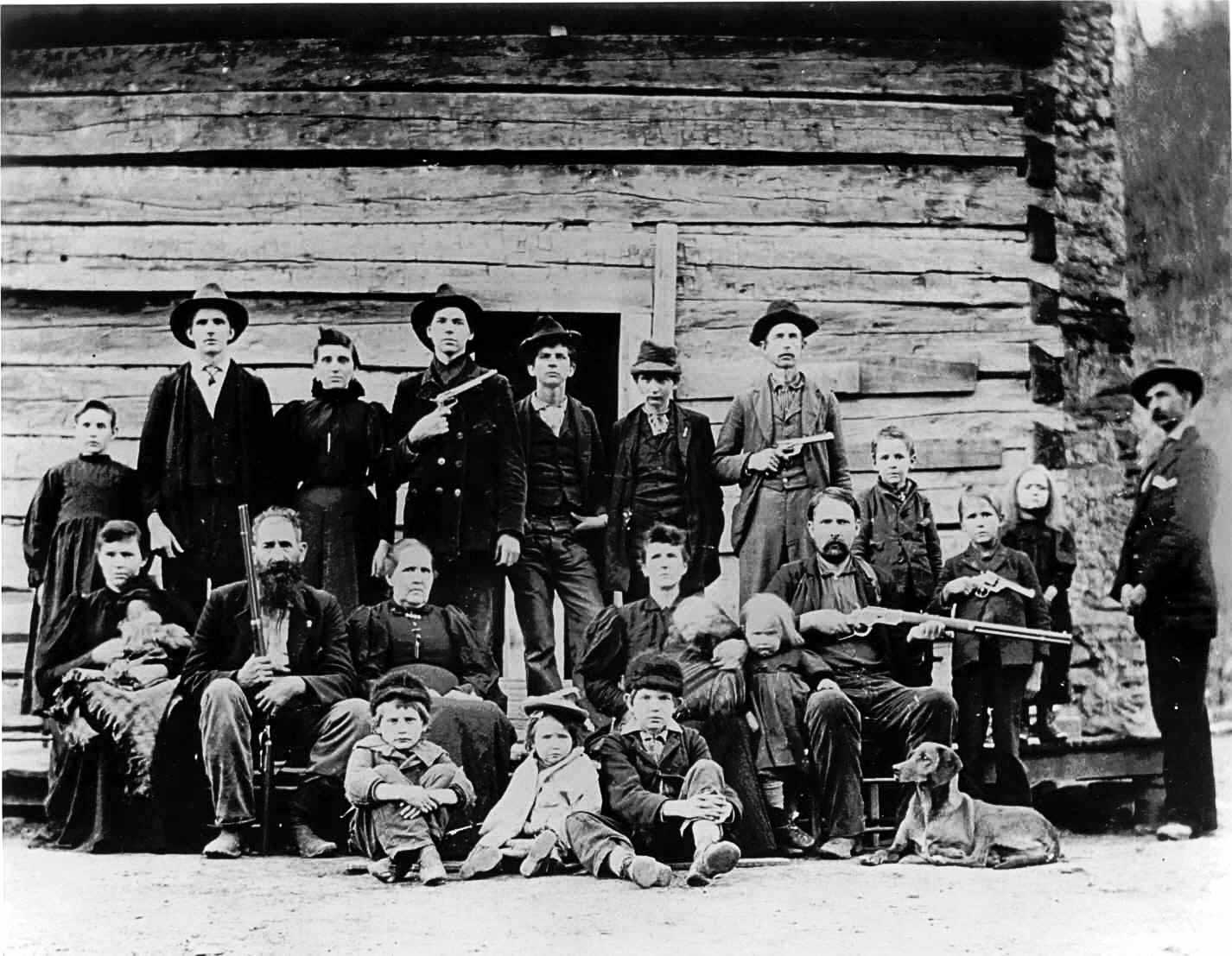
One brief and bloody tale from the epic Hatfield-McCoy feud was chronicled in the November 13, 1890 edition of the Brooklyn Daily Eagle:

“Charleston, W. Va.–Bud McCoy was waylaid by William Dyer and Ples McCoy on Peter’s Creek, Pike County, Ky., while on his way to the house of John Gostin and killed. The victim spoke pleasantly to the two men and passed them, when they turned in their saddles and shot him through the back, firing several shots into his dead body after he fell from his horse. The murder stirred up a tremendous excitement among the McCoys and Hatfields, and a posse at once started after the murderers, who fled through the Southwest corner of West Virginia into Kentucky. News was received to-day that the posse came up with the fugitives in Buchanan County, Virginia, Monday. Ples McCoy was shot and captured, but Dyer escaped after a running fight. A portion of he posse is in pursuit and he will probably be killed.”

••••••••••

Hatfields vs. McCoys, Family Feud, 1979:

Tags: , , ,

If only it were so. An economic prediction from “The Long Boom,” Wired, 1997:

“But there’s a new, very different meme, a radically optimistic meme: We are watching the beginnings of a global economic boom on a scale never experienced before. We have entered a period of sustained growth that could eventually double the world’s economy every dozen years and bring increasing prosperity for – quite literally – billions of people on the planet. We are riding the early waves of a 25-year run of a greatly expanding economy that will do much to solve seemingly intractable problems like poverty and to ease tensions throughout the world. And we’ll do it without blowing the lid off the environment.

If this holds true, historians will look back on our era as an extraordinary moment. They will chronicle the 40-year period from 1980 to 2020 as the key years of a remarkable transformation. In the developed countries of the West, new technology will lead to big productivity increases that will cause high economic growth – actually, waves of technology will continue to roll out through the early part of the 21st century. And then the relentless process of globalization, the opening up of national economies and the integration of markets, will drive the growth through much of the rest of the world.”

From “The Comfort Zone,” Jonathan Franzen’s great 2004 New Yorker essay about his childhood relationship with Charles Schulz’s Peanuts strip:

“I was unaware of it, but an epidemic had broken out across the country. Late adolescents in suburbs like ours had suddenly gone berserk, running away to other cities to have sex and not attend college, ingesting every substance they could get their hands on, not just clashing with their parents but rejecting and annihilating everything about them. For a while, the parents were so frightened and so mystified and so ashamed that each family, especially mine, quarantined itself and suffered in isolation.

When I went upstairs, my bedroom felt like an overwarm sickroom. The clearest remaining vestige of Tom was the Don’t Look Back poster that he’d taped to a flank of his dresser where Bob Dylan’s psychedelic hair style wouldn’t always be catching my mother’s censorious eye. Tom’s bed, neatly made, was the bed of a kid carried off by an epidemic.

In that unsettled season, as the so-called generation gap was rending the cultural landscape, Charles Schulz’s work was almost uniquely beloved. Fifty-five million Americans had seen A Charlie Brown Christmas the previous December, for a Nielsen share of better than fifty per cent. The musical You’re a Good Man, Charlie Brown was in its second sold-out year on Broadway. The astronauts of Apollo X, in their dress rehearsal for the first lunar landing, had christened their orbiter and landing vehicle Charlie Brown and Snoopy. Newspapers carrying Peanuts reached more than a hundred and fifty million readers, Peanuts collections were all over the best-seller lists, and if my own friends were any indication there was hardly a kid’s bedroom in America without a Peanuts wastebasket or Peanuts bedsheets or a Peanuts gift book. Schulz, by a luxurious margin, was the most famous living artist on the planet.”

••••••••••

The other Pigpen, 1970:

Tags: ,

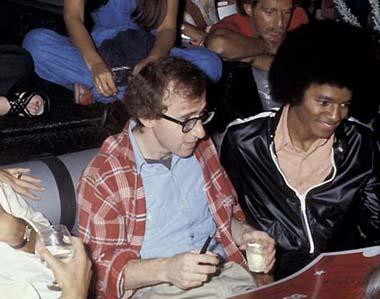
Woody Allen and Michael Jackson at Studio 54.

Woody Allen and Michael Jackson at Studio 54.

Dan Rather and 60 Minutes get disco fabulous in 1978.

Tags:

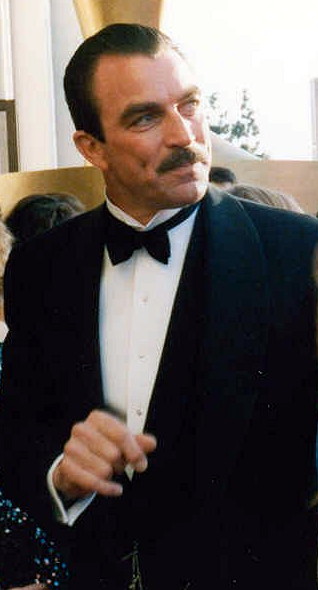
"You could play a president or secret agent or romantic lead as well as Harrison Ford any day of the week." (Image by Alan Light.)

To Tom Selleck (NYC )

I read your bio on IMDB after being fortunate to participate in an episode of Blue Bloods with you. I just want to say you are an icon and symbol of decency in tv/film, and the role you brought to life on Magnum PI entertained and inspired people to like cops. No one else could have done that role with such finesse. Don’t regret not doing Indiana Jones or the other projects. You could play a president or secret agent or romantic lead as well as Harrison Ford any day of the week. You are more than a movie star. You are a man people respect and listen to, and could easily expand your world to politics. You are larger than some on screen character. That’s why you did not have those parts. You obliged your contract with honor to Magnum PI, and turned a pilot into the top rated detective show of all time. That’s saying alot. I admire and respect you and hope Blue Bloods wins it’s time slot every week and continues for many seasons. You deserve nothing but the best. You are a class act.

-a fan whose dad and brother made her watch Magnum PI every week.

Tags:

In honor of what would have been animator’s Art Clokey’s 90th birthday, here’s an episode where Gumby goes to the moon. He probably saw Whitey while he was there.

Art Clokey.

Tags:

The single best description of a personality type that I have ever read is still “Caring for Your Introvert,” Jonathan Rauch’s 2003 Atlantic article. The opening:

“Do you know someone who needs hours alone every day? Who loves quiet conversations about feelings or ideas, and can give a dynamite presentation to a big audience, but seems awkward in groups and maladroit at small talk? Who has to be dragged to parties and then needs the rest of the day to recuperate? Who growls or scowls or grunts or winces when accosted with pleasantries by people who are just trying to be nice?

If so, do you tell this person he is ‘too serious,’ or ask if he is okay? Regard him as aloof, arrogant, rude? Redouble your efforts to draw him out?

If you answered yes to these questions, chances are that you have an introvert on your hands—and that you aren’t caring for him properly.”

••••••••••

“I vant to be…”:

Tags:

Mattel provides a great primer for young girls on how to judge men, 1973.

An excerpt from Spencer Ackerman’s Wired article about a brand new touchscreen war-planning tablet by the AAI Corporation, which makes lethal combat “easier” than ever:

“[Chris] Ellsworth provides a quick demo. On the massive tablet is a map of a hypothetical warzone. Blue icons represent the positioning of Team America assets — ground troops and overhead aircraft. Red icons show the enemy. When a new red diamond pops up, Ellsworth taps his finger on it, and then drags a bluish character over it.

It looks a little bit like a ghost from Ms. Pac-Man. But Ellsworth has just directed a drone — in this (fictional) case, one of AAI’s tiny Aerosonde-1 spy robots — to the enemy position. Whoever’s sitting miles away in an air conditioned Ground Control Station, wielding the joystick that controls the drone, has now received her new orders on an equivalent device — perhaps the smartphone that the Army might one day put in her pocket.

Either way, an IM confirming that the order is understood pops up on an adjacent flatscreen TV repurposed as a computer monitor. The drone above our fictional warzone should be on its way to its new position imminently.”

••••••••••

A piece about the increasing digitization of warfare, featuring AAI:

From an Ars Technica history of Wi-Fi, which surprisingly had its origins in the sandy environs of Hawaii:

“The journey started back in the early 1970s. The University of Hawaii had facilities scattered around different islands, but the computers were located at the main campus in Honolulu. Back then, computers weren’t all that portable, but it was still possible to connect to those computers from remote locations by way of a terminal and a telephone connection at the blazing speed of 300 to 1200 bits per second. But the telephone connection was both slow and unreliable.

A small group of networking pioneers led by Norman Abramson felt that they could design a better system to connect their remote terminals to the university’s central computing facilities. The basic idea, later developed into ‘AlohaNET,’ was to use radio communications to transmit the data from the terminals on the remote islands to the central computers and back again. In those days, the well-established approach to sharing radio resources among several stations was to divide the channel either into time slots or into frequency bands, then assign a slot or band to each of the stations. (These two approaches are called time division multiple access [TDMA] and frequency division multiple access [FDMA], respectively.)

Obviously, dividing the initial channel into smaller, fixed-size slots or channels results in several lower-speed channels, so the AlohaNET creators came up with a different system to share the radio bandwidth. AlohaNET was designed with only two high-speed UHF channels: one downlink (from Honolulu) and one uplink (to Honolulu). The uplink channel was to be shared by all the remote locations to transmit to Honolulu. To avoid slicing and dicing into smaller slots or channels, the full channel capacity was available to everyone. But this created the possibility that two remote stations transmit at the same time, making both transmissions impossible to decode in Honolulu. Transmissions might fail, just like any surfer might fall off her board while riding a wave. But hey, nothing prevents her from trying again. This was the fundamental, ground-breaking advance of AlohaNET, reused in all members of the family of protocols collectively known as ‘random access protocols.'”

Tags: , ,

« Older entries § Newer entries »