"So you FUCKEN DELETE ME AS YOUR FRIEND." (Image by Raphaël Labbé.)

WOW Could have at least been HONEST with me (my inbox)

I see you deleted me as your FB friend whats the point I must CREEP you out or some dumb shit LIKE WTF I ask you to help me out with another Mix you “say” sure and that you’ll get to work on it over and over and over again only to flake on it. And U just could of said “steve I dont have the time anymore to do it Im sorry” and that would have been that hell im not even mad about it. But why add me as a FB friend to just delete me I post a come about how I too made some good grub and miss chatting so you FUCKEN DELETE ME AS YOUR FRIEND sorry I was putting up playful banter. SORRY if my FB status my have been a bit down trodden My mother has CANCER AND IM GETTING EVICTED I MIGHT BE HOMELESS MY MONDAY but today to find out someone whom I thought was at least a decent humanbeing was at least my Music Buddy was no more then a fraud. I knew some cool ass ppl and bands going to NYC was going to ask for some advice but you know what it dont matter. People like you make me sick Your the reason Hipster a derogatory word. Thanks A lot for your help in past I don’t think I’ll ever ask anything upon you again.

Community organizer Saul Alinsky became an enemy of the American Right all over again three decades after his death, thanks to a posthumous link to President Obama. Amusingly enough, Alinsky pretty much predicted the American drift into Conservatism and the Presidency of anti-government traliblazer Ronald Reagan and the more extreme iterations that followed him. From a 1972 Playboy interview with Alinsky, which was conducted just months before he died in California from a heart attack. 

Saul Alinsky: The middle class actually feels more defeated and lost today on a wide range of issues than the poor do. And this creates a situation that’s supercharged with both opportunity and danger. There’s a second revolution seething beneath the surface of middle-class America — the revolution of a bewildered, frightened and as-yet-inarticulate group of desperate people groping for alternatives — for hope. Their fears and their frustrations over their impotence can turn into political paranoia and demonize them, driving them to the right, making them ripe for the plucking by some guy on horseback promising a return to the vanished verities of yesterday. The right would give them scapegoats for their misery — blacks, hippies, Communists — and if it wins, this country will become the first totalitarian state with a national anthem celebrating ‘the land of the free and the home of the brave.'”

Tags: , ,

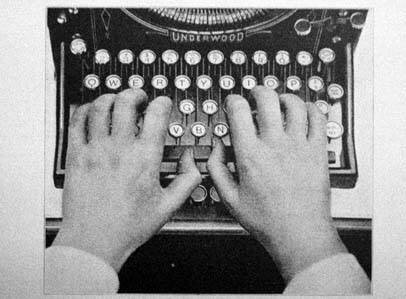
The office of the future, as imagined in 1969.

"Mooney was placed on the ship while drunk by a vessel man."

People who didn’t get waylaid during the 19th century got shanghaied, as proven by the following articles from the Brooklyn Daily Eagle.

••••••••••

“She Shanghaied a Sailor” (December 30, 1891): “Mrs. Amanda Hermanson, who keeps a sailors’ boarding house at 256 Van Brunt Street, was held by Justice Tighe this morning to await the action of the grand jury on the charges made by Steffano Valeno. She is the woman whom Valeno had arrested a fortnight ago for shipping him to China against his will and stealing $50 and a trunk from him while he was gone. Valeno brought witnesses to support his statements. After this hearing Mrs. Hermanson was arrested for keeping a sailors’ boarding house without a license, was convicted and sentenced to pay a fine of $100.”

••••••••••

“For Being Shanghaied” (December 6, 1897): “Vancouver, B.C.–News comes from Shanghai that Lawrence Mooney, an American citizen who went to Shanghai from Victoria on the lumber bark St. Catharine, has been awarded damages against the ship by a United States consul general. Mooney was placed on the ship while drunk by a vessel man who became notorious through his connection with the San Francisco smuggling ring.”

••••••••••

"He was first drugged into unconsciousnes, how, he cannot say, or at what place, and then placed in the hold of the vessel."

“Return of a Missing Man” (April 5, 1872): “About six weeks since Robert Seymour, a tinman, having a small store in South Fifth, married and the father of two children, left his home and place of business to perform a job of work on board of a vessel said to be then lying at the foot of Rutgers Street, New York, and up to yesterday nothing had been heard from him, although every effort had been exerted to obtain a clue to his whereabouts.

Among his friends most earnest in hunting Mr. Seymour was Mr. E. Gateson, a plumber, who was more than surprised at seeing the missing man, whom he had given up for dead, walk into his store at Broadway, and salute him, as of yore, by the title of ‘Boss.’ To Mr. Gateson the appended account was substantially related by Seymour, concerning his extended absence, from which it will be seen that an old-time practice of seizing men and shipping them against their will still prevails to some extent in the metropolis of the State.

In other words, Seymour was shanghaied, to accomplish which he was first drugged into unconsciousnes, how, he cannot say, or at what place, and then placed in the hold of the vessel, which was probably ready to sail at a moment’s notice. The first he knew he found himself in a dark and confined space, in company with three other men, and on the succeeding day was with them taken on deck, and asked to sign a paper binding him for a whaling voyage. He and his three companions refused to accede to this proposition, and upon their promising not to make any stir about this matter, nor inform upon their captors, they were taken ashore on a small boat to the mouth of the Chesapeke Bay, from where they made their way to Baltimore. From thence they were passed to New York, where the party arrived yesterday morning, overjoyed at once more finding themselves at home and among friends. He further stated that it was not the vessel upon which he was at work in which he was carried off to sea, and is unable to give either its name or that of the captain, as he had no communication with any one on board, neither did he know a single one of the crew.

Mr. Seymour still bears traces of the hardship endured by him, and says he has not yet recovered from the effects of the drug partaken of by him.”

••••••••••

Shipping to the Philippines, 1898:

Tags: , , , , ,

Virtual doctors at Rite Aid.  (Thanks Singularity Hub.)

Farhad Manjoo has an excellent new article in Fast Company,The Great Tech War of 2012,which looks at the quartet of dominant American technology companies poised to do battle with one another. An excerpt:

“To state this as clearly as possible: The four American companies that have come to define 21st-century information technology and entertainment are on the verge of war. Over the next two years, Amazon, Apple, Facebook, and Google will increasingly collide in the markets for mobile phones and tablets, mobile apps, social networking, and more. This competition will be intense. Each of the four has shown competitive excellence, strategic genius, and superb execution that have left the rest of the world in the dust. HP, for example, tried to take a run at Apple head-on, with its TouchPad, the product of its $1.2 billion acquisition of Palm. HP bailed out after an embarrassingly short 49-day run, and it cost CEO Léo Apotheker his job. Microsoft’s every move must be viewed as a reaction to the initiatives of these smarter, nimbler, and now, in the case of Apple, richer companies. When a company like Hulu goes on the block, these four companies are immediately seen as possible acquirers, and why not? They have the best weapons–weapons that will now be turned on one another as they seek more room to grow.”

••••••••••

Majoo on living in the post-fact digital world, 2008:

Barbara Walters on What’s My Line, 1969:

1977 Barbara Walters special: Liz Taylor, Shah of Iran, Barbara Jordan:

Tags:

"Guys who have enough money to randomly go to outer space."

thanks a lot asshole – you know who you are!

i fucking hate you. you make me angry. you ruined my life and now everything makes me angry. puppies make me angry. stupid hipster baristas piss me off. yoga makes me angry. people who wear leg warmers. people who wear arm warmers. facebook status updates. gluten-free labels. stores that don’t take $50 bills. atm’s that keep handing them out. vegetarians. vegans. people who don’t like fur. ugly people. fat people. skinny bitches. people who use bad grammar and make up words like refudiate. throwing up in my mouth a little and then having to swallow it. dropped calls on my iphone. waiting for the bus. paying for the bus. being ass grabbed on the bus. paying too much for cable. rainbows and fucking unicorns. children who at the age of 4 already feel entitled to give the world attitude. the asshole parents who make them like that. tim horton’s coffee. emails from nigerian princes and british estate lawyers. cel phone ringbacks. detox diets. thanksgiving. black friday. christmas. easter. valentine’s day. jesus. solar calculators. solar panels. saving planet earth. hippies. sorting my fucking garbage even though half the recycling still goes into landfill. guys who have enough money to randomly go to outer space. corn poo. tickle me elmo. endless voicemail options. the alarm clock. shitty take out. good take out. warm beer. creepy ass earwigs. god damn birds chirping in the morning. people who steal. and most of all these gorgeous awesome smelling tulips that were my favourite flower make me fucking angry!!!!!!! 

Tags:

Theater talker Mike Daisey has a particularly timely monologue with The Agony and the Ecstasy of Steve Jobs, in which he investigates the dark side of the modern miracle of consumer electronics, which stared squarely at him in the ginormous Chinese factories where the gadgets are manufactured at a high human cost. An excerpt from Ben Brantley’s New York Times review:

“For Mr. Daisey, as for many others, affection for Apple products evolved into reverence for Mr. Jobs, the Apple co-founder whose identification with the company and its products has been much remarked upon, and worried over, since his illness made news several years ago.

Mr. Daisey has been performing this show since July of last year, and while the death of Mr. Jobs lends the evening a certain eerie timeliness, it also means that many in the audience will be familiar with the life and career of Mr. Jobs from reading obituaries and tributes.

The hippie-meets-tech-geek ethos, the founding of and then ouster from Apple, the triumphant return and the revolutionary series of consumer products that followed: Mr. Daisey covers this material fluently and with amiable humor, mixing obvious hero worship with some pointed skepticism. (Mr. Jobs, he notes, was the kind of imperious guy who divided the world’s population into ‘geniuses and bozos.’)

But the show is most engrossing, and most disturbing, when Mr. Daisey delves into the grim realities of workers’ lives in Shenzhen, a city that he memorably describes as looking as if ‘Blade Runner threw up on itself.'”

••••••••••

“A laptop so thin you can slice a sandwich”:

Tags: ,

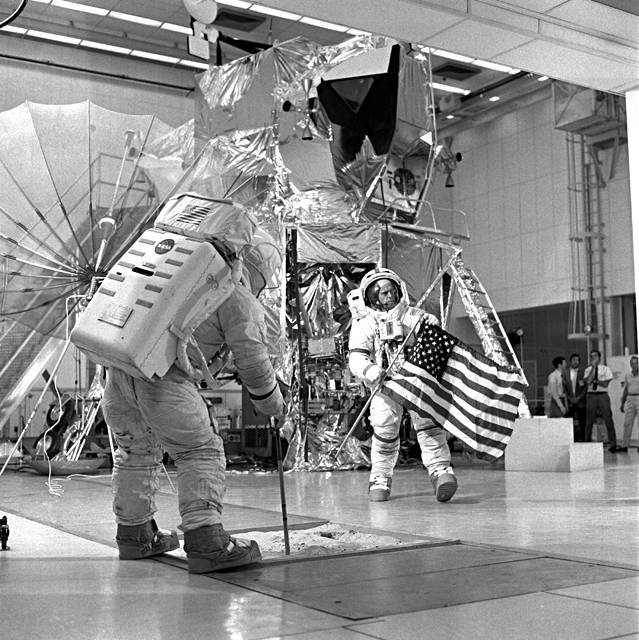
This classic NASA image chronicles the training of astronauts for 1971’s Apollo 14 mission, the third time we reached the moon. The astronauts had to practice everything, even that moment when they would plant the U.S. flag on our natural satellite. According to the Apollo 14 press kit, the astronauts spent approximately three weeks in quarantine after returning to Earth, being the final U.S. moonwalkers to be quarantined when they returned home.

••••••••••

Planting the flag:

Alan Shepard makes the moon his driving range during Apollo 14:

Tags:

In the Chronicle Review, Jeffrey R. Young has a fascinating profile of Stanford mathematician Persi Diaconis, who began his career as an intinerant magician’s assistant. The opening:

Persi Diaconis‘s unlikely scholarly career in mathematics began with a disappearing act.

He was 14 years old and obsessed with magic, spending much of his free time in or around Tannen’s Magic Store, on Times Square, where sleight-of-hand masters regularly gathered to show off tricks and to gossip. There, one of the most influential magicians of the past century, a card maestro named Dai Vernon, saw Diaconis’s prodigious trick dealing and invited the young man to leave New York and join him on the road.

Diaconis vanished from his regular life, dropping out of school and cutting ties with his family. ‘I packed a little bag—I took some decks of cards and some socks,’ remembers Diaconis, now 66 with unruly tufts of white hair, in his office at Stanford University, where he is a professor of mathematics and statistics. ‘I was sort of his assistant.’ And his student. Vernon, then in his 60s, promised that if his apprentice advanced far enough in his studies, he would reveal secrets of magic he had never shared with anyone else.

It was this search for the hidden workings of magic that led Diaconis to math. During a few years on the road doing his own magic act, he came to think of the hearts, diamonds, spades, and clubs in a deck of cards as variables that followed predictable formulas as he shuffled them. He could code the cards as binary numbers in his head and perform mental calculations as audience members cut the deck, so that when they picked a card, any card, Diaconis could name it.” (Thanks Browser.)

••••••••••

Diaconis’ mentor, Dai Vernon, in action:

Tags: ,

Monkey at Duke University Medical Center uses his brain to control virtual arm. (Thanks Gizmag.)

"Crying."

FEM ADULT BABY seeks heavily bearded MAN-SLAVE-TOY to FINGERPAINT with (Upper West Side)

preferably skilled in the areas of crawling and crying.

get in touch.

In a Financial Times article in which he elaborately kisses the ass of President Bill Clinton, historian Simon Schama also elicits some fine political analysis from 42. An excerpt about the Tea Party:

“‘The Tea Party,’ Clinton says, ‘is the most extreme incarnation of the 30-year cycle that began when Ronald Reagan said in his first inaugural that government isn’t the answer, government is the problem. But the real issue is not that the Tea Party is in control of the country, has captured the airwaves or represents a majority of public sentiment; the problem is that something [the deal-making system] that has worked for the American people in the past isn’t working now.’

And the ideologues haven’t had their ‘Waterloo moment to break the fever,’ such as the two shut-downs of the federal government engineered by Speaker Newt Gingrich and the incoming House Republicans in 1995. That triumphant phalanx assembled beneath the banner of the Contract with America to which they vowed to remain uncompromisingly faithful. But the public hated the shut-downs and blamed Republicans to the point when it became apparent they had actually taken out a contract on themselves. It was Gingrich, not Clinton, who was ousted, the president winning re-election a year later. The manufactured spat earlier this year over raising the debt ceiling had Waterloo-moment promise, but the prospect of the US defaulting for the only time in its history and the risk of sending the already stressed bond market over the cliff meant that Obama, unlike Clinton, couldn’t call the naysayers’ bluff.

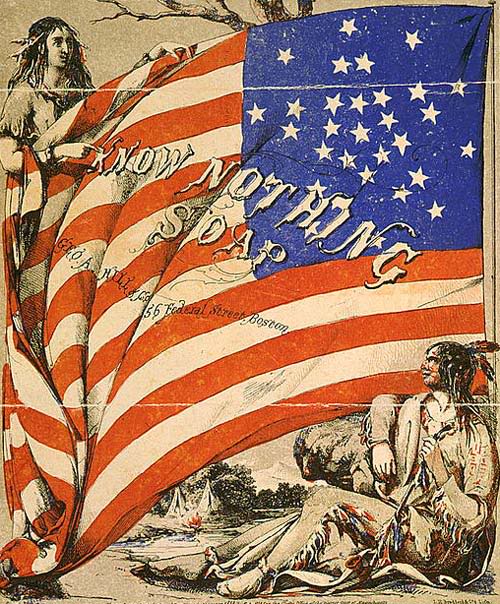
So what can be done about this latest edition of Know-Nothings? ‘You can’t convert the ideologues because they don’t care what the facts are. With the world as it is, you have to fight the fight you can win, and the fight you can win is economics.’ He gets intense at this point. ‘There isn’t a single example of a successful country on the planet today – if you define success as lower rates of unemployment, higher rates of job growth, less income inequality and a health system that produces the same or better care at lower cost – that doesn’t have both a strong economy and effective government that find some way to work in harness with each other … If you don’t do that, if you don’t have a system by which the poor can work their way into it, then you lose the social cohesion necessary to hold the country together and that is a big problem.”

••••••••••

Schama discusses slavery in America with perpetually exhausted Charlie Rose:

Tags: ,

The de facto theme song of the feminist movement of the 1970s, Helen Reddy’s “I Am Woman” was a giant radio hit and a huge target of derision. In 1975, the United Nations chose the song to officially represent International Women’s Year. Great slowed-down live version:

Reddy and Alice Cooper share scripted banter at the Grammys, 1974:

Tags: ,

In the wake of Steve Jobs’ death, his Apple cofounder Steve Wozniak talked to journalist Dan Lyons. In this segment, Woz recalls the early years:

How did you and Steve come up with the idea for the first Apple product, the Apple I?

Oh, a lot of people saw the Apple I before Steve Jobs even knew about it. I was in the Homebrew Computer Club. Steve was up in Oregon, working at an orchard, in a commune. We were really not in touch. But I got inspired to help this revolution. People in our club thought the personal computer would affect everyone’s life. We thought everyone would have a little computer, a little thing with switches and weird numbers on it, and people would learn to program to operate a computer. We didn’t think it would be normal stuff like it turned out to be.

I never wanted to run a business. I had a perfect job for life at HP. I went to club meetings every week and I passed out my schematics for the Apple I, no copyright, nothing, just, “Hey all you guys here is a cheap way to build a computer.” I would demo it on a TV set.

Then Steve Jobs came in from Oregon, and he saw what the club was about, and he saw the interest in my design. I had the only one that was really affordable. Our first idea was just to make printed circuit boards. We could make them for 20 dollars and sell them for 40 or something like that. I had given the schematics away. But Steve thought it could be a company.

This was actually our fifth product together. We always were 50-50 partners. We were best friends. We first did the blue boxes. The next one I did was I saw Pong at a bowling alley so I built my own Pong with 28 chips. I was at HP designing calculators. Steve saw Pong and ran down to Atari and showed it to them and they hired him. Whether they thought he had participated in the design, I don’t know and I could not care less. They offered him a job and put him on the night shift. They said he doesn’t get along with people very well, he’s very independent minded. It rubbed against people. So they put him on the night shift alone.

Our next project was when Steve said that Nolan (Bushnell, head of Atari) wanted a one-player game with bricks that you hit out. He said we could get a lot of money if we could design it with very few chips. So we built that one and got paid by Atari.

The legend is that Steve cheated you out of some money on that deal.

The legend is true. It didn’t matter to me. I had a job. Steve needed money to buy into the commune or something. So we made Breakout and it was a half-man-year job but we did it in four days and nights. It was a very clever design.” (Thanks Browser.)

Super Breakout, 1978;

Tags: , ,

"The three men overtook McHugh, knocked him down, kicked him, beat him, and ended by slashing him across the face with a knife."

You couldn’t walk down the street in the 19th century without getting waylaid, as evidenced by the following trio of articles from the Brooklyn Daily Eagle.

•••••••••••

“An Italian Music Teacher Almost Murdered” (August 17, 1874): “On Wednesday evening last Mr. Antonio Lopez, a teacher of the guitar, was waylaid and feloniously assaulted by Edward Hanger, who is a printer employed on the New York Herald. The affair took place in Sands Street, near Hudson Avenue, and the weapon used was a loaded cane with which the assailant approached his intended victim stealthily from behind. Jealousy seems to have been at the bottom of the matter, and there is scarcely any doubt but that Hanger intended to kill the music teacher. Lopez had a lady hanging on each arm at the time of the assault, both of them being pupils, and as his assailant approached him, turned to see who it was and thus the blow intended for his skull was received with terrible force on the left temple. It staggered him, and he fell upon the sidewalk in a faint, and a stream of blood from the wound flowed freely. His companions were greatly alarmed and screamed loudly, and a man on the opposite side who had witnessed the assault, at once raised the cry of ‘police,’ which quickly brought to the place Officer Dougherty, of the Second Precinct, who had been patrolling the block above. In the interval the printer had run off in the direction of High Street and endeavored to escape, but this he was not able to do, as the stranger who had seen his actions kept close behind him and pointed him out to the officer, who arrested him just as he was entering the house No. 143 High Street.

Lopez was conveyed to the Station House in Jay Street and Dr. Hemiston summoned, who dressed the wound, and did not, at the time, think it a dangerous one.”

••••••••••

“Night Watchman McHugh Waylaid on John Street” (June 14, 1902): “James McHugh, the night watchman of the city dump at the foot of Gold Street, was beaten and robbed on John Street, near Gold, last night about 10 o’clock, while on his way to work. Three men, representative toughs, who infest that neighborhood, asked McHugh for the price of a drink. He gave them 15 cents, and in doing so thoughtlessly exhibited a small roll of $1 and $2 bills. The men grabbed for the roll, and McHugh started down John Street, running and crying, ‘Police!’ ‘Murder!’

Of course, no wide awake policeman was in two blocks of the place, and the three men overtook McHugh, knocked him down, kicked him, beat him, and ended by slashing him across the face with a knife. They took his roll of money, $8, and walked away. The police didn’t know anything about the robbery until a long while afterward.”

••••••••••

"Upon examination it was found that the man's skull was crushed."

“Waylaid and Robbed” (October 10, 1893): “Charles Goldberg, a Willets Point soldier, was waylaid and robbed on Bayside Road, a small thoroughfare leading to the fort, yesterday afternoon. He was found lying in the street in an unconscious condition and was taken to the Flushing Hospital, where upon examination it was found that the man’s skull was crushed. He died in great agony shortly after his arrival there. Goldberg was 20 years old. Coroner Corey was notified and he has ordered a rigid investigation. Goldberg’s body was found not far from where the Pole, Schneider, was found last week with his skull fractured. He subsequently died in the Flushing Hospital. The police of Flushing are scouring the county for the men’s assailants.”

Tags: , , , , , , ,

From a 1997 Playboy Interview with Sen. Daniel Patrick Moynihan, in which he explains why religious fundamentalism became entrenched in contemporary American politics:

“Playboy: Fundamentalism is a big problem at home and abroad. Are you lobbied by the Christian right?

Moynihan: I will say this to you and if you can print it, do. Once a year the anti-abortion people come to Washington. They are the only people who come to see me. I shouldn’t say “only,” but they are the one group that comes to see me that doesn’t want anything other than to discuss a moral issue it’s concerned with. I might meet three or four other people a year like that, but not many. They’re the only working people I ever see. They come down by bus. They don’t go out to lunch at the mall. They just want to say they have a view of something. I’ve always voted against them.

Playboy: But the Christian right has other issues besides abortion. Some members say every word of the Bible is literally true and they want to impose their views on everyone else. The movement seems pretty important. Do you agree?

Moynihan: It is hugely important. And there’s nothing new about this. At different times in our history there have been very important political movements that were basically religious or concerned with matters of conscience. Abolition was one, out of which came the Republican Party. Prohibition was another. And abortion is a third. Roe vs. Wade just shook the conscience of a large segment of the American population, particularly the fundamentalist Protestants, who were quite content to live a life that didn’t have much politics in it. They didn’t have politics, they had their own religious concerns. Suddenly a matter of true import to them became the law of the land by a decision of the Supreme Court. And they thought, What is this? This has to change. And gradually they became a political force.

Playboy: Do you consider the Christian right dangerous?

Moynihan: No, good God. They’re the nicest people in the world if you leave their consciences alone. And if you don’t, it’s not the first time in history you get resentment. The Catholic Church is just as involved, but the Catholic Church has a wider agenda. In the way we are now using the word, the Catholic social doctrine is liberal. If you’re talking about minimum wage or something like that, they’re with you all the time.

Playboy: Do you feel you have to take the Christian right, creationism and all, into account?

Moynihan: Well, you’d better if you’re thinking to run for president.

Playboy: That makes them sound very powerful.

Moynihan: They are. We may lose our voting rights in the General Assembly because we passed a bill that would pay almost $1 billion in UN dues, but it included a provision that no money will go to any organization that performs abortions. The president has said he will veto the bill over that issue. If you go two years without paying your dues — which may happen if this impasse is not resolved — you can lose your voting rights in the General Assembly.

Playboy: This is bizarre.

Moynihan: Yeah. And it’s a big thing for us to lose our voting rights over something — over what?

Playboy: So a minority can make international policy?

Moynihan: The Southern Baptists aren’t exactly a minority. The Supreme Court is. And if nine people can say that something they find absolutely morally unacceptable is the law of the land, well, that makes people think.”

••••••••••

Moynihan discusses race, 1967:

Tags:

Why do I love airports so much? Because of the possibilities, the potential, the constant permutations of people? And I’m not alone.

A 1954 promotional film calling for the building of more American airports:

Engineering is never truly finished today as consumers continue to tinker with smart products to make them even smarter. From Bradley Berman’s smart piece in the New York Times:

“WITHIN weeks of when Nissan first began delivering the Leaf to buyers last December, do-it-yourselfers were looking for ways to make the new electric car — an engineering marvel from one of the world’s leading automakers — even better.

Among those who applied their 21st-century engineering skills to tinkering pursuits that date to the dawn of automobiles was Gary Giddings, 69, a retired engineer and a passionate supporter of electric vehicles.

‘At this point in my life, my goal is to spend whatever time I have trying to help E.V.’s become successful,’ Mr. Giddings said. He is using his Ph.D. in electrical engineering, earned at the University of California, Berkeley in the free-speech 1960s, to correct some of the Leaf’s shortcomings and to squeeze more performance out of it.”

••••••••••

Excellent Nissan Leaf ad by TBWA:

Tags: ,

There have been three notable third-party candidates for U.S. President in the past three decades: Ralph Nader, H. Ross Perot and John B. Anderson. The last of the three mounted a spirited campaign as alternative to Jimmy Carter and Ronald Reagan in 1980. He came away with almost 7% of the vote. A Republican from Illinois, he was a member of what is now an all-but-extinct breed: a cerebral and compassionate conservative who was disgusted by the mounting dirtiness of right-wing politics and the encroachment of an intolerant strain of religion on the political process. Anderson turned 89 this year and in the most recent Presidential election supported Barack Obama.

Tags:

"Where was this concept in 1965 when I was getting my ass kicked after school?"

All This Bully Stuff (Flashback To 1965)

Now this whole anti-bully this is so great, but ,where was this concept in 1965 when I was getting my ass kicked after school? You could speak to your father but his advice was to hit them back. You could speak to your teacher but it would have been brushed under the carpet. You could tell the police but they couldn.t care less. It’s amazing how time changed. 

Some search-engine keyphrases bringing traffic to Afflictor this week:

Afflictor: Fearing the Dixie Chicks will fare poorly once the Teapublicans take over.

  • Wi-Fi has its origins in 1970s Hawaii.

In this classic 1972 photograph, two unidentified NASA employees in period dresses pose in a sound-absorbing chamber next to the International Telecommunications Satellite. According to the NASA release, the Intelsat IV “was built by the Hughes Aircraft Company for an international consortium of 65 nations to meet the growing demand for channels of communication and greatly expanded the commercial communications network. Intelsat IV was placed in a synchronous orbit over the Atlantic Ocean with the capacity of about 6,000 circuits or 13 television channels.”

« Older entries § Newer entries »