Periodically, America needs a pep talk. Where have you gone Lee Iacocca? A nation turns its lonely eyes to you. From 1984.
Lee Iacocca’s Rock Concert, SCTV:
Ideas and technology and politics and journalism and history and humor and some other stuff.
Periodically, America needs a pep talk. Where have you gone Lee Iacocca? A nation turns its lonely eyes to you. From 1984.
Lee Iacocca’s Rock Concert, SCTV:
Tags: Lee Iacocca

"It's got 2 fucking almonds in it." (Image by Evan-Amos.)
Where do they get off calling it Almond Joy? It’s got 2 fucking almonds in it. They should call it Almond Rations instead.

Even though the word “meme” seems to have been invented during the Internet Age, Richard Dawkins actually coined the term–a truncated version of the ancient Greek word “mimeme,” which means “something repeated”–back in 1976. An excerpt from a 1995 Wired article by Michael Schrage about Dawkins:
“But even without futuristic morphing, Dawkins’s head holds more provocative ideas than most. Two decades ago, Dawkins presented a radical evolutionary perspective in a small book called The Selfish Gene, a disturbingly persuasive essay arguing that living things are little more than corporal vessels impelled to heed the primal dictates of selfish genes hellbent on their own replication and propagation. Much as the English philosopher and novelist Samuel Butler observed a century ago that a chicken is just a way an egg makes another egg, Dawkins proposed that we are nothing but expressions of our selfish genes in the process of making more selfish genes. Taking that idea even further, Dawkins proposed that genes themselves are expressions of particularly elegant code manipulating the world around it to its own reproductive end. He extended these notions into culture and described ideas as competing, self-replicating entities he called memes. Dawkins’s most recent book, River Out of Eden, extends his life’s work into a unified evolutionary theory arguing that all life, at its core, is a process of digital-information transfer.”
••••••••••
Dawkins in 2000 with semi-convincing male impersonator Rosie Charles:
Tags: Charlie Rose, Richard Dawkins
Finally a reason for me to stop smashing bottles on the ground when they’re empty. Thank you, K-Tel.

Some search-engine keyphrases bringing traffic to Afflictor this week:
Afflictor: Concerned that petting zoos will change once the Teapublicans take over.
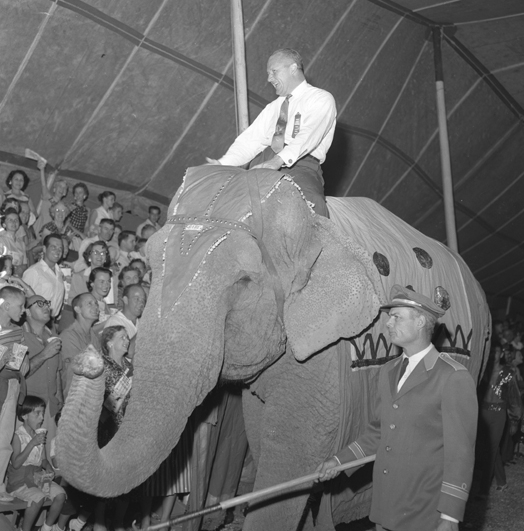
In this classic, uncredited 1958 Los Angeles Times photo, California’s Senator William Knowland rides an elephant at a circus in Orange County. Knowland was long a GOP power and nemesis of Richard Nixon. Sixteen years after this picture was taken, Knowland, awash in financial and personal troubles, took his own life. From the book, One Step From The White House:
“On Saturday morning, February 23, 1974, former U.S. Senator William F. Knowland was up early, and had coffee alone in his luxurious Oakland home. He left a note to his wife, saying, “Dear Ann, I will be back in a short time. Bill.” He left two cups and the instant coffee on a table in their Wayne Avenue apartment.
Knowland, publisher of the highly successful Oakland Tribune , drove slowly down Valdez Street; a few minutes later, at about 9 A.M., he guided his two-year-old Cadillac sedan into the company garage. He had a lot to think about. Two days earlier he had been at the right hand of California governor Ronald Reagan as they celebrated his family newspaper’s hundredth anniversary. He liked Reagan personally and agreed with his political views. He had told his political editor that day that Reagan would make a good president, and he would like to work toward that goal. But on this February day, he had a different mission.
He told the attendant at the Tribune garage to put only five gallons of gasoline in the gas tank. Pragmatic. Conservative. Practical. They were all adjectives that had been used often with his name over his lifetime. He didn’t need a full tank. He wasn’t coming back.
The senator eased his bulk back into the Cadillac and drove through the streets of Oakland for the last time. This was the city that he and his father before him had ruled. The Oakland Tribune . The Tower of Power. He must have thought of the days when the mayor asked him for advice before taking any action, when presidents and governors and senators and those who hoped to be presidents and governors and senators stood in line for an interview in the paneled board room on the twentieth floor of the Tribune Tower—the days when his endorsement could make or break a candidate. He must have remembered the glory days of the U.S. Senate.
But today, he traveled north from Oakland along the east shore of San Francisco Bay, across the Richmond—San Rafael Bridge to Highway 101, then north again, pointing toward the small town of Guerneville on the Russian River. Saturday morning traffic was light, and he drove quickly along the freeway.
The problems were insurmountable.
There were the women, the booze, and, yes, the gambling. That was what really finished him. The images of the tables in Las Vegas recently had filled his thoughts with the enormity of the problems he faced. His debts were huge and the payment date was near.
There was his reputation. All of his life, his reputation was the rock that had held everything in place—a political career that took him almost to the White House, his family, his newspaper, his civic life. Nothing else mattered as much as that reputation.
There was Ann, his new wife. She was part of the nightmare that was eroding that precious reputation, grinding him down, making him weak. To Knowland, lost in his thoughts, the eighty-mile trip to the family compound would have passed quickly.
As he drove westward along the Russian River, his speed increased—almost to a reckless level between Guerneville and the compound. The operator of the Northwood Lodge in the tiny hamlet of Monte Rio said he recognized Knowland in the blue Cadillac, looking “like he was on his way to a fire.”
He turned in at the familiar driveway at 19663 Redwood Drive and shut off the engine. He went into the house, then returned to the car briefly, leaving the keys in the ignition. He wouldn’t be needing them anymore.
He apparently had a last-minute thought, perhaps a change of heart. He tried to call the Oakland Tribune on his walkie-talkie radio, but the distance defeated the unit. He tossed the radio as far as he could. Tribune security did not receive any signals on the frequency of Knowland’s transceiver that morning.
He walked deliberately into his bedroom in the compound. A .32-caliber automatic was in a closet. It was lighter than the .45 automatic he had been wearing as an army major in Paris on the day in 1945 when California governor Earl Warren had appointed him to the U.S. Senate.
But it would do the job. Perhaps his memory flickered back to Paris, to his reading about the appointment in Stars and Stripes . It must have seemed so long ago.
He took the gun and went into the backyard, then strode down the steps alongside the half-submerged pier into the cold February water on the north shore of the Russian River. At the edge of the swift-running river, he checked the clip, then fired one shot into the river to assure himself that the pistol was dependable. He fired the second shot into his right temple. The immediate pain was like a hammer, but the greater pain was erased.”
Tags: William F. Knowland
Richard Feynman arguing against what he considered pseudo-science. I think statisical analysis and elements of scientific inquiry can be applied in social sciences, but literary studies was pretty ruined by academics in that field who wanted to behave as if they were scientists, who wanted to have the air of indisputability.
Tags: Richard Feynman
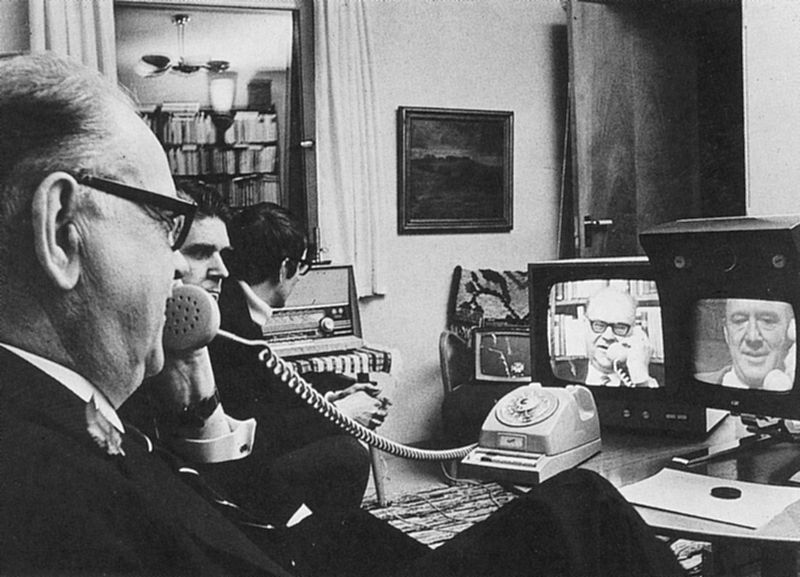
From Bernard Moon’s “The Coming Ubiquity of Video Communications,” via ReadWriteWeb:
“Over the past decades, the promise of video as a standard form of communication has been presented to us through many mediums, from Star Trek to The Jetsons and even through my old Avengers comic books over 30 years ago. While corporations utilize video conferencing technology at a rapid rate, it hasn’t yet penetrated the daily habits of people across the globe but it will.
The core technology has been there for decades, but not the bandwidth and compression technology along with the hardware to make it an everyday utility. With the growth of Skype’s video chat, Google’s GTalk, Apple’s Facetime and other services, combined with the proliferation of smartphones and tablets, video will become the standard form of communications versus SMS, voice only and even email in some situations within a few years.”
••••••••••
“Mom, it’s a picture phone”:
Tags: Bernard Moon
"MUHAHAAHAHAHAHAHAHAAHAHAHAA." (Image by priceyeah.)
It will be shits and giggles on Newsweek. I have to get to my bf can’t waste time on this loser anymore who starving for attention, but does not give his real name. Have fun, and if you are so foolish not to worry about this, you are dumber than I thought.
MUHAHAAHAHAHAHAHAHAAHAHAHAA
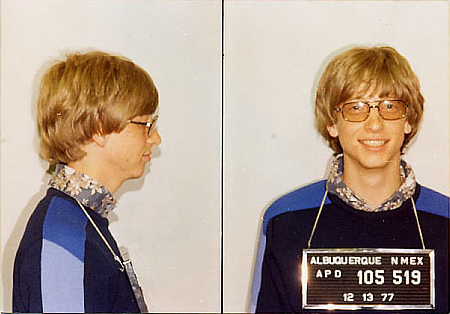
In Time, polymath Vartan Gregorian offers a riposte to the popular contemporary idea that college dropouts–Jobs, Gates, Dell, Zuckerberg–are more likely to become wealthy, an idea he says is espoused by books like Michael Ellsberg’s The Education of Millionaires. An excerpt:
“I am also not surprised that while Ellsberg highlights the accomplishments of dropouts, he excludes degree holders who have become wealthy and famous. For example, of the current Fortune 500 CEOs, some 99% have a college degree. Similarly, of the Forbes 400 richest people in America, 81% hold postsecondary degrees. (In my experience, when the time comes for both well-off college dropouts and graduates to send their children to school, they both opt for the most highly rated schools on anyone’s list, no matter what the cost.) So why should the exception — the dropout — become the rule to emulate?”
Tags: Michael Ellsberg, Vartan Gregorian

"An ensemble of moving parts, very much in motion, each drawing upon the others and pressing upon them." (Image by David Shankbone.)
The always eloquent and insightful Todd Gitlin analyzes the Occupy Wall Street movement at the Los Angeles Review of Books. An excerpt:
“But movement isn’t a thing. It isn’t, itself, an organization. It doesn’t have officers or headquarters. It’s a verb seeking to be a noun, yet fearful of hardening at the same time, for noun-things solidify, and anarchic energy afoot wants to be liquid, not so much a thing as a process: an ensemble of moving parts, very much in motion, each drawing upon the others and pressing upon them, each making their moves in the light of what others do, an ensemble of movement actors. There’s the inner movement, the outer movement, the politicians, the opposition — and, never forget, the police. They can do you favors, as did the NYPD, first with pepper spray, then with the Brooklyn Bridge mass arrest. But you can’t count on that.
The inner movement has a horizontally organized internal life: an amalgam of task forces and working groups operating under the awkward but so far workable discipline of direct democracy. A common sentiment in the public spaces, as far as I can make out, includes such deep suspicion of representative government — of the very principle of delegation — and such strong faith in the decision-making capacities of ordinary people, as to have invested all legitimate authority in the daily general assemblies.
‘Let the people decide’ was an early sixties slogan, but SDS never coherently knew what it meant, or even worried enough about not knowing. In the late ‘60s, when police bullhorns blared out arrest orders, ‘In the name of the people of California…,’ crowds shouted back, ‘We are the people.’ But we weren’t. In fact, a large majority of the people of California elected Ronald Reagan governor in 1966 and reelected him in 1970. The question of which people get to decide what: This is, of course, the master problem of political theory, and let’s just say I have no triumphant solution to offer here. It’s a problem that doesn’t go away. No matter the urgency, no matter the passion, no matter the circumstance, it just plain doesn’t go away. A serious movement has to be serious about it.”
Tags: Todd Gitlin
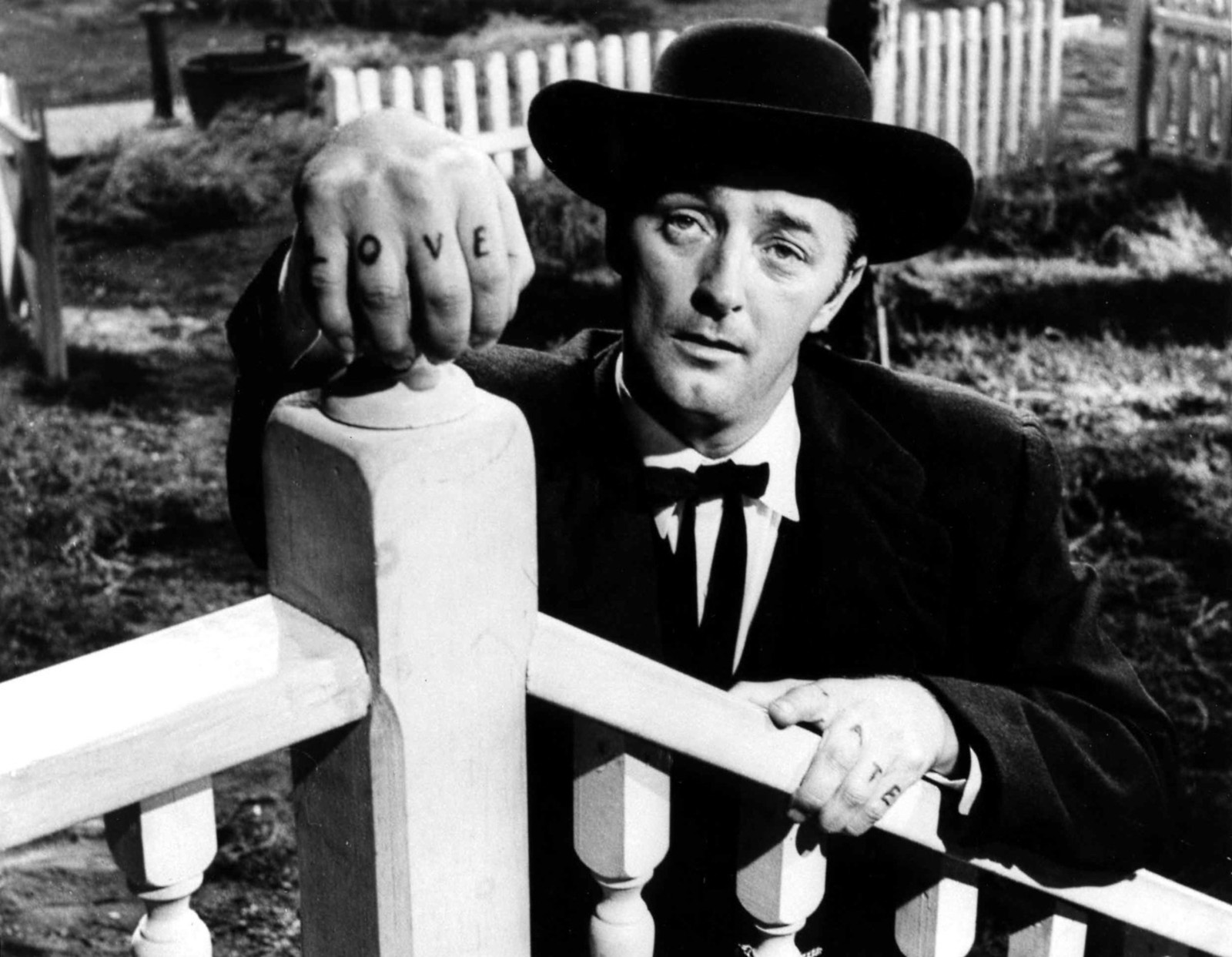
The great Robert Mitchum refuses to terrify Dick Cavett, 1971.
Tags: Dick Cavett, Robert Mitchum
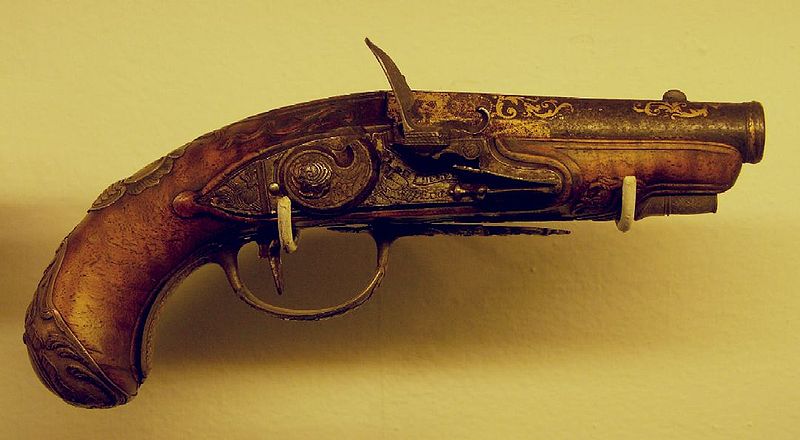
"She immediately disarmed him of a pistol." (Image by Andrzej Barabasz.)
Well, policing was apparently somewhat different in the 1890s. A brief article from the June 21, 1895 Brooklyn Daily Eagle:
“A special from Amory, Miss., says: At Greenwood Springs, a summer resort fifteen miles from here, Bruce Flanigan, a proprietor of the hotel, called at the residence of Frank Dean. Finding Mrs. Dean alone, he insulted her so she claims. She immediately disarmed him of a pistol which he had and blew his brains out. She then secured her husband’s shot gun and levelling the muzzle at the dead man’s breast fired both barrels. Mrs. Dean has not been arrested and will probably not be.”
Tags: Bruce Flanigan, Frank Dean, Mrs. Dean
In 1981, William F. Buckley and Diana Trilling investigated the ramifications of the murder of Dr. Henry Tarnower by his longtime companion, Jean Harris, a slaying which awakened all sorts of emotions about the dynamics between men and women.
From “Jean Harris: Murder with Intent to Love,” the 1981 Time article by Walter Isaacson and James Wilde: “Prosecutor George Bolen, 34, was cold and indignant in his summation, insisting that jealousy over Tarnower‘s affair with his lab assistant, Lynne Tryforos, 38, was the motivating factor for murder. Argued Bolen: ‘There was dual intent, to take her own life, but also an intent to do something else . . . to punish Herman Tarnower . . . to kill him and keep him from Lynne Tryforos.’ Bolen ridiculed the notion that Harris fired her .32-cal. revolver by accident. He urged the jury to examine the gun while deliberating. Said he: ‘Try pulling the trigger. It has 14 pounds of pull. Just see how difficult it would be to pull, double action, four times by accident.’ Bolen, who was thought by his superiors to be too gentle when he cross-examined Harris earlier in the trial, showed little mercy as he painted a vivid picture of what he claims happened that night. He dramatically raised his hand in the defensive stance he says Tarnower used when Harris pointed the gun at him. When the judge sustained an objection by Aurnou that Bolen‘s version went beyond the evidence presented, the taut Harris applauded until her body shook.”
Tags: Diana Trilling, George Bolen, Henry Tarnower, James Wilde, Joel Aurnou, Lynne Tryforos, Walter Isaacson, William F. Buckley
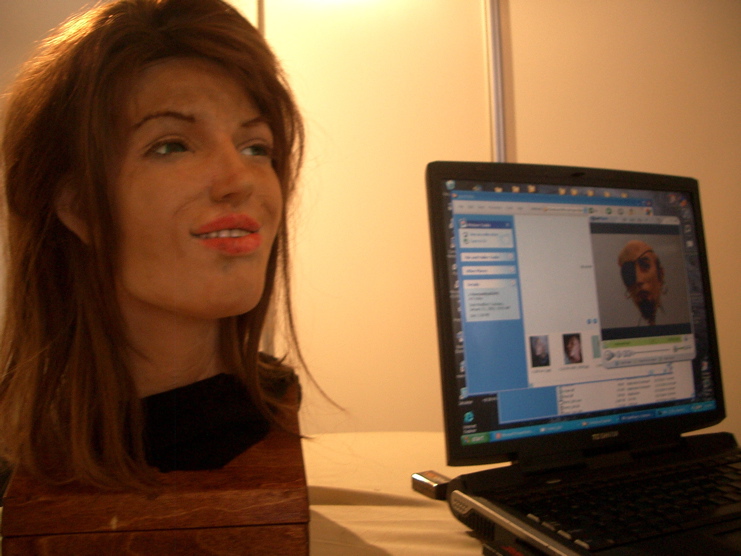
In the European, science historian George Dyson, son of physicist Freeman Dyson, is interviewed about evolution and innovation. An excerpt from the Q&A:
“The European: Is the Internet increasing the innovative potential of mankind?
Dyson: It is very easy to be a pessimist: There is no good music anymore, no good art. But maybe we have to recognize that innovation is still happening, albeit in very different ways. We might feel that all that time people spend on Facebook is a great loss for the creativity of the human species, but maybe that is not true.
The European: I expected a somewhat different answer: We used to have only human intelligence, and now that has been supplemented by computational intelligence. So we would expect the potential for innovation to become supplemented as well.
Dyson: Yes and no. The danger is not that machines are advancing. The danger is that we are losing our intelligence if we rely on computers instead of our own minds. On a fundamental level, we have to ask ourselves: Do we need human intelligence? And what happens if we fail to exercise it?
The European: The question becomes: What progress is good progress?
Dyson: Right. How do we maintain our diversity? It would be a great shame to lose something like human intelligence that was developed at such costs over such a long period of time. I spent a lot of my life living in the wilderness and building kayaks. I believe that we need to protect our self-reliant individual intelligence—what you would need to survive in a hostile environment. Few of us are still living self-reliant lives. That is not necessarily a bad thing, but we should be cautious not to surrender into dependency on other forms of intelligence. I am a historian of science, I believe in preserving the past.
The European: Are there any predictions for the future we can make, based on these lessons from the past?
Dyson: The universe is a probability space in which possible things can happen. Over the last fifty years, we have developed a combined human-computational intelligence that is able to search that space at a tremendous rate. But we have no way to predict what might happen in the future to that space of possibilities. The whole idea of species might be called into question. Darwin called his book On the Origin of Species, but evolution really isn’t limited to species. The next step might be the end of distinct species and the beginning of a more symbiotic life.” (Thanks Browser.)
••••••••••
In 2002, George Dyson recalls the spectacular Project Orion:
Tags: George Dyson
"No weed or any opiates or blow."
need asap can not have any drugs in your urine, except benzos if you take that its okay,, no weed or any opiates or blow, and no pain pills whats so ever quick easy 10 bucks if you live in cobble hill or carroll gardens please contact me asap, this is not for probation just so you know, serious replys only this evening please we can meet
From K-Tel, of course, for your 8-Track stash. Not to be confused with the Record Selector.

From the New York Times Op-Ed piece about Alabama’s draconian new immigration policy:
“Alabama’s reputation has also taken a huge hit just when it is trying to lure international businesses. No matter how officials may try to tempt foreign automakers, say, with low taxes and wages, the state is already infamous as a regional capital of xenophobia.
If Alabama succeeds in driving out all of its estimated 120,000 unauthorized immigrants, restrictionists will surely cheer. They will have only 49 states and 11 million more people to go.
There is another more humane and realistic path in which immigrants could earn the right to stay — if Congress would accept its responsibility and move ahead with serious immigration reform. America’s history shows that assimilation works better than deportation — for everyone. If first-generation immigrants don’t all learn English, their children and grandchildren invariably do. They may be poor, but their children grow up to be productive citizen taxpayers. Unless, of course, you frighten and oppress them, and forbid them to work, live and go to school.”
In this season of vitriolic debate, here’s the famously uncomfortable meeting of comedians Ricky Gervais and Garry Shandling. The latter has claimed that the whole thing was some sort of cerebral exercise on his part. Perhaps.
Tags: Garry Shandling, Ricky Gervais
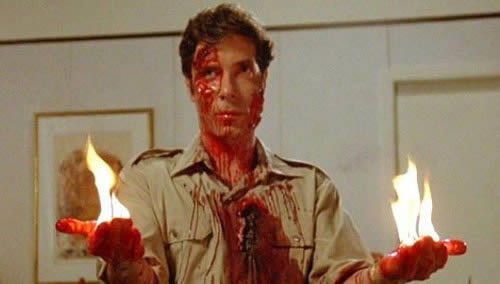
Released at a time when tech nerds were emerging from their garages and dorms to reengineer the world as we watched with shock and awe, David Cronenberg’s 1981 sci-fi mindblower about bioengineered telepaths, Scanners, could be read as an analogue to the rise of the machines and those who built them. Scanners and digital revolutionaries who began their ascent in the late 1970s can be described alike: born with special gifts, could see the future before others, desired to upset the accepted order and create a new society in which the mind and its powers would be predominant. “They’re pathetic social misfits,” says one character of the tortured titular telepaths but might as well be describing those responsible for technology’s migration from the monolith to the individual. “They want to destroy the society that created them.” And so they did, more or less.
In Cronenberg’s world, Scanners are misbegotten men and women who were born telepaths with terrible talents. They cannot only read your mind but can also use mere concentration to blow up your brain. In order to keep them from using this talent, Scanners are monitored and sometimes hunted. It seems that their strange skills are the result of their pregnant mothers being prescribed an experimental tranquilizer that was discontinued in the 1940s after a brief trial run. While the drug soon disappeared, the children have grown up with extraordinary powers, unbeknownst to most of the world.
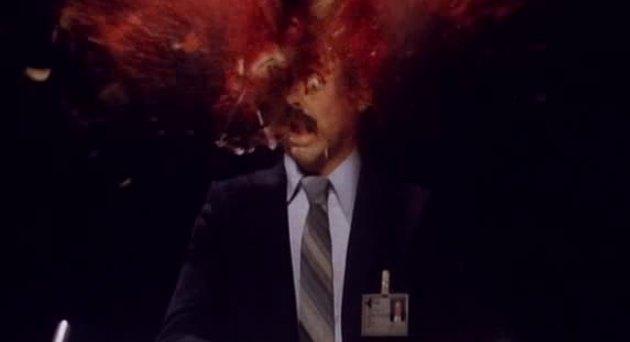
The scientist who created the drug, Dr. Paul Ruth (Patrick McGoohan), a pioneering biochemist with a patchy past, has made it his life’s work to monitor the Scanners for the ConSec corporation. Ruth reintroduces into society a Scanner named Cameron Vale (Stephen Lack), who he has kept “on ice,” to glean information about the machinations of a fellow Scanner, Darryl Revok (Michael Ironside). The latter has apparently hatched a plan with a confedrate inside ConSec to create a new breed of Scanners that he can use as his army. Cameron and Revok, who have some sort of mysterious link to one another, engage in a battle of terrifying, combustible wills.
Changing the world, or at least the way we interact with it and one another, requires getting others to see reality in a whole new way, whether you’re hoping to grow scanners or consumers, a fact which has become ever clearer as we now live in a world in which a small band of Silicon Valley superstars have commandeered the means of communication. As Revok says, while sounding not unlike a titan of technology preparing for an IPO: “We’ll bring the normals to their knees. We’ll have an empire so brilliant, so glorious that it will be the envy of the whole planet.”•
Tags: David Cronenberg, Michael Ironside, Patruck McGoohan, Stephen Lack
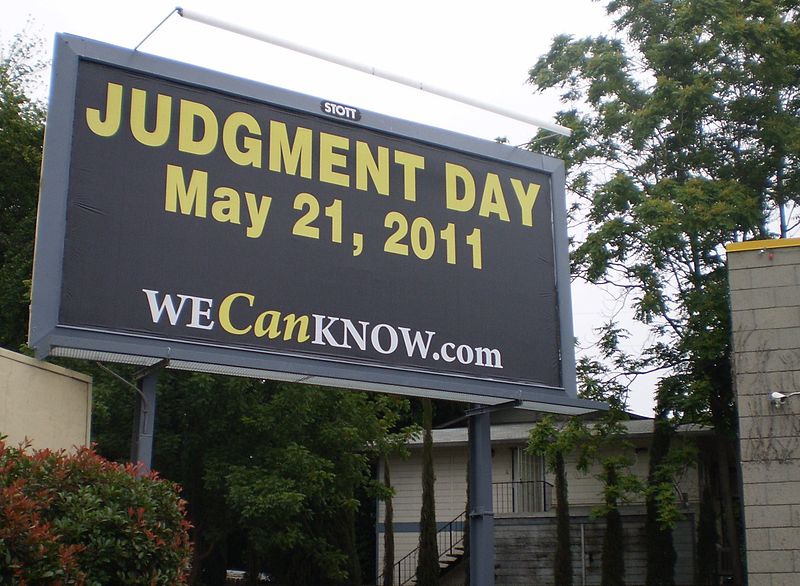
Betrayed by a stubborn Rapture that refused to abide his calculations, California-based televangelist Harold Camping was seemingly silenced in May when the Earth remained unscorched. But like any resilient prophet, Camping has dusted himself off and is doubling down on doom. An exceprt from Dan P. Lee’s smart new New York magazine article about the prognosticating preacher:
“By Monday, in a development he could not have previously fathomed, Camping found himself sitting back in his chair in his wood-paneled studio before a scrum of television cameras. His rail-thin body was clad in an old JCPenney suit, and in his lap he held a massive leather-bound Bible. Though ancient-looking, Camping came across surprisingly confident. After calling ‘this last weekend a very interesting weekend,’ he cut to the chase: ‘And so, the first question is, ‘Camping, what about you? Are you ready to shoot yourself, or are you ready to go on a booze trip, or whatever?’ ’ he asked rhetorically. ‘Well, I can tell you very candidly that when May 21 came and went, it was a very difficult time for me.’
As God had it, an answer began forming and was furthered along via some ideas in a letter he’d received that very morning from a listener. He realized, he explained, he’d been taking some of the end-time verses in the Bible too literally. ‘Suddenly it dawned on me, Oh, I see what happened,’ he said. God had indeed returned to Earth on May 21, he explained, but His return—and the earthquakes and terror that were to accompany it—was for now spiritual, not physical. It was, Camping said, necessary for it to be this way; if God had let Camping realize there would be no fire and brimstone, then his warnings might have been less vigorous. Most important, the timeline he’d parsed from the Bible was no less accurate. The Final Judgment was already occurring. It would last for five months—153 days—and we were already two days in.
‘And it will continue right up until October 21, 2011, and at that time the whole world will be destroyed,’ Camping said calmly. ‘This is why we don’t have to talk about this anymore. The world is under judgment. We are not going to be passing out any more tracts; all billboards are coming down. Our work is done. The world has been warned. My! How they have been warned.'”
Tags: Dan. P. Lee, Harold Camping
Wearable multitouch interaction everywhere. Oh, good. (Thanks Kurzweil and Marginal Revolution.)
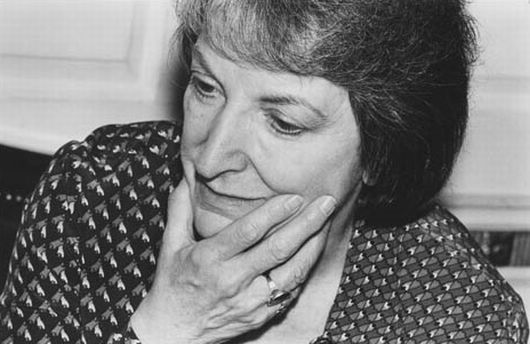
I’d be really happy if New York Times film critics A.O. Scott and Manohla Dargis were awarded Pulitzers in the same year. The quantity and quality of their writing is pretty stunning. The pair teamed up for a discussion about the legendary Pauline Kael, an influential scribe in her day (and ours, still) who was a thorny character, to say the least. An excerpt from Dargis about the erstwhile celebrity status of film critics:
“If she still casts a shadow it’s less because of her ideas, pugilistic writing style, ethical lapses and cruelties (and not merely in her reviews), and more because she was writing at a time when movies, their critics and, by extension, the mainstream media had a greater hold on American culture than they do now. In his book Easy Riders, Raging Bulls Peter Biskind relates a story from the mid-’80s when Kael turned to Richard Schickel at a meeting of film critics and said, ‘It isn’t any fun anymore.’ Mr. Schickel asked her why and she replied: ‘Remember how it was in the ’60s and ’70s, when movies were hot, whenwe were hot? Movies seemed to matter.’ The thing is, they did matter and still do, just differently.
One thing that changed was the role of the film critic, who by the mid-’80s no longer had to persuade a skeptical, sometimes hostile general audience that it was necessary to take movies seriously. In 1967, though, Kael had to explain in The New Yorker why and how Bonnie and Clyde was important (and in 9,000 words!). She was part of a critical vanguard spreading the new film gospel in reviews, books, talk shows, everywhere. They were true pop cultural figures. The critic Judith Crist even shilled for a feminine-hygiene spray. She later said that she did the ad because Richard Avedon took the photos, she could write most of the text and the ad would reach more than 100 million readers. Also: she got $5,000.”
•••••••••
Kael and other film critics were famous enough in 1977 to be spoofed by SCTV:
Tags: A.O. Scott, Judith Crist, Manohla Dargis, Pauline Kael
K-Tel cashing in on a mid-1970s fad with $5 mood rings. While supplies last.
At long last, a mood ring for my pectorals: