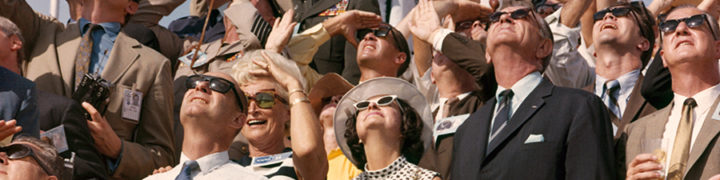
A demo of Goodyear’s “Inflatoplane” on I’ve Got A Secret, 1956 or so. Yes, a flying machine that could be brought down with a hairpin. Crappy footage, but interesting.

Whenever I’m On The Subway. . .
. . . I have to fight the urge to tickle people. Is there something wrong with me?

A new and horrifying way to keep “undesirables” away so that we can become even bigger jackasses–airport seating based on social network profiles. From Nicola Clark’s smart piece in the New York Times:
“This month, the Dutch carrier KLM began testing a program it calls Meet and Seat, allowing ticket-holders to upload details from their Facebook or LinkedIn profiles and use the data to choose seatmates.
The concept is a step beyond the not always successful efforts a few years ago by some airlines — including Air France, Virgin Atlantic and Lufthansa — to build ‘walled’ social networks out of their existing frequent flier memberships.
‘For at least 10 years, there has been this question about serendipity and whether you could improve the chances of meeting someone interesting onboard,’ said Erik Varwijk, a managing director in charge of passenger business at KLM. ‘But the technology just wasn’t available.’
Relative latecomers to the social media party, airlines are quickly becoming sophisticated users of online networks, not only as marketing tools, but as a low-cost way to learn more about their customers and their preferences.”
••••••••••
Aisle seat next to a penguin, please:
Tags: Erik Varwijk, Nicola Clark
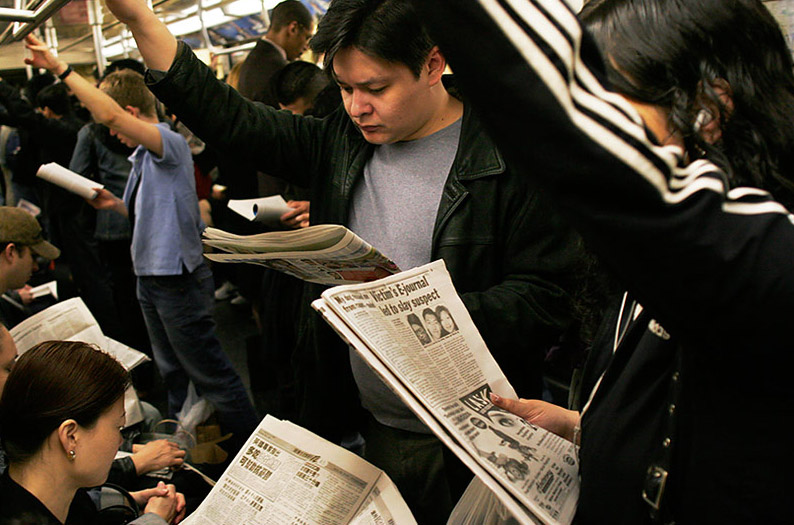
I found this 2005 photo of the interior of a New York City subway car, and as you can see, there was paper everywhere in the form of tabloids and soft-cover books. I’m not saying no one on the subway in NYC reads a newspaper in 2012–there are a few–and some straphangers still read dead-tree books, but you will never see anything like what’s represented in this photo occur again. It might as well be a shot from the 1940s of men wearing fedoras.
Riders now are, of course, reading smartphones, e-books and tablets. Usually, game-changing consumer electronics take quite a while to catch on (as in the case of record players and TVs) because of imperfections and pricing. But now the future arrives in a hurry, so fast you almost don’t notice the swiftness of the changes.•
Meaning of Robots is a doc about one man’s dream of making a stop-action robot porno. Creepy yet impressive.

I’m really bad at remembering faces but really good at reading them in the moment, which can be both advantageous and disconcerting. I don’t know that I’m happier for realizing that people are sometimes saying one thing while feeling another. I’m surprised when other people don’t seem to recognize the subtext contained in expressions and body language. Or perhaps they do and they’re just ignoring it. At any rate, it’s like having two very different conversations at the same time with a person, which is odd. From “The Naked Face,” Malcolm Gladwell’s excellent 2002 New Yorker article on the topic:
“All of us, a thousand times a day, read faces. When someone says ‘I love you,’ we look into that person’s eyes to judge his or her sincerity. When we meet someone new, we often pick up on subtle signals, so that, even though he or she may have talked in a normal and friendly manner, afterward we say, ‘I don’t think he liked me,’ or ‘I don’t think she’s very happy.’ We easily parse complex distinctions in facial expression. If you saw me grinning, for example, with my eyes twinkling, you’d say I was amused. But that’s not the only way we interpret a smile. If you saw me nod and smile exaggeratedly, with the corners of my lips tightened, you would take it that I had been teased and was responding sarcastically. If I made eye contact with someone, gave a small smile and then looked down and averted my gaze, you would think I was flirting. If I followed a remark with an abrupt smile and then nodded, or tilted my head sideways, you might conclude that I had just said something a little harsh, and wanted to take the edge off it. You wouldn’t need to hear anything I was saying in order to reach these conclusions. The face is such an extraordinarily efficient instrument of communication that there must be rules that govern the way we interpret facial expressions. But what are those rules? And are they the same for everyone?
In the nineteen-sixties, a young San Francisco psychologist named Paul Ekman began to study facial expression, and he discovered that no one knew the answers to those questions. Ekman went to see Margaret Mead, climbing the stairs to her tower office at the American Museum of Natural History. He had an idea. What if he travelled around the world to find out whether people from different cultures agreed on the meaning of different facial expressions? Mead, he recalls, ‘looked at me as if I were crazy.’ Like most social scientists of her day, she believed that expression was culturally determined– that we simply used our faces according to a set of learned social conventions. Charles Darwin had discussed the face in his later writings; in his 1872 book, The Expression of the Emotions in Man and Animals, he argued that all mammals show emotion reliably in their faces. But in the nineteen-sixties academic psychologists were more interested in motivation and cognition than in emotion or its expression. Ekman was undaunted; he began travelling to places like Japan, Brazil, and Argentina, carrying photographs of men and women making a variety of distinctive faces. Everywhere he went, people agreed on what those expressions meant. But what if people in the developed world had all picked up the same cultural rules from watching the same movies and television shows? So Ekman set out again, this time making his way through the jungles of Papua New Guinea, to the most remote villages, and he found that the tribesmen there had no problem interpreting the expressions, either. This may not sound like much of a breakthrough. But in the scientific climate of the time it was a revelation. Ekman had established that expressions were the universal products of evolution. There were fundamental lessons to be learned from the face, if you knew where to look.” (Thanks TETW.)
Tags: Malcolm Gladwell
In a report about utter bullshit, Mike Wallace interviews Major Donald Keyhoe about an alleged UFO cover-up, in 1958.
Tags: Donald Keyhoe, Mike Wallace

From CNN, a report about an outdoor billboard in London that can filter ads based on gender:
“A billboard that went up on Wednesday in London uses facial-recognition technology to know – 90% of the time – whether you’re a man or woman. And it gives you a different advertisement depending on your gender.
Women who walk up to the billboard, which is located at a London bus stop and will be viewable for two weeks, are greeted with a 40-second film explaining the plight of women and girls in poor countries around the world, who often are denied eduction and opportunities that are afforded to men.
Men, however, get a cut-down version of the content. They can’t see the film, but they do get to see shocking statistics about the situation, like the fact that 75 million girls are denied education.”

Thanks to the Browser for pointing me in the direction of Evgeny Morozov’s long New Republic consideration of Walter Isaacson’s Steve Jobs bio. The article, largely critical of Isaacson’s work, also devotes space to how much Jobs was influenced by Bauhaus and Braun designs. An excerpt:
“I DO NOT MEAN to be pedantic. The question of essence and form, of purity and design, may seem abstract and obscure, but it lies at the heart of the Apple ethos. Apple’s metaphysics, as it might be called, did not originate in religion, but rather in architecture and design. It’s these two disciplines that supplied Jobs with his intellectual ambition. John Sculley, Apple’s former CEO, who ousted Jobs from his own company in the mid-1980s, maintained that ‘everything at Apple can be best understood through the lens of designing.’ You cannot grasp how Apple thinks about the world—and about its own role in the world—without engaging with its design philosophy.
Isaacson gets closer to the heart of the matter when he discusses Jobs’s interest in the Bauhaus, as well as his and Ive’s obsession with Braun, but he does not push this line of inquiry far enough. Nor does he ask an obvious philosophical question: since essences do not drop from the sky, where do they come from? How can a non-existent product—say, the iPad—have an essence that can be discovered and then implemented in form? Is the iPad’s essence something that was dreamed up by Jobs and Ive, or does it exist independently of them in some kind of empyrean that they—by training or by visionary intuition—uniquely inhabit?
The idea that the form of a product should correspond to its essence does not simply mean that products should be designed with their intended use in mind. That a knife needs to be sharp so as to cut things is a non-controversial point accepted by most designers. The notion of essence as invoked by Jobs and Ive is more interesting and significant—more intellectually ambitious—because it is linked to the ideal of purity. No matter how trivial the object, there is nothing trivial about the pursuit of perfection. On closer analysis, the testimonies of both Jobs and Ive suggest that they did see essences existing independently of the designer—a position that is hard for a modern secular mind to accept, because it is, if not religious, then, as I say, startlingly Platonic.
This is where Apple’s intellectual patrimony—which spans the Bauhaus, its postwar successor in the Ulm School of Design, and Braun (Ulm’s closest collaborator in the corporate world)—comes into play. Those modernist institutions proclaimed and practiced an aesthetic of minimalism, and tried to strip their products of superfluous content and ornament (though not without internal disagreements over how to define the superfluous). All of them sought to marry technology to the arts. Jobs’s rhetorical attempt to present Apple as a company that bridges the worlds of technology and liberal arts was a Californian reiteration of the Bauhaus’s call to unite technology and the arts. As Walter Gropius, the founder of the Bauhaus, declared, ‘Art and technology—a new unity.'”

Tags: Evgeny Morozov, Steve Jobs, Walter Isaacson
I recently posted a classic 1937 photo of surrealist designer Elsa Schiaparelli and her amazing shoe hat. Here’s her 1952 appearance on What’s My Line?
Tags: Elsa Schiaparelli

"One of the ladies approached the balloon with a lighted candle, when the inflammable gas took fire."
An early flying machine had an accident and human error only made things worse, as described in an article in the November 6, 1850 Brooklyn Daily Eagle. The story in full:
“The flying machine owned by Captain Taggart, which took unceremonious French leave of its owner at Jersey City, last Wednesday, has, it appears, been destroyed, at Hempstead, on Long Island. The Suffolk Democrat gives the following interesting account of the affair:
‘On Wednesday evening last, at half-past six o’clock, a large balloon, with a beautiful car attached descended near the house of Jonathan Gildersleeve, at Clay Pitts, in this town. The car became entangled in the fence of a lane leading to the dwelling and barn while the balloon gently swayed with the world above it. When it was first discovered by a son of Mr. Gildersleeve, it occasioned a great deal of surprise, and he called to aid a brother and his wife, and his mother to assist securing it. A large opening was made in the balloon to permit the air to escape; but unfortunately at this moment one of the ladies approached the balloon with a lighted candle, when the inflammable gas took fire, and a violent explosion immediately followed, knocking down the whole party, and burning the two young men on the face and hands. The ladies escaped with very slight injuries. The balloon was torn to pieces, and enkindled in a blaze at the same time–and the beautiful car, with its machinery, greatly damaged. The varnished material of the balloon burned so vividly as to set the fence on fire–which, from its proximity to the barn and dwelling, would have communicated the flames to these also, but for the exertions of the injured persons, who, though in great agony, subdued the fire, by tearing down the fence, and throwing water upon the burning fragments of the balloon. The light of the explosion was noticed at the distance of several miles, and the concussion was so great that it was sensibly experienced by the inmates of a dwelling half a mile distant.”

"Can be handy if a problem comes up."
Knives
Please read the whole post, and if you see something you like, email me. NOT SELLING TO ANYONE UNDER AGE 18.
STILETTO STREET KNIFE– Handle is 6 inches, wood and stainless steel. Blade is 4 Inches, stainless steel. These are NOT legal to walk around with, so I wouldnt “reccommend” it. It is a flip open knife, not button operated. It is in beautiful condition, just laying on my shelf.*SHARP*- 20 dollars, email for pictures.
BOWIE KNIFE WITH KNUCKLES.- Comes in a sheath (not really durable quality). The handle of the blade is a “brass knuckle design”. This is a big knife, and not only is it “illegal” to carry, but you probably can’t conceal it anyway. However, beautiful knife, great design on the handle, feels powerful to hold and stainless steel. Truly a man’s knife, you’ll love the feel of it. Not razor sharp, but sharp enough to do alot of damage so handle with caution.Can be used as a hunting knife. 30 dollars and email for pictures.
REPLICA SCOTTISH ROYAL DAGGER– This is a replica of daggers that soldiers used to carry in Scotland. Just a beautiful thing itself, The blade is NOT sharp, and this is mostly a wall piece or just on display somewhere. Really is nice to look at. Email for pictures. 15 dollars.
NECK KNIVES– Not luxiorious things, but can be handy if a problem comes up. One is a metal scorpion hanging from a chain. It’s tail is a knife and concealable. Not very sharp, and blade is very small, but it is an impressive thing to show off, and can also be handy since it is a little sharp and pointed.It does not look at all like there is a knife, and its is completly legal to carry. Email for pictures. 8 dolllars. Very similiar is a dragons head, breathing fire, and the fire is a concealed knife. Once again, barely sharp, but does have a point, is concealable and its pretty cool to show off. 8 dollars. email for pictures
THE KUMA FINGER CLAW– I saved the best for last. I cant offer a very detailed discription, but email and I will send you pictures or a video showing it off. Basically it is a metal claw you wear on one finger, has bendable joints so you can bend your finger while wearing it, the tip is a claw, with a VERY sharp point. On top of the claw, approximately on the top of your finger, is a black, stainless stee blade. It is RAZOR sharp so, do NOT play with this thing. Very beautiful thing just to look at or wear once in a while. Feels powerful, erven though it is only on one finger. I believe it is “llegal” to carry, and for good reason. This thing would destroy someone. 30 dollars, email for pictures or maybe a video.
Yes, that sounds accurate. From 1966.
Tags: Salvador Dali
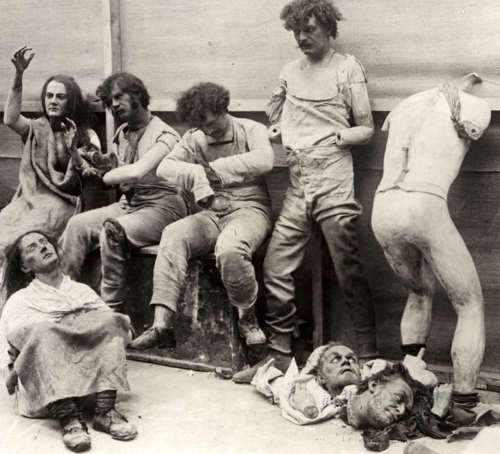
The erasure of memories through pharmaceuticals is upon us and has been reported with some concern. Will expunging traumatic memory alter a person fundamentally or did the trauma already do the trick? Thorny questions about the nature of identity abound. An excerpt from “The Forgetting Pill Erases Painful Memories Forever,” Jonah Lehrer’s new report on the topic for Wired:
“This new model of memory isn’t just a theory—neuroscientists actually have a molecular explanation of how and why memories change. In fact, their definition of memory has broadened to encompass not only the cliché cinematic scenes from childhood but also the persisting mental loops of illnesses like PTSD and addiction—and even pain disorders like neuropathy. Unlike most brain research, the field of memory has actually developed simpler explanations. Whenever the brain wants to retain something, it relies on just a handful of chemicals. Even more startling, an equally small family of compounds could turn out to be a universal eraser of history, a pill that we could take whenever we wanted to forget anything.
And researchers have found one of these compounds.
In the very near future, the act of remembering will become a choice.”
Tags: Jonah Lehrer
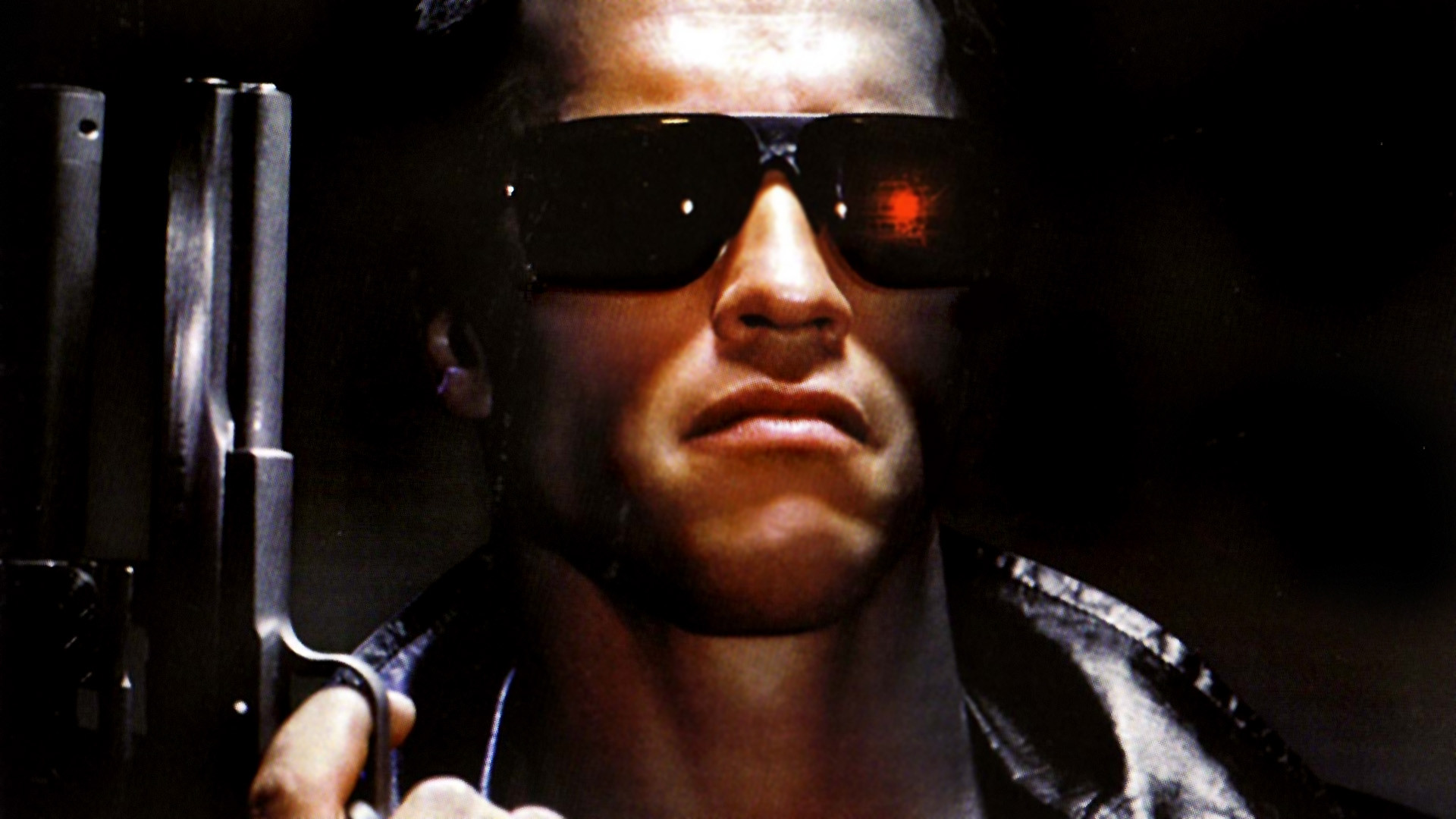
Nick Bilton has a post at the New York Times “Bits” blog, about Google’s new Terminator-style specs. They will have to suffice until Google eventually implants a chip in your brain. It really does seem like a smartphone is enough, but Larry and Sergey disagree. An excerpt:
“People who constantly reach into a pocket to check a smartphone for bits of information will soon have another option: a pair of Google-made glasses that will be able to stream information to the wearer’s eyeballs in real time.
According to several Google employees familiar with the project who asked not to be named, the glasses will go on sale to the public by the end of the year. These people said they are expected ‘to cost around the price of current smartphones,’ or $250 to $600.
The people familiar with the Google glasses said they would be Android-based, and will include a small screen that will sit a few inches from someone’s eye. They will also have a 3G or 4G data connection and a number of sensors including motion and GPS.”
Tags: Nick Bilton

According to a new Businessweek piece, there are some green shoots in the U.S. solar industry. But it’s been an agonizingly slow-to-develop energy source for Americans and everyone else because of the price of the hardware. Two videos about earthlings trying to harness the sun.
A 1970s NASA film from Huntsville, Alabama:
A contemporary suburban Tokyo experimental solar city:
Host issues. Damned host. I’ll post some stuff now.


"Last Tuesday evening she was attacked with severe paroxysms of sneezing." (Image by AnA oMeLeTe.)
From the August 8, 1891 Brooklyn Daily Eagle:
“Springfield, IL.–The physcians of South Charleston, a village twelve miles east of here, are completely baffled by the case of Miss May Creston, who is literally sneezing to death. She seems to be the victim of a strange nervous affliction and with the lingering effects of a severe case of the grip with which she was attacked last winter. Last Tuesday evening she was attacked with severe paroxysms of sneezing, following each other at rapid intervals. Suddenly the paroxysms stopped, leaving her very exhausted. The girl then went into a trance that lasted twelve hours. The terrified attendants thought the girl was dead. The physician treated her with hypodermic injections. She finally awoke languidly, and in a few minutes the sneezing came on. The physicians have been utterly unable to check them. The girl neither eats nor sleeps and seems to suffer terribly.”
Tags: May Creston
Anthony Burgess joins William F. Buckley in 1972 to discuss radical students.

"He doesn’t go out of his way to convince Republicans that he is one of them." (Image by R. DeYoung.)
Ron Paul has made only slight concessions to the mainstream, pretending he wasn’t responsible for the racist, extremist newsletters that funded his national political career, but in the last five years or so, the center has moved quite a ways to meet him. Rigidly doctrinaire to the point of absurdity, Paul has somehow captured the hearts and minds of a reasonably sizable portion of the American public. But he’s a Libertarian, not a Republican any more than a Democrat, which makes him even more of an odd duck in the GOP field. He’s a third-party candidate running for one of the first two. But is he the beginning of a serious strain of post-party politics?
Some of you read the New Yorker before you read Afflictor (bastids!), so you may have already taken in Kelefa Sanneh’s smart piece about Paul this week. But in case you haven’t gotten to it yet, here’s an excerpt:
“‘I think parties are pretty irrelevant,’ Paul says, and he doesn’t go out of his way to convince Republicans that he is one of them. He firmly opposed Obama’s health-care plan, and he might win a few more votes if he made this opposition the centerpiece of his stump speech. Instead, he tends toward arguments that are almost perversely nonpartisan—elaborating, say, the similarities between Bush’s war on terror and Obama’s. He asks, ‘Have you ever noticed that we change parties sometimes, but the policies never change?’ Even during that first Tea Party appearance, in Texas in 2007, Paul passed up a chance to reassure Republican voters. Skipping over the ‘United Nations’ and ‘I.R.S.’ barrels, he picked up one marked ‘Iraq War’ and heaved it into the river. He was seventy-two at the time, and surely relished the physical act as much as the symbolic one. ‘Start with that, and then we can solve the rest of the problems,’ he said.”
••••••••••
Paul on Morton Downey, Jr.’s screamfest, 1988:
Tags: Kelefa Sanneh, Ron Paul

Whitey has already been on the moon, and now hackers want in. A note from Adam Clark Estes on Atlantic Wire about the increasingly outré plans of attention-seeking hackers, who are Anonymous but don’t wish to be anonymous:
“‘At the Chaos Communication Camp 2011 Jens Ohlig, Lars Weiler, and Nick Farr proposed a daunting task: to land a hacker on the Moon by 2034,’ Tom Hardy writes on The Powerbase. ‘The plan calls for three separate phases: 1. Establishing an open, free, and globally accessible satellite communication network, 2. Put a human into orbit, 3. Land on the Moon.’
Hackers on the moon? Promoting these crazy-sounding plans may be a way for older school hackers to steal back the spotlight from LulzSec and its sometimes meaningless website takedowns in 2011. Even their fellow hackers made fun of the group at the time of the assaults. ‘They were rampaging, and clearly not willing to stop,’ one hacker who calls himself Asherah told The New York Times last summer. ‘Despite the rumors, they’re not very accomplished hackers. They’re attention-drunk.'”
Tags: Adam Clark Estes

"MUST SEE!!"
NEW DISCOUNTED FEMALE MANNEQUIN – DAMAGED – $65 (BROOKLYN, NYC)
LOOKING FOR A FEMALE MANNEQUIN? WELL LOOK NO FURTHER. WE CURRENTLY HAVE A NEW DAMAGED FEMALE MANNEQUIN THAT WILL ALSO BE DISCONTINUED. BROWN SKIN WITH BOTH ARMS BY THE SIDE – DAMAGED. CRACK UNDER RIGHT ARM, CRACK IN THE PAINT UNDER LEFT ARM, CRACK UNDER THE NECK AND ON THE BACK OF THE NECK. CHIP OF PAINT MISSING FROM THE FRONT OF THE HEAD (HAIR AREA), CORE (PLASTIC) BROKEN – WITHOUT THE CORE TORSO CANNOT BE DISPLAYED ON TOP OF LEGS. MUST SEE!!

Timed to the publication of his new book, Turing’s Cathedral, George Dyson is interviewed by Kevin Kelly in Wired. The opening:
“Wired: Because your father, Freeman Dyson, worked at the Institute for Advanced Study in Princeton, you grew up around folks who were building one of the first computers. Was that cool?
George Dyson: The institute was a pretty boring place, full of theoreticians writing papers. But in a building far away from everyone else, some engineers were building a computer, one of the first to have a fully electronic random-access memory. For a kid in the 1950s, it was the most exciting thing around. I mean, they called it the MANIAC! The computer building was off-limits to children, but Julian Bigelow, the chief engineer, stored a lot of surplus electronic equipment in a barn, and I grew up playing there and taking things apart.
Wired: Did that experience influence how you thought about computers later?
Dyson: Yes. I tried to get as far away from them as possible.
Wired: Why?
Dyson: Computers were going to take over the world. So I left high school in the 1960s to live on the islands of British Columbia. I worked on boats and built a house 95 feet up in a Douglas fir tree. I wasn’t antitechnology; I loved chain saws and tools and diesel engines. But I wanted to keep my distance from computers.” (Thanks Browser.)
Tags: George Dyson, Kevin Kelly
Evelyn Wood Reading Dynamics was the pre-Adderall way to cram. Steve Allen doing hosting duties, 1979.
Tags: Evelyn Wood, Steve Allen
Fifty years ago, the great John Glenn orbited the moon and America was on its way in the Space Race. Behind the scenes, things were murkier, as erstwhile Nazi Wernher von Braun was leading the program. The scientist collaborated with Walt Disney on the 1955 short film, “Man in Space.”
See also:
- Norman Mailer profiles Von Braun. (1969)
Tags: John Glenn, Walt Disney, Wernher von Braun