From a list of urban innovations at the Next Web, a section about using pedestrian energy to illuminate streetlights:

“Think about all the energy expended by pedestrians walking down the street. What if it could be harnessed to power street lighting? The Viha concept involves an electro-active slab with a lower portion that is embedded in the floor, and a mobile upper part that can produce energy.

While it won’t be able to replace power stations, this solution is designed to produce enough energy for use in the immediate vicinity, thus taking strain off the power grid and reducing the power bill of the local authority. In particularly crowded areas, this would work well.”

••••••••••

The Viha concept in practice:

Working off an incredibly slow connection.

I was thinking of Doris Lessing’s short novel about a ghastly offspring, The Fifth Child, for no real reason yesterday, so “Was Frankenstein Really About Childbirth?,” Ruth Franklin’s excellent New Republic article, seems particularly resonant to me today. The opening:

“I have no doubt of seeing the animal today,” Mary Wollstonecraft wrote hastily to her husband, William Godwin, on August 30, 1797, as she waited for the midwife who would help her deliver the couple’s first child. The “animal” was Mary Wollstonecraft Godwin, who would grow up to be Mary Shelley, wife of the Romantic poet Percy Bysshe Shelley and author of Frankenstein, one of the most enduring and influential novels of the nineteenth century. But Wollstonecraft would not live to see her daughter’s fame: She died of an infection days after giving birth.

The last notes that Wollstonecraft wrote to Godwin are included in the exhibition “Shelley’s Ghost: The Afterlife of a Poet,” which began last year at the Bodleian Library in Oxford and has now come to the New York Public Library. On display are numerous artifacts both personal and literary from the lives of the Shelleys, including manuscript pages from the notebook in which Mary wrote Frankenstein (with editing in the margins by her husband), which have never before been shown publicly in the United States. But it was Wollstonecraft’s scribbled note, in which she referred to her baby as “the animal”— the same word that the scientist in Frankenstein would use to describe his own notorious creation—that gave me pause. Could the novel—commonly understood as a fable of masculine reproduction, in which a man creates life asexually—also be a story about pregnancy?•

Tags: , ,

On International Women’s Day, here’s a 1973 John Chancellor report about the “Battle of the Sexes” tennis match between Billie Jean King and Bobby Riggs, which was hokey as a sporting event but used pitch-perfect hoopla on an Ali scale to become a huge national attraction. King triumphed in the Astrodome in straight sets: 6-4, 6-3, 6-3.

Tags: , ,

In his new Atlantic piece, “We’re Underestimating the Risk of Human Extinction,” Ross Andersen conducts a smart interview with Oxford’s Professor Nick Bostrom about the possibility of a global Easter Island, in which all of humanity vanishes from Earth. The conversation focuses on the threats we face not from our stars but from ourselves. I think Bostrom’s attitude is too dire, but he only has to be right once, of course. An excerpt:

What technology, or potential technology, worries you the most?

Bostrom: Well, I can mention a few. In the nearer term I think various developments in biotechnology and synthetic biology are quite disconcerting. We are gaining the ability to create designer pathogens and there are these blueprints of various disease organisms that are in the public domain—you can download the gene sequence for smallpox or the 1918 flu virus from the Internet. So far the ordinary person will only have a digital representation of it on their computer screen, but we’re also developing better and better DNA synthesis machines, which are machines that can take one of these digital blueprints as an input, and then print out the actual RNA string or DNA string. Soon they will become powerful enough that they can actually print out these kinds of viruses. So already there you have a kind of predictable risk, and then once you can start modifying these organisms in certain kinds of ways, there is a whole additional frontier of danger that you can foresee.

In the longer run, I think artificial intelligence—once it gains human and then superhuman capabilities—will present us with a major risk area. There are also different kinds of population control that worry me, things like surveillance and psychological manipulation pharmaceuticals.”

Read also:

Tags: ,

"After two bites Miller was taken violently ill."

From the December 26, 1886 Brooklyn Daily Eagle:

“Ten days before Mann, the Minneapolis quail eater, started in on his task to eat thirty birds in thirty days for a bet of $1,000, Charles Miller commenced the same business on another wager. Yesterday Miller attacked his twenty-eighth bird. He had been complaining for the past five days that he could not sleep at night and that he seemed to have a load of stones on his chest. He felt well when he sat down to his quail, ate a little bread and butter and potatoes, and then attacked the bird. After two bites Miller was taken violently ill, vomiting and being unable to go on with the task. A hack was sent for at once, and he was taken to a doctor’s and from thence to his home. No serious results are looked for, and he will probably be alright in a day or two. Mann ate his eighteenth quail last night, and is still feeling well.”

Tags: ,

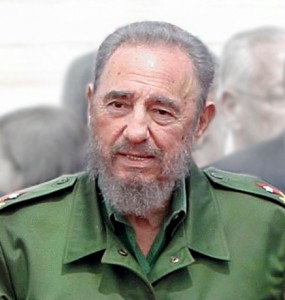
"There's only one Fidel."

Fidel in Central Park (nyc)

I saw Fidel again last night in Central Park. Under an elm he was with three men who guarded hiim sitting in a wheelchair. It was him. There’s only one Fidel.

Fidel a compatriot of Bloomberg?

What’s goin on here?

Tags:

In his two years coaching the erstwhile laughingstock New York Knicks in the late ’80s, the forward thinking Rick Pitino had his young and athletic players operate a full-court press on every play. It didn’t make them an NBA champion, but it maximized the talent at hand and earned the team its first division title in two decades. Years later, Malcolm Gladwell published “How David Beats Goliath” in the New Yorker, making a convincing case that this strategy was sound and should be employed more. But conventional wisdom is hard to shake so no one has ever tried it again, and current Knicks coach Mike D’Antoni has taken a lot of flak for his similarly aggressive “Seven Seconds or Less” offensive scheme

I wonder if a young and athletic NFL team should use similar aggression. You couldn’t blitz on every play because offenses are too proficient and rules are stacked in favor of scoring, But how about this for a team that went 2-14 last year: Never punt from anywhere outside your own 35-yard line. Never kick field goals inside the other team’s 35 except during the last two minutes of a game when it would give you the lead. 

It’s unlikely we’d ever see such an experiment in a league were most coaches get flustered by basic time management, but a gradual shift to using four downs much better is possible. From Brian Burke’s smart Slate piece on the topic:

“There are many doubters when it comes to four-down football. If you’re in that camp, indulge me in a quick thought experiment. Let’s imagine a football world where the punt and field goal had never been invented. (Sorry, Ray Guy and Jan Stenerud.) In this universe, there would be no second-guessing: Teams would go for it on every fourth down.

Then one day, some smart guy invents the punt and approaches a head coach with his new idea. ‘Hey coach,’ he’d say, ‘instead of trying for a first down every time, let’s voluntarily give the ball to the other team.’ Our coach would be incredulous at this suggestion. ‘You want me to give up 25 percent of our precious downs for just 35 yards of field position? Do you have any idea how difficult it would be for us to score?’ And the coach would be right.

Since that’s not how the game evolved, our thinking about fourth-down strategy is a lot different. But as the sport has changed, with offense securing a firm upper hand over defense, coaches need to rethink their fourth-down orthodoxy. Accounting for interceptions, teams netted around 3.5 yards per pass attempt in 1977, back when many of today’s head coaches were playing and learning the sport. In the modern game, teams are almost twice as productive when they throw the ball, netting close to six yards per passing attempt. As it gets easier for offenses to move down the field, possession (and maintaining possession by going for it on fourth down) becomes more important and field position becomes less important.”

See also:

Tags:

The Handroid has potential for creating better prosthetics and for the remote handling of dangerous materials. By the good people at ITK. (Thanks Singularity Hub.)

In the Atlantic, celebrity scientist Neil deGrasse Tyson discusses his new book about America’s foundering space program. An excerpt:

You write that space exploration is a ‘necessity.’ Why do you think others don’t agree?

I don’t think they’ve thought it through. Most people who don’t agree say, ‘We have problems here on Earth. Let’s focus on them.’ Well, we are focusing on them. The budget of social programs in the federal tax base is 50 times greater for social programs than it is for NASA. We’re already focused in ways that many people who are NASA naysayers would rather it become. NASA is getting half a penny on a dollar — I’m saying let’s double it. A penny on a dollar would be enough to have a real Mars mission in the near future.

Can the United States catch up in the 21st-century space race?

When everyone agrees to a single solution and a single plan, there’s nothing more efficient in the world than an efficient democracy. But unfortunately the opposite is also true, there’s nothing less efficient in the world than an inefficient democracy. That’s when dictatorships and other sort of autocratic societies can pass you by while you’re bickering over one thing or another.

But, I can tell you that when everything aligns, this is a nation where people are inventing the future every day. And that future is brought to you by scientists, engineers, and technologists. That’s how I’ve always viewed it. Once people understand that, I don’t see why they wouldn’t say, ‘Sure, let’s double NASA’s budget to an entire penny on a dollar! And by the way, here’s my other 25 pennies for social programs.’ I think it’s possible and I think it can happen, but people need to stop thinking that NASA is some kind of luxury project that can be done on disposable income that we happen to have left over. That’s like letting your seed corn rot in the storage basin.”

Tags:

Fischer, Yugoslavia, 1961.

Long before anyone knew that the earth beneath his feet would shake ever more violently with time, chess champion Bobby Fischer seemed like an eccentric winner–though definitely a winner. The paranoid accusations and erratic mood swings, however, weren’t merely gamesmanship or arrogance but harbingers of a serious mental illness that would eventually manifest itself in antisemitism and derangement. The opening of Brad Darrach’s 1971 Life profile, “Bobby Is a Ferocious Winner,” at a time when he was still considered combustible by nature rather than condemned by it:

“Angry voices rattles the door to Bobby Fischer’s hotel room as I raised my hand to knock. ‘Goddamnit, I’m sick of it!’ I heard Bobby shouting. ‘I’m sick of seeing people! I got to work, I got to rest! Why didn’t you ask me before you set up all those appointments? To hell with them!’ Then I heard the mild and dignified executive director of the U.S. Chess Federation addressing the man who may well be the greatest chess player in world history in a tone just slightly lower than a yell: ‘Bobby, ever since we came to Buenos Aires I’ve done nothing but take care of you, day and night. You ungrateful—-!’

It was 3 p.m., a bit early for Fischer to be up. Ten minutes later, finding the hall silent. I risked a knock and Fischer cracked the door. ‘Oh yeah, the guy from Life. Come on in.’ His smile was broad and boyish but his eyes were wary. Tall, wide and flat, with a head too small for his big body, he put me in mind of a pale transhuman sculpture by Henry Moore. I had seen him twice before but never so tired.

Just inside the door I stopped short. The room looked like a terminal moraine of bachelorhood. Bedclothes in tortured piles on the floor. Socks, underwear, bags, newspapers, magazines jumbled on the spare bed. Boxes stacked all over the couch, and on the floor between the beds a single graceful banana peel. The only clean place in the room was a small table by the window, where a set of handsome wooden chessmen had been set up for play. Serenely beautiful, an altar in the debris of battle.”


Tags: ,

The Rev. Dr. Billy Graham appears on What’s My Line?, 1960.

LBJ attends Graham crusade at the Astrodome, 1965:

Tags:

The opening of the new Economist article, “Computing with Soup,” which examines the medical benefits of using DNA-laced liquid instead of silicon chips:

“EVER since the advent of the integrated circuit in the 1960s, computing has been synonymous with chips of solid silicon. But some researchers have been taking an alternative approach: building liquid computers using DNA and its cousin RNA, the naturally occurring nucleic-acid molecules that encode genetic information inside cells. Rather than encoding ones and zeroes into high and low voltages that switch transistors on and off, the idea is to use high and low concentrations of these molecules to propagate signals through a kind of computational soup. 

Computing with nucleic acids is much slower than using transistors. Unlike silicon chips, however, DNA-based computers could be made small enough to operate inside cells and control their activity. ‘If you can programme events at a molecular level in cells, you can cure or kill cells which are sick or in trouble and leave the other ones intact. You cannot do this with electronics,’ says Luca Cardelli of Microsoft’s research centre in Cambridge, England, where the software giant is developing tools for designing molecular circuits.” (Thanks Browser.)

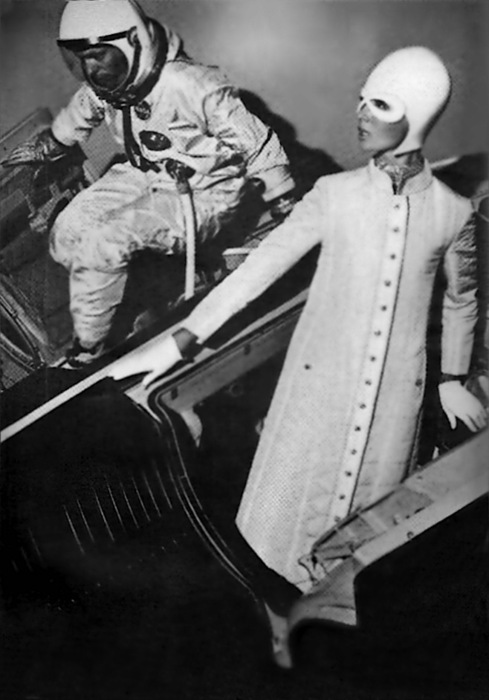
The designer as visionary in 1970, at the conclusion of the Space Race.

Tags:

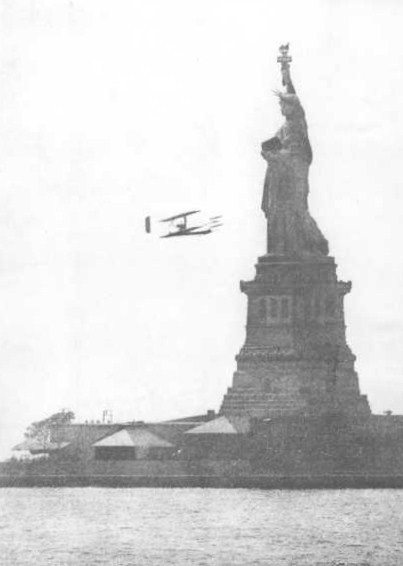
Wilbur Wright, flight around Statue of Liberty, 1909.

Look up in the sky and you will see neither bird nor plane but the future–it is here now. From Farhood Manjoo’s new Slate piece,I Love You, Killer Robots“:

“It was way back in May 2010 that I first spotted the flying drones that will take over the world. They were in a video that Daniel Mellinger, one of the robots’ apparently too-trusting creators, proudly posted on YouTube. The clip, titled ‘Aggressive Maneuvers for Autonomous Quadrotor Flight,’ depicts a scene at a robotics lab at the University of Pennsylvania, though a better term for this den might be “drone training camp.”

In the video, an insectlike, laptop-sized ‘quadrotor’ performs a series of increasingly difficult tricks. First, it flies up and does a single flip in the air. Then a double flip. Then a triple flip. In a voice-over so dry it suggests he has no idea the power he’s dealing with, Mellinger says, ‘We developed a method for flying to any position in space with any reasonable velocity or pitch angle.’ What does this mean? It means the drone can fly through or around pretty much any obstacle. We see it dance through an open window with fewer than 3 inches of clearance on either side. Next, it flies and perches on an inverted surface—lying in wait.”

Tags:

Up to 18 mph. From the good folks at Boston Dynamics.

"William was wily, wary and wicked."

A former cat-meat salesman named Pickles, who later turned to horse thievery, was the subject of a colorful profile in the March 27, 1876 Brooklyn Daly Eagle. An excerpt:

Another escape from the Penitentiary has come to light. This time it was a clean walk out instead of an escape. The fact has been concealed by the prison authorities for over a month. William Pickles, alias Clark, was the convict who, on the afternoon of February 23, shouldered a pitchfork and walked out at the Penitentiary, ostensibly to the cow stables opposite. They are waiting for his return, but he does not come. A facetious fellow convict, when he heard of William’s departure, began humming the tune, ‘Oh, Willie, we have missed you.’ This Pickles is a character who has made a mark on his day and generation.

"It was a dizzying leap from a cat meat purveyorship." (Image by Lipedia.)

He drew his first breath in ‘Lunnon Town,’ some forty-eight years ago. At a tender age he was apprenticed to a costermonger, who made vocal the streets of London with his cries of ‘Cat meat,’ ‘Cat meat.’ In course of time William became a boss caterer to the feline race. He bade farewell to the shores of his native land about twenty years ago, on account of some little misunderstanding with the authorities there. He came to New York, and at once began to flourish like the typical green bay tree. William was wily, wary and wicked. After viewing the opportunities presented to an enterprising mind in a free land he concluded to direct his attention to horse flesh. It was a dizzying leap from a cat meat purveyorship but Pickles had a great and adaptable soul. He became a trader in horses–in other people’s.

A man of Pickles’ qualities had not much difficulty in getting horses for nothing, and selling them for a good deal. He was thoroughly impartial in his selection of the noble quadroped. He would yank out a claim peddler’s horse from a stable as quick as he would a Hambletonian. It all depends on his opportunities. It is said that in the course of the two or three weeks Pickles would transmogrify the veriest hackney into as trim a looking animal as a gentleman would care to sit behind. He could make a white horse black to order, dapple a pure bay, affix a mark of aristocracy on the brow, make a moribund nag look fresh and cheerful–in short, he was a wizard veterinarian. He could take a kink out of the leg, put strength in the backbone, fructify the tail and do anything with the animal he had in hand in short of causing it to grow a pair of side whiskers. This might have come in time had not Pickles’ scientific pursuits been interrupted by the police. This occurred in the zenith of his prosperity, when he was in the enjoyment of the proud reputation of being ‘one of the handiest men about horses you ever saw.’ He was sent to Sing Sing for ten years. He languished there for about half of his term when one night he managed to reach the sewer pipe and through it he crawled out of the prison.”

 

Tags:

I miss my wife – still

This afternoon I thought about what kind of couch to buy. I thought that I should get one where the two of us could lie down naked comfortably together and cuddle up. This notion shocked me since we have been apart going on a few years now. Funny how the mind plays these tricks. Life goes on…  

From “Can You Build a Human Body?” an interactive BBC feature that explains how close we are to artificially creating a complete array of functioning organs. From the section on skin:

“One of the greatest challenges in bionics is to replicate skin – its ability to feel pressure, temperature and pain is incredibly difficult to reproduce.

Prof Ali Javey, from the University of California, Berkeley, is trying to develop an ‘e-skin’ a material that ‘mechanically has the same properties as skin.’ He has already woven a web of complex electronics and pressure sensors into a plastic which can bend and stretch.

Getting those sensors to send data to a computer could give a sense of touch to robots.”

••••••••••

Printing electronic skin:

Tags:

Harpo Marx, who was plugging his new book, appeared on I’ve Got a Secret, 1961. Johnny Carson on the panel.

From the 1983 New York Times obituary of Mildred Dilling, who taught Harpo how to play his musical instrument and was profiled in the New Yorker in 1940 (subscription required):

Mildred Dilling, a concert harpist who performed for five Presidents, taught Harpo Marx and owned the world’s largest private collection of harps, died in her Manhattan home last Thursday. She was 88 years old.

Miss Dilling performed throughout North and South America, the Orient and Europe. At the peak of her career, she gave 85 concerts and traveled 30,000 miles a year. In her early 80’s, Miss Dilling was still performing 10 concerts a year. She also conducted harp workshops at colleges and universities, giving master classes at the University of California, Los Angeles.”

Tags: , ,

"These realms of knowledge contain concepts such as data mining, non-linear dynamics and chaos theory." (Image by Steve Jurvetson.)

From “School for Quants,” Sam Knight’s interesting Financial Times look at the training of the next generation of financial-sector math geniuses who will likely be building and destroying and building and destroying the world’s economy in the near future:

“As of this winter, the centre had about 60 PhD students, of whom 80 per cent were men. Virtually all hailed from such forbiddingly numerate subjects as electrical engineering, computational statistics, pure mathematics and artificial intelligence. These realms of knowledge contain concepts such as data mining, non-linear dynamics and chaos theory that make many of us nervous just to see written down. Philip Treleaven, the centre’s director, is delighted by this. ‘Bright buggers,’ he calls his students. ‘They want to do great things.’

In one sense, the centre is the logical culmination of a relationship between the financial industry and the natural sciences that has been deepening for the past 40 years. The first postgraduate scientists began to crop up on trading floors in the early 1970s, when rising interest rates transformed the previously staid calculations of bond trading into a field of complex mathematics. The most successful financial equation of all time – the Black-Scholes model of options pricing – was published in 1973 (the authors were awarded a Nobel prize in 1997).

By the mid-1980s, the figure of the ‘quantitative analyst’ or ‘quant’ or ‘rocket scientist’ (most contemporary quants disdain this nickname, pointing out that rocket science is not all that complicated any more) was a rare but not unheard-of species in most investment houses. Twenty years later, the twin explosions of cheap credit and cheap computing power made quants into the banking equivalent of super-charged particles. Given freedom to roam, the best were able – it seemed – to summon ever more refined, risk-free and sophisticated financial products from the edges of the known universe.

Of course it all looks rather different now. Derivatives so fancy you need a degree in calculus to understand them are hardly flavour of the month these days. Proprietary trading desks in banks, the traditional home of quants, have been decimated by losses and attempts at regulation since the start of the financial crisis. There is nothing like the number of jobs there used to be.” (Thanks Browser.)

Tags:

Two Texas doctors, Billy Cohn and Bud Frazier, create life without a pulse.

Tags: ,

The Lytro camera by Ren Ng permits you to focus retroactively.

Tags:

We can’t unlearn what is learned, although we do have the capacity to change how we use knowledge, to improve or deteriorate ethically. From a story about civilian drones in the Economist:

“Safety is not the only concern associated with the greater use of civilian drones, however. There is also the question of privacy. In America, at least, neither the constitution nor common law prohibits the police, the media or anyone else from operating surveillance drones. As the law stands, citizens do not have a reasonable expectation of privacy in a public place. That includes parts of their own backyards that are visible from a public vantage point, including the sky. The Supreme Court has been very clear on the matter. The American Civil Liberties Union, a campaign group, says drones raise ‘very serious privacy issues’ and are pushing America ‘willy-nilly toward an era of aerial surveillance without any steps to protect the traditional privacy that Americans have always enjoyed and expected.'”


From “Carnival Ends in Disorder,” in the October 9, 1896 Brooklyn Daily Eagle:

“Kansas City, Mo.–Kansas City’s Fall Carnival came to an end amid scenes of roystering and riotous disorder seldom witnessed anywhere. Many fights and brawls resulted and over seventy arrests were made. As a result of the state of affairs Chief of Police Irwin has declared that in future carnivals no masqueraders will be permitted on the streets at night.”

Tags:

« Older entries § Newer entries »