"His first impulse was to brain the pest with a base ball bat."

The drunk editors of the Brooklyn Daily Eagle published an important medical story in the April 17, 1898 edition, which originally ran in the Philadelphia Times. The piece in full:

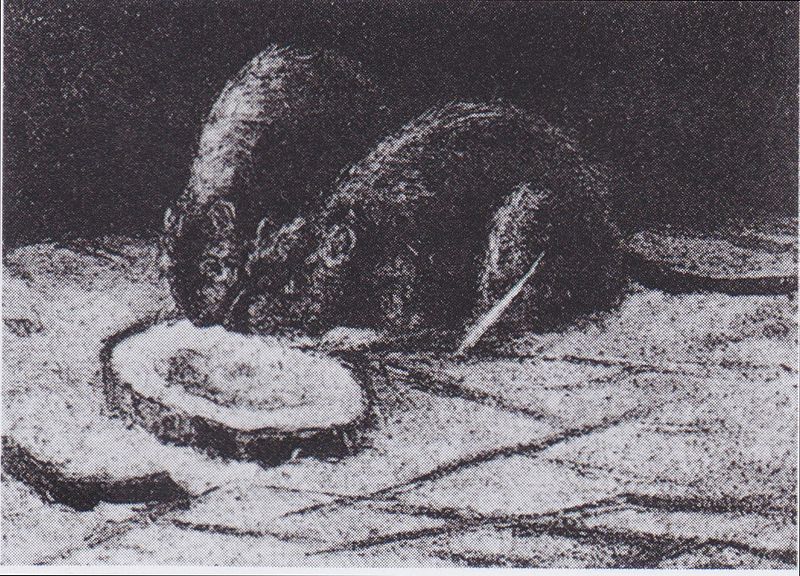
“A rat with a wooden leg is a curiosity as curiosities go nowadays. Yet such an animal can be seen any day at the residence of a man named Dugmore, in the southwestern section of the city. About a month ago, Willie Dugmore, a lad of 12 years, found the little rodent trapped in the cellar. His first impulse was to brain the pest with a base ball bat, but the rat looked at him so pleadingly that Willie’s heart was touched and he decided to take the trap to an adjoining vacant lot and liberate the animal. This he did, but instead of scampering off, as he expected, the rat limped painfully up to him and began to lick his hand. Willie then discovered that one of the animal’s legs had been almost severed by the trap. Taking the rat home, he cut the leg off and then bandaged the wound, using as a liniment a little vaseline. He then put the rat into a cage and carefully fed and nursed it for a week. He then removed the bandage and found that the wound had completely healed. The rat was, however, unable to walk, and Willie decided he would make for it an artificial leg. Going down to the cellar he obtained a piece of pine, and after some whittling succeeded in making a leg. This he fastened on with a string and was delighted to see that his plan was entirely successful. The rat is now the family pet and can be seen any day hobbling about the kitchen or teasing a little Irish terrier, of which it has made a lifelong friend.”

Tags:

"Give Austin a call."

koala bear for sale – $10 (new york)

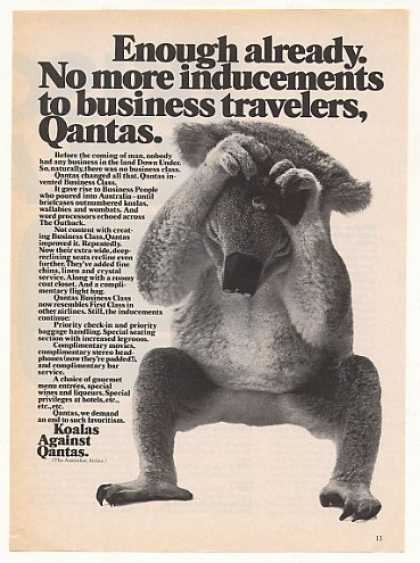
I am moving from my house in downtown New York to Spain. I have a 2 year old koala bear that I can not take with me on the trip. I just want to be assured that he will be cared for the right way and you have a place big enough for him. Please give Austin a call.

William F. Buckley, Jr. joined by hit-making producer David Merrick for a discussion about the future of American theater, 1966.

Tags: ,

If moderate conservatives like Jeb Bush are unable to rescue the Republican Party from its own extremism, if Presidential nomination victories become consistently Pyrrhic and disqualifying, will we see the emergence of a more centrist conservative party? Or is the madness of the GOP just a cycling out that will ultimately run its course? Nobody can sum up the Republicans’ recent rocky road and the fork that led it to its precarious current position more eloquently than Louis Menand does this week in the opening of his New Yorker piece, “Money Pol.” An excerpt:

“Once, when winters were cold and the world seemed large, creatures roamed the earth who were permissive on social issues and at ease with big government, yet remained ever faithful to the gods of business and finance. Their principles were abstract but broad-minded: tolerance, free trade, and a belief in something called the American Way. Their personal tastes were conventional. They were surprisingly allergic to indecorum, and disinclined to question the status quo. But they were not small-town or provincial; they were Wall Streeters, not Main Streeters. Their vista was international. They were private-sector types who answered the call to public service. They were liberal Republicans. Nelson Rockefeller was such a creature. So were Prescott Bush, William Scranton, Charles Percy, John Lindsay, Mark Hatfield, Elliot Richardson, and George Romney.

Then, one year, a powerful meteor struck the planet, and, virtually overnight, the entire species was wiped out. The meteor’s name was Ronald Reagan. Political paleontologists, looking back at the fossil record, can detect signs pointing to the organism’s imminent extinction that predate the Reagan era. Richard Nixon, for example, showed that a pro-business, big-government Republican, by appealing to suburban anti-Communism and white working-class resentment, could take a populist road to the White House. Men like Rockefeller and Romney despised Nixon; but they could never beat him. Liberal Republicans did not like to get into the political mud.”

••••••••••

Nelson Rockefeller, 1964: “The Republican Party must repudiate these people.”

Tags: , ,

Jonah Lehrer has an intriguing, counterintuitive argument in the Wall Street Journal, which posits that creativity isn’t just something for the chosen few, but a quality everyone possesses. Embedded in the article is the origin story of the Post-It Note. An excerpt:

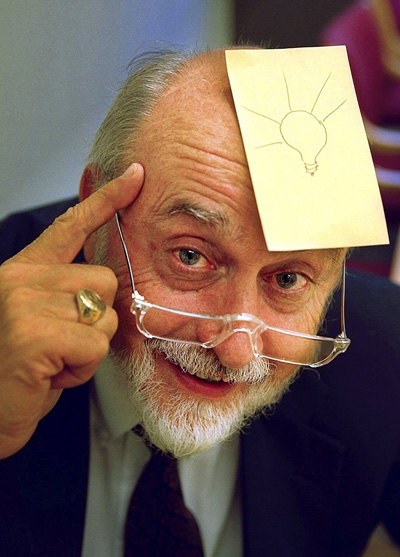
“Consider the case of Arthur Fry, an engineer at 3M in the paper products division. In the winter of 1974, Mr. Fry attended a presentation by Sheldon Silver, an engineer working on adhesives. Mr. Silver had developed an extremely weak glue, a paste so feeble it could barely hold two pieces of paper together. Like everyone else in the room, Mr. Fry patiently listened to the presentation and then failed to come up with any practical applications for the compound. What good, after all, is a glue that doesn’t stick?

On a frigid Sunday morning, however, the paste would re-enter Mr. Fry’s thoughts, albeit in a rather unlikely context. He sang in the church choir and liked to put little pieces of paper in the hymnal to mark the songs he was supposed to sing. Unfortunately, the little pieces of paper often fell out, forcing Mr. Fry to spend the service frantically thumbing through the book, looking for the right page. It seemed like an unfixable problem, one of those ordinary hassles that we’re forced to live with.

But then, during a particularly tedious sermon, Mr. Fry had an epiphany. He suddenly realized how he might make use of that weak glue: It could be applied to paper to create a reusable bookmark! Because the adhesive was barely sticky, it would adhere to the page but wouldn’t tear it when removed. That revelation in the church would eventually result in one of the most widely used office products in the world: the Post-it Note.”

Tags: , ,

I can’t believe this blog’s lasted this long. Seriously, I’m horrified.

So, texting while driving is pretty much fine now. I kid.

Printed knowledge made it possible for us to be intellectuals, to shift attention from land to library, even encouraged us to do so. But what does having a smartphone, with its icons and abbreviations, as our chief means of information gathering portend for us? And what does it mean for the next few generations born to its efficacy?

If we’re mainly typing with our thumbs, mostly communicating in short bursts of letters and symbols, relying largely on algorithms, who are we then? Will an ever-increasing reliance on technology dumb us down? Or will it ultimately free us of ideologies, those abstractions that often conflict violently with reality? And if so, is that a good thing?

In the excellent 2011 Wired article, “The World of the Intellectual vs. the World of the Engineer,” Timothy Ferris makes an argument for rigorous science over intellectual theory. I don’t completely agree with him. Democracy was a pretty potent and wonderful abstraction before it became a reality. And saying that Freud “discovered nothing and cured nobody” isn’t exactly fair since realizing that there are unconscious forces helping to drive our behavior has been an invaluable tool. But Ferris still makes a fascinating argument. An excerpt:

“Being an intellectual had more to do with fashioning fresh ideas than with finding fresh facts. Facts used to be scarce on the ground anyway, so it was easy to skirt or ignore them while constructing an argument. The wildly popular 18th-century thinker Jean-Jacques Rousseau, whose disciples range from Robespierre and Hitler to the anti-vaccination crusaders currently bringing San Francisco to the brink of a public health crisis, built an entire philosophy (nature good, civilization bad) on almost no facts at all. Karl Marx studiously ignored the improving living standards of working-class Londoners — he visited no factories and interviewed not a single worker — while writing Das Kapital, which declared it an ‘iron law’ that the lot of the proletariat must be getting worse. The 20th-century philosopher of science Paul Feyerabend boasted of having lectured on cosmology ‘without mentioning a single fact.’

Eventually it became fashionable in intellectual circles to assert that there was no such thing as a fact, or at least not an objective fact. Instead, many intellectuals maintained, facts depend on the perspective from which are adduced. Millions were taught as much in schools; many still believe it today.

Reform-minded intellectuals found the low-on-facts, high-on-ideas diet well suited to formulating the socially prescriptive systems that came to be called ideologies. The beauty of being an ideologue was (and is) that the real world with all its imperfections could be criticized by comparing it, not to what had actually happened or is happening, but to one’s utopian visions of future perfection. As perfection exists neither in human society nor anywhere else in the material universe, the ideologues were obliged to settle into postures of sustained indignation. ‘Blind resentment of things as they were was thereby given principle, reason, and eschatological force, and directed to definite political goals,’ as the sociologist Daniel Bell observed.

While the intellectuals were busy with all that, the world’s scientists and engineers took a very different path. They judged ideas (‘hypotheses’) not by their brilliance but by whether they survived experimental tests. Hypotheses that failed such tests were eventually discarded, no matter how wonderful they might have seemed to be. In this, the careers of scientists and engineers resemble those of batters in major-league baseball: Everybody fails most of the time; the great ones fail a little less often.”

••••••••••

Intellectualism allows for uncertainty:

Tags:

As their boy was newly named an astronaut in 1962, Neil Armstong’s parents appeared on I’ve Got a Secret.

Tags: , ,

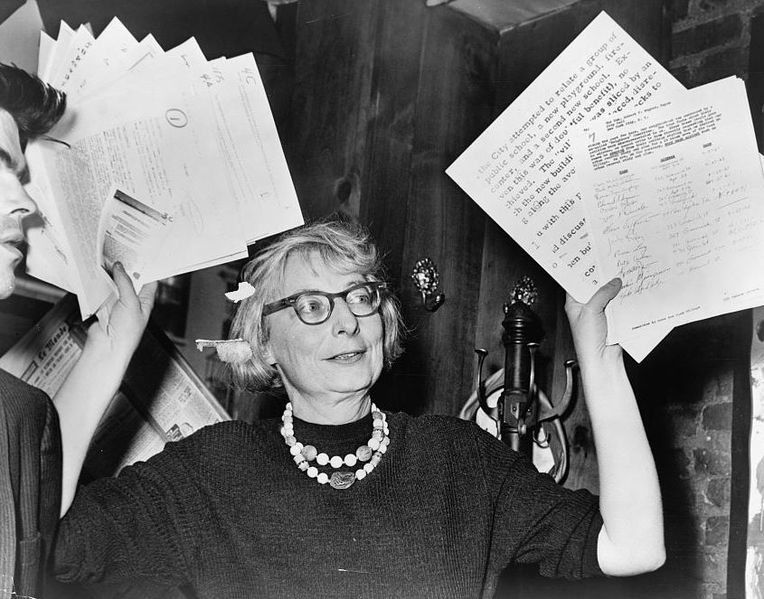
Jane Jacobs saw patterns in the disorder, benevolence in so-called blight, sublimity in street life, angels in the anarchic, and she was (thankfully) a huge pain in the ass until others could see the same. The opening of her landmark 1958 Fortune story, “Downtown Is for People“:

“This year is going to be a critical one for the future of the city. All over the country civic leaders and planners are preparing a series of redevelopment projects that will set the character of the center of our cities for generations to come. Great tracts, many blocks wide, are being razed; only a few cities have their new downtown projects already under construction; but almost every big city is getting ready to build, and the plans will soon be set.

What will the projects look like? They will be spacious, parklike, and uncrowded. They will feature long green vistas. They will be stable and symmetrical and orderly. They will be clean, impressive, and monumental. They will have all the attributes of a well-kept, dignified cemetery. And each project will look very much like the next one: the Golden Gateway office and apartment center planned for San Francisco; the Civic Center for New Orleans; the Lower Hill auditorium and apartment project for Pittsburgh; the Convention Center for Cleveland; the Quality Hill offices and apartments for Kansas City; the downtown scheme for Little Rock; the Capitol Hill project for Nashville. From city to city the architects’ sketches conjure up the same dreary scene; here is no hint of individuality or whim or surprise, no hint that here is a city with a tradition and flavor all its own.

These projects will not revitalize downtown; they will deaden it.”

•••••••••••

“For the answer, we went to the lady over there,” 1969:

Tags:

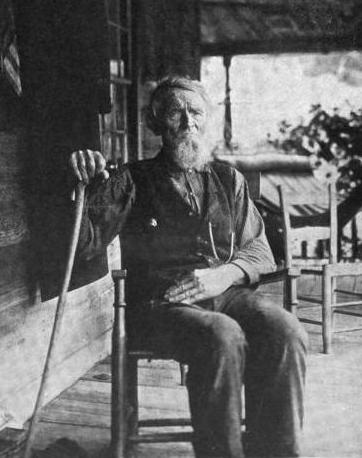
"He was not the fearless bully of old, but a much broken stoop shouldered and crazy old man."

An item about the physical and mental decline of a bullying man in East Tennessee, which was originally published in the Louisville Courier-Journal, appeared in the January 9, 1887 edition of the Brooklyn Daily Eagle. An excerpt from the piece, which is more tall tale than journalism:

“The mountain bully is not unlike his kind met with elsewhere, except in his habits, which are instinctively formed by circumstances and surroundings. He abounds in large numbers throughout the East Tennessee mountains, and generally makes his headquarters about the Summer resorts, country stores, elections, shooting matches and wherever there is a crowd gathered. He is always ‘spilling’ for a fight and frequently gets his satisfaction, usually from some quiet dispositioned person who ‘hain’t much to say.’ The mountain bully gets about half full, goes to a shooting match, chews tobacco, blows about his conquests and his ability to lick the best man in the State, runs upon a ‘say nothin’ sort of feller,’ who puts a head on him and an end to his bragadocio talk. 

A few years ago there died in a mountain county in East Tennessee a man who was a noted bully. He was a splendid specimen of physical manhood and was in every respect a fighting bully. He would fight at the drop of the hat and could knock out a half dozen ordinary men in one round. He would fight for the fun of it, and he who would dare cross his path was indeed a reckless man. In the old days of State militia and ‘musters’ he was a prominent man in his neighborhood and colonel of a militia regiment. On muster days, when the drill was over, he would proceed to clean up the regiment. When he shed his coat, twisted his huge fist around a few times, and yelled at the top of his voice: ‘Hide out, little ‘uns, I’m a comin’,’ there would be a general stampede. This was how he came to be called ‘Old Hide Out’ in after years.
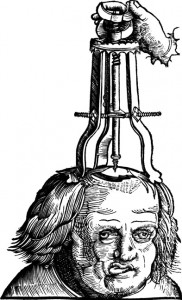
"He rushed into the midst of the Federal soldiers, putting them to flight, not, however, without receiving a serious wound in the head."

When the late war came on he joined a Confederate regiment and made a brave, fearless soldier. During a slight skirmish his company had with the Federals down in Georgia, he took his gun by the muzzle end, with his old time watchword, ‘Hide out, little ‘uns, I’m a comin’!’ rushed into the midst of the Federal soldiers, putting them to flight, not, however, without receiving a serious wound in the head, which put him into the hospital for months and permanently injured his mind.

When he returned to his native county he was not the fearless bully of old, but a much broken stoop shouldered and crazy old man. He would stroll through the neighborhood aimlessly, and seeming unconscious of his whereabouts, always muttering to himself as he went, ‘Hide out, little ‘uns, I’m a comin’.’ Little boys and girls would make sport of him, and ‘Old Hide Out,’ as they called him, paid no heed of their mockery. He had become perfectly harmless.

At last the old man became mortally ill. He was alone in a little cabin provided for his use by an old comrade in the army. A few friends who had known him in his better days gathered around his humble couch expecting the end. It was now late in the afternoon, and the old fellow had not spoken for days. He was rapidly sinking, and some one remarked that he would go down with the sun, which was then pouring its last rays through the chinks and crevices of the cabin wall. Just then his face seemed to lighten up, his eyes twinkled, and he opened his lips.

‘Hide out, little ‘uns, I’m a com–‘

But he never completed his sentence. He had gone.”
"Will I cheat on him while in Germany? Honestly yes."

advice please? (madhattan)

Okay so my boyfriend and I are both coke heads. He is 20 years older than me. Jewish. I have German heritage and am going to Germany with a girlfriend of mine. She is paying for everything. So he says if I go were finished. Then he talks about the Holocaust..like all Germans are happy about that. Anyways now he threatened her to me and it wasn’t pretty. He is kinda crazy but so am I! Will I cheat on him while in Germany? Honestly yes. I am definitely a free spirit. By the way my bf is married! He also shoots heroin and coke. I hate it when he does that because he turns into a paranoid mess! Great huh? What do you think of this? Oh he also has been pressuring me to have sex with him without a condom!! I’ll never do it believe me. 

In 1967, William F. Buckley welcomed beaded LSD guru Timothy Leary, who later became mortal enemies with Art Linkletter.

Tags: ,

There was a theory during Web 1.0, when possibilities seemed infinite, that in the near term the majority of workers would either telecommute or plop down in offices that had communal desks. Why would anyone need to be anchored when the Internet had connected us virtually and set us free? More people certainly telecommute today and many offices have far more democratic architecture, though anonymous desks still aren’t the norm.

But what if the thing that liberated us made us more anchored in other ways? What if being so connected means that our impetus to shift our material lives for new stimuli and opportunities has diminished? In an otherwise interesting Opinion article by Victoria and Todd G. Bucholz in the New York Times about the rising number of young Americans remaining moored in their home states–a trend that’s been increasing since before the recessesion–too little attention is paid to the role new media has played in reducing relocation in the U.S. I would assume a significant percent of that demographic change has to be assigned to technology: More money is spent on tablets, less on motorcycyles. At any rate, here’s an excerpt from the essay:

“The likelihood of 20-somethings moving to another state has dropped well over 40 percent since the 1980s, according to calculations based on Census Bureau data. The stuck-at-home mentality hits college-educated Americans as well as those without high school degrees. According to the Pew Research Center, the proportion of young adults living at home nearly doubled between 1980 and 2008, before the Great Recession hit. Even bicycle sales are lower now than they were in 2000. Today’s generation is literally going nowhere. This is the Occupy movement we should really be worried about.”

Tags:

Helen Keller meets Martha Graham, 1954.

Tags: ,


Some search-engine keyphrases bringing traffic to Afflictor this week:

Afflictor: Thinking the "Sports Illustrated" Swimsuit Issue will change after Rick Santorum becomes President.

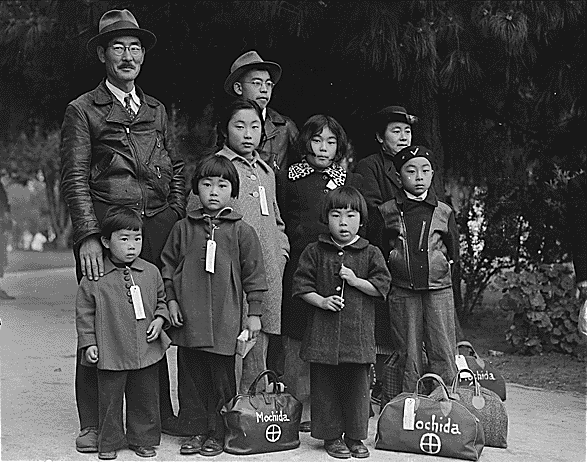
"He raised snapdragons and sweet peas."

While the United States acted with incredible bravery during World War II, one grievous mistake we made was the internment of Japanese-Americans, who were considered suspect merely because we were at war with the land of their ancestry. One such family forced to relocate from their home and community into a camp was the Mochidas of Hayward, California, seen in the above classic photograph, which was taken by the great Dorothea Lange. The original caption:

“Members of the Mochida family awaiting evacuation bus. Identification tags are used to aid in keeping the family unit intact during all phases of evacuation. Mochida operated a nursery and five greenhouses on a two-acre site in Eden Township. He raised snapdragons and sweet peas. Evacuees of Japanese ancestry will be housed in War Relocation Authority centers for the duration.”

••••••••••

Tags: ,

Very cool clip. William F. Buckley, Jr. welcomes filmmaker Otto Preminger in 1967, for a discussion about censorship.

Tags: ,

The opening of “Who Would God Vote For?” a blog post about the intersection of religion and politics in America and Iran that began in earnest in the 1970s, by the BBC’s always provocative Adam Curtis:

“When you bring God into politics very strange things happen. You can see this now in both America and Iran –  in their elections and also in the growing confrontation between them. But it wasn’t always like this – in fact for most of the 20th century fundamentalist religion in both America and Iran had turned its back on the world of politics and power.

But in the 1970s everything changed. For that was the moment when religion was deliberately brought into politics in both countries with the aim of using it as a revolutionary force. And those who did this – Khomeini in Iran, and right-wing activists in America – were inspired by the revolutionary theories and organisations of the left and their ambition to transform society in a radical way.

I want to tell the forgotten story of how this happened – and how in the 1980s both the Americans and the Iranian idealists came together in a very odd way – with disastrous consequences.”

Tags: ,

Sleazy, yes, but I need the traffic.

"The black car threw a baby at me." (Image by T bone.)

In my dream there were a lot of things that transpired.

At first I was in this house, there were two rooms. One was my room and there was a woman in the other. For some reason, it was very odd, I kept going to her bed. It wasn’t for sex. I wasn’t looking for sex. I don’t know if she was ill or what it was but something was the matter.

Then all of the sudden, I looked out the window and there was my mother…. next to this house. I felt safe with her next to me.

Then I walked down to this house that I knew had a problem. And it was a problem that limited my life and I wanted it gone and out and never returning.. So, I went to this black car and started swiping at it because it would not go away and it was throwing things at me.

I was swiping (knocking it out of my way) everything that it was throwing at me… it was so strange. Now this scared me to death. As I was swiping at this black car because it was throwing shit at me, all of the sudden, the black car threw a baby at me. I didn’t see that it was a baby until after I had swiped it… it was like debris coming from a shit storm.

I was frightened. The black car threw a baby at me, but at the time, I didn’t know it. When the baby landed on the ground, it was dead. The black car killed his own baby.

After that experience, I was so frightened. I went over to the baby to see if it was alive. He had killed it. I left because I was frightened and I didn’t know what to do… It was like collateral damage to the black car. Oh well. To me, I just wanted to get out of there and away from that mess.

I left the situation and went right. I walked up to this one area that would not let me get to where I needed to be.

To get to where I needed to be, I had to get past a pole of cement blocks. I remember in the dream, I was focusing on two cement blocks that were causing the most trouble, they were at the top of the pole. So what did I do, I climbed up the cement blocks and reached the top. I was in a very deep, flat area, but after getting past the cement blocks I reached the top.

After reaching the top, I started walking up this incline. I saw in the distance houses. I was walking towards the houses. Off to the side, there were these two women that were at the back door talking to someone. Then all of the sudden, they started coming at me. One woman followed the other woman as they were coming at me. They were both going down the incline. Their words to me as they past by were, “his pants are up and he is packed”. They said it like they were mad at me. They were coming at me and going down the incline. It was like what they were trying to do, they had no control of anymore. They had one last opportunity to come at me and then they were going down the incline to the bottom.

They were in the past and I was looking towards my future.

I climbed past them. It didn’t matter what they gained it was all just superficial blocks that could not stop me. I got to the top of them and they were left behind no longer affecting my life. They were the ones trying to keep me in a low place, but by my sheer tenacity, I was able to overcome them.

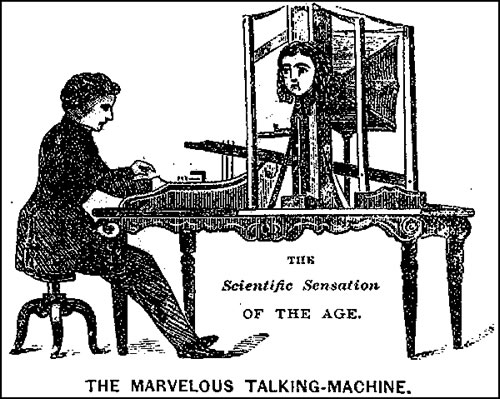
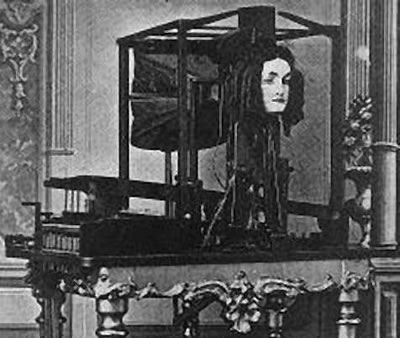
Nearly 170 years before Siri, German inventor Joseph Faber demonstrated his Talking Machine, most commonly known as “Euphonia,” which was able to speak sentences in a human if monotone voice. The marvel became a staple of Barnum’s shows, but Faber died without much to his name in the 1860s and his wife–and his contraption–fared just as poorly. Two brief articles follow about the inventor and his machine from the Brooklyn Daily Eagle.

••••••••••

“Talking Machines” (October 15, 1870): “Some readers may remember Professor Faber’s automaton speaking figure, called THE EUPHONIA, when exhibited in London. It was a draped bust with a wax face. Concealed from the visitors were sixteen keys or levers, a small pair of bellows, and numerous little bits of metal, wood, and India-rubber. When any word or sentence was spoken out, either by Faber or by one of the sudience, the exhibitor mentally divided all the syllables into as many distinct sounds as they embodied; he pressed upon a particular key for each particular sound, which admitted a blast of air to a particular compartment, in which the mechanism was of the kind to produce the sound required; there were thus as many pressures as there were elementary sounds. By a modification of the movements, whispering could be produced instead of speaking.”

••••••••••

“The Talking Machine Was There” (July 24, 1887): “Mrs. Mary Faber, the wife of Professor Faber, who had traveled around the country for years with his talking machine, took Paris green yesterday at 207 East Twenty-Fifth Street, New York. When the police were about to take her from the room Mrs. Faber recovered consciousness for a moment and, pointing to a satchel, declared that the talking machine was there. She wanted it sold to pay the rent. She will probably die.”

Tags: ,

Neil deGrasse Tyson testifying in D.C. about the foolishness of an absence of a comprehensive U.S. space program.

Tags:

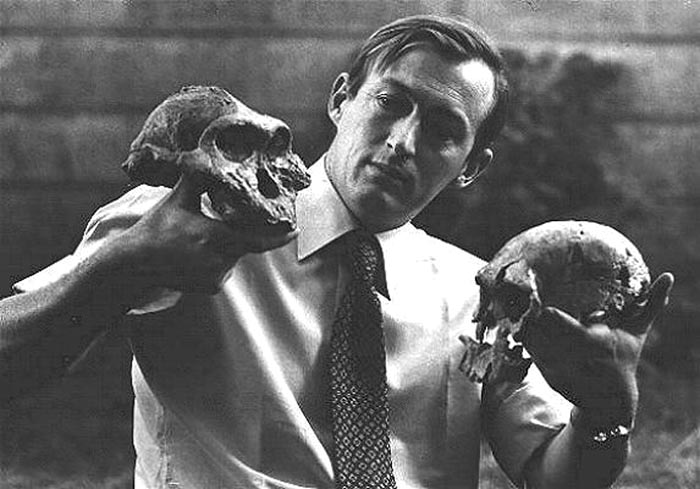
From “The Last Famine,” Paul Salopek’s sweeping Foreign Policy piece on hunger, a contemporary portrait of legendary paleoanthropologist Richard Leakey:

“The Turkana Basin is a freakishly beautiful place. A gargantuan wilderness of hot wind and thorn stubble, it covers all of northwestern Kenya and spills into neighboring Uganda, Ethiopia, and South Sudan. Black volcanoes knuckle up from its pale-ocher horizons. Lake Turkana — the largest alkaline lake in the world, 150 miles long — pools improbably in its arid heart. The lake is sometimes referred to, romantically, as the Jade Sea; from the air, its brackish waters appear a bad shade of green, like tarnished brass. Turkana, Pokot, Gabra, Daasanach, and other cattle nomads eke out a marginal existence around its shores. The basin’s dry sediments, which form part of the Great Rift Valley, hold a dazzling array of hominid remains. Because of this, the Turkana badlands are considered one of the cradles of our species.

Richard and Meave Leakey, the scions of the eminent Kenyan fossil-hunting family, have been probing deep history here for 45 years. Their oldest discovery, a pre-human skull, about 4 million years old, was found on a 1994 expedition led by Meave. An earlier dig headed by Richard uncovered a fabulous, nearly intact skeleton of Homo ergaster, dating back 1.6 million years, dubbed the Turkana Boy. Both Leakeys told me the modern landscape had changed nearly beyond recognition since their excavations began in the 1960s. The influx of food aid and better medical services had more than tripled the human population and stripped the region of most of its wild meat, wiping out the local buffalo, giraffe, and zebra. Domestic livestock — exploding and then crashing with successive droughts — had scalped the savannas’ fragile grasses. While driving one day near his headquarters, the Turkana Basin Institute, Richard pointed at a dusty cargo truck, its bed piled high with illegally cut wood. ‘Charcoal for the Somali refugee camps,” he said with a puckish smile. ‘The U.N. pays for it.’

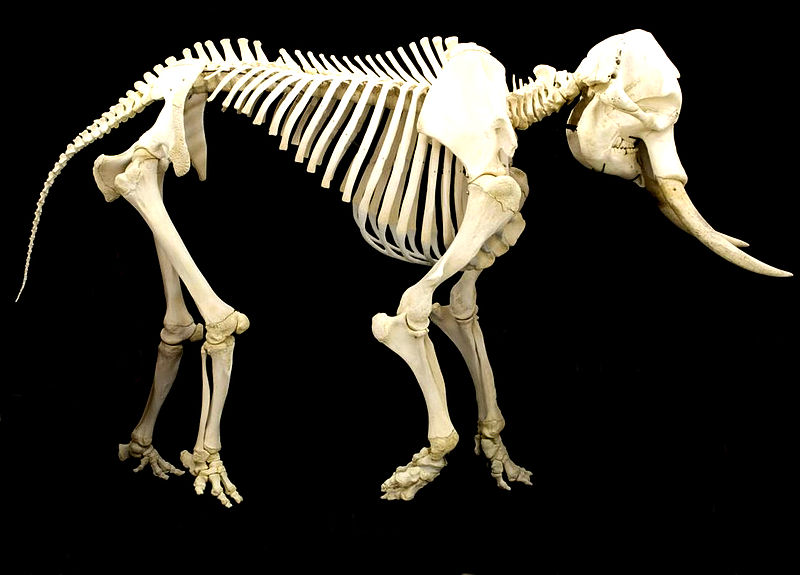
Leakey is not only a celebrity thinker. He is also an incorrigible provocateur and a man of big and restless ambitions. Bored with the squabbles of academic research (‘I could never go back to measuring one tooth against another’), he abandoned the summit of paleoanthropology in the late 1980s to assume the directorship of Kenya’s enfeebled wildlife service, where he became a hero to conservationists by ordering elephant poachers shot on sight. A few years later, he helped organize Kenya’s first serious opposition party, and those activities invited years of police harassment. (A 1993 plane crash, which Leakey blames on sabotage, resulted in the loss of both his legs below the knee; he now gets around — driving Land Rovers, piloting planes — on artificial feet.) At one point, I asked him about heavy bandages on his head and hands at a recent lecture at New York’s Museum of Natural History. He had been suffering from skin cancers, he explained, that metastasized from old police-baton injuries. Leakey tends to view humankind through a very long lens, and pessimistically.”

••••••••••

Two Richards, Leakey and Dawkins:


Tags: , ,

« Older entries § Newer entries »