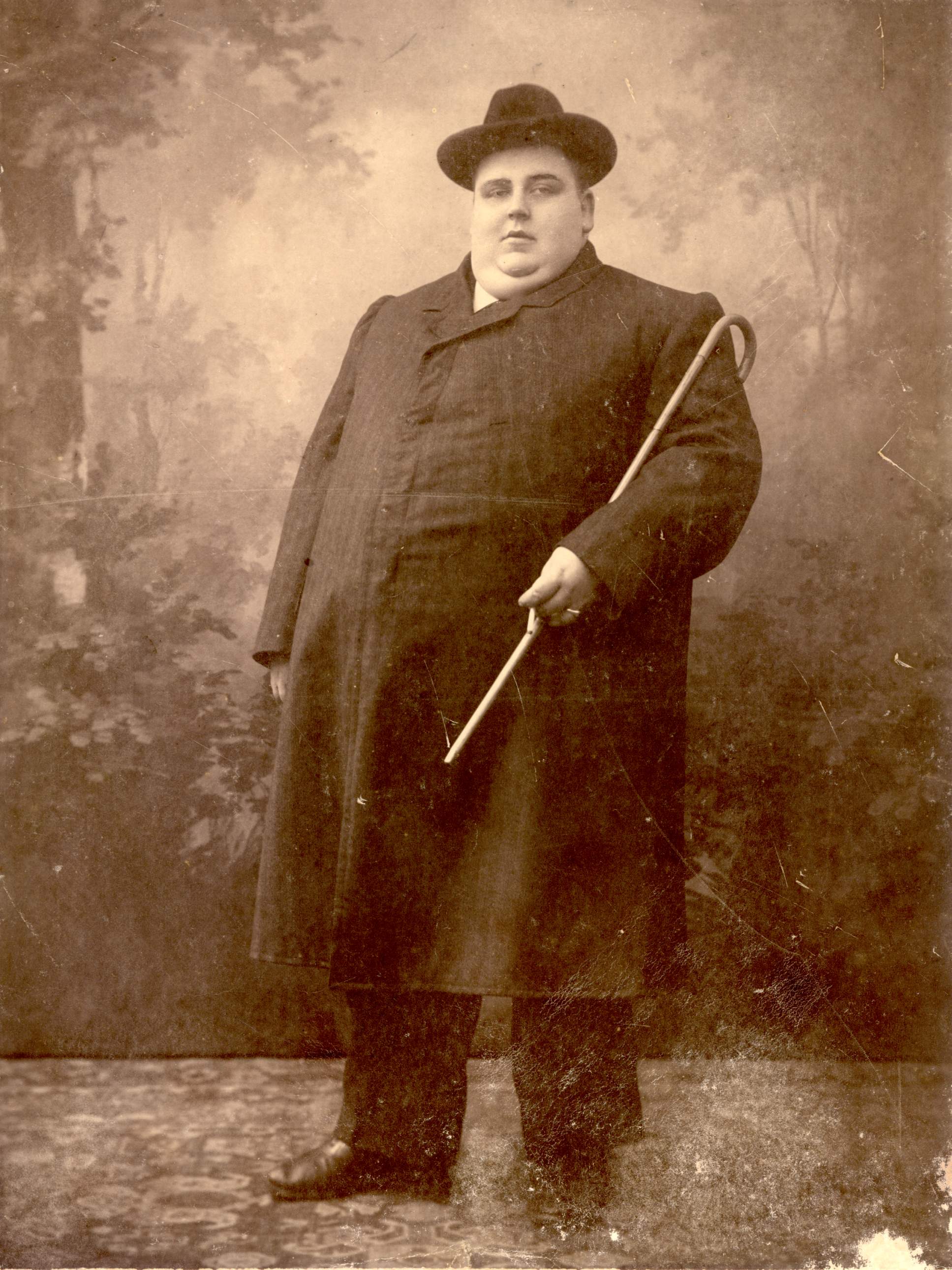
I don’t know how it is elsewhere, but in America we often choose to believe narratives rather than facts. That’s why union members vote for anti-union politicians and President Obama is referred to as a “socialist” after returning Wall Street to dizzying heights. Our delusional egos are often more important to us than even our self-interests, our fantasies dearer than our realities.

Below: The great George Carlin holds forth on advertising and other forms of deeply ingrained American bullshit.

Tags:

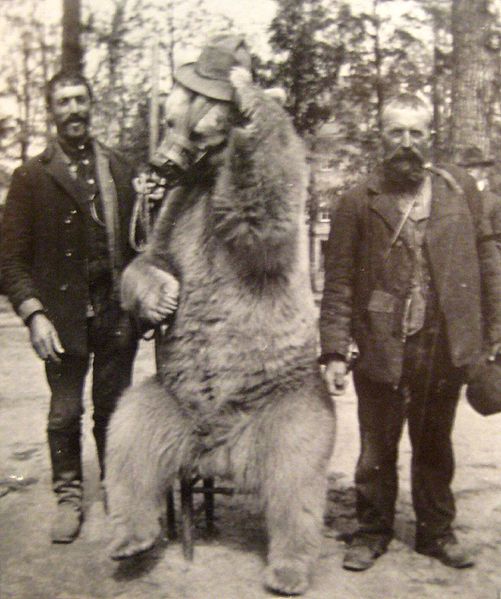
"He rushed into the room valiantly and found himself face to face with a huge brown bear. "

Somehow no one was mauled to death during a deeply dangerous and deeply funny practical joke that was reported on in the August 23, 1894 edition of the Brooklyn Daily Eagle. The story in full:

“A wild, unearthly yell broke the tower of the old iron pier at about 1 o’clock this morning. It proceeded from the handsome apartments occupied by Mr. A.S. Judge, the superintendent of the old iron pier, and the brother-in-law of Mr. Pierre Lorillard. So piercing was the shriek, that it even had the potence to arouse Sarcarichi, Mr. Judge’s Japanese servant, from his slumbers. Hurriedly throwing on a loose Japanese gown Sarcarichi flew to his master’s room, fully convinced that murder was being done. He rushed into the room valiantly and found himself face to face with a huge brown bear. Sarcarichi is no coward, but he glanced around very cautiously before he bolted again for the door. In this brief glimpse he saw his employer curled up in bed with clothes pulled up over his head. This was enough for Sarcarichi. With a yell which would not have been discreditable to a Comanche Indian he fled, his coattails flying backward. Bruin looked at the flying figure, and, thinking it was another chance for some fun, pursued the Japanese from the room. No sooner was it cleared than Judge leaped  to his feet, locked and double locked his door.

The bear’s keeper caught the animal at the bottom of the stairs. The entire trouble occurred because Mr. Judge boasted that even if the London Zoo broke loose it wouldn’t frighten him. Harry Sturdevent, to whom the remark was made, gave a dollar to the keeper of the bear. Whether or not there is any connection between these facts is matter for speculation.”


Tags: , , ,

Ben Ehrenreich, a brilliant guy who is consumed by death, looked at the end of print in an electric age in his great 2011 essay, “The Death of the Book,” at the Los Angeles Review of Books. An excerpt:

“In 1962, Marshall McLuhan had published an almost spookily prescient book titled The Gutenberg Galaxy. It was, among other things, an extended critique of the culture of print. Technology shapes our consciousness, McLuhan argued, and the development of the printed book in the mid-fifteenth century had inaugurated a reorientation of human experience towards the visual, the regimented, the uniform and instrumental. Language, which had once been a wild, uncontainable affair between the oral and aural (think whisper, shout, and song, the playful market-square dynamism of dialect and argot) was silenced, flattened, squeezed into lines evenly arrayed across the rectilinear space between the margins. Spellings were standardized, vernaculars frozen into national languages policed by strict academies. Print, for McLuhan, was the driver behind all that we now recognize as modern. Through it nationalisms arose, and other horrors: capitalism, individualism, alienation. Time itself was emptied out—reduced, like the words on each page, to a linear sequence of homogeneous moments. Print had stolen something. Books had shrunk us. They had ‘denuded’ conscious life. ‘All experience is segmented and must be processed sequentially,’ McLuhan mourned. ‘Rich experience eludes the wretched mesh or sieve of our attention.’

An end was in sight. We had already entered a ‘new electric age’ characterized by interdependence rather than segmentation. ‘The world has become a computer,’ McLuhan wrote, ‘an electronic brain, exactly as in an infantile piece of science fiction.’ The Internet was still a Cold-War fantasy, but for McLuhan print’s corpse was already growing cold. (He dated the collapse of the Gutenberg Galaxy to 1905 and Einstein’s early work on relativity.) This was not necessarily cause for optimism. McLuhan coined the phrase ‘global village’ to describe the hyper-networked world that was already taking shape. He had no illusions, though, about the nobility of village life. Our newly TV-, telephone-, and radio-enwebbed multiverse could just as easily be ruled by ‘panic terrors … befitting a world of tribal drums’ as by any bright pastoral harmony. And so it was and is.”

In 1967, when Jacques Derrida took up the theme of ‘the end of the book’ in Of Grammatology, McLuhan’s ideas were still sufficiently in the air that the philosopher could refer to ‘this death of the civilization of the book of which so much is said’ without need for further explanation. But the ‘civilization of the book,’ for Derrida, meant more than the era of moveable type. It preceded Gutenberg, and even the medieval rationalists who wrote of ‘the book of nature’ and via that metaphor understood the material world as revelation analogous to scripture. The book for Derrida stood in for an entire metaphysics that reached back through all of Western thought: a conception of existence as a text that could be deciphered, a text with a stable meaning lodged somewhere outside of language. ‘The idea of the book is the idea of a totality,’ he wrote. ‘It is the encyclopedic protection of theology and of logocentrism against the disruption of writing, against its aphoristic energy and … against difference in general.’ Those, in case you couldn’t tell, are fighting words.”

••••••••••

Dylan goes electric, Newport, 1965:

Tags: ,

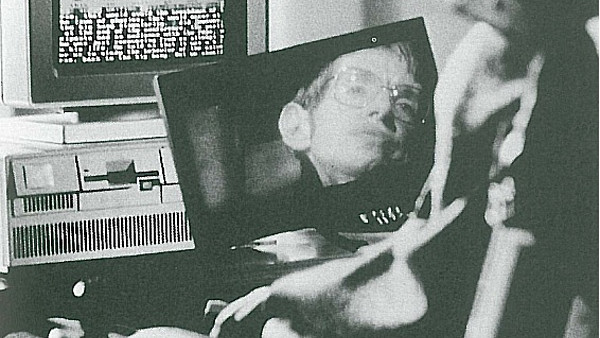
From “A Little Device Trying to Read Your Thoughts,” David Ewing Duncan’s New York Times article about Stephen Hawking adopting the iBrain:

“Already surrounded by machines that allow him, painstakingly, to communicate, the physicist Stephen Hawking last summer donned what looked like a rakish black headband that held a feather-light device the size of a small matchbox.

Called the iBrain, this simple-looking contraption is part of an experiment that aims to allow Dr. Hawking — long paralyzed by amyotrophic lateral sclerosis, or Lou Gehrig’s disease — to communicate by merely thinking.

The iBrain is part of a new generation of portable neural devices and algorithms intended to monitor and diagnose conditions like sleep apnea, depression and autism. Invented by a team led by Philip Low, a 32-year-old neuroscientist who is chief executive of NeuroVigil, a company based in San Diego, the iBrain is gaining attention as a possible alternative to expensive sleep labs that use rubber and plastic caps riddled with dozens of electrodes and usually require a patient to stay overnight.

‘The iBrain can collect data in real time in a person’s own bed, or when they’re watching TV, or doing just about anything,’ Dr. Low said.”

••••••••••

Main title music by Philip Glass for Errol Morris’ 1991 Hawking film:

Tags: , , , ,

Heart surgery from NYU Medical Center was broadcast on live TV in 1958. 

In the post about Olivetti, I mentioned the Austrian-born design genius Ettore Sottsass, who passed away in 2007. Here’s a piece from his best-known essay, “When I Was a Very Small Boy“:

“Now that I’m old they let me design electronic machines and other machines in iron, with flashing phosphorescent lights and sounds and no one knows whether they are cynical or ironical: now they only let me design furniture that ought to be sold, furniture they say, that is useful to society, they say, and other things that are sold ‘at low prices’ they say, and in this way they can sell more of them, for society they say, and now I design things of this kind. Now they pay me to design them. Not much, but they pay me. Now they look for me and wait for models from me, as they say, ideas and solutions which end up heaven knows where.

Now everything seems to have changed. The things I do (by myself or with my companions) seem to have changed and the way they are done also seems to have changed because, goodbye bright blue Planet, goodbye melodious seasons, goodbye stones, dust, leaves, ponds, and dragon flies, goodbye boiling-hot days, dead dogs by the roadside, shadows in the wood like prehistoric dragons, goodbye Planet, by now I feel as if I do the things I do sitting in a bunker of damp artificial light and conditioned air, sitting at this white laminate table, sitting in this silver plastic chair, captain of a spaceship traveling at thousands of miles an hour, squashed against this seat — immobile in the sky.

By now I have to think of things from an artificial space, with neither place nor time; a space only of words, phone-calls, meetings, timetables, politics, waiting, failures. By now I’m a professional acrobat, actor and tightrope walker, for an audience that I invent, that I describe to myself, a remote audience with whom I have no contact, stifled echoes of whose talking, clapping and disapproval reach me, whose wars, catastrophes, famines, suicides, escapes, poverty or anxious restings along crowded beaches or inside smoky stadiums I read about in papers; how can I know who are the ones expecting something from me?

I would like to break this strange mechanism I’ve been driven into.”

Tags:

"I don't want to kill him." (Image by George Chernilevsky.)

One stupid feeder goldfish – $1 (Flushing)

I bought him from a feeder tank at Petco. He’s been a headache for almost 2 months now. Three days after I got him, he got sick. The meds I bought cost a lot but I managed to nurse him back to health.

Now all he does is eat and poop and swim like he’s had ten mugs of coffee. Anyway, I don’t want him anymore. The Petco won’t take him back. And I don’t want to kill him cause I spent so much time and money saving him. The little idiot doesn’t know how lucky he is. Feeders are destined to die. He should’ve been eaten by a snake by now. Hell, if I had a snake, I’d have fed him to one by now.

As for why I got him to begin with, I’ve got other goldfish, and he was really beautiful at first. But he lost all his colors cause I had him quarantined in a hospital tank in a dark room. I say he’s a dollar, but you can have him for free. Don’t even need to tell me what you plan on doing with him. But it’d be nice if a kid would take him. I know folks believe goldfish are boring, but HE’S REALLY CRAZY ENERGETIC. Just give him plenty of room to swim and gravel to poke at. Or a fish treadmill. 

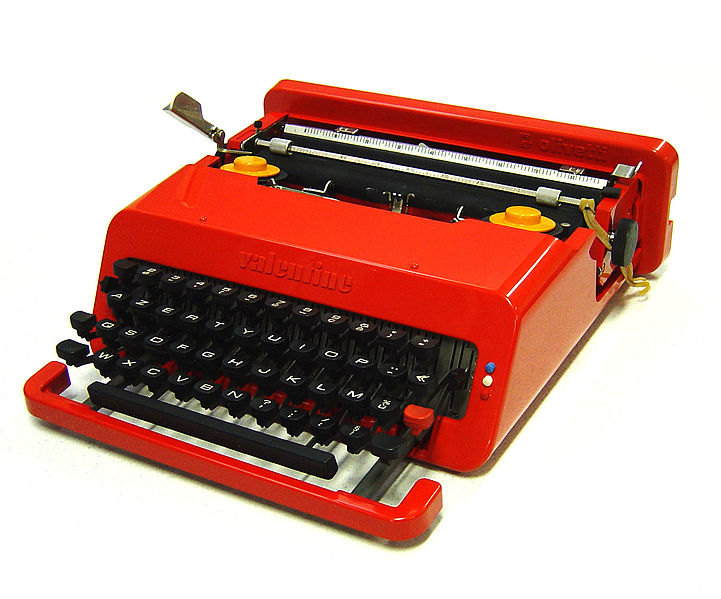
Short doc about the Olivetti company, which gave us the first desktop personal computer in 1964, the Programma 101, and brought a liberating modern design sense to all sorts of information systems. How could we be terrified of something that looked so cool?

The Valentine typewriter, designed in 1969 for Olivetti by Ettore Sottsass, is one of the best commercial designs ever. It was marketed as a typewriter you would use outside of the office. Information tools could be personal, portable and non-institutional.

Tags: , ,

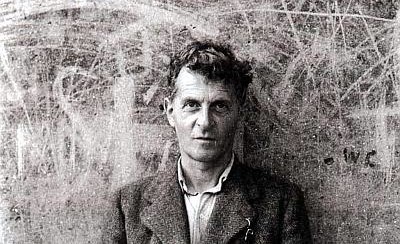
From Culture and Value, Ludwig Wittgenstein on technology:

The truly apocalyptic view of the world is that things do not repeat themselves. It is not e.g. absurd to believe that the scientific & technological age is the beginning of the end for humanity, that the idea of Great Progress is a bedazzlement, along with the idea that the truth will ultimately be known; that there is nothing good or desirable about scientific knowledge & that humanity, in seeking it, is falling into a trap. It is by no means clear that this is not how things are.•

___________________________

Karl Johnson as the philosopher in Derek Jarman’s 1993 biopic:

Tags: , ,

Old Time wrestling legend Chief Jay Strongbow reportedly passed away today. The good Chief was always very proud of his Native American heritage, which was impressive since he was Italian. Here he is fighting a galoot, for some strange reason, inside of a shark cage. Who booked this shit?

Tags:

Video about the press conference to promote the 1992 rematch between Bobby Fischer and Boris Spassky, which was played for money, not glory. Fischer was far gone at this point, a sad spectacle overflowing with demons.

Tags: ,

"Monkeys could choose whether they got a tiny square of blue Jell-O or a big chunk of red Jell-O." (Image by Donar Reiskoffer.)

From Amy Dockser Marcus’ WSJ article about Yale psychologist Laurie Santos’ experiments with monkey-based economics, an excerpt about the differences between human and simian fiscal sense:

The experiments that have been done so far show that many of our economic behaviors are deeply rooted. Still, there appears to be a place where the two species part ways.

Researchers wondered whether monkeys, like humans, desire an expensive item more. For the same number of tokens, the monkeys could choose whether they got a tiny square of blue Jell-O or a big chunk of red Jell-O. Later, the monkeys were allowed to choose which kind they wanted. If the monkeys were like humans, they would have gone for the blue Jell-O, the more ‘expensive’ choice. But the monkeys gorged happily on both.

The researchers are still gathering and analyzing the data. One possibility: Human taste preferences are based on many factors, whereas the monkeys’ are not. Some might argue that human economic behavior is more advanced since it includes ‘culture and meta-awareness’ in decision-making, said Dr. Santos. There’s another, less flattering possibility too. ‘The monkeys,’ she said, ‘are more rational.'”

••••••••••

Santos lectures on monkey economics at TED:

Tags: ,

Speaking of B.F. Skinner, his daughter, Deborah, has always vehemently denied charges that she was raised as a Behaviorist lab rat. From a 2004 Guardian article:

“My early childhood, it’s true, was certainly unusual – but I was far from unloved. I was a much cuddled baby. Call it what you will, the ‘aircrib,’ ‘baby box,’ ‘heir conditioner’ (not my father’s term) was a wonderful alternative to the cage-like cot. My father’s intentions were simple, and based on removing what he and my mother saw as the worst aspects of a baby’s typical sleeping arrangements: clothes, sheets and blankets. These not only have to be washed, but they restrict arm and leg movement and are a highly imperfect method of keeping a baby comfortable. My mother was happy. She had to give me fewer baths and of course had fewer clothes and blankets to wash, so allowing her more time to enjoy her baby.

I was very happy, too, though I must report at this stage that I remember nothing of those first two and a half years. I am told that I never once objected to being put back inside. I had a clear view through the glass front and, instead of being semi-swaddled and covered with blankets, I luxuriated semi-naked in warm, humidified air. The air was filtered but not germ-free, and when the glass front was lowered into place, the noise from me and from my parents and sister was dampened, not silenced.

I loved my father dearly. He was fantastically devoted and affectionate. But perhaps the stories about me would never have started if he had done a better job with his public image. He believed that, although our genes determine who we are, it is mostly our environment that shapes our personality. A Time magazine cover story ran the headline ‘BF Skinner says we can’t afford freedom.’ All he had said was that controls are an everyday reality – traffic lights and a police force, for instance – and that we need to organise our social structures in ways that create more positive controls and fewer aversive ones. As is clear from his utopian novel, Walden Two, the furthest thing from his mind was a totalitarian or fascist state.”

Tags: ,

Finally got around to reading the Economist article, “What Happened to the Flying Car?” An excerpt about a couple of such vehicles close to the market:

“The Transition is being aimed at pilots who want to be able to drive to the airport and take off without changing vehicles, or land at a distant airport and not be stranded. As its name implies, it is intended to be a transitional product, a step on the way to true sky cars capable of taking off and landing almost anywhere. Such aircraft will require the development of more efficient motors and better control systems, says Rob Bulaga, president of Trek Aerospace in Folsom, California, another company developing a flying car.

Trek is adapting a ‘personal aerial vehicle’ concept originally developed for DARPA, the research-funding agency of America’s Department of Defence, to create a civilian vehicle. This two-seater, the Tyrannos, has ducted propellers powered by petrol engines, with a battery backup. Although it has been possible to make such vehicles for decades, they are notoriously difficult to fly. ‘It’s just basic physics,’ says Mr Bulaga. ‘Any vehicle that takes off and lands vertically is unstable.’ To make it practical, computers are needed to make the constant tweaks required to achieve stable flight. Without them, even just hovering is like trying to stand on a beachball, he says.”

••••••••••

A personal flying vehicle from Trek Aerospace:

Tags:

William F. Buckley and B.F. Skinner, in 1973, discussing moral development.

See also:

Tags: ,

Before the sun dies, we are likely to be struck by about ten asteroids that can return us to the Permian Era–or worse. What to do? The opening of “Deflecting Asteroids,” Gregory L. Matloff’s IEEE Spectrum piece:

In early 2007, I took part in a NASA Marshall Space Flight Center study of proposed deflection techniques that could be ready for use by the end of 2020. My colleagues and I assumed that by that point we’d have a heavy-lift booster capable of sending 50 000 kg or more on an Earth-escape trajectory.

We considered several strategies. The most dramatic—and the favorite of Hollywood special-effects experts—is the nuclear option. Just load up the rocket with a bunch of thermonuclear bombs, aim carefully, and light the fuse when the spacecraft approaches the target. What could be simpler? The blast would blow off enough material to alter the trajectory of the body, nudging it into an orbit that wouldn’t intersect Earth.

But what if the target is brittle? The object might then fragment, and instead of one large body targeting Earth, there could be several rocks—now highly radioactive—headed our way. Also, a lot of people might object to even the mere testing of any plan that involved lobbing 100-megaton bombs into space. The nuclear option might then be limited to a last-ditch defense of Earth, should we get little warning of an impending impact.”

••••••••••

Future scientists in training, 1979:

Tags:

"High quality." (Image by Manfred Morgner.)

Free high-quality sand (Midtown West)

We have two tons of sand that was used for a photoshoot, and now have no use for. You can take as much as you can haul. We have dollys and shovels to help move it.


Befuddled dowager Margaret Dumont’s final appearance–hello, she must be going–was fittingly made with longtime tormentor Groucho Marx in 1965. She died three days after this ancient piece from Animal Crackers was taped. And speaking of ancient pieces, ladies and gentlemen, Margaret Dumont.

Tags: ,

"For a wager he would eat a whole sheep or whole pig."

A story about dietary anomalies, which appeared in the January 30, 1887 edition of the Brooklyn Daily Eagle and was originally published in Good Housekeeping. An excerpt:

“Elizabeth Charlotte, the Duchess of Orleans, writing under the date of December 5, 1718, says: ‘The late king, monsieur the Dauphin, and the Duc de Berri were enormous eaters. I have often seen the King eat four plates of different kinds of soup, a whole pheasant, a partridge, a dish of salad, two thick slices of ham, mutton flavored with garlic, a plateful of pastry and finish his repast with fruit and hard boiled eggs.’ There was a good old German from Wittemberg, where my Lord Hamlet attended the university, who had a fine faculty for storing away provender. His case is well attested. For a wager he would eat a whole sheep or whole pig or put out of sight a bushel of cherries, stones and all. He lived until he was 80 years of age, a great portion of the time supporting himself by exhibiting the peculiarity of his appetite, which, to say the least, must have been a very eccentric one. Thus, he would chew glass, earthenware and flint into small fragments. He had an especial preference for caterpillars, mice and birds, and when these were not procurable he would content himself with mineral substances. Once he put down his maw and gull a pen, the ink and the sand pounce and he would have gobbled the inkstand, too, had he not been restrained.

Dr. Copland, in speaking of two children who had wonderful appetites, the youngest 7 seven years old being the worst, said: ‘The quantity of food devoured by her was astonishing. Everything that could be laid hold of, even in its raw state, was seized upon most greedily. Among other articles, an uncooked rabbit, half a pound of candies and some butter, were taken at one time. The mother stated that this little girl, who was apparently in good health otherwise, took more food if she could possibly obtain it, than the rest of her family, consisting of six besides herself.’

Instances of depraved appetite are numerous, and men have been known to swallow fire, swords, spiders, flies, toads, serpents, cotton, hair, paper, wood, cinders, sand, earth, clay, chalk, flint, musket balls and gold watches. One man could swallow billiard balls.”
The late, great Hiram Bullock joins David Sanborn, Marcus Miller, Omar Hakim and Philippe Saisse on Night Music in 1989 to jam on electric toy instruments.

Tags: , , , ,

From a typically eccentric Adam Curtis essay, “Bodybuilding and Nation-Building,” a look at how developing muscles was begun as a riposte to industrialization:

“At the end of the nineteenth century a fanatical craze for physical fitness swept through Britain. Millions of men and women took up gymnastics, body building and other physical exercises.

Such a thing had never happened before – and it was given a name – Physical Culture.

The craze had an almost religious intensity because those who promoted it said that it was the only way to prevent the British nation – and its Empire – from collapsing. Behind this was a powerful belief that the modern world of the 1890s – the teeming cities with their slums and giant factories – was leading to a ‘physical degeneracy’ in millions of people.

It was a fear that had started with the elite who ran Britain’s public schools. Matthew Arnold warned of ‘the strange disease of modern life’ with its ‘sick hurry’ and ‘divided aims.’ Out of that came a movement called ‘Muscular Christianity’ which wanted to recreate the kind of heroic human being that existed before industry and the modern world came along and corroded everything.

It was a vision of a restored physical and moral perfection in the young men who were going to run the empire. And it involved doing lots of exercises in new things called Gymnasiums. Then liberal reformers got worried about the working classes –  convinced that the slums were leading to a ‘physical degeneracy.’ So they persuaded lots more people to do exercises.

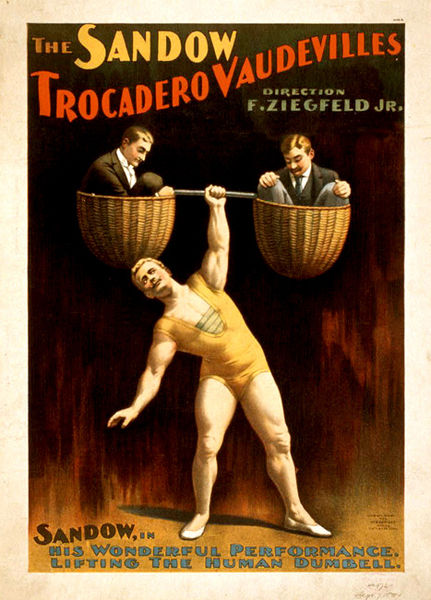
Then a figure rose up who united all of this dramatically into a mass movement. He was called Eugen Sandow.

Sandow came from Prussia, he started as a circus and music-hall performer. But then in the late 1890s he invented something he called ‘body-building.’ It caused a sensation throughout Europe and America – and he became a massive celebrity because he was seen as the leader of a crusade of Physical Culture that was going to stop the degeneracy that was plaguing Britain.” (The Browser.)

Tags: ,

Smart Sand shares information, joins together to form objects. From CNET: “Researchers at MIT have developed a robotic system for duplicating shapes, a potential alternative approach to three-dimensional printing. The Distributed Robotics Lab at MIT today detailed research aimed at replicating objects by essentially carving them from an unformed pile of ‘smart sand’ or ‘robot pebbles.’ The vision is to have these miniature robots automatically create replicas of different sizes with only an original shape to work with.”

Only a computer demo at this point:


"Talk more about that."

I’m always skeptical about the AMAs (Ask Me Anything posts) on Reddit, but this one by a kid claiming he’s being raised in a carnival has great sociological import. An excerpt:

IamA person who was raised in the carnival. AMA (self.IAmA)

submitted  ago by Harb1ng3r

Im 16 and have been raised on the road in the carnival since i was three, traveling all over the USA with my parents. ask me anything.

Edit : I will be in class until 1:45 i will try and answer some questions, but when i get home i will be on for a few hours and try to answer most of the questions. I also have no proof as of the moment as we dont keep our fair IDs, im sorry for that My proof is my answers. like it or leave it.

[–]Aquaberylius 180 points  ago

Tell us your sexual history please for the love of god give us awkward carney first time stories of love…

…she was a clown that left with another troupe after a honk in the night and some hot lovin in the back of a vw beetle with 9 other clowns.

[–]Harb1ng3r[S] 41 points  ago

one time i was with this girl in the back of my stock truck, the back door is open like 3 inches, enough for light to get in, but open enough you can just look in. All of a sudden while this girl is going down on me, I look and she does not see because she is facing away from the door, this guy peeked in, around my age. He gives me a wink, then just walks off

[–]casual_cummerbun 20 points  ago

you left out the part about her beard… talk more about that.

Is there a type of woman that follows around the carnival just sleeping with the carnie folk? and do they look like they should be groupies

[–]Harb1ng3r[S] 73 points  ago

they are called lot lizards. they are nasty”

I watched this excellent John Zorn documentary about a decade ago, but where? There was no Youtube. Was it all a dream? No, it was real.

Tags:

I’ve probably posted something about swarmbots being programmed to create their own language, but Marcus du Sautoy sums up the experimentation really well in a new article about the Turing Test in the Guardian. An excerpt:

“For me one of the most striking experiments in AI is the brainchild of the director of the Sony lab in Paris, Luc Steels. He has created machines that can evolve their own language. A population of 20 robots are first placed one by one in front of a mirror and they begin to explore the shapes they can make using their bodies in the mirror. Each time they make a shape they create a new word to denote the shape. For example the robot might choose to name the action of putting the left arm in a horizontal position. Each robot creates its own unique language for its own actions.

The really exciting part is when these robots begin to interact with each other. One robot chooses a word from its lexicon and asks another robot to perform the action corresponding to that word. Of course the likelihood is that the second robot hasn’t a clue. So it chooses one of its positions as a guess. If they’ve guessed correctly the first robot confirms this and if not shows the second robot the intended position.

The second robot might have given the action its own name, so it won’t yet abandon its choice, but it will update its dictionary to include the first robot’s word. As the interactions progress the robots weight their words according to how successful their communication has been, downgrading those words where the interaction failed. The extraordinary thing is that after a week of the robot group interacting with each other a common language tends to emerge. By continually updating and learning, the robots have evolved their own language. It is a language that turns out to be sophisticated enough to include words that represent the concept of ‘left’ and ‘right.’ These words evolve on top of the direct correspondence between word and body position. The fact that there is any convergence at all is exciting but the really striking fact for me is that these robots have a new language that they understand yet the researchers at the end of the week do not comprehend until they too have interacted and decoded the meaning of these new words.”

••••••••••

Luc Steels talks robot culture at TED:

Tags: ,

« Older entries § Newer entries »