
China has swiped all sorts of intellectual property during its fierce, fascinating and frightening vault into the future, but can it copy an entire Austrian town brick for brick? That’s the plan. Stealing is terrible, right? But is China any different than you and I, downloaders and freeloaders, except that its dreams are writ large? Information may not want to be free, but people want it to be. From “Xeroxed Village” in Spiegel:

“Residents of the Austrian mountain town of Hallstatt, population 800, are scandalized. A Chinese firm has plans to replicate the village — including its famous lake — in the southern Chinese province of Guangdong, Austrian media reported this week.

Architects secretly set their sights on the picturesque town in recent months, said Mayor Alexander Scheutz on Wednesday. ‘The people are not very amused that this has happened behind their backs,’ he told German news agency DPA.

The leader of the lakeside town in the picturesque Salzkammergut region heard about the plans coincidentally in May through an Austrian economic delegation in Hong Kong where the Chinese real estate company responsible inquired about arranging a partnership between the two cities.

But a few days ago Scheutz discovered what he called an ‘indiscretion’ — the plans for the Chinese version of Hallstatt were apparently far more advanced than he’d been led to believe. ‘I’m stunned, but not outraged,’ the mayor said. He has since alerted both UNESCO and national authorities.

‘Spying’ by Chinese architects would not have been conspicuous in Hallstatt, where there are up to 800,000 visitors each year who ‘photograph everything and everyone,’ Scheutz told Austrian news agency APA.”

••••••••••

The Hallstatt Bonehouse:
"For cooking."

bugs

anyone know of a place where i could purchase insects for cooking? pet shops and graveyards are excluded. :)

Junior Johnson having car trouble, 1953, a dozen years before he was famously profiled by Tom Wolfe.

Tags: ,

From a new Wall Street Journal analysis by Julia Angwin and Jeremy Singer-Vine of the data-devouring properties of apps, which are often free and almost always come with a cost:

“Not so long ago, there was a familiar product called software. It was sold in stores, in shrink-wrapped boxes. When you bought it, all that you gave away was your credit card number or a stack of bills.

Now there are ‘apps’—stylish, discrete chunks of software that live online or in your smartphone. To ‘buy’ an app, all you have to do is click a button. Sometimes they cost a few dollars, but many apps are free, at least in monetary terms. You often pay in another way. Apps are gateways, and when you buy an app, there is a strong chance that you are supplying its developers with one of the most coveted commodities in today’s economy: personal data.

Some of the most widely used apps on Facebook—the games, quizzes and sharing services that define the social-networking site and give it such appeal—are gathering volumes of personal information.

A Wall Street Journal examination of 100 of the most popular Facebook apps found that some seek the email addresses, current location and sexual preference, among other details, not only of app users but also of their Facebook friends.”

Tags: ,

From the July 27, 1884 edition of the Brooklyn Daily Eagle:

“A suit for absolute divorce has been commenced by Xavier Grammer, a middle aged German painter living in Bartlett Street, against his wife Augusta, who is now somewhere on the Rocky Mountain slopes engaged in cattle ranching with a lot of cowboys. At least that is the account of herself which Mrs. Grammer wrote her husband some time ago. The couple were married in 1884, the wife being about fifteen years younger than her husband. Less than a year after her marriage she ran away with one Joseph Pfaender, leaving her child behind. She was abandoned in Detroit by Pfaender, and from that place she wrote her husband a jolly letter, telling him to take good care of the baby. Several letters passed and finally Mr. Grammer received a letter from Walla Walla, in which she told him about crossing the Plains with a party of emigrants, hunting buffaloes, breaking her leg and falling into the hands of some Indians who treated her kindly. She wound up joining the cowboy camp and says she will never return to civilization.”

Tags: , ,

01010101010101010101
01010101010101010101
01010101010101010101
01010101010101010101
01010101010101010101

01010101010101010101
01010101010101010101
01010101010101010101
01010101010101010101
01010101010101010101

01010101010101010101
01010101010101010101
01010101010101010101
01010101010101010101
01010101010101010101

01010101010101010101
01010101010101010101
01010101010101010101
01010101010101010101
01010101010101010101

01010101010101010101
01010101010101010101
01010101010101010101
01010101010101010101
01010101010101010101


Luc Sante is one of my favorite writers on the planet, but he gave some really bad advice in his recent Wall Street Journal piece,
Finding the Editor Within.” The offending tip:

“I attempt to keep my paragraphs more or less the same length; a paragraph shorter than the rest is usually missing something important.”

Tags:

Did Chuck Barris, that master of the inside, absurdist joke, understand the greatness of Oingo Boingo when the group appeared on the Gong Show in 1976? One would think. Comedian Buddy Hackett, clearly unable to process what just happened, quickly reverts to default mode, making a crude joke about purchasing a prostitute for a sexually inexperienced teenager. Directly after the show, Barris decamped to Nicaragua where he murdered several spies. One of the greatest things in the history of things.

How many prostitutes will you require, Mr. Hackett?

Tags: , ,


Some search-engine keyphrases bringing traffic to Afflictor this week:


Afflictor: Thinking the NRA Easter card was perhaps in poor taste.

  • Ari Fleischer thinks no one notices his disrespect for the President.
  • Adam Curtis somehow connects nation-building and bodybuilding.
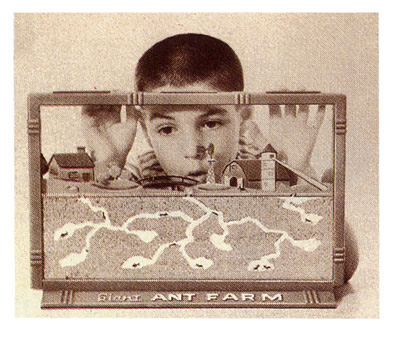
  • E.O. Wilson explains yet again how humans are like ants.
  • Luc Steels programs robots to learn their own language.


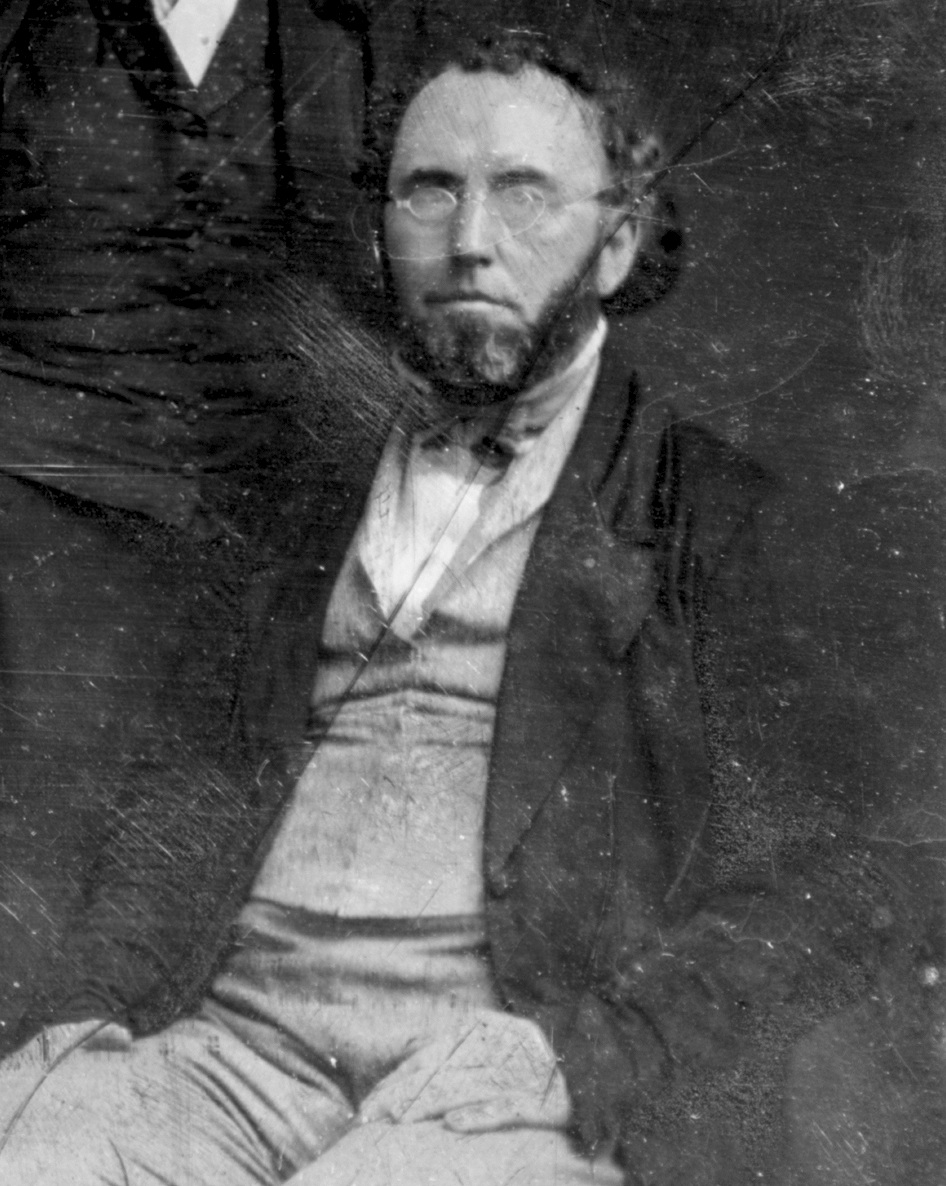
George Ripley had the best of intentions.

In 1841, the Transcendentalist social reformer and journalist founded the short-lived Massachusetts collective, Brook Farm. Established along with other progressives of his day, including Nathaniel Hawthorne, the communal space was to be a haven for workers who longed for industry, not toil. The profits would be shared fairly. But there were no profits, just debts. Brook Farm didn’t experience a moral collapse, but a financial one. The kinetic never was able to match the potential. Hawthorne got a a novel out of the experiment (The Blithedale Romance), but what did Ripley gain from this bitter failure apart from heartbreak? He said of the experience at its end in 1846: “I can now understand how a man would feel if he could attend his own funeral.”

But here’s the thing: Maybe Brook Farm wasn’t the unmitigated disaster it seemed at the time. Massachusetts today is the leader among American states in both education and health care. Ripley can’t claim responsibility for those developments, but perhaps he and other idealists help lay a foundation for the state’s magnanimity. Utopias can distort reality, yes, but they give us a goal in the distance.

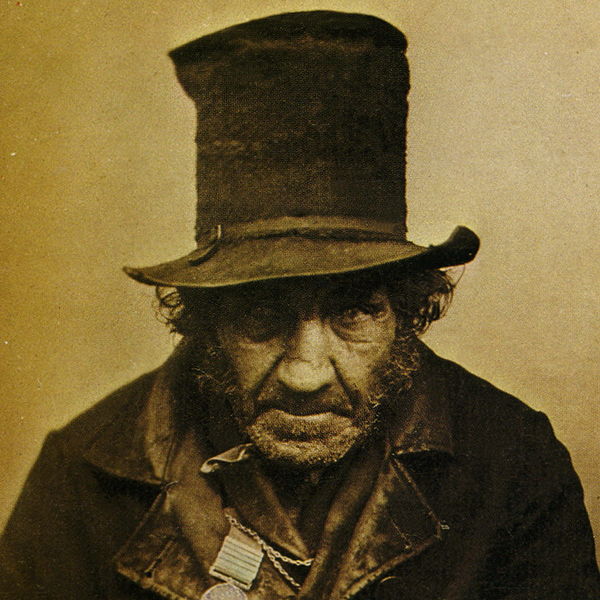
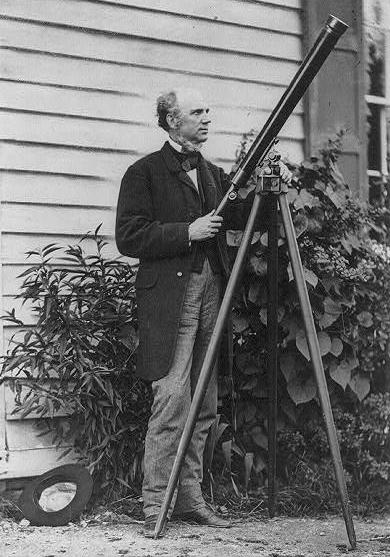
This classic photograph of Ripley, taken by Mathew Brady, is dated somewhere from 1849 to 1860. A brief article about the original promise of Brook Farm from the February 1, 1899 edition of the Brooklyn Daily Eagle:

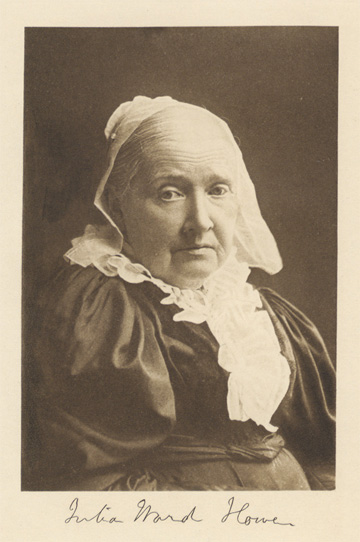
“‘The Brook Farm Experiment’ was the subject of a lecture given before the Long Island Historical Society last night. The lecturer was Mrs. Julia Ward Howe. The hall of the society, on Pierrepont and Clinton Streets, was so crowded that many stood in the aisles during the whole discourse.

“A tract of arable land was purchased, Mr. Ripley pledging his library for a part of the necessary payment.”

‘The story of what actually took place at Brook Farm,’ Mrs. Howe said, ‘is soon told. A tract of arable land was purchased, Mr. Ripley pledging his library for a part of the necessary payment. A dwelling house already on the premises was altered and enlarged, and other buildings of cheap construction were added from time to time, as the growth of the association made it necessary. Farming must have begun in 1841, as in 1842 Orestes Bronson writes of the community existing and flourishing. The work of the great family was carefully apportioned, Mr. Ripley taking upon himself some of the heaviest and least pleasant part of it, such as the daily cleaning of the stables. Justice was the ideal of the infant association. Within its domain, all labor was equally esteemed. Brain work should enjoy no preference over hand work, and the hand which guided the pen should be ready when so ordered to guide the plow. At times all the members of the community gathered to wash the dishes, and the male members did their full share. The first object in the administration was naturally the support of  life. Every effort was made to improve the land, which made but an ungrateful return for such labor. A practical farmer directed agricultural operations, much of what was produced was consumed on the premises, but milk and vegetables, excellent in their kind, were sent to the market. Mr. Ripley once mentioned to me a Boston conservative who used to say that he didn’t like Ripley’s ideas but he did like his peas.'”

Tags: , , ,

E.O. Wilson, who goes to picnics just for the ants, has an article in Newsweek which examines how humans are similar to tribal insects in regards to social networking. An excerpt:

“The drive to join is deeply ingrained, a result of a complicated evolution that has led our species to a condition that biologists call eusociality. ‘Eu-,’ of course, is a prefix meaning pleasant or good: euphony is something that sounds wonderful; eugenics is the attempt to improve the gene pool. And the eusocial group contains multiple generations whose members perform altruistic acts, sometimes against their own personal interests, to benefit their group. Eusociality is an outgrowth of a new way of understanding evolution, which blends traditionally popular individual selection (based on individuals competing against each other) with group selection (based on competition among groups). Individual selection tends to favor selfish behavior. Group selection favors altruistic behavior and is responsible for the origin of the most advanced level of social behavior, that attained by ants, bees, termites—and humans.”

••••••••••

Atom Ant intro, 1965:

Tags:

"No I do not want to give you a blow job."

I’ll be your friend and you be my friend (Downtown)

It sucks out here. And it sucks worse when you have no friends for no good reason. Me: (Im)mature old fart; highly intelligent (or difficult to get along with); can be funny, depending; financially and physically pitiful; prone to depression; broke (very); sophisticated (look it up); ugly; fat; shrewish; parent. I smoke cigarettes. I drink beer. Interests include: Your car; poker; scrabble (3 minutes–I have ADD); ‘treasure hunting’; fishing (bring a wheel chair); metal detecting (bring a wheel chair); arts; antiques; collectibles; avid reader; coonhound owner; musical tastes very very eclectic and loved; writer; cook; (food when available); apolitical because it’s pointless but yeah I’d wear a hoodie and eat skittles for sure; yada yada.

You could be 18. You could be 79. Male. Female. Homo. Trans. Cripple. You could be a poor person. You could be a “Master of the Universe.” I love everybody and can talk to anybody. In turn you are also non-judgemental.

Just looking for friends–you know like someone to talk to and shit. 

Please include phone number. 

No I do not want to give you a blow job. 

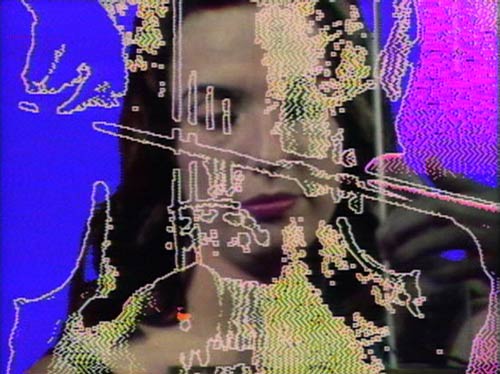
Nam June Paik’s satellite installation, Good Morning, Mr. Orwell, broadcast live in 1984, appropriately. It was an early, artsy step in the direction of people the world over sharing images as well as a riposte to George Orwell.

Tags:

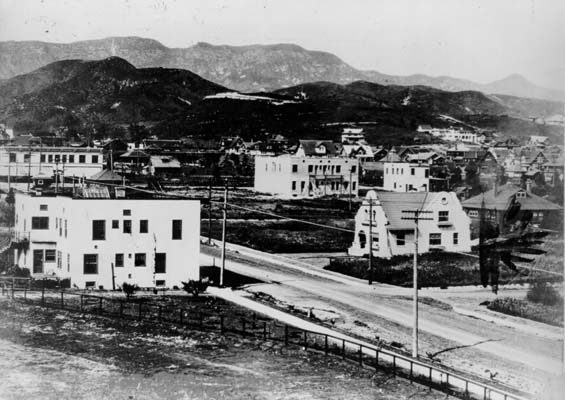
Hollywood and Highland, 1908.

Los Angeles isn’t a city–it’s a region. It has no center so it can’t be fixed or ruined. But different pieces of L.A. can become their own laboratories, experimenting, pushing forward. Hollywood, that glitzy, seamy dream factory, is being reimagined as a green, urban paradise in this age of post-peak oil, though not everyone’s happy about it. The opening of Adam Nagourney’s New York Times report:

“Hollywood, once a sketchy neighborhood in a spiral of petty crime and decay, has been well on its way over the past 10 years to becoming a bustling tourist destination and nightlife district. But now it is on the verge of another transformation: to a decidedly un-Californian urban enclave pierced by skyscrapers, clustered around public transportation and animated pedestrian street life.

A far-reaching rezoning plan that would turn parts of Hollywood into a mini-city — with residential and commercial towers rising on streets like Vine, Hollywood and Sunset — has won the support of key Los Angeles officials. And it has set off a storm of opposition from residents fearful that it would destroy the rakish small-town charm of their community with soaring anodyne buildings that block views of the Hollywood Hills (and its iconic sign) and overwhelm streets with traffic.”

••••••••••

“I’d like to dream / My troubles all away / On a bed of California stars”:

Tags:

Joni Mitchell performing “California,” 1970.

Tags:

Ari Fleischer: Failing upwards.

What was most amusing about President Obama’s fiery speech labeling Paul Ryan’s budget as “radical” was the aftermath. Conservative pundits like Ari Fleischer had to sit in front of cameras with straight faces and pretend that the President had breached some sense of decorum, that the GOP was this above-the-fray body that has flawless deportment. But the lies aren’t very convincing. The Republican Party, perhaps more extremist than at any point in its history, has had members question the President’s birthplace, yell at him during the State of Union Address and label him a “socialist” and one who is complicit with our enemies.

Fleischer, who was part of one of the two or three most incompetent Administrations in U.S. history, continually contributes to the air of disrespect, though he’s too savvy to do it in such an obvious way. Listen to him whenever he refers to our 45th President and notice that he always refers to him as “Barack Obama” and never as “President Obama.” Never. It’s a Gingrich-ish method of disqualifying and demeaning his subject, smugly disallowing his status. If Fleischer is so concerned about good manners, he should can his feigned outrage, and improve his own.

Tags:

The opening of “The Relativity of Wrong,” Isaac Asimov’s 1989 Skeptical Inquirer essay:

“I RECEIVED a letter the other day. It was handwritten in crabbed penmanship so that it was very difficult to read. Nevertheless, I tried to make it out just in case it might prove to be important. In the first sentence, the writer told me he was majoring in English literature, but felt he needed to teach me science. (I sighed a bit, for I knew very few English Lit majors who are equipped to teach me science, but I am very aware of the vast state of my ignorance and I am prepared to learn as much as I can from anyone, so I read on.)

It seemed that in one of my innumerable essays, I had expressed a certain gladness at living in a century in which we finally got the basis of the universe straight.

I didn’t go into detail in the matter, but what I meant was that we now know the basic rules governing the universe, together with the gravitational interrelationships of its gross components, as shown in the theory of relativity worked out between 1905 and 1916. We also know the basic rules governing the subatomic particles and their interrelationships, since these are very neatly described by the quantum theory worked out between 1900 and 1930. What’s more, we have found that the galaxies and clusters of galaxies are the basic units of the physical universe, as discovered between 1920 and 1930.

These are all twentieth-century discoveries, you see.

The young specialist in English Lit, having quoted me, went on to lecture me severely on the fact that in every century people have thought they understood the universe at last, and in every century they were proved to be wrong. It follows that the one thing we can say about our modern ‘knowledge’ is that it is wrong. The young man then quoted with approval what Socrates had said on learning that the Delphic oracle had proclaimed him the wisest man in Greece. ‘If I am the wisest man,’ said Socrates, ‘it is because I alone know that I know nothing.’ the implication was that I was very foolish because I was under the impression I knew a great deal.

My answer to him was, ‘John, when people thought the earth was flat, they were wrong. When people thought the earth was spherical, they were wrong. But if you think that thinking the earth is spherical is just as wrong as thinking the earth is flat, then your view is wronger than both of them put together.’

The basic trouble, you see, is that people think that ‘right’ and ‘wrong’ are absolute; that everything that isn’t perfectly and completely right is totally and equally wrong.

However, I don’t think that’s so.”

Tags:

From the July 30, 1897 Brooklyn Daily Eagle:

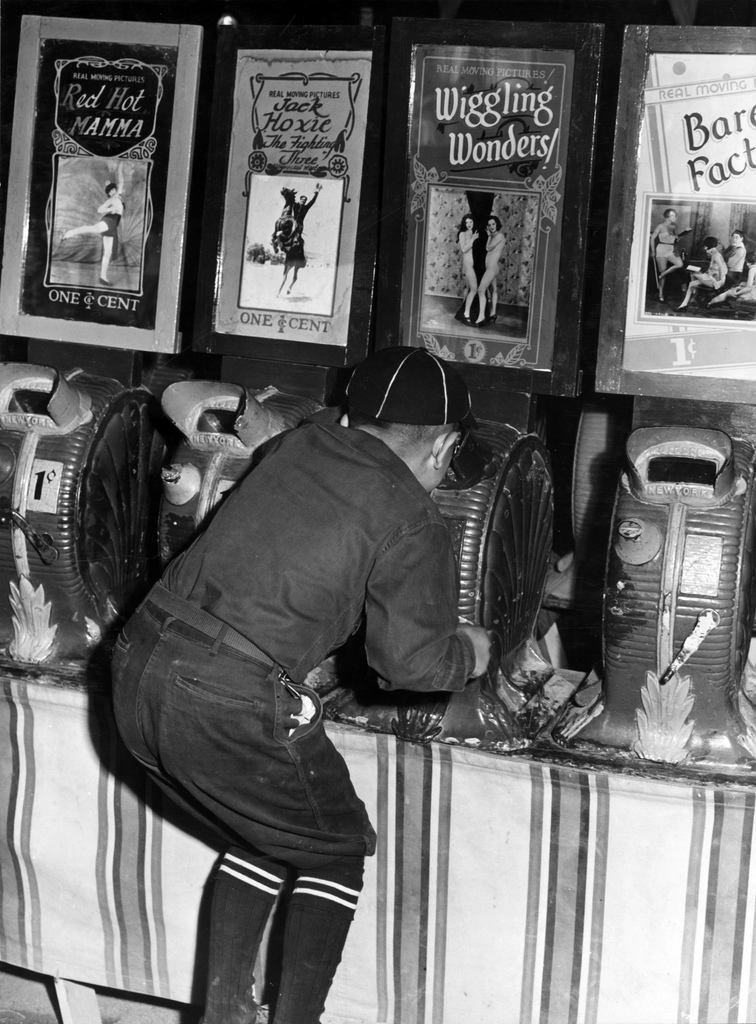
“The Rev. Frederick Bruce Russell made a raid on the Mutoscope machines at Coney Island this morning and closed several of them. These are a species of moving picture contrivances and show various scenes. They are operated by the dropping of a nickel in a slot. Those closed by Mr. Russell to-day were at Feltman’s Pavilion, Koster’s Concert Hall, the Sea Beach Palace and the Old Iron Pier. The particular pictures which fell under the reformer’s eye were entitled ‘What the Girls Did With Willie’s Hat’ and ‘Fun in a Boarding School.'”

Tags: ,

Kevin Kelly has pointed out that we never really throw away tools or technologies, even when their betters come along. We still use them for utility but also for contrast to what has become the norm. They are an aged parent more beloved for what they did for us than what they can now do. Oddly the nostalgia is passed along to generations that were never nurtured by them. The wheelchair still gets pushed.

Tags: ,

From “Darwin’s Devices,” John Long’s piece at Slate about evolutionary robotics, the use of futuristic tools to teach us about the past:

“My fellow researchers and I are using them to harness evolution, putting it to work as an automatic, hands-off process to go where no robot has gone before: the ancient past of animals and the unknown future of human technology.

Making robots that can evolve solves a serious problem that has long vexed biologists: Dead fossils tell no tales. While fossils inform us about evolutionary patterns, they don’t tell us about life’s processes, like the dynamics of physiology, behavior, and the ‘struggle for existence’ that Darwin recognized as the basis of the evolutionary game of life. We can reconstruct and re-enact those missing processes using biorobots, a special class of physically embodied and fully autonomous machines designed to mimic living and behaving animals.

At first blush, this field, called evolutionary biorobotics, seems to present a Zen koan: How does one use evolution to study evolution?”

Tags:

Making noise, 1966.

Playing amplified cacti, 1984:

Tags:

"This bear was waxed by my Great Aunt."

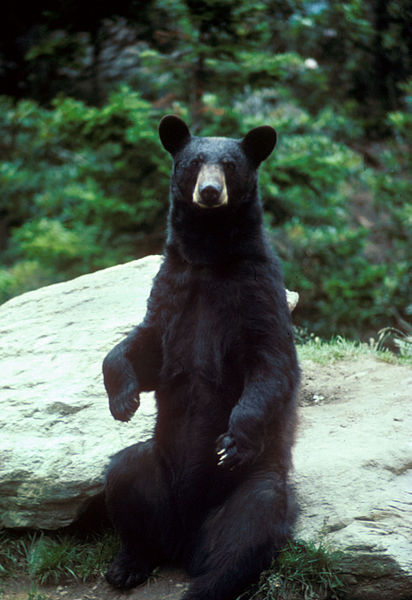
Huge Black Bear Rug (real) – $2000 (Fairfield, CT)

Real Canadian Black Bear Rug. Was 440 lbs. Full thick coat, museum quality mounting by Jonas Brothers. Over 6 foot, this is a full size rug, lightly padded underneath with black felt trim edging. This bear’s BIG! Can be seen on display at Forest & Field Shooting Range / Gun Shop in Norwalk, CT.

AND, for you few whiny douchebags who insist on writing to tell me what a scumbag I must be….

This was NOT a nice bear…This was NOT Yogi da Bear…This bear was waxed by my Great Aunt, 25(?) years ago…(she was 85 at the time) after raiding her farm several times. It destroyed chicken coops, killed hens, it killed a goat that was tethered, it maimed and blinded the Labrador that tried to chase it off….Her cat ran over and stood on top of the dog after he was down to protect it, and the bear swatted the cat too….So Fuck off. He got his, and now he’s a rug….A big, soft, fat, thick, plush rug. GET OVER IT.

I never realized the timeline of the reemergence of dinosaur studies in academia until reading this passage from paleontologist Paul Barrett at the Browser:

“It’s really only from the 70s onwards that we start to get this change in view and only from the 80s that we had a crystallisation of this view that dinosaurs were very exciting animals. For most of the 20th century dinosaurs were viewed as a dead end – an evolutionary dead end that was kind of interesting because they were big and odd-looking, but that never really went anywhere. It was the recognition in the 70s that dinosaurs and birds were closely related, and that dinosaurs were more like birds than like other reptiles, that suddenly led to a new burst of interest in them and new research programmes. If you spoke to a student in the 1940s or 50s they would just view dinosaurs as curiosities, but these days they’re viewed as an integral part of a greater knowledge of how animals are related to each other and how animal behaviour has changed through time, not just as a side-show oddity.”

Tags:

Michael Parkinson interviews Orson Welles in the wake of Watergate, 1974.

Tags: ,

"A nearly bankrupt Finnish company called Rovio hit upon a similarly perfect fusion of game and device: Angry Birds."

The New York Times Magazine is deservedly getting a lot of play for the Asteroids-like video game it’s embedded in the online version of its featureJust One More Game…but Sam Anderson’s article is excellent, gimmicks or not. It looks from every angle at our obsession with seemingly dumbed-down, repetitive, low-fi digital time-killers in the age of the iPhone. From Anderson’s article, an excerpt about the back-story of two relentless compulsions, Tetris and Angry Birds:

“Tetris was invented exactly when and where you would expect — in a Soviet computer lab in 1984 — and its game play reflects this origin. The enemy in Tetris is not some identifiable villain (Donkey Kong, Mike Tyson, Carmen Sandiego) but a faceless, ceaseless, reasonless force that threatens constantly to overwhelm you, a churning production of blocks against which your only defense is a repetitive, meaningless sorting. It is bureaucracy in pure form, busywork with no aim or end, impossible to avoid or escape. And the game’s final insult is that it annihilates free will. Despite its obvious futility, somehow we can’t make ourselves stop rotating blocks. Tetris, like all the stupid games it spawned, forces us to choose to punish ourselves.

In 2009, 25 years after the invention of Tetris, a nearly bankrupt Finnish company called Rovio hit upon a similarly perfect fusion of game and device: Angry Birds. The game involves launching peevish birds at green pigs hiding inside flimsy structures. Its basic mechanism — using your index finger to pull back a slingshot, over and over and over and over and over and over and over — was the perfect use of the new technology of the touch screen: simple enough to lure a suddenly immense new market of casual gamers, satisfying enough to hook them.

Within months, Angry Birds became the most popular game on the iPhone, then spread across every other available platform. Today it has been downloaded, in its various forms, more than 700 million times.”

••••••••••

Tetris, the music:

Tags:

« Older entries § Newer entries »