Babies with tablets is probably inevtiable, as a piece in the Atlanticabout a new $389 model suggests:
“This month,Vinci, the 7-inch touch-pad tablet displayed above, will go on sale through Amazon, which is already accepting pre-orders. ‘The Vinci is not an imitation — it is a real touch-screen Android-based product, bringing the most advanced technology to the benefit of our youngest citizens,’ according to the product’s website.
Designed to compete with LeapFrog’s new LeapPad, a $99 tablet aimed at 4- to 9-year-olds, the Vinci targets an even younger audience (0- to 4-year-olds) — one it could potentially grow up with for some time. With its protective soft-corner case, this tablet is meant to last. And don’t let the non-toxic packaging or the durable handles fool you: This is far different than any other electronics you’ll find in the baby aisle. Vinci lacks Wi-Fi or 3G capability, but, with a Cortex A8 processor and 4GB of internal storage, it still packs a serious punch — it’s even outfitted with a built-in microphone and a 3-megapixel built-in camera to capture that special moment when your child first realizes just powerful our current computing technology is.”
In “Practical Magic,” Russell Davies of Ogilvy & Mather provides his vision of the Internet of Things, which is borne of regular people futzing around with endless reams of data and cheap physical materials:
“Do you remember Big Mouth Billy Bass – the strange animated fish that became a popular novelty a few years back? It looked like a regular fisherman’s trophy but when you hit a button on the frame it would suddenly come to life and start singing ‘Take Me to the River’ or some other amusing aquatically themed song.
Now imagine that Billy had the intelligence of your average smart phone. He’d know where he was in the world. What the time was. What the weather was like. Who’d won the football. Whether the trains were running late. And, assuming you’d programmed a little bit of profile information into him, he’d know which of your Foursquare friends were nearby, and which of your favorite bands were playing in the area. He’d know a lot. With some simple text-to-speech stuff in his head and a bit of ingenuity, he’d be able to tell you all sorts of interesting and useful things when you pressed that button. And you would press that button, wouldn’t you?
Well, something like Billy will get made. It’s bound to. Cheap electronics, cheap plastics and cheap intelligence are going to get welded together with free, ubiquitous data feeds to make hundreds of products just like him. It’s the warped magic you’ll get when two waves of innovation crash together – the flood of data from the internet and the sea of stuff from Chinese factories. That right there is your Internet of Things.” (Thanks Browser.)
Sweltering summer temperatures seem to be just part of the reason why the people of Tbilisi, Georgia, tend to see the apocalypse hurtling toward them from all directions. From aninteresting New York Times report by Ellen Barry:
“Word that scorpions had been sighted on her street clinched it, as far as Nana Beniashvili was concerned.
The giant locusts had been bad enough, and the snakes, which are known in Georgian as ‘that which cannot be mentioned.’ She actually hadn’t seen any scorpions herself, but she believed that one of her neighbors had, and in the asphalt-melting, earth-parching, brain-scrambling heat of midsummer, she was not in the mood to be fastidious about evidence.
‘This means the apocalypse is coming,’ said Ms. Beniashvili, 72, who was leaning out of a window. ‘I cannot tell you exactly when, because I am not very knowledgeable about this. But it is clear that the apocalypse is coming. The world has gone crazy.
‘Anyway, I hope we will survive,’ she sighed, and went inside to look for lemonade.”
In aSpiegel interview, Swedish crime writerHenning Mankelldiscusses Norwegian mass murderer Anders Breivik and the nature of evil. To counter Mankell somewhat, I do think that some people may have a greater proclivity to violence based on biological makeup, and there may beneurogical reasonsthat arise which can trigger violent impulse. But, yes, these probably are exceptions, and extreme environments can certainly lead to extreme behaviors. An excerpt from the interview:
“SPIEGEL: Does our consternation over the mystery of evil also stem from the fact that Breivik, as the police put it, literally came out of nowhere?
Mankell: We want to recognize the characteristics of evil early on, and we search for marks of Cain and stigmata, the warning signs of the horrific before it occurs. But that kind of thinking is based on magic.
SPIEGEL: But it isn’t just a question of the banality of evil, but also of our fascination with evil.
Mankell: You address an important aspect. What I fear most of all is that a new discussion will emerge about the concept of innate evil. That was the way people thought 500 years ago. No one is born evil. People become evil through external circumstances, which provoke evil behavior.
SPIEGEL: But everyone has the inherent capability to be evil?
Mankell: In the Balkan wars, following the breakup of Yugoslavia, neighbors who had lived together in peace until then suddenly began attacking one another. I saw child soldiers in Africa, 14 and 15-year-old boys, who slaughtered their parents after someone had held a gun to their heads. I’m not sure what I would have done, as a child, in their situation. The explanation for evil lies in its circumstances and conditions, not in its diabolical nature. That is what Hannah Arendt taught us.”
••••••••••
Mankell at the Strand Book Store in Manhattan in 2010:
From a1967 New York Times interview with Theremin: “He ushered the visitor into a room in which a small dance floor had been constructed. Mr. Theremin stood on the floor, raised his arms, made motions, and started to play the Massenet Elegy on nothing at all.
The room was filled with sound, and it was positively spooky. No wires, no gadgets, nothing visible. Merely electromagnetic sorcery,
‘I made my last public appearance in 1938,’ Mr. Theremin said. ‘I sometimes think it would be nice to come back once more to United States and show my latest instruments.'”
One of the best opening sentences I have read in a while comes from Avi Steinberg’sexcellent new Paris Review pieceabout a ventriloquist convention in Kentucky. Here’s that opening line plus the rest of the first two paragraphs:
“I’m waiting for the elevator in a medieval-themed hotel in Fort Mitchell, Kentucky, when the elevator doors open to reveal a heated exchange between a bald man in a Hawaiian shirt and a puppet shaped like a toucan. My presence brings an uncomfortable end to their private imbroglio. Both stare at me silently as I enter the elevator, and for five awkward floors I’m brought into direct contact with what George Bernard Shaw described as the “unvarying intensity of facial expression” of puppets, an attribute he believed makes them more compelling actors than humans.
I’m at theVent Haven ConVENTionwhere, each July, hundreds of ventriloquists, or “vents,” as they call themselves, gather from all over the world. For four days, they attend lectures on the business, getting advice on AV equipment, scriptwriting, or creating an audience through social networking. They listen to a keynote address by Comedy Central’s ventriloquist-in-residence, Jeff Dunham, who exhorts his notoriously defensive colleagues to ‘quit complaining that people say we’re weird. We talk to dolls. We are weird, ok. Just own it.’ They eat at a Denny’s off the highway and visit the creationist museum down the road. And they don’t go anywhere without the accompaniment of their alter egos.”
From the Escapist comes a report about Brewster Kahle’s Herculean effort to collect every book every published, in original dead-tree form:
“Kahle, a computer scientist with a degree from MIT, is most famous as the creator of the Internet Archive, a non-profit group formed in 1996 with a goal of preserving every web page ever created.
In that same archival spirit, Kahle has recently set his sights on preserving the existing written history of mankind, and he’s off to a pretty solid start.
To date, Kahle’s warehouse in Richmond, California houses 500,000 books. That’s a drop in the bucket compared to the 130 million tomes collected by Google in its efforts to digitize the entirety of our literature, but Kahle is heartened by the speed at which his group has been able to accrue their half-million books.
The existence of Google’s aforementioned project also causes one to question Kahle’s motivations. After all, if we’ve got the text available online, why keep their archaic dead tree iterations?
‘There is always going to be a role for books,’ Kahle says. ‘We want to see books live forever.'”
•••••••••
Kahle discusses his work in digital archiving at TED:
Alternet has a report about the development of a slew of so-called “non-lethal weapons systems” that can be used to control crowds. One example:
“The Invisible Pain Ray
It sounds like a weapon out of Star Wars. The Active Denial System, or ADS, works like an open-air microwave oven, projecting a focused beam of electromagnetic radiation to heat the skin of its targets to 130 degrees. This creates an intolerable burning sensation forcing those in its path to instinctively flee (a response the Air Force dubs the ‘goodbye effect’).
The Pentagon’s Joint Non-Lethal Weapons Program (JNLWP) says, ‘This capability will add to the ability to stop, deter and turn back an advancing adversary, providing an alternative to lethal force.’ Although ADS is described as non-lethal, a 2008 report by physicist and less-lethal weapons expert Dr. Jürgen Altmann suggests otherwise:
‘… the ADS provides the technical possibility to produce burns of second and third degree. Because the beam of diameter 2 m and above is wider than human size, such burns would occur over considerable parts of the body, up to 50% of its surface. Second- and third-degree burns covering more than 20% of the body surface are potentially life-threatening – due to toxic tissue-decay products and increased sensitivity to infection – and require intensive care in a specialized unit. Without a technical device that reliably prevents re-triggering on the same target subject, the ADS has a potential to produce permanent injury or death. ‘”
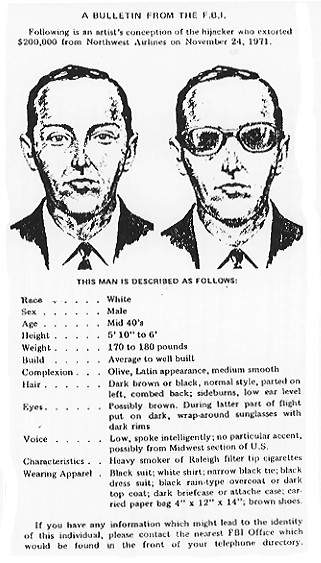
Four decades after his brazen crime and complete disappearance made the inscrutable man known as D.B. Cooper into an American folk hero, the FBI has credible evidence as to his identity. The opening of a well-written new article by Katharine Q. Seelye and Charlie Savage in the New York Times:
“He smoked Raleigh cigarettes, wore a black clip-on tie and drank whiskey, and when zero hour came, he was one cool cat.
From Seat 18C on a Northwest Orient flight from Portland, Ore., to Seattle, he passed a note to the stewardess — this was 1971, pre-‘flight attendant’ era. She slipped it in her pocket, unread.
‘Miss, you’d better look at that note,’ the passenger calmly advised. ‘I have a bomb.’ He opened his briefcase and showed her what could have been a bomb, nestled in a mass of wires.
With that, the man known as D. B. Cooper hijacked the plane, later parachuting out of it and into the unknown. His body was never found. Mr. Cooper became a folk hero, and the case remains the only unsolved hijacking in American history.
Now, 40 years later, comes what seems like a tantalizing new tip. The Federal Bureau of Investigation says it has a new suspect, one whose name has never surfaced in the ocean of tips that has washed in over four decades.”
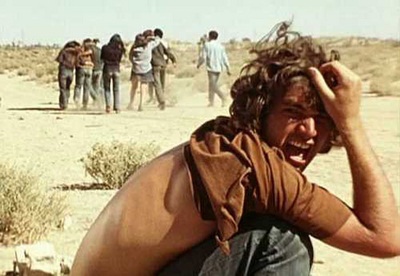
Early in his career, Peter Watkins made documentary-style narrative films that were so politically charged as to be almost unreleasable. Two of these were particularly great. The War Game, from 1965, shows the horrors that would befall Britain if the nation engaged in a nuclear war. It was so convincing that it was banned from broadcast in its native country and won a Best Documentary Oscar despite not being a documentary. Punishment Park, from 1971, takes things a step further. Set in America in the wake of Kent State, Watkins exaggerates the truly tumultuous divide between conservatives and radicals, creating a landscape so brutal and bitter that nuclear devastation might seem the lesser evil.
In America, young, anti-establishment activists who oppose the Vietnam War or support Black Power are arrested, interrogated and tried before a jury of peerless right-wingers. The convicted can either do decades in prison, or they can try their luck in Punishment Park. A punitive expanse of cracked earth in the California desert, Punishment Park is an obstacle course of sorts in which prisoners must complete a 53-mile trek with armed officers in pursuit. If they successfully finish the course in sweltering temperatures and reach an American flag at journey’s end, they will supposedly be released. But the sweet release of death seems more likely with the numerous threats to their well-being.
There’s a scene in which a young officer opens fire on a group of the political prisoners, and is almost immediately interviewed by the faux documentary crew, as he cries and pleads in confusion. The passage comes as close to recreating the visceral pain of the tragedy at Kent State as is imaginable. During an era when the news was the scariest show on TV and the pseudo-documentary was the perfect approach, Watkins presented a searing vision intended to jolt those who were sleepwalking through the nightmare.•
Recent Film Posts:
Strange, Small & Forgotten Films: The Intruder (1962)
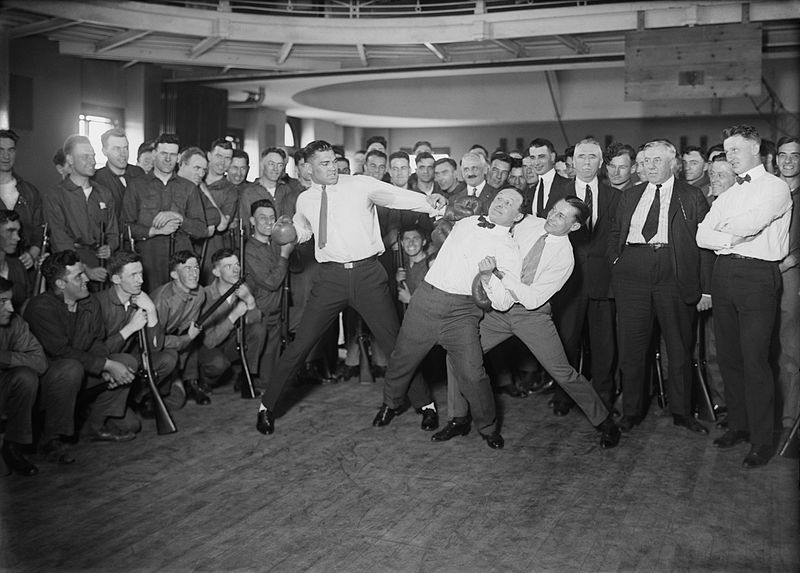
This classic undated picture captures Jack Dempsey and Harry Houdini engaged in a mock fight for a photo op. Even though its tangential to this photo, I’ve been eager for awhile to share an insane 1930 New York Times obituary of a colorful character nicknamed “John the Barber,” who was Dempsey’s first manager. An excerpt from “Jack Dempsey’s First Manager Succumbs To Infection Of His Finger”:
“‘John the Barber,’ in private life John J. Reisler, known on Broadway for many years as a barber, fight manager and friend of the street’s great and near-great, died yesterday morning in Lebanon Hospital, the Bronx, of an infection caused by an ingrown hair on his finger. He had been in the hospital for three weeks and was surrounded by his family, including his wife, Mrs. Minnie Reisler, with whom he had been reconciled recently after a long separation. He was 53 years old.
Also at the bedside was Morris Reisler, his son, whose sentence of twenty years to life in 1923 was commuted by Governor Roosevelt last March. Morris had been sent to Sing Sing for killing his aunt, Miss Bertha Katz, whose death climaxed a family feud in which Mrs. Reisler had accused Miss Katz, her younger sister, of stealing Reisler’s affections. When Morris was released his father, whom he had seen in 1927 when he was permitted to visit the elder Reisler, who lay ill in a Bronx hospital, met him at the prison gate and escorted him back to New York.
As a prizefight manager Reisler was one of Jack Dempsey’s first managers. That was in 1915 and 1916. Although the two parted and later Reisler sued Dempsey for breach of contract, he always was proud of having known and handled Demspey in the days before he was champion.
Born in Austria, he came to New York as a young boy. He became a barber, and in that capacity shaved some of the best-known chins on Broadway. He ran several athletic clubs at various times and knew many celebrities. One of his latest fighters was Vincent Serici. Recently he had handled his three boxing sons, Johnny, Georgie and Sid.
Reisler first came into prominence, however, in 1912, when Herman Rosenthal, the gambler, was murdered early on the morning of July 16 in front of the Hotel Metropole, in Forty-third Street, east of Broadway. Reisler was one of the first on the scene, and it reached the ears of District Attorney Charles S. Whitman that he had seen something. He was subpoenaed, and told Mr. Whitman that has had seen ‘Bridgey’ Webber, one of those accused of the murder, running from the scene.
Put on the stand at Coroner Feinberg’s hearing, Reisler, who had known for years Rosenthal, Webber and others involved in the affair, recanted his story. He was fearful that gunmen in the crowd would ‘put him on the spot.’ Mr. Whitman had him arrested for perjury and after a night in a cell he decided to tell his original story. Webber, who turned informer, was freed later, as was Reisler, after his testimony. Police Lieutenant Charles A. Becker and four gunmen, ‘Gyp the Blood’ Horowitz, ‘Lefty Louie’ Rosenberg, ‘Whitey’ Lewis and ‘Dago Frank’ Cirofici, went to the electric chair for the crime.”
••••••••••
Young Dempsey demolishes a washed-up Jess Willard in 1919:
Kurzweil reports on a new spying device from China:
“A new aquatic microrobot that mimics the water-walking abilities of the water strider has been developed by researchers at the Harbin Institute of Technology in China.
The robot is about the size of a quarter, with ten water-repellent, wire legs and two movable, oar-like legs propelled by two miniature motors. Because the weight of the microrobot is equal to that of about 390 water striders, one might expect that it would sink quickly when placed on the water surface. But it stands effortlessly on water surfaces and also walks and turns freely.
It imitates water striders, mosquitoes, and water spiders, who are able to walk on water due largely to their highly water-repellent (superhydrophobic) legs.”
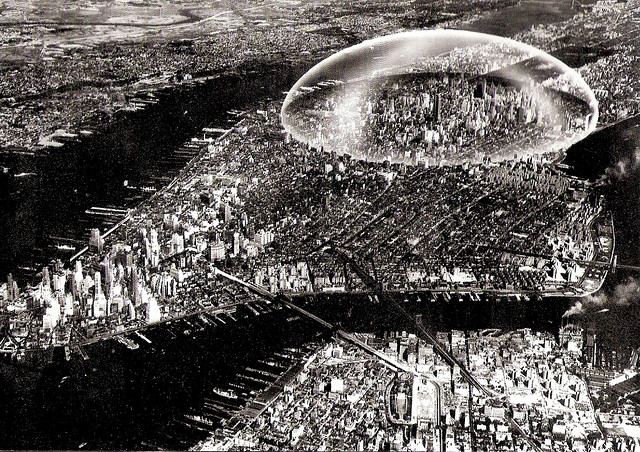
From a newNew York Times article about smart cities comes this recollection about Buckminster Fuller, that dreamer, who somehow thought it would be good idea to build a geodesic dome over a large swath of Manhattan:
“At a time before urban planning was formally taught in universities, Mr. Fuller — a Harvard dropout turned inventor, engineer, architect and philosopher — directed his attention to cities.
He perfected and popularized the geodesic dome, and after building several smaller ones in the 1950s, he teamed up with the architect Shoji Sadao in 1960 to propose a dome with a width of two miles, or 3.2 kilometers, above Midtown Manhattan. The dome would have covered the island from the East River to the Hudson River, with one axis running along 42nd Street. It would have reached from 21st Street to 64th Street, covering the southern lip of Central Park.
During a time when air-conditioning was coming to many U.S. homes and businesses, Mr. Fuller said the giant dome would greatly reduce cooling costs in summer and heating costs in winter by reducing the ratio of surface to volume. Instead of each building’s having to be heated or cooled separately, the entire dome would be kept at a ‘very moderate temperature level’ throughout the year.
The glass would be threaded by a heating wire — much like the rear window of many cars — so that snow and ice accumulation would not become a problem. Melted snow and rain would be collected in catch basins and used for things like irrigation and cleaning.
The scalable dome, according to Mr. Fuller, became stronger and sturdier as it was built larger.”
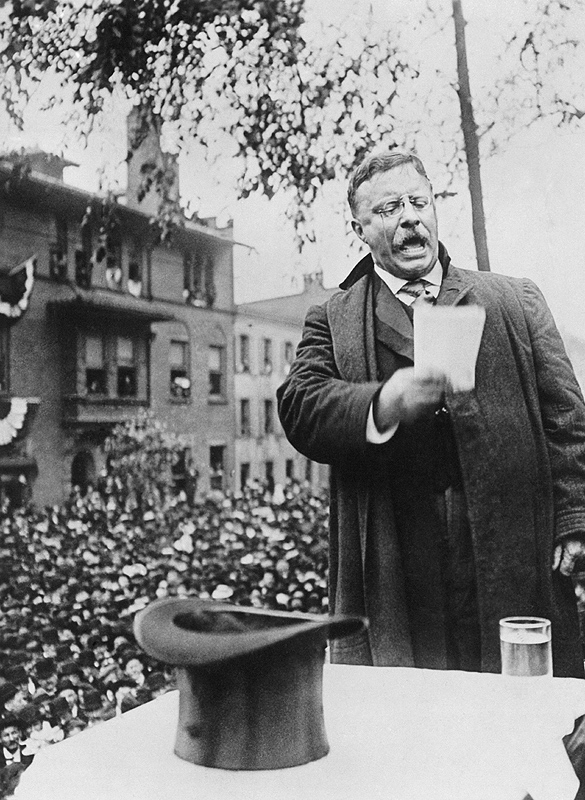
This classic 1912 picture of Theodore Roosevelt on the stump originally appeared in the New York Times, though the photographer is unknown. Roosevelt was trying to regain the White House, as he split from the Republicans and formed the Bull-Moose Party. His efforts, of course, failed.
With the upturned hat on the table, Roosevelt gives the impression of a magician. Some critics, however, wanted the politician and his domineering personality to disappear. Mark Twain was one such detractor, and he wrote the following text in 1908 when Roosevelt was exiting the White House:
“Astronomers assure us that the attraction of gravitation on the surface of the sun is twenty-eight times as powerful as is the force at the earth’s surface, and that the object which weights 217 pounds elsewhere would weight 6,000 pounds there.
For seven years this country has lain smothering under a burden like that, the incubus representing, in the person of President Roosevelt, the difference between 217 pounds and 6,000. Thanks be we got rid of this disastrous burden day before yesterday, at last. Forever? Probably not. Probably for only a brief breathing spell, wherein, under Mr. Taft, we may hope to get back some of our health – four years. We may expect to have Mr. Roosevelt sitting on us again, with his twenty-eight times the weight of any other Presidential burden that a hostile Providence could impose upon us for our sins.
Our people have adored this showy charlatan as perhaps no impostor of his brood has been adored since the Golden Calf, so it is to be expected that the Nation will want him back again after he is done hunting other wild animals heroically in Africa, with the safeguard and advertising equipment of a park of artillery and a brass band.”
••••••••••
Silent clip of Roosevelt with some fellow Rough Riders:
As noted onRay Kurzweil’s site,a small but fiunctional aircraft was created for the first time using a 3-D printer:
“Engineers at the University of Southampton have designed and flown the world’s first ‘printed’ aircraft, which could revolutionize the economics of aircraft design, the engineers say.
The SULSA (Southampton University Laser Sintered Aircraft) plane is an unmanned air vehicle (UAV), with its entire structure printed. This includes wings, integral control surfaces, and access hatches. It was printed on an EOS EOSINT P730 nylon laser sintering machine, which fabricates plastic or metal objects, building up the item layer-by-layer.
It took only 48 hours to print. No fasteners were used and all equipment was attached using ‘snap fit’techniques so the entire airframe could be put together without tools in about 30 seconds, according to Prof. Andy Keane. The aircraft took around 8 person weeks. It passed tests for speed, maneuverability, and climb rates.”