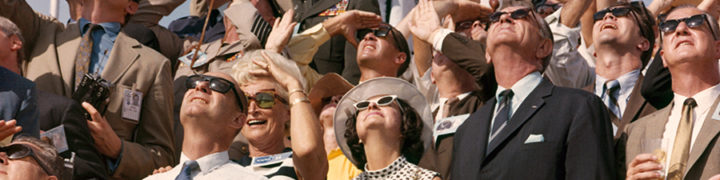
From 1959.
You are currently browsing the archive for the Videos category.
Ted Koppel reports about militaristic paintball games played by adults, in 1987.
Tags: Ted Koppel
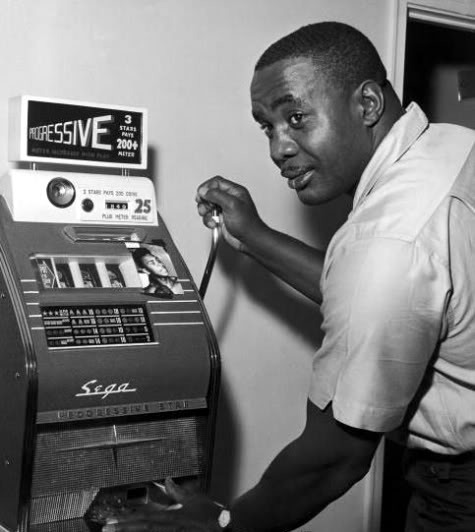
If Salvador Dali and Whitey Ford could team up to shill for Braniff Airlines, why not Andy Warhol and Sonny Liston?
The opening of The Devil and Sonny Liston, Nick Tosches beautiful, bruising biography of the boxer, who died young and mysteriously: “The corpse was rolled over and lay face down on the metal slab. It was then that the coroner saw them; the copper-colored whipping welts, old and faint, like one might imagine those of a driven slave.
To say that Charles Liston had been a slave would be to render cheap metaphor of the life of a man. And yet those scars on his back were as nothing to deeper scars, the kind that no coroner could ever see, scars of a darkness far less imaginable than those from any lash. Charles Liston, the most formidable of men, the most unconquerable of heavyweight boxers, had been enslaved by the forces of that darkness: enslaved, conquered, and killed by them.
Born with dead man’s eyes, he had passed from the darkness of those scars on his back to the darkness of the criminal underworld, to a darkness beyond, a darkness whose final form was the last thing he ever saw.”
Tags: Andy Warhol, Nick Tosches, Sonny Liston
Perhaps everyone else knew that communicators on Star Trek inspired Martin Cooper to create the cell phone, but I didn’t.
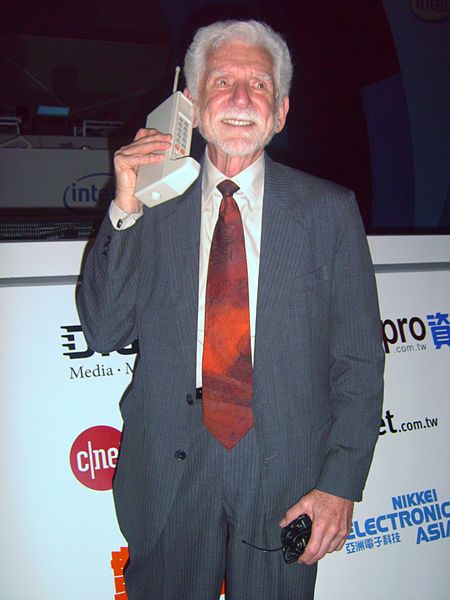
Dr. Martin Cooper, in 2007, with the first cell phone.
Tags: Martin Cooper
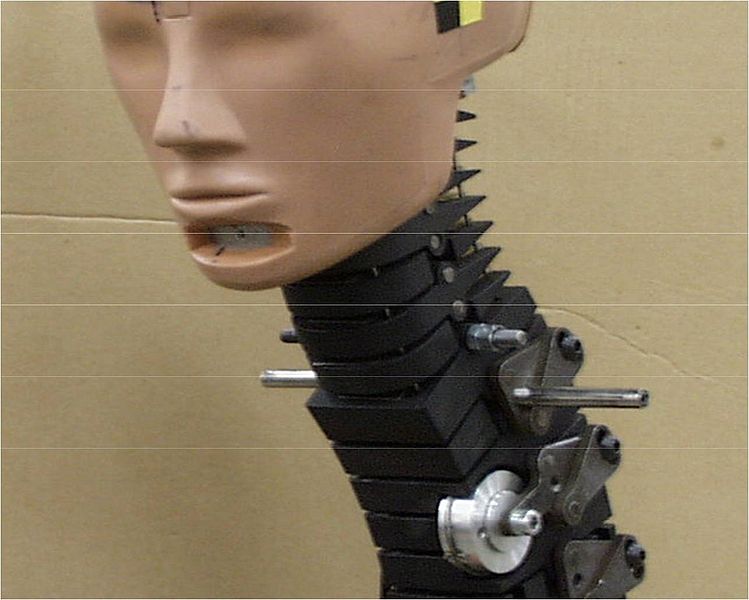
Life extension predictions that seem too optimistic, from “The Coming Death Shortage,” Charles C. Mann’s provocative 2005 Atlantic article:
“In the past century U.S. life expectancy has climbed from forty-seven to seventy-seven, increasing by nearly two thirds. Similar rises happened in almost every country. And this process shows no sign of stopping: according to the United Nations, by 2050 global life expectancy will have increased by another ten years. Note, however, that this tremendous increase has been in average life expectancy—that is, the number of years that most people live. There has been next to no increase in the maximum lifespan, the number of years that one can possibly walk the earth—now thought to be about 120. In the scientists’ projections, the ongoing increase in average lifespan is about to be joined by something never before seen in human history: a rise in the maximum possible age at death.
Stem-cell banks, telomerase amplifiers, somatic gene therapy—the list of potential longevity treatments incubating in laboratories is startling. Three years ago a multi-institutional scientific team led by Aubrey de Grey, a theoretical geneticist at Cambridge University, argued in a widely noted paper that the first steps toward ‘engineered negligible senescence’—a rough-and-ready version of immortality—would have ‘a good chance of success in mice within ten years.’ The same techniques, De Grey says, should be ready for human beings a decade or so later. ‘In ten years we’ll have a pill that will give you twenty years,’ says Leonard Guarente, a professor of biology at MIT. ‘And then there’ll be another pill after that. The first hundred-and-fifty-year-old may have already been born.'” (Thanks TETW.)
••••••••••
Cocoon trailer, 1985:
Tags: Aubrey de Grey, Charles C. Mann
Iran Air TV ad that ran in the U.S. in the 1970s. Because of political fallout from the Islamic Revolution, the final flight from NYC was November 7, 1979.
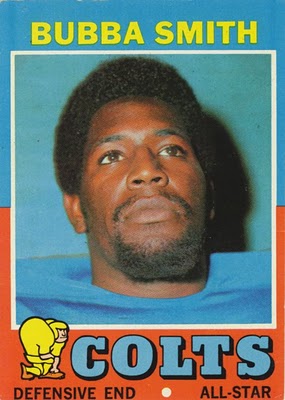
From Michael Weinreb’s Grantland postmortem of the larger-than-life existence of towering football player-Police Academy thespian Bubba Smith, who just passed away:
“Smith — who was found dead in his Los Angeles home yesterday, apparently of natural causes, at age 66 — wanted to follow his brother to Kansas, but they didn’t want another Smith brother there; he wanted to go to the University of Texas, but, like most southern schools in the early 1960s, they couldn’t take him. And so he went to East Lansing, having never really interacted with white society before. The first time he stood up to meet his white roommate, the roommate’s parents nearly fainted. It was not a utopian community — Smith and his teammates often had trouble finding an apartment to rent in town — but Bubba had an unmistakable charm. He reportedly joined a Jewish fraternity; he was voted the most popular student on campus, even as he tested the limits of authority. His senior year, according to Mike Celizic’s The Biggest Game of Them All, he drove an Oldsmobile with his name written in gold letters on the door, most likely paid for through the largesse of alumni and boosters. Occasionally, Bubba parked it in the university president’s space.”
••••••••••
Harvey Shine + Bubba Smith:
Tags: Bubba Smith, Michael Weinreb
An amazing Matchbox-centric work, “Metropolis II,” by artist Chris Burden. (Thanks Singularity Hub.)
From Peter Schjeldahl’s 2007 New Yorker piece about Burden: “An efficient test of where you stand on contemporary art is whether you are persuaded, or persuadable, that Chris Burden is a good artist. I think he’s pretty great. Burden is the guy who, on November 19, 1971, in Santa Ana, California, produced a classic, or an atrocity (both, to my mind), of conceptual art by getting shot. ‘Shoot’ survives in desultory black-and-white photographs with this description: ‘At 7:45 p.m. I was shot in the left arm by a friend. The bullet was a copper jacket .22 long rifle. My friend was standing about fifteen feet from me.’ Why do such things? “I wanted to be taken seriously as an artist,’ Burden explained, when I visited him recently at his studio in a brushy glen of Topanga Canyon, where he lives with his wife, the sculptor Nancy Rubins. ‘The models were Picasso and Duchamp. I was most interested in Duchamp.””
“Shoot,” 1971:
Tags: Chris Burden, Peter Schjeldahl
A 1993 report about the rise of the Internet as a mass tool.
 An Atlantic article by Betsy Morais explores whether the simian engineering in Rise of the Planet of the Apes could actually occur. While no one expects chimps to transform into geniuses overnight, there is fear that introducing human DNA into non-human creatures could create unfortunate hybrids. An excerpt;
“Nature magazine published a report last year suggesting that non-human primates with sections of human DNA implanted into their genomes at the embryonic stage—through a process called transgenics—might develop enough self-awareness ‘to appreciate the ways their lives are circumscribed, and to suffer, albeit immeasurably, in the full psychological sense of that term.’
‘That’s the ethical concern: that we would produce a creature,’ says bioethicist Dr. Marilyn Coors, one of the authors of the Nature report. ‘If it were cognitively aware, you wouldn’t want to put it in a zoo. What kind of cruelty would that be? You wouldn’t be able to measure the cruelty—or maybe it could tell you. I don’t know.’
Although Walker doesn’t know of anyone doing research to enhance cognitive function in apes, and Coors knows of no transgenic apes, Coors points out that scientists theoretically have the technical capability to produce them.”
••••••••••
Ham, the first Astrochimp, 1961:
Tags: Betsy Morais, Marilyn Coors
Before bringing his antics to David Letterman’s late-night show, Andy Kaufman made audiences squirm at the host’s short-lived morning program in 1980.
Tags: Andy Kaufman, David Letterman

The opening of “The World of Blind Mathematicians,” Allyn Jackson’s article which describes just that:
“A visitor to the Paris apartment of the blind geometer Bernard Morin finds much to see. On the wall in the hallway is a poster showing a computer generated picture, created by Morin’s student François Apéry, of Boy’s surface, an immersion of the projective plane in three dimensions. The surface plays a role in Morin’s most famous work, his visualization of how to turn a sphere inside out. Although he cannot see the poster, Morin is happy to point out details in the picture that the visitor must not miss. Back in the living room, Morin grabs a chair, stands on it, and feels for a box on top of a set of shelves. He takes hold of the box and climbs off the chair safely—much to the relief of the visitor. Inside the box are clay models that Morin made in the 1960s and 1970s to depict shapes that occur in intermediate stages of his sphere eversion. The models were used to help a sighted colleague draw pictures on the blackboard. One, which fits in the palm of Morin’s hand, is a model of Boy’s surface. This model is not merely precise; its sturdy, elegant proportions make it a work of art. It is startling to consider that such a precise, symmetrical model was made by touch alone. The purpose is to communicate to the sighted what Bernard Morin sees so clearly in his mind’s eye.”
Another mathematician post:
Tags: Allyn Jackson, Bernard Morin
I previously posted some clips of irascible 1960s talk show host Joe Pyne. Here are three more, each from 1966, just four years before the chain-smoking shock jock died from cancer.
••••••••••
Yippie leader Jerry Rubin storms off:
Georgia Governor Lester Maddox storms off:
Future Nixon enemy, journalist Jack Anderson, stays put:
Tags: Jack Anderson, Jerry Rubin, Joe Pyne, Lester Maddox

Sci-fi writer and futurist Bruce Sterling donated his papers to the University of Texas in decidedly lo-fi form. Kari Kraus explains why at the New York Times:
“LAST spring, the Harry Ransom Center at the University of Texas acquired the papers of Bruce Sterling, a renowned science fiction writer and futurist. But not a single floppy disk or CD-ROM was included among his notes and manuscripts. When pressed to explain why, the prophet of high-tech said digital preservation was doomed to fail. ‘There are forms of media which are just inherently unstable,’ he said, ‘and the attempt to stabilize them is like the attempt to go out and stabilize the corkboard at the laundromat.”
Mr. Sterling has a point: for all its many promises, digital storage is perishable, perhaps even more so than paper. Disks corrode, bits ‘rot’ and hardware becomes obsolete.”
••••••••••
Sterling predicts the nature of media in 25 years:
Tags: Bruce Sterling, Kari Kraus

Major League Baseball Commissioner Bud Selig believes that players may be trying to get around the ban on performance-enhancing drugs by ingesting–no kidding–deer antler spray, which is believed to contain some of the same muscle-building properties as steroids. From ESPN:
“MLB players have been issued a warning over the use of deer-antler spray, a substance administered under the tongue that includes a banned chemical known for its muscle-building and fat-cutting effects, SI.com has reported.
Players had felt free to use the spray at nearly no risk until the warning was sent last week by the league, the report said.
In its warning, issued in reaction to reports from the drug-testing industry, MLB requested players not use the spray because it contained ‘potentially contaminated nutritional supplements’ and had been added to the league’s cautionary list of products.”
••••••••••
Dingers:
Tags: Bid Selig
William Friedkin interviews Fritz Lang in 1975.
Tags: Fritz Lang, William Friedkin
Mike Wallace predicts the Internet (albeit, via cable TV) in 1970.
Tags: Mike Wallace

I’ve long admired “Staring Into the Heart of the Heart of Darkness,” Ron Rosenbaum’s 1995 New York Times Magazine essay. In it, he looked at how Tarantino subtly introduced the idea of moral relativism into key scenes of Pulp Fiction. I think ideas of depth are scarce in film right now. Offhand, I can only think of Dogtooth and Exit Through the Gift Shop from last year as being rife with ideas. And certainly the Coens’ A Serious Man from the previous year. But there’s currently little such cinema. Hollywood used to dream the biggest dreams and science-fiction used to predict science, but no more. I try to figure out why there are so many ideas in tech right now and so few in film, since both are aimed at a global audience. I suppose it’s because film is about content and tech about function, and function is more readily translatable if it’s intuitive. Anyhow, an excerpt from Rosenbaum’s essay:
“PERHAPS IT’S UNDERSTANDABLE THAT SO MUCH OF THE critchat discussion about Pulp Fiction has missed the point: the flashy violence, trashy language and bloody brain spatterings are red herrings that easily distract.
In fact, in its own sly but serious way, Pulp Fiction is engaged in a sustained inquiry into the theological problem of the relativity of good and evil. What I love about Quentin Tarantino’s screenplay is how apparently throwaway time-passing dialogue often embodies tricky theological questions.
Consider the much-discussed but little-understood ‘mindless chitchat’ about the French names for Big Macs and Quarter Pounders with cheese that preoccupies the hit men, Vincent and Jules, as they cruise through L.A. on the way to commit a contract hit for their big-time drug-dealer boss.
Just two bored ‘thick-witted hit men’ (as the jacket copy for the published version of the screenplay inaccurately describes them) filling time. No, wrong: the Quarter Pounder exchange is one of the key poles of the sophisticated philosophic argument underlying Pulp Fiction.
Like the discussion of the contextual legality of hash bars in Amsterdam (‘It’s legal, but it ain’t a hundred percent legal’) and the gender-based framework for judging the transgressiveness of giving the boss’s wife a foot massage (‘You’re sayin’ a foot massage don’t mean nothin’ and I’m sayin’ it does. . . . We act like they don’t, but they do’), the exchange about Quarter Pounders is ultimately about the relativity of systems of value.”
••••••••••
Royale with cheese:
Tags: Quentin Tarantino, Ron Rosenbaum
23 minutes.

Information that is collected will be utilized, and in ways that we didn’t necessarily anticipate. Carnegie Mellon researchers have shown how social network photos can be repurposed into identity recognition materials. From Techsac;
“A Carnegie Mellon University researcher today described how he built a database of nearly 25,000 photographs expropriated from students’ Facebook profiles. Then he set up a desk in one of the campus buildings and asked few volunteers to peep into Webcams.
The results: face recognition software put a name to the face of 31 percent of the students after, on come, lower than trey seconds of rapid-fire comparisons.
In a few years, ‘facial visual searches may be as popular as today’s text-based searches,’ says Alessandro Acquisti, who presented his development in cooperation with Ralph Receipts and Fred Stutzman at the Black Hat computer conference.
As a check of idea, the Carnegie Mellon researchers also formed an iPhone app that can position a exposure of someone, piping it through facial recognition software, and then exhibit on-screen that person’s canvas and essential statistics.’
••••••••••
Free face-recognition software:
Tags: Alessandro Acquisti
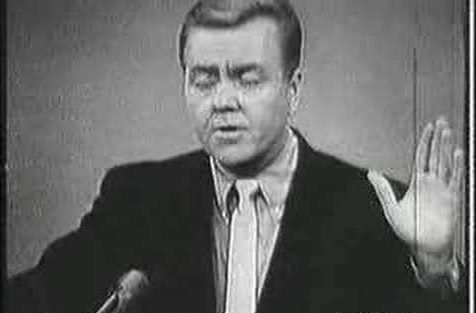
Proto-shock jock Joe Pyne had a 1960s TV talk show that exploited vital issues with zestful tastelessness. Some of his most notorious interviews follow.
Satanist Anton LaVey.
Transsexual Christine Jorgensen.
Pimp Iceberg Slim, author of Trick Baby.
Tags: Joe Pyne
Paglia, when she burst into the mainstream, with an unlikely interlocutor.
Tags: Bob Costas, Camille Paglia
From the good people at Riken.
Yes, they discuss nukes.
Tags: Hugh Hefner, William F. Buckley
Steve Jobs lets the Mac out of the bag in 1984.
Tags: Steve Jobs