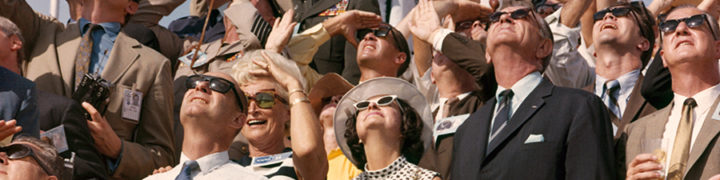
During the 1970s, the golden era of the airline industry.
You are currently browsing the archive for the Videos category.

Trains that look like rockets will, perhaps, take China to the moon or the future or something, even as concerns about corruption and safety linger. In “How Fast Can China Go?” in the new Vanity Fair, Simon Winchester writes about riding the recent inaugural CRH380A bullet between Shanghai and Beijing. An excerpt:
“Shanghai’s Rainbow Bridge Station is sited next to the city’s old (but newly rebuilt) domestic airport and in a fast-growing nexus of skyscrapers, restaurants, and subway lines (the city had no subway lines until 1995 and now has 11, each one built deeper than the last). The station is run by a woman, Bao Zhenghong. She is a little under 40, pretty, brisk, friendly, with a blue diamond-shaped badge of authority (over dozens of men, at least) on the sleeve of her no-nonsense uniform blouse. As she paced down the concourse marble she remarked, between shy grins and blushes, that she had started work as a menial at a suburban station 20 years ago, on graduation from technical school. She could not in her wildest dreams, she said, have imagined being so swiftly promoted to take total control of this $2.3 billion glass monument (built in only two years) to China’s newness. Hers is the largest station in Asia, with 60 platforms: it sees 250,000 passengers a day, is made of 80,000 tons of steel, is home to countless stores and restaurants and viewing galleries, and is powered by the biggest solar-panel array in creation.
Miss Bao earns only $900 a month, hardly within a whisper of her country’s growing battalions of millionaires, but she’s proud nonetheless: A young woman like me, she gestured at the echoing immensity, standing under a football-field-size electronic display flickering with train information. Who could have believed it?
But behind her was a red silk banner, which was half the station’s width, and which probably granted her all the credibility she needed. It was a banner displaying a 100-yard-long sentence in large Chinese characters, a reminder of the underpinning ethos of a country that to many seems merely—but probably wrongly—a capitalist juggernaut, spinning wildly toward an improbable future. The sign was old-school politburo propaganda, the kind of rhetoric that once blared interminably down from loudspeakers in every factory and village commune in the country. It displayed for the ideological benefit of everyone in her station a sober exhortation, one that most station workers know by heart: LET US ALL WORK HARD TO HARNESS THE GOOD OF TECHNOLOGICAL ACHIEVEMENT TO CREATE THE FINEST RAILWAY IN THE WORLD FOR THE ULTIMATE BETTERMENT OF THE CHINESE PEOPLE. Miss Bao grinned. Perhaps that is why an achievement like hers is more believable.”
••••••••••
Zooooom…
Tags: Simon Winchester
John Lennon dropped by the Today Show in 1974, the same year he paid a visit to Monday Night Football.
Tags: John Lennon

Kleenex was apparently not originally intended for nose-blowing. From “It’s Spreading,” Jill Lepore’s excellent 2009 New Yorker article about the media feeding frenzy that created the Parrot Flu scare of the 1929-30:
“By the twenties, Americans, and especially housewives, lived in fear of germs. Not only did newspapers and magazines run almost daily stories about newly discovered germs like undulant fever but their pages were filled with advertisements for hygiene products, like Listerine (first sold over the counter in 1914 and, in many ways, the granddaddy of Purell), Lysol (marketed, in 1918, as an anti-flu measure), Kotex (‘feminine hygiene,’ the first menstrual pad, introduced in 1920, a postwar conversion of a surgical dressing developed by Kimberly-Clark), Cellophane (1923), and Kleenex (1924; another Kimberly-Clark product, sold as a towel for removing makeup until a consumer survey revealed that people were using it to blow their noses).” (Thanks Longform.)
••••••••••
Baby ogre sells Kleenex in Japan, 1986:
Tags: Jill Lepore

Why build a skyscraper or shopping mall in a developing country when you can put up a small private city? That’s the thinking of Russia’s Renaissance Partners, which is currently building an insta-city in Kenya and has announced plans for another in the Congo. A note about the massive projects from the Moscow Times:
“The investment unit of Renaissance Group plans to build a 2,600-hectare city in the Democratic Republic of Congo as it seeks to benefit from Africa’s urbanization.
Renaissance Partners is working on a master plan for the new urban center after securing land outside Lubumbashi, the country’s second-largest city, Arnold Meyer, Renaissance Partners’ managing director for real estate in Africa, said in London.
‘The West has peaked in terms of economic growth and the new markets are in Africa,’ Meyer said. ‘And the main drivers of this growth in Africa are going to be cities.
Renaissance’s Lubumbashi project will be more than double the size of Tatu City, the $5 billion center that the firm is building from scratch outside the Kenyan capital of Nairobi.” (Thanks Marginal Revolution.)
••••••••••
“The city will be called Tatu”:

If you’re in NYC in early October, looking for smart entertainment and poor–or perhaps just incredibly cheap–there are going to be free performances of Up From the Stacks, a new musical by Ben Katchor and Mark Mulcahy. I’m a really big fan of Katchor, who sifts through the remnants of cities, finds value in the wreckage and uses it to construct something that isn’t exactly factual but seems truer than what once was. The info:
Set in The New York Public Library at Fifth Avenue and 42nd Street and in the environs of Times Square circa 1970, Up From the Stacks is the story of Lincoln Cabinée, a college student working part-time as a page, retrieving books for readers from the Library’s collection of 43 million items. This routine evening job inadvertently thrusts young Cabinée into the treacherous crossroads of scholarly obsession and the businesses of amusement and vice that then flourished in the 42nd Street area. The intellectual life of the city and the happiness of a young man hang in the balance.
Co-commissioned by the Dorothy and Lewis B. Cullman Center for Scholars and Writers at The New York Public Library, and Lincoln Center for the Performing Arts for Target Free Thursdays at the David Rubenstein Atrium.
Four performances:
Monday, October 3, 2011 at 6pm at The New York Public LIbrary for the Performing Arts at Lincoln Center, 40 Lincoln Center Plaza, Bruno Walter Auditorium
http://www.nypl.org/locations/tid/55/node/129318?lref=55%2Fcalendar
Tuesday, October 4 and Wednesday, October 5, 2011 both at 7pm at The New York Public Library, Fifth Ave. and 42nd St. (Stephen A. Schwarzman Building) South Court Auditorium
Register here for free seats:
Thursday, October 6, 2011 at 8:30 at The David Rubinstein Atrium at Lincoln Center (Broadway at 62nd St.)
http://new.lincolncenter.org/live/index.php/atrium-up-from-the-stacks-oct-6-2011
All performances are free.
••••••••••
From Pleasures of Urban Decay, a documentary about Katchor by Sam Ball:
Tags: Ben Katchor, Mark Mulcahy, Sam Ball
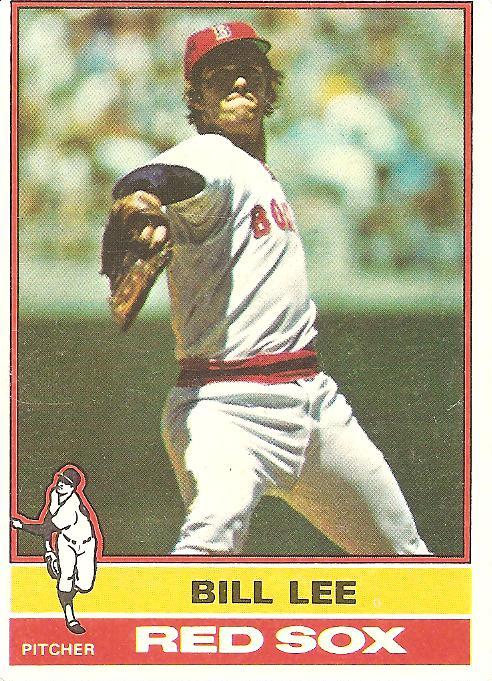
Bill “Spaceman” Lee, a true countculture character who starred in the very button-down sport of baseball from 1969-1982, was an outspoken eccentric who bragged about sprinkling marijuana on his pancakes. In the years before he was blackballed from the sport, Lee was profiled in all his mad glory in a 1978 Sports Illustrated article by Curry Kirkpatrick. An excerpt:
“Much of Lee’s rambling over the years has been about such terrific subjects as pyramid power, zero population growth, the goodness of soyburgers, the badness of sugar, interplanetary creative Zen Buddhism and heavy, heavy, zapped-out karma. But Lee’s philosophy is more out of comic books—to be specific, The Fabulous Furry Freak Brothers, which his 8-year-old son Michael shares with his dad—than Nietzsche or Vonnegut or even Paramahansa Yogananda…
The Boston-area public always has been divided along geographical as well as generational lines in its feelings toward Lee. In the blue-collar Irish bars of Southie, Lee was anathema after he defended Judge Arthur Garrity Jr., who ordered the desegregation of Boston schools by busing, as ‘the only guy in this town with any guts.’ On the other hand, the Spaceman was a prince to the city’s hip-liberal college population—largely based in Cambridge—which was thrilled by his outspoken lobbying for decriminalization of marijuana and his open defiance of pot laws.
The Red Sox were left in a quandary as to just what to do with Lee. Possibly the most straitlaced organization in all of pro sports, Boston was one of the first teams to impose a no-liquor rule on team flights and one of the last to dress out in form-fitting knit uniforms. In the matter of race, the Sox signed their first black player—Pumpsie Green—long after every other team in the majors had blacks. Even today only two U.S.-born blacks are on theRed Sox’ roster, Jim Rice and George Scott.
In Lee, team officials saw a flaming radical, junkballing journeyman lefthander with no fastball, no loyalty and no moral values. Yet they also saw a media hero who visited all the sick children, kept the sports talk shows in clover and drew crowds to Fenway Park.”
••••••••••
The Spaceman as an Expo:
A Fabulous Furry Freak Brothers strip:
Tags: Bill Lee, Curry Kirkpatrick
Good time-warp documentary about feminism, 1974.
Tags: Shirley Chisolm
The Morning Show on CBS on early September 11, 2001, right before the attacks began:

This classic 1974 NASA photograph shows the Skylab Orbital Workshop in its final orbit before returning to Earth. Skylab became a sensation of sorts behind closed doors in Washington because the astronauts photographed the super-secretive Area 51 (also known as “Groom Lake”), even though they had been ordered not to. Once the mission was complete, there was a scrum among various agencies for control of the photos (which were never released). Dwayne A. Day revealed the brouhaha in 2006 for the Space Review. An excerpt:
“Far out in the Nevada desert, miles from prying eyes, is a secret Air Force facility that has been known by numerous names over the years. It has been called Paradise Ranch, Watertown Strip, Area 51, Dreamland, and Groom Lake. Groom is probably the most mythologized real location that few people have ever seen. According to people with overactive imaginations, it is where the United States government keeps dead aliens, clones them, and reverse-engineers their spacecraft. It is also where NASA filmed the faked Moon landings.
However, for humans whose feet rest on solid ground, Groom is the site of highly secret aircraft development. It is where the U-2 spyplane, the Mach 3 Blackbird, and the F-117 stealth fighter were all developed. It has also probably hosted its own fleet of captured, stolen, or clandestinely acquired Soviet and Russian aircraft. Because of this, the United States government has gone to extraordinary lengths to preserve the area’s secrecy and to prevent people from seeing it.
This secrecy was threatened in early 1974 when the astronauts on Skylab pointed their camera out the window and took pictures of a facility that did not officially exist. They returned to Earth and their photographs quickly became a headache for NASA, the CIA, and the Department of Defense.”
••••••••••
“It had been a successful mission”:
Tags: Dwayne A. Day

“GPS and the End of the Road“ is Ari N. Schulman’s New Atlantis article about how the technological boom has resulted in a revolution in navigation. Of course, while we know better where we’re headed, other people also know where we’re headed. And reliance on GPS likely diminishes our ability to naturally navigate, making it one more step in the direction of cars that drive themselves. An excerpt:
“If each successive era has closed an old realm of exploration while opening up another, then what are we to make of the innovations in navigational technologies that have just gotten underway in earnest over the last ten years? The rise of digital mapping and the Global Positioning System (GPS) has seemed to come upon us almost as a matter of course, blended in with the general dawning of the digital age, and on its own relatively unremarked — but it has in a blink ushered in the greatest revolution in navigation since the map and compass.
The conception of GPS by the U.S. military began in the 1960s. Satellites with extremely precise onboard clocks constantly send out packets of information containing the time and coordinate at which they were sent; navigation devices here below receive the signal and calculate the transit time and distance. By combining information from several satellites, an accurate and precise coordinate for the navigation device can be calculated. In 1983, a navigational error sent Korean Air Lines Flight 007 into restricted Soviet airspace, where it was shot down, killing all 269 people aboard; subsequently, President Reagan directed that GPS be opened up for civilian use once it had been fully implemented. This occurred in the early 1990s, when a network of satellites was put in place.” (Thanks Longform.)
••••••••••
GPS, with Snoop Dogg:
Tags: Ari N. Schulman
Hexagonal ADAPTIV panels make military vehicles invisible. From the good people at BAE Systems. (Thanks Discovery.)

Syd Barrett, 1975.
For whatever reason, I lately find myself thinking about a 2006 Economist obituary for Pink Floyd’s Syd Barrett, who self-medicated his worsening mental illness with massive doses of LSD, extinguishing his great talent by 1968, three years after the group had formed. An excerpt from the obit:
“His weird words and odd, simplistic melodies, sent through an echo-machine, seemed sometimes to be coming from outer space.
Yet there was also something quintessentially English and middle class about Mr Barrett. His songs contained the essence of Cambridge, his home town: bicycles, golden robes, meadows and the river. Startlingly, he sang his hallucinations in the perfect, almost prissy enunciation of the Home Counties. He made it possible to do rock in English rather than American, inspiring David Bowie among others. The band’s first album, ‘The Piper at the Gates of Dawn’ (1967), made Mr Barrett central, plaintively calling up the new age from some distant and precarious place.
Yet the songs were already tipping over into chaos, and by January 1968 Mr Barrett was unable to compose or, almost, to function. Dope, LSD and pills, consumed by the fistful, overwhelmed a psyche that was already fragile and could not bear the pressures of success. At concerts he would simply play the same note over and over, or stand still in a trance. If he played, no one knew where he was going, least of all himself. The band did not want to part with him, but could not cope with him; so he was left behind, or left them, enduring drug terrors in a cupboard under the stairs in his London flat. Casualties of ‘bad trips’ usually recovered, with stark warnings for the unwary. Mr Barrett, famously, went on too many and never came back.”
••••••••••
“Come on you raver, you seer of visions / Come on you painter, you piper, you prisoner”:
Tags: Syd Barrett
Waiting for Elton John as he shows up for a 1975 concert in Los Angeles? A sequined Bob Mackie baseball uniform and a guffawing Charles Nelson Reilly. Not that there’s anything wrong with that.

Civilization was encroaching on the Wild West in the 1890s, as cowboys began to trade their trusted steeds for bicycles. At least that’s what was reported in the December 18, 1895 edition of the Brooklyn Daily Eagle. An excerpt:
“Kansas and Texas cowboys are now using bicycles in herding, rounding up and driving cattle to pasture, corral or barn. As a lively broncho has more double cussedness bound up in his diminutive carcass than any other animal in existence, the use of the wheel in its stead will destroy the romance which distance lends to the festive cowboy. Imagine a long haired, leather-breeched, sombreroed cowboy, guns, cartridge belt. etc.; cavorting across prairie, canyon and divide, in the effort to round up or rope a frisky long horn or cut out marketable steers from the bunch. Then when the Mescalero, Chiricahua and Yaqui Apache, the hereditary foes of the cowboy, are compelled to steal the bicycles instead of the ponies of the cow punchers, the demoralization of the trail, round-up and drive will have been complete.”
••••••••••
“Bucking Broncho,” 1894:
After briefly making love to a pack of Parliaments, Mike Wallace interviews Salvador Dali, 1958.
Tags: Mike Wallace, Salvador Dali

Has the rise of the machines made widespread enployment in America a thing of the past? That’s the question Douglas Rushkoff asks at the CNN site. An excerpt:
“New technologies are wreaking havoc on employment figures — from EZpasses ousting toll collectors to Google-controlled self-driving automobiles rendering taxicab drivers obsolete. Every new computer program is basically doing some task that a person used to do. But the computer usually does it faster, more accurately, for less money, and without any health insurance costs.
We like to believe that the appropriate response is to train humans for higher level work. Instead of collecting tolls, the trained worker will fix and program toll-collecting robots. But it never really works out that way, since not as many people are needed to make the robots as the robots replace.
And so the president goes on television telling us that the big issue of our time is jobs, jobs, jobs — as if the reason to build high-speed rails and fix bridges is to put people back to work. But it seems to me there’s something backwards in that logic. I find myself wondering if we may be accepting a premise that deserves to be questioned.
I am afraid to even ask this, but since when is unemployment really a problem? I understand we all want paychecks — or at least money. We want food, shelter, clothing, and all the things that money buys us. But do we all really want jobs?
We’re living in an economy where productivity is no longer the goal, employment is. That’s because, on a very fundamental level, we have pretty much everything we need. America is productive enough that it could probably shelter, feed, educate, and even provide health care for its entire population with just a fraction of us actually working.”
••••••••••
“All with the push of a button”:
Tags: Douglas Rushkoff
In 1979, an earnest Merv Griffin interviews Kathleen and George Lutz, the Long Island couple at the heart of the Amityville Horror hokum.
Tags: George Lutz, Kathleen Lutz, Merv Griffin
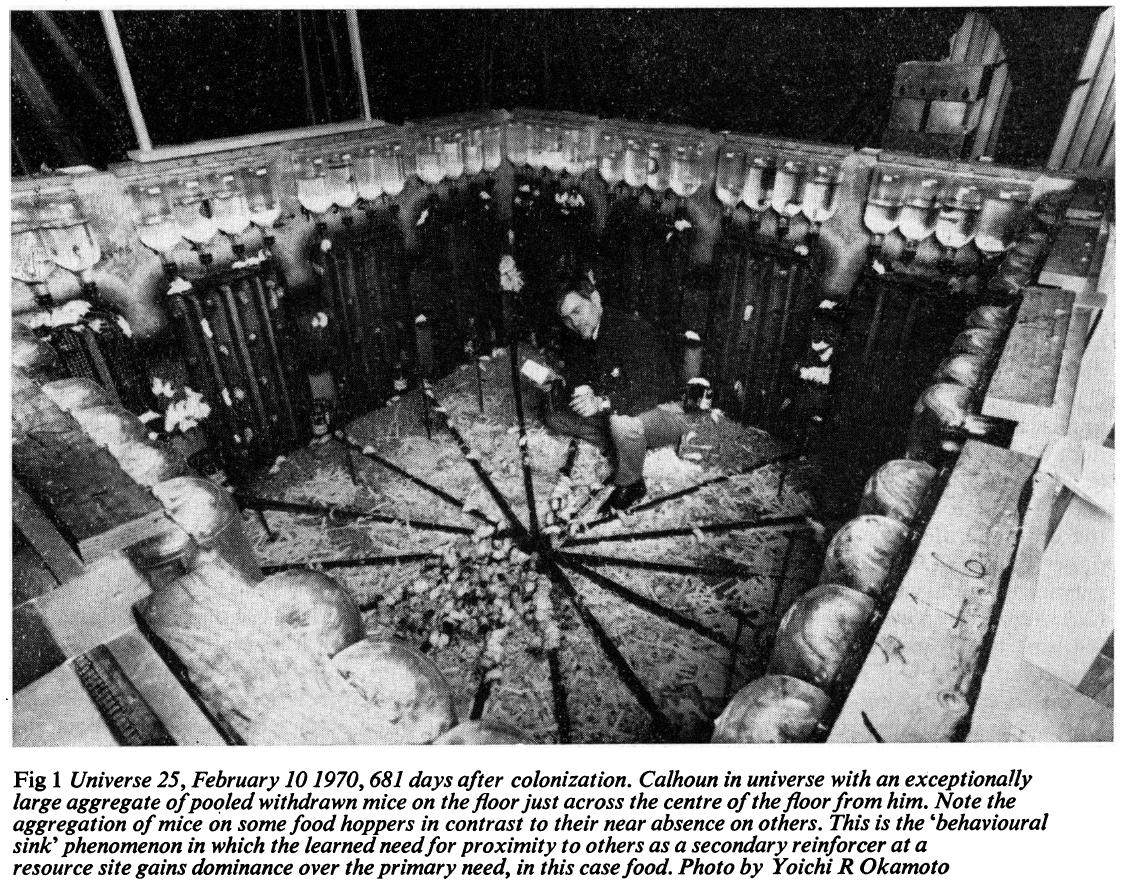
In Cabinet, Will Wiles recalls the work of John B. Calhoun, a scientist who used rodents to study the effects of overpopulation. Despite Malthusian hand-wringing, population density seems to be a good thing overall for humans. An excerpt:
“So what exactly happened in Universe 25? Past day 315, population growth slowed. More than six hundred mice now lived in Universe 25, constantly rubbing shoulders on their way up and down the stairwells to eat, drink, and sleep. Mice found themselves born into a world that was more crowded every day, and there were far more mice than meaningful social roles. With more and more peers to defend against, males found it difficult and stressful to defend their territory, so they abandoned the activity. Normal social discourse within the mouse community broke down, and with it the ability of mice to form social bonds. The failures and dropouts congregated in large groups in the middle of the enclosure, their listless withdrawal occasionally interrupted by spasms and waves of pointless violence. The victims of these random attacks became attackers. Left on their own in nests subject to invasion, nursing females attacked their own young. Procreation slumped, infant abandonment and mortality soared. Lone females retreated to isolated nesting boxes on penthouse levels. Other males, a group Calhoun termed ‘the beautiful ones,’ never sought sex and never fought—they just ate, slept, and groomed, wrapped in narcissistic introspection. Elsewhere, cannibalism, pansexualism, and violence became endemic. Mouse society had collapsed.” (Thanks Longreads.)
••••••••••
Ratsploitation, 1972:
Tags: John B. Calhoun, Will Wiles
The advent of cashless transactions, 1969.
Karen Carpenter, placid on the outside but tormented beneath the surface, performs a hit with her brother, Richard, for David Frost, 1970.
Todd Haynes’ 1983 cult classic, “Superstar: The Karen Carpenter Story”:
Dennis Hopper interviewed by David Brenner in 1986, just as David Lynch released his masterpiece, Blue Velvet, which would lead to a career renaissance for the actor. Hopper was married for a few years to Daria Halprin.
Tags: Daria Halprin, David Brenner, Deniis Hopper

Alternet has an article by Tana Ganeva about creepy new uses for facial recognition technology. An excerpt:
“In the fall, police officers from 40 departments will hit the streets armed with the Mobile Offender Recognition and Information System (MORIS) device. The gadget, which attaches to an iPhone, can take an iris scan from 6 inches away, a measure of a person’s face from 5 feet away, or electronic fingerprints, according to Computer vision central. This biometric information can be matched to any database of pictures, including, potentially, one of the largest collections of tagged photos in existence: Facebook. The process is almost instant, so no time for a suspect to opt out of supplying law enforcement with a record of their biometric data.
Lee Tien of the Electronic Frontier Foundation told AlterNet that while it’s unclear how individual departments will use the technology, there are two obvious ways it tempts abuse. Since officers don’t have to haul in an unidentified suspect to get their fingerprints, they have more incentive to pull people over, increasing the likelihood of racial profiling. The second danger lurks in the creation and growth of personal information databases. Biometric information is basically worthless to law enforcement unless, for example, the pattern of someone’s iris can be run against a big database full of many people’s irises.”
••••••••••
“It’s getting better all the time”:
Tags: Lee Tien, Tana Ganeva
Allen Ginsberg shares an LSD-inspired poem with William F. Buckley in the first video. Buckley entertains a drunk Jack Kerouac in the second clip.
More William F. Buckley posts:
- Buckley meets Groucho Marx. (1967)
- Buckley interviews Muhammad Ali. (1968)
- Buckley debates James Baldwin. (1965)
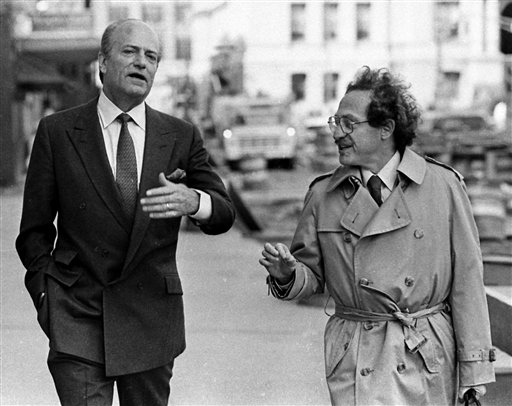
In 1985, Barbara Walters interviewed infamous society spouse Claus von Bülow, who married well though his wife did not. One odd thing: Walters was made up like Tammy Faye Bakker. Did female reporters on TV in the ’80s always wear such heavy make-up?
Shockingly, Vanity Fair squeezed in a story or two about the lurid case of heiress Sunny von Bülow. From Dominick Dunne’s 1985 article, “Fatal Charm: The Social Web of Claus von Bülow“:
From the beginning, the von Bülow proceedings, legal and otherwise, had had an air of unreality about them. His once beautiful wife was one of the country’s richest heiresses. His stepchildren were a prince and princess. His daughter was a disinherited teenager. His former mistress was a socialite actress. His current lady friend was a thrice-married Hungarian adventuress who was not the countess she was often described as being. The maid who testified against him had once worked for the Krupps. And lurking darkly in the background was a publicity-mad con man bent on destroying him.
The apartment of Sunny von Bülow, even by Fifth Avenue standards, is very grand. Located in one of the most exclusive buildings in New York, its current market value is estimated by one of the city’s top realtors at nearly $8 million. Although a sophisticated friend of von Bülow’s complained that the forty-foot drawing room has ‘far, far too many legs,’ it should be pointed out that the legs are by Chippendale and of museum quality, as is nearly every object in the fourteen-room apartment looking down on Central Park.
According to the terms of Sunny von Bülow’s will, the apartment will go to von Bülow when she dies. So will Clarendon Court, the fabulous mansion set on ten acres overlooking the sea in Newport, Rhode Island, where her two comas took place during successive Christmas holidays, in 1979 and 1980. So will $14 million of her $75 million fortune. In the meantime the maintenance on the apartment is paid for by Sunny’s estate, so in effect von Bülow and his self-proclaimed mistress, Andrea Reynolds, have been largely supported by his comatose wife since his conviction in 1982 for her attempted murder. That verdict was overturned on appeal because certain materials had been withheld from the defense and others had been improperly admitted as evidence.•
Tags: Andrea Reynolds, Barbara Walters, Claus von Bulow, Sunny von Bülow