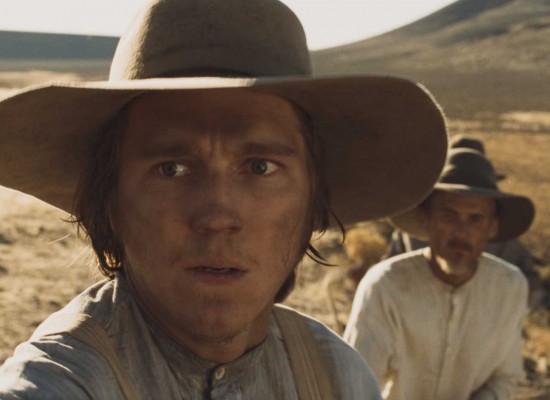
Unmentioned in my post on Meek’s Cutoff was that two of its cast members are the great young actors Paul Dano and Zoe Kazan (an off-screen couple as well). Dano came to notice in Little Miss Sunshine and gave a mind-blowing performance in There Will Be Blood. He was the subject of a short profile by Melena Ryzik in the New York Times Magazine in 2009. An excerpt:
“Mr. Dano grew up in Manhattan and Wilton, Conn. He made his Broadway debut at 12 in Inherit the Wind, with George C. Scott and Charles Durning, and a few years later appeared as a troubled teenager preyed upon by a pedophile (played by Brian Cox) in the film L.I.E. Despite the steady work, Mr. Dano wasn’t thinking about building a career. Acting was just fun, he said, on a par with other after-school activities, like basketball.
Little Miss Sunshine, released in 2006, was a turning point. The story of a misfit family’s road trip, it became the toast of Sundance and won two Oscars. Mr. Dano’s character, a misfit among misfits, doesn’t speak for most of the movie, yet manages to be a focal point in a cast including Alan Arkin and Steve Carell.
Mr. Dano auditioned for it two years before it was made. ‘Sometimes when people don’t have a line, they want to mime the line or communicate too much, but he was good at holding it all in,’ Ms. Faris said. ‘His silence was so much more intimidating, in a way, than other actors.'”
••••••••••
“The devil is in your hands and I will suck it out”:
From an MSNBC report about the first time the smiley emoticon was used:
“At 11:44 a.m. on September 19, 1982, a man named Scott Fahlman posted a message to an electronic computer-science department bulletin board at Carnegie Mellon University. And with that simple action he did something wonderful: He became the individual who would later be credited as the inventor of :-), an ASCII-based emoticon.”
••••••••••
Ten years after the Smiley was born, Jessica Yu captured a different expression in “Sour Death Balls”:
Unlike her Dick Cavett interview from the same year, in which she largely seemed bitter and hard, Lucille Ball is her bright self in this 1974 chat with Phil Donahue.
From the opening chapter of Thomas Kuhn’s 1957 book, The Copernican Revolution, about the biggest game-changer in science history:
“Even its consequences for science do not exhaust the Revolution’s meanings. Copernicus lived and worked during a period when rapid changes in political, economic, and intellectual life were preparing the bases of modern European and American civilization. His planetary theory and his associated conception of a sun-centered universe were instrumental in the transition from medieval to modern Western society, because they seemed to affect man’s relation to the universe and to God. Initiated as a narrowly technical, highly mathematical revision of classical astronomy, the Copernican theory became one focus for the tremendous controversies in religion, in philosophy, and in social theory, which, during the two centuries following the discovery of America, set the tenor of the modern mind. Men who believed that their terrestrial home was only a planet circulating blindly about one of an infinity of stars evaluated their place in the cosmic scheme quite differently than had their predecessors who saw the earth as the unique and focal center of God’s creation. The Copernican Revolution was therefore also part of a transition in Western Man’s sense of values.”
This must have been the most insane episode of the Love Boat ever, one with some sort of fashion-world premise. Designers on board: Geoffrey Beene, Halston, Bob Mackie and Gloria Vanderbilt (designer jeans giant and Anderson Cooper’s mom!). Also on the cruise were Cristina Ferrare, the model who was married to a midlife-crisis John DeLorean; and Dick Shawn, most famously of The Producers. I’ve always contended that episodes of the series were written by putting 100 monkeys in front of 100 typewriters and 100 bowls of cocaine.
Apple claims that Samsung has ripped off design aspects of its iPad; Samsung has countered by charging Apple with lifting the iPad design from 2001: A Space Odyssey. Odd defense, which I doubt will work. From the legal paperwork, via disinfo:
“Attached hereto as Exhibit D is a true and correct copy of a still image taken from Stanley Kubrick’s 1968 film 2001: A Space Odyssey. In a clip from that film lasting about one minute, two astronauts are eating and at the same time using personal tablet computers…As with the design claimed by the D’889 Patent, the tablet disclosed in the clip has an overall rectangular shape with a dominant display screen, narrow borders, a predominately flat front surface, a flat back surface (which is evident because the tablets are lying flat on the table’s surface), and a thin form factor.”
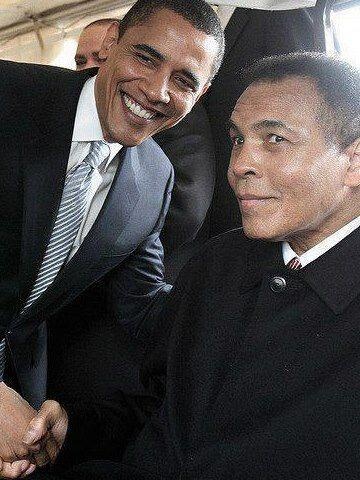
Muhammad Ali, long before anyone could imagine an African-American President, sagely suggested that a person of color will hold that office only once the job has become completely undesirable.
From “Ego,” the 1971 Norman Mailer Life article mentioned in the video:
Muhammad Ali begins with the most unsettling ego of all. Having commanded the stage, he never pretends to step back and relinquish his place to other actors–like a six-foot parrot, he keeps screaming at you that he is the center of the stage, ‘Come here, and get me, fool,’ he says. ‘You can’t, ’cause you don’t know who I am. You don’t know where I am. I’m human intelligence and you don’t even know if I’m good or evil.’ This has been his essential message to America all these years. It is intolerable to our American mentality that the figure who is probably most prominent to us after the President is simply not comprehensible, for he could be a demon or a saint. Or both!•
Rona Barrett interviewed a slew of major entertainers, before she could be apprehended. In 1973, she and Sir Clement Freud, the polymath grandson of Sigmund Freud, got into a dust-up on a program Jack Paar hosted years after he abandoned the Tonight Show.
From Freud’s 2009 obituary in the Telegraph: “In England the bearded Freud, who bore an uncanny resemblance to King Edward VII, became a household name appearing in dog food commercials alongside an equally mournful bloodhound named Henry.
His journalistic output was prodigious, running the gamut from the New Yorker to the pre-Murdoch Sun. He was at his best writing on food and drink (he had been an apprentice at the Dorchester and trained at the Martinez in Cannes). He wrote about recalcitrant head waiters, overrated chefs and curmudgeonly customs officers, waging a ceaseless battle against their arrogance, even though not always free of the trait himself.
Once, having waited 25 minutes for turtle soup, he told the waitress: ‘If you are making fresh turtle soup it is going to take two days, and we do not have the time. If it is canned turtle soup, I do not wish to eat here if it takes you 25 minutes to open a can.'”
As Hollywood’s studio system collapsed in the 1960s and the anti-hero indie Easy Rider showed a new path to riches, mavericks like Dennis Hooper could do anything they wanted. That freedom, of course, wasn’t the best thing for Hopper’s health or sanity. One of the least self-lacerating things he did during that era was to read a Rudyard Kipling poem for Johnny Cash in 1970.
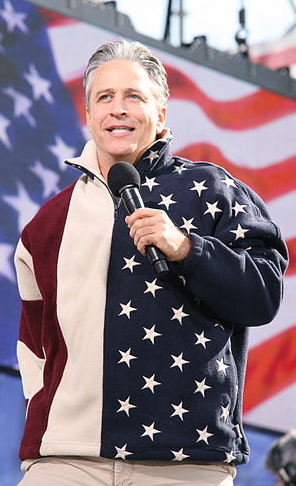
I don’t agree with the great Esquire writer Tom Junod that Jon Stewart has lost his sense of humor over the years, but here’s an excerpt from his interesting new profile of TV’s most-lauded truth-teller:
“Now, you have to understand Jon Stewart is just like everybody else: He can be a dick. His father took off when he was a kid, leaving a hole in his heart approximately the old man’s shoe size. He’s damaged and is capable of doing damage in return, especially in close quarters. There are plenty of Daily Show staffers, present and former, who love and revere their boss for his difficult brilliance. There are also plenty — mostly on the former side — who have been, well, fucked up by him and his need to dominate. When he arrived at The Daily Show in 1999, its humor was goofy and improvisational, based on the interplay between the fake-news host and the fake-news correspondents and dependent on whimsy and happenstance. But Stewart knew what he wanted right away, and it wasn’t that. He wanted the show to be more competitive, almost in a news-gathering sense, and he wanted it to have a point of view, which happened to be his own. There are writers and producers from the first five years of the show, both male and female, who are described as ‘battered wives’; hell, there are people who used to work for him who are scared to talk about him because they’re scared of not being able to work again. And before he pushed out the show’s cocreator, he notoriously threw a newspaper at her in a story meeting and then, according to a staffer, apologized to her later with the words ‘Sorry, that was the bad Jon — I try not to let him out…'”
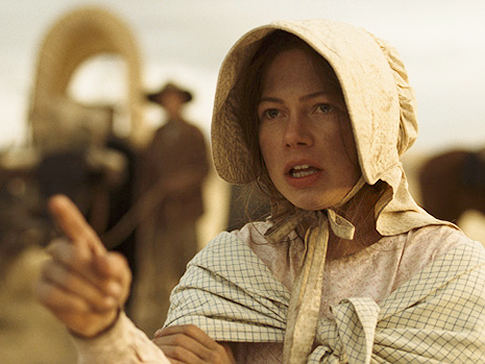
“We’ve come to a terrible place,” says a member of a lost and increasingly desperate 1845 traveling party on the Oregon Trail, in Kelley Reichardt’s understated 2010 drama. A portrait of pioneers who have a date with Manifest Destiny, the film follows a blustery guide and several clans as they traverse the Northwest looking for America’s future, having been sold on stories of plenty, but instead finding a cruel earth that dispenses wealth or woe on a whim.
Gruff guide Stephen Meek (Bruce Greenwood) talks big about the gold in them thar hills, but the three families who’ve paid him to deliver them to some semblance of utopia—the Tetherows, the Whites and the Gatelys–are low on water and patience. They’ve been wandering the desert for weeks and have come no closer to their original destination. Lost in a strange land that is not yet American, the party puts up with all manners of privations as they continue on their road to nowhere. When Meek captures an Indian, Emily Tetherow (Michelle Williams) believes that they may be better off allowing the stranger (Rod Rondeaux) to lead them than their puzzled pathfinder, although there is the chance they will be delivered into an ambush. But one thing can be scarier than this choice: the realization that there truly is no choice to be made, that the forks in the road will decide their fate regardless of who is at the head of the line.
It’s easy to forget in our insta-societry that for much of our country’s history pioneering meant heading somewhere and then waiting for the future to arrive. Until civilization took root, settlers were prone to the conditions and dependent on luck as well as grit. But the pioneer spirit has come to mean something different to us–not waiting for the future to arrive, but trying to keep up with one that arrives with stunning regularity. That’s where we are now, pioneers all, willing or not.•
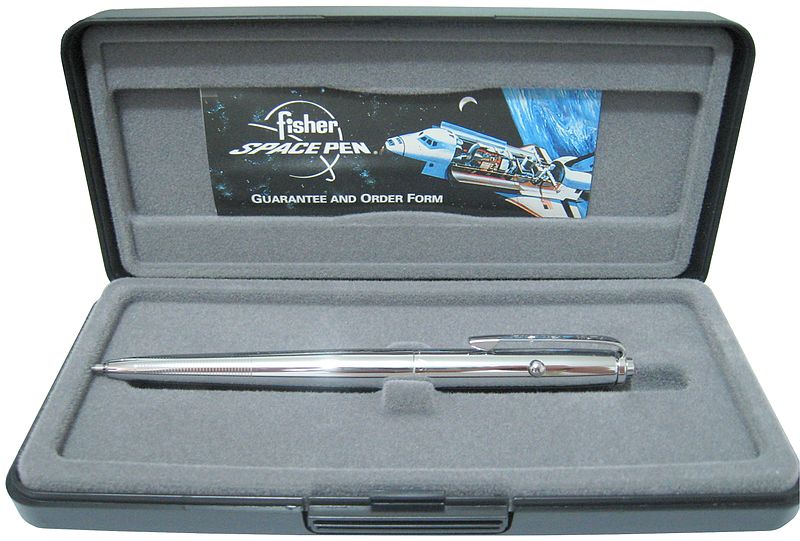
“There’s a popular myth that NASA spent ‘millions’ of dollars developing a pen for astronauts to use in the weightless environment of a space ship — while their sensible Russian counterparts were happy to use the low-tech pencil. Alas, for all its appeal and plausibility, this is not true. Initially, astronauts and cosmonauts were both equipped with pencils, but there were problems: if a piece of lead broke off, for example, it could float into someone’s eye or nose. A pen was needed, one that would defy gravity, write in extreme heat or cold, and be leak proof: blobs of ink floating around the cabin would be more perilous than a stray pencil lead. A long-time pen maker named Paul C. Fisher patented the ‘space pen’ in 1965 (which he had developed at the cost of a million dollars, at the request of but not under the auspices of NASA.) NASA bought four hundred of them at $6 each, and, after a couple of years of testing, the pens were put into space.”
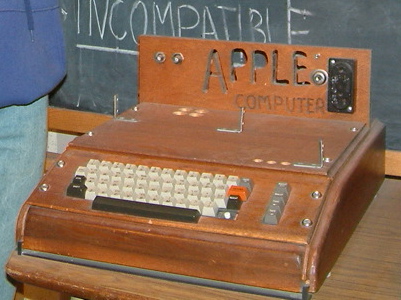
Steven Johnson, who wroteThe Ghost Map,a fascinating account of amateur epidemiology in Victorian England,shares his recollectionsof the mind-altering, game-changing effect of the Macintosh computer, in the Wall Street Journal. An excerpt:
“But that first Macintosh did much more than expand my data storage needs. It also fundamentally changed my relationship to technology—and in doing that, ultimately changed the course of my life.
It’s hard to remember now, but in the mid-1980s—before Wired Magazine, Pixar, dot-com start-ups, celebrity tweeting—being obsessed with your computer had almost no cultural cachet. You were just a nerd, full stop. The computers of the day had all the playfulness of a tax audit, and the creative people who used them did so begrudgingly.
But one look at the Mac and you could tell something was different. The white screen alone seemed revolutionary, after years of reading green text on a black background. And there were typefaces! I had been obsessed with typography since my grade-school years; here was a computer that treated fonts as an art, not just a clump of pixels. The then-revolutionary graphic interface made the screen feel like a space you wanted to inhabit, to make your own. To paraphrase Le Corbusier, the Mac was a machine you wanted to live in.” (Thanks Browser.)
••••••••••
Steven Johnson revisits the cholera outbreak of 1854 during his TED Talk:
Akinori Ito has created a machine that transforms plastic back into oil. Maybe someday the millions of tons of plastics that are accidentally dropped into the oceans from recycling barges each year will be sought the way oil is now.
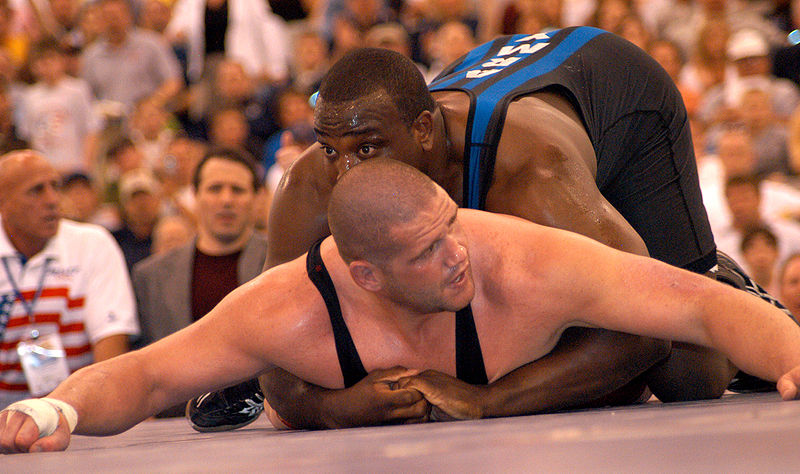
"There was no way for Ru to moderate his frenetic relentlessness. He pushed everything to the max." (Image by Tim Hipps.)
From frostbite to a broken neck to a plane crash to morbid obesity, Greco-Roman wrestler Rulon Gardner has famously cheated death so many times it’s difficult to remember that the farmboy scored one of the greatest upsets in Olympic history just a little more than a decade ago. From a 2007 GQ profile by Michael Paterniti:
“After defeating Karelin—in a match that became known as Miracle on the Mat—Ru appeared on Leno, Oprah, Letterman. He showed up at the Espy Awards and was photographed with Tiger Woods and Lara Flynn Boyle. He befriended heroes like Garth Brooks and Jason Giambi. He won the prestigious Sullivan Award, given to the country’s best amateur athlete. There were parades and city keys, more awards and gifts, including a waverunner from Rosie. He showed up in a ‘Got Milk?’ ad, hoisting buckets of milk while wearing a creamy white mustache. He went on tour, giving inspirational speeches to corporate clients willing to pay up to $15,000 a speech. He wrote his autobiography, titledNever Stop Pushing.
If he didn’t entirely believe his own legend yet, if he approached everyone as if he were still the old affectless Rulon Gardner, the farm boy from Star Valley seeking a little love and approval, he had seen through to a life beyond the Valley. And that life included proving he was no fluke by winning World Championships the following year and then preparing to defend his gold medal at the 2004 Games.
Where he once clandestinely sold the Cuban cigars he’d collected at an international meet in Havana in order to support himself, his new-won fame now turned on a spigot of income flow. His father had once lived over him, always on the verge of bankruptcy, and here he was, Rulon Gardner, a national treasure having made $250,000 the year after he won his gold—and the number was climbing. (‘He spent nine minutes on the mat with that ugly man from Russia,’ Reed Gardner jokingly told a reporter. ‘I spent fifty to sixty years on the farm, and I don’t have nothin’.’) So, he’d begun to accumulate toys, to live a grown-up version of the childhood he’d missed, with motorcycles and guns and a shiny snowmobile he took into the mountains near Star Valley. Of course there was no way for Ru to moderate his frenetic relentlessness. He pushed everything to the max.
Extreme snowmobiling can be as harrowing as any sport invented, man and machine against the mountain, finding aggressive routes up pitched faces, jumping rivers, riding into deep powder, and searching for perfect isolation. There are breakdowns and strandings, sudden submersions in icy water and the constant challenge of righting a 500-pound machine after having fallen chest-deep in snow—all in quest of some banana-cream vision out there through the trees, up on the ridge, gazing all those silver miles over Wyoming. In other words, it combines all the ingredients that make someone like Rulon Gardner tick: high-octane risk-taking, brute physicality, farm-boy ingenuity, nimble coordination, and conflict reduced to its simplest denominator, survival.
In February 2002, Ru went out snowmobiling with two friends in the Bridger-Teton National Forest, in Wyoming, thirty minutes from his home. They cruised the high peaks and winding valleys for a couple of hours until Ru peeled off, alone, into a gully of virgin snow near the head of the Salt River, ‘to play a little,’ as he put it. Shooshing down into the gully, he had no inkling that he wouldn’t be able to get out for seventeen hours. He was wearing a T-shirt, sweatshirt, and fleece pullover, having left his jacket behind. The sun had begun to dip in the sky; the temperature, which had been twenty-five degrees, began to plummet. Over the course of the next hours, Rulon tried to work his way out of the gully. His machine didn’t have the power necessary to take him back up the route he’d just dropped down. Worse, as he crisscrossed the Salt River in an increasing panic, occasionally submerging his sled, he found himself in a narrow gully where, ultimately, his machine became stuck between two boulders. During the journey, he had to repair a belt and fell four times into the river, soaking his clothes. (‘Once I got wet, I knew I had about an hour before frostbite and hypothermia,’ he said.) Finally, as night fell, he dug out a spot among the trees and waited for his own inevitable death. Sometime around 2 a.m., he heard the roar of snowmobiles, but then the sound faded. ‘I thought I was rescued,’ he said. ‘They came within 200 yards, and I was yelling, but they couldn’t hear me over their engines—and then they just turned away.’ He slipped in and out of consciousness, having visions: first of Jesus and then of his brother Ronald, who died at the age of 14 of a rare blood disease. (When his leg had to be amputated because of gangrene, Ronald said, ‘It’s okay, Dad, I can wrestle with one leg.’) Time crawled. What helped keep him alive was the thought of his family and friends finding him frozen there, a lifeless face with eyes open like Jack Nicholson in The Shining.
The next morning he was spotted by a search plane, and two hours later a helicopter landed, and he was able to crawl across the snow and climb in. His core body temperature had dropped into the 80s, and both his feet were so badly frostbit it would take four surgeries and three months before he could walk.” (Thanks TETW.)
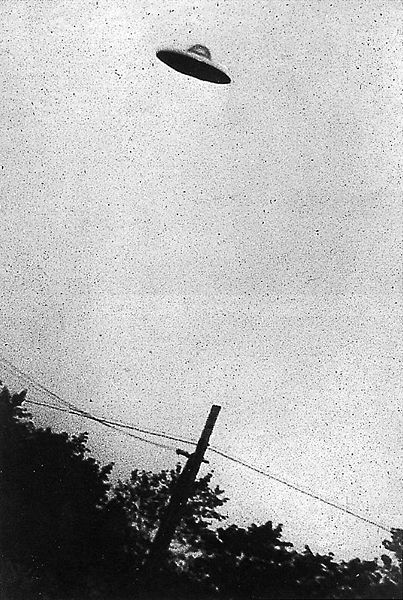
Did anyone see the ufo hovering over NY harbor near the statue of liberty and governor’s Isl. The thing stood there about 40 seconds then shot straight up like a rocket faster than anything I’ve ever seen before. about a hour ago