Urban Studies

You are currently browsing the archive for the Urban Studies category.

"His waitresses lived in company housing and kept curfew."

The Wall Street Journal’s Jonathan Eig has published a smart book review of Stephen Fried’s Appetite for America. The book examines how Fred Harvey’s chain of lunchrooms–America’s first national chain of any kind–which grew up around railroads in the Old West beginning in the 1870s, helped to tame that still-wild region of America. Harvey served surprisingly good food, offered a warm environment and imported an all-female waitstaff (“Harvey Girls“) to attract single men looking for brides.

For a formerly poor New York immigrant pot scrubber to have accomplished so much, Harvey had to run a tight ship. An excerpt from the review about his strict business practices:

“He ran his railroad-restaurant business, operating along the Atchison, Topeka & Santa Fe lines, like a military operation. His waitresses lived in company housing and kept curfew. On and off the job, they were expected to follow rules: ‘Have a Sincere Interest in People’ was the first on a list that Mr. Fried reprints. Another reminded employees that ‘Tact is an Asset and HONESTY is still a Virtue.’ Harvey’s decrees didn’t necessarily apply to Harvey: A newspaper in 1881 reported that when he fired the manager of a train-station restaurant in Deming, N.M., Harvey threw the man out the front door onto the train platform ‘and the dining room equipment followed after him in quick order.'”

Tags: , ,

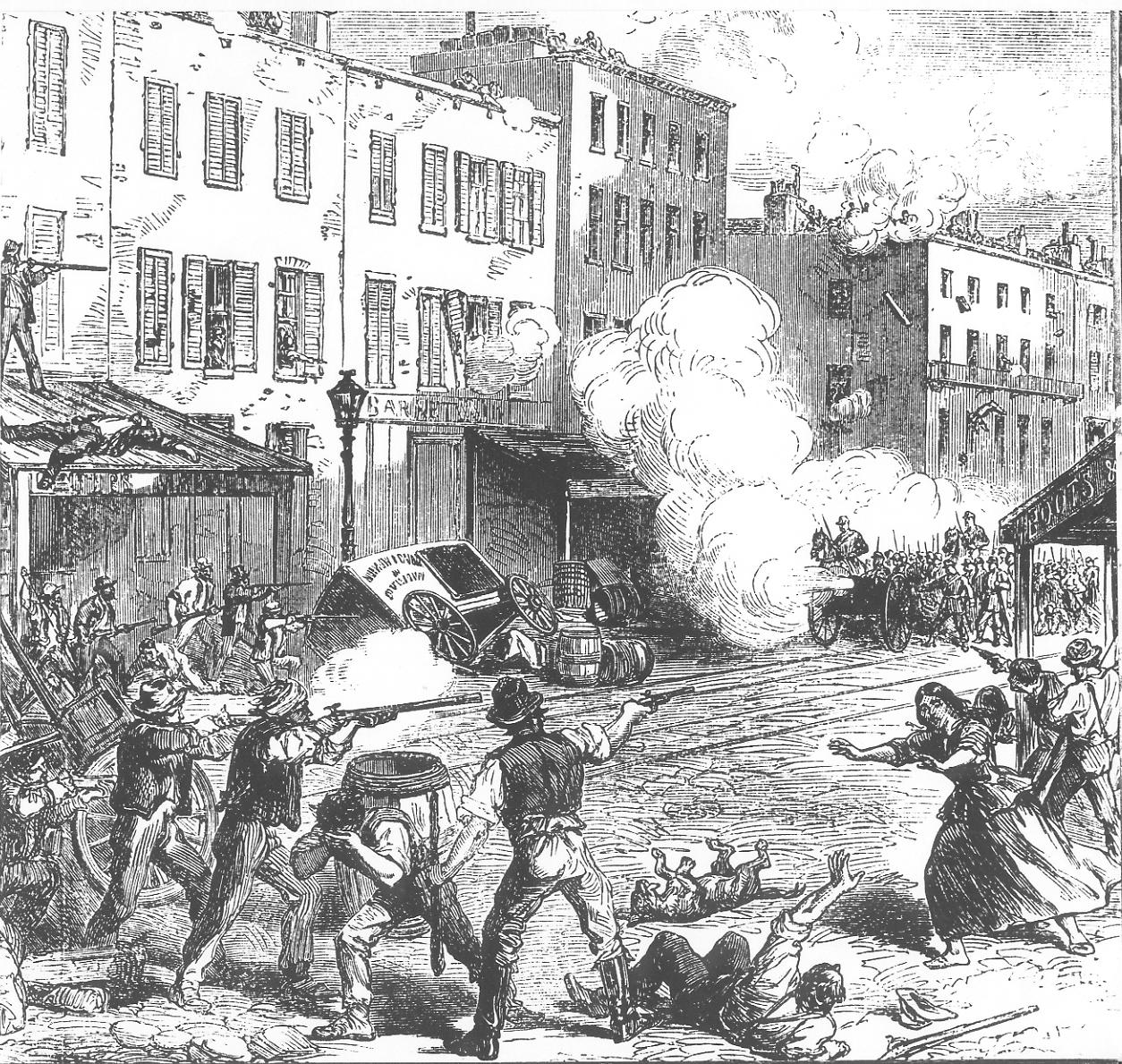
Women are present in this 1863 depiction of a New York City draft riot.

This old print article from the July 19, 1899 issue of the Brooklyn Daily Eagle is a special kind of chauvinistic crazy. New York in the 19th century was prone to riots of all kind (gang, labor, race, draft, drunken, etc.), and I guess this was some sort of op-ed warning to the fairer sex: Do not get involved or else! I would further have to assume one of the editors had an argument with his wife that morning. The piece in full:

“No man wishes to hurt a woman. No man will intentionally hurt one. But the kind of women who unsex themselves to mix with rioters and who throw stones and bottles at our motormen and passengers on our street cars incur danger to their lives. People who are assailed by overwhelming numbers do not and can not cooly select the enemies whom they will shoot or club, and if, in striking at random here and there, a policeman hits a woman’s head, the blame attaches to the woman, not the policeman.

During this strike in Brooklyn several harridans from the tenements have mixed with the loafers and the rowdies who have blocked the cars and attacked the passengers. They believe their skirts defend them. They have yelled profane and obscene epithets at the men who were trying to earn an honest living and have encouraged the disorderly element with voice and example.

When a woman debases herself to companion with drunkards, ruffians and dynamite sneaks, when she teaches her children to defy our ordinances and sets examples to them of disorder and brutality, the outraged law can hardly regard her as a woman at all. The same law sent one woman to the electric chair awhile ago for murder. Her case created a great deal of maudlinism though it deserved not a jot of it, for her crime was premeditated, cold-blooded and devilish. The same law may require harshness in its dealings with all rioters and would-be slayers of fellow creatures, whether they wear beards or not. The place for women in a time like this is at home.”

Carlsen prepares to move that horsie thingy.

The tremendous kottke.org pointed me in the direction of a great Der Spiegel interview with chess champ Magnus Carlsen. While I’m not very interested in chess as a game, I find great chess players to be fascinating psychologically. You would assume their monomania for the game might make them similar personality types, but that doesn’t seem to be the case.

The Norwegian teen Carlsen, currently ranked number one in the world, is as interesting and aware of himself as he is talented. A few quick excerpts from the interview.

*****

Spiegel: Mr Carlsen, what is your IQ?

Carlsen: I have no idea. I wouldn’t want to know it anyway. It might turn out to be a nasty surprise.

Spiegel: Why? You are 19 years old and ranked the number one chess player in the world. You must be incredibly clever.

Carlsen: And that’s precisely what would be terrible. Of course it is important for a chess player to be able to concentrate well, but being too intelligent can also be a burden. It can get in your way. I am convinced that the reason the Englishman John Nunn never became world champion is that he is too clever for that.

*****

Spiegel: You are a sloppy genius?

Magnus Carlsen: I’m not a genius. Sloppy? Perhaps. It’s like this: When I am feeling good, I train a lot. When I feel bad, I don’t bother. I don’t enjoy working to a timetable. Systematic learning would kill me.

*****

Spiegel: Do you win [at online poker]?

Magnum Carlsen: If I take a game seriously, I do. If not, I sometimes lose. But that doesn’t matter. What is important is that I have a life beyond chess.

Spiegel: Why?

Magnum Carlsen: Chess should not become an obsession. Otherwise there’s a danger that you will slide off into a parallel world, that you lose your sense of reality, get lost in the infinite cosmos of the game. You become crazy. I make sure that I have enough time between tournaments to go home in order to do other things. I like hiking and skiing, and I play football in a club.

Tags:

Harrisburg, Pennsylvania: Incorporated as a town in 1812.

In this time of economic calamity, why should only individual citizens be broke when entire towns can manage it collectively?

I came across this Economist story about Harrisburg, Pennsylvania, the Keystone State’s pretty and pretty much bankrupt capital city. The article, “A Burning Issue,” details how a huge investement in an incinerator system that doesn’t work properly and a bungling city council have left the quaint town of 47,000 on the brink of filing for bankruptcy protection, even though new Mayor Linda Thompson doesn’t want to consider it. An excerpt:

“‘It’s a long way to Heaven. It’s closer to Harrisburg,’ sings Josh Ritter, a contemporary singer-songwriter. But these days Harrisburg, Pennsylvania’s picturesque state capital, home to 47,000 people, would make a poor alternative to heaven. Mainly because of a crippling $288m loan guarantee for a trouble-plagued rubbish incinerator, the city is in a hellish financial state.

Its budget deficit over the next five years is projected to be $164m, including $68.7m of debt service due this year. Moody’s downgraded its bond rating last month. Some people, including Dan Miller, the city controller, are recommending that Harrisburg should seek protection in the bankruptcy courts. ‘It’s too late to do anything else,’ he says.”

Tags: , ,

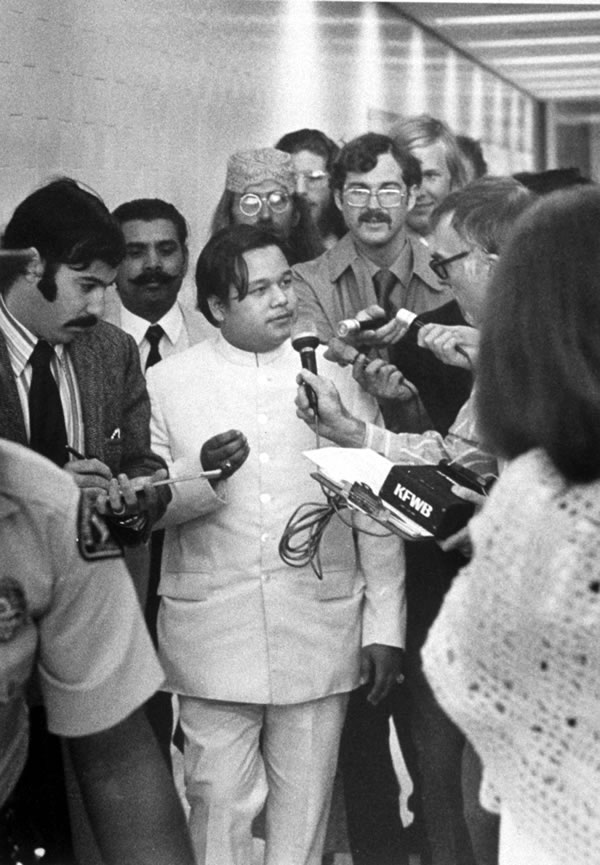
The world was strange in 1973, even stranger than it is today. That was the year of the three-day festival, Millennium ’73, when thousands of Vietnam War protestors gathered at the Houston Astrodome to hear the words of 15-year-old Shri Guru Maharaj Ji, who they believed was God. The attendees also thought that perhaps they could use their spiritual powers to levitate the stadium and make it fly, which would somehow stop the war.

i found a three-and-a-half-minute clip from the David Loxton documentary The Lord of the Universe, which captures some of the madness surrounding the teenage guru, who later changed his name to Prem Rawat. This segment particularly examines how the controversial event caused a deep rift between Chicago Seven member Rennie Davis and leaders of the Left, including Abbie Hoffman. 

Tags: , , , ,

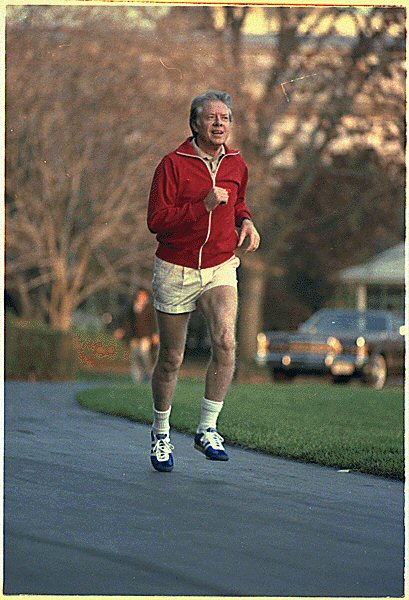
Jimmy Carter, the first jogging U.S. President, out on a run in 1978.

Jogging as an exercise reached critical mass in the United States during the 1970s, but it was during the 1960s when it first took flight. Bill Bowerman, the University of Oregon Track and Field Coach, wrote (along with heart specialist W.E. Harris) the 1966 book, Jogging, which popularized the sport in America. Bowerman, who would later co-found Nike, learned about jogging as a fitness regimen while visiting New Zealand. The book would ultimately sell more than a million copies.

Jogging seemed as much a fad as the CB radio during the ’60s and ’70s, but it endured and became a seemingly permanent part of American fitness. The March 22, 1968 issue of Life published a dopey, tongue-in-cheek review of the Bowerman-Harris book by William Zinsser, during the sport’s first burst of popularity. An excerpt:

“The highest inaugural rite that the government can bestow on its program of outdoor exertion–now that Pierre Salinger has retired from this kind of work–took place recently when four jogging trails were opened near Washington D.C. Secretary of the Interior Stewart L. Udall led 40 people, including several congressmen and 20 members of a Baltimore jogging club, on a two-mile jog over one of the new trails, ending with a speech in which he predicted ‘jogging is going to catch on nationwide.’ Soon, across America, we can expect to hear the rhythmic pad-pad-pad of the sneaker and rustle of the sweat suit. Hearty cries of ‘Well jogged!’ will mingle with the chirping of birds in the virgin air.”

Tags: , ,

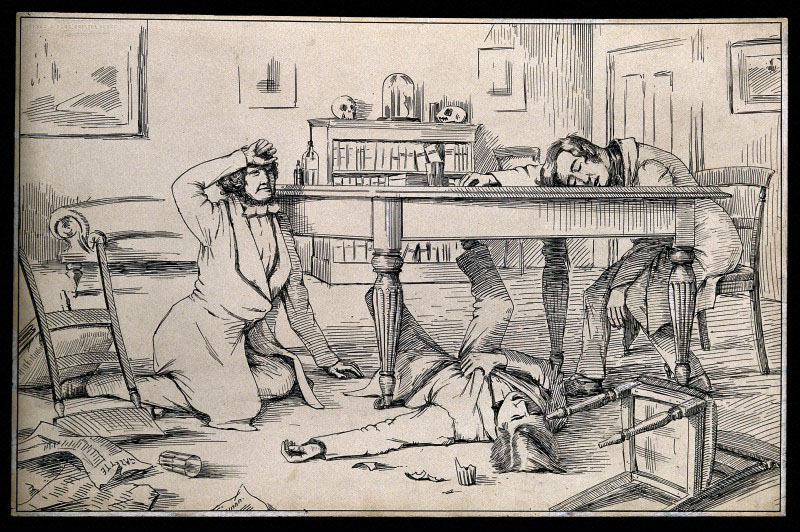
An illustration from the 1840s that show the effects of chloroform. Kids, don't try this at home.

Love, lust, adultery, chloroform, gunplay, a hatchet and insurance money were a lethal combination (of course!) for a dentist in Detroit, Michigan, in 1895. An excerpt from a story in that year’s February 3 edition of the Brooklyn Daily Eagle:

“Dr. Horace E. Pope, a dentist, with an office on Michigan avenue, where he resided, was killed this morning by William Brusseau, Mrs. Pope’s nurse. Brusseau says he found the dentist sitting on the side of his wife’s bed, holding a cloth saturated with chloroform over her mouth. The nurse says that when he entered the room Dr. Pope fired at him. Brusseau says he seized a hatchet and struck the dentist in the head. It is said that the deceased and his wife frequently quarreled over the attention paid the latter by the nurse.

In unearthing the circumstances surrounding the murder, it is learned that Mrs. Pope had urged her husband to place heavier insurance on his life. He had accordingly been insured for $9,000 and but a few days ago transferred the payment of his policies from his estate to his wife.”

Tags: ,

Roy Mark Hofheinz kept a wonderfully gaudy apartment in the Dome. The pad had a shooting gallery, a putting green and a puppet theater.

As the new textbook rules in the Lone Star State remind us, there’s no kind of crazy like Texas crazy. But that’s not always a bad thing.

One example of the good kind of Texas crazy was Roy Mark Hofheinz, the subject of “Fast Man with a .45,” a 1962 Sports Illustrated article.

Hofheinz was first owner of the Houston Astros (originally called the Colt .45s) and spearheaded the building of the glitzy Astrodome, the first domed sports stadium in the world, which the wealthy Texan claimed was inspired by the Roman Colosseum. It cost a then-staggering sum of $22 million. When it first opened, the Astrodome was nicknamed the “Eighth Wonder of the World.” Hofheinz was a part owner of Ringling Bros. Circus, so such breathless hoopla was never in short supply.

Even though it’s now in its dotage, the Dome had a fascinating existence. In addition to baseball and football, it hosted everything from national political conventions to the Super Bowl to the “Battle of the Sexes” tennis match. It also temporarily housed homeless citizens in the aftermath of Hurricane Katrina. An excerpt from the SI article about the man who got it built:

“Roy Hofheinz is a large man with an even larger stomach, a theatrical flair and a mind as quick as a cash-register drawer. He smokes a box of cigars a day, sleeps only when there is nothing else to do and would, if charged with the U.S. space program, have had John Glenn in orbit by the astronaut’s third birthday. He is considered unusual even in Texas.

The grandson of a Lutheran missionary, who spoke 11 languages and came over from Alsace-Lorraine to preach and plant potatoes, Hofheinz has been a dance-band promoter, a radio huckster and a boy-wonder politician (he was Lyndon Johnson’s first campaign manager). He also is a multimillionaire and at one time was the most controversial mayor in the history of Houston.”

Tags:

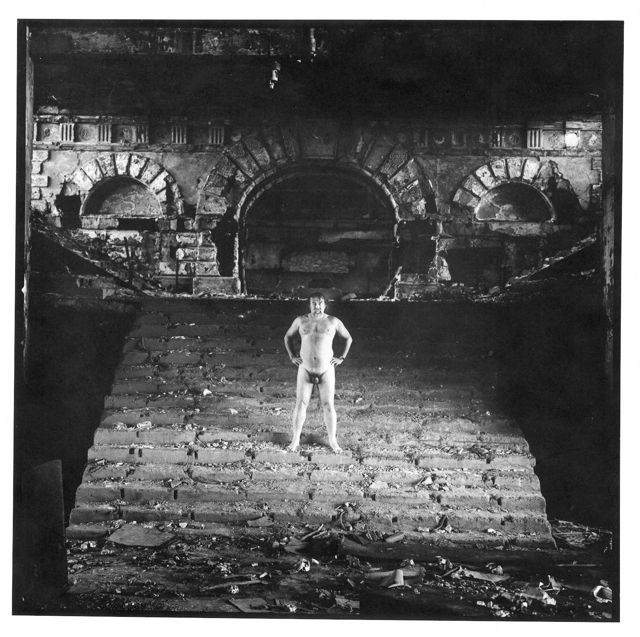
Kienholz is certainly on exhibit in this picture by German photographer Lothar Wolleh.

One of the founders of the famed Ferus Gallery in Los Angeles, Edward Kienholz used found objects and carpentry skills learned from a boyhood spent on a farm to create his installations. Mannequins, abandoned cars and hollowed out TVs were modified and arranged with great care to serve as social criticism, sometimes giving off the vibe of American life descended into a sort of pulpy horror movie.

This 21-minute documentary by June Steel chronicles Kienholz’s controversial 1966 show at the L.A. County Museum of Art. That exhibit included “Back Seat Dodge ’38.” This piece and others were thought to be obscene by certain critics. Instead of interviewing the artist, Steel gets reactions to the installations from museum visitors, a cross section of people of different races and ages.

The smart movie is as much a chronicle of the time and place it was made in as it is of the artist’s work. Watch “Kienholz on Exhibit.”

Tags: ,

The oral history Working is one of the best books by the late, great writer, historian and radio host Studs Terkel. I can’t recommend this book enough. There’a also a graphic adaptation that Harvey Pekar worked on, though I haven’t seen a copy.

An excerpt from “Dolores Dante, Waitress”:

People imagine a waitress couldn’t think or have any kind of aspiration other than to serve food. When somebody says to me, ‘You’re great, how come you’re just a waitress?’

Just a waitress. I’d say, ‘Why, don’t you think you deserve to be served by me?’ It’s implying that he’s not worthy, not that I’m not worthy. It makes me irate. I don’t feel lowly at all. I myself feel sure. I don’t want to change the job. I love it.

Some don’t care. When the plate is down you can hear the sound. I try not to have that sound. I want my hands to be right when I serve. I pick up a glass, I want it to be just right. I get to be almost Oriental in the serving. I like it to look nice all the way. To be a waitress, it’s an art.

I feel like a ballerina, too. I have to go between those tables, between those chairs. Maybe that’s the reason I always stayed slim. It is a certain way I can go through a chair no one else can do. I do it with an air. If I drop a fork, there is a certain way I pick it up. I know they can see how delicately I do it. I’m on stage. I tell everyone I’m a waitress and I’m proud.•

Tags: ,

President Obama has set aside $10 million in matching funds to replicate the Harlem Children's Zone in other areas. It's a good first step, but the amount is too paltry. (Photo by Steve Jurvetson.)

Some stories get covered a lot but can’t get covered enough. That’s the case with sociologist and educator Geoffrey Canada‘s amazing two-decade-old anti-poverty initiative, Harlem’s Children Zone, which has won plaudits from both sides of the political aisle.

More importantly, it’s working. Children enrolled in HCZ grow to be healthy, well-educated adults, whereas previous generations who grew up on their same blocks, often got lost in the system, their dreams deferred until they were all but lost.

Newsweek is the latest to shine a light on the HCZ (and other pioneering programs like it). An excerpt from Raina Kelley’s article “The Future of Black History“:

“What the HCZ does is first recognize that the amelioration of poverty does not begin and end with an excellent education, but also requires a full belly, parental education, safety, advocacy, and the expectation that every student will succeed.

‘We help parents and kids through the system,’ HCZ founder Geoffrey Canada says. ‘We get them past every hindrance put in their way, whether it be at home or with social services. We can advocate on a child’s behalf, whether it be at home or in the classroom or with the juvenile justice system.’

Indeed, the HCZ starts early: it provides new parents with a Baby College to teach parenting skills during the crucial first three years of a child’s life and a preschool Gems program, where kids learn not only French and Spanish but healthy eating habits to combat childhood obesity. The Zone also offers the HCZ Asthma Initiative to provide medical care and education to families, thus drastically cutting down on the number of school days missed by students suffering from asthma.

And it has a network of afterschool programs that teach media literacy, karate, and computer skills. It’s called the pipeline–once familes enter, it’s hoped that they’ll stay until their child graduates from college.”

Tags: , ,

We're sweet-looking young men who enjoy pugilistic displays.

Why would I even comment on this insane article from the June 4, 1873 issue of the Brooklyn Daily Eagle when I could never, ever do it justice? Unfortunately, it’s not bylined, but here’s an excerpt from “Pugs at Gothic Hall”:

“The sporting fraternity, at least that portion given to pugilistic displays and wrestling encounters, was out in all its glory at Gothic Hall last night. The entertainment, which called together this distinguished crowd of first citizens, was somewhat facetiously termed by its originators a ‘grand international boxing and wrestling festival.’

The assemblage was more respectable in its general character than are usually met on such occasions. Among the audience were numerous young men dressed in the height of fashion, and looking quite decent in their new clothes. The Fulton street dry goods clerks were represented by a large delegation of real sweet looking young men, made particularly prominent by their loud red neckties and low necked shirts. It was noticeable that the majority of these promising youths wore their hats on the right sides of their respective heads at an angle of about forty degrees.

And then they talked in a free and easy sort of way about ‘good’uns’ and  ‘bad’uns,’ of ‘duffers’ and ‘snoozes,’ calculated to convey the impression that they were very reckless and altogether dangerous young men to meddle with.

Those who chewed tobacco chewed heavy cuds, and when they walked around the room they walked like men determined to push a house over, or bite someone’s ear off, or something equally horrifying and dreadful.”

I'm really filthy. Wanna watch? (Image by KVDP.)

England is a little wacky with the “Oceania” surveillance methods, but the country has outdone itself with its latest Big Brother act. An Associated Press article on Google details how the government secretly installed 2.6 million microchips in trash bins to monitor how much garbage residents are disposing of. The chips haven’t been yet used to tax citizens who are creating what’s deemed excessive waste, but that’s the eventual plan.

I’m all in favor of conservation, reusing and recycling, but this is just creepy and invasive. It’s also seems like the future. An excerpt:

“The trash microchips are now part of the British information grid, which already includes a heavy reliance on closed-circuit television surveillance and cameras to monitor the population, particularly on the crowded public transportation system.

‘This is yet another piece of surveillance that the councils are taking on in our daily life,’ said [Big Brother Watch campaign director Dylan Sharpe. ‘With this information they can tell if we are home or not, and the information is stored on their database, which is not that secure.’

He said the ‘pay as you throw’ policy councils are planning to implement would discriminate against large families that generate more waste and might encourage people to burn their refuse–or dump it illegally–rather than pay extra.”

Tags:

One of Studs Terkel’s oral histories wrapped around a central theme, Working presents people discussing in their own words their jobs and careers. It’s Terkel’s usual mix of astute social commentary and literature, marked by his inimitable knack for getting people to open up in profound ways. Some professions covered include: farm worker, bus driver, jockey, cop, film critic and prostitute. An excerpt from “Terry Mason, Airline Stewardess”:

“When people ask what you’re doing and you say stewardess,you’re really proud, you think it’s great. It’s like a stepping stone. The first two months I started flying I had already been to London, Paris and Rome. And me from Broken Bow, Nebraska. But after you start working it’s not as glamorous as you thought it was going to be.

They like girls that have a nice personality and that are pleasant to look at. If a woman has a problem with blemishes, they take her off. Until the appearance counselor thinks she’s ready to go back on. One day this girl showed up, she had a very slight black eye. They took her off. Little things like that.

We had to go to stew school for five weeks. We’d go through a whole week of make-up and poise. I didn’t like this. They make you feel like you’ve never been out in public. They showed you how to smoke a cigarette, when to smoke a cigarette, how to look at a man’s eyes. Our teacher, she had this idea we had to be sexy. One day in class she was showing us how to accept a light for a cigarette from a man and never blow it out. When he lights it, just look in his eyes. It was really funny, all the girls laughed.”

Read also:

Tags: ,

Are you basing story selections on how many cat photos you have stored in your cell phone?

An AP story that was picked up by the New York Times reports that roughly 70 percent of voters in Switzerland on Sunday struck down a referendum that would have allowed for special lawyers to represent abused animals–be they house pets or farm livestock.

Switzerland has what are probably the most stringent animal-rights laws in the world, but activists think that they are often unenforceable without legal intervention to untangle the esoterica. An excerpt:

“The country’s 160-page animal protection law states exactly how much space owners must give Mongolian gerbils (233 square inches) and what water temperature is required for African clawed frogs (64-72 degrees Fahrenheit).

It stipulates that pigs, budgies, goldfish and other social animals cannot be kept alone. Horses and cows must have regular exercise outside their stalls and dog owners have to take a training course to learn how to properly look after their pets.

Swiss daily Tribune de Geneve reported earlier this year that a woman who decapitated four chickens and left their heads on the doorstep of her love rival received a 90-day suspended sentence.”

Tags:

During his 1970 gubernatorial race against Ronald Reagan in California, the philosopher, LSD guru and countercultural icon, Dr. Timothy Leary, was railroaded into a 20-year prison sentence for the dubious charge of possession of two joints. Leary escaped from the penitentiary, spent time in Algeria with Black Panther Eldridge Cleaver before the two had a falling out, and was finally recaptured at an airport in Afghanistan. He was returned to the states to continue his sentence at Folsom Prison.

During his stint there, Leary was able to film a 27-minute interview that his wife Joanna could use to stump for his release. Despite being made by Leary and his spouse and not an objective third party, it’s an interesting encounter.

California Governor Jerry Brown released Leary in 1976 and the controversial figure ended up focusing the last two decades of his life encouraging the construction of space colonies and being an early Internet enthusiast. Despite being right on many issues, Leary always seemed to me like a slickster with the gigantic ego of a small child. But you can decide for yourself while watching the video.

Structural damage in Fallujah may be the least of that city's problems.

The BBC has a very scary story about a reportedly high number of birth defects showing up in newborns in Fallujah. The Iraqi city was the site of some of the most intense fighting at the height of the ongoing American war there.

Some Iraqi medical researchers think that chemicals from sophisticated weapons are the cause, though the U.S, is saying it has yet to see any conclusive data proving a spike in birth defects in Fallujah. An excerpt:

“British-based Iraqi researcher Malik Hamdan told the BBC’s World Today program that doctors in Fallujah were witnessing a ‘massive unprecedented number’ of heart defects, and an increase in the number of nervous system defects.

She said that one doctor in the city had compared data about birth defects from before 2003–when she saw about one case every two months–with the situation now, when, she saw cases every day.

‘I’ve seen footage of babies born with an eye in the middle of the forehead, the nose on the forehead,’ she added.”

Tags:

Chinese president Hu Jintao with Brother None-Too-Sharp.

Those enterprising economists over at the wonderful Marginal Revolution pointed me in the direction of this fascinating Independent article about a homeless man in Ningbo, China, nicknamed “Brother Sharp,” who has become a style icon and symbol of shabby chic bohemian coolness.

Brother Sharp, also dubbed “Handsome Vagabond” and “Beggar Prince,” has an online posse that considers him the coolest man in China. It’s good to know that people in China are just as shallow and stupid as we are. An excerpt:

“He is 5′ 8”, around 35 years old, and always has a cigarette between his fingers. He also appears to have a fondness for women’s clothes, which has only served to fuel his status as a fashion icon. His good looks are reminiscent of popular Asian actors like Takeshi Kaneshiro or the Oscar-nominated Ken Watanabe.

His identity remains a secret, and social workers in Ningbo say they want to keep it that way. ‘Homeless people are vulnerable. It is incorrect to use them for entertainment purposes,’ said one worker at a homeless centre in Ningbo. Brother Sharp is said to appear mentally disturbed when approached on the street.

In China, begging is technically illegal, as the Communist Party-run state provides all a citizen could need. In reality, the rapid development of the Chinese economy in the last 30 years has marginalized many.

The rumors surrounding Brother Sharp’s true identity persist. Some say he is a university graduate who lost his mind after his girlfriend left him. Others have blogged about how they sought him out and tried to help him find work or to go back to his family, but that he appeared frightened and cried out without speaking.”

Tags:

You better keep me away from the time machine. (Image by Brett Weinstein.)

“Magistrate’s Ire Aroused,” declares the sub-heading of this article from the December 1, 1902 issue of the Brooklyn Daily Eagle. It seems that several days before he turned 16, a boy married a bride several years his senior and then saw fit to abandon her. The judge wasn’t a fan of these May-December relationships, especially when the groom was a minor. There may have been steam shooting out of his ears during the hearing. An excerpt:

“‘There should be some way of punishing ministers who marry children,’ said Magistrate Furlong, in the Myrtle avenue court yesterday, when Mrs. Tessie Mich Gordon, who says she is 18 years old, caused her 16 year old boy husband, James C. Gordon of 262 Fifteenth street, to be arraigned on a charge of abandonment.

The Magistarte’s face was flushed, and it was obvious he was not in favor of early marriages–at least, early marriages, of that kind. Young Gordon, the groom, who is a mere stripling, both in years and in size, and who has not even the suspicion of a mustache, stood in front of the judge in a semi-dazed way, as if he were not thoroughly conscious of the important step which he had taken in life. His bride, whom he married less than three months ago, was a Miss Tessie Mich, who gives her age at 18, but is thought to be two years older, is a pretty blond, with bright expressive eyes and a rich head of hair falling in innumerable ringlets. She is petite in figure.

When Court Officer William J. Wyse arrested young Gordon at his father’s house, 262 Fifteenth street, on Saturday night, the boy was at supper, with other members of his family.

‘I have seen a great many strange things over the course of my career on the police force,’ said Oficer Wyse, ‘but I can tell you I was surprised on finding out that the man I was in search of on a charge of abandonment was only a boy.'”

Tags: , , ,

The Dharavi Slum in Mumbai bustles with life despite the poverty. Some slums in India are home to one million people per square mile. (Image by Kounosu.)

For most of the past decade, New Urbanists have been touting the slum or squatter city (especially the massive ones in India) as the key to understanding the future of urban dwelling. Whole Earth Catalogue founder Stewart Brand makes a cogent argument for this type of thinking in “How Slums Can Save the Planet,” a new article in Prospect. It’s well worth reading, especially since Brand has been spookily prescient in the past.

A billion people currently reside in squatter cities and by all estimates, that number is likely to grow at a rapid pace in the coming decades. And that’s good news for the planet, since cities are far more green than rural areas, thanks to their population density. While there is danger in well-fed Westerners being too sanguine about the lives of slum denizens–the poverty there still is crushing despite the ingenuity of the people–there’s much for all urbanites to learn from these bustling quarters. An excerpt:

“One idea that could be transferred from squatter cities is urban farming. An article by Gretchen Vogel in Science in 2008 enthused: ‘In a high-tech answer to the ‘local food’ movement, some experts want to transport the whole farm shoots, roots, and all to the city. They predict that future cities could grow most of their food inside city limits, in ultraefficient greenhousess. A farm on one city block could feed 50,000 people with vegetables, fruit, eggs, and meat. Upper floors would grow hydroponic crops; lower floors would house chickens and fish that consume plant waste.’”

Tags: ,

Wanna hang? (image courtesy of Chris 73.)

I found this old print article in the February 3, 1853 issue of the Brooklyn Daily Eagle. Like all great stories, it contains a hanging, witchcraft and a pair of pants. The two men who were hanged, William Saul and John Howlett, were river pirates convicted of murdering a watchmen on the deck of a vessel. An excerpt from “Witchcraft–High Price of Old Pants”:

“We had supposed that witches, witchcraft and all things appertaining thereto, except spiritual rappings, were quietly resting in their graves for the last century. But it appears we are mistaken. A curious proof that such superstitions are not altogether exploded, occurred in relation to Saul and Howlett, who were executed a few days back.

A Dutchman who was to be present at the execution, was applied to by another Dutchman to procure him a small piece from the clothes in which the malefactors were to be hanged, and for which he promised to pay a liberal price. The man to whom the application was made, asked the applicant what inducement he had to procure pieces of the malefactors’ dress. ‘I want it,’ replied he, ‘to witch people.’

A day or two after the execution, the man who wanted to ‘witch people’ applied to his friend for what he had bespoken from him, but the latter had forgotten to procure it and instead of delivering the real article according to contract, he cut two strips from an old pair of pants and received $10 for them, and no doubt they were just as good as the genuine article.”

Tags: ,

A photo of the 1906 ruins taken by Arnold Genthe, also famous for his shots of San Fran's Chinatown.

February 27, 2010 was a historically tragic day in Chile due to an 8.8-magnitude earthquake. President Michelle Bachelet officially declared a “state of catastrophe.” In 1906, a similar magnitude earthquake rocked San Francisco, causing massive devastation.

Fires started by the quake created a second wave of terror, and things were so frightful that Mayor Eugene Schmitz gave police and order to kill anyone found looting (though perhaps he should have been shot). The Press Democrat of Santa Rosa declared that “it came with awful force and suddenness, hurling many people from their beds. Before the terrified community could realize what had happened, the entire business section was a mass of ruins, every residence had been more or less damaged, some being completely wrecked, and approximately half a hundred or more people had been swept into eternity.”

The results of the natural disaster can be seen in a five-minute Edison newsreel recorded in the aftermath of the quake. View it here.

Tags:

Do not lick this icon. It is the symbol for arsenic. It will kill you.

I came across a review on the Guardian of James C. Whorton’s new book, The Arsenic Century: How Victorian Britain Was Poisoned at Home, Work, and Play. The book details how the vast majority of deaths in Victorian England from arsenic weren’t perpetrated by sinister poisoners but resulted from incidental contact with a substance that permeated nearly every aspect of British life at the time.

In Kathryn Hughes’ review, she details how an interior decorating trend proved lethal because of arsenic’s use in the creation of green dye. An excerpt:

“Even more fateful was the craze for deep green wallpaper, which led to thousands of families meeting their deaths as a result of their taste in home furnishings. Not that they actually licked their walls: the dye was very unstable, so the slightest breeze could dislodge a puff of toxic dust. Queen Victoria herself was so appalled by the homicidal tendencies of green wallpaper that she ordered every room in Buckingham Palace to be stripped of the stuff.”

Tags: , ,

The intrepid octogenarian photojournalist Bill Cunningham. (Image by Georg Petschnigg.)

The great kottke.org pointed me in the direction of a cool-sounding forthcoming documentary by Richard Press called Bill Cunningham New York, which is set to open the New Director/New Films series at MoMA. Cunningham, an octogenarian style/street photographer for the New York Times, still gets around Manhattan on a Schwinn.

An excerpt from Cunningham’s reminiscences about how he ended up being a street photographer who focused on fashion, after having been everything from a waiter to a writer to a milliner to an Army recruit:

“After that, I went to work for The Chicago Tribune, for Eleanor Nangle. She had been there since the 1920’s. A wonderful woman. The best of the best. The Tribune had an office in New York, in the Times building. One night, in about 1966, the illustrator Antonio Lopez took me to dinner in London with a photographer named David Montgomery. I told him I wanted to take some pictures. When David came to New York a few months later, he brought a little camera, an Olympus Pen-D half-frame. It cost about $35. He said, ‘Here, use it like a notebook.’ And that was the real beginning.

I HAD just the most marvelous time with that camera. Everybody I saw I was able to record, and that’s what it’s all about. I realized that you didn’t know anything unless you photographed the shows and the street, to see how people interpreted what designers hoped they would buy. I realized that the street was the missing ingredient.”

Tags: , , ,

When Peter Lorre is born, I'm going to look like him.

The first person to ever use the term “magazine” for a periodical was Londoner Edward Cave, who used the word in 1731 for The Gentleman’s Magazine. A wide-ranging periodical that focused some of its space on reports from the American colonies, it was also the first place of employment for Samuel Johnson. Cave edited under the name Sylvanus Urban and put together a journal that had reprinted articles from other publications and original pieces. He died in 1754, but the magazine continued publishing until 1907.

I’m sure Cave was happy in that great beyond when an 1825 issue, ran an inscrutable piece entitled “Gigantic Organic Remains.” An excerpt:

“We lately mentioned that the bones of a nondescript animal, of an immense size, and larger than any bones that have hitherto been noticed by any naturalists, had been discovered about twenty miles from New Orleans, in the alluvial ground formed by the Mississippi River and the lakes, and but a short distance from the sea. It now appears that these giant remains had been disinterred by Mr. W. Schofield, of New Orleans, who spent about a year in this arduous undertaking. A fragment of a cranium is said to measure twenty-two feet in length; in its broadest part four feet high, and perhaps nine inches thick, and it is said to weigh 1,200lbs. The largest extremity of this bone is said to answer to the human scapula; it tapers off to a point and retains a flatness to the termination. From these facts, it is conferred that the bone constituted a fin or a fender. One of its edges, from alternate exposures to the tide and atmosphere has become spongy or porous, but, generally, it is in a perfect state of ossification.”

Tags: , ,

« Older entries § Newer entries »