I interviewed Werner Herzog once and asked him if Klaus Kinski was his muse. “No, we were collaborators,” he answered immediately. Considering that their turbulent relationship might have ended in a doube homicide, I wasn’t surprised with the director’s response when I asked if he missed Kinski. “No…only very rarely,” he answered calmly. Peter Geyer’s Jesus Christus Erlöser is a chronicle of Kinski’s crazed and doomed 1971 attempt at a spoken-word performance about Jesus Christ. (Thanks Documentarian.)
"The man's body was reduced almost to pulp by the fall and it is estimated that every bone in his body was broken." (Image by Joseph Murphy.)
Window cleaning was a perilous endeavor in Old New York, becoming more dangerous as skyscrapers began stretching to the heavens. The harness belt that window cleaners wear today was devised all the way back in 1897, but it wasn’t universally adopted right away nor could it protect against injuries from other unexpected hazards, as these hard-boiled accounts from the Brooklyn Daily Eagle demonstrate.
••••••••••
“Fell Fourteen Stories” (November 4, 1902): “While cleaning windows on the fourteenth floor of the Broadway-Maiden Lane building, an eighteen story sky scraper, on the southeast corner of Broadway and Maiden Lane, Manhattan, this morning, Daniel Murphy, 32 years old, of 961 Dekalb avenue, Brooklyn, missed his footing and fell to the basement. The man’s body was reduced almost to pulp by the fall and it is estimated that every bone in his body was broken.”
••••••••••
“Modern Window Cleaning: A New Device to Keep Men From Falling” (March 28, 1897): “With the advent of the sky scraper office building has come a new device to protect window cleaners who have to work at perilous heights. The cleaner wears a belt which is attached to a fastening on either side of the window by means of a rope. This device is a safeguard against danger and prevents all possibility of accident in the heretofore perilous occupation of window cleaning. The responsibility for accidents from falling rests upon the owners of the buildings, and hence the scheme has met with considerable favor. The plan herewith described is one of several devices, now patented, for the protection of window cleaners. Many of the large office buildings in New York and Brooklyn are equipped with one or another of these devices.”
••••••••••
“A Bootblack Killed By Electricity” (March 18, 1890): “An Italian bootblack named Joe Soleastiani of 47 Mulberry street, New York, while engaged in cleaning windows for the Inter State Bank, at 167 Broadway, late yesterday afternoon placed his hands on an electric light wire that ran into the building.”
••••••••••
“Killed By a Fall From Window” (November 23, 1902): Minnie Siebert, 10 years old, fell from the window of her home, 515 West Fifty-second street, yesterday afternoon and was instantly killed. Yesterday her mother told her to clean the windows. The little girl bowed the shutters and tying them with a string, stood on the window sill and began to her task. The string broke, however, and the child was dashed to the pavement below. Her mother, who was within a few feet of the window from which the child fell, ran down stairs and picked up the child and endeavored to revive her.”
••••••••••
“Nearly Three Years Ago” (August 10, 1859): “Nearly three years ago a young woman broke a pane of glass while cleaning a window, and cut her arm near the wrist. Her wound soon healed, but in a few weeks a swelling arose some distance from the cut which at times was painful. Three medical men were consulted at various times, who all advised compression on the part. This for a time was always successful, but a few days ago, having been more than usually painful, she went to Mr. E. Sidebottom, surgeon, who extracted a piece of glass nearly a half inch square, which had been embedded edge downward all this time. It was taken out about an inch and half from where the first wound was.”
Tree-papers are going and gone in the United States, but Ethiopians still require newsprint to find work and lodging. For those too poor to buy papers, so-called “newspaper landlords” have the solution. They rent periodicals at a penny for about 20 minutes. From a CNN report:
“Garum Tesfaye is one of Addis Ababa’s ‘newspaper landlords,’ a group of entrepreneurs in the Ethiopian capital who rent out papers to people too poor to buy them.
Surrounded by worn-out copies of old newspapers, stacks of gossip magazines and the crisp print of the latest news, Tesfaye sits attentively, checking his watch every now and then.
Near him, a pedestrian bridge provides shelter from the sun to dozens of avid readers who quickly, albeit meticulously, get their dose of the latest news.
For 20 to 30 minutes, these readers can get their hands on a newspaper for a fraction of the price of having to buy it. If they keep the paper longer than their allotted rental time, they have to pay extra.
A newspaper in Addis Ababa costs about six birr (35 U.S. cents) to buy. In contrast, it costs only 50 Ethiopian cents (less than one U.S. cent) to rent one.” (ThanksMarginal Revolution.)
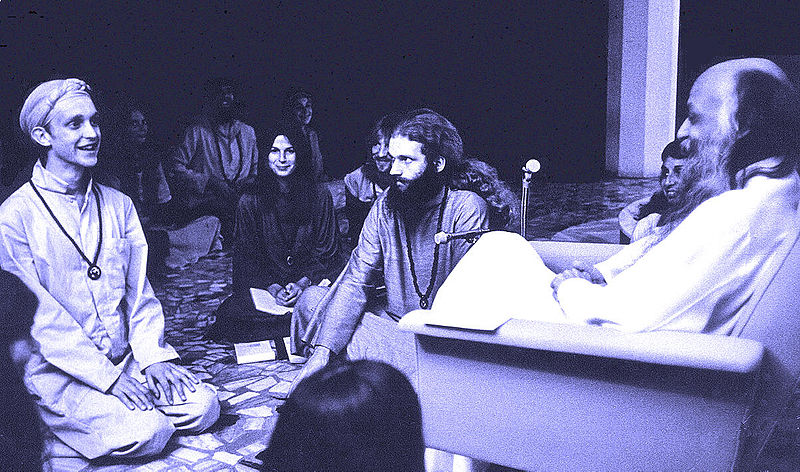
While still located in India, Rajneesh, far right, receives his followers. (Image by Redheylin.)
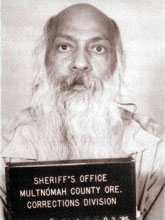
Using access to newly declassified government files, Les Zaitz of Oregon Live has written “Rajneeshees in Oregon: The Untold Story,” a chilling account of the mad American experience of Bhagwan Shree Rajneesh, an Indian guru who relocated to the Beaver State during the 1980s, invited 2,000 of his followers to live on his land, incorporated his parcel into a city, ran afoul of local authorities and became involved in bio-terrorism and assassination plots. An excerpt:
“From time to time, Puja retreated to a laboratory hidden in a cabin up a canyon on the ranch to secretly experiment with viruses and bacteria. Sheela wanted something to sicken people.
In summer 1984, Puja field-tested her work, handing unlabeled vials to those on the secret teams.
The operatives knew, or suspected, the brown liquid was salmonella, which produces severe diarrhea and other symptoms. Over months, they were dispatched to spread the poison in The Dalles. They initially hoped to sicken public officials standing in their way, but then pursued a grander scheme to attack innocent citizens.
Swami Krishna Deva, mayor of Rajneeshpuram, smeared Puja’s mixture onto fixtures in the men’s restroom at the Wasco County Courthouse in The Dalles.
Ma Dhyan Yogini, also known as Alma Peralta, went to town with vials in her purse. She stepped into a local political rally and took a seat. She secreted some of the contaminant on her hand, turned to an elderly man sitting next to her and shook hands. She also made her way into a nursing home in The Dalles, but her plan to contaminate food was disrupted by a suspicious kitchen worker.
Sheela tried her hand at contamination as well, taking a half-dozen Rajneeshees, including Puja, to a grocery store in The Dalles.
‘Let’s have some fun,’ Sheela said.
The group spread across the store with Sheela targeting the produce section, pouring brownish liquid from the vial she had hidden up her sleeve.
When there were no public reports of anyone getting sick, Sheela pushed Puja to find a more toxic solution.
About that time, Hulse and two other Wasco County commissioners arrived at the ranch for a tour. They parked Hulse’s car outside the commune’s welcome center and loaded into a commune van for their visit. When they got back, Hulse’s car had a flat. The Rajneeshees arranged a repair on the spot that would cost Hulse $12.
As the commissioners waited in the hot August sun, Puja approached, offering each a glass of water. Her gesture was odd, for Puja was in her medical whites and had no role as a greeter.
The thirsty men took the water.” (Thanks Longform.)
From Wolfe’s 1965 essay about McLuhan in the New York Herald Tribune, “What If He Is Right?“: “There are currently hundreds of studs of the business world, breakfast food package designers, television net work creative department vice-presidents, advertising ‘media reps,’ lighting fixture fortune heirs, smiley patent lawyers, industrial spies, we- need vision board chairmen, all sorts of business studs who are all wondering if this man, Marshall McLuhan … is right…. He sits in a little office off on the edge of the University of Toronto that looks like the receiving bin of a second-hand book store, grading papers, grading papers, for days on end, wearing-well, he doesn’t seem to care what he wears. If he feels like it, he just puts on the old striped tie with the plastic neck band. You just snap the plastic band around your neck and there the tie is, hanging down and ready to go, Pree-Tide.
But what if-all sorts of huge world-mover & shaker corporations are trying to put McLuhan in a box or some thing. Valuable! Ours! Suppose he is what he sounds like, the most important thinker since Newton, Darwin, Freud, Einstein, and Pavlov, studs of the intelligentsia game suppose he is the oracle of the modern times – what if he is right? he’ll be in there. It almost seems that way. An ‘undisclosed corporation’ has put a huge ‘undisclosed sum’ into, McLuhan’s Centre for Culture and Technology at the University of Toronto. One of the big American corporations has offered him $5000 to present a closed- circuit-ours!-television lecture on-oracle!-the ways the products in its industry will be used in the future. Even before all this, IBM, General Electric, Bell Telephone were flying McLuhan in from Toronto to New York, Pittsburgh, God knows where else, to talk to their hierarchs about . . . well, about whatever this unseen world of electronic environments that only he sees fully is all about.”
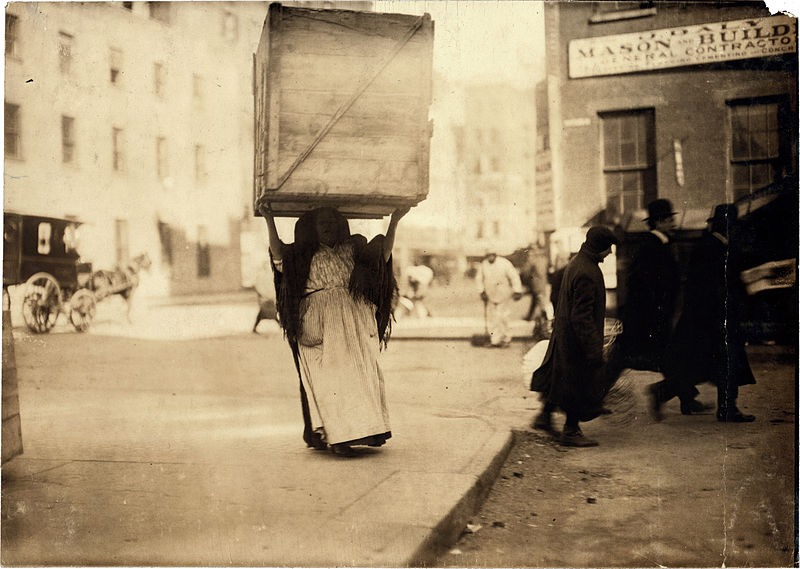
Lewis Hine was a schoolteacher, a photographer, a muckraker, and, above all, an artist. His work brought about real changes in American child-labor laws, but his pictures remain brilliant because of his amazing eye for subject and composition. In the above classic photo, an Italian-American immigrant woman on Bleecker Street in New York hauls an enormous dry-cleaning box the best she can. To see more great work by Hine, go here.
Hine’s philosophy on photography: “Whether it be a painting or photograph, the picture is a symbol that brings one immediately into close touch with reality. In fact, it is often more effective than the reality would have been, because, in the picture, the non-essential and conflicting interests have been eliminated.
The average person believes implicitly that the photograph cannot falsify. Of course, you and I know that this unbounded faith in the integrity of the photograph is often rudely shaken, for, while photographs may not lie, liars may photograph.”
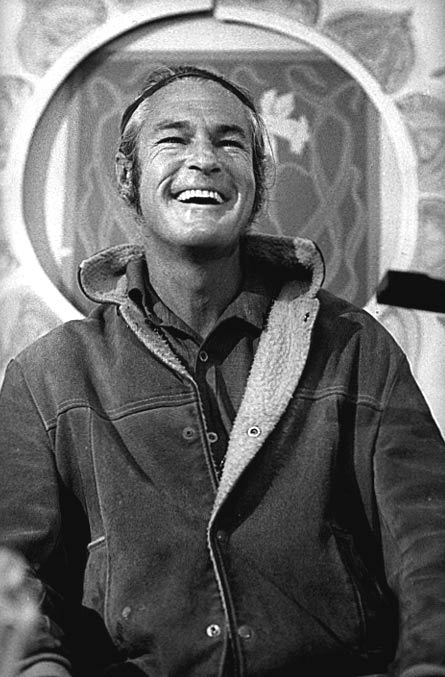
Art Linkletter’s daughter plunged to her death from a six-story window in 1969, perhaps influenced to suicide by LSD. Timothy Leary was the most famous proponent of LSD. Talk show host Stanley Siegel thought it would be a good idea in 1977 to have Linkletter and Leary talk by phone on live TV.
The opening of “This Tech Bubble Is Different,” an Ashlee Vance Businessweek article which wonders whether the current media companies with stratospheric valuations will leave behind anything of worth if the market goes bust:
“As a 23-year-old math genius one year out of Harvard, Jeff Hammerbacher arrived at Facebook when the company was still in its infancy. This was in April 2006, and Mark Zuckerberg gave Hammerbacher—one of Facebook’s first 100 employees—the lofty title of research scientist and put him to work analyzing how people used the social networking service. Specifically, he was given the assignment of uncovering why Facebook took off at some universities and flopped at others. The company also wanted to track differences in behavior between high-school-age kids and older, drunker college students. ‘I was there to answer these high-level questions, and they really didn’t have any tools to do that yet,’ he says.
Over the next two years, Hammerbacher assembled a team to build a new class of analytical technology. His crew gathered huge volumes of data, pored over it, and learned much about people’s relationships, tendencies, and desires. Facebook has since turned these insights into precision advertising, the foundation of its business. It offers companies access to a captive pool of people who have effectively volunteered to have their actions monitored like so many lab rats. The hope—as signified by Facebook’s value, now at $65 billion according to research firm Nyppex—is that more data translate into better ads and higher sales.
After a couple years at Facebook, Hammerbacher grew restless. He figured that much of the groundbreaking computer science had been done. Something else gnawed at him. Hammerbacher looked around Silicon Valley at companies like his own, Google (GOOG), and Twitter, and saw his peers wasting their talents. ‘The best minds of my generation are thinking about how to make people click ads,’ he says. ‘That sucks.'”
Human augmentations by Sarif Industries. Fake, for now.
Comment posted for this video on Youtube: “I can’t wait until this stuff is real… and only the top 1% can afford it, allowing them to cybernetically stomp on the impoverished underclasses.”
There are stories of people awakening from horrifying head injuries and being able to speak languages that they never knew before. Perhaps these tales are urban legends, but that’s not the case with Mark Hogancamp, the subject of Jeff Malmberg’s amazing documentary, who learned to communicate in a whole new way after barely surviving a savage beating.
Hogancamp was a gifted amateur artist and raging alcoholic who loved women–and wearing their clothes. One night about a decade ago he drunkenly acknowledged to a group of young men in an upstate New York bar that he was a cross-dresser and they battered him into a nine-day coma and caused massive brain damage and memory loss. Medicare cruelly cut Hogancamp off long before his recovery was complete, so he had to create his own therapy.
With hands now unsteady, drawing was no longer possible. So Hogancamp collected junk and made small purchases at the local hobby shop and worked meticulously to create an elaborate hyperrealistic scale version of a fantasy WWII-era Belgian town, called Marwencol, with characters based on himself, his relatives, his friends and his attackers. Into this tableaux he introduced narratives that allowed him to jog his memory and run through his tortured feelings about his victimization. Hogancamp took thousands of photographs of his sprawling installation and serendipitously became acelebrated outsider artist.
Perhaps what’s most interesting is seeing the stunning ways the human brain can compensate for such devastation, not able to completely restore what’s been lost but activating new pathways that have never been utilized before. Marwencol isn’t a simple, life-affirming film. It acknowledges all the rage that still seethes within the artist, but it is an amazing tale of perseverance. Somehow Hogancamp took the loose threads of his memories and weaved a rich tapestry, created something from nothing when nothing was all that seemed to be left inside his head.•
"I have collected celebrity hair since the 70's." (Image by Roy Kerwood.)
CELEBRITY HAIR COLLECTION
I am retiring and liquidating my collections over the next few months I have collected celebrity hair since the 70’s and will liquidated in groups.EACH PIECE COMES WITH A CERTIFICATES OF AUTHENTICITY FROM A VERY REPUTABLE AUTOGRAPH DEALER THAT I CHECKED OUT YEARS AGO,,.Mary Surratt.. movie “conspirator”…I have some of her hair possibly taken while she was hanging from the rope..The following lots will be sold 1st John Lennon $300, CIVIL WAR GROUP.. Abraham Lincoln, Mary Todd Lincoln, John Brown William Quantril, Mary Surratt (portrayer in the conspirator movie), Robert E. Lee, and Jefferson Davis.. $2,000.OBO…..PRESIDENT’S COLLECTION: John F. Kennedy, Lyndon Johnson, Richard Nixo, Dwight Eisenhower, and Ronald Reagan..$ 2,0000 OBO … Founding fathers collection: George Washington. John Adams (SUPER RARE), Alexander Hamolton $3,000 OBO, Napoleon Buonaparte $300.
Posting recently about Dog Day Afternoon by the late, great Sidney Lumet brought to mind various videos of informant New York cop Frank Serpico, who was immortalized by Lumet and Al Pacino in their 1973 film. From Corey Kilgannon’s 2010 New York Times articleabout the most famous cop on the force: “Anyone who has seen the celebrated 1973 film Serpico knows that he often dressed up — bum, butcher, rabbi — to catch criminals. His off-duty look was never vintage cop either, with the bushy beard and the beads.
This is the man whose long and loud complaining about widespread corruption in the New York Police Department made him a pariah on the force. The patrolman shot in the face during a 1971 drug bust while screaming for backup from his fellow officers, who then failed to immediately call for an ambulance. The undaunted whistle-blower whose testimony was the centerpiece of the Knapp Commission hearings, which sparked the biggest shakeup in the history of the department.”
••••••••••
Real Serpico watches Pacino’s Serpico:
••••••••••
Pacino’s Serpico:
••••••••••
Charlie goes Serpico on the gang on It’s Always Sunny in Philadelphia:
As we fly headlong into a Gutenberg-free future, with tree-based books facing the ax, U.S. libraries are beginning to consider going book-less and reinventing themselves as community centers. But the national library in Brazil, the Biblioteca Nacional de Brasília, has already arrived at this point. There are hardly any books on the shelves, but Internet access and massage chairs are available. See photos of the library’s interior at the Longest Journey blog. An excerpt from the post:
“Biblioteca National de Brasilia Do take the offer of a tour… else you will end up completely baffled (like me). I have no idea what this building is about. It is very pretty… but a national library without books? It is all very Zen (well… there are a couple shelves of books but probably less than your local library…)” (Thanks Marginal Revolution.)
""A boy stowaway 3 years old arrived to-day on the steamship Citti di Milano from Naples."
People were always desperate to come to America, so desperate in fact that they would routinely stow away aboard ships back in the day. The following are a quintet of stowaway stories from the Brooklyn Daily Eagle.
••••••••
“Three Year Old Stowaway” (December 23, 1902): “A boy stowaway 3 years old arrived to-day on the steamship Citti di Milano from Naples. He refused to talk about himself, but it was believed his mother would claim him when she landed at Ellis Island. The boy was classified as clandestine.”
••••••••
“Will Be Sent Home” (March 15, 1888): “Mrs. Lette Fendre, the stowaway, will be returned to Germany by the steamer Lahn, which sails this morning. Collector Magione would not allow her to land until he had got some assurance that she would not be a charge on the county. When the woman arrived she said that a sister named Mrs. Cook, living at 435 Carroll street, Brooklyn, would pay her fare for the passage in coming from Germany. This was not satisfactory to the Collector, however. Yesterday a young man visited Customs Officer Judd. He offered $27, the passage money, to have the old lady released. He was told to see the Collector, but has not since put in an appearance. Mrs. Fendre said: ‘I don’t know who he was. My niece in Brooklyn got married while I was in Germany, but I guess that isn’t her husband. It doesn’t look like the young man who was sparkin’ her when I was here before.’ Repeated explanations were ineffectual to make Mrs. Fendre comprehend her position.”
••••••••
"She was not discovered until the vessel was far out to the sea."
“Stowaway Girl a Bride” (September 25, 1899): “Olivette Nielson, the girl stowaway, who managed to get from her home in Copenhagen to New York by secreting herself on the Norge of Thingvalla line, was married yesterday at the Barge Office to Andrew Guttormansen of 215 Twenty-seventh street, Brooklyn. Olivette and Andrew were lovers in their native city and Andrew came over about ten weeks ago to prepare the way for his sweetheart. Two weeks or so ago he wrote that he was ready for her, but he forgot to send her the money for her passage. Olivette was not put out by this little detail, however. She proceeded to conceal herself on board the Norge just as it was about to sail from Copenhagen. She was not discovered until the vessel was far out to the sea.”
••••••••
“Beck Fully Recovered” (December 9. 1902): “Johann Beck, who arrived in this country last week after having been shipped as a ‘model’ in a packing case in the hold of the Hamburg-American steamship Palatia was discharged as recovered from the effects of his exhaustion and starvation to-day at St. Mary’s Hospital Hoboken. He has been taken to Ellis Island, where he will await examination before the board of special inquiry as a stowaway.
He is still pale, but is able to walk about and is hopeful of being allowed to land. He says that he was not seeking notoriety, but was genuinely anxious to come to this country and took chances to do so. He adds that he is willing to work and expects to get work if allowed to land. The agents of the Hamburg-American Company have offered to pay his fine of $10 if his health stands the test and he is permitted to land.”
••••••••
"Two policemen saw the chase and stepping aside allowed Dreher to run into their arms."
“Objected to Going Back” (September 5, 1900): “Battery Park was the scene of an exciting chase after an immigrant about to be deported this morning escaped. The fugitive was Jacob Dreher, 23 years old, who arrived from Antwerp on August 28 as a stowaway on the Red Line steamer Southwark. Dreher was taken to the Barge Office and ordered returned to Belgium. With a number of other persons this morning he was in a wagon in front of the Barge Office awaiting transportation to the Southwark pier. Watching his chance Dreher leaped from his place, and before Professor Smith could realize what was happening the young fellow was halfway across the park. Smith and Policeman Grogi started in pursuit, and they were joined by several hundred men. A man who had been sitting on a bench endeavored to stop the immigrant and received a blow on the point of the jaw that knocked him over into the grass. Another man undertook the task a short distance away and received almost as violent treatment. Two policemen saw the chase and stepping aside allowed Dreher to run into their arms. He was taken back and manacled to the wagon. All the way back he fought, and it was all the policemen could do to restrain him.
‘Hurrah for liberty! Hurrah for liberty!’ shouted the immigrant, shaking his manacled hands at the crowd. The young fellow was finally put aboard the ship.”
"It’s gonna be huge. Support us. The Cosmos are back."
The Cosmos, the New York soccer team that Steve Ross and Warner Communications built into a jet-setting, championship-getting phenomenon more than three decades ago, with the the aid of aging international stars like Pelé. Franz Beckenbauer and that ball hog Giorgio Chinaglia, are back–well, possibly. A British entrepreneur named Paul Kemsley is reviving the brand and hoping to coax lightning to strike twice, something the skies generally do rarely and at their own caprice. David Segal of the New York Times reports:
“’Thanks so much for coming,’ [Paul Kemsley] said, turning serious. ‘We hope you get it. It’s gonna be huge. Support us. The Cosmos are back.’
Hang on — the team that gave Americans their first taste of soccermania, once packing Giants Stadium with more than 77,000 fans? That rum band of night prowlers with their own table at Studio 54 and Hollywood hangers-on? The franchise that vanished not long after Steve Ross, the head of Warner Communications, decided that pro soccer had no future? Those Cosmos are back?
Certainly the brand is back. Amid all the team memorabilia on display at that February party were plenty of crisp new Cosmos shirts, shorts and warm-ups, part of a recently unveiled line of clothing from Umbro, the English company that co-sponsored the shindig.
But Kemsley’s ambitions far exceed retro sportswear. A former real estate mogul who flamed out spectacularly in England when the recession struck, he is now chairman of the Cosmos, whose rights he bought recently. Since then, the team has been his all-consuming passion; he talks about building a stadium as well as Cosmos-related restaurants and hotels in New York City. He predicts that he and Umbro will sell a fortune’s worth of shirts in Europe and Asia. He has a staff of 16 already (including an executive named Terry Byrne, a close friend and former manager of David Beckham’s). He is touring the world to spread news of a second coming.”
••••••••••
The trailer for the Cosmos documentary, Once in a Lifetime:
"Robert Earl fell into a muddy ditch and had to be pulled out with a tractor and belts by the town’s men."
Robert Earl Hughes was large of mind, heart and, unfortunately, body. Born in 1926, Hughes was a sweet-tempered Illinois country boy with uncanny mnemonic skills, who suffered from a malfunctioning pituitary gland, which caused him to grow larger and larger. As his weight gradually rose above the half-ton mark, he worked intermittently as a carnival attractiom, before dying at the young age of 32. Persistent rumors that he was buried in a piano case were unfounded. In “Heavy,” a Chicago magazine article, Robert Kurson recalls the man who became a prisoner to his ever-expanding flesh. An excerpt:
“Most Saturdays, the Hughes family would travel to the general store, where they would trade their farm goods for life’s essentials. When he was ten, Robert Earl stepped for the first time on the store’s platform scale, where the owner, Gerald Kurfman, added counterweights, then more counterweights, before announcing a reading of 378 pounds. Word spread to neighboring counties about the heavy lad in Fishhook. A doctor who came to examine Robert Earl told his parents that the boy would likely die by 15—that no heart could stand such stress. After that, Robert Earl avoided doctors whenever possible; he thought they were interested only in experimenting on him. While the Hughes family continued to visit the store, no one remembers Georgia watching Robert Earl’s calories or scolding him for coveting marshmallows or treating him differently in any way than she treated his brothers.
At school, Robert Earl leapfrogged his peers in reading and writing, and startled teachers with a memory that bordered on eerie. ‘If he read something or met someone, he would remember it forever,’ says Harry Manley, 77, who worked for a couple of years in the general store. ‘He only needed one time.’ Robert Earl sat in a specially constructed chair reinforced with wires. Every month that chair got tighter and tighter, and every month the boy seemed to get smarter and smarter, to know more about the world and its odd places with strange names. By 12, Kurfman had weighed him at 500 pounds, and Robert Earl had taken to carrying a gallon of milk and two loaves of bread to school every day for lunch. In the fifth grade, while walking home from school, Robert Earl fell into a muddy ditch and had to be pulled out with a tractor and belts by the town’s men. ‘It scared us all so terribly,’ recalls Gladys Still, a childhood friend who watched the rescue. Though the boy never spoke of dying, kids knew he wasn’t supposed to live long, and they remember that day as the first time they were scared for the life of their friend.” (Thanks Longform.)