
In 1972, Clifford Irving wrote an “authorized” biography of Howard Hughes, claiming he had the cooperation of the ultra-reclusive figure. The book turned out to be an elaborate hoax.
Ideas and technology and politics and journalism and history and humor and some other stuff.
You are currently browsing the archive for the Urban Studies category.
In 1972, Clifford Irving wrote an “authorized” biography of Howard Hughes, claiming he had the cooperation of the ultra-reclusive figure. The book turned out to be an elaborate hoax.
Tags: Clifford Irving, Mike Wallace

Rural areas of India lack electricty, so the typewriter remains a popular tool. From an article by Mark Magnier in the Los Angeles Times:
“It’s a stultifying afternoon outside the Delhi District Court as Arun Yadav slides a sheet of paper into his decades-old Remington and revs up his daily 30-word-a-minute tap dance.
Nearby, hundreds of other workers clatter away on manual typewriters amid a sea of broken chairs and wobbly tables as the occasional wildlife thumps on the leaky tin roof above.
‘Sometimes the monkeys steal the affidavits,’ Yadav said. ‘That can be a real nuisance.’
The factories that make the machines may be going silent, but India’s typewriter culture remains defiantly alive, fighting on bravely against that omnipresent upstart, the computer.”
Tags: Arun Yadav, Mark Magnier

Eye-scanning on a massive scale is currently being carried out in India, in efforts to have permanent records of poor people. From a report in the New York Times by:Lydia Polgreen:
“KALDARI, India — Ankaji Bhai Gangar, a 49-year-old subsistence farmer, stood in line in this remote village until, for the first time in his life, he squinted into the soft glow of a computer screen.
His name, year of birth and address were recorded. A worker guided Mr. Gangar’s rough fingers to the glowing green surface of a scanner to record his fingerprints. He peered into an iris scanner shaped like binoculars that captured the unique patterns of his eyes.
With that, Mr. Gangar would be assigned a 12-digit number, the first official proof that he exists. He can use the number, along with a thumbprint, to identify himself anywhere in the country. It will allow him to gain access to welfare benefits, open a bank account or get a cellphone far from his home village, something that is still impossible for many people in India.”
Tags: Ankaji Bhai Gangar, Lydia Polgreen

William Gibson describes discovering personal computers, via The Paris Review:
“I was walking around Vancouver, aware of that need, and I remember walking past a video arcade, which was a new sort of business at that time, and seeing kids playing those old-fashioned console-style plywood video games. The games had a very primitive graphic representation of space and perspective. Some of them didn’t even have perspective but were yearning toward perspective and dimensionality. Even in this very primitive form, the kids who were playing them were so physically involved, it seemed to me that what they wanted was to be inside the games, within the notional space of the machine. The real world had disappeared for them—it had completely lost its importance. They were in that notional space, and the machine in front of them was the brave new world.
The only computers I’d ever seen in those days were things the size of the side of a barn. And then one day, I walked by a bus stop and there was an Apple poster. The poster was a photograph of a businessman’s jacketed, neatly cuffed arm holding a life-size representation of a real-life computer that was not much bigger than a laptop is today. Everyone is going to have one of these, I thought, and everyone is going to want to live inside them. And somehow I knew that the notional space behind all of the computer screens would be one single universe.”
Tags: William Gibson
A 1968 segment from the British science and tech show, Tomorrow’s World, which looks at how Pink Floyd’s “improvised” light show was created.

"The chief subjects we wish to elucidate concern the brain and the nerves."
Even in the 19th century, conducting medical experiments on criminals was generally frowned upon. But not by everyone, as evidenced by an article from the October 21, 1886 edition of the Brooklyn Daily Eagle, which was originally published in the Chicago Journal. An excerpt:
“In a conversation that I had recently with a prominent Chicago physician, he was bemoaning the prejudice that existed against vivisection autopsies, and all the means by which the medical profession acquires its knowledge of the human body and its skill in relieving human suffering. ‘What we need now,’ he said, ‘is a legal enactment turning over criminals convicted of heinous capital offenses to the medical fraternity for experimentation on the vital forces. Of course I never expect to see this done. The sentimentalists would rather see a million good people languish and die for want of medical skill than to see one cutthroat like Frank Rand subjected to surgical operations which would prove fatal. The truth is that this would be less liable to the charge of inhumanity than the vivisection of the lower animals. It would pain me exceedingly to have a dog subjected to torture, because the dog is an innocent and affectionate animal, whereas some of the men we now hang deserve a worse fate. Then, too, we would not have to keep up the practice for years. If there were only a law turning over the worst capital criminals of the year 1886 to us for the purpose, the benefit to suffering humanity could not be estimated. The chief subjects we wish to elucidate concern the brain and the nerves.”
Amazing futuristic Braniff Airlines ad, from 1968.

Jaron Lanier, who was profiled in the New Yorker not long ago, holds forth at Edge on human capital in the age of machines:
This brings us back, literally thousands of years to an ancient discussion that continues to this day about exactly how people can make a living, or make their way when technology gets better. There is an Aristotle quote about how when the looms can operates themselves, all men will be free. That seems like a reasonable thing to say, a precocious thing for somebody to have said in ancient times. If we zoom forward to the 19th century, we had a tremendous amount of concern about this question of how people would make their way when the machines got good. In fact, much of our modern intellectual world started off as people’s rhetorical postures on this very question.
Marxism, the whole idea of the left, which still dominates the Bay Area where this interview is taking place, was exactly, precisely about this question. This is what Marx was thinking about, and in fact, you can read Marx and it sometimes weirdly reads likes a Silicon Valley rhetoric. It’s the strangest thing; all about ‘boundaries falling internationally,’ and ‘labor and markets opening up,’ and all these things. It’s the weirdest thing.
In fact, I had the strange experience years ago, listening to some rhetoric on the radio … it was KPFA, in fact, the lefty station … and I thought, ‘Oh, God, it’s one of these Silicon startups with their rhetoric about how they’re going to bring down market barriers,’ and it turned out to be an anniversary reading of Das Kapital. The language was similar enough that one could make the mistake.
The origin of science fiction was exactly in this same area of concern. H.G. Wells’ The Time Machine foresees a future in which there are the privileged few who benefit from the machines, and then there are the rest who don’t, and both of them become undignified, lesser creatures. Separate species.•
H.G. Wells meets Orson Welles in San Antonio (audio only):
Tags: H.G. Wells, Jaron Lanier, Orson Welles

"She is the most tiniest and the sexiest girl I know." (Image by Landii1-3.)
I think I’m in love with my cousin. She is the most wonderful-est person I know. She is the most tiniest and the sexiest girl I know. She’s been thru a lot. A lot of guy problems, etc. I wish I can just take all the aches and pains away from her and give her the love that she needs and deserves. I wish I can just say all these things and a lot more to her face to face but I can’t…cuz she’s my cousin. I know what you all must be thinking that this is weird and I can’t and shouldn’t have these feelings for her. But if you saw what I saw in her, you would know. I wasn’t meant to be her cousin. I love her too much. Love, £.
Roger Ebert is one of the all-time great newspaper writers, on par with Royko and Breslin and Hamill. He’s amazingly lucid, prolific and bright. And his ability to continue growing and learning, especially in the face of his health problems, is inspiring. But that doesn’t mean he hasn’t been hugely wrong about films at times. The first video below, a ridiculous review of Blade Runner, by Ebert and his late TV partner Gene Siskel, was dug up by Open Culture. The second one, a pan of Blue Velvet, is etched into my brain for its wrongheadedness. Luckily for Roger, I can’t find his venomous take of Jim Jarmusch’s 1995 masterpiece, Dead Man. Well, we all have our moments.
Starts at the two-minute mark:
Ebert disses Blue Velvet, 1986:
Tags: Roger Ebert

Ellington Air Force Base, Houston, Texas, June, 1966.
This classic 1966 NASA photo shows Apollo 1 astronauts Edward White, Roger B. Chaffee and Virgil Grissom training to exit from their craft. Yup, they floated in a swimming pool at the Ellington Air Force Base in Houston, Texas. It wasn’t exactly a perfect simulation of what they’d be facing during the actual egress at the end of a real mission, even if they encountered the best of circumstances. But the best wasn’t what they encountered. A cabin fire during a launch-pad test in January of 1967 killed all three men and no American astronaut would by blasted into space for another 20 months while NASA scientists worked their way through the variety of errors that led to the disaster.
••••••••••
White, Chaffee and Grissom in 1966: “There’s always the possibility you have a catastrophic failure.”
Tags: Edward White, Gus Grissom, Roger Chaffee, Virgil Grissom
After hosting David Bowie in 1975, Dinah Shore invited him back, along with Iggy Pop, in 1977. Dinah called Iggy by his real first name “Jimmy.” Rosemary Clooney was also on hand. Not in color for part and some stills are used, but still worth it. In fact, the technical deficiencies actually enhance the viewing, as if Chris Marker directed an episode of Dinah!
Tags: David Bowie, Dinah Shore, Iggy Pop, Rosemary Clooney

With stem-cell sprayguns, swarmbots in outer space, hand transplants and bio-printers. among other innovations, the impossible never seemed more possible. In a great essay on his blog, “Why the Impossible Happens More Often,” Kevin Kelly holds forth on how a new level of organization and collaboration are creating new possibilities that were out of the question just a few years ago. The opening:
“I’ve had to persuade myself to believe in the impossible more often. In the past several decades I’ve encountered a series of ideas that I was conditioned to think were impossibilities, but which turned out to be good practical ideas. For instance, I had my doubts about the online flea market called eBay when it first came out. Pay money to a stranger selling a car you have not seen? Everything I had been taught about human nature suggested this could not work. Yet today, strangers selling automobiles is the major profit center for the very successful eBay corporation.
I thought the idea of an encyclopedia that anyone could change at any time to be a non-starter, a hopeless romantic idea with no chance of working. It seemed to go against my general understanding of human nature and group interaction. I was so wrong. Today I use Wikipedia at least once a day.
Twenty years ago if I had been paid to convince an audience of reasonable, educated people that in 20 years time we’d have street and satellite maps for the entire world on our personal hand held phone devices — for free — and with street views for many cities — I would not be able to do it. I could not have made an economic case for how this could come about “for free.” It was starkly impossible back then.
These supposed impossibilities keep happening with increased frequency.”
••••••••••
Kevin Kelly lectures on the meaning of technology, in Amsterdam in 2009:
Tags: Kevin Kelly

I’ve never tried Booktrack, a service that provides a cinematic-ish soundtrack for digital books, but it sounds truly hideous. An excerpt from a Betsy Morais article at the Atlantic:
“There is a long-held belief about cinema: ‘There never was a silent film.’ From the early days, when moving images fascinated viewers in their mute spectacle, musical accompaniment drowned out the incessant whirring of the projector machine. Sound brought cinema’s haunting figures into being, amplifying their moods and heightening the intensity of the action.
Reading, however, is silent by design. Unless readers add their own accompaniment. On any given public transit commute, one might find an audience of readers trying to do just that, headphones in, books open, providing soundtracks to literature. Mark Cameron noticed this on his daily ferry rides, and as he selected his own music-reading pairings, found himself choosing songs that emotionally corresponded to the words on the page. When he told his brother, the two started cooking up an idea for ‘a more cinematic-type experience’ for reading, says Paul Cameron, who is now the CEO of the company they co-founded, Booktrack.”
••••••••••
“Enter Booktrack, a radical new technology”:
Tags: Betsy Morais, Mark Cameron

My friend with benefits is moving away and we are having one more night. Issue is, can’t go to my place and we can’t go to hers. Anyone have ideas about where we CAN go? It won’t be overnight, but is “getting a room” the only option? If so, who has ideas for where? (99% of our connections were out of town, so this hasn’t been an issue before).
Help a guy out?

Amazing 35-minute short doc about Henry Miller from 1975 that was directed by Tom Schiller, who was an original Saturday Night Live writer.
Tags: Henry Miller, Tom Schiller

The city of Bonn, trying desperately to make up for budget shortfalls, has instituted a tax on prostitution, which is legal in Germany. Since many sex workers are from overseas and don’t understand the language, Bonn officials have come up with a solution in the form of a “sex meter.” From Spiegel:
“The budget is tight in Bonn. So tight, in fact, that city officials instituted a new ‘sex tax’ for prostitution this year. They hoped to raise up to €200,000 per year in additional revenues.
Yet while it might sound straightforward enough, the sex tax has been difficult to enforce among those prostitutes who do not work in established brothels and sex clubs. Leading the city to come up with plan B: an automated ticket machine in an area frequented by prostitutes and their customers.
Since Monday, freelance sex workers on the city streets have been required to pay €6 per night into the machine, which resembles an automated parking ticket distributor. This machine, however, emits nightly permits to practice prostitution.”

The metaphor is too obvious for someone else not to have also thought of it. There were a rash of news stories a few weeks back about the numerous fake Apple stores popping up in China, and the question is this: Can China, with its present government and business structure, ever turn out a company like Apple? One that’s innovative and leads the market?
It’s obviously a generalization, but China seems more like Microsoft Nation, appropriating ideas and managing them with brutal efficiency. And that can certainly be very successful for a long time, but can that success be sustained without the fuel of original inventions? Perhaps that nation is about to file a huge number of patents, and I just know nothing about it. But for all its many strengths, China doesn’t seemed to be positioned to nurture free-thinking entrepreneurs.•

Only in the Bizarro world of 2011, when the Republican Party is essentially the de facto Tea Party, can Jon Huntsman seem too liberal to be the party’s Presidential nominee. He’s ultra-conervative on social issues and has the type of sophisticated intelligence that could be attractive to Independents who’ve wearied of Obama. But because he believes in global warming and thought the debt ceiling shenanigans were ridiculous, he has essentially no shot at the nomination. You will accept the self-defeating ideology without question or else. An excerpt about Huntsman’s formative years at the American Conservative:
“Huntsman Jr. had a rebellious phase. He dropped out of high school to focus on his progressive-rock band, Wizard. Ask him about those days and he slips into semi-seriousness. He describes Emerson Lake and Palmer, Yes, and Genesis as ‘highly impactful in terms of [his] view of the music world.’ And he jokes that the ’80s were a mostly ‘lost decade’ in terms of music when explaining his fondness for ’90s acts like the Foo Fighters and Ben Folds Five.
He eventually completed his GED and went to University of Utah; he also went on a two-year mission on behalf of the LDS church. Assigned to Taiwan, he quickly set to learning Standard Chinese Mandarin and Taiwanese Hokkein. These years proved pivotal. He not only acquired the skills that would allow him to expand his father’s business in Asia, he also found himself an unofficial diplomat.
‘It was not just the effort to learn the language, the effort to learn the new highly structured system,’ he recalls, ‘I learned a lot about Asia, and I learned a lot about the United States.’ Huntsman arrived in Taiwan in the years following the Shanghai Communique, during which U.S. relations with mainland China began to normalize, a development that angered the Taiwanese.” (Thanks Marginal Revolution.)
••••••••••
Prog rock, via Anderson, Bruford, Wakeman and Howe:
Dean discovers prog rock:
Tags: Jon Huntsman
Brian Wilson created a fantasy world of endless waves to escape his demons, but eventually drugs and mental illness caused him to wipe out. Interviewed by Mike Douglas in 1976.
Tags: Brian Wilson, Mike Douglas

whats with the police helicopter outside my bedroom window
183 and university
Man apparently draws while asleep.
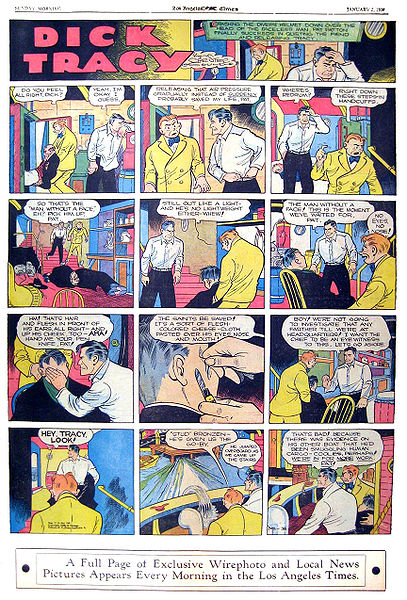
I’ve never been a fan of comic strips, even as a child, but a passage at the Los Angeles Review of Books by Brian Doherty about comics curator Bill Blackbeard caught my eye. It woud seem that one man’s obsession is responsible for much of the trove of pulpy panels still available to us. An excerpt:
“The historian, editor, and collector Bill Blackbeard made the world of modern comic strip reprints possible by his dogged efforts to rescue them from far-flung newspapers being systematically destroyed by libraries. With his masterful co-edited Smithsonian Collection of Newspaper Comics anthology in 1977, Blackbeard exposed a generation of fans and cartoonists to the fact that moldering, disappeared old comic strips were cool and desirable.
Blackbeard personally clipped and collated over 350,000 Sunday strips and over 2 million dailies, stored them in his own home for decades, and eventually donated them to Ohio State University. Jenny Robb, who now curates the archive Blackbeard created, says that Blackbeard’s careful preservation, contextualization, and editing ‘transformed comic strips into objects with legitimate cultural, historic and sometimes even aesthetic value.'”
••••••••••
Fiorello La Guardia reads Dick Tracy, 1945:
Tags: Bill Blackbeard, Brian Doherty

"He preferred to spend his time learning the tango in Buenos Aires or archery in Kyoto." (Image by Olivier Ezratty.)
If you haven’t had a chance yet to read Rebecca Mead’s great New Yorker profile of souped-up self-help guru, Timothy Ferriss, don’t let it slide. Ferriss is the best-selling author behind the 4-Hour Workweek and other similarly alluring titles. The article is hilarious and sums up the age we live in, the desperation people feel to find some way to the other side of this very discomfiting paradigm shift we’re experiencing. An excerpt;
“Ferriss’s first book, The 4-Hour Workweek, was turned down by twenty-six publishers before being accepted by Crown, and he recounts this statistic with pride. But it’s easy to understand the caution of those twenty-six. Ferriss’s aesthetic is a pointed rejection of the culture of constant BlackBerrying, corporate jockeying, and office all-nighters that is celebrated in most business-advice books, and in films such as The Social Network. The 4-Hour Workweek was inspired by a personal epiphany. In 2004, Ferriss, feeling burned out as the C.E.O. of a sports-nutrition company, where he worked twelve-hour days, seven days a week, discovered that he preferred to spend his time learning the tango in Buenos Aires or archery in Kyoto. He also found that, by automating his business operations to the largest extent possible, he was able to pull this off. (To a point, at least. Kane Ng, a Hollywood executive who is Ferriss’s friend, told me, expansively, ‘Tim is a total fraud, you know. ‘Four-hour workweek’? He is constantly busting ass.’ Of course, it was Seneca who said that hyperbole ‘asserts the incredible in order to arrive at the credible.’) Ferriss advises would-be members of the New Rich to check e-mail no more than twice a day, and to set automated responses advising correspondents of the recipient’s unavailability. (Anyone who e-mails Ferriss these days immediately receives in her inbox an automated response, with the cheery sign-off ‘Here’s to life outside of the inbox!’) The book counsels readers to take what Ferriss calls ‘mini-retirements’ now—a month in Costa Rica, three months in Berlin—rather than saving up the prospect of leisure for the final decades of life. And it recommends funding all this by discovering a ‘muse,’ which Ferriss defines, as Seneca did not, as ‘an automated vehicle for generating cash without consuming time.’
Finding one’s muse, like catching one’s rabbit before cooking it, is more easily said than done, but Ferriss’s advocacy of liberation from the workplace has had a wide appeal, especially among younger people to whom the workplace may be unattainable in the first place, given the unemployment rate. Similarly, his latest book, The 4-Hour Body, speaks to the peculiar obsessions and insecurities of the young American male. Ferriss tells readers how they might lose twenty pounds in thirty days without exercise—eggs, spinach, and lentils are crucial—and how to triple their testosterone levels. (Gentlemen, put your iPhone in the pocket of your backpack, not the pocket of your jeans.) The book, which is five hundred and forty-eight pages long, contains a lot of colorfully odd advice—he recommends increasing abdominal definition with an exercise he calls ‘cat vomiting’—but it also reassures readers that they need not go so far as to have Israeli stem-cell factor injected into the cervical spine, as Ferriss did in the name of inquiry. Nor need they necessarily incorporate into their regimen Ferriss’s method for determining the effectiveness of controlled binge eating: weighing his feces to find out exactly what kind of shit he was full of.”
••••••••••
“The four-hour workweek is possible, but you need to completely unplug and reset”:
Tags: Rebecca Mead, Timothy Ferriss

David Bowie, Dinah Shore, Henry Winkler and Nancy Walker in 1975. In one segment, Bowie gets a karate lesson.
More from the same interview:
Tags: David Bowie, Dinah Shore, Henry Winkler, Nancy Walker