Urban Studies

You are currently browsing the archive for the Urban Studies category.

I disagree with many of Nick Carr’s concerns about the Internet, though I always find him a really smart and lively thinker. I don’t believe new media will necessarily make us a lot smarter–at least not in the short term–but I don’t think it’s turned us from a contemplative nation of readers of thick Russian novels into pinheads. I mean, when did that earlier nation even exist? When was it ever going to exist? An excerpt from “We Turn Ourselves Into Media Creations,” a new inteview by Lars Mensel in The European in which Carr makes some points about social networking:

Carr: There are social pressures and brain chemicals that encourage us to stay connected: It becomes very difficult to cut ourselves off from the flow of information. As technology becomes ever more deeply woven into our social processes and expectations, it becomes something more than just a matter of personal discipline. In their jobs, many people face the expectation to always monitor messages and emails coming from colleagues or clients. That pressure goes on even when they leave work and go home; they are still constantly checking information. Thanks to Facebook, social networking and other communication tools, there is now a situation where similar pressures are arising in our social lives: People you know are using online tools to plot their social lives and exchange information – it makes you feel compelled to also always be monitoring information. Obviously that doesn’t mean we don’t have free will or the choice to disconnect, we shouldn’t miss the fact that it is – like earlier technology such as the automobile – being woven so deeply into society that it is not just a matter of personal discipline to decide how to use it.

The European: A study has shown that using Facebook causes people to romanticize other peoples’ lives whilst seeing their own in a negative light: It is because people share predominately good news of flattering photos…

Carr: I saw a study that examined how people regard their Facebook friends and when somebody admired the exciting life of a friend, this friend often said exactly the same about them. It shows you how we turn ourselves and each other into media creations through social networks. As with celebrities and other media personalities, the reality can be very different from how we present ourselves online.” (Thanks Browser.)

Tags: ,

From Tiffany Kaiser’s DailyTech piece about Berkeley researchers making a breakthrough in the translation of brainwaves into words, which could create communication possibilities for those unable to speak–and all sorts of ethical quandaries:

“At some point in the near future, mind-reading could be a power possessed not only by fictional characters like Professor Charles Xavier (Professor X), but also real-life researchers who are searching for ways to help individuals who have lost their ability to speak.

Robert Knight, of the Helen Wills Neuroscience Institute at the University of California – Berkeley, and Brian Pasley, a scientist in Knight’s lab at UC Berkeley, have successfully translated brain activity into words.

The team was able to do this by recruiting the cooperation of 15 patients, who were already in the hospital for intractable epilepsy treatment. This particular operation requires removal of the top of the patient’s skull, where a net of electrodes are then placed along the surface of the brain. Theelectrodes identify the origin areas of the patient’s fit, and that particular tissue is eliminated.”

Tags: , ,

Alistair Cook brought his Omnibus TV show into the New York Times newsroom in 1954 to see how men–and only men–published news in that era. Listen to those clunky typewriter keys tapping. Notice the lack of a healthy blue glow on the faces of the editors.

A piece of this Cook clip was included in the excellent doc about the latter-day Gray Lady, Page One:

Tags:

"My guys would love to eat some fresh roadkill."

Roadkill for my dogs (Phillipsburg)

I’m looking for deer to feed to my dogs if you see any dead deer. My guys would love to eat some fresh roadkill…& I need to save some money on dog food so I can pay my vets for services. Thanks Peter 3dogs.

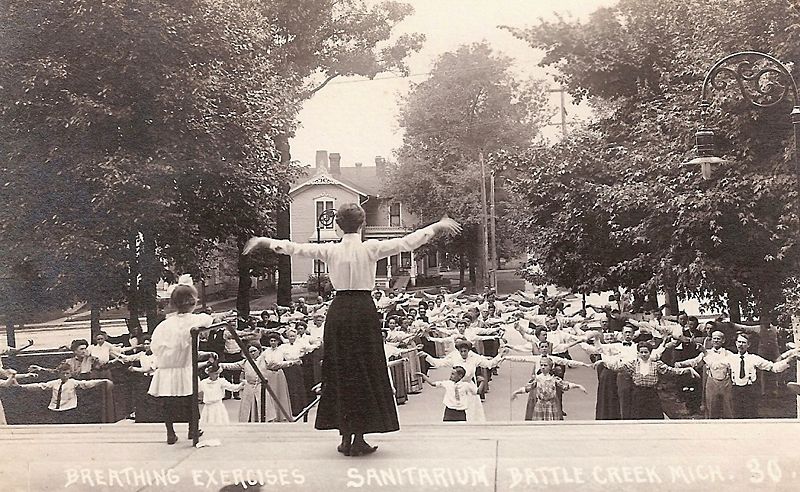
This classic photograph from the early 1900s captures a group breathing activity at the Battle Creek Sanitarium in Michigan, which became one of the most famous health resorts in the world under the stewardship of Dr. John Harvey Kellogg, a brilliant if eccentric doctor, a holistic enthusiast and an enterprising Adventist. Originally established in 1866 as the Western Health Reform Institute, Kellogg’s spa offered restorative hydrotherapy, diet, exercise, enemas and vibratory chairs. The good doctor also was co-inventor of the cornflake with his brother, Will Keith Kellogg. The sanitarium remained open until the 1940s when it was purchased by the U.S. government and converted into an Army hospital. An excerpt from the 1943 New York Times obituary for Kellogg, who lived until 91:

“A determined practitioner of the rules for simple eating and living he preached for all humanity, Dr. Kellogg was perhaps the best example of the truth of his own dogmas.

When he became a physician Dr. Kellogg determined to devote himself to the problems of health, and after taking over the sanitarium he put into effect his own ideas. Soon he had developed the sanitarium to an unprecedented degree, and he launched the business of manufacturing health foods. He gained recognition as the originator of health foods and coffee and tea substitutes, ideas which led to the establishment of huge cereal companies besides his own, in which his brother, W. K. Kellogg, produced the cornflakes he invented. His name became a household word.

Dr. Kellogg’s youth was one of hard work. Born in Tyrone, N. Y., on Feb. 26, 1852, he moved to Battle Creek with his parents, John Preston and Ann Jeanette Kellogg, at an early age. He worked in his father’s broom factory and also served as a ‘printer’s devil’ in Battle Creek publishing houses.”

••••••••••

Anthony Hopkins as Kellogg in the 1994 film adaptation of T.C. Boyle’s novel, The Road to Wellville:

Tags: ,

Conversational bot with a brain that’s a mesh of wires. Just like you and I.

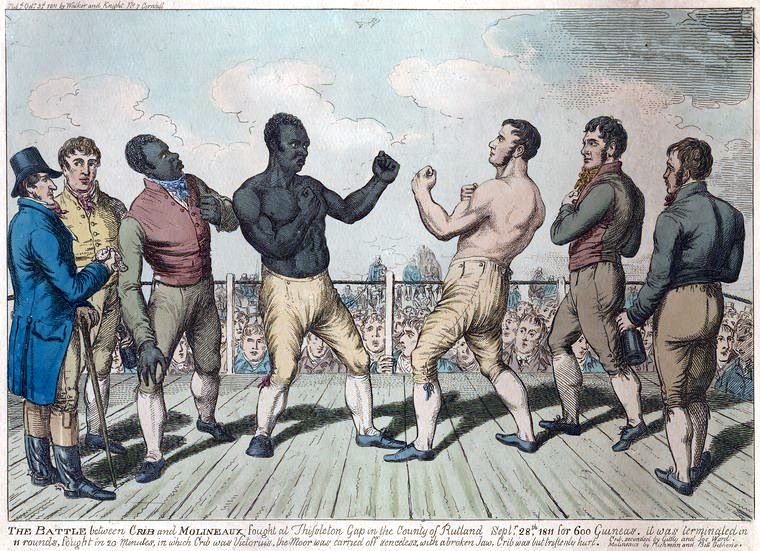
The opening of “A Fighter Abroad,” Brian Phillips’ smart Grantland article about an 1810 boxing match, noted for its brutality, hoopla and racial politics, which helped birth modern sports:

“On December 10, 1810, in a muddy field around 25 miles from London, a fight took place that was so dramatic, controversial, and ferocious that it continues to haunt the imagination of boxing more than 200 years later. One of the fighters was the greatest champion of his age, a bareknuckle boxer so tough he reportedly trained by punching the bark off trees. The other was a freed slave, an illiterate African-American who had made the voyage across the Atlantic to seek glory in the ring. Rumors about the match had circulated for weeks, transfixing England. Thousands of fans braved a pounding rain to watch the bout. Some of the first professional sportswriters were on hand to record it.

It was the greatest fight of its era. But its significance went beyond that. Even at the time, it seemed to be about more than boxing, more than sport itself. More than anything, the contest between a white English champion and a black American upstart seemed to be about an urgent question of identity: whether character could be determined in the boxing ring, whether sport could confirm a set of virtues by which a nation defined itself.

The fight cemented a set of stock characters — the fast-talking, ultra-talented, self-destructive black athlete; the Great White Hope; the canny coach who’s half devoted to his pupil and half exploiting him — that have echoed down the centuries. In fact, so much about the fight feels familiar today, from the role of race to the role of the media, that if you had to name a date, you could make a good case that December 10, 1810, was the moment sport as we know it began.”

Tags: ,

A paperback is still my favorite medium for reading. Don’t care for cloth books because I’m a reader, not a collector. Don’t like trade paper because those were made oversized just to jack up the price, and they can’t slide into a pocket. But while I do not own an e-reader yet, I can’t say I have any major problem with them. Jonathan Franzen, however, does. From Anita Singh’s Telegraph piece about Franzen’s criticism of e-books:

The author of Freedom and The Corrections, regarded as one of America’s greatest living novelists, said consumers had been conned into thinking that they need the latest technology.

‘The technology I like is the American paperback edition of Freedom. I can spill water on it and it would still work! So it’s pretty good technology. And what’s more, it will work great 10 years from now. So no wonder the capitalists hate it. It’s a bad business model,’ said Franzen, who famously cuts off all connection to the internet when he is writing.

‘I think, for serious readers, a sense of permanence has always been part of the experience. Everything else in your life is fluid, but here is this text that doesn’t change.'”

Tags: ,

Jacques Cousteau, surfacing briefly in 1956 to appear on What’s My Line? Just-retired Yankee Phil Rizzuto on the panel.

Tags: ,

It’s amazing how little effect a disgraced Richard Nixon’s resignation had on the future of the GOP. It cost the Republicans the White House in 1976, but his party has held the Oval Office more often than not since. And Nixon’s brand of conservatism, which at least had some room for environmentalism and Affirmative Action, has all but vanished from the Right. In 1967, before he was President, Nixon discussed the GOP’s future with William F. Buckley, Jr.


Tags: ,

"There is absolutely no relation between intelligence and stature."

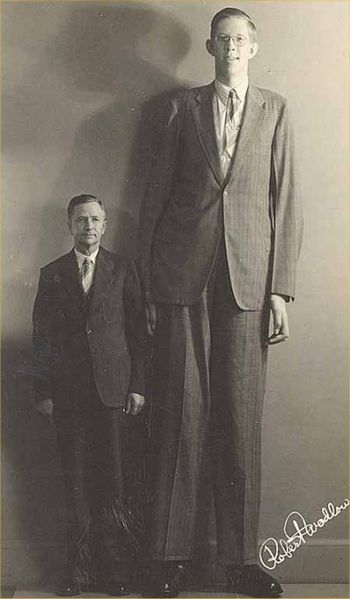
While it’s true that taller people aren’t necessarily smarter than shorter people, that would seem to be the only correct scientific fact presented by Dr. Charles E. Woodruff in this January 6, 1901 article from the Brooklyn Daily Eagle. An excerpt:

“From investigations among soldiers and from the literature on the subject, there is no doubt in my own mind that if a man’s development is so unstable that he has physical stigmata, he is invariably of bad physical development also. As far as I know, there are few, if any, cases of abnormal minds in average bodies devoid of stigmata. It is a fair inference, then, that if a man’s body is nearly an average in all respects–height, weight, proportions, etc.–there must also be an average brain, and, therefore, a normal mind–excluding. of course, normal men who have acquired insanity. Beyond this we dare not go, for there is absolutely no relation between intelligence and stature. Men of genius may be big, like Bismarck, or little, like Napoleon or Da Costa, and the same may be said of the feeble-minded as well as those of average intelligence. George Washington’s physical measurements are said to have been identical with those of Jeffries, the giant pugilist. Other illustrations might be given indefinitely.

It is true that the human brain weight depends upon the body weight, for the muscles require many brain cells. In like manner the sparrow needs but a few grains of brain, while the whale and the elephant must have more than man. Yet the indescribable and immeasurable variable called intelligence depends upon other things in addition to weight of brain, and the increased stature consists of tissue which may not and probably does not, have any bearing on intelligence.

A big physique, with immense reserve power and endurance, is a decided element in forcing men to the front in the struggle of life. This is in accordance with recent investigations among Chicago school children, which are said to show that the best scholars in any class are apparently bigger than the rest. Hence, other things being equal, the big men, having an advantage, should have a larger percentage of their number successful than the little men. Yet, statistics show the very opposite, for Lambroso mentions (“Man of Genius,” page 6) but twenty-six great men of tall stature, while he names fifty-nine who are short, some of them being even dwarfish or less than five feet in height. As the anomalies of height are equally distributed to each side of the mean, there must be some tremendously active cause to make the little men more than twice as brilliant as the big. The two classes, being equally removed from the average, should be equally abnormal mentally.”

From David Sheff’s 1989 Rolling Stone interview with the late artist Keith Haring, who used spare subway station panels as his canvas:

How did you begin drawing in the subways?
One day, riding the subway, I saw this empty black panel where an advertisement was supposed to go. I immediately realized that this was the perfect place to draw. I went back above ground to a card shop and bought a box of white chalk, went back down and did a drawing on it. It was perfect – soft black paper; chalk drew on it really easily.

I kept seeing more and more of these black spaces, and I drew on them whenever I saw one. Because they were so fragile, people left them alone and respected them; they didn’t rub them out or try to mess them up. It gave them this other power. It was this chalk-white fragile thing in the middle of all this power and tension and violence that the subway was. People were completely enthralled.

Except the police.
Well, I was arrested, but since it was chalk and could easily be erased, it was like a borderline case. The cops never knew how to deal with it. The other part that was great about it was the whole thing was a performance.

When I did it, there were inevitably people watching – all kinds of people. After the first month or two I started making buttons because I was so interested in what was happening with the people I would meet. I wanted to have something to make some other bonding between them and the work. People were walking around with little badges with the crawling baby with glowing rays around it. The buttons started to become a thing now, too; people with them would talk to each other, there was a connection between people in the subway.

The subway pictures became a media thing, and the images started going out into the rest of the world via magazines and television. I became associated with New York and the hip-hop scene, which was all about graffiti and rap music and break dancing. It had existed for five years or more, but it hadn’t really started to cross over into the general population. It was incredibly interesting to me that it was reaching all kinds of people in different levels from different backgrounds. Then, in 1982, I had my first one-man show in New York at a big gallery, Tony Shafrazi, in SoHo.” (Thanks Longform.)

••••••••••

“You are known as the Michelangelo of the New York subway”:

Tags: ,

Don’t believe your psychic family member or friend? (NYC)

Anyone out there have a family member or friend who claims to be psychic but you believe they’re lying or potentially delusional? 

Elsa Lanchester, most famously Frankenstein’s bride in 1935, chatting up Dick Cavett in 1970. Her longtime husband, Charles Laughton, was famously childish in his recreational tastes, often dragging people, including Ray Bradbury, to Disneyland, one of his favorite places.

Woman notices streak of gray in hair, settles for brain-dead douchebag with bolts in neck:

Tags: , ,

As Kevin Kelly is wont to say, no tool or technology we’ve ever created has become completely extinct. The following reports concern the “last” typewriter repairman. After they’re all gone, there will still somehow be a few typewriters and a few people who can fix them. Likely, someone will continue manufacturing typewriters for a niche market. They will exist in the margins, but they will never end.

••••••••••

Jacksonville:

Chicago:

Houston:

Read also:

Tags:

Provided it’s done in a safe and healthy way, I’m in favor of all sorts of performance enhancement. The idea of human “purity” is a lie that we tell ourselves while behaving counter to it. In his post, “The Ethics of Brain Boosting,” Jonathan Wood examines the ramifications of transcranial direct current stimulation or TDCS, which seems to enhance brain function. An excerpt:

Dr Roi Cohen Kadosh, who has carried out brain stimulation studies at the Department of Experimental Psychology, very definitely has a vision for how TDCS could be used in the future: ‘I can see a time when people plug a simple device into an iPad so that their brain is stimulated when they are doing their homework, learning French or taking up the piano,’ he says.

The growing number of positive results in early-stage studies, led the neuroscientists Dr Cohen Kadosh and Dr Jacinta O’Shea to talk to Professor Neil Levy, Dr Nick Shea and Professor Julian Savulescu in the Oxford Centre for Neuroethics about what ethical issues there may be in future widespread use of TDCS to boost abilities in healthy people.

The researchers outline the issues in a short paper in the journal Current Biology, and indicate the research that is now necessary to address some of the potential concerns.

‘We ask: should we use brain stimulation to enhance cognition, and what are the risks?’ explains Roi. ‘Our aim was to look at whether it gives rise to new ethical issues, issues that will increasingly need to be thought about in our field but also by policymakers and the public.’” (Thanks Browser.)

Tags: ,

Former heavyweight champ Jack Dempsey, the “Manassa Mauler,” the most famous athlete on earth during the 1920s, on What’s My Line?, 1965. During the interview segment, Dempsey suggests that the Ali-Liston fight was bogus.

In 1927, at the end of his run of dominance thanks to age and Gene Tunney, while he was training for a return to greatness which would never arrive, Dempsey suffered a personal tragedy when his brother, John, murdered his wife and committed suicide. An excerpt from a July 3, 1927 New York Times article:

“Schenectady–Apparently in a spell of temporary insanity due to a recurring attack of an illness to which he had been subject for several years, John Dempsey, brother of the former heavyweight champion, fatally shot his 21-year-old wife, Edna, in a rooming house here today. He turned the gun on himself, dying instantly.

The Dempseys had been estranged for about a year. They are survived by a two year-old son, Bruce.

Jack Dempsey was deeply affected when notified at his training camp at White Sulphur Springs, Saratoga Lake. He came at once to Schenectady and positively identified the bodies.

The boxer ordered his brother’s body to be sent tonight for burial to Salt Lake City, his former home, and Mrs. Dempsey’s body to be taken to Green Island.

It was announced that Jack Dempsey would cease his training activities for a few days because of the tragedy, but would not cancel his match with Sharkey, set for July 21 in New York City.”

See also:

Tags:

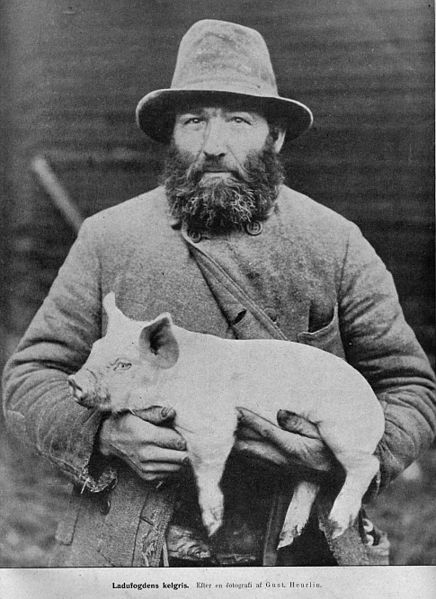
"One of the greatest department stores in the West was the creation of a man who used to exhibit an educated pig in a travelling circus."

From a 1901 edition of Ainslee’s Magazine:

“The department store is an evolution of the dry goods store, which exists no longer as an ambitious retail business. One of the greatest department stores in the West was the creation of a man who used to exhibit an educated pig in a travelling circus. When his estate was probated it was appraised at $15,000,000. This man opened a small dry goods store in Chicago and annexed one business after another in his neighborhood until he owned what some declare was the first department store in America. However that may be, the idea is older in England and France.”

Industry has poisoned the environment in the past, so it’s possible mysterious illnesses can arise from chemical dumping or such behaviors. But more often we simply want to believe that the cause of our trouble is outside of ourselves, that there is a culprit somewhere else. And clusters can form. We saw it just recently with the nonsense about immunizations supposedly causing autism. The brain is mysterious and we’re often at the mercy of it, to its demands and delusions.

From Stanford history professor Richard White’s answer to the question, “Does California need a high-speed rail line, ultimately connecting San Francisco to Los Angeles?” in the New York Times:

“We shouldn’t build it. At best it will not solve any problems for decades to come, and at worst it will become an expensive problem itself. It will become a Vietnam of transportation: easy to begin and difficult and expensive to stop.

In a state dismantling its education system and watching its existing infrastructure collapse, it is criminally profligate to build a system that will drain revenue from more-needed projects. This is like building a state-of-the-art driveway while your house collapses.

Highway 5 between Los Angeles and San Francisco is miserable, but it is not the key transportation problem in California. For high-speed rail to work, it needs to get people out of cars, but the project doesn’t touch the huge mass of traffic, which swirls daily in the Los Angeles and San Francisco metropolitan areas. High-speed rail between Boston and Washington, D.C., connects trains with functioning public transportation systems. This is not true in Los Angeles nor in large parts of the Bay area.”

Tags:

“Here in my car / You know I’ve started to think / About leaving tonight / Although nothing seems right.” Created by OgilvyWest for Cisco Systems.

"GO GIANTS."

TWO GIRLS DESPERATE FOR SUPER BOWL TICKETS – $1000 (NEW YORK, NY)

WE ARE TWO VERY LOVELY GIRLS IN OUR MID 20’S WHO NEED TICKETS TO THE SUPER BOWL

WE SADLY CANNOT PAY $2000 A TICKET BUT CANT A KIND SOUL HELP US GET IN SOMEHOW?

WE HAVE A CAR AND WE CAN DRIVE THERE FROM NYC.

PLEASE HELP US!!!!!!!!!!!!!!!!!!!!!!!! WE NEED TO GET TO INDY!!!!!!!!!!!!!!!!!!!!!!!!!!

GO GIANTS

Carrie Brownstein, now a comedy star for Portlandia and already an indie rock icon for Sleater-Kinney, had a wordless role in Miranda July’s odd, haunting 2001 short, “Getting Stronger Every Day.”

Tags: ,

At the Institute of Robotics and Mechatronics of the German Aerospace Center.

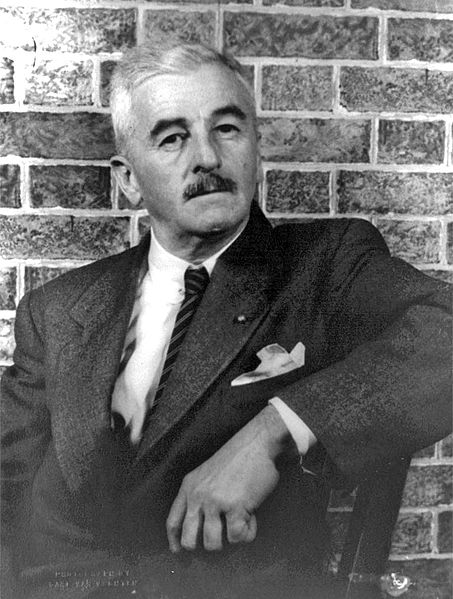
William Styron attended his idol William Faulkner’s 1962 funeral and filed a report for Life. The opening of the questionably titled, “As He Lay Dead, a Bitter Grief“:

“He detested more than anything the invasion of his privacy. Though I am made to feel welcome in the house by Mrs. Faulkner and by his daughter, Jill, and though I know that the welcome is sincere, I feel an intruder nonetheless. Grief, like few things else, is a private affair. Moreover, Faulkner hated those (and there were many) who would poke about in his private life–literary snoops and gossips yearning for the brief glimpse of propinquity with greatness and a mite of reflected fame. He had said himself more than once, quite rightly, that the only thing that should matter to other people about a wirter is his books. Now that he is dead and helpless in a gray wooden coffin. I feel even more an interloper, prying around in a place I should not be.

But the first fact of the day, aside from that final fact of a death which has so diminished us, is the heat, and it is a heat which is like a small mean death itself, as if one were being smothered to extinction in a damp woolen overcoat. Even the newspapers in Memphis, 60 miles to the north, have commented on the ferocious weather. Oxford lies drowned in heat, and the feeling around the courthouse square on this Saturday forenoon is a hot, sweaty languor bordering on desperation. Parked slantwise against the curb, Fords and Chevrolets and pickup trucks bake in merciless sunlight. People in Mississippi have learned to move gradually, almost timidly, in this climate. They walk with both caution and deliberation. Beneath the portico of the First National Bank and around the scantily shaded walks around the courthouse itself, the traffic of shirtsleeved farmers and dewy-browed housewives and marketing Negroes is listless and slow moving. Painted high up against the side of a building to the west of the courthouse and surmounted by a painted Confederate flag is a huge sign at least 20 feet long reading ‘Rebel Cosmetology College.’ Sign, flag and wall, dominating one hot angle of the square, are caught in blazing light and seem to verge perilously close to combustion. It is a monumental heat, heat so desolating to the body and spirit as to have the quality of a half-remembered bad dream, until one realizes that it has, indeed, been encountered before, in all these novels and stories of Faulkner through which this unholy weather–and other weather more benign–moves with almost touchable reality.”

••••••••••

Read also:

Tags: ,

« Older entries § Newer entries »