
Urban Studies

You are currently browsing the archive for the Urban Studies category.

Janelle Nanos has a timely article, “So Appy Together,” in Boston Magazine, which asks whether smartphones are fundamentally changing what it means to be human. The short answer is “yes.” Until we figure out how to safely use biotech to make our memories more elastic than they naturally are, we need strategies and processes and tools to manage data overload. If you read this blog very much, you know that I think the net gain from these tools far outweighs any negative, but with utility comes dependency–perhaps even a sort of control. An excerpt from Nanos’ piece:

I LOVE MY SMARTPHONE. It’s become a second brain in my pocket that’s changed how I process information. It’s with me every waking moment — and the sleeping moments, too — tracking my daily habits. And through my constant e-mail and Facebook activity, and the personal documentation of my life via Twitter and Instagram photos, it’s become the lens through which I see the world. All day long, I find myself instinctively reaching for my phone, using it as a tool to validate my existence.

But lately, my smartphone and I have taken our relationship to the next level. I provide it with ever-more-intimate details about my life. Last year, for example, I set a few goals for myself. I wanted to lose some weight, save money, and run a half marathon. With only a few app downloads, my phone became a trainer, life coach, and confidant. It now knows what I eat, how I sleep, how much I spend, how much I weigh, and how many calories I burn (or don’t) at the gym each day. It’s gotten to the point where my phone now somehow knows more about me than anyone else in the world, including my own darling husband. My gadget has become a tiny black mirror, reflecting back how I see myself. Which means things are getting more complicated between us.” (Thanks Browser.)


Tags:

When the Tea Party was red hot and the Birther movement was at its peak, an Esquire interviewer asked Chris Rock if he thought racism was returning–or had never declined–in America. He was undisturbed. “When I see the Tea Party and all this stuff,” Rock answered, “it actually feels like racism’s almost over. Because this is the last — this is the act up before the sleep.”

I think this national contraception brouhaha may be saying the same thing about sexism. On one level, it’s a just an awkward and desperate act of pandering to an extremist base by opportunistic politicians in the year of election. But there may be something more fundamental about it. Over the last decade, women have embraced higher education as men have fallen from it, and while education is no longer the definite path to success and power it once was, you would have to assume the numbers say women will be ascendant in business and politics in America for the next couple of decades.

And that shift may be disconcerting to some who still cling to a paternalistic vision of America. But those who feel this way tend to be on the higher end of the age scale and their numbers continue to thin.

Political power doesn’t shift quietly or easily, but the big picture tells us it’s going to shift in the favor of women in the near fiuture. That doesn’t mean there will never be sexism (or racism) any more, but that its viability as a means of political control is all but over. The clamor over reproductive rights sounds less like a clarion call than a death rattle.•

In 1967, Professor David F. James visited I’ve Got a Secret for a demonstration.

Tags:

"I’m too excited to drive." (Image by Niki Sublime.)

From “An Uneasy Spy Inside 1970s Suburbia,” one of a series of retrospective 2010 articles in the Los Angeles Times about Philip K. Dick, who speeded to his death with the help of amphetamines, but not before decoding our future:

“During his last few years, when he became financially stable for one of the rare times in his life, his daughters visited him at the Santa Ana apartment he moved to after the implosion of his marriage. Dick’s oldest child, daughter Laura, born in 1960, recalls his place full of Bibles, encyclopedias – Dick was a ferocious autodidact – and recordings of Wagner operas.

Phil’s second daughter Isolde, now 42, visited enough during this period to get to know her father for the first time. She recalls him as working hard to be a good father and struggling to overcome his limitations, both with and without success.

During one visit, he got Isa excited about a trip to Disneyland, then open past midnight. ‘He said, ‘We’re gonna go and stay ‘til it closes!’ But in my mind we were there for only 20 or 30 minutes before he said, ‘Honey, my back’s really hurting.’ I think he was just overwhelmed by all the crowds. I knew him, and knew he was uncomfortable moving outside his comfort zone.’

He spent more of his time walking from the apartment to a nearby Trader Joe’s to get sandwiches, a park where he and Isa tried awkwardly to play kickball, and an Episcopalian church where he had running theological discussions with the clergy.

He’d bought himself a Fiat sports car, but almost never drove, telling Isa, ‘Honey, I’m just so excited to see you, I’m too excited to drive.’ She learned quickly to read her father’s code, which seemed designed to protect her from ugly realities.

Sometimes he’d stay up all night, leaving his visitors laughing for hours as he spun idea after idea, or wrote, in a blaze, until dawn. ‘He could go from that really engaging personality to being withdrawn and closed off,’ Isa remembered, explaining that he would sometimes cancel visits at the last minute. ‘I could tell when we spoke on the phone his voice would go really low and flat. When he had that tone he was depressed. He’d say something like he had the flu. ‘The flu’ was usually his code.'”

Tags:

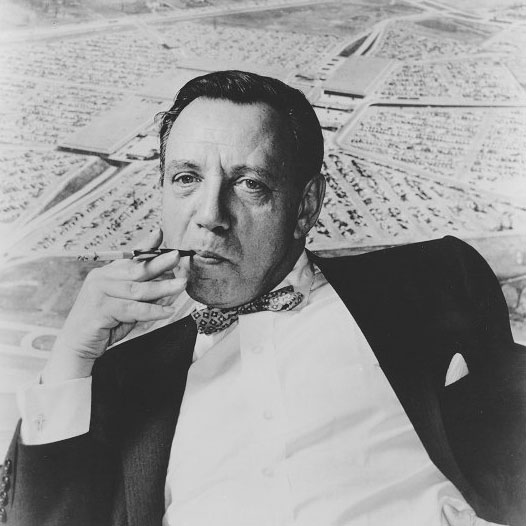
"Victor Gruen was short, stout, and unstoppable."

FromThe Terrazzo Jungle,” Malcolm Gladwell’s great 2004 New Yorker article about the birth of the mall, long before anyone could imagine many of them becoming ghosts or virtual:

“Victor Gruen was short, stout, and unstoppable, with a wild head of hair and eyebrows like unpruned hedgerows. According to a profile in Fortune (and people loved to profile Victor Gruen), he was a ‘torrential talker with eyes as bright as mica and a mind as fast as mercury.’ In the office, he was famous for keeping two or three secretaries working full time, as he moved from one to the next, dictating non-stop in his thick Viennese accent. He grew up in the well-to-do world of prewar Jewish Vienna, studying architecture at the Vienna Academy of Fine Arts—the same school that, a few years previously, had turned down a fledgling artist named Adolf Hitler. At night, he performed satirical cabaret theatre in smoke-filled cafés. He emigrated in 1938, the same week as Freud, when one of his theatre friends dressed up as a Nazi Storm Trooper and drove him and his wife to the airport. They took the first plane they could catch to Zurich, made their way to England, and then boarded the S.S. Statendam for New York, landing, as Gruen later remembered, ‘with an architect’s degree, eight dollars, and no English.’ On the voyage over, he was told by an American to set his sights high—’don’t try to wash dishes or be a waiter, we have millions of them’—but Gruen scarcely needed the advice. He got together with some other German émigrés and formed the Refugee Artists Group. George S.  Kaufman’s wife was their biggest fan. Richard Rodgers and Al Jolson gave them money. Irving Berlin helped them with their music. Gruen got on the train to Princeton and came back with a letter of recommendation from Albert Einstein. By the summer of 1939, the group was on Broadway, playing eleven weeks at the Music Box. Then, as M.  Jeffrey Hartwick recounts in Mall Maker, his new biography of Gruen, one day he went for a walk in midtown and ran into an old friend from Vienna, Ludwig Lederer, who wanted to open a leather-goods boutique on Fifth Avenue. Victor agreed to design it, and the result was a revolutionary storefront, with a kind of mini-arcade in the entranceway, roughly seventeen by fifteen feet: six exquisite glass cases, spotlights, and faux marble, with green corrugated glass on the ceiling.  It was a ‘customer trap.’  This was a brand-new idea in American retail design, particularly on Fifth Avenue, where all the carriage-trade storefronts were flush with the street.  The critics raved. Gruen designed Ciro’s on Fifth Avenue, Steckler’s on Broadway, Paris Decorators on the Bronx Concourse, and eleven branches of the California clothing chain Grayson’s.  In the early fifties, he designed an outdoor shopping center called Northland outside Detroit for J.  L.  Hudson’s. It covered a hundred and sixty-three acres and had nearly ten thousand parking spaces. This was little more than a decade and a half since he stepped off the boat, and when Gruen watched the bulldozers break ground he turned to his partner and said, ‘My God but we’ve got a lot of nerve.'” (Thanks TETW.)

••••••••••

Gruen commissioned this 1968 film about the revitalization of Fresno and the building of the Fulton Mall:

Tags: ,

"He can be playful, naughty, curious, angry, depressed and rude."

Robonetics Robopet – the perfect pet. Mint. Remote and user manual. – $45 (southwest suffolk, sayville)

Robopet is the perfect fusion of technology and personality. He comes alive with a combination of user-controlled movements and autonomous, free-roaming behaviors, some of them naughty and some of them nice. And, at seven inches, he’s the perfect interactive pet to take anywhere!

Man’s best friend? Robopet is more than that. In fact his creators claim that he’s the ultimate fusion of technology and personality. And we’d have to agree; because thanks to a clever combination of user-controlled movements and autonomous, free roaming behavior this ultra-intelligent dog practically comes alive. And just like a real pet he can be playful, curious, angry, depressed, rude and even disobedient.

Robopet can walk, run, sit down, stand up, lie down and get up, and roll over. He can be playful, naughty, curious, angry, depressed and rude. He makes digital animal sounds, like barking, whimpering, growling and panting. Train your Robopet

Robopet is trainable, teach him to sit, beg, and roll over. You can reinforce good behavior You can discourage bad behavior You can influence Robopet’s personality. But remember: Praise him too much and you’ll spoil him, Punish him too much and he’ll become timid. Robopet can learn tricks

He can see and avoid obstacles in his path, He can see and avoids table edges, He responds to sounds, He responds to human movement, He can function as a guard dog. Robopet also responds to commands from Robosapien V2.

Length 9in. Long Battery requirements: Robopet: 4 x AAA batteries (not included) Remote Controller: 3 x AAA batteries (not included) Mint condition. Had to have for Christmas and then never used!!!! Original remote and user’s maunal. Can meet local. $45

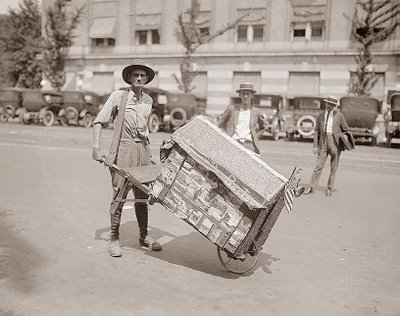
From “An Odd Little Fire,” in the September 24, 1895 Brooklyn Daily Eagle:

“Edward McCann, a peripatetic pop corn peddler, had his wagon on the corner of Tompkins Avenue and Quincey Street last night when the naphtha tank which furnishes illumination exploded. The wagon caught fire and was burned up, together with the contents. McCann estimates his loss at $200.”


Tags:

"The elevator would zip along at 125 mph." (Image by Robert Lawton.)

I’m assuming better options for civilian space travel will come along before 2050 when Japan is planning on opening its Elevator Into Space, but here’s a bit about it from CNET:

“Japanese construction company Obayashi wants to build an elevator to space and transport passengers to a station about a tenth the distance to the moon.

The elevator would use super-strong carbon nanotubes in its cables and could be ready as early as 2050, according to Tokyo-based Obayashi.

The cables would stretch some 60,000 miles, about a quarter the distance to the moon, and would be attached to Earth at a spaceport anchored to the ocean floor. The other end would dangle a counterweight in space.

The elevator would zip along at 125 mph, possibly powered by magnetic linear motors, but would take about a week to get to the station. It would carry up to 30 people.”

•••••••••••

Philo T. Farnsworth, the Utah-born whiz kid who was hugely responsible for the creation of television, appearing on the medium he helped birth, on I’ve Got a Secret, in 1957. It may seem odd that someone who did something so monumental could appear to be anonymous on the show, but Farnsworth wasn’t widely known for his invention during his life. Even though the architecture of the medium has morphed wildly in the last two decades, we still watch his magic picture box in one form or another.

Tags:

"Ideas cause ideas and help evolve new ideas." (Image by Hannes Grobe.)

FromWhat Defines a Meme?James Gleick’s great 2011 Smithsonian article, a section about French scientist Jacques Monod’s prescient, pre-PC ideas about the organic spread of information:

“Jacques Monod, the Parisian biologist who shared a Nobel Prize in 1965 for working out the role of messenger RNA in the transfer of genetic information, proposed an analogy: just as the biosphere stands above the world of nonliving matter, so an ‘abstract kingdom’ rises above the biosphere. The denizens of this kingdom? Ideas.

‘Ideas have retained some of the properties of organisms,’ he wrote. ‘Like them, they tend to perpetuate their structure and to breed; they too can fuse, recombine, segregate their content; indeed they too can evolve, and in this evolution selection must surely play an important role.’

Ideas have ‘spreading power,’ he noted—’infectivity, as it were’—and some more than others. An example of an infectious idea might be a religious ideology that gains sway over a large group of people. The American neurophysiologist Roger Sperry had put forward a similar notion several years earlier, arguing that ideas are ‘just as real’ as the neurons they inhabit. Ideas have power, he said:

Ideas cause ideas and help evolve new ideas. They interact with each other and with other mental forces in the same brain, in neighboring brains, and thanks to global communication, in far distant, foreign brains. And they also interact with the external surroundings to produce in toto a burstwise advance in evolution that is far beyond anything to hit the evolutionary scene yet.” (Thanks TETW.)

Tags: ,

A TED Talk “from the future,” courtesy of Ridley Scott.

Tags:

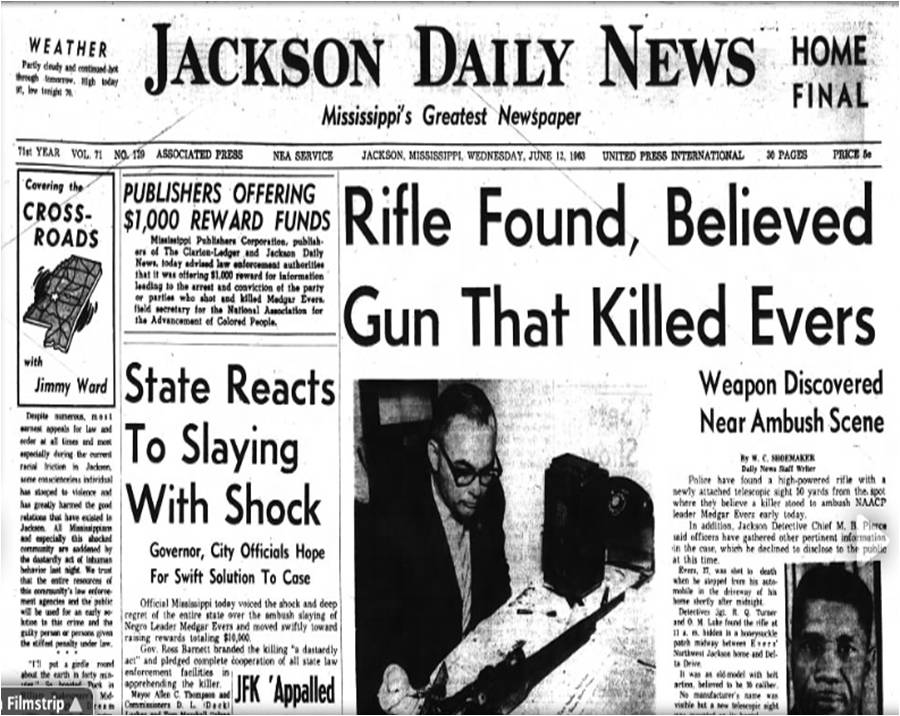
The opening of “He Said He Wouldn’t Mind Dying–If,” Myrlie Evers’ eloquent 1963 essay in Life, about the assassination of her husband, civil rights leader Medgar Evers:

“We all knew the danger was increasing. Threats came daily, cruel and cold and constant, against us and the children. But we had lived with this hatred for years and we did not let it corrode us.

Medgar was a happy man with a rich smile and a warmth that touched many people. He was never too busy to listen or too tired to to help. But beneath that gentle sympathy lay strength that could not be intimidated. Lord knows, enough people tried. But it never worked and that, I suppose, is why they killed him.

I don’t know what makes one man feel so passionately the needs of his people. It began for Medgar when he was a little boy in Decatur, Miss., where he was born. A family friend was lynched, and years later Medgar could still recall the shock with which he turned to his father.

‘Why did they kill him, Daddy?’ he asked.

‘Well, just because he was a colored man,’ his father said.

‘Could they kill you too?’

‘If I did anything they didn’t like, they sure could.’

Medgar never forgot that blunt statement of the facts of Negro life in Mississippi.”

•••••••••••

“A bullet from the back of a bush took Medgar Evers’ blood / A finger fired the trigger to his name”:

Tags: ,

"It'll be a sacrifice." (Image by Gage Skidmore.)

I’m giving up condoms and liver for Lent.

It’ll be a sacrifice, but I’ll pull through it.

Soon our vital signs will be tracked continuosly and automatically, with predictive data allowing for preemptory strikes against oncoming health problems. The opening of “The Patient of the Future,” John Cohen’s excellent new MIT Technology Review article about Larry Smarr, a computer genius at the forefront of the “self-quant” movement;

“Back in 2000, when Larry Smarr left his job as head of a celebrated supercomputer center in Illinois to start a new institute at the University of California, San Diego, and the University of California, Irvine, he rarely paid attention to his bathroom scale. He regularly drank Coke, added sugar to his coffee, and enjoyed Big Mac Combo Meals with his kids at McDonald’s. Exercise consisted of an occasional hike or a ride on a stationary bike. ‘In Illinois they said, ‘We know what’s going to happen when you go out to California. You’re going to start eating organic food and get a blonde trainer and get a hot tub,’ ’ recalls Smarr, who laughed off the predictions. ‘Of course, I did all three.’

Smarr, who directs the California Institute for Telecommunications and Information Technology in La Jolla, dropped from 205 to 184 pounds and is now a fit 63-year-old. But his transformation transcends his regular exercise program and carefully managed diet: he has become a poster man for the medical strategy of the future. Over the past decade, he has gathered as much data as he can about his body and then used that information to improve his health. And he has accomplished something that few people at the forefront of the ‘quantified self’ movement have had the opportunity to do: he helped diagnose the emergence of a chronic disease in his body.

Like many ‘self-quanters,’ Smarr wears a Fitbit to count his every step, a Zeo to track his sleep patterns, and a Polar WearLink that lets him regulate his maximum heart rate during exercise. He paid 23andMe to analyze his DNA for disease susceptibility. He regularly uses a service provided by Your Future Health to have blood and stool samples analyzed for biochemicals that most interest him. But a critical skill separates Smarr from the growing pack of digitized patients who show up at the doctor’s office with megabytes of their own biofluctuations: he has an extraordinary ability to fish signal from noise in complex data sets.” (Thanks Browser.)

••••••••••

Gary Wolf with more about the Quantified Self at TED, 2010:

Tags: , ,

The tremendously talented–and tremendously disturbed–chess champion Bobby Fischer, who would go on to become both a king and pawn in life, appearing on I’ve Got A Secret, 1958. Dick Clark is the inquisitor.

Tags: ,

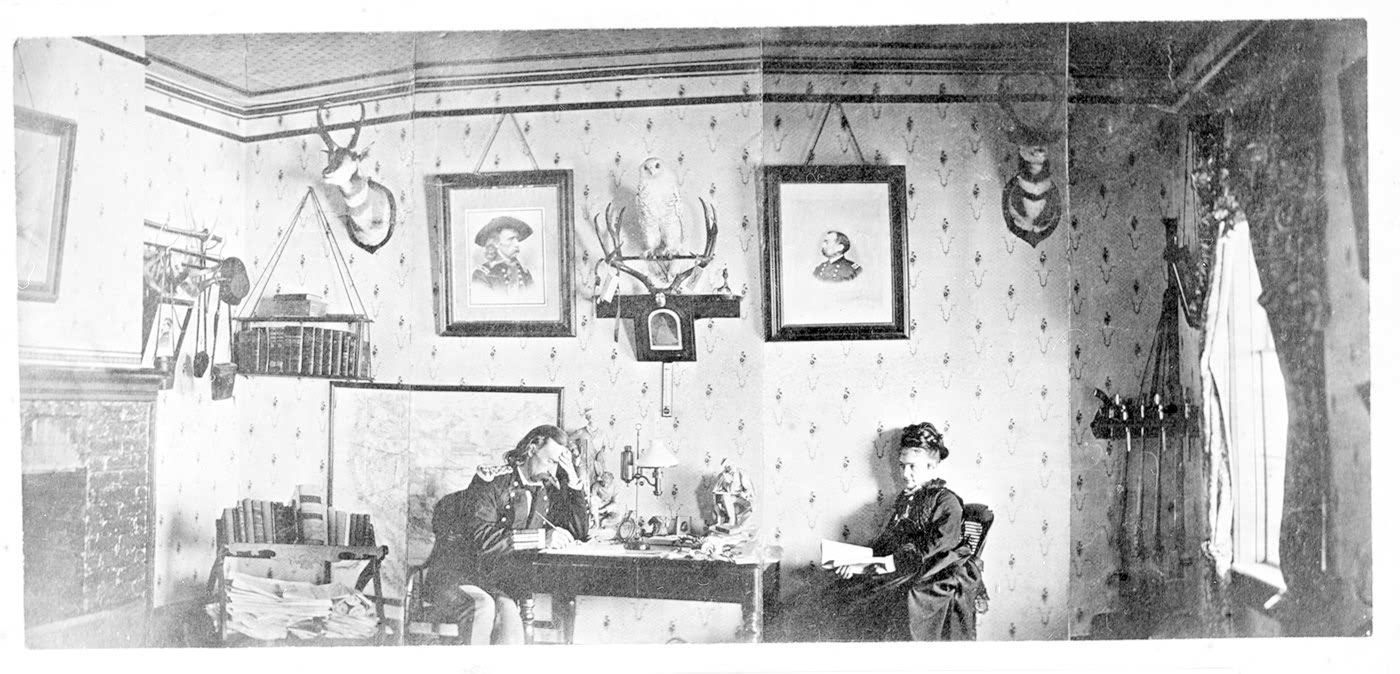
This classic photo profiles General George A. Custer with his wife, Elizabeth, at Fort Lincoln in Dakota Territory, two years before he met his waterloo at Little Big Horn. The slaughter that Custer and his cavalry walked into in 1876 was a shocking event that reverberated throughout the country in a time before media was truly mass. Custer’s fame, which was burnished continually by his wife after his death, was also enhanced by the brewery Anheuser-Busch, which commissioned a series of large-scale paintings of the general’s last stand and hung them in saloons and theaters in states all over the nation. A story of what occurred at the foot of the canvas in Detroit from the August 7, 1891 edition of the Brooklyn Daily Eagle:

“A tall, venerable looking man stood upon the platform of the cyclorama of the battle of Big Horn yesterday afternoon and gazed long and earnestly upon the canvas. The old man was feeble, and as he leaned upon the ropes for support the hot tears coursed each other down his furrowed cheeks. The other spectators in his vicinity eyed him with a mix of sympathy and curiosity. Presently a crowd of survivors of the Sixth cavalry, which was commanded by George A. Custer during the war, came up the stairs. Just as the cyclorama lecturer began to tell in his monologue how Custer, his brothers Tom and Boston and his brother in law, Lieutenant Calhoun, had been slaughtered at Big Horn by the Sioux, the old man turned to go as though the narrative had no special interest for him, when one of the veterans, seizing his hand, exclaimed: ‘Why, old man, God bless you.’ Then, turning to his comrades, he ejaculated: ‘Boys, this is George A. Custer’s father.’ Instantly the white haired patriarch was surrounded by boys in blue, who fairly struggled for the privilege of grasping his hand.

‘I was with your son,’ said one, ‘when he made the raid out of Winchester and broke through Early’s line.’

‘I was with him in the First cavalry,’ said another, ‘when Tom, his brother, was shot in the mouth.’

‘I remember that engagement very well,’ replied the old man: ‘Tom brought the red necktie home that he wore on that day, and I’ve got it yet. The blood is on it still.’

There were tears in the eyes of many of the crowd that saw General Custer’s cavalry introducing themselves to the general ‘s venerable father. The latter is now 84 years old.”

Tags: ,

Andy Warhol and Bianca Jagger interviewing young Steven Spielberg, 1979.

Tags: , ,

Seeing the women from Bridesmaids on the Oscars broadcast last night made me think of something. Right now there are a lot of great female comedians and there are a lot of great male comedians. But if you go beyond people doing comedy professionally, women are just much funnier. Most of the women I know are hilarious. They could be doing comedy professionally if they had followed that career path. I don’t think the same is true of male friends and acquaintances. Whoever has to put up with more shit in society will naturally be funnier. If you’re not standing in the mainstream, you’re looking at the world from an angle, and that’s just a more amusing way to see things.

You don’t see a lot of female faces at the head of Fortune 500 companies or on currency, and that’s why you see so many of them on comedy and improv stages. It’s sort of like how pro basketball is dominated in America by whatever ethnic group in living in the ghetto. Before African-Americans ruled the sport, the players were mostly Jewish men. As economic power shifts, so do talents.

Of course, women were putting up with a lot of crap long before they had the opportunity to shine in comedy. And they were probably funnier then, too.

•••••••••

“You feel that steam. It’s coming from my undercarriage”:

John Cale in 1963, the year before he met Lou Reed, on I’ve Got a Secret.

Tags: ,

What happens if President Obama gets another term? What about if the tax code changes so “job creators” are taxed like everyone else and the number of jobs don’t decrease? What if the Affordable Care Act improves our health and doesn’t bankrupt us? What if gay marriage is legalized at the federal level and has no ill effect whatsoever on society? What if women having access to free contraception actually improves our society?

What would those things mean? Is it permanently the end of 30 years of trickle-down economics? Is it the end of Reagan Republicanism? Is the time when the Right could exploit so-called value voters over? Thanks to shifting demographics, we may find out. From “2012 Or Never,” clear-eyed analysis of the political scene by New York‘s Jonathan Chait:

“‘America is approaching a ‘tipping point’ beyond which the Nation will be unable to change course,’ announces the dark, old-timey preamble to Paul Ryan’s ‘The Roadmap Plan,’ a statement of fiscal principles that shaped the budget outline approved last spring by 98 percent of the House Republican caucus. Rick Santorum warns his audiences, ‘We are reaching a tipping point, folks, when those who pay are the minority and those who receive are the majority.’ Even such a sober figure as Mitt Romney regularly says things like ‘We are only inches away from no longer being a free economy,’ and that this election ‘could be our last chance.’

The Republican Party is in the grips of many fever dreams. But this is not one of them. To be sure, the apocalyptic ideological analysis—that ‘freedom’ is incompatible with Clinton-era tax rates and Massachusetts-style health care—is pure crazy. But the panicked strategic analysis, and the sense of urgency it gives rise to, is actually quite sound. The modern GOP—the party of Nixon, Reagan, and both Bushes—is staring down its own demographic extinction. Right-wing warnings of impending tyranny express, in hyperbolic form, well-grounded dread: that conservative America will soon come to be dominated, in a semi-permanent fashion, by an ascendant Democratic coalition hostile to its outlook and interests. And this impending doom has colored the party’s frantic, fearful response to the Obama presidency.

The GOP has reason to be scared. Obama’s election was the vindication of a prediction made several years before by journalist John Judis and political scientist Ruy Teixeira in their 2002 book, The Emerging Democratic MajorityDespite the fact that George W. Bush then occupied the White House, Judis and Teixeira argued that demographic and political trends were converging in such a way as to form a ­natural-majority coalition for Democrats.”

Tags:

Silicon does certain things really well, but so does carbon. I’ve always wondered if the Singularity won’t be that moment when computers surpass humans in cognition but rather a time when the two fuse to form something that’s greater than the sum of the parts. It’s probably inevitable since whatever progress we can dream up will eventually come true. From Katie Drummond’s Wired report about a breakthrough in the neural-prosthetic interface:

“A replacement limb that moves, feels and responds just like flesh and blood. It’s the holy grail of prosthetics research. The Pentagon’s invested millions to make it happen. But it’s been elusive — until, quite possibly, now.

The body’s own nerves are arguably the biggest barrier towards turning the dream of lifelike replacements into a reality. Peripheral nerves, severed by amputation, can no longer transmit or receive any of the myriad sensory signals we rely on every day. Trying to fuse them with robot limbs, to create a direct neural-prosthetic interface, is no easy task.

But now a team of scientists believe they’ve overcome that massive barrier. Their research is still in the early stages. But if successful, it’d yield artificial arms and legs that can move with agility; discern hot from lukewarm from freezing; and restore even the subtlest sensations of touch.

‘We think the interface problem is key to enabling the neuro-prosthetic concept,’ Dr. Shawn Dirk, one of the researchers behind the finding, tells Danger Room. “And solving that is how we’re going to give amputees their bodies back.'”

Tags:

I’ve always believed that smaller offices in which there is a great deal of incidental interaction is a way more productive environment than spacious, comfy quarters. In a segment of “True Innovation,” Jon Gertner’s New York Times Opinion piece about creativity in America, the author explains the guiding principles of Mervin Kelly, one of the leading lights of Bell Labs during its glorious future-building run in the 20th century, who designed architecture that forced employee contact. An excerpt:

“At Bell Labs, the man most responsible for the culture of creativity was Mervin Kelly. Probably Mr. Kelly’s name does not ring a bell. Born in rural Missouri to a working-class family and then educated as a physicist at the University of Chicago, he went on to join the research corps at AT&T. Between 1925 and 1959, Mr. Kelly was employed at Bell Labs, rising from researcher to chairman of the board. In 1950, he traveled around Europe, delivering a presentation that explained to audiences how his laboratory worked.

His fundamental belief was that an ‘institute of creative technology’ like his own needed a ‘critical mass’ of talented people to foster a busy exchange of ideas. But innovation required much more than that. Mr. Kelly was convinced that physical proximity was everything; phone calls alone wouldn’t do. Quite intentionally, Bell Labs housed thinkers and doers under one roof. Purposefully mixed together on the transistor project were physicists, metallurgists and electrical engineers; side by side were specialists in theory, experimentation and manufacturing. Like an able concert hall conductor, he sought a harmony, and sometimes a tension, between scientific disciplines; between researchers and developers; and between soloists and groups.

ONE element of his approach was architectural. He personally helped design a building in Murray Hill, N.J., opened in 1941, where everyone would interact with one another. Some of the hallways in the building were designed to be so long that to look down their length was to see the end disappear at a vanishing point. Traveling the hall’s length without encountering a number of acquaintances, problems, diversions and ideas was almost impossible. A physicist on his way to lunch in the cafeteria was like a magnet rolling past iron filings.”

••••••••••

1960s computer animation by Bell Labs visual neuroscientist Béla Julesz:

Tags: , ,

"Where's the route to an alternate world?" (Image by T bone.)

Alternate universe for people who don’t want to be people

If you’ve considered the illogical thought that maybe this world just isn’t for you, how do you deal with wanting nothing in particular out of life? Where’s the route to an alternate world for people who understand how insignificant their existences are and have no hobbies and interests to distract themselves from that.

"In the large glass case in the rear of the saloon he has caged more concentrated venom than can be found anywhere outside of a poison factory."

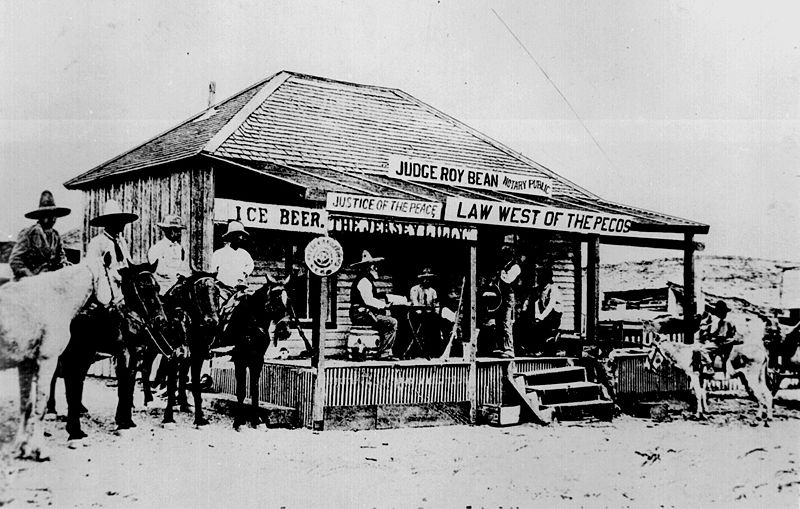
That larger-than-life Old West character, Roy Bean, a so-called hanging judge who hardly ever hung anyone, owned a Texas saloon with an usual display case. From a report in the September 27, 1885 Brooklyn Daily Eagle, which was originally published in the Philadelphia Times:

“This is an eating station on the Southern Pacific railroad, and stands well out on the great Prison plain, about midway between El Paso and Del Rio. Old Roy Bean, who formerly dispensed frontier justice of a decidedly original and peculiar kind while acting as a magistrate at Murderville during the building of the railroad, owns the eating privilege at Sanderson and the liquid refreshing business connected therein.

"I suggested to old Roy that it would be a good idea to pull out their teeth, and he kindly gave me permission to operate on them dentally."

In the large glass case in the rear of the saloon he has caged more concentrated venom than can be found anywhere outside of a poison factory. First on the list is a family of centipedes, consisting of a giant nearly ten inches in length, the old fellow’s son and daughter and a numerous progeny of babies. The centipede is not a pretty insect. Once I thought of them as no use, but after seeing a lot of little Chiricahua Indian papooses pulling centipedes from their holes and greedily devouring them, legs, poison and all, I no longer doubted the wisdom and beneficence of their creation. In the course of my checkered career I have had several adventures with centipedes, and always came out second best. A centipede can raise a blister on a man’s body quicker than a red hot iron. If you don’t immediately apply a remedial poultice of pounded prickly pear and dose yourself inwardly with post whisky–the latter is warranted to kill anything but an army mule–the resultant effects may be serious. Centipedes usually attack their victim at night when he is asleep and can’t defend himself. They are armed with about two hundred little lances conveniently lashed to the toe of each foot–of which they have several–and at the base of each lance is a tiny sack of venom. If a centipede crawls across your body, which he’ll most likely do if you lie down anywhere within half a mile of him–you’ll have no difficulty in following his trail, and you’ll remember his visit for weeks. No man ever died from the bite of a centipede, but I have known one to make a man wish he were dead.

"They were about the size of a common saucer, and were as hairy as Esau."

In the cage adjoining that occupied by the centipedes was a den of tarantulas, whose scientific name is lycosa. The den contained two lycosas, but whether they were brother and sister, mother and daughter, father and son, or husband and wife, I am unable to declare. They were about the size of a common saucer, and were as hairy as Esau. Their mouths were blood red, and they each had four red teeth, which from time to time they snapped viciously. I was bitten by a tarantula once, and I felt thankful that these two were caged. I suggested to old Roy that it would be a good idea to pull out their teeth, and he kindly gave me permission to operate on them dentally. I declined. The tarantula is an exaggerated spider, with teeth and hair. They are always ready for a fight, and will tackle anything, not excluding a buzz saw. In days gone by I have often amused myself by teasing one with a red hot coal, and never surrender until they were burned to a crisp. I never heard of anything eating a tarantula. If one bites you, use the same remedies as prescribed for centipede sting, only more so.”

Tags:

Eleanor Roosevelt for Good Luck Margarine, in 1959.

Tags:

« Older entries § Newer entries »