Urban Studies

You are currently browsing the archive for the Urban Studies category.

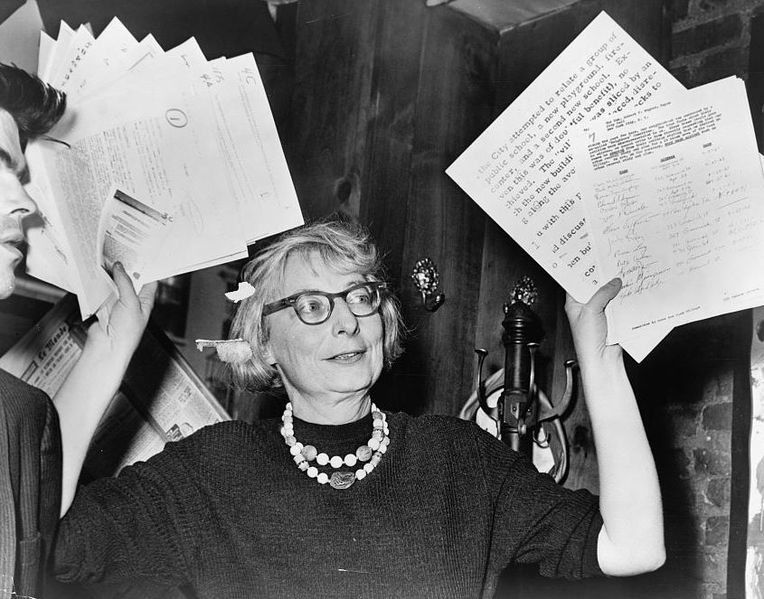
Jane Jacobs saw patterns in the disorder, benevolence in so-called blight, sublimity in street life, angels in the anarchic, and she was (thankfully) a huge pain in the ass until others could see the same. The opening of her landmark 1958 Fortune story, “Downtown Is for People“:

“This year is going to be a critical one for the future of the city. All over the country civic leaders and planners are preparing a series of redevelopment projects that will set the character of the center of our cities for generations to come. Great tracts, many blocks wide, are being razed; only a few cities have their new downtown projects already under construction; but almost every big city is getting ready to build, and the plans will soon be set.

What will the projects look like? They will be spacious, parklike, and uncrowded. They will feature long green vistas. They will be stable and symmetrical and orderly. They will be clean, impressive, and monumental. They will have all the attributes of a well-kept, dignified cemetery. And each project will look very much like the next one: the Golden Gateway office and apartment center planned for San Francisco; the Civic Center for New Orleans; the Lower Hill auditorium and apartment project for Pittsburgh; the Convention Center for Cleveland; the Quality Hill offices and apartments for Kansas City; the downtown scheme for Little Rock; the Capitol Hill project for Nashville. From city to city the architects’ sketches conjure up the same dreary scene; here is no hint of individuality or whim or surprise, no hint that here is a city with a tradition and flavor all its own.

These projects will not revitalize downtown; they will deaden it.”

•••••••••••

“For the answer, we went to the lady over there,” 1969:

Tags:

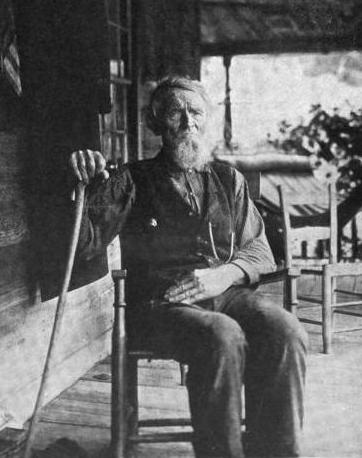
"He was not the fearless bully of old, but a much broken stoop shouldered and crazy old man."

An item about the physical and mental decline of a bullying man in East Tennessee, which was originally published in the Louisville Courier-Journal, appeared in the January 9, 1887 edition of the Brooklyn Daily Eagle. An excerpt from the piece, which is more tall tale than journalism:

“The mountain bully is not unlike his kind met with elsewhere, except in his habits, which are instinctively formed by circumstances and surroundings. He abounds in large numbers throughout the East Tennessee mountains, and generally makes his headquarters about the Summer resorts, country stores, elections, shooting matches and wherever there is a crowd gathered. He is always ‘spilling’ for a fight and frequently gets his satisfaction, usually from some quiet dispositioned person who ‘hain’t much to say.’ The mountain bully gets about half full, goes to a shooting match, chews tobacco, blows about his conquests and his ability to lick the best man in the State, runs upon a ‘say nothin’ sort of feller,’ who puts a head on him and an end to his bragadocio talk. 

A few years ago there died in a mountain county in East Tennessee a man who was a noted bully. He was a splendid specimen of physical manhood and was in every respect a fighting bully. He would fight at the drop of the hat and could knock out a half dozen ordinary men in one round. He would fight for the fun of it, and he who would dare cross his path was indeed a reckless man. In the old days of State militia and ‘musters’ he was a prominent man in his neighborhood and colonel of a militia regiment. On muster days, when the drill was over, he would proceed to clean up the regiment. When he shed his coat, twisted his huge fist around a few times, and yelled at the top of his voice: ‘Hide out, little ‘uns, I’m a comin’,’ there would be a general stampede. This was how he came to be called ‘Old Hide Out’ in after years.
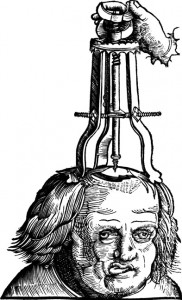
"He rushed into the midst of the Federal soldiers, putting them to flight, not, however, without receiving a serious wound in the head."

When the late war came on he joined a Confederate regiment and made a brave, fearless soldier. During a slight skirmish his company had with the Federals down in Georgia, he took his gun by the muzzle end, with his old time watchword, ‘Hide out, little ‘uns, I’m a comin’!’ rushed into the midst of the Federal soldiers, putting them to flight, not, however, without receiving a serious wound in the head, which put him into the hospital for months and permanently injured his mind.

When he returned to his native county he was not the fearless bully of old, but a much broken stoop shouldered and crazy old man. He would stroll through the neighborhood aimlessly, and seeming unconscious of his whereabouts, always muttering to himself as he went, ‘Hide out, little ‘uns, I’m a comin’.’ Little boys and girls would make sport of him, and ‘Old Hide Out,’ as they called him, paid no heed of their mockery. He had become perfectly harmless.

At last the old man became mortally ill. He was alone in a little cabin provided for his use by an old comrade in the army. A few friends who had known him in his better days gathered around his humble couch expecting the end. It was now late in the afternoon, and the old fellow had not spoken for days. He was rapidly sinking, and some one remarked that he would go down with the sun, which was then pouring its last rays through the chinks and crevices of the cabin wall. Just then his face seemed to lighten up, his eyes twinkled, and he opened his lips.

‘Hide out, little ‘uns, I’m a com–‘

But he never completed his sentence. He had gone.”
"Will I cheat on him while in Germany? Honestly yes."

advice please? (madhattan)

Okay so my boyfriend and I are both coke heads. He is 20 years older than me. Jewish. I have German heritage and am going to Germany with a girlfriend of mine. She is paying for everything. So he says if I go were finished. Then he talks about the Holocaust..like all Germans are happy about that. Anyways now he threatened her to me and it wasn’t pretty. He is kinda crazy but so am I! Will I cheat on him while in Germany? Honestly yes. I am definitely a free spirit. By the way my bf is married! He also shoots heroin and coke. I hate it when he does that because he turns into a paranoid mess! Great huh? What do you think of this? Oh he also has been pressuring me to have sex with him without a condom!! I’ll never do it believe me. 

In 1967, William F. Buckley welcomed beaded LSD guru Timothy Leary, who later became mortal enemies with Art Linkletter.

Tags: ,

There was a theory during Web 1.0, when possibilities seemed infinite, that in the near term the majority of workers would either telecommute or plop down in offices that had communal desks. Why would anyone need to be anchored when the Internet had connected us virtually and set us free? More people certainly telecommute today and many offices have far more democratic architecture, though anonymous desks still aren’t the norm.

But what if the thing that liberated us made us more anchored in other ways? What if being so connected means that our impetus to shift our material lives for new stimuli and opportunities has diminished? In an otherwise interesting Opinion article by Victoria and Todd G. Bucholz in the New York Times about the rising number of young Americans remaining moored in their home states–a trend that’s been increasing since before the recessesion–too little attention is paid to the role new media has played in reducing relocation in the U.S. I would assume a significant percent of that demographic change has to be assigned to technology: More money is spent on tablets, less on motorcycyles. At any rate, here’s an excerpt from the essay:

“The likelihood of 20-somethings moving to another state has dropped well over 40 percent since the 1980s, according to calculations based on Census Bureau data. The stuck-at-home mentality hits college-educated Americans as well as those without high school degrees. According to the Pew Research Center, the proportion of young adults living at home nearly doubled between 1980 and 2008, before the Great Recession hit. Even bicycle sales are lower now than they were in 2000. Today’s generation is literally going nowhere. This is the Occupy movement we should really be worried about.”

Tags:

Helen Keller meets Martha Graham, 1954.

Tags: ,

"He raised snapdragons and sweet peas."

While the United States acted with incredible bravery during World War II, one grievous mistake we made was the internment of Japanese-Americans, who were considered suspect merely because we were at war with the land of their ancestry. One such family forced to relocate from their home and community into a camp was the Mochidas of Hayward, California, seen in the above classic photograph, which was taken by the great Dorothea Lange. The original caption:

“Members of the Mochida family awaiting evacuation bus. Identification tags are used to aid in keeping the family unit intact during all phases of evacuation. Mochida operated a nursery and five greenhouses on a two-acre site in Eden Township. He raised snapdragons and sweet peas. Evacuees of Japanese ancestry will be housed in War Relocation Authority centers for the duration.”

••••••••••

Tags: ,

Very cool clip. William F. Buckley, Jr. welcomes filmmaker Otto Preminger in 1967, for a discussion about censorship.

Tags: ,

The opening of “Who Would God Vote For?” a blog post about the intersection of religion and politics in America and Iran that began in earnest in the 1970s, by the BBC’s always provocative Adam Curtis:

“When you bring God into politics very strange things happen. You can see this now in both America and Iran –  in their elections and also in the growing confrontation between them. But it wasn’t always like this – in fact for most of the 20th century fundamentalist religion in both America and Iran had turned its back on the world of politics and power.

But in the 1970s everything changed. For that was the moment when religion was deliberately brought into politics in both countries with the aim of using it as a revolutionary force. And those who did this – Khomeini in Iran, and right-wing activists in America – were inspired by the revolutionary theories and organisations of the left and their ambition to transform society in a radical way.

I want to tell the forgotten story of how this happened – and how in the 1980s both the Americans and the Iranian idealists came together in a very odd way – with disastrous consequences.”

Tags: ,

Sleazy, yes, but I need the traffic.

"The black car threw a baby at me." (Image by T bone.)

In my dream there were a lot of things that transpired.

At first I was in this house, there were two rooms. One was my room and there was a woman in the other. For some reason, it was very odd, I kept going to her bed. It wasn’t for sex. I wasn’t looking for sex. I don’t know if she was ill or what it was but something was the matter.

Then all of the sudden, I looked out the window and there was my mother…. next to this house. I felt safe with her next to me.

Then I walked down to this house that I knew had a problem. And it was a problem that limited my life and I wanted it gone and out and never returning.. So, I went to this black car and started swiping at it because it would not go away and it was throwing things at me.

I was swiping (knocking it out of my way) everything that it was throwing at me… it was so strange. Now this scared me to death. As I was swiping at this black car because it was throwing shit at me, all of the sudden, the black car threw a baby at me. I didn’t see that it was a baby until after I had swiped it… it was like debris coming from a shit storm.

I was frightened. The black car threw a baby at me, but at the time, I didn’t know it. When the baby landed on the ground, it was dead. The black car killed his own baby.

After that experience, I was so frightened. I went over to the baby to see if it was alive. He had killed it. I left because I was frightened and I didn’t know what to do… It was like collateral damage to the black car. Oh well. To me, I just wanted to get out of there and away from that mess.

I left the situation and went right. I walked up to this one area that would not let me get to where I needed to be.

To get to where I needed to be, I had to get past a pole of cement blocks. I remember in the dream, I was focusing on two cement blocks that were causing the most trouble, they were at the top of the pole. So what did I do, I climbed up the cement blocks and reached the top. I was in a very deep, flat area, but after getting past the cement blocks I reached the top.

After reaching the top, I started walking up this incline. I saw in the distance houses. I was walking towards the houses. Off to the side, there were these two women that were at the back door talking to someone. Then all of the sudden, they started coming at me. One woman followed the other woman as they were coming at me. They were both going down the incline. Their words to me as they past by were, “his pants are up and he is packed”. They said it like they were mad at me. They were coming at me and going down the incline. It was like what they were trying to do, they had no control of anymore. They had one last opportunity to come at me and then they were going down the incline to the bottom.

They were in the past and I was looking towards my future.

I climbed past them. It didn’t matter what they gained it was all just superficial blocks that could not stop me. I got to the top of them and they were left behind no longer affecting my life. They were the ones trying to keep me in a low place, but by my sheer tenacity, I was able to overcome them.

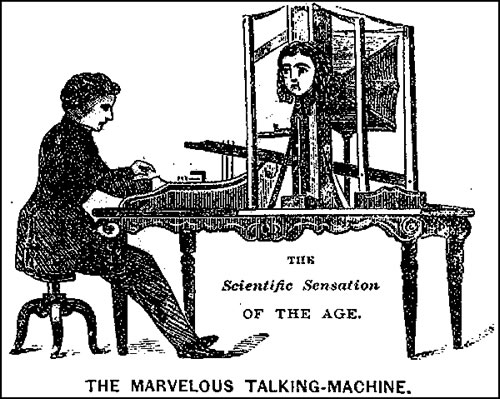
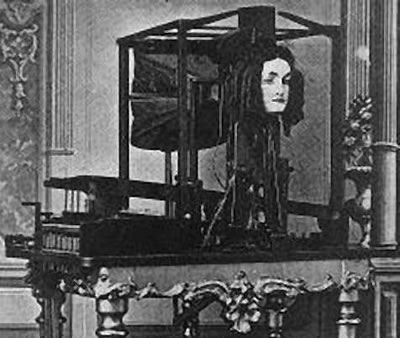
Nearly 170 years before Siri, German inventor Joseph Faber demonstrated his Talking Machine, most commonly known as “Euphonia,” which was able to speak sentences in a human if monotone voice. The marvel became a staple of Barnum’s shows, but Faber died without much to his name in the 1860s and his wife–and his contraption–fared just as poorly. Two brief articles follow about the inventor and his machine from the Brooklyn Daily Eagle.

••••••••••

“Talking Machines” (October 15, 1870): “Some readers may remember Professor Faber’s automaton speaking figure, called THE EUPHONIA, when exhibited in London. It was a draped bust with a wax face. Concealed from the visitors were sixteen keys or levers, a small pair of bellows, and numerous little bits of metal, wood, and India-rubber. When any word or sentence was spoken out, either by Faber or by one of the sudience, the exhibitor mentally divided all the syllables into as many distinct sounds as they embodied; he pressed upon a particular key for each particular sound, which admitted a blast of air to a particular compartment, in which the mechanism was of the kind to produce the sound required; there were thus as many pressures as there were elementary sounds. By a modification of the movements, whispering could be produced instead of speaking.”

••••••••••

“The Talking Machine Was There” (July 24, 1887): “Mrs. Mary Faber, the wife of Professor Faber, who had traveled around the country for years with his talking machine, took Paris green yesterday at 207 East Twenty-Fifth Street, New York. When the police were about to take her from the room Mrs. Faber recovered consciousness for a moment and, pointing to a satchel, declared that the talking machine was there. She wanted it sold to pay the rent. She will probably die.”

Tags: ,

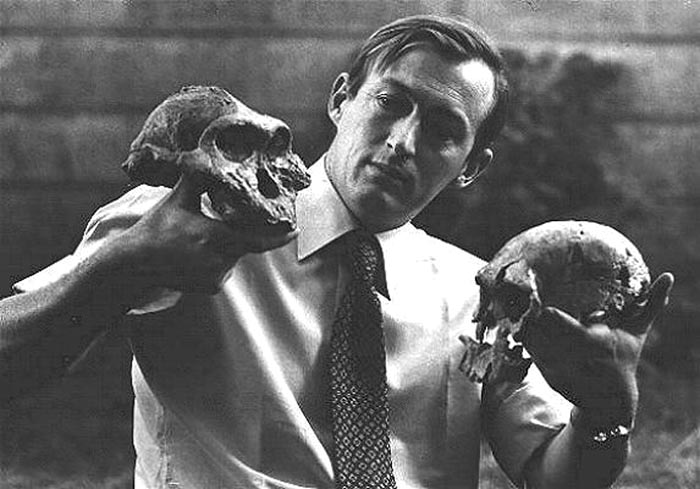
From “The Last Famine,” Paul Salopek’s sweeping Foreign Policy piece on hunger, a contemporary portrait of legendary paleoanthropologist Richard Leakey:

“The Turkana Basin is a freakishly beautiful place. A gargantuan wilderness of hot wind and thorn stubble, it covers all of northwestern Kenya and spills into neighboring Uganda, Ethiopia, and South Sudan. Black volcanoes knuckle up from its pale-ocher horizons. Lake Turkana — the largest alkaline lake in the world, 150 miles long — pools improbably in its arid heart. The lake is sometimes referred to, romantically, as the Jade Sea; from the air, its brackish waters appear a bad shade of green, like tarnished brass. Turkana, Pokot, Gabra, Daasanach, and other cattle nomads eke out a marginal existence around its shores. The basin’s dry sediments, which form part of the Great Rift Valley, hold a dazzling array of hominid remains. Because of this, the Turkana badlands are considered one of the cradles of our species.

Richard and Meave Leakey, the scions of the eminent Kenyan fossil-hunting family, have been probing deep history here for 45 years. Their oldest discovery, a pre-human skull, about 4 million years old, was found on a 1994 expedition led by Meave. An earlier dig headed by Richard uncovered a fabulous, nearly intact skeleton of Homo ergaster, dating back 1.6 million years, dubbed the Turkana Boy. Both Leakeys told me the modern landscape had changed nearly beyond recognition since their excavations began in the 1960s. The influx of food aid and better medical services had more than tripled the human population and stripped the region of most of its wild meat, wiping out the local buffalo, giraffe, and zebra. Domestic livestock — exploding and then crashing with successive droughts — had scalped the savannas’ fragile grasses. While driving one day near his headquarters, the Turkana Basin Institute, Richard pointed at a dusty cargo truck, its bed piled high with illegally cut wood. ‘Charcoal for the Somali refugee camps,” he said with a puckish smile. ‘The U.N. pays for it.’

Leakey is not only a celebrity thinker. He is also an incorrigible provocateur and a man of big and restless ambitions. Bored with the squabbles of academic research (‘I could never go back to measuring one tooth against another’), he abandoned the summit of paleoanthropology in the late 1980s to assume the directorship of Kenya’s enfeebled wildlife service, where he became a hero to conservationists by ordering elephant poachers shot on sight. A few years later, he helped organize Kenya’s first serious opposition party, and those activities invited years of police harassment. (A 1993 plane crash, which Leakey blames on sabotage, resulted in the loss of both his legs below the knee; he now gets around — driving Land Rovers, piloting planes — on artificial feet.) At one point, I asked him about heavy bandages on his head and hands at a recent lecture at New York’s Museum of Natural History. He had been suffering from skin cancers, he explained, that metastasized from old police-baton injuries. Leakey tends to view humankind through a very long lens, and pessimistically.”

••••••••••

Two Richards, Leakey and Dawkins:


Tags: , ,

From a list of urban innovations at the Next Web, a section about using pedestrian energy to illuminate streetlights:

“Think about all the energy expended by pedestrians walking down the street. What if it could be harnessed to power street lighting? The Viha concept involves an electro-active slab with a lower portion that is embedded in the floor, and a mobile upper part that can produce energy.

While it won’t be able to replace power stations, this solution is designed to produce enough energy for use in the immediate vicinity, thus taking strain off the power grid and reducing the power bill of the local authority. In particularly crowded areas, this would work well.”

••••••••••

The Viha concept in practice:

On International Women’s Day, here’s a 1973 John Chancellor report about the “Battle of the Sexes” tennis match between Billie Jean King and Bobby Riggs, which was hokey as a sporting event but used pitch-perfect hoopla on an Ali scale to become a huge national attraction. King triumphed in the Astrodome in straight sets: 6-4, 6-3, 6-3.

Tags: , ,

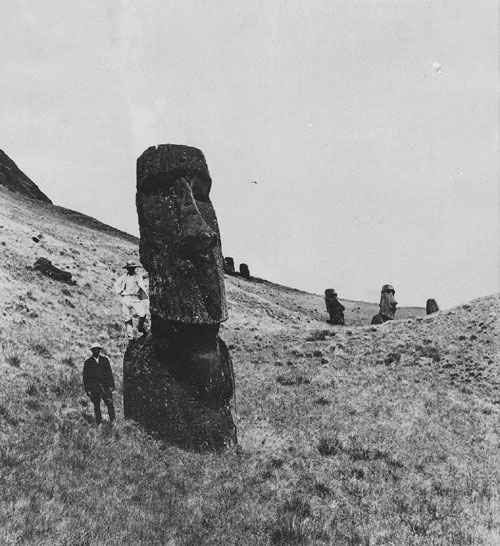
In his new Atlantic piece, “We’re Underestimating the Risk of Human Extinction,” Ross Andersen conducts a smart interview with Oxford’s Professor Nick Bostrom about the possibility of a global Easter Island, in which all of humanity vanishes from Earth. The conversation focuses on the threats we face not from our stars but from ourselves. I think Bostrom’s attitude is too dire, but he only has to be right once, of course. An excerpt:

What technology, or potential technology, worries you the most?

Bostrom: Well, I can mention a few. In the nearer term I think various developments in biotechnology and synthetic biology are quite disconcerting. We are gaining the ability to create designer pathogens and there are these blueprints of various disease organisms that are in the public domain—you can download the gene sequence for smallpox or the 1918 flu virus from the Internet. So far the ordinary person will only have a digital representation of it on their computer screen, but we’re also developing better and better DNA synthesis machines, which are machines that can take one of these digital blueprints as an input, and then print out the actual RNA string or DNA string. Soon they will become powerful enough that they can actually print out these kinds of viruses. So already there you have a kind of predictable risk, and then once you can start modifying these organisms in certain kinds of ways, there is a whole additional frontier of danger that you can foresee.

In the longer run, I think artificial intelligence—once it gains human and then superhuman capabilities—will present us with a major risk area. There are also different kinds of population control that worry me, things like surveillance and psychological manipulation pharmaceuticals.”

Read also:

Tags: ,

"After two bites Miller was taken violently ill."

From the December 26, 1886 Brooklyn Daily Eagle:

“Ten days before Mann, the Minneapolis quail eater, started in on his task to eat thirty birds in thirty days for a bet of $1,000, Charles Miller commenced the same business on another wager. Yesterday Miller attacked his twenty-eighth bird. He had been complaining for the past five days that he could not sleep at night and that he seemed to have a load of stones on his chest. He felt well when he sat down to his quail, ate a little bread and butter and potatoes, and then attacked the bird. After two bites Miller was taken violently ill, vomiting and being unable to go on with the task. A hack was sent for at once, and he was taken to a doctor’s and from thence to his home. No serious results are looked for, and he will probably be alright in a day or two. Mann ate his eighteenth quail last night, and is still feeling well.”

Tags: ,

"There's only one Fidel."

Fidel in Central Park (nyc)

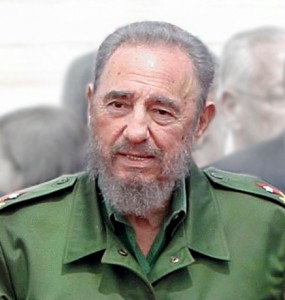
I saw Fidel again last night in Central Park. Under an elm he was with three men who guarded hiim sitting in a wheelchair. It was him. There’s only one Fidel.

Fidel a compatriot of Bloomberg?

What’s goin on here?

Tags:

In his two years coaching the erstwhile laughingstock New York Knicks in the late ’80s, the forward thinking Rick Pitino had his young and athletic players operate a full-court press on every play. It didn’t make them an NBA champion, but it maximized the talent at hand and earned the team its first division title in two decades. Years later, Malcolm Gladwell published “How David Beats Goliath” in the New Yorker, making a convincing case that this strategy was sound and should be employed more. But conventional wisdom is hard to shake so no one has ever tried it again, and current Knicks coach Mike D’Antoni has taken a lot of flak for his similarly aggressive “Seven Seconds or Less” offensive scheme

I wonder if a young and athletic NFL team should use similar aggression. You couldn’t blitz on every play because offenses are too proficient and rules are stacked in favor of scoring, But how about this for a team that went 2-14 last year: Never punt from anywhere outside your own 35-yard line. Never kick field goals inside the other team’s 35 except during the last two minutes of a game when it would give you the lead. 

It’s unlikely we’d ever see such an experiment in a league were most coaches get flustered by basic time management, but a gradual shift to using four downs much better is possible. From Brian Burke’s smart Slate piece on the topic:

“There are many doubters when it comes to four-down football. If you’re in that camp, indulge me in a quick thought experiment. Let’s imagine a football world where the punt and field goal had never been invented. (Sorry, Ray Guy and Jan Stenerud.) In this universe, there would be no second-guessing: Teams would go for it on every fourth down.

Then one day, some smart guy invents the punt and approaches a head coach with his new idea. ‘Hey coach,’ he’d say, ‘instead of trying for a first down every time, let’s voluntarily give the ball to the other team.’ Our coach would be incredulous at this suggestion. ‘You want me to give up 25 percent of our precious downs for just 35 yards of field position? Do you have any idea how difficult it would be for us to score?’ And the coach would be right.

Since that’s not how the game evolved, our thinking about fourth-down strategy is a lot different. But as the sport has changed, with offense securing a firm upper hand over defense, coaches need to rethink their fourth-down orthodoxy. Accounting for interceptions, teams netted around 3.5 yards per pass attempt in 1977, back when many of today’s head coaches were playing and learning the sport. In the modern game, teams are almost twice as productive when they throw the ball, netting close to six yards per passing attempt. As it gets easier for offenses to move down the field, possession (and maintaining possession by going for it on fourth down) becomes more important and field position becomes less important.”

See also:

Tags:

The Handroid has potential for creating better prosthetics and for the remote handling of dangerous materials. By the good people at ITK. (Thanks Singularity Hub.)

In the Atlantic, celebrity scientist Neil deGrasse Tyson discusses his new book about America’s foundering space program. An excerpt:

You write that space exploration is a ‘necessity.’ Why do you think others don’t agree?

I don’t think they’ve thought it through. Most people who don’t agree say, ‘We have problems here on Earth. Let’s focus on them.’ Well, we are focusing on them. The budget of social programs in the federal tax base is 50 times greater for social programs than it is for NASA. We’re already focused in ways that many people who are NASA naysayers would rather it become. NASA is getting half a penny on a dollar — I’m saying let’s double it. A penny on a dollar would be enough to have a real Mars mission in the near future.

Can the United States catch up in the 21st-century space race?

When everyone agrees to a single solution and a single plan, there’s nothing more efficient in the world than an efficient democracy. But unfortunately the opposite is also true, there’s nothing less efficient in the world than an inefficient democracy. That’s when dictatorships and other sort of autocratic societies can pass you by while you’re bickering over one thing or another.

But, I can tell you that when everything aligns, this is a nation where people are inventing the future every day. And that future is brought to you by scientists, engineers, and technologists. That’s how I’ve always viewed it. Once people understand that, I don’t see why they wouldn’t say, ‘Sure, let’s double NASA’s budget to an entire penny on a dollar! And by the way, here’s my other 25 pennies for social programs.’ I think it’s possible and I think it can happen, but people need to stop thinking that NASA is some kind of luxury project that can be done on disposable income that we happen to have left over. That’s like letting your seed corn rot in the storage basin.”

Tags:

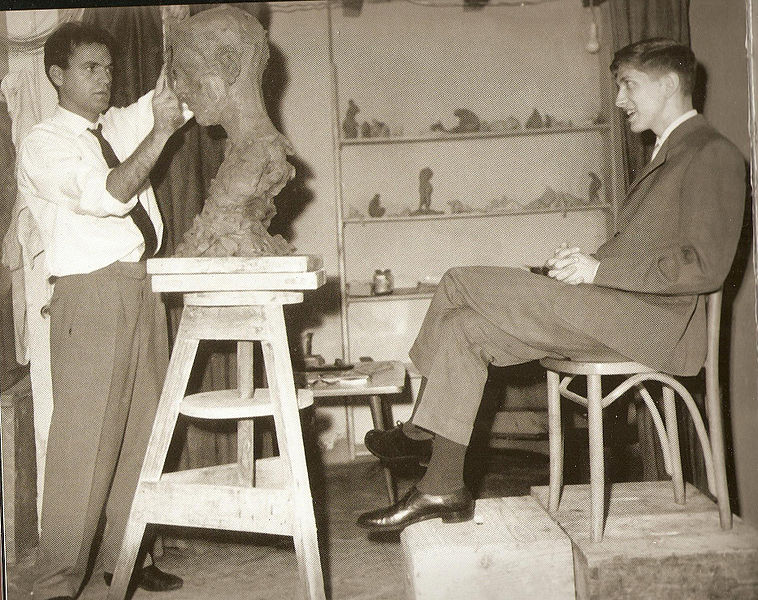
Fischer, Yugoslavia, 1961.

Long before anyone knew that the earth beneath his feet would shake ever more violently with time, chess champion Bobby Fischer seemed like an eccentric winner–though definitely a winner. The paranoid accusations and erratic mood swings, however, weren’t merely gamesmanship or arrogance but harbingers of a serious mental illness that would eventually manifest itself in antisemitism and derangement. The opening of Brad Darrach’s 1971 Life profile, “Bobby Is a Ferocious Winner,” at a time when he was still considered combustible by nature rather than condemned by it:

“Angry voices rattles the door to Bobby Fischer’s hotel room as I raised my hand to knock. ‘Goddamnit, I’m sick of it!’ I heard Bobby shouting. ‘I’m sick of seeing people! I got to work, I got to rest! Why didn’t you ask me before you set up all those appointments? To hell with them!’ Then I heard the mild and dignified executive director of the U.S. Chess Federation addressing the man who may well be the greatest chess player in world history in a tone just slightly lower than a yell: ‘Bobby, ever since we came to Buenos Aires I’ve done nothing but take care of you, day and night. You ungrateful—-!’

It was 3 p.m., a bit early for Fischer to be up. Ten minutes later, finding the hall silent. I risked a knock and Fischer cracked the door. ‘Oh yeah, the guy from Life. Come on in.’ His smile was broad and boyish but his eyes were wary. Tall, wide and flat, with a head too small for his big body, he put me in mind of a pale transhuman sculpture by Henry Moore. I had seen him twice before but never so tired.

Just inside the door I stopped short. The room looked like a terminal moraine of bachelorhood. Bedclothes in tortured piles on the floor. Socks, underwear, bags, newspapers, magazines jumbled on the spare bed. Boxes stacked all over the couch, and on the floor between the beds a single graceful banana peel. The only clean place in the room was a small table by the window, where a set of handsome wooden chessmen had been set up for play. Serenely beautiful, an altar in the debris of battle.”


Tags: ,

The Rev. Dr. Billy Graham appears on What’s My Line?, 1960.

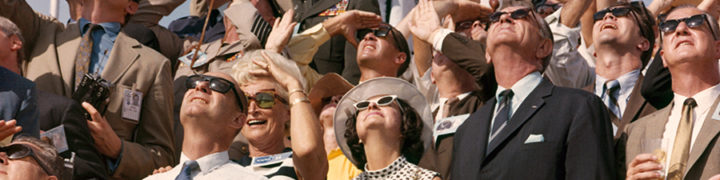
LBJ attends Graham crusade at the Astrodome, 1965:

Tags:

The opening of the new Economist article, “Computing with Soup,” which examines the medical benefits of using DNA-laced liquid instead of silicon chips:

“EVER since the advent of the integrated circuit in the 1960s, computing has been synonymous with chips of solid silicon. But some researchers have been taking an alternative approach: building liquid computers using DNA and its cousin RNA, the naturally occurring nucleic-acid molecules that encode genetic information inside cells. Rather than encoding ones and zeroes into high and low voltages that switch transistors on and off, the idea is to use high and low concentrations of these molecules to propagate signals through a kind of computational soup. 

Computing with nucleic acids is much slower than using transistors. Unlike silicon chips, however, DNA-based computers could be made small enough to operate inside cells and control their activity. ‘If you can programme events at a molecular level in cells, you can cure or kill cells which are sick or in trouble and leave the other ones intact. You cannot do this with electronics,’ says Luca Cardelli of Microsoft’s research centre in Cambridge, England, where the software giant is developing tools for designing molecular circuits.” (Thanks Browser.)

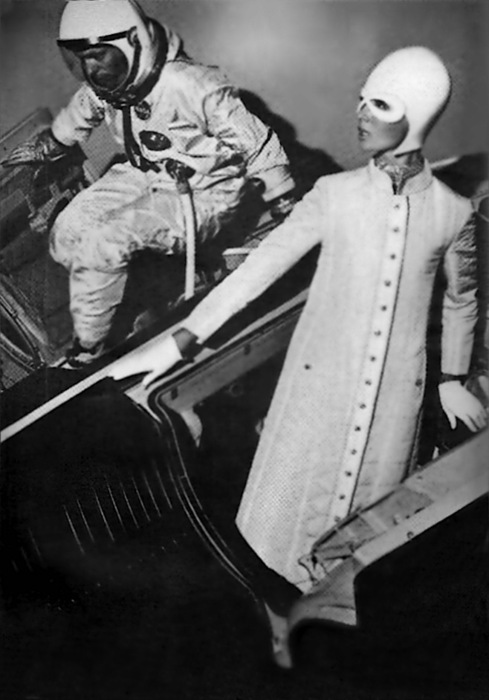
The designer as visionary in 1970, at the conclusion of the Space Race.

Tags:

« Older entries § Newer entries »