Science/Tech

You are currently browsing the archive for the Science/Tech category.

About the engineering of self-destroying species, from New Scientist:

“IN THE urban jungle of Juazeiro in Brazil, an army is being unleashed. It is an army like no other: the soldiers’ mission is to copulate rather than fight. But they are harbingers of death, not love. Their children appear healthy at first but die just before they reach adulthood, struck down by the killer genes their fathers passed on to them.

These soldiers are the first of a new kind of creature – ‘autocidal’ maniacs genetically modified to wipe out their own kind without harming other creatures. The first animals being targeted with these ‘living pesticides’ are disease-carrying mosquitoes and crop-munching caterpillars, but the approach should work with just about any animal – from invasive fish and frogs to rats and rabbits. If it is successful, it could transform the way we think about genetically engineered animals.”

Why build a skyscraper or shopping mall in a developing country when you can put up a small private city? That’s the thinking of Russia’s Renaissance Partners, which is currently building an insta-city in Kenya and has announced plans for another in the Congo. A note about the massive projects from the Moscow Times:

“The investment unit of Renaissance Group plans to build a 2,600-hectare city in the Democratic Republic of Congo as it seeks to benefit from Africa’s urbanization.

Renaissance Partners is working on a master plan for the new urban center after securing land outside Lubumbashi, the country’s second-largest city, Arnold Meyer, Renaissance Partners’ managing director for real estate in Africa, said in London.

‘The West has peaked in terms of economic growth and the new markets are in Africa,’ Meyer said. ‘And the main drivers of this growth in Africa are going to be cities.

Renaissance’s Lubumbashi project will be more than double the size of Tatu City, the $5 billion center that the firm is building from scratch outside the Kenyan capital of Nairobi.” (Thanks Marginal Revolution.)

••••••••••

“The city will be called Tatu”:

Hart, left, 2006 (Image by Marcello.)

E-books pioneer Michael Hart, who began Project Gutenberg back in 1971, just passed away. From his New York Times obituary:

“Michael Hart, who was widely credited with creating the first e-book when he typed the Declaration of Independence into a computer on July 4, 1971, and in so doing laid the foundations for Project Gutenberg, the oldest and largest digital library, was found dead on Tuesday at his home in Urbana, Ill. He was 64

His death was confirmed by Gregory B. Newby, the chief executive and director of Project Gutenberg, who said that the cause had not yet been determined.

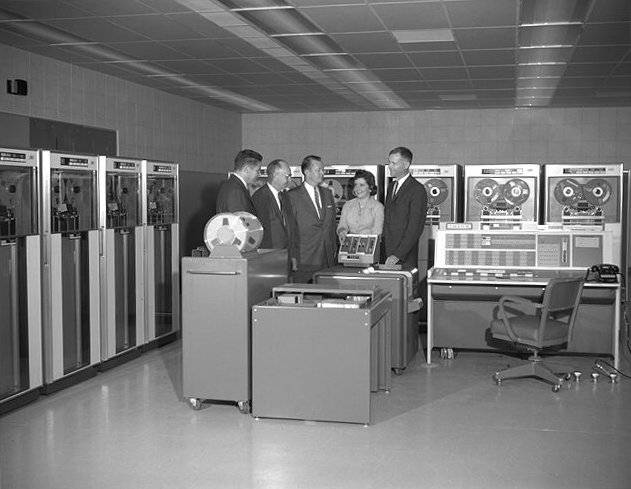
Mr. Hart found his life’s mission when the University of Illinois, where he was a student, gave him a user’s account on a Xerox Sigma V mainframe computerat the school’s Materials Research Lab.

Estimating that the computer time in his possession was worth $100 million, Mr. Hart began thinking of a project that might justify that figure. Data processing, the principal application of computers at the time, did not capture his imagination. Information sharing did.”

Tags:

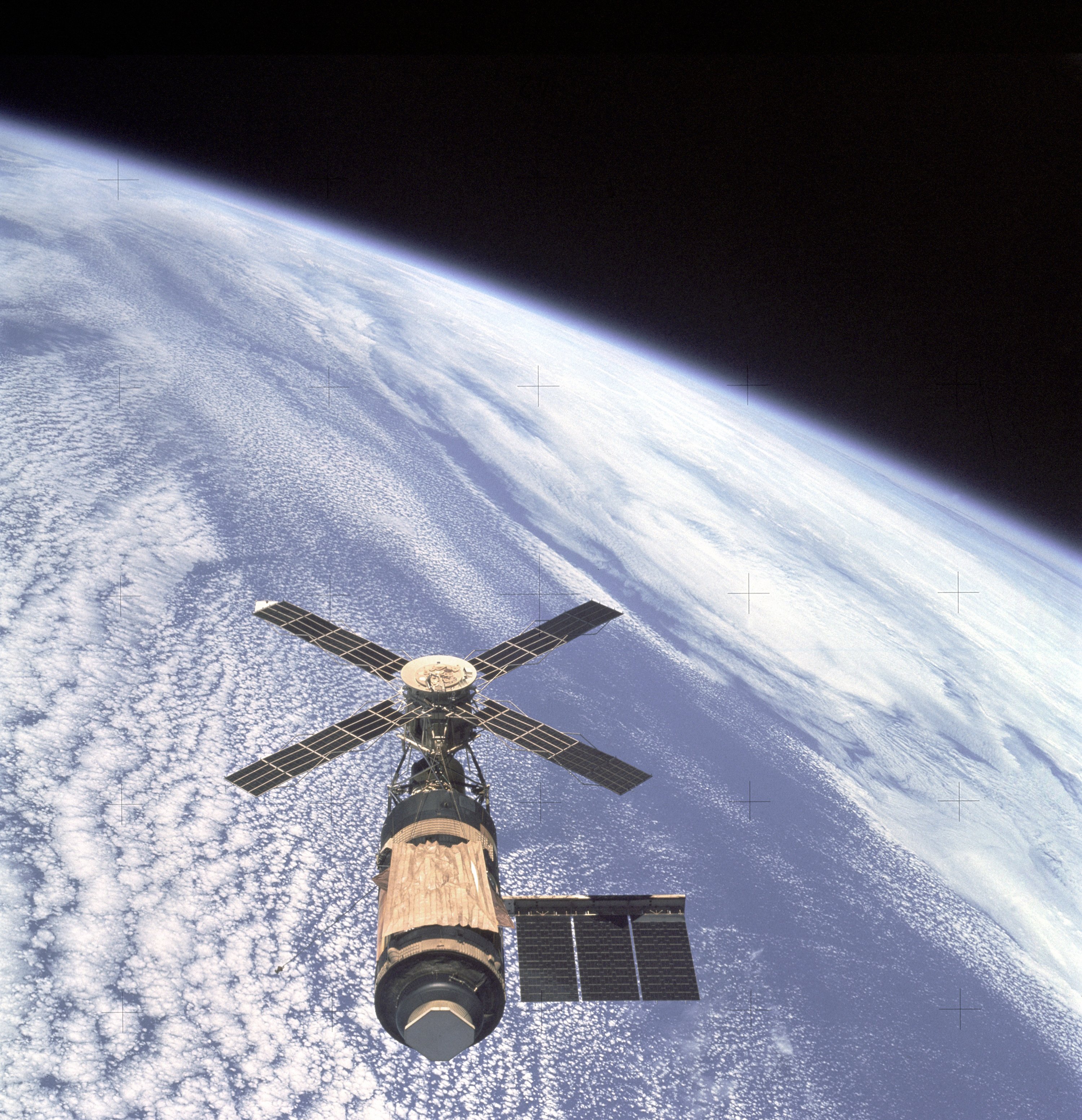
This classic 1974 NASA photograph shows the Skylab Orbital Workshop in its final orbit before returning to Earth. Skylab became a sensation of sorts behind closed doors in Washington because the astronauts photographed the super-secretive Area 51 (also known as “Groom Lake”), even though they had been ordered not to. Once the mission was complete, there was a scrum among various agencies for control of the photos (which were never released). Dwayne A. Day revealed the brouhaha in 2006 for the Space Review. An excerpt:

“Far out in the Nevada desert, miles from prying eyes, is a secret Air Force facility that has been known by numerous names over the years. It has been called Paradise Ranch, Watertown Strip, Area 51, Dreamland, and Groom Lake. Groom is probably the most mythologized real location that few people have ever seen. According to people with overactive imaginations, it is where the United States government keeps dead aliens, clones them, and reverse-engineers their spacecraft. It is also where NASA filmed the faked Moon landings.

However, for humans whose feet rest on solid ground, Groom is the site of highly secret aircraft development. It is where the U-2 spyplane, the Mach 3 Blackbird, and the F-117 stealth fighter were all developed. It has also probably hosted its own fleet of captured, stolen, or clandestinely acquired Soviet and Russian aircraft. Because of this, the United States government has gone to extraordinary lengths to preserve the area’s secrecy and to prevent people from seeing it.

This secrecy was threatened in early 1974 when the astronauts on Skylab pointed their camera out the window and took pictures of a facility that did not officially exist. They returned to Earth and their photographs quickly became a headache for NASA, the CIA, and the Department of Defense.”

••••••••••

“It had been a successful mission”:

Tags:

GPS and the End of the Road is Ari N. Schulman’s New Atlantis article about how the technological boom has resulted in a revolution in navigation. Of course, while we know better where we’re headed, other people also know where we’re headed. And reliance on GPS likely diminishes our ability to naturally navigate, making it one more step in the direction of cars that drive themselves. An excerpt:

“If each successive era has closed an old realm of exploration while opening up another, then what are we to make of the innovations in navigational technologies that have just gotten underway in earnest over the last ten years? The rise of digital mapping and the Global Positioning System (GPS) has seemed to come upon us almost as a matter of course, blended in with the general dawning of the digital age, and on its own relatively unremarked — but it has in a blink ushered in the greatest revolution in navigation since the map and compass.

The conception of GPS by the U.S. military began in the 1960s. Satellites with extremely precise onboard clocks constantly send out packets of information containing the time and coordinate at which they were sent; navigation devices here below receive the signal and calculate the transit time and distance. By combining information from several satellites, an accurate and precise coordinate for the navigation device can be calculated. In 1983, a navigational error sent Korean Air Lines Flight 007 into restricted Soviet airspace, where it was shot down, killing all 269 people aboard; subsequently, President Reagan directed that GPS be opened up for civilian use once it had been fully implemented. This occurred in the early 1990s, when a network of satellites was put in place.” (Thanks Longform.)

••••••••••

GPS, with Snoop Dogg:

Tags:

Hexagonal ADAPTIV panels make military vehicles invisible. From the good people at BAE Systems. (Thanks Discovery.)

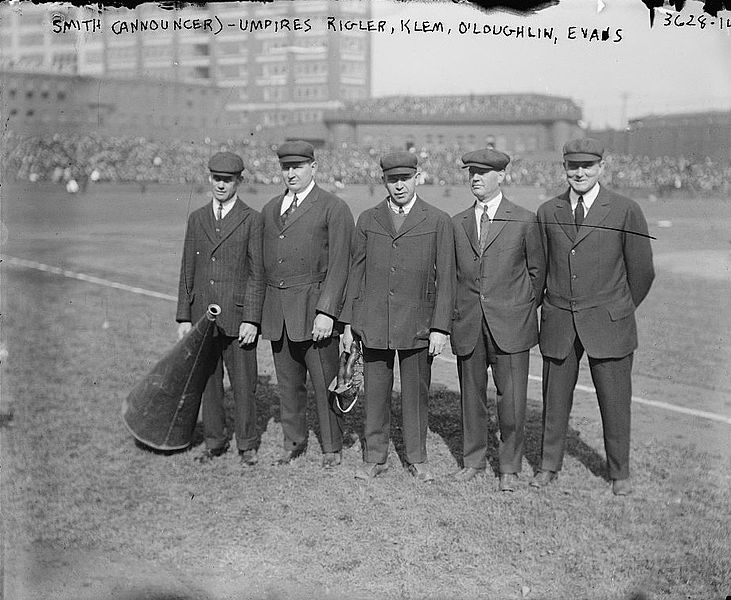
Baseball umpires, 1915.

Umpiring baseball apparently comes with a degree of ethnic bias, as millions of pitch calls were analyzed and umpires displayed a persistent tendency to call pitches more favorably for members of their own ethnic group. Considering how few African-American baseball players there currently are and the lack of Latin American umpires, I wonder if that sample size had an effect on the study. An excerpt from an article on Ars Technica by John Timmer:

“Several studies have shown that sporting officials have a tendency to exhibit subtle biases in favor of members of their own ethnic group, So, an umpire that’s white might be expected to favor a white pitcher, giving him more favorable calls when pitches are at the edge of the strike zone. This sort of bias might be expected to be subtle, but the research has the sort of statistical power that comes from large numbers: a record of over 3.5 million pitches, and what their outcomes were. (Here, the authors turned to ESPN.com for a pitch-by-pitch record of the game to match up with their computer data.)

After eliminating things like foul balls, swinging strikes, and intentional balls, the authors still had a very impressive collection of data to work with: 1.9 million pitches in which the umpires made a decision. Then came the real drudge work. Using sources such as About.com and web searches, the authors pieced together the ethnic origins of all the major league players and umpires involved. And then they started crunching numbers. And what they found was a subtle bias that went away when the umpires thought someone was watching them.”

••••••••••

Earl Weaver goes apeshit:

Tags:

Has the rise of the machines made widespread enployment in America a thing of the past? That’s the question Douglas Rushkoff asks at the CNN site. An excerpt:

“New technologies are wreaking havoc on employment figures — from EZpasses ousting toll collectors to Google-controlled self-driving automobiles rendering taxicab drivers obsolete. Every new computer program is basically doing some task that a person used to do. But the computer usually does it faster, more accurately, for less money, and without any health insurance costs.

We like to believe that the appropriate response is to train humans for higher level work. Instead of collecting tolls, the trained worker will fix and program toll-collecting robots. But it never really works out that way, since not as many people are needed to make the robots as the robots replace.

And so the president goes on television telling us that the big issue of our time is jobs, jobs, jobs — as if the reason to build high-speed rails and fix bridges is to put people back to work. But it seems to me there’s something backwards in that logic. I find myself wondering if we may be accepting a premise that deserves to be questioned.

I am afraid to even ask this, but since when is unemployment really a problem? I understand we all want paychecks — or at least money. We want food, shelter, clothing, and all the things that money buys us. But do we all really want jobs?

We’re living in an economy where productivity is no longer the goal, employment is. That’s because, on a very fundamental level, we have pretty much everything we need. America is productive enough that it could probably shelter, feed, educate, and even provide health care for its entire population with just a fraction of us actually working.”

••••••••••

“All with the push of a button”:

Tags:

Misphonia is a condition which causes the sufferer to feel rage and panic when they hear mouth sounds, like those caused by eating and drinking. It can be socially isolating, of course. From a New York Times article about the affliction by Joyce Cohen:

“He believes the condition is hard-wired, like right- or left-handedness, and is probably not an auditory disorder but a ‘physiological abnormality’ that resides in brain structures activated by processed sound.

There is ‘no known effective treatment,’ Dr. Moller said. Patients often go from doctor to doctor, searching in vain for help.

Dr. Johnson agreed. ‘These people have been diagnosed with a lot of different things: phobic disorders, obsessive-compulsive disorder, bipolar, manic, anxiety disorders,’ she said.

Dr. Johnson’s interest was piqued when she saw her first case in 1997. ‘This is not voluntary,’ she said. ‘Usually they cry a lot because they’ve been told they can control this if they want to. This is not their fault. They didn’t ask for it and they didn’t make it up.’ And as adults, they ‘don’t outgrow it,’ she said. ‘They structure their lives around it.’

Taylor Benson, a 19-year-old sophomore at Creighton University in Omaha, says many mouth noises, along with sniffling and gum chewing, make her chest tighten and her heart pound. She finds herself clenching her fists and glaring at the person making the sound.

‘This condition has caused me to lose friends and has caused numerous fights,’ she said.” (Thanks Marginal Revolution.)

Tags:

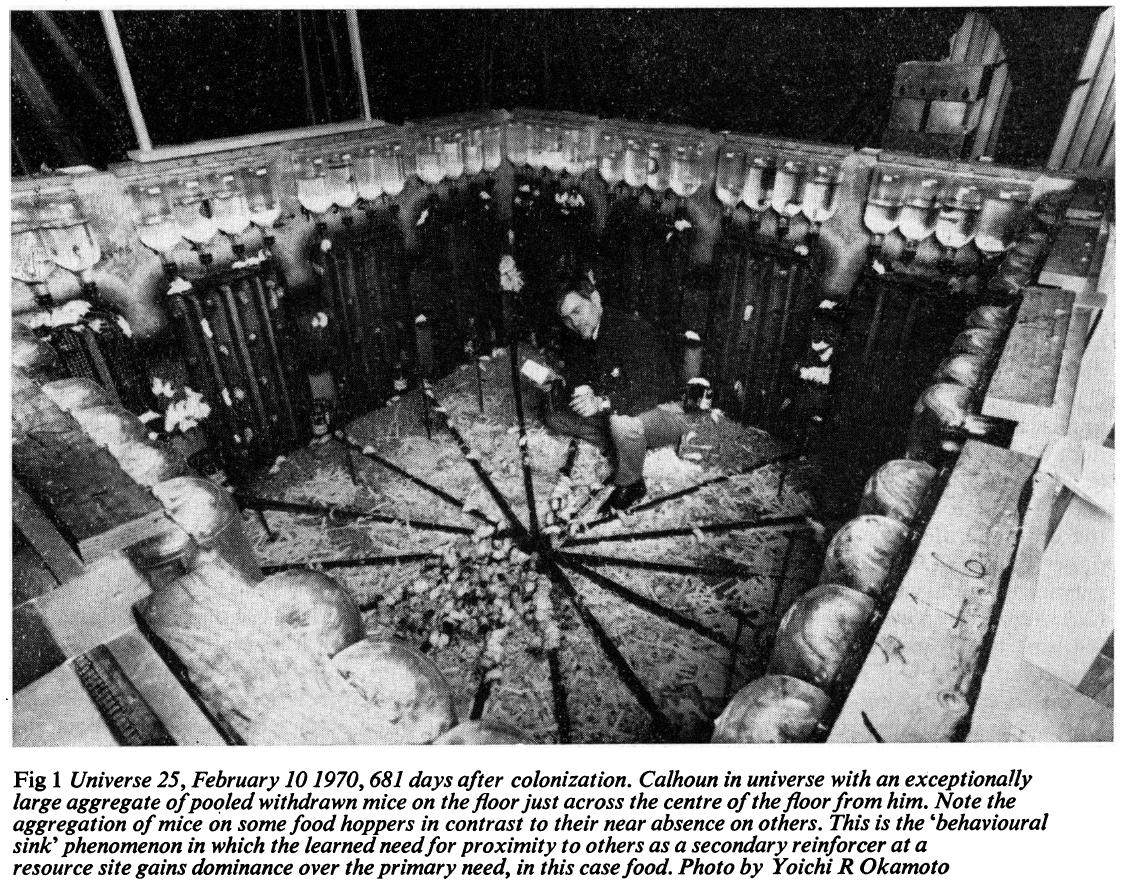
In Cabinet, Will Wiles recalls the work of John B. Calhoun, a scientist who used rodents to study the effects of overpopulation. Despite Malthusian hand-wringing, population density seems to be a good thing overall for humans. An excerpt:

“So what exactly happened in Universe 25? Past day 315, population growth slowed. More than six hundred mice now lived in Universe 25, constantly rubbing shoulders on their way up and down the stairwells to eat, drink, and sleep. Mice found themselves born into a world that was more crowded every day, and there were far more mice than meaningful social roles. With more and more peers to defend against, males found it difficult and stressful to defend their territory, so they abandoned the activity. Normal social discourse within the mouse community broke down, and with it the ability of mice to form social bonds. The failures and dropouts congregated in large groups in the middle of the enclosure, their listless withdrawal occasionally interrupted by spasms and waves of pointless violence. The victims of these random attacks became attackers. Left on their own in nests subject to invasion, nursing females attacked their own young. Procreation slumped, infant abandonment and mortality soared. Lone females retreated to isolated nesting boxes on penthouse levels. Other males, a group Calhoun termed ‘the beautiful ones,’ never sought sex and never fought—they just ate, slept, and groomed, wrapped in narcissistic introspection. Elsewhere, cannibalism, pansexualism, and violence became endemic. Mouse society had collapsed.” (Thanks Longreads.)

••••••••••

Ratsploitation, 1972:

Tags: ,

The advent of cashless transactions, 1969.

Jacqueline Mroz has an interesting article in the New York Times about a single sperm donor siring 150 children. Having so many kids from the same sperm donor living in close proximity to one another causes complications, as you might expect. An excerpt: 

“As more women choose to have babies on their own, and the number of children born through artificial insemination increases, outsize groups of donor siblings are starting to appear. While Ms. Daily’s group is among the largest, many others comprising 50 or more half siblings are cropping up on Web sites and in chat groups, where sperm donors are tagged with unique identifying numbers.

Now, there is growing concern among parents, donors and medical experts about potential negative consequences of having so many children fathered by the same donors, including the possibility that genes for rare diseases could be spread more widely through the population. Some experts are even calling attention to the increased odds of accidental incest between half sisters and half brothers, who often live close to one another.

‘My daughter knows her donor’s number for this very reason,’ said the mother of a teenager conceived via sperm donation in California who asked that her name be withheld to protect her daughter’s privacy. ‘She’s been in school with numerous kids who were born through donors. She’s had crushes on boys who are donor children. It’s become part of sex education’ for her.”

Tags:

Margaret Mead commenting on speeded-up America in Life in 1968, remarks that seem even more applicable in our time:

“There is tremendous confusion today about change. This isn’t surprising because people are living in a period of the fastest change the world has ever known. Young people have been confronted with the changes, but at the same time they have no sense of history and no one has been able to explain to them what has happened. We are always very poor at teaching the last 25 years of history. Adults have been shrieking about the fact that great newnesses are here but they are not talking about what the newnesses are.”

••••••••••

“Trance And Dance In Bali,” by Margaret Mead and Gregory Bateson, 1939:

Tags:

Steve Jobs was wary of technology in the classroom when he was asked about the topic in 1993, and now schools decked out with the latest tech teaching tools are so far seeing stagnant test scores. Are our measurements of educational growth lacking and passé or is the problem with our schools (and ourselves) something that can’t be remedied by bytes and bots? An excerpt from a piece on the topic by Matt Richtel in the New York Times:

“CHANDLER, Ariz. — Amy Furman, a seventh-grade English teacher here, roams among 31 students sitting at their desks or in clumps on the floor. They’re studying Shakespeare’s As You Like It — but not in any traditional way.

In this technology-centric classroom, students are bent over laptops, some blogging or building Facebook pages from the perspective of Shakespeare’s characters. One student compiles a song list from the Internet, picking a tune by the rapper Kanye West to express the emotions of Shakespeare’s lovelorn Silvius.

The class, and the Kyrene School District as a whole, offer what some see as a utopian vision of education’s future. Classrooms are decked out with laptops, big interactive screens and software that drills students on every basic subject. Under a ballot initiative approved in 2005, the district has invested roughly $33 million in such technologies.”

••••••••••

A computer in a British school in 1969:

Tags: ,

Good piece by Jonathan Newton in the Washington Post about the arm operation known as Tommy John Surgery. The procedure, created by Dr. Frank Jobe, was first performed in 1974 on the pitcher for whom it was named. The article gets to the heart of just how experimental the ligament-reconstruction procedure was when John went under the knife, and explains what changes to the operation have reduced risk. An excerpt:

“When Jobe operated, he sliced John’s elbow wide open and moved the ulnar nerve in order to reach the bone. He took a tendon from a cadaver’s leg and attached it with screws. Then he hoped John’s body would react favorably and the tendon would serve the same role as the ligament.

‘We didn’t really know whether we could do it or not,’ Jobe said. ‘We didn’t know whether we could heal it or not. We didn’t know whether a tendon would be accepted by the body and receive blood supply and become part of the body.’

Jobe and John waited. John did not throw a ball again for 16 weeks. Jobe decided he should not pitch in a major league game again until one year of rigorous rehab. Every step of the way, the recovery unfolded as Jobe hoped. John returned in 1974, and in seven of the next eight seasons he threw more than 200 innings.

‘I would never have thought it would happen,’ Jobe said. ‘I didn’t do it again for another two years. After another year or so, I had a couple successes. I thought, This may be something we ought to use a little more routinely.”

••••••••••

Elton John (no relation) performs at Dodger Stadium in 1975, the year Tommy John couldn’t pitch for L.A. as he recuperated from surgery:

Tags: , ,

Michael Crichton’s prophetic 1978 genre picture foresaw an America with a small number of haves and many have-nots, and the ethical problems that could develop in a land of such disparate levels of wealth and so many emergent technologies. Adapted from a novel by Robin Cook, the Queens-born doctor who’s turned out a slew of medical thrillers, the film version of Coma was perhaps most famous in its day for its feminist hero, Dr. Susan Wheeler, played by Geneviève Bujold, but it now makes its mark most prominently in ways that cross gender lines.

Boston Medical is a wealthy and prestigious hospital with a sterling reputation, as it seems no one has yet noticed that a higher-than-average number of young, healthy patients have signed in for mundane operations to remove appendixes or repair knees and have flatlined on the operating table. Dr. Wheeler certainly notices when her best friend is added to the growing list of the comatose, and she starts poking around the hospital for answers even though everyone, even her fellow doctor and boyfriend (Michael Douglas), believes she’s hysterical. As Wheeler follows the trail of corpses from the hospital to the nearby Jefferson Institute, a cutting edge facility where those healthy bodies with dead brains are kept pristine-but for what purpose?–she is sure that the “accidents” in O.R. are no mistake.

As Wheeler tries to sort through the welter of lies, she meets Jeffeson Institute attendant Mrs. Emerson (Elizabeth Ashley), who pointedly tells her, “I have no supervisor.” Emerson isn’t just talking about herself but about the ability of the powerful to prey on the weak in a society that clearly favors the former. There are certainly some hokey plot twists in Coma, as a few scenes were written to increase the action element at the expense of logic, but it’s still a powerful film instead of a dated one.

Bio-printers will be able to create perfect replacement organs in the future, so harvesting flesh, which actually still happens in developing countries, will eventually be a thing of the past. But does that mean our organs will be safe? Not exactly. What is ever more in play isn’t our organs themselves, but the information within one of them in particular–our brains. The nouveau tech corporations are aimed at locating and marking our personal preferences, tracking our interests and even our footsteps, knowing enough about what’s going on inside our heads to predict our next move. In a time of want and desperation and disparity of wealth, how much information will we surrender? It may be far less nefarious to read a mind than pluck a brain, but what we’re seeing now is probably just the beginning, as the profit motive is huge. To not pay attention to a line from Crichton’s film would mean we ourselves our in a collective coma: “We are dealing in an area of uncertainty, an area where there are no rules, contradictory laws and no clear social consensus as to what should be done.”•

Tags: , , ,

Atlanta-based PodPonics grows produce in shipping containers in urban environments. (Thanks Singularity Hub.)

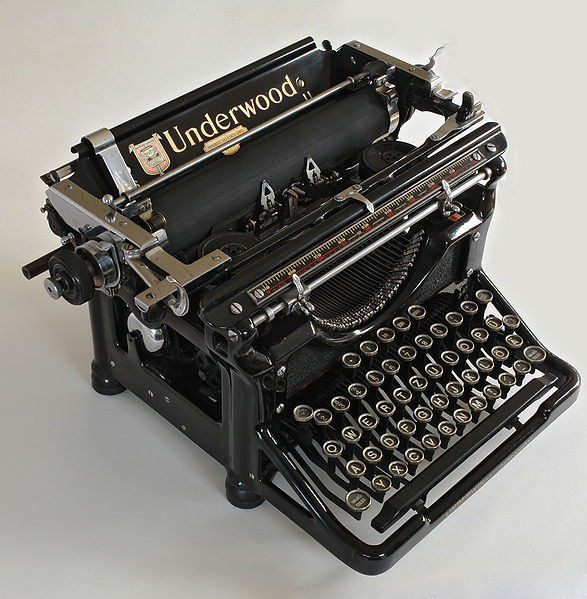
Rural areas of India lack electricty, so the typewriter remains a popular tool. From an article by Mark Magnier in the Los Angeles Times:

“It’s a stultifying afternoon outside the Delhi District Court as Arun Yadav slides a sheet of paper into his decades-old Remington and revs up his daily 30-word-a-minute tap dance.

Nearby, hundreds of other workers clatter away on manual typewriters amid a sea of broken chairs and wobbly tables as the occasional wildlife thumps on the leaky tin roof above.

‘Sometimes the monkeys steal the affidavits,’ Yadav said. ‘That can be a real nuisance.’

The factories that make the machines may be going silent, but India’s typewriter culture remains defiantly alive, fighting on bravely against that omnipresent upstart, the computer.”

Tags: ,

Eye-scanning on a massive scale is currently being carried out in India, in efforts to have permanent records of poor people. From a report in the New York Times by:Lydia Polgreen:

“KALDARI, India — Ankaji Bhai Gangar, a 49-year-old subsistence farmer, stood in line in this remote village until, for the first time in his life, he squinted into the soft glow of a computer screen.

His name, year of birth and address were recorded. A worker guided Mr. Gangar’s rough fingers to the glowing green surface of a scanner to record his fingerprints. He peered into an iris scanner shaped like binoculars that captured the unique patterns of his eyes.

With that, Mr. Gangar would be assigned a 12-digit number, the first official proof that he exists. He can use the number, along with a thumbprint, to identify himself anywhere in the country. It will allow him to gain access to welfare benefits, open a bank account or get a cellphone far from his home village, something that is still impossible for many people in India.”

Tags: ,

William Gibson describes discovering personal computers, via The Paris Review:

“I was walking around Vancouver, aware of that need, and I remember walking past a video arcade, which was a new sort of business at that time, and seeing kids playing those old-fashioned console-style plywood video games. The games had a very primitive graphic representation of space and perspective. Some of them didn’t even have perspective but were yearning toward perspective and dimensionality. Even in this very primitive form, the kids who were playing them were so physically involved, it seemed to me that what they wanted was to be inside the games, within the notional space of the machine. The real world had disappeared for them—it had completely lost its importance. They were in that notional space, and the machine in front of them was the brave new world.

The only computers I’d ever seen in those days were things the size of the side of a barn. And then one day, I walked by a bus stop and there was an Apple poster. The poster was a photograph of a businessman’s jacketed, neatly cuffed arm holding a life-size representation of a real-life computer that was not much bigger than a laptop is today. Everyone is going to have one of these, I thought, and everyone is going to want to live inside them. And somehow I knew that the notional space behind all of the computer screens would be one single universe.”


Tags:

A 1968 segment from the British science and tech show, Tomorrow’s World, which looks at how Pink Floyd’s “improvised” light show  was created.

"The chief subjects we wish to elucidate concern the brain and the nerves."

Even in the 19th century, conducting medical experiments on criminals was generally frowned upon. But not by everyone, as evidenced by an article from the October 21, 1886 edition of the Brooklyn Daily Eagle, which was originally published in the Chicago Journal. An excerpt:

“In a conversation that I had recently with a prominent Chicago physician, he was bemoaning the prejudice that existed against vivisection autopsies, and all the means by which the medical profession acquires its knowledge of the human body and its skill in relieving human suffering. ‘What we need now,’ he said, ‘is a legal enactment turning over criminals convicted of heinous capital offenses to the medical fraternity for experimentation on the vital forces. Of course I never expect to see this done. The sentimentalists would rather see a million good people languish and die for want of medical skill than to see one cutthroat like Frank Rand subjected to surgical operations which would prove fatal. The truth is that this would be less liable to the charge of inhumanity than the vivisection of the lower animals. It would pain me exceedingly to have a dog subjected to torture, because the dog is an innocent and affectionate animal, whereas some of the men we now hang deserve a worse fate. Then, too, we would not have to keep up the practice for years. If there were only a law turning over the worst capital criminals of the year 1886 to us for the purpose, the benefit to suffering humanity could not be estimated. The chief subjects we wish to elucidate concern the brain and the nerves.”

Amazing futuristic Braniff Airlines ad, from 1968.

Jaron Lanier, who was profiled in the New Yorker not long ago, holds forth at Edge on human capital in the age of machines:

This brings us back, literally thousands of years to an ancient discussion that continues to this day about exactly how people can make a living, or make their way when technology gets better. There is an Aristotle quote about how when the looms can operates themselves, all men will be free. That seems like a reasonable thing to say, a precocious thing for somebody to have said in ancient times. If we zoom forward to the 19th century, we had a tremendous amount of concern about this question of how people would make their way when the machines got good. In fact, much of our modern intellectual world started off as people’s rhetorical postures on this very question.

Marxism, the whole idea of the left, which still dominates the Bay Area where this interview is taking place, was exactly, precisely about this question. This is what Marx was thinking about, and in fact, you can read Marx and it sometimes weirdly reads likes a Silicon Valley rhetoric. It’s the strangest thing; all about ‘boundaries falling internationally,’ and ‘labor and markets opening up,’ and all these things. It’s the weirdest thing.

In fact, I had the strange experience years ago, listening to some rhetoric on the radio … it was KPFA, in fact, the lefty station … and I thought, ‘Oh, God, it’s one of these Silicon startups with their rhetoric about how they’re going to bring down market barriers,’ and it turned out to be an anniversary reading of Das Kapital. The language was similar enough that one could make the mistake.

The origin of science fiction was exactly in this same area of concern. H.G. Wells’ The Time Machine foresees a future in which there are the privileged few who benefit from the machines, and then there are the rest who don’t, and both of them become undignified, lesser creatures. Separate species.•


H.G. Wells meets Orson Welles in San Antonio (audio only):

Tags: , ,

Ellington Air Force Base, Houston, Texas, June, 1966.

This classic 1966 NASA photo shows Apollo 1 astronauts Edward White, Roger B. Chaffee and Virgil Grissom training to exit from their craft. Yup, they floated in a swimming pool at the Ellington Air Force Base in Houston, Texas. It wasn’t exactly a perfect simulation of what they’d be facing during the actual egress at the end of a real mission, even if they encountered the best of circumstances. But the best wasn’t what they encountered. A cabin fire during a launch-pad test in January of 1967 killed all three men and no American astronaut would by blasted into space for another 20 months while NASA scientists worked their way through the variety of errors that led to the disaster.

••••••••••

White, Chaffee and Grissom in 1966: “There’s always the possibility you have a catastrophic failure.”

Tags: , , ,

« Older entries § Newer entries »