The year 2001: A Space Odyssey was released and a year before Apollo 11 landed on the moon, Stanley Kubrick was asked during a Playboy Interview what he thought we would find on the surface of our natural satellite. An excerpt:
“Playboy: What do you think we’ll find on the moon?
Kubrick: I think the most exciting prospect about the Moon is that if alien races have ever visited Earth in the remote past and left artifacts for man to discover in the future, they probably chose the airless lunar vacuum, where no deterioration would take place and an object could exist for millennia. It would be inevitable that as man evolved technologically, he would reach his nearest satellite and the aliens would then expect him to find their calling card–perhaps a message of greeting, a cache of knowledge or simply a cosmic burglar alarm signaling that another race had mastered space flight. This, of course, was the central situation of 2001.”
••••••••••
“Universe,” Roman Kroitor and Colin Low’s 1960 short which informed 2001:
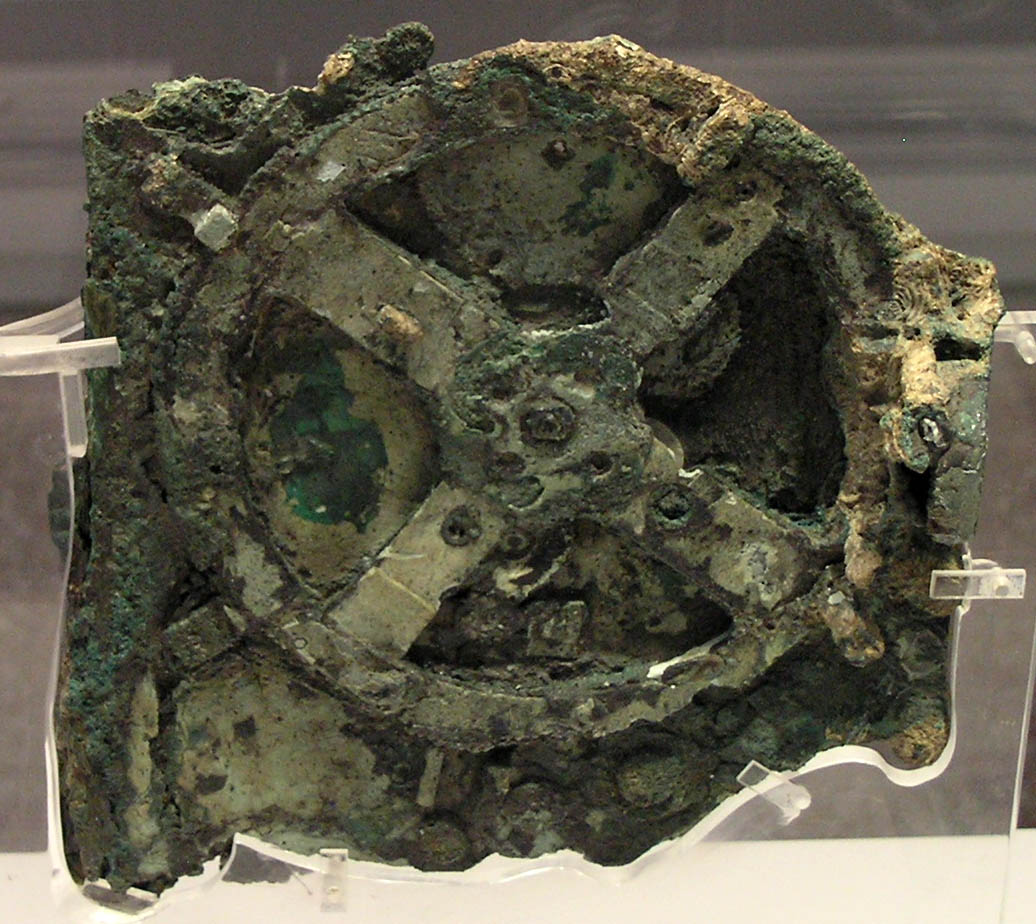
From “Fragmentary Knowledge,” John Seabrook’s 2008 New Yorker article about the Antikythera Mechanism, perhaps humankind’s first computer:
“Looking back over the first 50 years of research on the Mechanism, one is struck by the reluctance of modern investigators to credit the ancients with technological skill. The Greeks are thought to have possessed crude wooden gears, which were used to lift heavy building materials, haul up water, and hoist anchors, but historians do not generally credit them with possessing scientifically precise gears—gears cut from metal and arranged into complex ‘gear trains’ capable of carrying motion from one driveshaft to another.Paul Keyser, a software developer at IBM and the author of Greek Science of the Hellenistic Era, told me recently, ‘Those scholars who study the history of science tend to focus on science beginning with Copernicus and Galileo and Harvey, and often go so far as to assert that no such thing existed before.’ It’s almost as if we wished to reserve advanced technological accomplishment exclusively for ourselves. Our civilization, while too late to make the fundamental discoveries that the Greeks made in the sciences—Euclidean geometry, trigonometry, and the law of the lever, to name a few—has excelled at using those discoveries to make machines. These are the product and proof of our unique genius, and we’re reluctant to share our glory with previous civilizations.
In fact, there is evidence that earlier civilizations were much more technically adept than we imagine they were. As Peter James and Nick Thorpe point out inAncient Inventions,published in 1994, some ancient civilizations were aware of natural electric phenomena and the invisible powers of magnetism (though neither concept was understood). The Greeks had a tradition of great inventors, beginning with Archimedes of Syracuse (ca. 287–212 BC), who, in addition to his famous planetarium, is believed to have invented a terrible clawed device made up of large hooks, submerged in the sea, and attached by a cable to a terrestrial hoist; the device was capable of lifting the bow of a fully loaded warship into the air and smashing it down on the water—the Greeks reportedly used the weapon during the Roman siege of Syracuse around 212 BC. Philon of Byzantium (who lived around 200 BC) made a spring-driven catapult. Heron of Alexandria (who lived around the first century AD) was the most ingenious inventor of all. He described the basic principles of steam power and is said to have invented a steam-powered device in which escaping steam caused a sphere with two nozzles to rotate. He also made a mechanical slot machine, a water-powered organ, and machinery for temples and theaters, including automatic swinging doors. He is perhaps best remembered for his automatons—simulations of animals and men, cleverly engineered to sing, blow trumpets, and dance, among other lifelike actions.” (Thanks Electric Typewriter.)
A passage about the threats that attend our amazing scientific progress, from Wil S. Hylton’s New York Times Magazine article, “How Ready Are We For Bioterroism?“:
“The specter of a biological attack is difficult for almost anyone to imagine. It makes of the most mundane object, death: a doorknob, a handshake, a breath can become poison. Like a nuclear bomb, the biological weapon threatens such a spectacle of horror — skin boiling with smallpox pustules, eyes blackened with anthrax lesions, the rotting bodies of bubonic plagues — that it can seem the province of fantasy or nightmare or, worse, political manipulation. Yet biological weapons are as old as war itself. The ancient Hittites marched victims of plague into the cities of their enemies; Herodotus described archers’ firing arrows tipped with manure. By the 20th century, nearly every major nation developed, produced and in some cases used a panoply of biological weapons, including anthrax, plague, typhoid and glanders.
A decade after the 9/11 attacks, it is easy to forget the anthrax letters that sprang up just a few weeks later and to dismiss the fear that swept the country as a relic of a fragile moment that already belongs to history. But in the wake of those events, many national-security experts began to reconsider the risk of a biological attack — and reached some unsettling conclusions. Since the collapse of the Soviet Union, most scientists had assumed that the difficulty of building a bioweapon was far beyond the ability of a terror cell, but looking again in the early 21st century, many experts came to believe that advances in laboratory technology brought the science within reach. ‘What took me three weeks in a sophisticated laboratory in a top-tier medical school 20 years ago, with millions of dollars in equipment, can essentially be done by a relatively unsophisticated technician,’ Brett Giroir, a former director at the Defense Advanced Research Projects Agency (Darpa), told me recently. ‘A person at a graduate-school level has all the tools and technologies to implement a sophisticated program to create a bioweapon.'”
“PLAYBOY: When you say that young people are doing their own thinking and refusing to follow dogma, do you feel that this generation is fundamentally different from those that came before?
FULLER: Most assuredly. The masses of them are different. Let me go back to the reasons for this, because one of the most interesting discoveries I’ve made relates to it. When Malthus, as a young economist, began receiving his data at the start of the 19th Century, he was the first economist dealing with total data from the whole earth seen as a closed system. And he found that apparently, people were reproducing themselves more rapidly than they were producing food for themselves. Darwin followed, with his survival of the fittest, and these two compounded to justify the actions of the men I call the great pirates, the imperialists of that period, the elect, as they thought of themselves. Then Karl Marx came along, with the same jargon, assuming scarcity as a permanent condition and agreeing with the Darwin argument. And Marx said that the fittest among men was the worker, because the worker was closest to nature and knew how to cope with it. He knew how to cultivate and handle the chisel, and so forth, and the other people were parasites.
As late as 1815 in England, commoners caught killing a rabbit were often hanged on the spot without a trial; those animals belonged to the nobles and the king. These most powerful men ate the meat and the other people could make do with what was left over. And in their ignorance about what they should eat and what would give them nourishment, they let themselves get into a position where those who were powerful and ate well could rule by the sword. The proportion of nobles to the total population was so small that everybody assumed there must be some mystical reason they should have the best of it. And what was evident to everybody was that not only were the poor people illiterate and ill-clothed, and so forth, but they also seemed dumb.
Now, this was something that hurt me very much when I was a kid. I was brought up with this class thing, and I hated it and didn’t believe it was valid. But I couldn’t get over this thing that confronted me: Poor people seemed to be dumb. I worked with them and I loved them, but they were dumb. And Karl Marx accepted this. These people, while they were the fittest, gave in to the nobles out of dumbness, so Marx saw that people like that would need powerful rules if they were to be saved. If you’re going to pull the top down on society and your people are dumb, there have to be standards that everyone can recognize and follow, so you make a virtue of your dumbness and your coarseness and you live by strong rules. You wear your baggy and stupid clothes and make yourself proud of them.
A great many young people feel tremendously sympathetic with this idea these days, as I did at Harvard more than 50 years ago. You want to join with the underdog and therefore you wear his clothing and give up your standard of living. But this idea is becoming obsolete, however much it might appeal to the moral logic of young people. Because only in the past ten years have we finally had the first scientific proof – and now absolute scientific proof – that malnutrition during the child’s time in the womb and during the early years of life causes permanent brain damage. So this dumbness and coarseness factor that Mark built into his theory of class warfare is purely the damaged brain of malnutrition – something we now can eliminate by the kind of revolution that pulls the bottom up instead of pulling the top down.”
Scientist John McCarthy, who just passed away, coined the term “Artificial Intelligence” in 1955. From the BBC:
“Professor McCarthy is also credited with coining the term “Artificial Intelligence” in 1955 when he detailed plans for the first Dartmouth conference. The brainstorming sessions helped focus early AI research.
Prof McCarthy’s proposal for the event put forward the idea that “every aspect of learning or any other feature of intelligence can in principle be so precisely described that a machine can be made to simulate it”.
The conference, which took place in the summer of 1956, brought together experts in language, sensory input, learning machines and other fields to discuss the potential of information technology.”
Live ten-minute coverage of the total eclipse of the sun, 1979. Anchored by Frank Reynolds, with reports by anyone who could get unduly excited about a temporary absence of light.
It probably doesn’t matter if childrem have a low-tech or high-tech education provided their parents are interested and encouraging. But some employees of Silicon Valley’s biggest digital companies are opting to educate their own children sans computers. An excerpt from Matt Richtel’s New York Times article on the topic:
“While other schools in the region brag about their wired classrooms, the Waldorf school embraces a simple, retro look — blackboards with colorful chalk, bookshelves with encyclopedias, wooden desks filled with workbooks and No. 2 pencils.
On a recent Tuesday, Andie Eagle and her fifth-grade classmates refreshed their knitting skills, crisscrossing wooden needles around balls of yarn, making fabric swatches. It’s an activity the school says helps develop problem-solving, patterning, math skills and coordination. The long-term goal: make socks.
Down the hall, a teacher drilled third-graders on multiplication by asking them to pretend to turn their bodies into lightning bolts. She asked them a math problem — four times five — and, in unison, they shouted “20” and zapped their fingers at the number on the blackboard. A roomful of human calculators.”
••••••••••
Miss Crabtree didn’t need electronic gizmos to keep Chubbsy Ubbsy enrapt:
“The lunch with Jobs took place in a huge hangar-like restaurant—then-fashionable, now-defunct—called, I swear, ‘America.’ I had been doing a story about California surfer-styled ad man Jay Chiat, the one who devised the Apple’s turning-point ‘1984’ ad, depicting a lithe young woman hurling a hammer at a screen upon which an evil looking Big Brother-type was delivering a harangue. The ad captured—or created—the Apple ethos of rebellion against the tyranny of conformity.
Anyway Jobs was in town and he came to the lunch with Chiat, and after the introductions, he told me about how the blue box article had inspired him and Wozniak. How they’d taken down the cycles-per-second of the tones AT&T used to translate phone numbers into audio signals, some of which I’d disclosed in the article, and how they’d found the others in some obscure technical journals and had begun building their own blue boxes, hoping to sell them on the underground market. (Gamblers and mobsters liked to use them to keep their communications outside the system.)
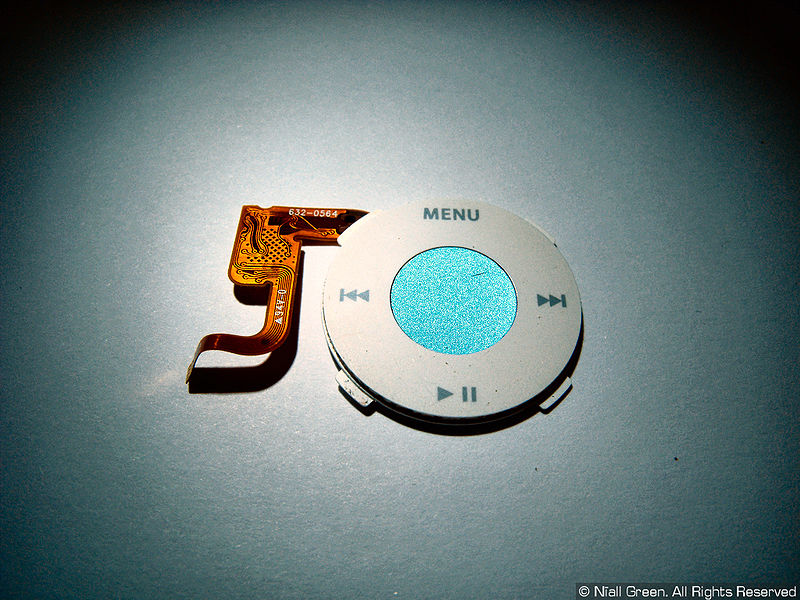
Even then, at that lunch, Jobs displayed his characteristic design sensibility when talking about these illicit gadgets. Some of the sleeker ones were about the size of cigarette pack, with silvery keyboard panels—not too different in appearance from the later iPod—and I remember his keen interest in what model, what design, I’d gotten hold of.
But he came across as a very level-headed guy, unpretentious even though his company was then blowing up big time. I remember being gratified at my story having some influence, and indeed I put Jobs’ revelation into the story about Chiat, but it was cut by an otherwise astute editor. Jobs just wasn’t that important then.”
Even though the word “meme” seems to have been invented during the Internet Age, Richard Dawkins actually coined the term–a truncated version of the ancient Greek word “mimeme,” which means “something repeated”–back in 1976. An excerpt from a 1995 Wired article by Michael Schrage about Dawkins:
“But even without futuristic morphing, Dawkins’s head holds more provocative ideas than most. Two decades ago, Dawkins presented a radical evolutionary perspective in a small book called The Selfish Gene, a disturbingly persuasive essay arguing that living things are little more than corporal vessels impelled to heed the primal dictates of selfish genes hellbent on their own replication and propagation. Much as the English philosopher and novelist Samuel Butler observed a century ago that a chicken is just a way an egg makes another egg, Dawkins proposed that we are nothing but expressions of our selfish genes in the process of making more selfish genes. Taking that idea even further, Dawkins proposed that genes themselves are expressions of particularly elegant code manipulating the world around it to its own reproductive end. He extended these notions into culture and described ideas as competing, self-replicating entities he called memes. Dawkins’s most recent book, River Out of Eden, extends his life’s work into a unified evolutionary theory arguing that all life, at its core, is a process of digital-information transfer.”
••••••••••
Dawkins in 2000 with semi-convincing male impersonator Rosie Charles:
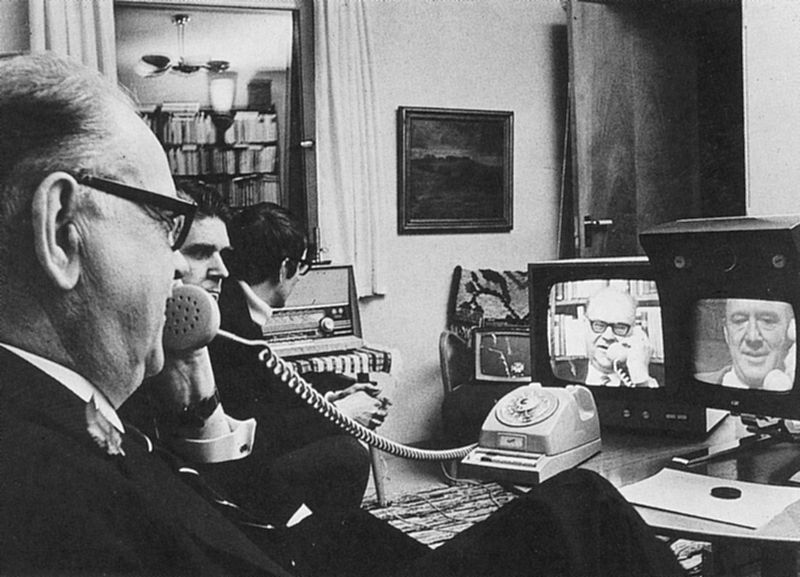
“Over the past decades, the promise of video as a standard form of communication has been presented to us through many mediums, from Star Trek to The Jetsons and even through my old Avengers comic books over 30 years ago. While corporations utilize video conferencing technology at a rapid rate, it hasn’t yet penetrated the daily habits of people across the globe but it will.
The core technology has been there for decades, but not the bandwidth and compression technology along with the hardware to make it an everyday utility. With the growth of Skype’s video chat, Google’s GTalk, Apple’s Facetime and other services, combined with the proliferation of smartphones and tablets, video will become the standard form of communications versus SMS, voice only and even email in some situations within a few years.”
In the European, science historian George Dyson, son of physicist Freeman Dyson, is interviewed about evolution and innovation. An excerpt from the Q&A:
“The European: Is the Internet increasing the innovative potential of mankind?
Dyson: It is very easy to be a pessimist: There is no good music anymore, no good art. But maybe we have to recognize that innovation is still happening, albeit in very different ways. We might feel that all that time people spend on Facebook is a great loss for the creativity of the human species, but maybe that is not true.
The European: I expected a somewhat different answer: We used to have only human intelligence, and now that has been supplemented by computational intelligence. So we would expect the potential for innovation to become supplemented as well.
Dyson: Yes and no. The danger is not that machines are advancing. The danger is that we are losing our intelligence if we rely on computers instead of our own minds. On a fundamental level, we have to ask ourselves: Do we need human intelligence? And what happens if we fail to exercise it?
The European: The question becomes: What progress is good progress?
Dyson: Right. How do we maintain our diversity? It would be a great shame to lose something like human intelligence that was developed at such costs over such a long period of time. I spent a lot of my life living in the wilderness and building kayaks. I believe that we need to protect our self-reliant individual intelligence—what you would need to survive in a hostile environment. Few of us are still living self-reliant lives. That is not necessarily a bad thing, but we should be cautious not to surrender into dependency on other forms of intelligence. I am a historian of science, I believe in preserving the past.
The European: Are there any predictions for the future we can make, based on these lessons from the past?
Dyson: The universe is a probability space in which possible things can happen. Over the last fifty years, we have developed a combined human-computational intelligence that is able to search that space at a tremendous rate. But we have no way to predict what might happen in the future to that space of possibilities. The whole idea of species might be called into question. Darwin called his book On the Origin of Species, but evolution really isn’t limited to species. The next step might be the end of distinct species and the beginning of a more symbiotic life.” (Thanks Browser.)
••••••••••
In 2002, George Dyson recalls the spectacular Project Orion:
Farhad Manjoo has an excellent new article in Fast Company, “The Great Tech War of 2012,” which looks at the quartet of dominant American technology companies poised to do battle with one another. An excerpt:
“To state this as clearly as possible: The four American companies that have come to define 21st-century information technology and entertainment are on the verge of war. Over the next two years, Amazon, Apple, Facebook, and Google will increasingly collide in the markets for mobile phones and tablets, mobile apps, social networking, and more. This competition will be intense. Each of the four has shown competitive excellence, strategic genius, and superb execution that have left the rest of the world in the dust. HP, for example, tried to take a run at Apple head-on, with its TouchPad, the product of its $1.2 billion acquisition of Palm. HP bailed out after an embarrassingly short 49-day run, and it cost CEO Léo Apotheker his job. Microsoft’s every move must be viewed as a reaction to the initiatives of these smarter, nimbler, and now, in the case of Apple, richer companies. When a company like Hulu goes on the block, these four companies are immediately seen as possible acquirers, and why not? They have the best weapons–weapons that will now be turned on one another as they seek more room to grow.”
••••••••••
Majoo on living in the post-fact digital world, 2008:
Theater talker Mike Daisey has a particularly timely monologue with The Agony and the Ecstasy of Steve Jobs, in which he investigates the dark side of the modern miracle of consumer electronics, which stared squarely at him in the ginormous Chinese factories where the gadgets are manufactured at a high human cost. An excerpt from Ben Brantley’s New York Times review:
“For Mr. Daisey, as for many others, affection for Apple products evolved into reverence for Mr. Jobs, the Apple co-founder whose identification with the company and its products has been much remarked upon, and worried over, since his illness made news several years ago.
Mr. Daisey has been performing this show since July of last year, and while the death of Mr. Jobs lends the evening a certain eerie timeliness, it also means that many in the audience will be familiar with the life and career of Mr. Jobs from reading obituaries and tributes.
The hippie-meets-tech-geek ethos, the founding of and then ouster from Apple, the triumphant return and the revolutionary series of consumer products that followed: Mr. Daisey covers this material fluently and with amiable humor, mixing obvious hero worship with some pointed skepticism. (Mr. Jobs, he notes, was the kind of imperious guy who divided the world’s population into ‘geniuses and bozos.’)
But the show is most engrossing, and most disturbing, when Mr. Daisey delves into the grim realities of workers’ lives in Shenzhen, a city that he memorably describes as looking as if ‘Blade Runner threw up on itself.'”
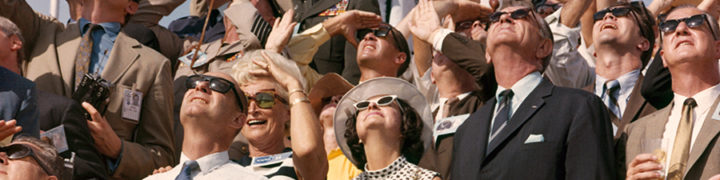
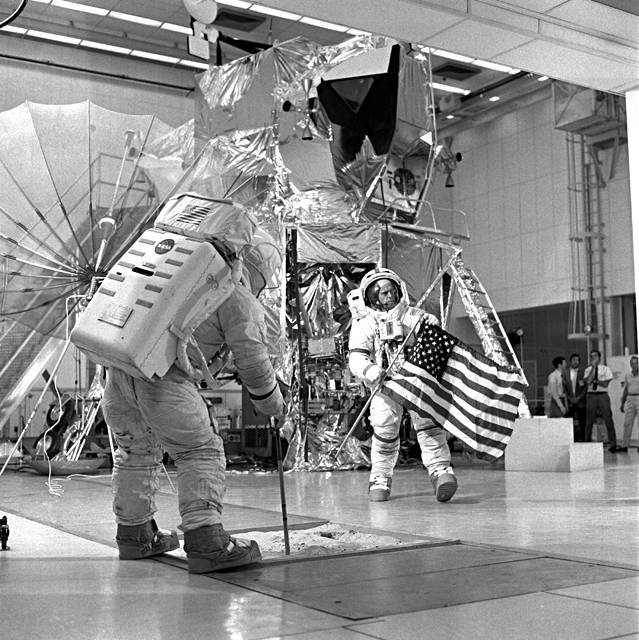
This classic NASA image chronicles the training of astronauts for 1971’s Apollo 14 mission, the third time we reached the moon. The astronauts had to practice everything, even that moment when they would plant the U.S. flag on our natural satellite. According to theApollo 14 press kit, the astronauts spent approximately three weeks in quarantine after returning to Earth, being the final U.S. moonwalkers to be quarantined when they returned home.
••••••••••
Planting the flag:
Alan Shepardmakes the moon his driving range during Apollo 14:
“Persi Diaconis‘s unlikely scholarly career in mathematics began with a disappearing act.
He was 14 years old and obsessed with magic, spending much of his free time in or around Tannen’s Magic Store, on Times Square, where sleight-of-hand masters regularly gathered to show off tricks and to gossip. There, one of the most influential magicians of the past century, a card maestro named Dai Vernon, saw Diaconis’s prodigious trick dealing and invited the young man to leave New York and join him on the road.
Diaconis vanished from his regular life, dropping out of school and cutting ties with his family. ‘I packed a little bag—I took some decks of cards and some socks,’ remembers Diaconis, now 66 with unruly tufts of white hair, in his office at Stanford University, where he is a professor of mathematics and statistics. ‘I was sort of his assistant.’ And his student. Vernon, then in his 60s, promised that if his apprentice advanced far enough in his studies, he would reveal secrets of magic he had never shared with anyone else.
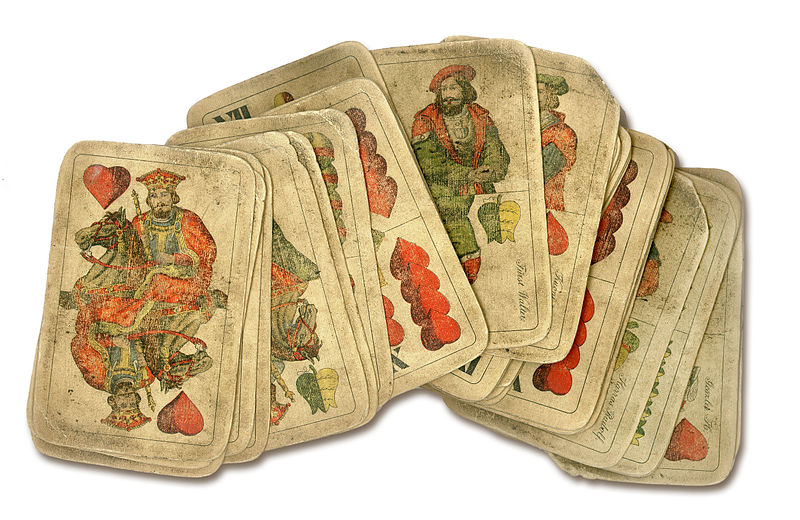
It was this search for the hidden workings of magic that led Diaconis to math. During a few years on the road doing his own magic act, he came to think of the hearts, diamonds, spades, and clubs in a deck of cards as variables that followed predictable formulas as he shuffled them. He could code the cards as binary numbers in his head and perform mental calculations as audience members cut the deck, so that when they picked a card, any card, Diaconis could name it.” (Thanks Browser.)
“How did you and Steve come up with the idea for the first Apple product, the Apple I?
Oh, a lot of people saw the Apple I before Steve Jobs even knew about it. I was in the Homebrew Computer Club. Steve was up in Oregon, working at an orchard, in a commune. We were really not in touch. But I got inspired to help this revolution. People in our club thought the personal computer would affect everyone’s life. We thought everyone would have a little computer, a little thing with switches and weird numbers on it, and people would learn to program to operate a computer. We didn’t think it would be normal stuff like it turned out to be.
I never wanted to run a business. I had a perfect job for life at HP. I went to club meetings every week and I passed out my schematics for the Apple I, no copyright, nothing, just, “Hey all you guys here is a cheap way to build a computer.” I would demo it on a TV set.
Then Steve Jobs came in from Oregon, and he saw what the club was about, and he saw the interest in my design. I had the only one that was really affordable. Our first idea was just to make printed circuit boards. We could make them for 20 dollars and sell them for 40 or something like that. I had given the schematics away. But Steve thought it could be a company.
This was actually our fifth product together. We always were 50-50 partners. We were best friends. We first did the blue boxes. The next one I did was I saw Pong at a bowling alley so I built my own Pong with 28 chips. I was at HP designing calculators. Steve saw Pong and ran down to Atari and showed it to them and they hired him. Whether they thought he had participated in the design, I don’t know and I could not care less. They offered him a job and put him on the night shift. They said he doesn’t get along with people very well, he’s very independent minded. It rubbed against people. So they put him on the night shift alone.
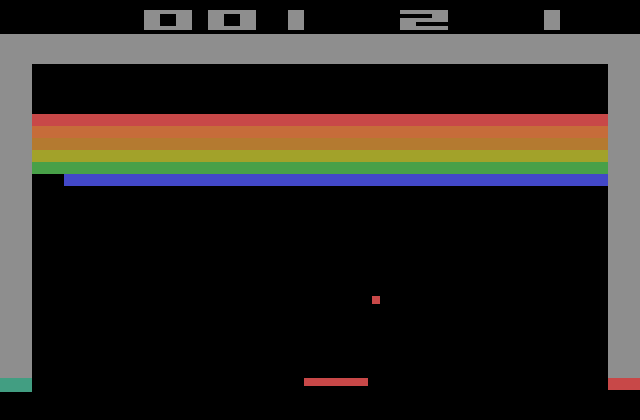
Our next project was when Steve said that Nolan (Bushnell, head of Atari) wanted a one-player game with bricks that you hit out. He said we could get a lot of money if we could design it with very few chips. So we built that one and got paid by Atari.
The legend is that Steve cheated you out of some money on that deal.
The legend is true. It didn’t matter to me. I had a job. Steve needed money to buy into the commune or something. So we made Breakout and it was a half-man-year job but we did it in four days and nights. It was a very clever design.” (Thanks Browser.)
Engineering is never truly finished today as consumers continue to tinker with smart products to make them even smarter. From Bradley Berman’s smart piece in the New York Times:
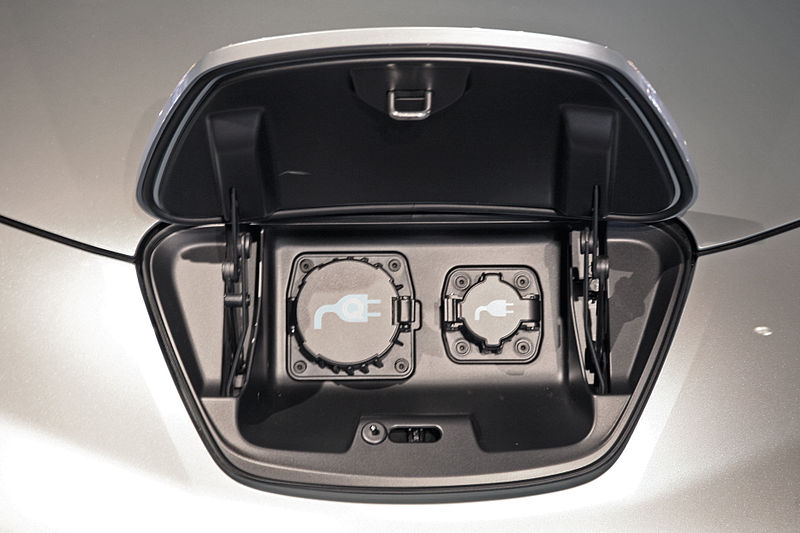
“WITHIN weeks of when Nissan first began delivering the Leaf to buyers last December, do-it-yourselfers were looking for ways to make the new electric car — an engineering marvel from one of the world’s leading automakers — even better.
Among those who applied their 21st-century engineering skills to tinkering pursuits that date to the dawn of automobiles was Gary Giddings, 69, a retired engineer and a passionate supporter of electric vehicles.
‘At this point in my life, my goal is to spend whatever time I have trying to help E.V.’s become successful,’ Mr. Giddings said. He is using his Ph.D. in electrical engineering, earned at the University of California, Berkeley in the free-speech 1960s, to correct some of the Leaf’s shortcomings and to squeeze more performance out of it.”