Politics

You are currently browsing the archive for the Politics category.

Personalization is good for a lot of things, but democracy isn’t one of them. Yet, I think we’re better off in America during this time of unfettered distribution. My sense is that in the big picture people are better informed now. Not everyone, but more of us. Yes, some still believe in anti-immunization hokum and there are citizens who desperately need Obamacare who think it’s “bad,” but there are ways to now chip away at such notions. Senator Joseph McCarthy thrived for a long time when few controlled channels of distribution, but today he would be treated like just another derp on Twitter.

So algorithms disseminating news concerns me, but maybe not as much as I thought it would a few years ago. From Stuart Dredge’s Guardian report about a SXSW conference which featured Kelly McBride of the Poynter Institute:

McBride claimed that in the 20th century, the marketplace of ideas was the professional press, complete with gatekeepers to those ideas in the form of journalists. ‘You either had to be an editor, or had to have access to an editor, or once television came along you had to have access to the means of production,’ she said.

‘The modern marketplace of ideas has completely changed in just the last six or seven years. You can be the first one to publish information,’ she said, referring to the famous first photograph of the plane that landed on New York’s Hudson River, as well as to blog posts that have gone viral.

In theory, then, we’re in a time when anyone can have an idea, publish it and theoretically have it float up to be encountered and considered by the wider population without the permission of those 20th-century gatekeepers.

The challenge: the modern marketplace of ideas is ‘a very noisy place: so noisy that you yourself don’t get to just sort through all of the ideas’ said McBride.

‘If you look at the research on how people get their news now: you often hear this phrase: ‘If news is important, news will find me’ – particularly for millennials. But behind that statement is something really important: if news is going to find you, it’s going to find you because of an algorithm.'”
Tags: ,

In a New York Time Magazine interview conducted by Amy Chozick, Guardian editor Alan Rusbridger explains how contemporary technologies have democratized expression whereas some older ones inhibited it, making non-experts passive:

Question:

You’ve played piano since you were a child, and you’ve written about parallels between this pursuit and digital news. Can you explain that?

Alan Rusbridger:

Amateur music-making used to be very commonplace and was valued in its own right. When recorded sound came along, most people became the passive receivers of other people’s music. I do think that mirrors something that’s going on in journalism at the moment, which is that anybody can blog, anybody can tweet, anybody can write and publish.

Question:

You’ve said you want to make The Guardian a platform as well as a publisher. Is this an effort to tap into that?

Alan Rusbridger:

Absolutely. For years, news organizations had a quasi monopoly on information simply because we had the means of distribution. I think if as a journalist you are not intensely curious about what has been created by people who are not journalists, then you’re missing out on a lot.”

Tags: ,

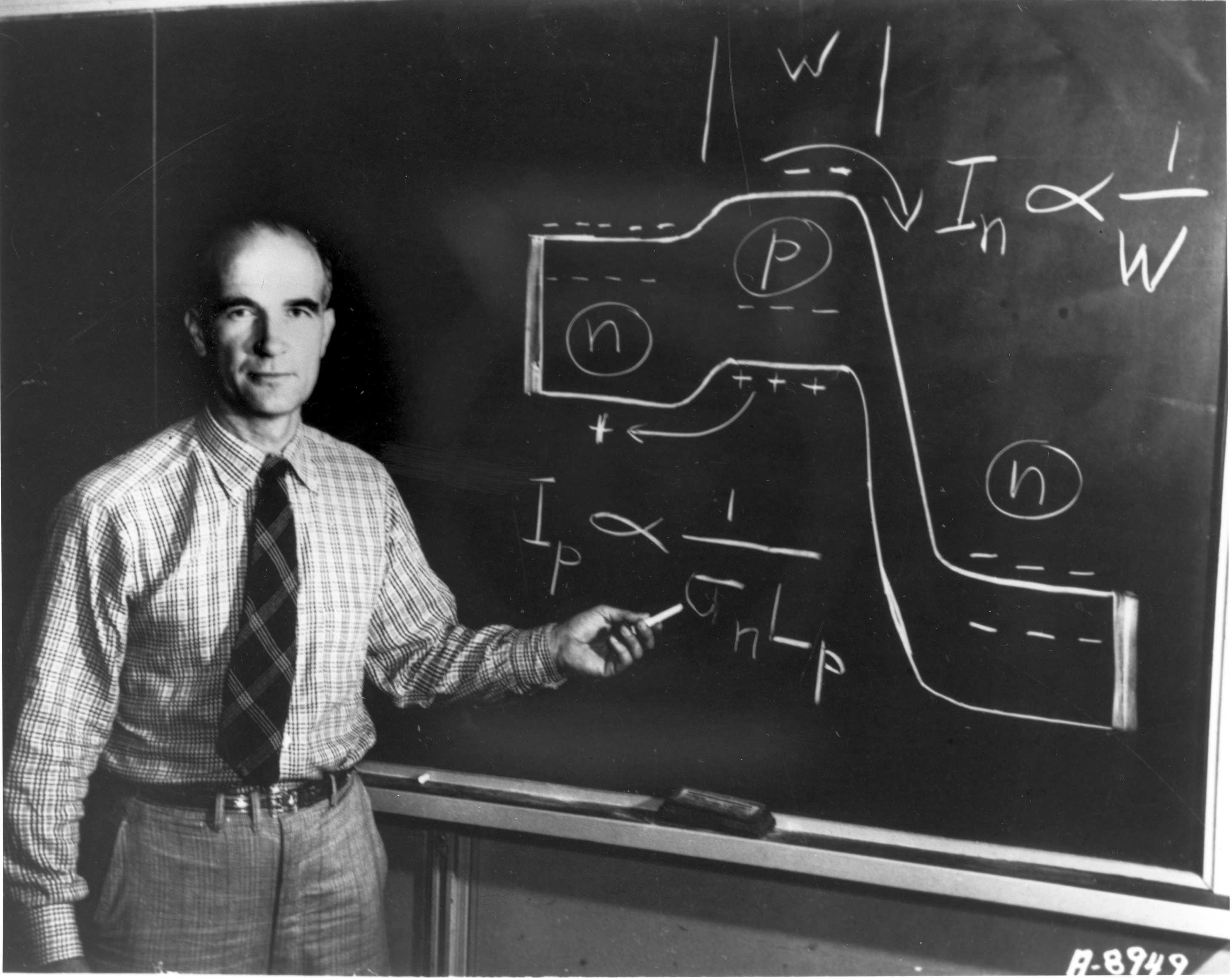
A 1974 clip from Firing Line of William Shockley, the Bell Labs genius who gave us transistors and helped birth Silicon Valley, who was at this point sadly tarnishing his reputation with a second act as a quack attempting to link race, class and IQ, with African-Americans not faring too well in his theories nor anyone who was an unskilled laborer. It’s difficult to be angry at Shockley for his bigotry or Bobby Fischer for his ugly anti-Semitism because they were both clearly deeply ill, but how strange the human brain is that such genius and idiocy can reside in the same organ.

In an article by Stuart Dredge at the Guardian, Google’s Eric Schmidt holds forth on totalitarian regimes trying to control what they cannot stop: the Internet. The opening:

“Dictators are taking a new approach in their responses to use of the internet in popular uprisings, according to Google’s executive chairman Eric Schmidt.

‘What’s happened in the last year is the governments have figured out you don’t turn off the internet: you infiltrate it,’ said Schmidt, speaking at the SXSW conference in Austin, Texas.

‘The new model for a dictator is to infiltrate and try to manipulate it. You’re seeing this in China, and in many other countries.’

Schmidt was interviewed on-stage alongside Jared Cohen, director of the company’s Google Ideas think tank. The session, moderated by Wired journalist and author Steven Levy, took the pair’s The New Digital Age book as its starting point.

Levy wondered whether their enthusiasm for technology’s potential role in popular uprisings has been dampened in the last year by events in Egypt, the Ukraine and elsewhere.

‘We’re very enthusiastic about the empowerment of mobile phones and connectivity, especially for people who don’t have it,’ said Schmidt. ‘In the book, we actually say that revolutions are going to be easier to start, but harder to finish.

He suggested that governments have realised that simply trying to block internet access for citizens is unlikely to end well – partly because it shows that they’re ‘scared’ – which may encourage more people onto the streets, not less. Hence the infiltration approach.”

Tags: ,

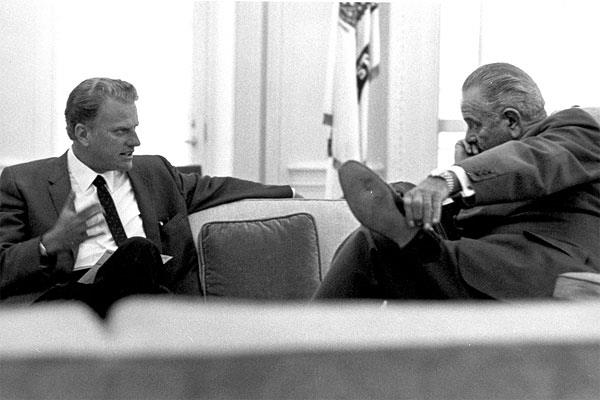
As Bryan Cranston takes on the drawl of a lifetime on Broadway, here’s LBJ in 1965 attending the Houston stop of a Rev. Billy Graham crusade, a tricked-out, latter-day revival show for the television-and-arena age.

From the LBJ Library, a transcript of a 1964 telephone call between the President and the preacher:

“[Graham is on hold 0:35 at beginning of call]

Secretary: Dr. Graham on nine-one

BG: Mr. President?

LBJ: Hello, Billy. How are you, my friend?

BG: Well, God bless you. I was telling Bill [Moyers] that last night I couldn’t sleep, and I got on my knees and prayed for you that the Lord would just give you strength.

LBJ: I told my sweet wife last night–we got mental telepathy–I said that if I didn’t think I’d embarrass him [Graham], I’d say, “Please, dear Lord, I need you more than I ever did in my life. I got the Russians on one side of me taking after, the Chinese are dropping bombs around contaminating the atmosphere, and the best man I ever knew, uh, had a stroke and disease hit him, and I’ve been tied in here with my Cabinet all day…and I’d have Him just make him come down and spend Sunday with me.”

BG: Well, bless your heart, I’ll be glad to. I told Bill that there were two things. One was I just felt terribly impressed to tell you to slow down a little bit. I’ve been awfully worried about you physically.

LBJ: Well–

BG: And then the second thing–you’ve got this election, in my opinion, wrapped up and you’ve got it wrapped up big. There’s no doubt in my mind about that. And then the second thing, you know when Jesus dealt with people with moral problems, like dear Walter [Jenkins] had–and I was telling Bill I wanted to send my love and sympathy to him–

LBJ: Thank you–

BG: –He always dealt tenderly. Always. This is the way He handled it. And that’s the way I feel about it. I know the weaknesses of men, and the Bible says we’re all sinners and we’re all involved one way or another, and I just hope that if you have any contact with him, you’ll just give him my love and understanding.

LBJ: Well, that’ll mean more than anything. Come down here Saturday evening and have dinner with us, and let’s have a quiet visit and maybe have a little service Sunday morning in the White House itself.

BG: Well, I’ll be very happy to. I told Bill that my wife couldn’t come because she’s in bed sick with the flu.

LBJ: Oh, gosh, I’m sorry–

BG: I’m up in Maine and I’m traveling all over New England in different towns, preaching every night in a different town.

LBJ: Oh, wonderful, wonderful. Well, I know you’re doing a lot of good, and I’ll look forward to seeing you Saturday. You just come, bring your bag on in and call Bill and tell him what time you’ll be in so they can have a gate, and we’ll send a car for you.

BG: One of my associates, T.W. Wilson, the brother of the fellow that you met before–

LBJ: Bring him with you.

BG: Alright.

LBJ: I want him with you. I want anybody. And we’ll just have a good visit and I’ll feel stronger next week.

BG: Well, God bless you.

LBJ: Thank you so much.

BG: Bye.

LBJ: Bye.”


Tags: , ,

I don’t worry too much about the human loss of skill in driving cars or piloting planes if those things are made autonomous. Before America was fully developed, people used to know many home remedies to treat ailments, but eventually those practices, some of which weren’t quackery, were forgotten as we entrusted ourselves during emergencies to the technology of hospitals. But in order for us to give up “ownership” of our medical care, the technology had to reach a saturation point so that we could feel certain it would be there for us at moments of need.

Similarly, the great dream of many technologists who work in the driverless-car sector is that citizens won’t only give up the wheel but also ownership. A fleet of on-demand autonomous taxis can certainly replace cabs with human drivers and convoys of programmed delivery trucks are likely to be welcomed by most (though not by truck drivers), but will the American impulse to own, to possess, material goods be usurped by algorithms? From a post by Brad Templeton, a Google consultant, about what the government can do to aid in the development of robocars:

“Many of the big effects of this technology on cities, energy, parking, carsharing, delivery and more come about only when the vehicles can operate unamnned to deliver themselves to users, to store themselves and to refuel/recharge themselves. The lifesaving benefit of superior driving with passengers and the timesaving benefit of recovering productive time are great, but are only part of the story. Take special care to assure what you do doesn’t inhibit the deployment of safe empty vehicles.”

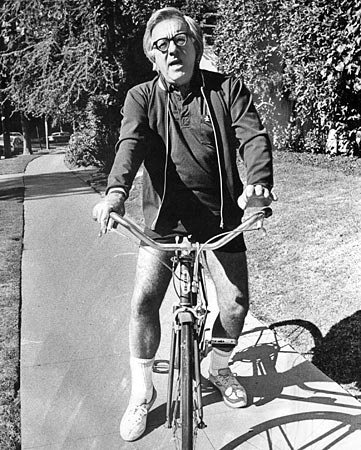
In a 1996 Playboy interview, longtime Angeleno Ray Bradbury provided his predictably sci-fi vision for the future of urban life, in the wake of the Rodney King trial and the subsequent riots. Seemingly unaware that crime had begun to decrease precipitously in American cities (for reasons still impossible to pin down), he shared an awful solution for supposedly unmanageable metropolises. An excerpt:

Playboy:

If Los Angeles is an indicator for the nation, what is the future of other big cities?

Ray Bradbury:

Along with man’s return to the moon, my biggest hope is that L.A. will show the way for all of our cities to rebuild, because they’ve gone to hell and the crime rate has soared. When we can repopulate them, the crime rate will plunge.

Playboy:

What will help?

Ray Bradbury

We need enlightened corporations to do it; they’re the only ones who can. All the great malls have been built by corporate enterprises. We have to rebuild cities with the same conceptual flair that the great malls have. We can turn any bad section of town into a vibrant new community.

Playboy

How do you convince corporate leaders and bureaucrats that you have the right approach?

Ray Bradbury: 

They listen because they know my track record. The center of downtown San Diego was nonexistent until a concept of mine, the Horton Plaza, was built right in the middle of bleakest skid row. Civilization returned to San Diego upon its completion. It became the center of a thriving community. And the Glendale Galleria, based on my concept, changed downtown Glendale when it was built nearly 25 years ago. So if I live another ten years – please, God! – I’ll be around to witness a lot of this in Los Angeles and inspire the same thing in big cities throughout the country.•

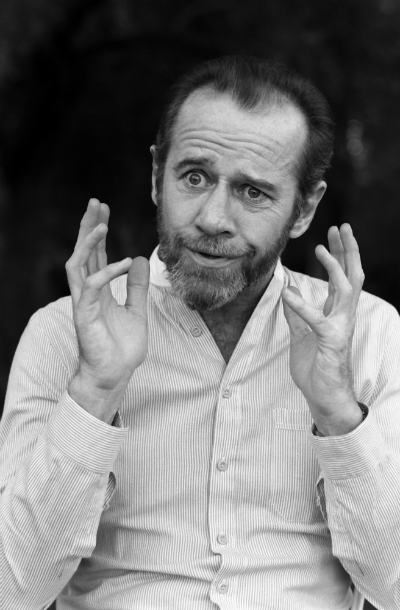
George Carlin was about to release his first comedy album in seven years in 1982 when he sat for a Playboy interview. He was wondering at that point if he would have a third act after being a straight comic in the ’60s and a countercultural force the following decade, and ultimately he found it in the role of philosopher and self-designated mourner for a sense of decency and honesty in American politics and media. Carlin has been criticized for this latter stage of his career, accused of being too angry to be funny, but I think it’s as valuable a phase as his 1970s brilliance. It elevated him to greatest American stand-up ever, and no one has quite reached that level since, though Louis C.K. and Chris Rock have their moments. The opening of the Playboy Q&A:

Playboy:

Back in the early Sixties, when you were still a disc jockey and just beginning to do comedy in small clubs, Lenny Bruce supposedly selected you as his heir—

George Carlin:

Apparently, Lenny told that to a lot of people. But he never said it to me and I didn’t hear it until years later. Which is probably fortunate. It’s difficult enough for a young person to put his soul on the line in front of a lot of drunken people without having that hanging over his head, too.

Playboy:

Because of what Bruce said about you, are you now overly sensitive about being compared to him?

George Carlin:

Yes, and those comparisons are unfair to both of us. Look, I was a fan of Lenny’s. He made me laugh, sure, but more often he made me say, ‘Fuckin’ A; why didn’t I think of that?’ He opened up channels in my head. His genius was the unique ability to investigate hypocrisy and expose social inequities in a street rap that was really a form of poetry. I believe myself to be a worthwhile and inventive performer in my own right. But I’m not in a league with Lenny, certainly not in terms of social commentary. So when people give me this bullshit, ‘Well, I guess you’re sort of…uh…imitating Lenny Bruce,’ I just say, ‘Oh, fuck. I don’t want to hear it.’ I want to be known for what I do best.

Playboy:

Nevertheless, throughout the early to mid-Seventies, with a five-year run of albums and packed auditoriums for an act that viciously ridiculed every nook and cranny of “the establishment,” you really did seem to be fulfilling Lenny’s prophecy. Then it stopped abruptly about five years ago. No more albums; no more college tours. Why?

George Carlin:

I’ve just now completed a five-year period that can perhaps best be called a breathing spell. A time of getting my health back and gathering my strength. That time also included incredible cocaine abuse, a heart attack and my wife’s recovery from both alcoholism and cocaine abuse.

Playboy:

It’s comforting to hear you talk about that breathing spell in the past tense.

George Carlin:

My wife, Brenda, and I are both clean and sober now. I’ve been doing a lot of writing. By the time this interview appears, my first album in seven years will be out. I’m also working on a series of Home Box Office specials, a book and a motion picture. It’s the American view that everything has to keep climbing: productivity, profits, even comedy. No time for reflection. No time to contract before another expansion. No time to grow up. No time to fuck up. No time to learn from your mistakes. But that notion goes against nature, which is cyclical. And I hope I’m now beginning a new cycle of energy and creativity. If so, it’ll really be my third career. The first was as a straight comic in the Sixties. The second was as a counterculture performer in the Seventies. The third will be…well, that’s for others to judge.”

________________________

“I’ve been uplinked and downloaded”:

“You have to be asleep to believe it”:

Tags: , ,

It’s no surprise that once President Obama adopted Heritage Foundation ideas for his signature health-care legislation that conservatives turned on policies that originated with them. A great deal of political bias–or any kind of prejudice–comes from a seemingly natural, perhaps evolutionary, inclination to favor who and what reminds us of ourselves. Even a degree of self-knowledge doesn’t seem to mitigate this tendency. Everything, including the jury system, is compromised by such urges. The opening of “What, Me Biased?” by Tom Jacobs at Pacific-Standard:

“Pretty much all of us are prone to ‘bias blindness.’ We can easily spot prejudice in others, but we’re oblivious to our own, insisting on our impartiality in spite of any and all evidence to the contrary.

Newly published research suggests this problem is actually worse than we thought. It finds that even when people use an evaluation strategy they concede is biased, they continue to insist their judgments are objective.

‘Recognizing one’s bias is a critical first step in trying to correct for it,’ writes a research team led by Emily Pronin and Katherine Hansen of Princeton University. ‘These experiments make clear how difficult that first step can be to reach.'”

Tags: ,

The guest on a very good episode of Russ Roberts’ EconTalk this week was Cornell economist Robert Frank. One highlight late in the show was a debate about smoking bans. The host, a non-smoker, argued against them, while the guest, who began smoking as a teenager, spoke for them. I go along with smoking bans not because it makes me deeply sad whenever I see someone with a cigarette (though it does), but because employees in, say, bars shouldn’t be prone to secondhand smoke. And while they have the freedom to not work in such an environment, that right is limited by opportunity. I’ll pay more to supplement health insurance for smokers, but I don’t want my health or anyone else’s to be compromised by a smoker’s behavior. That’s why I’m not in favor of a ban on large sodas. While people who down gigantic sugary drinks are harming themselves and costing us more in healthcare, you’re going to catch diabetes from them. Education is the best way to reverse that problem.

The other highlight, though that’s admittedly an odd word choice given the dire subject, was Frank’s chillingly straightforward description of climate models in response to a question about a carbon tax. The whole planet is essentially a chain smoker. An excerpt:

“If you read the climate science literature, though, I think there’s less ambiguity here than many believe. The science is inexact; that’s the first thing that the climate scientists themselves will stress. They have no idea really where this is going exactly. What we know, though, is that every estimate that’s come in has been dramatically more pessimistic than the one from a year ago. And the best simulation model that we have, the MIT Global Climate Simulation Model, in a recent set of simulations estimated that by the end of this century, by 2095, not even quite the end of the century, there is a 1 in 10 chance that we are going to see an increase of average global temperature by more than 12 degrees Fahrenheit. And if that happened, 1 in 10, the model is uncertain, so it could be 1 in 5, it could be 1 in 3, it could be 1 in 20–we don’t know–but let’s take their estimate at face value, 1 in 10, then we get 12 degrees increase. All the permafrost melts; all the methane, the billions of tons of methane are released into the atmosphere, each ton 50 times more powerful than CO2 as a greenhouse gas. That’s essentially the end of life as we know it on the planet.”

Tags: ,

A good portion of the clothes charitable Americans place in drop boxes provided by the Salvation Army and other non-profits winds up being resold in sub-Saharan Africa. That provides impoverished people in that region with ultra-cheap clothes, but it also might be stymieing garment industries in those nations. An unintended consequence, sure, though perhaps taking away this market would have unforeseen consequences as well. We should give, but give as intelligently as possible. Give now to help with immediate needs, while working to incentivize future markets. From Shannon Whitehead at Medium:

“People will argue that the second-hand clothing industry in Africa is booming. And, on the surface, it is — over one-third of Sub-Saharan Africans wear second-hand. The reality, though, is that for as long as the second-hand clothing industry thrives, Africa’s economy is unlikely to improve.

According to Professor Garth Frazer from the University of Toronto, no country has ever achieved a sustainable per capita national income (at a level associated with a developing economy) without also achieving a clothing-manufacturing workforce that employs at least 1 percent of the population.

Over the years, certain African nations have attempted to ban or restrict the influx of Western clothing imports. In an effort to give existing industries a chance and to maintain traditional culture, countries such as South Africa, Uganda and Nigeria have tried to implement regulation. While it’s done some good for those countries, it hasn’t provided a solution.

Simply put, as long as we, the consumer, continue to buy and discard at our current rate, there will be a market for our wasted fashion.”

Tags: ,

After Hurricane Sandy devastated so many people in Queens and on Staten Island in 2012, the federal government gave New York City millions to help rebuild the houses of the newly homeless (and those remaining in barely livable, damaged homes). Mayor Bloomberg set up a program called Build It Back, staffed offices with workers, and for the next 15 months not a single home was rebuilt by the program as people in need, people still struggling along in shelters, were stonewalled. NOT A SINGLE HOME. The Rapid Repair project which restored electrical and boiler service was a good use of money, but Build It Back has been a fiasco.

You read about this colossal failure in the local newspapers sometimes, but not much. It’s been treated as a minor subplot. What I have noticed is that a lot of newsprint has been devoted to nitpicking newly inaugurated Bill de Blasio over small matters since he got into office. Perhaps that’s just locals being wary of what’s unfamiliar or maybe some moneyed interests are worried about tax increases. Perhaps it’s a little of both.

No one knows yet if de Blasio will be a good mayor or not, but he did make a solid (if obvious) call in replacing the failed official in charge of the Build It Back program. Perhaps some people can still get help. From “De Blasio and the Motorcade Sideshow,” a Sally Goldenberg article in Capital:

“When a CNN reporter asked him Monday whether he believes the press is treating him unfairly, de Blasio began by saying he can ‘take the heat,’ then criticized reporters for focusing on ‘sideshows,’ instead of announcements about Hurricane Sandy rebuilding, and his court fight to keep open Long Island College Hospital. (The LICH story was covered widely, despite the detail flap.)

‘These are issues that fundamentally affect peoples’ lives and I think that’s where the public debate should reside,’ he said. ‘And I think too much of the time debate veers away into, you know, sideshows.'”

Tags: ,

Sooner or later–and probably sooner–genetic engineering in humans is going to be a reality, despite fears of such things. Especially since a lot of those fears are dubious. Science and technology are imperfect, but so is nature. If we can avoid congenital disease or defect, we should. And, yes, there will be a temptation to abuse these advances as there always are, but you can’t hold back progress for that reason. For all the thousands of people who’ve been helped by science to become parents, isn’t it worth it to put up with the occasional Octomom? From a New York Times article by Sabrina Tavernise about the intersection of genetic therapy and human fertility:

“Such genetic methods have been controversial in the United States, where critics and some elected officials ask how far scientists plan to go in their efforts to engineer humans, and question whether such methods might create other problems later on.

‘Every time we get a little closer to genetic tinkering to promote health — that’s exciting and scary,’ said Dr. Alan Copperman, director of the division of reproductive endocrinology and infertility at Mount Sinai Medical Center in New York. ‘People are afraid it will turn into a dystopian brave new world.’

He added that the current meeting and discussion was an attempt at ‘putting together a framework for us to prepare for this genetic revolution.’

‘The most exciting part, scientifically,’ he said, ‘is to be able to prevent or fix an error in the genetic machinery.'”

Tags: ,

As difficult as it is to comprehend the horror that slavery ever existed at all, it really stuns that it still exists now. The opening of a Priceonomics blog post by Zachary Crockett about the Mauritanian slave trade:

“Abdel Nasser Ould Ethmane received his first slave when he was seven years old. It was the afternoon of his circumcision — his right of passage into early manhood — and he had the liberty to pick any gift imaginable. ‘It was as if I were picking out a toy,’ he recalls. ‘It was as if he were a thing — a thing that pleased me.’

With the point of a finger, Abdel selected a small boy with almond eyes and skin the color of coal to be his slave until death.

Abdel is a resident of the Islamic Republic of Mauritania in western North Africa, where this is commonplace. In fact, Mauritania has the highest proportional population of slaves in the world: as many as 680,000 of the country’s 3.4 million people — 20% of the population — are considered ‘property.'”

Tags:

It’s difficult to legislate widespread behavior. Prohibition didn’t work because people kept drinking. They voted with their actions. They same is true about spying, about invasions of what we formerly considered privacy. Perhaps laws can prohibit some government intrusions, but our technology makes it too tempting for it to stop completely. Of course, the power has passed into the hands of the people as well, which has forced a transparency on government that it did not want. At the moment when people are most worried about the government having too much control, the reverse is actually happening. It’s falling away. And it’s not really about Snowden or Manning but about humans and our nature. We want to know. We like to watch. 

From Eli Lake’s Daily Beast article about James Clapper, the nation’s top intelligence officer who has come to realize the hard way that information now flows down a two-way street:

“Clapper also acknowledges that the very human nature of the bureaucracy he controls virtually insures that more mass disclosures are inevitable. ‘In the end,’ he says, ‘we will never ever be able to guarantee that there will not be an Edward Snowden or another Chelsea Manning because this is a large enterprise composed of human beings with all their idiosyncrasies.’

Ben Rhodes, deputy national security adviser for strategic communications, concurs: ‘I do think he recognizes that we are in a new normal after Snowden where we can’t operate with the expectation where nothing will get out,” he said. ‘If you are going to be dealing with the world where there are these disclosures you have to be more transparent to make the case to the public what you are doing and not doing.'”

Tags: , ,

If you’ve never watched it, here’s the 1991 BBC program, Don DeLillo: The Word, The Image, and The Gun. If I had to pick my favorite of his novels, I would say that I probably got the most pleasure from White Noise. Although “pleasure” is an admittedly odd word choice given the book’s topic is an airborne toxic event. I think the majority of his readers would choose Underworld or Libra.

Mao II is such a strange thing: Published the same year as this show, that novel has wooden characters and plotting, but it’s so eerily correct about the coming escalation of terrorism, how guns would become bombs and airplanes would not just be redirected but repurposed. It’s like DeLillo tried to alert us to a targets drawn in chalk on all sides of the Twin Towers, but we never really fully noticed. 

This program is a great portrait of DeLillo and his “dangerous secrets” about technology, surveillance, film, news, the novel, art and the apocalypse.

Tags:

The private sector is often as incompetent as the government was in its botched Healthcare.gov launch, despite what techies and extreme free-marketers might have you believe. Mistakes in privately held technology companies are common, launches and relaunches are disasters, sites (like Twitter) have trouble with stability for years. I think Clay Shirky gives this truth no mention in his new Foreign Affairs piece about the Affordable Care Act tech meltdown, but it contains a lot of important points about project management. The opening:

Late last October, the management expert Jeffrey Zients was given a mandate to fix HealthCare.gov, the website at the forefront of U.S. President Barack Obama’s health-care reform, after its disastrous launch. Refusing to engage in happy talk about how well things were going or how soon everything would be fixed, Zients established performance metrics for the site’s responsiveness, insisted on improvements to the underlying hardware, postponed work on nonessential features, demanded rapid reporting of significant problems, and took management oversight away from the Centers for Medicare and Medicaid Services (CMS, a federal agency within the Department of Health and Human Services) and gave it instead to a single contractor reporting to him. The result was a newly productive work environment that helped the website progress from grave dysfunction in early October to passable effectiveness two months later.

Zients’ efforts demonstrated the government’s ability to tackle complex technological challenges and handle them both quickly and effectively. Unfortunately for the Obama administration, the transformation came too late to rescue its reputation for technical competence. Given that the people who hired Zients clearly understood what kind of management was required to create a working online insurance marketplace, why did they wait to put in place that sort of management until the project had become an object of public ridicule? And more important, is there any way to prevent other such debacles in the future? The answers to both questions lie in the generally tortured way that the government plans and oversees technology.”

Tags: , ,

Am I misreading the tea leaves? It seems like a lot of well-to-do New Yorkers are ready to pounce on the new mayor, Bill de Blasio, for any mistakes he makes while becoming acclimated to the job. Could it be that these are faux liberals who are secretly resentful about perhaps paying higher taxes? Maybe not. Time will tell. 

From “What Lottery Winners and Tom Perkins Have in Common,” Charles Kenny’s new Businessweek piece about the thought process of a man who is awful even by the non-rigorous standards of the venture-capital world:

“Perkins had the chance to be a successful executive in the first place because he was born privileged enough to enter the Massachusetts Institute of Technology as an undergraduate in 1953, when a little more than 5 percent of Americans aged 25 to 29 had a bachelor’s degree. If he had been born in Liberia, perhaps to a single mother, all bets of billionaire status would be completely off. He surely worked hard, and took risks informed by smarts and insight, but he was incredibly lucky to start where he did and end up where he is now, with enough money for a classic car collection and a massive yacht.

Yet Perkins is far from alone in thinking he’s rich because he earned it and the poor are poor because they didn’t. Indeed, the view seems to be an almost unavoidable side effect of becoming wealthy. A study by British economists Nattavudh Powdthavee and Andrew Oswald released last week looked at lottery winners involved in a general survey of attitudes in the U.K. Comparing views before and after lottery wins, the economists looked at winners’ political allegiances and views toward income distribution. Those surveyed were asked if they agreed or disagreed with the statement ‘ordinary people get a fair share of the nation’s wealth,’ and if they supported the (more right-wing) Conservative Party or the (left-leaning) Labour Party.

A win of just £500 (about $840) made survey respondents 5 percent more likely to change their vote to Conservative from Labour and significantly more likely to think that the current distribution of income was fair. The larger the lottery win, the bigger the impact on the respondents’ beliefs—even though their income rankings rose purely by chance. Considering that Perkins’s earnings from betting on tech startups are more than 1 million times the £500 that Powdthavee and Oswald found sufficient to shift attitudes, and since he did far more to earn his wealth than the lottery winners did, his views on redistribution aren’t surprising.”

Tags: , , , ,

War is an exchange of information with terrible human consequences. Perhaps eventually any loss of life will be unacceptable, and it will just be our robots versus your robots. But until then greater information may lead to greater casualties.

Some scientists are now looking to emulate termite “architecture” in robots, which may ultimately lead to automated navies. It’s not termite art but termite war. An excerpt from the Economist:

Individual termites are, of course, far too dim to understand such things as convection and solar flux. Instead, a few simple rules encoded in their nervous systems by evolution and regulated by signalling chemicals called pheromones steer them to produce their mounds in all their architectural glory. This kind of behaviour, in which simple actions combine to produce sophisticated results, is called emergence.

Now human designers are getting interested in emergence, too. In a paper just published in Science, a group at Harvard, led by Justin Werfel, describes termite-inspired robots that can build things by combining magnetic bricks of a standard size. All their human controller has to do is program them with a few appropriate rules and leave them to get on with it.

Robot construction teams are not, in themselves, new. Researchers at the University of Pennsylvania have already demonstrated a system which uses remotely controlled flying robots to build things. What makes Dr Werfel’s approach different is that instead of having a controlling force, in the form of a computer program, sitting at the centre telling everything else what to do (as was the case in Pennsylvania), control is distributed throughout the system’s components, which cannot communicate with each other. The robots, which are little wheeled contraptions, do not need to see the bigger picture.

In the case of termites, the bigger picture is provided by natural selection, which has, over the millennia, refined the rules that individual termites obey. In the case of Dr Werfel’s robots, a human designer specifies the desired outcome and, with the help of a program developed by the team, generates the rules that will lead to its construction, with which each robot is then programmed. All that remains is to place a foundation brick to show the robots where to start building.”

Tags:

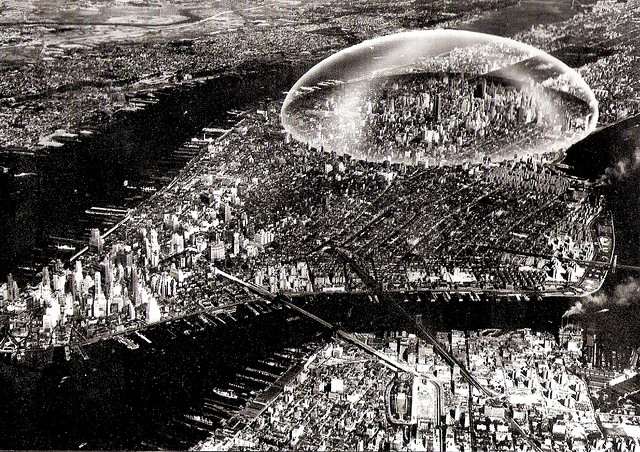
Can New York survive–thrive, even–as a self-sufficient and green city-state, with all its food coming from farming towers and miniature greenhouses? It’s not something that’s ever going to completely happen, but knowing what is possible could lead us to healthier, more-sustainable choices. From an Aeon essay by Michael Sorkin of NYC (Steady) State, an organization that hopes to answer that question:

“New York is a city of foodies with a staggering profusion of cuisines, and it has bred an advanced discourse about nutrition, organisation, justice, technology, and culture. It abounds with community gardens, with increasingly large commercial farming, and other sites of production, from backyards to rooftops to the tofu-producing cellars of Chinatown, but also with a rich distributive infrastructure of food co‑ops, farmers’ markets, meals‑on‑wheels, soup kitchens, school cafeterias and restaurants. The question for us was: how can all of this be elaborated into more supple and comprehensive networks that take account of our transformed habits and desires? And, to what degree could this be scaled up to feed 8.5 million people?

We discovered that it is in fact technically feasible to produce 2,500 nutritious calories a day for everyone in the city. At one level, the required infrastructure is not entirely outlandish. It would depend on the widespread use of vertical farming, building over existing infrastructure – railways, highways, factories, etc – and the densification of some parts of the city currently built at suburban scale. The cost, however, would be prodigious and many of the implications highly vexed. For example, the energy required to light, heat, and build all of this is, we’ve calculated, approximately equivalent to the output of 25 nuclear power plants, an eventuality that is, to put it mildly, somewhat at odds with our larger intentions. Likewise, the necessarily industrialised character of such production would beg the question of resisting the tender mercies of agri-business and the huge variety of its downside effects.

But, by finding a series of ‘sweet spots’, or more nominally ‘practical’ scales for sustainable food production, we’ve sought to balance cost and benefit socially, environmentally, economically, and culturally. We’ve looked at window boxes; at using the subways for freight; at a scheme encompassing the territory with a 100-mile radius around the city; and at reusing the 19th-century Erie Canal for a statewide system. We’ve recaptured street space, designed skyscraper farms for plants and animals, and plotted how to integrate all this into the fabric of the existing city. And, we’ve sought to deepen the idea of the urban neighbourhood as the core unit of sustainable urban organisation.”

Tags:

Chicago, the major American metropolis with the most stubborn racial divides, has seen its tale of two cities be told with even greater emphasis since Rahm Emanuel became Mayor. From Edward Luce’s insightful Financial Times article about the former Obama chief of staff:

“Crudely measured, Chicago is roughly a third white, a third black and a third Hispanic. Most Chicagoans seem to accept it that way. ‘We are the most segregated city in America,’ goes the joke. ‘Ain’t it great?’ Since Emanuel took office, however, things have polarised. Most white Chicagoans support him – as do a majority of Hispanics, according to the polls. Most African-Americans no longer do. The corporate world within Chicago’s elevated rail ‘loop’ has rarely had it so good. The same goes for pockets inside its largely Hispanic West Side. But Chicago’s South Side, where a young Obama cut his teeth as a community organiser, continues to fester. A rash of school closures last year did little to help. ‘Black families who can leave Chicago are still leaving,’ says Cobb. They call it ‘degentrification.’

Emanuel’s often testy relations with Chicago’s black neighbourhoods could be pivotal to his re-election next year. The gulf between the two Chicagos is at least as big as that between the ‘two New Yorks’, which Bill de Blasio, the new mayor of the Big Apple, has promised to bridge. De Blasio comes from the Democratic party’s liberal (‘Sandinista’) wing and promised to make New York’s Upper East Side pay more to make life better for its underclasses. Emanuel is closer to Michael Bloomberg, de Blasio’s predecessor, who drew on his philanthropic networks to revitalise New York’s economic heart. Both are enthusiasts for non-union charter schools. De Blasio, on the other hand, is a champion of the unions.

Emanuel’s Chicago versus de Blasio’s New York may be the closest America has to an experiment in how to make its cities both liveable and competitive in the 21st century. ‘Look, we face international forces that are far bigger than us,’ Emanuel told me in an interview in Mexico City, which he was visiting to inaugurate a city-to-city partnership (almost a quarter of Chicagoans were born in Mexico). I had asked him whether he and de Blasio were rivals. ‘We both have a great amount of concentrated wealth and great poverty,’ he replied. ‘My challenge is to make it a still-great city for the middle-class families that are the bedrock of Chicago.’

Emanuel’s impact so far depends on whom you ask.”
__________________

“It’s supposed to be fun”:

Tags: , , ,

Economist editors discuss how Big Data is changing human modeling, how it can be used to predict–even direct–group behavior, with MIT’s Alex Pentland, author of the new book, Social Physics. Watch six-minute video here.

Tags:

After a steep decline in manufacturing, the U.S, has an opportunity to drive the future of the sector. But there’s a catch: You and I may not be necessary. The rapid growth of robotics in America may largely close factories to human hands. We’ll be richer in the aggregate, but those riches will not be distributed very much to workers. Good in the long run but not so much now. From Amar Toor at Verge:

“Some see automated manufacturing as a potential boon for the US economy, a way to lure companies back to American soil with the promise of higher productivity and lower labor costs. But others fear that the push could displace the last vestiges of middle-class American manufacturing workers at a time of high unemployment and soaring inequality.

‘The pace and scale of this encroachment into human skills is relatively recent and has profound economic implications,’ MIT economists Erik Brynjolfsson and Andrew McAfee wrote in their 2011 book Race Against the Machine. In the book, the authors argue that technology has destroyed more American jobs at a faster pace than it’s created new ones, leading to higher unemployment and stagnant median incomes despite higher productivity levels. Although they conclude on an optimistic note, arguing that technological change will yield benefits in the long run, Brynjolfsson and McAfee say its short-term effects could be devastating for American workers.”

Tags: , ,

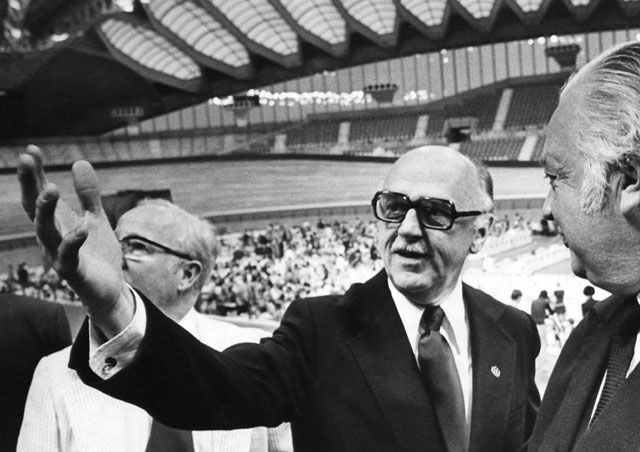
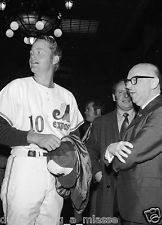
Thinking about the impact of the Olympics on host cities reminds me of Frank Deford’s great 1970 Sports Illustrated profile of then-Montreal mayor Jean Drapeau whose unwavering will brought a subway system, a World’s Fair, Major League Baseball and, yes, the Olympics to his city. It should be noted, however, that the construction of the Olympic buildings was bungled horribly and cost overruns left the citizens indebted for three decades. The opening:

One bright day in the summer of 1970, shortly after Montreal had obtained the 1976 Olympics but in the months just before the city annexed Vermont and then acquired the Vatican to place up on Mont-Royal (the Orange Bowl, after all, seemed so lonely up there with only the Bolshoi Ballet and the Ganges River for company), the mayor of Montreal sat in City Hall and faced down another skeptic. This he does with aplomb, for it is a whole world of skeptics that the mayor endures, and thus he has much practice in the endeavor. The mayor’s working philosophy is: ‘Problems are solved en route,’ and, of course, since Vietnam this is not the most popular mode of operation everywhere. The mayor is not deterred.

Having warmed up at some length, he waves for effect and declares: ‘The Olympics will do even more for Montreal than Expo ’67. Seventy-six is only a target, and we won’t stop. Seventy-six is the means, not the end. Sixty-seven was just taking us into orbit, but the Olympics will take us to the moon [he waves], to Mars! I feel it! I feel it! And I’m not wrong when I feel as strongly as this. There is no challenge too big for Montreal, because, like the Olympics, we are acting with the spirit of Baron de Coubertin, we are acting in a humanistic way. The city possesses an environment, an ambience that can be felt. ‘Montreal is en route to becoming The City of the world. Twenty years from now, no matter what happens, it will have achieved this position, and it will be referred to in all parts of the world as The City.’

Now make no mistake, the mayor of The (incipient) City is a politician. His office is testament to that. There is the portrait of Queen Elizabeth juxtaposed with a crucifix. There are the flowers that adorn the room in bunches, while nestled among them is the mayor’s 125-pound bull mastiff, Due, whose elegiac face does not betray the fact that he could eat for lunch, if he were so disposed, all the flowers, the artifacts and the entire Quebec separatist movement. But if the symbols around the man add up to a balanced display, there is no compromise in the mayor. Charles Bronfman, vice-president of Seagrams, Ltd. and chairman of the baseball Expos, observes: ‘However much he sounds it, the mayor is never a huckster. He is altogether sincere. He has drives that are unusual and dreams that others of us cannot understand.’

This means that when the mayor says Montreal is going to sprint ahead and leave crossroads like Paris and New York back with Terre Haute, he is not putting you on. He means it. Also, all those enigmatic celestial references to the Olympics are not being emitted just for florid effect. It is worth recalling that at about this same point in the planning stage for Expo ’67, the mayor had already decided to make a permanent exposition of it—though he neglected to let anyone else in on this revelation for some time. Expo ’67 is now Man and His World and is still drawing people to Montreal.

After a certain amount of watching His Honor, one instinctively recalls what Cassius Clay used to say after various correct predictions: ‘If I tell you a fly can pull a plow, hitch him up.’ The mayor brought a world’s fair to Montreal in record time after Moscow reneged on the project. He lured major league baseball into expanding outside the U.S., and happily watched the team prosper and even play well amid predictions of financial and artistic calamity. He took the Olympics away from the U.S. and Russia and left another world power, personified by Charles de Gaulle, put down in a stunning speech after De Gaulle had suggested French Canada might want to, more or less, separate itself from Canada. He built a cultural palace and a subway system in a world where nobody constructs anything that lasts. With a sprinkle of flowers and trees on almost every street, he encouraged a greenhouse of a town to bloom in a place that had been another kind of house for the whole Western world.

The mayor’s name is Jean Drapeau.”

Tags: ,

When happens to the tent when the circus leaves town, especially if it’s the greatest show on Earth? The Olympics are a mixed blessing locally because they promise massive infrastructure improvements in only a few years, but they also can indebt a host city, displace citizens and cause environmental damage. And the march of history (e.g., war) can quickly undo any of the good, make something grotesque from it. Jon Pack and Gary Hustwit of the Olympic City Project photograph hosts years after the Games are over to see what the event has wrought. A couple of exchanges from an Ask Me Anything they just did at Reddit.

______________________

“Question:

In your opinion, are the Olympics have a positive or negative long-term effects on the cities hosting it?

Jon Pack and Gary Hustwit:

That a complex question, because it really depends on your point of view. Barcelona’s 1992 Olympics is held up as having a positive effect on the city, since they were able to redevelop the waterfront area and turn the beach into a huge tourist draw. They were also able to do 30 years of planned infrastructure improvements in 5 years, using the Games as the impetus. But there are many citizens who were displaced by the new development there, or complain that the improvements are really just for the sake of tourism, their rents are higher now, etc.

Every city/country has their own reasons for hosting the Olympics, some just want to prove they can do it, that they’re a global city. For some it’s a public relations move (how many of us had heard of Sochi before this year? In the project, we’ve tried not to express an opinion one way or the other, if it’s positive or negative, but try to give a feel for what these cities are like now, a few years or decades after the Games.

______________________

Question:

I’ve been to the Sarajevo site, which is pretty disturbing; tons of the open spaces were used for graves during the war in the 90s, and everything else is practically falling apart.

Which city, in your opinion, has done the best job of reusing and refurbishing former olympic sites?

Jon Pack:

Yes, Sarajevo is an especially sad case. It’s impossible to separate the Games’ legacy from the war. Most of the Olympic structures were destroyed or damaged significantly. But I found the people to be amazingly resilient; almost everyone would tell me a harrowing story of that time and then follow it up with a dark joke. When I was there in the summer, I found most of the sites being used in some way. The bobsleigh track had some picnickers, skaterboarders and tourists around, for instance. The Igman ski jumps sat in ruins, but the base was full of campers playing football. It seems like they may not have the money to rebuild the sites, but they’re making the best of it.

Gary Hustwit:

There are plenty of interesting re-uses of Olympic sites in different cities, I don’t think I could say any one city has done it all well. But we’ve seen some bizarre ones. Lake Placid couldn’t get federal funding to build athlete housing for the ’80 Winter Games, but the government would fund a new prison. So they built a prison, housed the athletes and officials in it, and after the Games were over the prisoners moved in. It’s still a working prison today.”

Tags: ,

« Older entries § Newer entries »