Politics

You are currently browsing the archive for the Politics category.

At Practical Ethics, Rebecca Roache, one of the interview subjects in Ross Andersen’s excellent Aeon piece about criminal punishment during a time of radical life extension, answers some of the more overheated criticism her philosophical musings received. An excerpt:

“Even if technology is harnessed to devise new punishment methods, it might not be clear how the new methods compare to old methods. Radical lifespan enhancement might enable us to send people to prison for hundreds of years, but would this be a more severe punishment than current life sentences, or a less severe one? On the one hand, longer prison sentences are more severe punishments than shorter prison sentences, so a 300-year sentence would be a more severe punishment than a 30-year one. On the other hand, consider that many prisoners sentenced to death in the US appeal to have their death sentences converted to life sentences. This suggests that a longer sentence is viewed by prisoners who are sentenced to death as less severe than a shorter sentence (followed by execution). I made this point in the Aeon interview, and some people took me to be rejecting the idea of technologically-extended life sentences on the ground that this would be too lenient, and therefore bad. In fact, my point was that it might not always be obvious how technologically-induced changes in a punishment affect its severity.”

Tags: ,

In a Spiegel interview by Marc Hujer and Holger Stark, former NSA director Michael Hayden addresses what he feels is the chilling effect the Snowden leaks have had on the Internet globally. I think, like it or not, the world is ultimately stuck with the Internet and a new normal in regards to privacy. An excerpt:

Spiegel:

On the one hand, the United States promotes the Internet as a tool of freedom. On the other hand, it now appears to many people to be a tool of surveillance.

Michael Hayden:

I am quite willing to have a discussion about what my country has or has not done, but it has to be based on facts. Let me first point out that the NSA doesn’t monitor what every American is doing on the Internet. The NSA doesn’t check who goes to what websites. But you’ve got these beliefs out there now.

Spiegel:

Your predecessor as head of the NSA, General Kenneth Minihan, compared the Internet with the invention of the atomic bomb. He said a new national effort should be dedicated to one single goal, ‘information superiority for America’ in cyberspace. It looks like you’ve gotten pretty close.

Michael Hayden:

We Americans think of military doctrine and ‘domains’ — land, sea, air, space. As part of our military thought, we now think of cyber as a domain. Let me define air dominance for you: Air dominance is the ability of the United States to use the air domain at times and places of its own choosing while denying its use to its adversaries at times and places when it is in our legitimate national interest to do so. It’s just a natural thing for him to transfer that to the cyber domain. I do not think it is a threat to world peace and commerce any more than the American Air Force is a threat to world peace and commerce.

Spiegel:

But do you understand if people in other countries are concerned about one country trying to gain “superiority” over something transnational like the Internet?

Michael Hayden:

I certainly do, and I thoroughly understand that. Now, other countries are creating cyber commands, but we were first, public, and very forceful in our language. We are now accused of militarizing cyberspace. Around the time US Cyber Command was created, McAfee did a survey of cyber security experts around the world. One of the questions they asked of them was, ‘Who do you fear most in cyberspace?’ The answer for the Americans was the Chinese. With the plurality of people around the world, it was the Americans.”

Tags: , ,

Kevin Kelly is probably the most articulate contemporary voice on matters relating to how the rise of the machines will remake the meaning of humanity, but, of course, these hopes and fears have been around for awhile. In Michael Belfiore’s new Guardian article, which I think is way too chipper about what will likely be a very painful transition to an autonomous society, he quotes Arthur C. Clarke from five decades ago on the topic. 

By the way, if memory serves, the Clarke essay that’s referenced predicted that by 2001 houses would be able to fly, and communities could migrate south when it was cold. I can’t be mistaking that detail, can I? The excerpt:

As early as the 1960s, Arthur C. Clarke, professional visionary and inventor of the communications satellite, predicted the end of menial labor (mental as well as manual), due to mechanization (and, more disturbingly, bio-engineered apes). In his essay The World of 2001, originally published in Vogue and reprinted in his book The View from Serendip, Clarke wrote: ‘the main result of all these developments will be to eliminate 99 percent of human activity … if we look at humanity as it is constituted today.’

Our salvation, in Clarke’s view, will lie in our looking toward loftier pursuits than all those kinds of jobs that machines will take over:

In the day-after-tomorrow society there will be no place for anyone as ignorant as the average mid-twentieth-century college graduate. If it seems an impossible goal to bring the whole population of the planet up to superuniversity levels, remember that a few centuries ago it would have seemed equally unthinkable that everybody would be able to read. Today we have to set our sights much higher, and it is not unrealistic to do so.”

Tags: , ,

In this year’s Gates Annual Letter, which was mentioned during his appearance at the American Enterprise Institute, Bill Gates sees a world without impoverished nations in about 20 years. We certainly have the tools to make that a reality, though I would assume some nations will be held back by awful political realities. An excerpt:

“The bottom line: Poor countries are not doomed to stay poor. Some of the so-called developing nations have already developed. Many more are on their way. The nations that are still finding their way are not trying to do something unprecedented. They have good examples to learn from.

I am optimistic enough about this that I am willing to make a prediction. By 2035, there will be almost no poor countries left in the world. (I mean by our current definition of poor.)2 Almost all countries will be what we now call lower-middle income or richer. Countries will learn from their most productive neighbors and benefit from innovations like new vaccines, better seeds, and the digital revolution. Their labor forces, buoyed by expanded education, will attract new investments.”

Tags:

In a new Financial Times article, Tim Harford looks at all angles of behavioral economics, which has reached its ascendancy in the years since Daniel Kahneman’s Nobel Prize win in 2002. In Kahneman’s hands, the discipline seems to have a lot of merit, but all too often with others its feels like shaky narratives supplanting other shaky narratives. There are so many variables in the world that easy answers can obscure complex situations. Did the Broken Windows Theory really lead to a reduction in crime in NYC when other cities that didn’t implement it experienced similar decreases? Is the answer more complicated? Is it not completely knowable? Does just replacing shattered glass make it easier to not address why we’re producing criminals? From Harford:

“In 2010, behavioural economists George Loewenstein and Peter Ubel wrote in The New York Times that ‘behavioural economics is being used as a political expedient, allowing policy makers to avoid painful but more effective solutions rooted in traditional economics.’

For example, in May 2010, just before David Cameron came to power, he sang the praises of behavioural economics in a TED talk. ‘The best way to get someone to cut their electricity bill,’ he said, ‘is to show them their own spending, to show them what their neighbours are spending, and then show what an energy-conscious neighbour is spending.’

But Cameron was mistaken. The single best way to promote energy efficiency is, almost certainly, to raise the price of energy. A carbon tax would be even better, because it not only encourages people to save energy but to switch to lower-carbon sources of energy. The appeal of a behavioural approach is not that it is more effective but that it is less unpopular.

Thaler points to the experience of Cass Sunstein, his Nudge co-author, who spent four years as regulatory tsar in the Obama White House. ‘Cass wanted a tax on petrol but he couldn’t get one, so he pushed for higher fuel economy standards. We all know that’s not as efficient as raising the tax on petrol – but that would be lucky to get a single positive vote in Congress.’

Should we be trying for something more ambitious than behavioural economics?”

Tags: , , ,

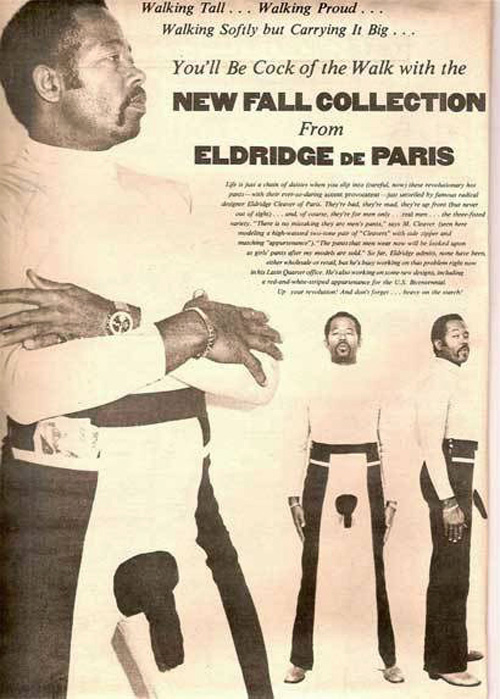
Black Panther Eldridge Cleaver was many things, and not all of them were good. But no one could deny he was a fascinating fashion designer. After fleeing the United States when charged with the attempted murder of police officers in Oakland in 1968, the revolutionary spent seven years hiding in a variety of foreign countries.  A mostly forgotten part of his walkabout was Cleaver surfacing as a fashion designer in Paris at the very end of his exile. As shown in the print advertisement above, his so-called “Penis Pants” had an external sock attached so that a guy could wear his manhood on the outside. Cucumber sales soared.

From an article Cleaver penned about the early part of his life at large for Ramparts in 1969, a look at the more serious side of expatriation:

“SO NOW IT IS OFFICIAL. I was starting to think that perhaps it never would be. For the past eight months, I’ve been scooting around the globe as a non-person, ducking into doorways at the sight of a camera, avoiding  English-speaking people like the plague. I used so many names that my own was out of focus. I trained myself not to react if I heard the name Eldridge Cleaver called, and learned instead to respond naturally, spontaneously, to my cover names. Anyone who thinks this is easy to do should try it. For my part, I’m glad that it is over.

This morning we held a press conference, thus putting an end to all the hocus-pocus. Two days ago, the Algerian government announced that I had arrived here to participate in the historic First Pan-African Cultural Festival. After that, there was no longer any reason not to reach for the telephone and call home, so the first thing I did was to call my mother in Los Angeles. ‘Boy, where are you at?’ she asked. It sounded as though she expected me to answer, ‘Right around the corner, mom,’ or ‘Up here in San Francisco,’ so that when I said I was in Africa, in Algeria, it was clear that her mind was blown, for her response was, “Africa? You can’t make no phone call from Africa!” That’s my mom. She doesn’t relate to all this shit about phone calls across the ocean when there are no phone poles. She has both her feet on the ground, and it is clear that she intends to keep them there.

It is clear to me now that there are forms of imprisonment other than the kind I left Babylon to avoid, for immediately upon splitting that scene I found myself incarcerated in an anonymity, the walls of which were every bit as thick as those of Folsom Prison. I discovered, to my surprise, that it is impossible to hold a decent conversation without making frequent references to one’s past. So I found myself creating personal histories spontaneously, off the top of my head, and I felt bad about that because I know that I left many people standing around scratching their heads. The shit that I had to run down to them just didn’t add up.

Now all that is over. So what? What has really changed? Alioto is still crazy and mayor, Ronald Reagan is still Mickey Mouse, Nixon is in the White House and the McClellan Committee is investigating the Black Panther Party. And Huey P. Newton is still in prison. I cannot make light of this shit because it is getting deeper. And here we are in Algeria. What is a cat from Arkansas, who calls San Francisco home, doing in Algeria? And listen to Kathleen behind me talking over the telephone in French. With a little loosening of the will, I could easily flip out right now!”

____________________________

Cleaver was sadly not wearing his Penis Pants when he sat down in 1969 with William F. Buckley to discuss the Man and the Pigs and other handy generalizations. At the 3:28 mark.

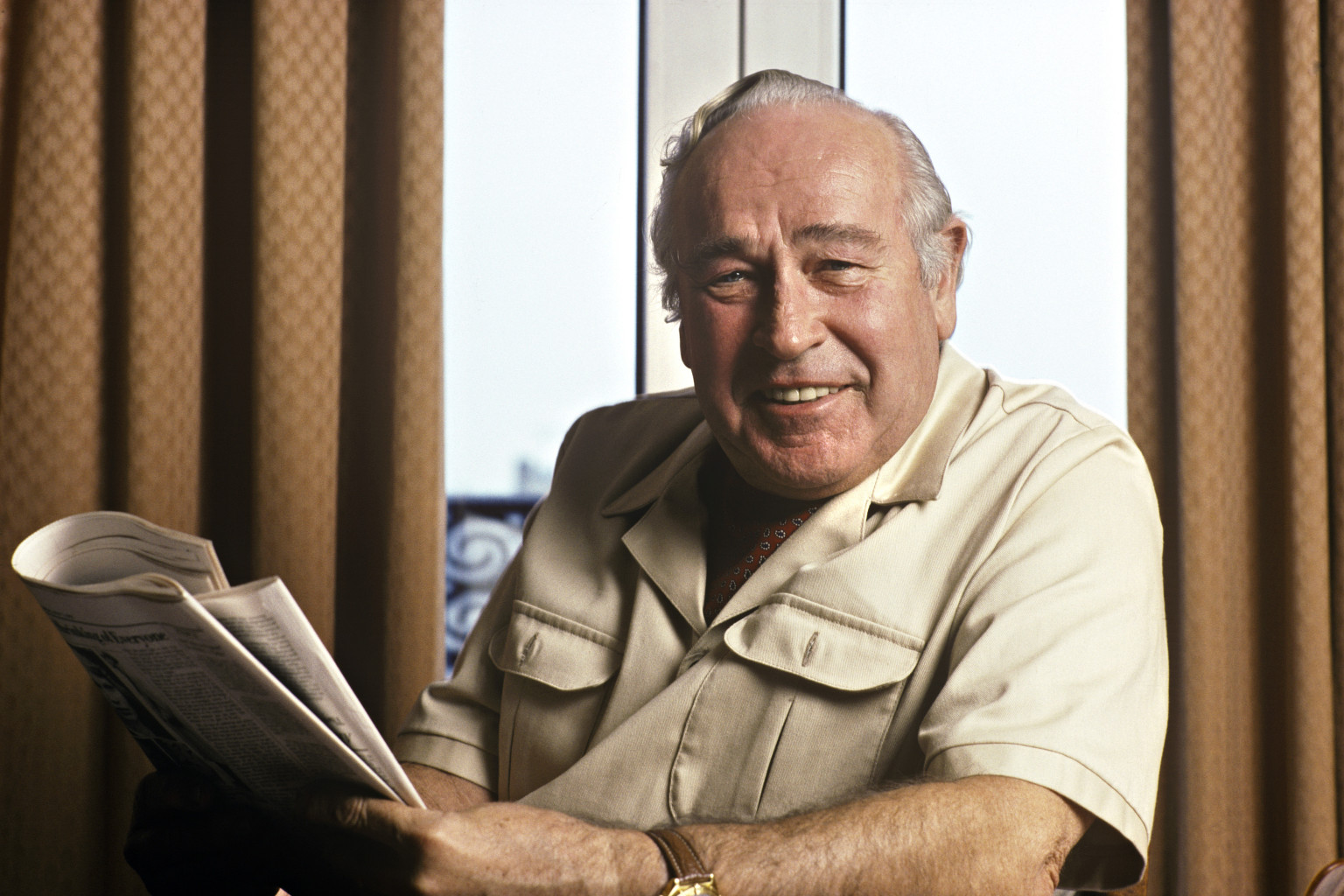
Bill Boggs interviewing legendary thriller writer Robert Ludlum, who hasn’t let his 2001 death slow “his” writing output. No year specified, but it was likely 1982. More than 30 years after these comments, the author would no doubt have been even more angered about what privacy has become during the Internet Age. Video quality less than stellar.

I admire Google for its Bell Labs-sized ambitions, but Larry Page telling us to trust his company with our private information is only slightly less ludicrous than Mark Zuckerberg lecturing the President about the NSA. It’s just a ruse to try to convince the more gullible among us that Silicon Valley isn’t Big Brother-ish. That’s a lie, of course. The government and Google and Facebook and, to a good extent, the rest of us, are all working in the same direction: to gather as much data we can to survive in the Information Age. Page and Zuckerberg want what’s inside your head; they even want to implant information there. I don’t doubt that Page has plenty of noble intentions, but a publicly traded behemoth’s largesse only goes so far. The beast must be fed.

From a WSJ report of a conversation between Page and Charlie Rose, a handsome robot who once had an epiphany on a tennis court:

In what has become a Silicon Valley ritual, Page criticized electronic surveillance by U.S. intelligence agencies, based on leaks by former National Security Agency contractor Edward Snowden.

‘We need to know the parameters of what the government is doing and why,’ Page said. ‘The government has done itself a disservice. I’m sad that Google is in the position of protecting you from what the government is doing.’

When it comes to individuals trying to shield themselves from private companies, however, Page said people shouldn’t be ‘throwing the baby out with the bath water.’

Page suggested sharing information with the ‘right’ companies is important for technology to advance, and that Google is among those companies. ‘We spend a lot of time thinking about these issues,’ he said. ‘The main thing we need to do is provide (users) choice” and show them what data will be used.'”

Tags: , , ,

Via the always amusing Delancey Place blog comes this excerpt from Ross King’s Brunelleschi’s Dome about laws governing prostitutes’ clothing in Renaissance Italy:

“Held … in Florence’s communal prison the Stinche … were more serious criminals-heretics, sorcerers, witches and murderers — for whom unpleasant fates awaited: decapitation, amputation or burning at the stake. Executions took place outside the walls, in the Prato della Giustizia, ‘Field of Justice.’ These were popular public spectacles — so popular, in fact, that criminals often had to be imported from other cities to satisfy the public’s demand for macabre drama. This vice squad worked in tandem with the Orwellian-sounding Ufficiali dell’Onesta ‘Office of Decency,’ which was charged with licensing and administering the municipal brothels that had been created in the area around the Mercato Vecchio. The specific aim of these public brothels was to wean Florentine men from the ‘greater evil’ of sodomy. Prostitutes became a common sight in Florence, not least because the law required them to wear distinctive garb: gloves, high-heeled shoes, and a bell on the head.”

Tags:

I was not a fan of the New York Times allowing the dictator Vladimir Putin to pose as a peacenik in its pages during the Syrian chemical-weapons crisis. The current Ukraine situation makes the decision look even worse. A few excerpts from Putin’s op-ed piece in the September 11, 2013 Times:

“The United Nations’ founders understood that decisions affecting war and peace should happen only by consensus…”

“No one wants the United Nations to suffer the fate of the League of Nations, which collapsed because it lacked real leverage. This is possible if influential countries bypass the United Nations and take military action without Security Council authorization.”

“The potential strike by the United States against Syria, despite strong opposition from many countries and major political and religious leaders, including the pope, will result in more innocent victims and escalation…”

“From the outset, Russia has advocated peaceful dialogue enabling Syrians to develop a compromise plan for their own future. We are not protecting the Syrian government, but international law.”

“It is alarming that military intervention in internal conflicts in foreign countries has become commonplace for the United States.”

“The world reacts by asking: if you cannot count on international law, then you must find other ways to ensure your security.”

“We are all different, but when we ask for the Lord’s blessings, we must not forget that God created us equal.”

Tags:

Technology is an opportunity but not a panacea. While the Cold War was still on, it seemed to some that interconnectivity would warm relations, that we could 0 and 1 our way to utopia. As the current headlines remind us, disconnects can still occur among the connected.

The opening of “Slow Scan To Moscow,” Adam Hochschild’s 1986 Mother Jones article about the growing electronic link between peoples of the U.S. and the Soviet Union:

“Joel Schatz has wire-rimmed glasses and an Old Testament-sized beard. A big head of curly black hair flecked with gray adds a few extra inches to his sixfoot-two frame. ‘This trip we’re about to take,’ he says enthusiastically, ‘is so important that I’ve even gotten a haircut.’ Its effects are not noticeable.

Joel is sitting in the study of his San Francisco apartment, where most of the furniture consists of pillows on the floor. The largest thing in sight is an enormous reflector telescope, which can be pivoted around on its pedestal and aimed out a high window, Joel explains, ‘to remind me of my place in the cosmos. We’re all voyagers out there.

‘If I had millions of dollars I’d build neighborhood observatories all over the world. And at each one I’d have good conga drums, so people could drum together as well as observe.’

The object of Joel’s attention at this moment, however, as it is much of the time, is his four-pound, briefcase-size Radio Shack Tandy Model 100 portable computer. ‘I bought this machine for $399. For $1.82 a minute – $1.82! – I can send a telex message to Moscow. This technology is going to revolutionize human communications! Think what it will mean when you can get thousands of Americans and Soviets on the same computer network. Once scientists in both countries begin talking to each other on these machines they won’t be able to stop. And we’ll be taking a running leap over the governments on both sides.

‘I’m not a scientist,’ Joel adds. ‘I’ve only owned a computer for four months. I don’t understand how they work. I’ll leave that to other people. I’m just interested in how they can improve communication on this planet.’”

__________________________

Radio Shack Tandy 102 portable computer, the final refresh of the 100 series:

It’s difficult to envision a time when driving by humans is outlawed even if autonomous vehicles are safer, but perhaps a “sin tax” will arise in the form of higher insurance for those who cling to the wheel. In “Would We Ever Ban Human Driving?” all sides of the issue are analyzed by Brad Templeton, who’s a consultant to Google in the driverless sector. The opening:

“I often see the suggestion that as Robocars get better, eventually humans will be forbidden from driving, or strongly discouraged through taxes or high insurance charges. Many people think that might happen fairly soon.

It’s easy to see why, as human drivers kill 1.2 million people around the world every year, and injure many millions more. If we get a technology that does much better, would we not want to forbid the crazy risk of driving? It is one of the most dangerous things we commonly do, perhaps only second to smoking.

Even if this is going to happen, it won’t happen soon. While my own personal prediction is that robocars will gain market share very quickly — more like the iPhone than like traditional automotive technologies — there will still be lots of old-style cars around for many decades to come, and lots of old-style people. History shows we’re very reluctant to forbid old technologies. Instead we grandfather in the old technologies. You can still drive the cars of long ago, if you have one, even though they are horribly unsafe death traps by today’s standards, and gross polluters as well. Society is comfortable that as market forces cause the numbers of old vehicles to dwindle, this is sufficient to attain the social goals.”

Tags:

There are few things grosser than David Brooks breathlessly extolling the virtues of meritocracy when he’s not one of the Americans who could withstand the arrival of a system that truly values talent. Here’s someone who’s been lavishly rewarded materially for being a screaming mediocrity, not nearly one of the best writers and thinkers of his generation. If people were actually judged on real flair, almost everything Brooks has would be taken from him. What he defends isn’t a just system but one based on access and privilege, of getting into the right schools and making the right connections, of “achieving” rather than creating anything novel. There are very few people I find interesting who come from Brooks’ model for success.

The opening of a recent Robert Reich article in Salon which sends some of Brooks’ customary hogwash down the drain:

“Occasionally David Brooks, who personifies the oxymoron ‘conservative thinker’ better than anyone I know, displays such profound ignorance that a rejoinder is necessary lest his illogic permanently pollute public debate. Such is the case with his New York Times column last Friday, arguing that we should be focusing on the ‘interrelated social problems of the poor’ rather than on inequality, and that the two are fundamentally distinct.

Baloney.

First, when almost all the gains from growth go to the top, as they have for the last thirty years, the middle class doesn’t have the purchasing power necessary for buoyant growth.

Once the middle class has exhausted all its coping mechanisms – wives and mothers surging into paid work (as they did in the 1970s and 1980s), longer working hours (which characterized the 1990s), and deep indebtedness (2002 to 2008) – the inevitable result is fewer jobs and slow growth, as we continue to experience.

Few jobs and slow growth hit the poor especially hard because they’re the first to be fired, last to be hired, and most likely to bear the brunt of declining wages and benefits.

Second, when the middle class is stressed, it has a harder time being generous to those in need. The ‘interrelated social problems’ of the poor presumably will require some money, but the fiscal cupboard is bare. And because the middle class is so financially insecure, it doesn’t want to, nor does it feel it can afford to, pay more in taxes.

Third, America’s shrinking middle class also hobbles upward mobility. Not only is there less money for good schools, job training, and social services, but the poor face a more difficult challenge moving upward because the income ladder is far longer than it used to be, and its middle rungs have disappeared.

Brooks also argues that we should not be talking about unequal political power, because such utterances cause divisiveness and make it harder to reach political consensus over what to do for the poor.

Hogwash. The concentration of power at the top — which flows largely from the concentration of income and wealth there — has prevented Washington from dealing with the problems of the poor and the middle class.”

Tags: ,

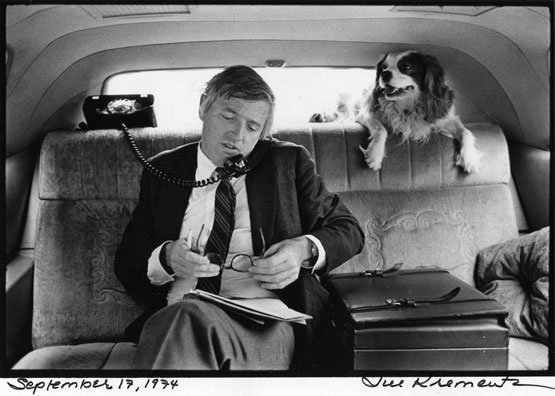
In my nightmares, ranked just below Ed McMahon’s direct participation in the Johnny Carson sex tape, is William F. Buckley discussing vivisection. That’s what he does in this 1990 Firing Line episode about animal rights that featured surgeon, Yale professor and author Dr. Sherwin Nuland (who passed away two weeks ago). The host and guest agree that animals should be used in medical experiments, though treated as “humanely” as possible. Nuland scoffs at the notion of speciesism and misnames the philosopher who popularized the concept in the 1970s, Peter Singer, as Peter “Berger.” All the while, Michael Kinsley darts around just offscreen, like an opossum with an impeccable résumé.

Tags: , , ,

Iran, 1960s.

Iran, 1960s.

As the world’s attention is fixed on Ukraine and parts unknown (wherever the missing Malaysian jetliner is), BBC’s Chief International Correspondent Lyse Doucet just conducted an Ask Me Anything at Reddit about another area of global interest, Iran. A few exchanges follow.

____________________________

Question:

What is the biggest misconception we have about life in Iran?

Lyse Doucet:

Iran is one of the most hospitable places in the world. And Iranians are also among the most inventive people I have had the pleasure to spend time with. Please don’t see it as a dark and hostile place. There are different views about the world, but it doesn’t want to turn its back on the world.

____________________________

Question:

How do Iranian women feel about their status in society compared to what it was before the Islamic revolution?

Lyse Doucet:

Women’s issues have always been at the heart of Iranian politics since the 1979 Islamic revolution. There have been advances in some areas including access to education including at University level, information and access to birth control, availability of some jobs, but not others. Women are still barred from many high level positions. Many women are hoping for greater freedoms after last year’s election of the reformist President Rouhani. But, like most Iranians, they are also just hoping that sanctions will be lifted and their daily lives will improve…

____________________________

Question:

How do you think Irans’ nuclear program is going to pan out?

Lyse Doucet:

That is the big question. on this visit i noticed that iranians, across the political spectrum, expressed support for a comprehensive nuclear deal..but that will require tough choices, on all sides..it’s still not clear there will be a deal by late July..but what is clear is that there will be a lot of work to try to reach one..

____________________________

Question:

Why do you think the general attitude of the West (western media) towards Iran has been changing in a positive way in the past few months?

Lyse Doucet:

..perhaps because more journalists are now being given visas to visit Iran ..and also because of the success of the nuclear negotiations so far..Also, the new leadership of President Rouhani and his Foreign Minister Javad Zarif are engaging with the world with a different tone.

____________________________

Question:

Would you tell us about your Internet experience in Iran?

Lyse Doucet:

I was suprised by how widely used the internet was including social media. Iranians are very inventive. They’ve found ways around the blocks on sites like twitter and facebook. To my relief, I was able to access my email account and use twitter. And Iranians, of all political persuasions, quoted my posts .

____________________________

Question:

What is daily life like for the young people of Iran and how does it compare to what we see in the Western world? Do they play video games, go insane over singers/bands, care about fashion and gossip?

Lyse Doucet:

Iranians are sometimes justifiably upset when we imagine they are somehow different from the rest of us. There is a very lively music scene, the fashion is fab (Iranian women even develop glamourous hair styles for their head scarves), Iranians of all political views are on the internet, talking to themselves and to the world. But they would like their restrictions to be lifted, and to have more freedom to come and go.•

____________________________

Iran Air TV ad that ran in the U.S. in the 1970s. Because of political fallout from the Islamic Revolution, the final flight from NYC was November 7, 1979.

Tags:

I really enjoyed Jeff Goodell’s Rolling Stone interview with Bill Gates, though I wish there were clarifying follow-up questions in two areas.

The first concerns Gates’ critique of Snowden’s info leak. Does he feel similarly about the Pentagon Papers? Would he also be opposed to an illegal leak if it exposed an Abu Ghraib situation?

The second regards the technologist’s comments about poverty in America. It comes across that Gates may believe that there aren’t Americans who are truly poor, but I doubt he really thinks that.

Here’s a rather technocratic exchange about U.S. healthcare reform and the impact new science and technologies will have on the system:

Rolling Stone:

Well, there certainly is plenty of frustration with our political system.

Bill Gates:

But I do think, in most cases, when you get this negative view of the situation, you’re forgetting about the innovation that goes on outside of government. Thank God they actually do fund basic research. That’s part of the reason the U.S. is so good [at things like health care]. But innovation can actually be your enemy in health care if you are not careful.

 Rolling Stone:

How’s that?

Bill Gates:

If you accelerate certain things but aren’t careful about whether you want to make those innovations available to everyone, then you’re intensifying the cost in such a way that you’ll overwhelm all the resources.

 Rolling Stone:

Like million-dollar chemotherapy treatments.

Bill Gates:

Yeah, or organ transplants for people in their seventies from new artificial organs being grown. There is a lot of medical technology for which, unless you can make judgments about who should buy it, you will have to invade other government functions to find the money. Joint replacement is another example. There are four or five of these innovations down the pipe that are huge, huge things.

 Rolling Stone:

Yeah, but when people start talking about these issues, we start hearing loaded phrases like ‘death panels’ and suggestions that government bureaucrats are going to decide when it’s time to pull the plug on Grandma.

Bill Gates:

The idea that there aren’t trade-offs is an outrageous thing. Most countries know that there are trade-offs, but here, we manage to have the notion that there aren’t any. So that’s unfortunate, to not have people think, ‘Hey, there are finite resources here.'”

Tags: ,

No publication birthed on the Internet is better than Aeon, a provocative stream of essays about technology, consciousness, nature, the deep future, the deep past and other fundamental concerns of life on Earth. In a world of brief tweets and easy access, the site asks the long and hard questions. Two great recent examples: Michael Belfiore’s “The Robots Are Coming,” a look at society when our silicon sisters no longer have an OFF switch; and Ross Andersen’s “Hell on Earth,” an examination of how infinite life extension will impact the justice system. (And if you’ve never read Andersen’s work about philosopher Nick Bostrom, go here and here.) Excerpts from these essays follow.

From “The Robots Are Coming”:

“Robots in the real world usually look nothing like us. On Earth they perform such mundane chores as putting car parts together in factories, picking up our online orders in warehouses, vacuuming our homes and mowing our lawns. Farther afield, flying robots land on other planets and conduct aerial warfare by remote control.

More recently, we’ve seen driverless cars take to our roads. Here, finally, the machines veer toward traditional R U R territory. Which makes most people, it seems, uncomfortable. A Harris Interactive poll sponsored by Seapine Software, for example, announced this February that 88 per cent of Americans do not like the idea of their cars driving themselves, citing fear of losing control over their vehicles as the chief concern.

The main difference between robots that have gone before and the newer variety is autonomy. Whether by direct manipulation (as when we wield power tools, or grip the wheel of a car) or via remote control (as with a multitude of cars and airplanes), machines have in the past remained firmly under human control at all times. That’s no longer true and now autonomous robots have even begun to look like us.

I got a good, long look at the future of robotics at an event run by the Defense Advanced Research Projects Agency (known as the DARPA Robotics Challenge, or DRC Trials), outside Miami in December. What I saw by turns delighted, amused, and spooked me. My overriding sense was that, very soon, DARPA’s work will shift the technological ground beneath our feet yet again.”

____________________

From “Hell on Earth”:

“It is hard to avoid the conclusion that Hitler got off easy, given the scope and viciousness of his crimes. We might have moved beyond the Code of Hammurabi and ‘an eye for an eye’, but most of us still feel that a killer of millions deserves something sterner than a quick and painless suicide. But does anyone ever deserve hell?

That used to be a question for theologians, but in the age of human enhancement, a new set of thinkers is taking it up. As biotech companies pour billions into life extension technologies, some have suggested that our cruelest criminals could be kept alive indefinitely, to serve sentences spanning millennia or longer. Even without life extension, private prison firms could one day develop drugs that make time pass more slowly, so that an inmate’s 10-year sentence feels like an eternity. One way or another, humans could soon be in a position to create an artificial hell.

At the University of Oxford, a team of scholars led by the philosopher Rebecca Roache has begun thinking about the ways futuristic technologies might transform punishment. In January, I spoke with Roache and her colleagues Anders Sandberg and Hannah Maslen about emotional enhancement, ‘supercrimes’, and the ethics of eternal damnation. What follows is a condensed and edited transcript of our conversation.

Ross Andersen:

Suppose we develop the ability to radically expand the human lifespan, so that people are regularly living for more than 500 years. Would that allow judges to fit punishments to crimes more precisely?

Rebecca Roache:

When I began researching this topic, I was thinking a lot about Daniel Pelka, a four-year-old boy who was starved and beaten to death [in 2012] by his mother and stepfather here in the UK. I had wondered whether the best way to achieve justice in cases like that was to prolong death as long as possible. Some crimes are so bad they require a really long period of punishment, and a lot of people seem to get out of that punishment by dying. And so I thought, why not make prison sentences for particularly odious criminals worse by extending their lives?

But I soon realised it’s not that simple. In the US, for instance, the vast majority of people on death row appeal to have their sentences reduced to life imprisonment. That suggests that a quick stint in prison followed by death is seen as a worse fate than a long prison sentence. And so, if you extend the life of a prisoner to give them a longer sentence, you might end up giving them a more lenient punishment.

The life-extension scenario may sound futuristic, but if you look closely you can already see it in action, as people begin to live longer lives than before. If you look at the enormous prison population in the US, you find an astronomical number of elderly prisoners, including quite a few with pacemakers. When I went digging around in medical journals, I found all these interesting papers about the treatment of pacemaker patients in prison.”

Tags: , , ,

In an interview conducted by Marlow Stern of the Daily Beast, Robert Duvall runs down Johnny Depp, True Detective, James Gray and one of my all-time favorite films, Network. Here’s an exchange about American history and politics:

The Daily Beast:

Republicans in Hollywood seem to get a lot of flack and be a bit marginalized. Has it ever been tough, for you, to be a Republican in Hollywood?

Robert Duvall:

Let me say it this way: my wife’s from Argentina, she’s been here for a while, and she’s very smart. She calls herself a ‘tree-hugging Republican,’ but she might even vote Democrat next time because the Republican Party is a mess. I’ll probably vote Independent next time. I think it was Jack Kerouac who said something like, ‘Don’t run down my country. My people are immigrants, so I believe in this country with all its faults. To me, it’s a big country that’s made mistakes.’ Some of the bleeding-heart left-wing, extreme left-wing, are actually different from liberals. That movie The Butler? It’s very inaccurate. JFK had one of the worst Civil Rights voting records. And the Rockefellers were much more liberal with the blacks. All the atrocities in the South were committed by the Democratic Party, but now, everything’s been turned around in a strange way. Some of these very conservative Republicans… I don’t know, man. I believe in a woman’s choice. I believe in certain things. I hear they booed Rick Perry last night on the Jimmy Kimmel Show. But it’s a great country. We’ve done bad things. Slavery was terrible. One-third of all Freedmen in New Orleans fought for the South. I can’t figure that out. Those things aren’t told in the history books. There’ve been lots of contradictions and this and that. But I think the country’s okay, and hopefully it will survive.”

Tags: ,

An interesting (if audio-only) 1977 Tonight Show clip of Gore Vidal, who may have been Sandusky, trashing Jimmy Carter during the opening weeks of his Presidency, discussing income inequality and demonstrating a waterless toilet. As with all episodes of the program, Johnny Carson performed the monologue with a loaded gun and a bag of cocaine stashed in his underpants.

Tags: ,

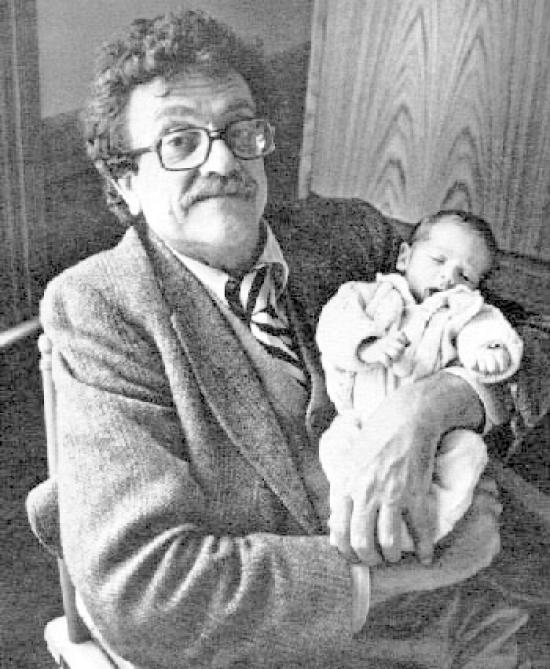
From Kurt Vonnegut’s 1988 missive to the people of 2088, via Letters of Note, the guidance wise political leaders would give to citizens in regards to Mother Nature:

  1. Reduce and stabilize your population.
  2. Stop poisoning the air, the water, and the topsoil.
  3. Stop preparing for war and start dealing with your real problems.
  4. Teach your kids, and yourselves, too, while you’re at it, how to inhabit a small planet without helping to kill it.
  5. Stop thinking science can fix anything if you give it a trillion dollars.
  6. Stop thinking your grandchildren will be OK no matter how wasteful or destructive you may be, since they can go to a nice new planet on a spaceship. That is really mean, and stupid.
  7. And so on. Or else.

Tags:

The Pew Research Center released its “Digital Life in 2025” report. Here are two items from its “15 Theses About the Digital Future,” neither of which is particularly surprising.

From “More-hopeful theses”:

• Information sharing over the Internet will be so effortlessly interwoven into daily life that it will become invisible, flowing like electricity, often through machine intermediaries.

David Clark, a senior research scientist at MIT’s Computer Science and Artificial Intelligence Laboratory, noted, “Devices will more and more have their own patterns of communication, their own ‘social networks,’ which they use to share and aggregate information, and undertake automatic control and activation. More and more, humans will be in a world in which decisions are being made by an active set of cooperating devices. The Internet (and computer-mediated communication in general) will become more pervasive but less explicit and visible. It will, to some extent, blend into the background of all we do.”

Joe Touch, director at the University of Southern California’s Information Sciences Institute, predicted, “The Internet will shift from the place we find cat videos to a background capability that will be a seamless part of how we live our everyday lives. We won’t think about ‘going online’ or ‘looking on the Internet’ for something — we’ll just be online, and just look.understood.”

From “Less-hopeful theses”:

• Dangerous divides between haves and have-nots may expand, resulting in resentment and possible violence.

Oscar Gandy, an emeritus professor at the Annenberg School, University of Pennsylvania, explained, “We have to think seriously about the kinds of conflicts that will arise in response to the growing inequality enabled and amplified by means of networked transactions that benefit smaller and smaller segments of the global population. Social media will facilitate and amplify the feelings of loss and abuse. They will also facilitate the sharing of examples and instructions about how to challenge, resist, and/or punish what will increasingly come to be seen as unjust.”

Tags: , ,

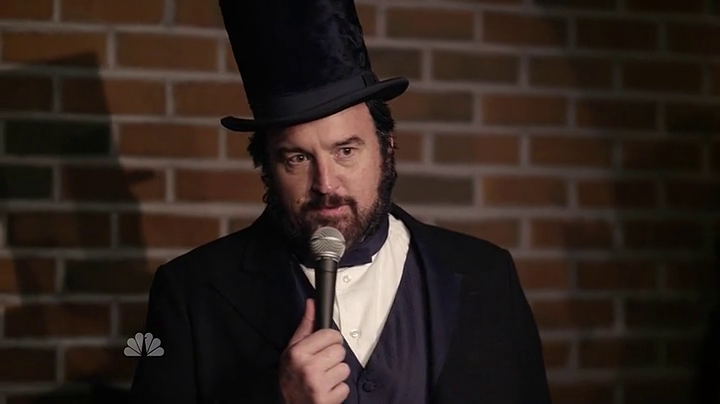
President Abraham Lincoln, refined man that he was, always turned down requests to appear on faux talk shows on the Internet. But here are some other things he agreed to do (courtesy of Carl Sandburg’s Abraham Lincoln: The Prairie Years):

Judge cockfights:

“The Clary’s Grove boys called on [Lincoln] sometimes to judge their horse races and cockfights, umpire their matches and settle disputes. One story ran that Lincoln was on hand one day when an old man had agreed, for a gallon jug of whisky, to be rolled down a hill in a barrel. And Lincoln talked and laughed them out of doing it. He wasn’t there on the day, as D.W Burner told it, when the gang took an old man with a wooden leg, built a fire around the wooden leg, and held the man down until the wooden leg was burned off.”

Wrestle for the entertainment of knife-wielding gamblers:

“Offut talked big about Lincoln as a wrestler, and Bill Clary, who ran a saloon thirty steps north of the Offut store, bet Offut that Lincoln couldn’t throw Jack Armstrong, the Clary’s Grove champion. Sports from miles around came to a level square next to Offut’s store to see the match; bets of money, knives, trinkets, tobacco, drinks were put up, Armstrong, short and powerful, aimed from the first to get in close to his man and use his thick muscular strength. Lincoln held him off with long arms, wore down his strength, got him out of breath, surprised and ‘rattled.’ They pawed and clutched in many holds and twists till Lincoln threw Armstrong and had both shoulders to the grass.”

Drink whiskey from bungholes:

“When a small gambler tricked Bill Greene, Lincoln’s helper at the store, Lincoln told Bill to bet him the best fur hat in the store that he [Lincoln] could lift a barrel of whisky from the floor and hold it while he took a drink from the bunghole. Bill hunted up the gambler and made the bet. Lincoln sat squatting on the floor, lifted the barrel, rolled it on his knees till the bunghole reached his mouth, took a mouthful, let the barrel down–and stood up and spat out the whisky.”

Press barefoot boys’ muddy soles to the ceiling:

“He put barefoot boys to wading in a mud puddle near the home trough, pulled them up one by one, carried them to the house upside down, and walked their muddy feet across the ceiling. The stepmother came in, laughed at their foot tracks, told Abe he ought to be spanked–and he cleaned the ceiling so that it looked new.”

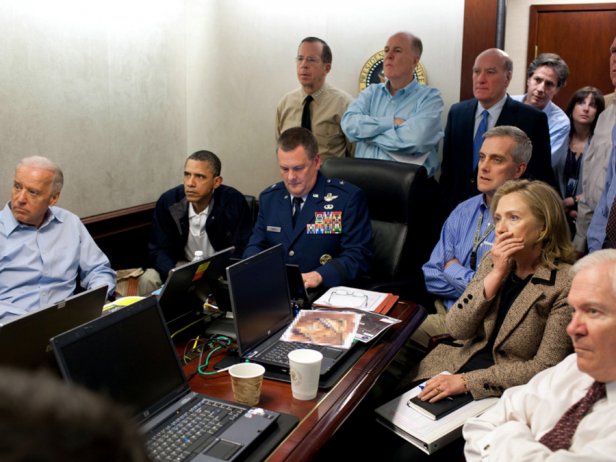
Last year Seymour Hersh made comments about the official U.S. government report regarding the Obama bin Laden killing, labeling it as “bullshit.” It was taken to mean initially that the journalist believed the terrorist hadn’t actually been eliminated, but he quickly clarified, saying that bin Laden was dead but that the White House version of the mission was fantastical. In a wide-ranging New Republic interview conducted by Isaac Chotiner, New Yorker editor David Remnick pushes back at his contributor’s assertion. An excerpt:

Isaac Chotiner:

Speaking of Hersh, he claims that the U.S. government’s story of the Osama bin Laden raid is bullshit. What do you say to that given that your magazine ran a piece that relied heavily on government sources?

David Remnick:

I thoroughly stand by the story we published.

Isaac Chotiner:

And his comments?

David Remnick:

Look, there is a difference between what people say loosely or in speeches and what we publish. All I can be in charge of is what we publish. I have enormous respect for him.

Isaac Chotiner:

Hersh wrote a piece a few months back hinting that the rebels were the ones who used chemical weapons in Syria. Why did that run in the London Review of Books and not The New Yorker?

David Remnick:

Or The Washington Post. I have worked with Sy on many dozens of pieces and am proud of that work. And a lot of those pieces had the potential to break a lot of crockery. I was willing, and am still willing, to go to the wall with investigative journalism. But if he and I disagree, it is not an easy thing. I hope we will work again together. I hope you will print this: I wish him all the best, and I think he is one of the great journalists of our age.”

Tags: , , ,

Sir Tim Berners-Lee, who gave us the web and refuses to take it back no matter how nicely we ask, just did an AMA at Reddit. A few exchanges follow.

___________________________

Question:

Do you ever look at the stuff on the web now and feel like Robert Oppenheimer?

Tim Berners-Lee:

No, not really. The web is a — primarily neutral — tool for humanity. When you look at humanity you see the good and the bad, the wonderful and the awful. A powerful tool can be used for good or ill. Things which are really bad are illegal on the web as they are off it. On balance, communication is good think I think: much of the badness comes from misunderstanding.

___________________________

Question:

Edward Snowden- Hero or Villain?

Tim Berners-Lee:

Because he ✓ had no other alternative ✓ engaged as a journalist / with a journalist to be careful of how what was released, and ✓ provided an important net overall benefit to the world, I think he should be protected, and we should have ways of protecting people like him. Because we can try to design perfect systems of government, and they will never be perfect, and when they fail, then the whistleblower may be all that saves society.

___________________________

Question:

What are your thoughts on the increased surveillance on internet based mediums like GCHQ’s monitoring of all the Yahoo video chats. Do you personally think it should be controlled, non existent or fine the way it is now?

Tim Berners-Lee:

I think that some monitoring of the net by government agencies is going to be needed to fight crime. We need to invent a new system of checks and balances with unprecedented power to be able to investigate and hold the agencies which do it accountable to the public.

___________________________

Question:

What other names did you consider other than the world wide web?

Tim Berners-Lee:

Mine of Information, The Information Mine, The Mesh

None had quite the right ring. I liked WWW partly because I could start global variable names with a W and not have them clash with other peoples’ (in a C world) …in fact I used HT for them)

___________________________

Question:

What was one of the things you never thought the internet would be used for, but has actually become one of the main reasons people use the internet?

Tim Berners-Lee:

Kittens.•

Tags: ,

The automation of the workforce is good in the long run but difficult until the new normal becomes, well, normal. How can a roboticized economy and a free-market economy coexist? New industries will be created, of course, but there still may be a shortfall in employment. One solution: an economic output tax. From Rachel Emma Silverman at the WSJ:

“Carl Bass, the chief executive of Autodesk, acknowledged that workplace automation has eliminated or reduced many manufacturing jobs, and will continue to do so in the future, leading to major shifts in the labor market. Entire industries, such as trucking, will eventually be disrupted by robotic advances like self-driving cars, he said. (Bass cited the book, The Second Machine Age, by Erik Brynjolfsson and Andrew McAfee as a source for this robot-heavy scenario.)

But, Bass asked: ‘Are the jobs lost to automation ones that you would want for your children?’ Few parents, he said, dreamed their kids would someday become fuel pumpers or elevator operators, jobs already replaced by automation. In the next 30 years, Bass added, smart machines and robots will outnumber humans on the planet.

Bass presented some outlandish ideas to help societies deal with the structural changes generated by a robot-heavy workforce, including taxing economic output rather than income, or implementing a ‘negative income tax,’ in which governments pay citizens a stipend in order to guarantee a level of income.

‘With our creativity and imagination, we will find harmony with the robots,’ Bass said.”

Tags: , , ,

« Older entries § Newer entries »