Politics

You are currently browsing the archive for the Politics category.

From the Bulletin of Atonmic Scientists, about one of the lesser costs, the financial one, of the wars in Iraq and Afghanistan:

“If the newspapers periodically remind us of these slain American soldiers by showing us the ‘faces of the fallen,’ the injured are less visible, but the cost of caring for them will only increase. Nearly 100,000 American soldiers have been officially wounded in Iraq and Afghanistan, but many injuries, such as post-traumatic-stress disorder, may not manifest until after deployment. More than 522,000 veterans of our Middle Eastern wars have now filed disability claims. Based on prior experience in World War II, Korea, and Vietnam, we know that the health care costs of such veterans do not peak until 30 to 40 years after the wars are over. In other words, we could pull every last soldier out of Iraq and Afghanistan tomorrow, but the costs of caring for them will keep climbing until at least 2040. These costs are expected to total between $600 billion and $1 trillion.”

The Morning Show on CBS on early September 11, 2001, right before the attacks began:

Margaret Mead commenting on speeded-up America in Life in 1968, remarks that seem even more applicable in our time:

“There is tremendous confusion today about change. This isn’t surprising because people are living in a period of the fastest change the world has ever known. Young people have been confronted with the changes, but at the same time they have no sense of history and no one has been able to explain to them what has happened. We are always very poor at teaching the last 25 years of history. Adults have been shrieking about the fact that great newnesses are here but they are not talking about what the newnesses are.”

••••••••••

“Trance And Dance In Bali,” by Margaret Mead and Gregory Bateson, 1939:

Tags:

After two decades of the GOP trying to destroy a couple of moderate Presidents whose main fault is that they belong to another party, we should drop the pretense that a Republican Party still exists. It’s fully and finally the Tea Party now. It’s a political group based on scorched-earth policies, bad science, tax cuts for the wealthy and adherence to an irrational and injurious ideology at all costs. It’s politics as hostage negotiations and nothing more.

Bill Clinton may have had moral failings that made him an easy target (though he wasn’t nearly as morally bankrupt as those who pursued him), but he was going to be targeted regardless. Obama, who has made it easy for them to rally their base by virtue of being black and intelligent, is a clear centrist who has been branded an extremist and undermined at every turn at the expense of the American people. The Tea Party will now run its Presidential election saying that the economy is struggling because of too many government restrictions (too little oversight caused the economic collapse) and high taxes on so-called “job creators” (taxes have been low on the wealthy for almost a decade and no jobs have been created because of it).

Mike Lofgren, a Republican operative for 30 years, recently stepped away from what he now sees as a fringe party. He’s written about the experience on truthout. An excerpt:

“To those millions of Americans who have finally begun paying attention to politics and watched with exasperation the tragicomedy of the debt ceiling extension, it may have come as a shock that the Republican Party is so full of lunatics. To be sure, the party, like any political party on earth, has always had its share of crackpots, like Robert K. Dornan or William E. Dannemeyer. But the crackpot outliers of two decades ago have become the vital center today: Steve King, Michele Bachman (now a leading presidential candidate as well), Paul Broun, Patrick McHenry, Virginia Foxx, Louie Gohmert, Allen West. The Congressional directory now reads like a casebook of lunacy.

It was this cast of characters and the pernicious ideas they represent that impelled me to end a nearly 30-year career as a professional staff member on Capitol Hill. A couple of months ago, I retired; but I could see as early as last November that the Republican Party would use the debt limit vote, an otherwise routine legislative procedure that has been used 87 times since the end of World War II, in order to concoct an entirely artificial fiscal crisis. Then, they would use that fiscal crisis to get what they wanted, by literally holding the US and global economies as hostages.

The debt ceiling extension is not the only example of this sort of political terrorism. Republicans were willing to lay off 4,000 Federal Aviation Administration (FAA) employees, 70,000 private construction workers and let FAA safety inspectors work without pay, in fact, forcing them to pay for their own work-related travel – how prudent is that? – in order to strong arm some union-busting provisions into the FAA reauthorization.”

Tags:

From “Lost in the Supermarket,” David Mattin’s attempt to make sense of the recent London riots, published today at the Los Angeles Review of Books:

“Now, two weeks on, Britain is puzzling over what has happened. In the sound of the metropolitan British middle-class — the politicians, the columnists, the activists — trying to explain these riots to each other, there can be discerned a strange, schizophrenic mixture of anger and uncertainty, a frustrating inability to get much beyond first principles. What caused these riots? What do the people who participated in them want? What do they tell us about the country in which we live? What, in short, do the riots mean? 

Across the last two weeks, these questions have been the subject of much talk; they can accommodate so much talk because their answers are so elusive. Even the left’s best attempt to imbue the riots with a meaning — the argument that contends that they were an expression of inchoate anger at the current austerity, and the mismanagement that brought us to it — is, on close examination, not satisfactory. And that is because there is a sense in which the English riots of 2011 mean nothing at all. Nothing, at least, to the people who participated in them. Which is what makes them so uniquely frightening, and problematic. “

Tags:

Jaron Lanier, who was profiled in the New Yorker not long ago, holds forth at Edge on human capital in the age of machines:

This brings us back, literally thousands of years to an ancient discussion that continues to this day about exactly how people can make a living, or make their way when technology gets better. There is an Aristotle quote about how when the looms can operates themselves, all men will be free. That seems like a reasonable thing to say, a precocious thing for somebody to have said in ancient times. If we zoom forward to the 19th century, we had a tremendous amount of concern about this question of how people would make their way when the machines got good. In fact, much of our modern intellectual world started off as people’s rhetorical postures on this very question.

Marxism, the whole idea of the left, which still dominates the Bay Area where this interview is taking place, was exactly, precisely about this question. This is what Marx was thinking about, and in fact, you can read Marx and it sometimes weirdly reads likes a Silicon Valley rhetoric. It’s the strangest thing; all about ‘boundaries falling internationally,’ and ‘labor and markets opening up,’ and all these things. It’s the weirdest thing.

In fact, I had the strange experience years ago, listening to some rhetoric on the radio … it was KPFA, in fact, the lefty station … and I thought, ‘Oh, God, it’s one of these Silicon startups with their rhetoric about how they’re going to bring down market barriers,’ and it turned out to be an anniversary reading of Das Kapital. The language was similar enough that one could make the mistake.

The origin of science fiction was exactly in this same area of concern. H.G. Wells’ The Time Machine foresees a future in which there are the privileged few who benefit from the machines, and then there are the rest who don’t, and both of them become undignified, lesser creatures. Separate species.•


H.G. Wells meets Orson Welles in San Antonio (audio only):

Tags: , ,

The city of Bonn, trying desperately to make up for budget shortfalls, has instituted a tax on prostitution, which is legal in Germany. Since many sex workers are from overseas and don’t understand the language, Bonn officials have come up with a solution in the form of a “sex meter.” From Spiegel:

“The budget is tight in Bonn. So tight, in fact, that city officials instituted a new ‘sex tax’ for prostitution this year. They hoped to raise up to €200,000 per year in additional revenues.

Yet while it might sound straightforward enough, the sex tax has been difficult to enforce among those prostitutes who do not work in established brothels and sex clubs. Leading the city to come up with plan B: an automated ticket machine in an area frequented by prostitutes and their customers.

Since Monday, freelance sex workers on the city streets have been required to pay €6 per night into the machine, which resembles an automated parking ticket distributor. This machine, however, emits nightly permits to practice prostitution.”

957562-news-file-fake-apple-store-20110721

The metaphor is too obvious for someone else not to have also thought of it. There were a rash of news stories a few weeks back about the numerous fake Apple stores popping up in China, and the question is this: Can China, with its present government and business structure, ever turn out a company like Apple? One that’s innovative and leads the market?

It’s obviously a generalization, but China seems more like Microsoft Nation, appropriating ideas and managing them with brutal efficiency. And that can certainly be very successful for a long time, but can that success be sustained without the fuel of original inventions? Perhaps that nation is about to file a huge number of patents, and I just know nothing about it. But for all its many strengths, China doesn’t seemed to be positioned to nurture free-thinking entrepreneurs.•

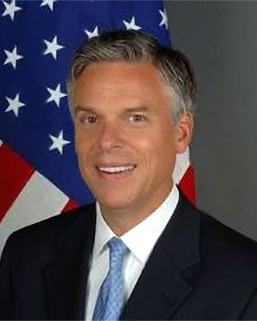
Only in the Bizarro world of 2011, when the Republican Party is essentially the de facto Tea Party, can Jon Huntsman seem too liberal to be the party’s Presidential nominee. He’s ultra-conervative on social issues and has the type of sophisticated intelligence that could be attractive to Independents who’ve wearied of Obama. But because he believes in global warming and thought the debt ceiling shenanigans were ridiculous, he has essentially no shot at the nomination. You will accept the self-defeating ideology without question or else. An excerpt about Huntsman’s formative years at the American Conservative:

“Huntsman Jr. had a rebellious phase. He dropped out of high school to focus on his progressive-rock band, Wizard. Ask him about those days and he slips into semi-seriousness. He describes Emerson Lake and Palmer, Yes, and Genesis as ‘highly impactful in terms of [his] view of the music world.’ And he jokes that the ’80s were a mostly ‘lost decade’ in terms of music when explaining his fondness for ’90s acts like the Foo Fighters and Ben Folds Five.

He eventually completed his GED and went to University of Utah; he also went on a two-year mission on behalf of the LDS church. Assigned to Taiwan, he quickly set to learning Standard Chinese Mandarin and Taiwanese Hokkein. These years proved pivotal. He not only acquired the skills that would allow him to expand his father’s business in Asia, he also found himself an unofficial diplomat.

‘It was not just the effort to learn the language, the effort to learn the new highly structured system,’ he recalls, ‘I learned a lot about Asia, and I learned a lot about the United States.’ Huntsman arrived in Taiwan in the years following the Shanghai Communique, during which U.S. relations with mainland China began to normalize, a development that angered the Taiwanese.” (Thanks Marginal Revolution.)

••••••••••

Prog rock, via Anderson, Bruford, Wakeman and Howe:

Dean discovers prog rock:

Tags:

Stetson Kennedy, the civil rights activist and folklorist, just passed away at 94. Kennedy wrote the book, I Rode With The Ku Klux Klan, in the 1950s, which was an eye-opener for America, but he was later acccused (rightly, it would seem) of exaggeration and sensationalism. He even brought his anti-KKK struggle to the airwaves while working as a consultant for the Superman radio program. Kennedy ran (unsuccessfully) for governor of Florida, and Woody Guthrie wrote a song about him. Quite a life.

Kennedy interviewed for Freakonomics:

Billy Bragg sings “Stetson Kennedy”:

Tags: ,

From Jon Gertner’s excellent New York Times Magazine article about the burgeoning lithium-battery market and the future of manufacturing in America:

“On both sides of the world, the fundamental appeal of expanding manufacturing is jobs. It is a curiosity of modern life that information companies can create extraordinary social disruptions and vast shareholder wealth but relatively few jobs. Facebook has about 2,000 employees worldwide. Google has about 29,000. Even in its new, slimmed-down state, General Motors, a decidedly less valuable company, has about 200,000 employees. What’s more, that number represents only a fraction of the people behind the production of a G.M. car. ‘When you’re manufacturing anything, even if the work is done by robots and machines, there’s an incredible value chain involved,’ Susan Hockfield, the president of M.I.T., says. ‘Manufacturing is simply this huge engine of job creation.’ For batteries, that value chain would include scientists researching improved materials to companies mining ores for metals; contractors building machines for factory work; and designers, engineers and machine operators doing the actual plant work. By some estimates, manufacturing employs about 65 percent of America’s scientists and engineers.”

Tags: ,

In 1959, Hugh Hefner talks with Lenny Bruce, who had not yet been consumed by heroin and legal troubles.

Tags: ,

Speaking of The Day of the Locust

  • Rep. Joe Wilson: “You lie!”

  • Town Hall, WI: “Congressman Steve Kagen…found out the rough way.”

  • Casey Anthony trial: “Calm down! Calm down!”

  • Candlestick Park shooting: “Both inside the stadium and out, it was chaotic.”

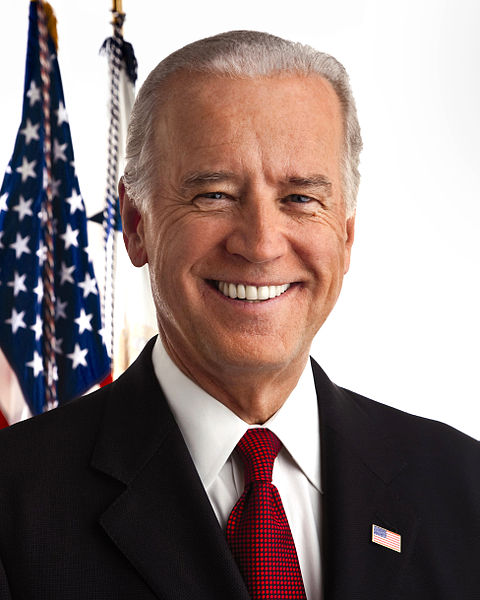
Joe Biden famously christened health-care reform as a “Big Fucking Deal,” but there is another BFD in his past, an inexplicable one, which may be health-care reform’s undoing when lawsuits go before the Supreme Court next year. An excerpt from Jeffrey Toobin’s excellent new New Yorker profile about Justice Clarence Thomas and his equally conservative wife, Virginia:

“Thomas was confirmed in the Senate by a vote of fifty-two to forty-eight, and neither the Judiciary Committee nor any other part of the government has since seen fit to reëxamine the Thomas-Hill controversy. Still, a good deal of evidence has since emerged about the protagonists and their testimony. Even near the end of the hearings, several other women who had worked for Thomas were prepared to testify and corroborate Hill’s testimony that Thomas had a history of making female subordinates uncomfortable with personal and sexual talk. The group included Angela Wright, Rose Jourdain, and Sukari Hardnett; other associates of Thomas, among them Kaye Savage and Fred Cooke, would have testified about the nominee’s long-standing interest in pornography, which would have corroborated Hill’s account. But Joseph Biden, the chairman of the Judiciary Committee at the time, decided not to call these witnesses. This year, Lillian McEwen, a Washington lawyer who had a long-term romantic relationship with Thomas before he met Ginni, published a memoir, D.C. Unmasked & Undressed. She, too, remarked on the Justice’s ‘strong interest in pornography,’ and she also said that Thomas scrutinized his work colleagues as prospective sexual partners. In short, virtually all the evidence that has emerged since the hearings corroborates Hill’s version of events.”

••••••••••

Anita Hill, October 11, 1991:

Tags: , , , , , , , , ,

"They lack the ability to process all that information in real time and then intelligently act on the results." (Image by Bin im Garten.)

From Autonomous Robots in the Fog of War,” Lori G. Weiss’ new IEEE Spectrum report about the future of robotic warfare, which may be more in the distance than in the offing:

“So why haven’t we seen a fully autonomous robot that can sense for itself, decide for itself, and seamlessly interact with people and other machines? Unmanned systems still fall short in three key areas: sensing, testing, and interoperability. Although the most advanced robots these days may gather data from an expansive array of cameras, microphones, and other sensors, they lack the ability to process all that information in real time and then intelligently act on the results. Likewise, testing poses a problem, because there is no accepted way to subject an autonomous system to every conceivable situation it might encounter in the real world. And interoperability becomes an issue when robots of different types must interact; even more difficult is getting manned and unmanned systems to interact.

To appreciate the enormous challenge of robotic sensing, consider this factoid, reported last year in The Economist: ‘During 2009, American drone aircraft…sent back 24 years’ worth of video footage. New models…will provide ten times as many data streams…and those in 2011 will produce 30 times as many.’ It’s statistics such as those that once prompted colleagues of mine to print up lanyards that read ‘It’s the Sensor, Stupid.'”

••••••••••

BigDog, from the good people at Boston Dynamics:

Tags:

In “What Would Hillary Clinton Have Done?” Rebecca Traister’s smart piece in this week’s New York Times Magazine, the writer offhandedly raises a provocative question in the margins: Would there be a Tea Party if Barack Obama wasn’t President and a white Democrat was? I suppose my answer is “yes.”

The Tea Party is ostensibly a reaction to our financial sector’s gross malfeasance (which does indeed exist), a greater government interference in our lives (which does not) and a rising budgetary deficit (which didn’t seem to bother them while W. was creating it). But you don’t have to look too closely to see the racism barely below the surface.

The biggest tell is the Birther movement. Obama is not the same color as us and has a name that is different than ours, so he is Other. And “non-American” is, of course, just a code word for “non-white.” And the incivility directed at Obama from elected officials and a Supreme Court justice is a disrespect that seems to be driven by feelings of entitlement, perhaps the racial kind.

But let’s recall Bill Clinton’s Presidency and the viciousness directed at him. In Clinton’s case he was labeled “Liberal,” which in many ways was about as accurate as calling Obama “Kenyan.” The Christian Conservative movement that fueled the Reagan ascendancy came up against the first President who wasn’t its choice, and things got ugly in a hurry. Hillary Clinton was likewise smeared, in a sexist way. There was no organized Tea Party, but the same anti-progress strain was driving the movement.

Chris Rock has referred to the Birther Movement in particular and the Tea Party in general as the last angry vestiges of racism, the scary loudness being nothing more than a death rattle. That may be true when it comes to the racial element. But can’t anyone be demonized by this segment of our society if its greatest fear isn’t of a black planet but simply of the future?•

Tags:

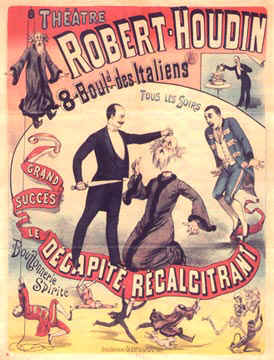
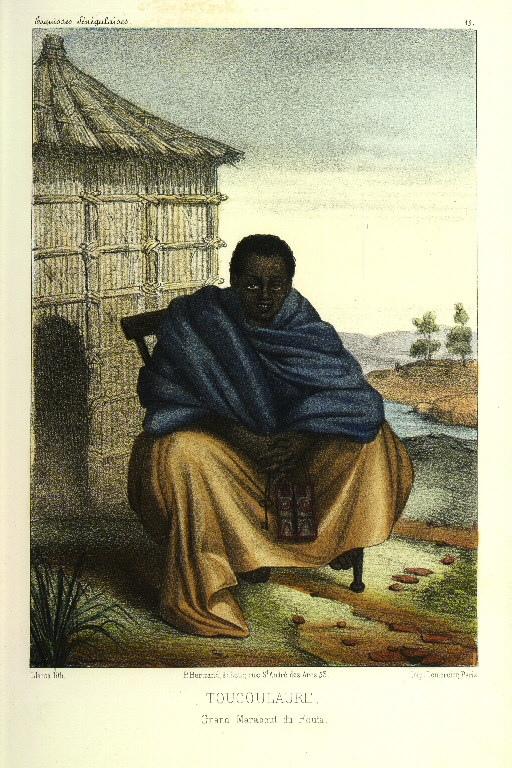
Magicians used to take the name of a famous predecessor, bastardize it slightly, and pay homage to their forebearer while placing themselves in a continuum. Harry Houdini, born Ehrich Weiss, took his name from the famed French magus Jean Eugène Robert-Houdin. At one point, the Frenchman was supposedly assigned by his government the odd task of traveling to Algeria and using his hocus-pocus to influence so-called Arab tribes away from the guidance of Islamic leaders (or “marabouts,” as they are referred to in the piece.) An excerpt about this deeply ethnocentric (and largely fictional) story from an awkwardly written piece in the November 7, 1857 Brooklyn Daily Eagle, which originally appeared in the London Times:

“Every one has seen or heard speak of Robert Houdin. Besides being the prince of conjurers he is an able mathematician and mechanician, and his electric clock, made for the Hotel de Ville of his native town of Blois, obtained a medal of the Paris exhibition. It is not generally known that he was sent to Algeria by the French Government, on a mission connected with the Black Art–probably the first time that a conjurer has been called upon to exercise his profession in government employ. Some details of his expedition have been published. Its object was to destroy the influence exercised among the Arab tribes by the marabouts–an influence often mischievously applied. By a few clumsy tricks and impostures these marabouts pass themselves off as sorcerers; no one it was thought, was better able to eclipse their skill and discredit their science than the man of inexhaustible bottles.

One of the greatest pretensions of the marabouts was to invulnerability. At the moment that a loaded musket was fired at him, amd the trigger pulled, he pronounced a few cabalistic words, and the weapon did not go off. Houdin detected the trick, and showed that the touchhole was plugged. The Arab wizard was furious and abused the French rival.

‘You may revenge yourself,’ quietly remarked Houdin, ‘take a pistol, load it yourself; here are bullets, put one in the barrel, but before doing so mark it with your knife.’ The Arab did as he was told.
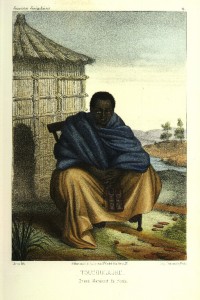
"A fanatical marabout had agreed to give himself up to the sorcerer."

‘You are quite certain, now,’ said Houdin, ‘that the pistol is loaded and will go off. Tell me, do you feel no remorse in killing me thus, notwithstanding that I authorize!’

‘You are my enemy,’ cooly replied the Arab, ‘I will kill you.’ Without replying, Houdin struck an apple on the point of a knife, and calmly gave the word to fire.

The pistol was discharged, the apple flew far away, and there appeared in its place, stuck on the point of the knife, the bullet the marabout had marked.

The spectators remained mute from stupefaction; the marabout bowed before his superior; ‘Allah is great,’ he said, ‘I am vanquished.’ Instead of the bottle from which, in Europe, Robert Houdin pours an endless stream of every description of wine and liquor, he called for an empty bowl, which he kept continually full of boiling coffee, but few of the Arabs would taste it, for they made sure that they came from the devil’s own coffee pot. He told them that it was in his power to deprive them of all strength and to restore it to them at will, and he produced a small box, so light that a little child could lift it with its finger; but it suddenly became so heavy that the strongest man present could not life it, and the Arabs, who prize physical strength above everything. looked with terror at the great magician who, they doubted not, could annihilate them by the mere exertion of his will. They expressed this belief; Houdin confirmed them in it, and promised that on a day appointed, he would convert one of them into smoke. The day came; the throng was prodigious; a fanatical marabout had agreed to give himself up to the sorcerer. They made him stand upon a table and covered him with a transparent gause; then Houdin and another person lifted the table by the two ends, and the Arab disappeared in the cloud of smoke.

The terror of the spectators was indescribable; they rushed out of the place and run a long distance before some of the boldest thought of returning to look after the marabout. They found him near the place where he had been evaporated; but he could tell them nothing, and was like a drunken man, ignorant of what had happened to him. Thenceforward Houdin was venerated and the marabouts despised; the object of the French Government was completely attained.”
Harold Bloom on the Tea Party, via the Browser:

What are the rewards of reading, and of literary scholarship?

Harold Bloom: One must read, try to possess by memory, and be possessed by the very best that has been imagined, cognitively apprehended and expressed powerfully. Thinking clearly and well is based upon memory. Unless you have read and absorbed the best that can be read and absorbed, you will not think clearly or well, and democracy will not survive.

We have this horrible contemporary phenomenon in the Tea Party – a real menace not only to America but to the world. Because if it goes on like this, they will destroy our economy and they will destroy America. They have no democratic vision, and I don’t mean with a capital ‘D’, I mean with a small ‘d’. They frighten me. They’re like the early followers of Adolf Hitler, and I’m willing to be quoted on that. They are a sickening phenomenon. That is because they have not read deeply and widely enough. But then maybe they’re not to blame, because American education – even in elite universities – has become a scandal in my opinion. It has committed suicide.”

Tags:

Andy Warhol explains why he would be a better President than Richard Nixon.

Tags: ,

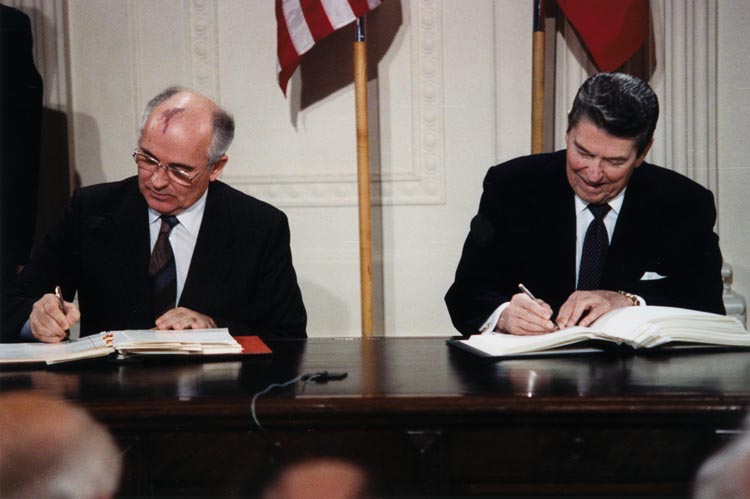
Newly minted octogenarian Mikhail Gorbachev holds forth in Spiegel on modern Russia, which looks to his experienced eyes a whole lot like the stubbornly backwards Soviet Union. An excerpt:

SPIEGEL: Let’s jump forward in time to present-day Russia. When Putin came into office in 2000, you supported him. Had you already known him for some time?

Gorbachev: He helped me when I ran in the 1996 presidential election.

SPIEGEL: You thought he was clever at the time. Now you say that under his leadership Russia came to resemble an African country, where dictators rule for 20 to 30 years. What do you suddenly find so objectionable about him?

Gorbachev: Careful: It is you that is using the word ‘dictator.’ I supported Putin during his presidency, and I still support him in many ways today.

SPIEGEL: You asked him not to run for president again.

Gorbachev: What troubles me is what the United Russia party, which is led by Putin, and the government are doing. They want to preserve the status quo. There are no steps forward. On the contrary, they are pulling us back into the past, while the country is urgently in need of modernization. Sometimes United Russia reminds me of the old Soviet Communist Party.

SPIEGEL: Putin and President Dmitry Medvedev want to decide between themselves who will be the next president in 2012.

Gorbachev: Putin wants to stay in power, but not so that he can finally solve our most pressing problems: education, health care, poverty. The people are not being asked, and the parties are puppets of the regime. Governors are no longer directly elected. Direct mandates in elections were eliminated. Everything works through party lists now. But new parties are not being allowed, because they get in the way.” (Thanks Longreads.)

•••••••••••

Gorbachev-Reagan Chiclets commercial by Spitting Image puppets, 1987:

Tags: ,

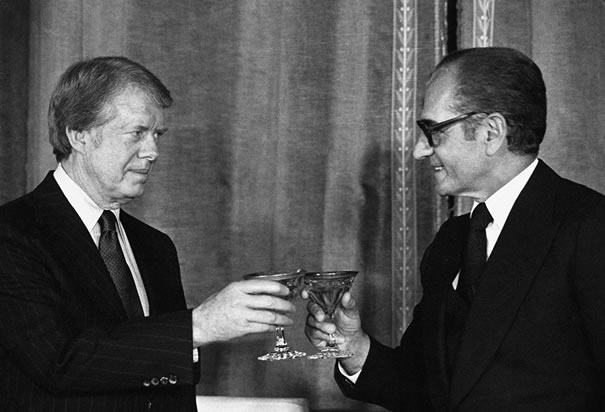
In 1980, David Frost met the Shah of Iran in Panama for the deposed leader’s final interview.

Tags: , ,

The opening of “Lithium Dreams,” Lawrence Wright’s excellent 2010 New Yorker article about Bolivia’s chance for economic renaissance during the age of lightweight batteries:

“In southern Bolivia, there is a mountain called Cerro Rico—’the hill of wealth.’ It is a pale, bald rock, crisscrossed with dirt roads that climb the slope like shoelaces. More than four thousand mining tunnels have so thoroughly riddled its interior that the mountain is in danger of collapse. Its base is ringed with slums that spill into the old city of Potosí, a World Heritage site. Evo Morales, the President of Bolivia, recently told me that he and his countrymen see Potosí as ‘a symbol of plunder, of exploitation, of humiliation.’ The city represents a might-have-been Bolivia: a country that had capitalized on its astounding mineral wealth to become a major industrial power. Such a Bolivia could easily have been imagined in 1611, when Potosí was one of the biggest cities in the world, with a hundred and eighty thousand inhabitants—roughly the size of London at the time. Although Potosí began as a mining town, with the saloons and gaming houses that accompany men on the frontier, it soon had magnificent churches and theatres, and more than a dozen dance academies. From the middle of the sixteenth century until the middle of the seventeenth, half the silver produced in the New World came from Cerro Rico. Carlos Mesa, a historian who served as Bolivia’s President from 2003 to 2005, told me, ‘It was said throughout the Spanish empire, ‘This is worth a Potosí,’ when speaking of luck or riches.’ Potosí is now one of the poorest places in what has long been one of the poorest countries in South America.

Across the divide of the industrial revolution, there is another city whose promise of greatness now lies in ruins: Detroit. Even before the Curved Dash Oldsmobile rolled off the assembly line, in 1901, becoming the first mass-produced American car, Detroit was a showplace of labor, its huge factories producing iron, copper, freight cars, ships, pharmaceuticals, and beer. Following Oldsmobile’s lead, carmakers such as Ford, Packard, and Cadillac transformed the American economy. But Detroit’s triumph was remarkably short-lived. The city is half the size it was fifty years ago. Two of the Big Three carmakers, General Motors and Chrysler, went bankrupt in 2009, and all of them have cut their workforces drastically. Unemployment in Detroit is at fifteen per cent; the murder rate is the fourth highest in the country; and about a third of its citizens live in poverty. An estimated seventy thousand structures—houses, churches, factories, even skyscrapers—stand empty, many of them vandalized or burned. Parts of town are being farmed. Like Bolivia, Detroit is hoping for a second chance. And both of them are looking to a treasure that could revive their fortunes, and, incidentally, lead the world to a cleaner environment. That treasure is lithium.” (Thanks TETW.)

••••••••••

Bolivian President Evo Morales on the Daily Show in 2007:

Tags: ,

About the Carter-Ford Presidential debate, in 1976.

Tags: , , , ,

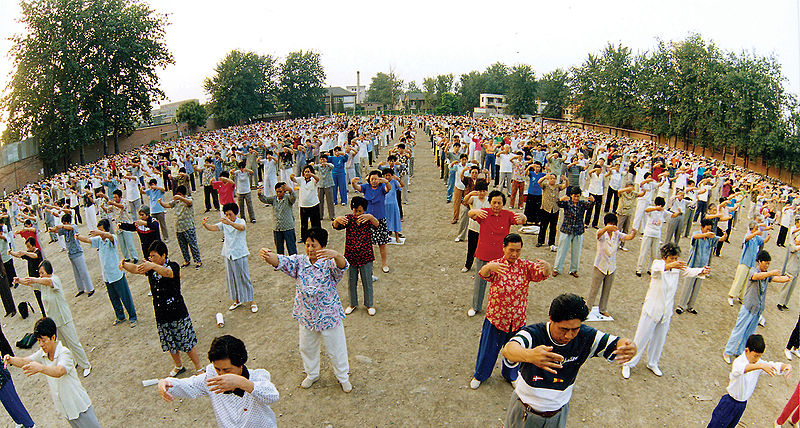
"By all means avoid practitioners of Falun Gong." (Image by ClearWisdom.net.)

From Andrew Jacobs’ interesting new article in the New York Times about the odd instructions given by the Chinese government to their citizens visiting more liberal Taiwan:

“TAIPEI, Taiwan — As two dozen anxious Chinese travelers began their maiden voyage across the Taiwan Strait, their tour guide called an impromptu meeting in the airport departure lounge.

He warned them about littering, spitting, flooding hotel bathroom floors — and the local cuisine. ‘Our Taiwanese brothers do not like salt, oil and MSG the way we do,’ the guide, Guo Xin, said with a sigh.

Then his voice grew serious, the way a coach might caution his team about the impending face-off with a deceptively courteous opponent. Do not talk about politics with the locals, he warned, say only positive things about Taiwan and China, and by all means avoid practitioners of Falun Gong, the spiritual group whose adherents roam freely on Taiwan but are regularly jailed on the mainland. ‘They will definitely try to talk to you,’ he said. ‘When that happens, get away as fast as you can.'”

Tags:

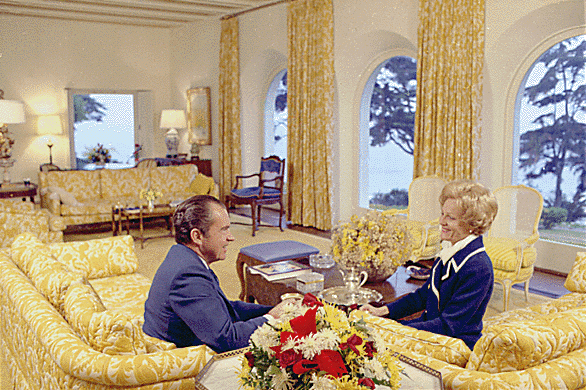
In this classic January 13, 1971 photograph, President Richard Nixon and his wife Pat rest in their San Clemente home, the “Western White House,” as it had become known, on couches with the type of garish upholstery that was inexplicably popular at that time. The seaside home, formerly known as the H.H. Cotton House and La Casa Pacifica, hosted a slew of politicos during Nixon’s abbreviated two-term presidency, including Soviet premier Leonid Brezhnev. The house was the disgraced president’s oasis after he was forced to resign from office in 1974 during the Watergate scandal. The famous Frost/Nixon interviews were planned to be held at the San Clemente abode, but radio signals from the nearby Coast Guard station interfered with the TV equipment. From a 1983 New York Times article about Nixon’s lifestyle in San Clemente:

“San Clemente was in its prime in the early 1970’s when President Nixon’s Spanish-style residence here, Casa Pacifica, served as the ‘Western White House.’ Memories of the excitement of Government helicopters whirring overhead are still fresh. Regardless of how they feel about Mr. Nixon, a lot of people here miss that.

”I find it pretty humorous that San Clemente looks at Richard Nixon as a claim to fame,’ said Harold Warman, a college instructor who said he believed ”any man who becomes President of the United States has made so many moral compromises he’s sold out long before he even got there.’

But even as one of Mr. Nixon’s few critics in San Clemente, Mr. Warman suggested that the status of being a President’s home away from home gave life here a certain style.

‘If he wanted a pizza, they’d circle Shakey’s Pizza with the Secret Service,’ he recalled. ‘One day when I was down there, they brought him in by helicopter and closed the pizza parlor off. That’s pretty impressive.'”

••••••••••

Soundless footage of the Nixons receiving celebrity guests (John Wayne, Glenn Campbell, Frank Sinatra, etc.) at their San Clemente home in 1972:

Tags: ,

« Older entries § Newer entries »