Politics

You are currently browsing the archive for the Politics category.

Milton Friedman, in defense of sweatshops, from a 1972 Playboy Interview:

PLAYBOY: Even if minimum-wage laws have been as counterproductive as you say, isn’t there a need for some government intervention on behalf of the poor? Laissez faire, after all, has long been synonymous with sweatshops and child labor—conditions that were eliminated only by social legislation.

FRIEDMAN: Sweatshops and child labor were conditions that resulted more from poverty than from laissez-faire economics. Wretched working conditions still exist in nations with all sorts of enlightened social legislation but where poverty is still extreme. We in the United States no longer suffer that kind of poverty because the free-enterprise system has allowed us to become wealthy.

Everybody does take the line that laissez faire is heartless. But when do you suppose we had the highest level of private charitable activity in this country? In the 19th century. That’s when we had the great movement toward private nonprofit hospitals. The missions abroad. The library movement. Even the Society for Prevention of Cruelty to Animals. That was also the era in which the ordinary man, the low-income man, achieved the greatest improvement in his standard of living and his status. During that period, millions of penniless immigrants came in from abroad, with nothing but their hands, and enjoyed an enormous rise in their standard of living.

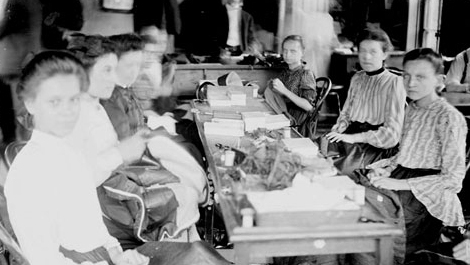
My mother came to this country when she was 14 years old. She worked in a sweatshop as a seamstress, and it was only because there was such a sweatshop in which she could get a job that she was able to come to the U.S. But she didn’t stay in the sweatshop and neither did most of the others. It was a way station for them, and a far better one than anything available to them in the old country. And she never thought it was anything else. I must say that I find it slightly revolting that people sneer at a system that’s made it possible for them to sneer at it. If we’d had minimum-wage laws and all the other trappings of the welfare state in the 19th century, half the readers of Playboy would either not exist at all or be citizens of Poland, Hungary or some other country. And there would be no Playboy for them to read.”

••••••••••

An Open Mind episode with Friedman, 1975:

Tags:

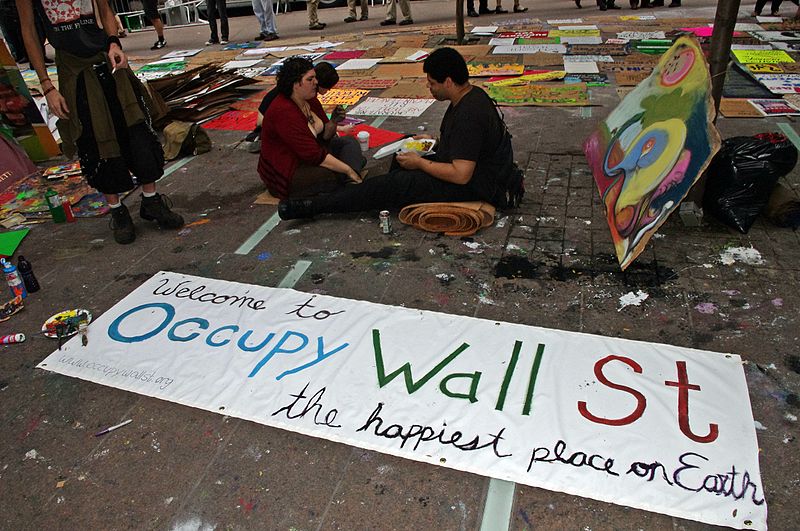
"Some on the right were baffled that the ostensible Marxists demonstrating in lower Manhattan would observe a moment of silence and assemble makeshift shrines for a top one-percenter like Jobs." (Image by David Shankbone.)

In his excellent new piece in New York about the looming class war, which has been waged silently and unilaterally for nearly three decades against the middle class, Frank Rich explains why the Occupiers expressed grief over the death of that wealthy capitalist Steve Jobs. An excerpt:

“But while Romney is a class enemy liberals and conservatives can unite against, perhaps nothing has revealed how much the class warriors of the right and left of our time have in common than the national outpouring after Steve Jobs’s death. Indeed, the near-universal over-the-top emotional response—more commensurate with a saintly religious or civic leader, not a sometimes bullying captain of industry—brought Americans of all stripes together as few events have in recent memory.

Some on the right were baffled that the ostensible Marxists demonstrating in lower Manhattan would observe a moment of silence and assemble makeshift shrines for a top one-percenter like Jobs, whose expensive products were engineered for near-­instant obsolescence and produced by Chinese laborers in factories with substandard health-and-safety records. For heaven’s sake, the guy didn’t even join Warren Buffett and Bill Gates in their Giving Pledge. ‘There is perhaps no greater image of irony,’ wrote the conservative blogger Michelle Malkin, ‘than that of anti-capitalist, anti-corporate, anti-materialist extremists of the Occupy Wall Street movement paying tribute to Steve Jobs.’

Yet those demonstrators who celebrated Jobs were not necessarily hypocrites at all—and no more anti-capitalist than the Bonus Army of 1932. If you love your Mac and iPod, you can still despise CDOs and credit-default swaps. Jobs’s genius—in the words of Regis McKenna, a Silicon Valley marketing executive who worked with him early on—was his ability ‘to strip away the excess layers of business, design, and innovation until only the simple, elegant reality remained.’ The supposed genius of modern Wall Street is the exact reverse, piling on excess layers of business and innovation on ever thinner and more exotic creations until simple reality is distorted and obscured. Those in Palin’s ‘real America’ may not be agitated about the economic 99-vs.-one percent inequality brought about by the rise of the financial sector in the past three decades, but, like class warriors of the left, they know that ‘financial instruments’ wreaked havoc on their 401(k)s, homes, and jobs. The bottom line remains that Wall Street’s opaque inventions led directly to TARP, the taxpayers’ bank bailout that achieved the seemingly impossible feat of unifying the left and right in rage against government—much as Jobs’s death achieved the equally surprising coup of unifying left and right in mourning a corporate god.”

•••••••••••

Frank Rich, being treated slightly better than Lindsey Buckingham:

Tags: ,

Richard Nixon, during his “Wilderness Years,” just months after losing the gubernatorial race in California, political obituary already written, schmoozing with Jack Paar, 1963.

Tags: ,

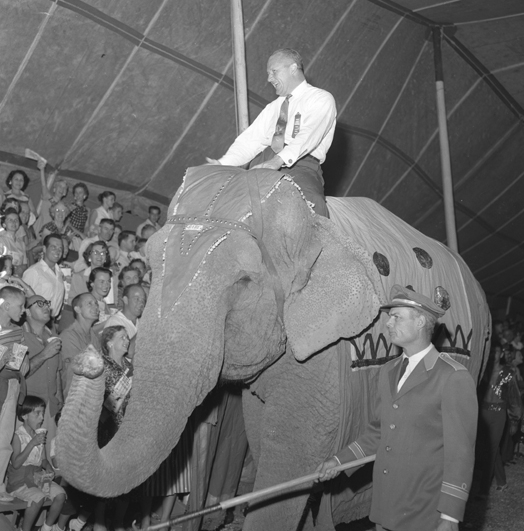
In this classic, uncredited 1958 Los Angeles Times photo, California’s Senator William Knowland rides an elephant at a circus in Orange County. Knowland was long a GOP power and nemesis of Richard Nixon. Sixteen years after this picture was taken, Knowland, awash in financial and personal troubles, took his own life. From the book, One Step From The White House:

“On Saturday morning, February 23, 1974, former U.S. Senator William F. Knowland was up early, and had coffee alone in his luxurious Oakland home. He left a note to his wife, saying, “Dear Ann, I will be back in a short time. Bill.” He left two cups and the instant coffee on a table in their Wayne Avenue apartment.

Knowland, publisher of the highly successful Oakland Tribune , drove slowly down Valdez Street; a few minutes later, at about 9 A.M., he guided his two-year-old Cadillac sedan into the company garage. He had a lot to think about. Two days earlier he had been at the right hand of California governor Ronald Reagan as they celebrated his family newspaper’s hundredth anniversary. He liked Reagan personally and agreed with his political views. He had told his political editor that day that Reagan would make a good president, and he would like to work toward that goal. But on this February day, he had a different mission.

He told the attendant at the Tribune garage to put only five gallons of gasoline in the gas tank. Pragmatic. Conservative. Practical. They were all adjectives that had been used often with his name over his lifetime. He didn’t need a full tank. He wasn’t coming back.

The senator eased his bulk back into the Cadillac and drove through the streets of Oakland for the last time. This was the city that he and his father before him had ruled. The Oakland Tribune . The Tower of Power. He must have thought of the days when the mayor asked him for advice before taking any action, when presidents and governors and senators and those who hoped to be presidents and governors and senators stood in line for an interview in the paneled board room on the twentieth floor of the Tribune Tower—the days when his endorsement could make or break a candidate. He must have remembered the glory days of the U.S. Senate.

But today, he traveled north from Oakland along the east shore of San Francisco Bay, across the Richmond—San Rafael Bridge to Highway 101, then north again, pointing toward the small town of Guerneville on the Russian River. Saturday morning traffic was light, and he drove quickly along the freeway.

The problems were insurmountable.

There were the women, the booze, and, yes, the gambling. That was what really finished him. The images of the tables in Las Vegas recently had filled his thoughts with the enormity of the problems he faced. His debts were huge and the payment date was near.

There was his reputation. All of his life, his reputation was the rock that had held everything in place—a political career that took him almost to the White House, his family, his newspaper, his civic life. Nothing else mattered as much as that reputation.

There was Ann, his new wife. She was part of the nightmare that was eroding that precious reputation, grinding him down, making him weak. To Knowland, lost in his thoughts, the eighty-mile trip to the family compound would have passed quickly.

As he drove westward along the Russian River, his speed increased—almost to a reckless level between Guerneville and the compound. The operator of the Northwood Lodge in the tiny hamlet of Monte Rio said he recognized Knowland in the blue Cadillac, looking “like he was on his way to a fire.”

He turned in at the familiar driveway at 19663 Redwood Drive and shut off the engine. He went into the house, then returned to the car briefly, leaving the keys in the ignition. He wouldn’t be needing them anymore.

He apparently had a last-minute thought, perhaps a change of heart. He tried to call the Oakland Tribune on his walkie-talkie radio, but the distance defeated the unit. He tossed the radio as far as he could. Tribune security did not receive any signals on the frequency of Knowland’s transceiver that morning.

He walked deliberately into his bedroom in the compound. A .32-caliber automatic was in a closet. It was lighter than the .45 automatic he had been wearing as an army major in Paris on the day in 1945 when California governor Earl Warren had appointed him to the U.S. Senate.

But it would do the job. Perhaps his memory flickered back to Paris, to his reading about the appointment in Stars and Stripes . It must have seemed so long ago.

He took the gun and went into the backyard, then strode down the steps alongside the half-submerged pier into the cold February water on the north shore of the Russian River. At the edge of the swift-running river, he checked the clip, then fired one shot into the river to assure himself that the pistol was dependable. He fired the second shot into his right temple. The immediate pain was like a hammer, but the greater pain was erased.”
Tags:

"An ensemble of moving parts, very much in motion, each drawing upon the others and pressing upon them." (Image by David Shankbone.)

The always eloquent and insightful Todd Gitlin analyzes the Occupy Wall Street movement at the Los Angeles Review of Books. An excerpt: 

“But movement isn’t a thing. It isn’t, itself, an organization. It doesn’t have officers or headquarters. It’s a verb seeking to be a noun, yet fearful of hardening at the same time, for noun-things solidify, and anarchic energy afoot wants to be liquid, not so much a thing as a process: an ensemble of moving parts, very much in motion, each drawing upon the others and pressing upon them, each making their moves in the light of what others do, an ensemble of movement actors. There’s the inner movement, the outer movement, the politicians, the opposition — and, never forget, the police. They can do you favors, as did the NYPD, first with pepper spray, then with the Brooklyn Bridge mass arrest. But you can’t count on that.

The inner movement has a horizontally organized internal life: an amalgam of task forces and working groups operating under the awkward but so far workable discipline of direct democracy. A common sentiment in the public spaces, as far as I can make out, includes such deep suspicion of representative government — of the very principle of delegation — and such strong faith in the decision-making capacities of ordinary people, as to have invested all legitimate authority in the daily general assemblies.

‘Let the people decide’ was an early sixties slogan, but SDS never coherently knew what it meant, or even worried enough about not knowing. In the late ‘60s, when police bullhorns blared out arrest orders, ‘In the name of the people of California…,’ crowds shouted back, ‘We are the people.’ But we weren’t. In fact, a large majority of the people of California elected Ronald Reagan governor in 1966 and reelected him in 1970. The question of which people get to decide what: This is, of course, the master problem of political theory, and let’s just say I have no triumphant solution to offer here. It’s a problem that doesn’t go away. No matter the urgency, no matter the passion, no matter the circumstance, it just plain doesn’t go away. A serious movement has to be serious about it.”

Tags:

From the New York Times Op-Ed piece about Alabama’s draconian new immigration policy:

“Alabama’s reputation has also taken a huge hit just when it is trying to lure international businesses. No matter how officials may try to tempt foreign automakers, say, with low taxes and wages, the state is already infamous as a regional capital of xenophobia.

If Alabama succeeds in driving out all of its estimated 120,000 unauthorized immigrants, restrictionists will surely cheer. They will have only 49 states and 11 million more people to go.

There is another more humane and realistic path in which immigrants could earn the right to stay — if Congress would accept its responsibility and move ahead with serious immigration reform. America’s history shows that assimilation works better than deportation — for everyone. If first-generation immigrants don’t all learn English, their children and grandchildren invariably do. They may be poor, but their children grow up to be productive citizen taxpayers. Unless, of course, you frighten and oppress them, and forbid them to work, live and go to school.”

Community organizer Saul Alinsky became an enemy of the American Right all over again three decades after his death, thanks to a posthumous link to President Obama. Amusingly enough, Alinsky pretty much predicted the American drift into Conservatism and the Presidency of anti-government traliblazer Ronald Reagan and the more extreme iterations that followed him. From a 1972 Playboy interview with Alinsky, which was conducted just months before he died in California from a heart attack. 

Saul Alinsky: The middle class actually feels more defeated and lost today on a wide range of issues than the poor do. And this creates a situation that’s supercharged with both opportunity and danger. There’s a second revolution seething beneath the surface of middle-class America — the revolution of a bewildered, frightened and as-yet-inarticulate group of desperate people groping for alternatives — for hope. Their fears and their frustrations over their impotence can turn into political paranoia and demonize them, driving them to the right, making them ripe for the plucking by some guy on horseback promising a return to the vanished verities of yesterday. The right would give them scapegoats for their misery — blacks, hippies, Communists — and if it wins, this country will become the first totalitarian state with a national anthem celebrating ‘the land of the free and the home of the brave.'”

Tags: , ,

Theater talker Mike Daisey has a particularly timely monologue with The Agony and the Ecstasy of Steve Jobs, in which he investigates the dark side of the modern miracle of consumer electronics, which stared squarely at him in the ginormous Chinese factories where the gadgets are manufactured at a high human cost. An excerpt from Ben Brantley’s New York Times review:

“For Mr. Daisey, as for many others, affection for Apple products evolved into reverence for Mr. Jobs, the Apple co-founder whose identification with the company and its products has been much remarked upon, and worried over, since his illness made news several years ago.

Mr. Daisey has been performing this show since July of last year, and while the death of Mr. Jobs lends the evening a certain eerie timeliness, it also means that many in the audience will be familiar with the life and career of Mr. Jobs from reading obituaries and tributes.

The hippie-meets-tech-geek ethos, the founding of and then ouster from Apple, the triumphant return and the revolutionary series of consumer products that followed: Mr. Daisey covers this material fluently and with amiable humor, mixing obvious hero worship with some pointed skepticism. (Mr. Jobs, he notes, was the kind of imperious guy who divided the world’s population into ‘geniuses and bozos.’)

But the show is most engrossing, and most disturbing, when Mr. Daisey delves into the grim realities of workers’ lives in Shenzhen, a city that he memorably describes as looking as if ‘Blade Runner threw up on itself.'”

••••••••••

“A laptop so thin you can slice a sandwich”:

Tags: ,

In a Financial Times article in which he elaborately kisses the ass of President Bill Clinton, historian Simon Schama also elicits some fine political analysis from 42. An excerpt about the Tea Party:

“‘The Tea Party,’ Clinton says, ‘is the most extreme incarnation of the 30-year cycle that began when Ronald Reagan said in his first inaugural that government isn’t the answer, government is the problem. But the real issue is not that the Tea Party is in control of the country, has captured the airwaves or represents a majority of public sentiment; the problem is that something [the deal-making system] that has worked for the American people in the past isn’t working now.’

And the ideologues haven’t had their ‘Waterloo moment to break the fever,’ such as the two shut-downs of the federal government engineered by Speaker Newt Gingrich and the incoming House Republicans in 1995. That triumphant phalanx assembled beneath the banner of the Contract with America to which they vowed to remain uncompromisingly faithful. But the public hated the shut-downs and blamed Republicans to the point when it became apparent they had actually taken out a contract on themselves. It was Gingrich, not Clinton, who was ousted, the president winning re-election a year later. The manufactured spat earlier this year over raising the debt ceiling had Waterloo-moment promise, but the prospect of the US defaulting for the only time in its history and the risk of sending the already stressed bond market over the cliff meant that Obama, unlike Clinton, couldn’t call the naysayers’ bluff.

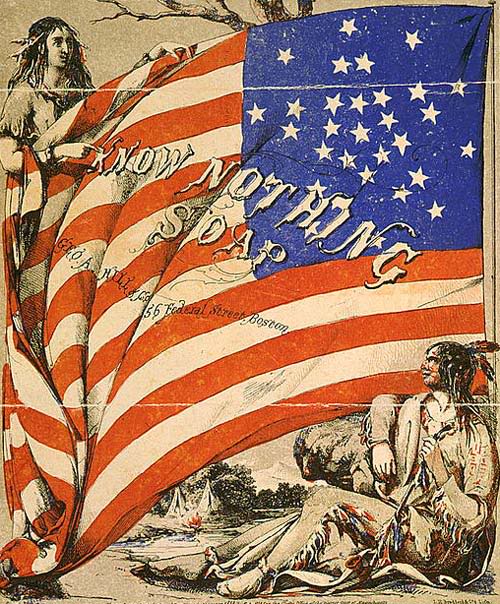
So what can be done about this latest edition of Know-Nothings? ‘You can’t convert the ideologues because they don’t care what the facts are. With the world as it is, you have to fight the fight you can win, and the fight you can win is economics.’ He gets intense at this point. ‘There isn’t a single example of a successful country on the planet today – if you define success as lower rates of unemployment, higher rates of job growth, less income inequality and a health system that produces the same or better care at lower cost – that doesn’t have both a strong economy and effective government that find some way to work in harness with each other … If you don’t do that, if you don’t have a system by which the poor can work their way into it, then you lose the social cohesion necessary to hold the country together and that is a big problem.”

••••••••••

Schama discusses slavery in America with perpetually exhausted Charlie Rose:

Tags: ,

The de facto theme song of the feminist movement of the 1970s, Helen Reddy’s “I Am Woman” was a giant radio hit and a huge target of derision. In 1975, the United Nations chose the song to officially represent International Women’s Year. Great slowed-down live version:

Reddy and Alice Cooper share scripted banter at the Grammys, 1974:

Tags: ,

From a 1997 Playboy Interview with Sen. Daniel Patrick Moynihan, in which he explains why religious fundamentalism became entrenched in contemporary American politics:

“Playboy: Fundamentalism is a big problem at home and abroad. Are you lobbied by the Christian right?

Moynihan: I will say this to you and if you can print it, do. Once a year the anti-abortion people come to Washington. They are the only people who come to see me. I shouldn’t say “only,” but they are the one group that comes to see me that doesn’t want anything other than to discuss a moral issue it’s concerned with. I might meet three or four other people a year like that, but not many. They’re the only working people I ever see. They come down by bus. They don’t go out to lunch at the mall. They just want to say they have a view of something. I’ve always voted against them.

Playboy: But the Christian right has other issues besides abortion. Some members say every word of the Bible is literally true and they want to impose their views on everyone else. The movement seems pretty important. Do you agree?

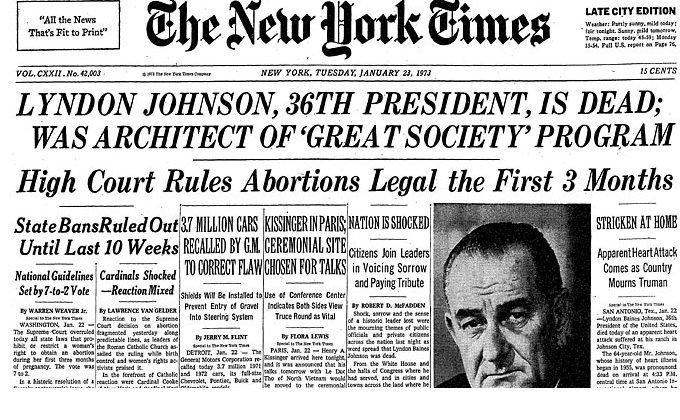
Moynihan: It is hugely important. And there’s nothing new about this. At different times in our history there have been very important political movements that were basically religious or concerned with matters of conscience. Abolition was one, out of which came the Republican Party. Prohibition was another. And abortion is a third. Roe vs. Wade just shook the conscience of a large segment of the American population, particularly the fundamentalist Protestants, who were quite content to live a life that didn’t have much politics in it. They didn’t have politics, they had their own religious concerns. Suddenly a matter of true import to them became the law of the land by a decision of the Supreme Court. And they thought, What is this? This has to change. And gradually they became a political force.

Playboy: Do you consider the Christian right dangerous?

Moynihan: No, good God. They’re the nicest people in the world if you leave their consciences alone. And if you don’t, it’s not the first time in history you get resentment. The Catholic Church is just as involved, but the Catholic Church has a wider agenda. In the way we are now using the word, the Catholic social doctrine is liberal. If you’re talking about minimum wage or something like that, they’re with you all the time.

Playboy: Do you feel you have to take the Christian right, creationism and all, into account?

Moynihan: Well, you’d better if you’re thinking to run for president.

Playboy: That makes them sound very powerful.

Moynihan: They are. We may lose our voting rights in the General Assembly because we passed a bill that would pay almost $1 billion in UN dues, but it included a provision that no money will go to any organization that performs abortions. The president has said he will veto the bill over that issue. If you go two years without paying your dues — which may happen if this impasse is not resolved — you can lose your voting rights in the General Assembly.

Playboy: This is bizarre.

Moynihan: Yeah. And it’s a big thing for us to lose our voting rights over something — over what?

Playboy: So a minority can make international policy?

Moynihan: The Southern Baptists aren’t exactly a minority. The Supreme Court is. And if nine people can say that something they find absolutely morally unacceptable is the law of the land, well, that makes people think.”

••••••••••

Moynihan discusses race, 1967:

Tags:

There have been three notable third-party candidates for U.S. President in the past three decades: Ralph Nader, H. Ross Perot and John B. Anderson. The last of the three mounted a spirited campaign as alternative to Jimmy Carter and Ronald Reagan in 1980. He came away with almost 7% of the vote. A Republican from Illinois, he was a member of what is now an all-but-extinct breed: a cerebral and compassionate conservative who was disgusted by the mounting dirtiness of right-wing politics and the encroachment of an intolerant strain of religion on the political process. Anderson turned 89 this year and in the most recent Presidential election supported Barack Obama.

Tags:

Will the 2012 Presidential election be an opportunity for the GOP to take back the White House or for centrist members to take back their own party? From Matt Bai’s New York Times Magazine piece,  “Does Anyone Have a Grip on the G.O.P.?“:

“It’s worth pointing out that when Republicans express concern about the anti-government militancy in their midst, it has a ring of serious denial. After all, generations of Republican candidates have now echoed the theme of Ronald Reagan in his 1981 inaugural address: ‘In this present crisis, government is not the solution to our problem. Government is the problem.’ And a progression of ideological uprisings inside the party — the Reagan revolutionaries, Pat Buchanan’s pitchfork brigades, Newt Gingrich’s band of guerrilla lawmakers and now the Tea Partiers — have only pushed the anti-Washington argument closer to its illogical extreme. Thus could a smiling Michele Bachmann stand on a debate stage last month and declare that no one should pay the federal government a penny of taxes, for anything — a statement that didn’t even draw a follow-up question from the panel of Fox News journalists arrayed before her.

Longtime Republicans have been satisfied enough to have their candidates run down activist government as a campaign tactic, even as they themselves retained a more nuanced view of the federal government’s role (which is why a Republican Congress, working with a Republican president, managed to pass a Medicare prescription-drug bill in 2003). But when you talk to them now, these same Republicans seem positively baffled that anyone could have actually internalized, so literally, all the scorching resentment for government that has come to define the modern conservative campaign.”

Tags:

In the “Ethics of Voting,” philosopher Jason Brennan argues that people shouldn’t vote if they’re not sufficiently educated about the issues and shouldn’t vote for self-interest. I actually would be more than happy with people voting for self-interest. When you see union members supporting candidates openly hostile to unions or senior citizens who need Social Security to survive voting for candidates who detest that safety net, there is definitely a dangerous disconnect. But, yes, democracy without an informed public is a bad thing. An excerpt from Brennan’s piece:

“Imagine a jury is about to decide a murder case. The jury’s decision will be imposed involuntarily (through violence or threats of violence) upon a potentially innocent person. The decision is high stakes. The jury has a clear obligation to try the case competently. They should not decide the case selfishly, capriciously, irrationally, or from ignorance. They should take proper care, weigh the evidence carefully, overcome their biases, and decide the case from a concern for justice.

What’s true of juries is also true of the electorate. An electorate’s decision is imposed involuntarily upon the innocent. The decision is high stakes. The electorate should also take proper care.” (Thanks Marginal Revolution.)

••••••••••

“A vote for Popeye means free ice cream for all the kiddies,” 1956:

Tags:

Walter Cronkite reports on the Three Mile Island accident–March 30, 1979.

Tags:

If only it were so. An economic prediction from “The Long Boom,” Wired, 1997:

“But there’s a new, very different meme, a radically optimistic meme: We are watching the beginnings of a global economic boom on a scale never experienced before. We have entered a period of sustained growth that could eventually double the world’s economy every dozen years and bring increasing prosperity for – quite literally – billions of people on the planet. We are riding the early waves of a 25-year run of a greatly expanding economy that will do much to solve seemingly intractable problems like poverty and to ease tensions throughout the world. And we’ll do it without blowing the lid off the environment.

If this holds true, historians will look back on our era as an extraordinary moment. They will chronicle the 40-year period from 1980 to 2020 as the key years of a remarkable transformation. In the developed countries of the West, new technology will lead to big productivity increases that will cause high economic growth – actually, waves of technology will continue to roll out through the early part of the 21st century. And then the relentless process of globalization, the opening up of national economies and the integration of markets, will drive the growth through much of the rest of the world.”

An excerpt from Spencer Ackerman’s Wired article about a brand new touchscreen war-planning tablet by the AAI Corporation, which makes lethal combat “easier” than ever:

“[Chris] Ellsworth provides a quick demo. On the massive tablet is a map of a hypothetical warzone. Blue icons represent the positioning of Team America assets — ground troops and overhead aircraft. Red icons show the enemy. When a new red diamond pops up, Ellsworth taps his finger on it, and then drags a bluish character over it.

It looks a little bit like a ghost from Ms. Pac-Man. But Ellsworth has just directed a drone — in this (fictional) case, one of AAI’s tiny Aerosonde-1 spy robots — to the enemy position. Whoever’s sitting miles away in an air conditioned Ground Control Station, wielding the joystick that controls the drone, has now received her new orders on an equivalent device — perhaps the smartphone that the Army might one day put in her pocket.

Either way, an IM confirming that the order is understood pops up on an adjacent flatscreen TV repurposed as a computer monitor. The drone above our fictional warzone should be on its way to its new position imminently.”

••••••••••

A piece about the increasing digitization of warfare, featuring AAI:

Slavoj Žižek, that provocateur and performance artist, gave a speech at Occupy Wall Street. Thankfully, his rhetoric was short on his usual bullshit (smirking apologias for Stalin, for example) and long on common sense. The speech’s opening from the full transcript provided by Sarah Shin at Verso:

“Don’t fall in love with yourselves, with the nice time we are having here. Carnivals come cheap—the true test of their worth is what remains the day after, how our normal daily life will be changed. Fall in love with hard and patient work—we are the beginning, not the end. Our basic message is: the taboo is broken, we do not live in the best possible world, we are allowed and obliged even to think about alternatives. There is a long road ahead, and soon we will have to address the truly difficult questions—questions not about what we do not want, but about what we DO want. What social organization can replace the existing capitalism? What type of new leaders we need? The XXth century alternatives obviously did not work.

So do not blame people and their attitudes: the problem is not corruption or greed, the problem is the system that pushes you to be corrupt. The solution is not ‘Main Street, not Wall Street,’ but to change the system where main street cannot function without Wall street. Beware not only of enemies, but also of false friends who pretend to support us, but are already working hard to dilute our protest. In the same way we get coffee without caffeine, beer without alcohol, ice-cream without fat, they will try to make us into a harmless moral protest. But the reason we are here is that we had enough of the world where to recycle your Coke cans, to give a couple of dollars for charity, or to buy Starbucks cappuccino where 1% goes for the Third World troubles is enough to make us feel good. After outsourcing work and torture, after the marriage agencies started to outsource even our dating, we see that for a long time we were allowing our political engagements also to be outsourced—we want them back.

They will tell us we are un-American. But when conservative fundamentalists tell you that America is a Christian nation, remember what Christianity is: the Holy Spirit, the free egalitarian community of believers united by love. We here are the Holy Spirit, while on Wall Street they are pagans worshipping false idols.

They will tell us we are violent, that our very language is violent: occupation, and so on. Yes we are violent, but only in the sense in which Mahathma Gandhi was violent. We are violent because we want to put a stop on the way things go—but what is this purely symbolic violence compared to the violence needed to sustain the smooth functioning of the global capitalist system?”

••••••••••

Žižek at Occupy Wall Street:

Žižek holding forth in a garbage dump, in Astra Taylor’s Examined Life:

Tags: , ,

This 1978 NBC News promo is a real time warp. It’s anchored by the late Jessica Savitch, who was, fleetingly, the golden girl of broadcast journalism, and died young and mysteriously five years after this clip. Following the news brief are an American Express commercial featuring the great tennis player Virginia Wade and a promo for Headliners with David Frost, that show’s star being one of the biggest names in America after going mano-a-mano with disgraced former President Richard Nixon.

Tags: , , ,

At Slate, James Verini examines “The Obama Effect,” a theory gaining traction which states that dwindling violent-crime rates in predominantly African-American neighborhoods in the past three years, even during this bruising recession, is the result of a more positive outlook among blacks since the election of the first African-American President. An excerpt:

“One unlikely explanation that is gaining credence among experts, including some of the biggest names in the field, is a phenomenon tentatively dubbed ‘the Obama Effect.’ Simply put, it holds that the election of the first black president has provided such collective inspiration that it has changed the thinking or behavior of would-be or one-time criminals. The effect is not yet quantifiable, but some very numbers-driven researchers believe it may exist. 

Rick Rosenfeld, the president of the American Society of Criminology, studies the relationship between consumer sentiment and crime rates, which appear to track closely. Despite the recession, Rosenfeld has found, black Americans are remarkably confident about their economic futures. In 2009, despite being in the midst of the worst economic downturn since the Great Depression, 39 percent of black people surveyed said they were better off than they’d been five years before, as opposed to just 20 percent who answered that question in the affirmative in 2007. In the same survey, there was a 14 percent increase among blacks who said they thought the standard of living gap between themselves and whites was diminishing, and a 9 percent increase in blacks who believed that the future for black people will be better.

‘I think there’s little question the election had the effect of improving the general outlook of blacks and especially their economic outlook,’ Rosenfeld told me. ‘Normally, blacks tend to be more pessimistic about economic prospects, even in good economic times.'”

Tags: , ,

And then maybe, after all that time, there was clarity. For 30 years, they’ve come, often wearing flags and crosses, with promises that only divided, and they were after just one thing: money. Then, maybe, just maybe, it became apparent to the 99% that they were the ones who were paying, that they were the ones not using their power, that they were one.

Tags:

"Now the scope of the protests are even wider, more global." (Image by David Shankbone.)

From a post on Kevin Kelly’s Technium blog, in which he meditates on the ever-decreasing centralization of political power in the Digital Age:

“There seems to be a global-scale protest underway. People, mostly young people, are bypassing the institutional voting system to try to force change through decentralized adhocracy and anarchy. The world saw something similar in the 1960s when student protests erupted in Europe and the US and the Americas all at the same time. Now the scope of the protests are even wider, more global, reaching from Arab Africa, to the Mid East, to East Asia, to the the heartland of Europe and the US.

In a clear-headed front-page article in the New York Times today, one factor in this global unrest is assigned to technology. In particular common communication technology is seen as enabling this protest to blossom (although not causes the protest).

I agree with the Times that more important than the technology which is embraced are the mind-habits, the framework, the ideology of the technology, which the protesters are trying to migrate into non-electronic situations.

Here is a bit from the middle of the article:

The critical mass of wiki and mapping tools, video and social networking sites, the communal news wire of Twitter and the ease of donations afforded by sites like PayPal makes coalitions of like-minded individuals instantly viable.‘You’re looking at a generation of 20- and 30-year-olds who are used to self-organizing,’ said Yochai Benkler, a director of the Berkman Center for Internet and Society at Harvard University. ‘They believe life can be more participatory, more decentralized, less dependent on the traditional models of organization, either in the state or the big company. Those were the dominant ways of doing things in the industrial economy, and they aren’t anymore.'”

Tags: ,

The opening of “Slow Scan To Moscow,” Adam Hochschild’s 1986 Mother Jones article about the growing electronic connectivity between people of the U.S. and the Soviet Union, two countries that were still locked in the Cold War:

“Joel Schatz has wire-rimmed glasses and an Old Testament-sized beard. A big head of curly black hair flecked with gray adds a few extra inches to his sixfoot-two frame. ‘This trip we’re about to take,’ he says enthusiastically, ‘is so important that I’ve even gotten a haircut.’ Its effects are not noticeable.

Joel is sitting in the study of his San Francisco apartment, where most of the furniture consists of pillows on the floor. The largest thing in sight is an enormous reflector telescope, which can be pivoted around on its pedestal and aimed out a high window, Joel explains, ‘to remind me of my place in the cosmos. We’re all voyagers out there.

‘If I had millions of dollars I’d build neighborhood observatories all over the world. And at each one I’d have good conga drums, so people could drum together as well as observe.’

The object of Joel’s attention at this moment, however, as it is much of the time, is his four-pound, briefcase-size Radio Shack Tandy Model 100 portable computer. ‘I bought this machine for $399. For $1.82 a minute – $1.82! – I can send a telex message to Moscow. This technology is going to revolutionize human communications! Think what it will mean when you can get thousands of Americans and Soviets on the same computer network. Once scientists in both countries begin talking to each other on these machines they won’t be able to stop. And we’ll be taking a running leap over the governments on both sides.

‘I’m not a scientist,’ Joel adds. ‘I’ve only owned a computer for four months. I don’t understand how they work. I’ll leave that to other people. I’m just interested in how they can improve communication on this planet.'” (Thanks Longform.)

••••••••••

Radio Shack Tandy 102 portable computer, the final refresh of the 100 series:

Tags: ,

Mike Wallace interviews the Shah of Iran, 1976. Three years later, the Shah would flee into exile.

In World Policy, sci-fi writer Neal Stephenson vents about the diminishing of the American space program, and what it says about our nation’s capacity for executing large-scale, top-down, risk-heavy endeavors. The opening:

“My lifespan encompasses the era when the United States of America was capable of launching human beings into space. Some of my earliest memories are of sitting on a braided rug before a hulking black-and-white television, watching the early Gemini missions. This summer, at the age of 51—not even old—I watched on a flatscreen as the last Space Shuttle lifted off the pad.  I have followed the dwindling of the space program with sadness, even bitterness.  Where’s my donut-shaped space station? Where’s my ticket to Mars? Until recently, though, I have kept my feelings to myself. Space exploration has always had its detractors. To complain about its demise is to expose oneself to attack from those who have no sympathy that an affluent, middle-aged white American has not lived to see his boyhood fantasies fulfilled.  

Still, I worry that our inability to match the achievements of the 1960s space program might be symptomatic of a general failure of our society to get big things done. My parents and grandparents witnessed the creation of the airplane, the automobile, nuclear energy, and the computer to name only a few. Scientists and engineers who came of age during the first half of the 20th century could look forward to building things that would solve age-old problems, transform the landscape, build the economy, and provide jobs for the burgeoning middle class that was the basis for our stable democracy.” (Thanks Browser.)

••••••••••

“You became a learning machine”:

Tags:

« Older entries § Newer entries »