In the New York Review of Books, John Lanchester takes on Michael Lewis’ new volume about the global economic meltdown, Boomerang. A passage about the apocalyptic view of fund manager Kyle Bass:
“His first interlocutor, Kyle Bass, is a classic example. Bass is a fund manager who made a fortune ‘shorting’ toxic mortgage assets, and then became preoccupied by the subject of global debt levels. Bass is, to put it very mildly, a pessimist on the subject of sovereign debt:
Spain and France had accumulated debts of more than ten times their annual revenues. Historically, such levels of government indebtedness had led to government default. ‘Here’s the only way I think things can work out for these countries,’ Bass said. ‘If they start running real budget surpluses. Yeah, and that will happen right after monkeys fly out of your ass.’
The prognostications that ensue from Bass’s analysis are gloomy, and form the basis of Boomerang‘s big-picture overview. ‘The financial crisis of 2008 was suspended only because investors believed that governments could borrow whatever they needed to rescue their banks. What happened when the governments themselves ceased to be credible?’
Bass thinks that the only reliable investments are guns and gold, and has just bought twenty million nickels, because the metal in a five-cent nickel is worth 6.8 cents, and they are going to be a stable source of value when things go wrong.”
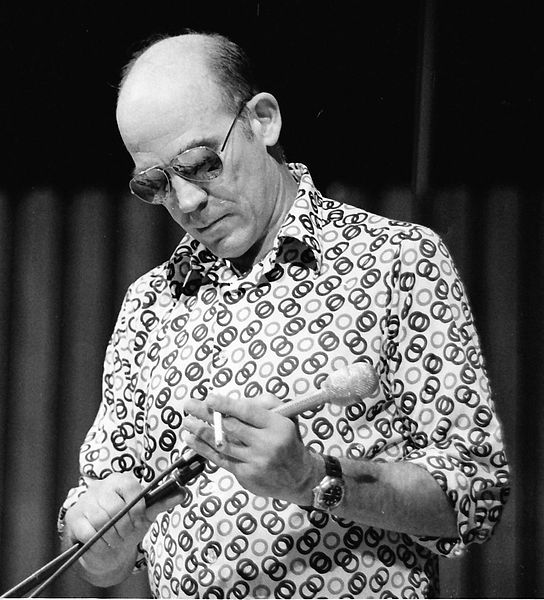
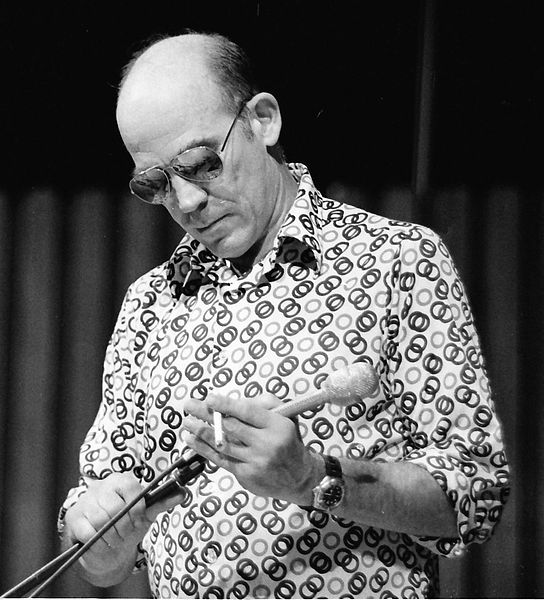
"He has learned not to let premonitions of apocalypse spoil his good mood." (Image by David Shankbone.)
If you haven’t read it already, the new issue of the New Yorker has a brief article by Mattathias Schwartz about Kalle Lasn, the odd duck publisher of Adbusters magazine who gave Occupy Wall Street its name and vision, though I doubt many protesters see things the same why he does. An excerpt:
“Lasn is sixty-nine years old and lives with his wife on a five-acre farm outside Vancouver. He has thinning white hair and the small eyes of a bulldog. In a lilting voice, he speaks of ‘a dark age coming for humanity’ and of ‘killing capitalism,’ alternating gusts of passion with gentle laughter. He has learned not to let premonitions of apocalypse spoil his good mood.
The magazine, which he founded twenty-two years ago, depicts the developed world as a nightmare of environmental collapse and spiritual hollowness, driven to the brink of destruction by its consumer appetites. Adbusters’ images—a breastfeeding baby tattooed with corporate logos; a smiling Barack Obama with a clown’s ball on his nose—are combined with equally provocative texts and turned into a paginated montage. Adbusters is not the only radical magazine calling for the end of life as we know it, but it is by far the best-looking.”
E.O. Wilson wondered if we’re programmed to do away with ourselves in his 2005 Cosmos article, “Is Humanity Suicidal?” An excerpt:
“Unlike any creature that lived before, humans have become a geophysical force, swiftly changing the atmosphere and climate as well as the composition of the world’s fauna and flora.
Now in the midst of a population explosion, this species has doubled in number to more than 6 billion during the past 50 years. It is scheduled to double again in the next 50 years. No other single species in evolutionary history has even remotely approached the sheer mass in protoplasm generated by humanity.
Darwin’s dice have rolled badly for Earth. It was a misfortune for the living world in particular, many of our scientists believe, that a carnivorous primate and not some more benign form of animal made the breakthrough.
Our species retains hereditary traits that add greatly to our destructive impact. We are tribal and aggressively territorial, intent on private space beyond minimal requirements and oriented by selfish sexual and reproductive drives. Cooperation beyond the family and tribal levels comes hard. Worse, our liking for meat causes us to use the Sun’s energy at low efficiency.” (Thanks TETW.)
I’m not a part of Occupy Wall Street, and I certainly recognize it as a flawed movement, but movements for real change always are. When you search, you make false starts and have to retrace your steps and begin again. Martin Luther King, Jr. led some protests that were utter failures, but his constancy of vision sustained the Civil Rights Movement despite its missteps. My guess is that OWS won’t ultimately change much, whether it be tax codes or politicians using Congress as a cash register, though I hope I’m wrong. I know a lot of forces in the late 19th-century came together in America to cause real economic change, but something like that is the exception and not the rule. However, this incredibly condescending Daily Show piece, which obliviously accuses OWS organizers of being condescending, is too smug to be believed.
I’ll say one thing for Occupy Wall Street: It’s far better than Jon Stewart’s March for Nothing on Washington from last October, which allowed the Daily Show host to practice an inane brand of moral equivalency and spew a few platitudes, before everyone returned to their comfortable homes feeling better about themselves, without having had to confront the complexity of actual social responsibility. Nice and neat, with no chance of progress.
From James Kirchick’s righteously bruisingForeign Affairs pieceabout that modern totalitarian hellhole, Belarus, which is lorded over by vicious thugocrat, Aleksandr Lukashenko, who has not only brutalized his opponents but even gone so far as to crack down on (no joke) applause:
“That Belarus has been ruled for seventeen years by a regime that would proscribe clapping is hardly the least of its problems. But as the former Soviet republic faces the worst economic crisis since the dissolution of the Soviet Union, Lukashenko’s ossified leadership is, for the first time, actually beginning to threaten his near-two decade rule. Belarus’s economic predicament is the result of several factors, but was made inevitable once Lukashenko suddenly increased the salaries of public employees by thirty percent just weeks before last year’s presidential election, the results of which were declared on December 19th. In a country where little has changed since Soviet times and where some eighty percent of the public is still employed by the state, the move was Lukashenko’s attempt to literally buy support. Given his near total control over the country’s media, domination of the electoral commission, and harassment of opposition activists, however, he didn’t need to resort to such a Peronist tactic. His regime rigged the ballot in a process widely condemned by international observers, dispatched violent riot police to set upon thousands of peaceful protestors, and imprisoned seven of the nine opposition presidential candidates, two of whom remain in jail to this day.
A former collective farm manager who won a democratic election in 1994 and has withstood both Western sanctions and Russian pipeline politics to stay in power, Lukashenko can definitely boast of possessing certain leadership skills, but basic economic literacy is clearly not among them. Artificially raising the salaries of the vast majority of the country’s citizens was obviously going to boost inflation, which it almost immediately did. By April, the country’s foreign currency reserves had fallen by more than $2 billion to $3.7 billion. The following month, the government devalued the ruble against the dollar by thirty-seven percent. From the time I visited Minsk in December to my return in June, the value of the ruble had been cut in half.
In the aftermath of last year’s brutal post-election crackdown—which saw more than seven hundred people detained—a pall of desperation descended upon the country’s already beleaguered democrats. Many of the Belarusians I spoke to that frigid December night, both those formally affiliated with opposition politics and those who had never taken part but felt inspired to gather outside the main government building and demand an end to Lukashenko’s rule, genuinely felt that they had a chance to bring down the man often described as ‘The Last Dictator in Europe.’The large presence of international media and election observers (welcomed by Lukashenko in a halfhearted bid to prove his democratic bona fides), added to the perception that he would negotiate with the people on the street. That naive hope came crashing down when Lukashenko unleashed truncheon-wielding riot police, expelled representatives from the Organization for Security and Cooperation in Europe, and held a series of Stalinist show trials against his opponents. Many activists fled the country, adding to the already sizable Belarusian diaspora.” (ThanksBrowser.)
In HiLoBrow, Peggy Nelson conducts an excellent interview with media ecologist Douglas Rushkoff, which covers currency, corporations and how the word “home” was gradually redefined to have an isolating effect. An excerpt:
“Rushkoff: From the 1920s to the 1970s an iconography was developed that turned corporations into our heroes. Instead of me buying stuff from people I know, I actually trust the Quaker Oat Man more than you. This is the result of public relations campaigns, and the development of public relations as a profession.
Nelson: Did the rise of PR just happen, or did they have to do that in order to prevent things from getting out of control?
Rushkoff: They had to do that in order to prevent things from getting out of control. The significant points in the development of public relations were all at crisis moments. For example, labor movements; it’s not just that labor was revolting but that people were seeing that labor was revolting. There was a need to re-fashion the stories so that people would think that labor activists were bad scary people, so that people would think they should move to the suburbs and insulate themselves from these throngs of laborers, from ‘the masses.’ Or to return to the Quaker Oats example, people used to look at long-distance-shipped factory products with distrust. Here’s a plain brown box, it’s being shipped from far away, why am I supposed to buy this instead of something from a person I’ve known all my life? A mass media is necessary to make you distrust your neighbor and transfer your trust to an abstract entity, the corporation, and believe it will usher in a better tomorrow and all that.
It got the most crafty after WWII when all the soldiers were coming home. FDR was in cahoots with the PR people. Traumatized vets were coming back from WWII, and everyone knew these guys were freaked out and fucked up. We had enough psychology and psychiatry by then to know that these guys were badly off, they knew how to use weapons, and — this was bad! If the vets came back into the same labor movement that they left before WWII, it would have been all over. So the idea was that we should provide houses for these guys, make them feel good, and we get the creation of Levittown and other carefully planned developments designed with psychologists and social scientists. Let’s put these vets in a house, let’s celebrate the nuclear family.
Nelson: So home becomes a thing, rather than a series of relationships?
Rushkoff: The definition of home as people use the word now means ‘my house,’ rather than what it had been previously, which was ‘where I’m from.’My home’s New York, what’s your home?’
Nelson: Right, my town.
Rushkoff: Where are you from? Not that ‘structure.’ But they had to redefine home, and they used a lot of government money to do it. They created houses in neighborhoods specifically designed to isolate people from one another, and prevent men in particular from congregating and organizing — there are no social halls, no beer halls in these developments. They wanted men to be busy with their front lawns, with three fruit trees in every garden, with home fix-it-up projects; for the women, the kitchen will be in the back where they can see the kids playing in the back yard.
Nelson: So you don’t see the neighbors going by. No front porch.
Rushkoff: Everything’s got to be individual, this was all planned! Any man that has a mortgage to pay is not going to be a revolutionary. With that amount to pay back, he’s got a stake in the system. True, he’s on the short end of the stick of the interest economy, but in 30 years he could own his own home.” (Thanks Longform.)
••••••••••
“And now my bags are packed for travelin’ / Glass, concrete, and stone / It’s just a house, not a home”:
“Here’s your ticket, pack your bag / Time for jumpin’ overboard / Transportation is here / Burning down the house”:
In what is ostensibly a New York Times op-ed piece about Mitt Romney bringing Mormonism to the U.S. political mainstream, but is actually a condemnation of the widespread worship of greed, Harold Bloom crystallizes some truly perplexing things about American voting patterns. An excerpt:
“A dark truth of American politics in what is still the era of Reagan and the Bushes is that so many do not vote their own economic interests. Rather than living in reality they yield to what oddly are termed ‘cultural’ considerations: moral and spiritual, or so their leaders urge them to believe. Under the banners of flag, cross, fetus, exclusive marriage between men and women, they march onward to their own deepening impoverishment. Much of the Tea Party fervor merely repeats this gladsome frolic.”
The opening of “2050 Or Bust,” Frederick Deknatel’s L.A. Review of Books piece about the bold future of urban planning that Mubarak had envisioned for Egypt, which he never, ever would have delivered:
“This past August in Heliopolis, the Cairo suburb built over desert by a Belgian industrialist in 1905, I sat in an architect’s office, a place called Cube Architectural Consultants, and heard a glowing, impromptu presentation on ‘Cairo 2050.’ Cairo 2050 is a series of outlandish master plans and megaprojects for Egypt’s capital that the regime of Hosni Mubarak began promoting in 2008, with the help of the United Nations and the Japanese government. Its future, an earnest architect informed me gently, was ‘uncertain in the new Egypt.’
Imagine Dubai in the Nile Valley, if instead of building it on empty sand, futurist skyscrapers and business parks rose over what are now the packed, informal neighborhoods that today house the majority of Cairo’s estimated 17 million people. This authoritarian, outsized development ‘vision’ would involve relocating millions to the furthest edges of the desert — areas banally termed ‘new housing extensions’— to make way for ’10 star’ hotels, huge parks, ‘residential touristic compounds,’ and landing-strip-sized boulevards lined with a monotony of towers. It’s unlikely to happen in an Egypt after Mubarak — if it was ever possible at all, given budgets and popular resistance. Still, Cairo 2050 offers a glimpse at the Egyptian government’s approach to urban planning and policy. As David Sims, an economist and consultant who has worked in Cairo since 1974, writes in Understanding Cairo: The Logic of a City Out of Control, the Cairo 2050 project represents ‘a continued penchant for the manufacture of unrealistic dreams’ on the part of ‘government planners and their consultants.'”
Tom Wolfe interviewed for some British show at the time The Bonfire of the Vanities was published, the last time the great New Journalist had his finger on the pulse of America and a time when people still purchased their books at brick-and-mortar stores where new volumes were arranged proudly like pyramids.
“The idea of the exhibition is to look forward 50 or 100 years, not back, said Michael Shara, the curator of the show. ‘We’re at a crossroads,’ he said. ‘We have to decide what to do when we grow up. Where is the vision?’
In this case, the vision is solely Dr. Shara’s, he admitted, arrived at by picking the brains of space experts. Lest you get too excited, it does not yet represent the official agenda of NASA or any other agency.
The world sorely needs some kind of cosmic blueprint going forward, if indeed we are to go forward and outward, and though one can quibble with many details, this one is as good as any. One can fantasize that this show could have the same long-range impact on shaping public expectations in space as magazine articles and television shows did in the 1950s. In that case, I hope it travels to the other countries that are now flexing their space muscles, like China.
Those who think that human spaceflight is ridiculously expensive, wasteful, dangerous and unscientific — a group that includes a lot of scientists I know — might want to stop reading right here. The exhibition plays shamelessly to those of us who were captivated long ago by science fiction dreams and the notion that humanity’s destiny is somehow tied to the stars. For the most part these plans don’t come with price tags attached nor, for that matter, any indication of what currency the price should be denominated in.
‘Somebody will do these things,’ Dr. Shara said. ‘Maybe not the U.S.””
From “Why Americans Won’t Do Dirty Jobs,” Elizabeth Dwoskin’s Businesweek article about the lack of interest that born-and-bred U.S. citizens have in work that is dangerous, dirty and disgusting:
“There’s no shortage of people he could give those jobs to. In Alabama, some 211,000 people are out of work. In rural Perry County, where Harvest Select is located, the unemployment rate is 18.2 percent, twice the national average. One of the big selling points of the immigration law was that it would free up jobs that Republican Governor Robert Bentley said immigrants had stolen from recession-battered Americans. Yet native Alabamians have not come running to fill these newly liberated positions. Many employers think the law is ludicrous and fought to stop it. Immigrants aren’t stealing anything from anyone, they say. Businesses turned to foreign labor only because they couldn’t find enough Americans to take the work they were offering.
At a moment when the country is relentless focused on unemployment, there are still jobs that often go unfilled. These are difficult, dirty, exhausting jobs that, for previous generations, were the first rickety step on the ladder to prosperity. They still are—just not for Americans”
Having a film version of The Rum Diary in theaters and a movie about J. Edgar Hoover ready to be released reminded of a1974 Playboy Interview with Hunter S. Thompsonthat I read a couple of years ago. In the piece, which took Craig Vetter seven months to complete, Thompson cracked a joke about being pals with the former FBI honcho. An excerpt:
“PLAYBOY: Would you run for the Senate the same way you ran for sheriff?
THOMPSON: Well, I might have to drop the mescaline issue, I don’t think there’d be any need for that—promising to eat mescaline on the Senate floor. I found out last time you can push people too far. The backlash is brutal.
PLAYBOY: What if the unthinkable happened and Hunter Thompson went to Washington as a Senator from Colorado? Do you think you could do any good?
THOMPSON: Not much, but you always do some good by setting an example—you know, just by proving it can be done.
PLAYBOY: Don’t you think there would be a strong reaction in Washington to some of the things you’ve written about the politicians there?
THOMPSON: Of course. They’d come after me like wolverines. I’d have no choice but to haul out my secret files—all that raw still Ed Hoover gave mejust before he died. We were good friends. I used to go to the track with him a lot.
PLAYBOY: You’re laughing again, but that raises a legitimate question: Are you trying to say you know things about Washington people that you haven’t written?
THOMPSON: Yeah, to some extent. When I went to Washington to write Fear and Loathing: On the Campaign Trail ’72, I went with the same attitude I take anywhere as a journalist: hammer and tongs—and God’s mercy on anybody who gets in the way. Nothing is off the record, that kind of thing. But I finally realized that some things have to be off the record. I don’t know where the line is, even now. But if you’re an indiscreet blabber-mouth and a fool, nobody is going to talk to you—not even your friends.”
••••••••••
Thompson and Keith Richards consider the reincarnation of Hoover, 1973:
Speaking of Marshall McLuhan, in the 1996 Wired article, “Channeling McLuhan,” Gary Wolf interviewed one of the Canadian media philosopher’s doppelgangers, a shadowy person who posted to a computer mailing list under the McLuhan name. It was an odd gambit, but the exchange elicited a contrarian idea about the invasion of privacy in the digital age, which seems an even more apt point of discussion now. An excerpt:
“Wired: Do you think privacy and anonymity are being eroded in the digital age?
“MM”: Don’t be fooled by ‘anonymity.’ There is no such thing, since every node in a communication system must have an ID. Concerns about privacy and anonymity are outdated. Cypherpunks think they are rebels with a cause, but they are really sentimentalists.
In the ’50s, men were crying about the ‘mass’ man and spilling tears over too much anonymity. And they were right, or more right than the cypherpunks. Factories and corporations gave men roles, not souls. Industrial society was anonymous. Cities, factories, secret ballots with mechanical polling booths – that’s anonymity. The Big Brother bogeyman of the machine age used technology to enforce anonymity and prevent anybody from doing his own thing.
The era of politics based on private identities, anonymous individuals, and independent citizens began with the French Revolution and Napoleon’s armies (a product of the popular press) and ended with Hitler (the product of radio). The cypherpunks are still marching to the same martial music. You think private individuals and mass industrial society are opposites? They are part of the industrial configuration. Instantaneous electronic society gives everybody an identity – which we all want, and which we all also want to lose – while putting almost intolerable pressure on our sense of privacy.
Privacy disappears in the simultaneous stimulation of our patterns of thought.”
In the Boston Globe, Samuel Arbesman’s uses cliodynamics, which applies math to history, to predict if America will flourish or fall. An excerpt: from “How Long Will America Last?”:
“This data set is expansive, including everything from the Babylonian Empire of ancient Mesopotomia — known for such contributions as Hammurabi’s Code — to the Byzantine Empire, which has provided us with the eponymous word for red tape. Some of the world’s empires lasted an exceptionally long time: The ancient, and now little known, Elam empire located in present-day Iran lasted a thousand years. Others were short-lived, for all their power: The Phrygian and Lydian empires were around for only about six decades each. (The data set, based on earlier research in empires, ends at 600 A.D.)
If you crunch these all together, the first thing you discover is that the average lifetime of these powers is 215 years.
If you’re playing at home, this number is pessimistically eerie: It’s been 223 years since the ratification of the US Constitution. And that should perhaps give us some pause. To make this explicit, the United States has now outlasted the majority of the empires in my historical data set, and is now crossing the threshold into hoary old age.
But there is a more interesting way to look at it than simply taking an average. By putting all the life spans together, we can see a pattern that statisticians call a distribution — the underlying shape of the ‘density’ of the life spans. Distributions give us a much better sense than the average because, just as with incomes, life spans needn’t be distributed like a bell-shaped curve. They can be skewed towards one end or the other.”
"...too incompetent even to hold his own in televised debates with a half-bright pizza salesman like Herman Cain and a goggle-eyed megachurch Joan of Arc like Michele Bachmann." (Image by Gage Skidmore.)
I don’t exactly trust Matt Taibbi’s work, and not just because of the lack of impartiality. His seems to possess a massive ego, needs to take everything to extremes, and fails to acknowledge his mistakes even when he’s utterly wrong. But he is a really talented writer, dazzling sometimes, and useful for information provided you don’t take him as gospel. Rick Perry, the floundering former frontrunner of the GOP, is his target in the latest Rolling Stone. An excerpt:
“Perry’s campaign is still struggling to recover from the kind of spectacular, submarine-at-crush-depth collapse seldom seen before in the history of presidential politics. The governor went from presumptive front-runner to stammering talk-show punch line seemingly in the speed of a single tweet, rightly blasted for being too incompetent even to hold his own in televised debates with a half-bright pizza salesman like Herman Cain and a goggle-eyed megachurch Joan of Arc like Michele Bachmann. But such superficial criticisms of his weirdly erratic campaign demeanor don’t even begin to get at the root of why we should all be terrified of Perry and what he represents. After all, you have to go pretty far to stand out as a whore and a sellout when you come from a state that has produced such luminaries in the history of political corruption as LBJ, Karl Rove and George W. Bush. But Rick Perry has managed to set a scary new low in the annals of opportunism, turning Texas into a swamp of political incest and backroom dealing on a scale not often seen this side of the Congo or Sierra Leone.
In an era when there’s exponentially more money in politics than we’ve ever seen before, Perry is the candidate who is exponentially more willing than we’ve ever seen before to whore himself out for that money. On the human level he is a nonpersonality, an almost perfect cipher – a man whose only discernible passion is his extreme willingness to be whatever someone will pay him to be, or vote for him to be. Even scarier, the religious community around which he has chosen to pull his human chameleon act features some of the most extreme end-is-nigh nutcases in America, the last people you want influencing the man with the nuclear football. Perry is a human price tag – Being There meets Left Behind. And sometimes there’s nothing more dangerous than nothing at all.”
From Brook Larmer’sNew York Times Magazine articleabout Chinese animator Pi San and the dangerous art of Internet political humor in modern China:
“No government in the world pours more resources into patrolling the Web than China’s, tracking down unwanted content and supposed miscreants among the online population of 500 million with an army of more than 50,000 censors and vast networks of advanced filtering software. Yet despite these restrictions — or precisely because of them — the Internet is flourishing as the wittiest space in China. ‘Censorship warps us in many ways, but it is also the mother of creativity,’ says Hu Yong, an Internet expert and associate professor at Peking University. ‘It forces people to invent indirect ways to get their meaning across, and humor works as a natural form of encryption.’
To slip past censors, Chinese bloggers have become masters of comic subterfuge, cloaking their messages in protective layers of irony and satire. This is not a new concept, but it has erupted so powerfully that it now defines the ethos of the Internet in China. Coded language has become part of mainstream culture, with the most contagious memes tapping into widely shared feelings about issues that cannot be openly discussed, from corruption and economic inequality to censorship itself. ‘Beyond its comic value, this humor shows where netizens are pushing against the boundaries of the state,’ says Xiao Qiang, an adjunct professor at the University of California, Berkeley, whose Web site, China Digital Times, maintains an entertaining lexicon of coded Internet terms. ‘Nothing else gives us a clearer view of the pressure points in Chinese society.'”
A post from TechnoAnthropology about employment in a time of increasing technological efficiency:
“The old Luddite fears seem to have been somewhat founded. Factories are making cars and needing less workers to do it. Brad McClenny (who sits in the office next to mine), armed with the internet, MS Word, machine translation, and digital phones, runs the international student program for our college in a way that it took a team of three people to do ten years ago (Kathy, Amanda, and that other girl).
As a starry-eyed libertarian, I try to believe that for every job that efficiency kills, we’ll get other ones, as all of the unemployed people begin to invent killer iPhone apps and musical masterpieces that we all can’t live without, and sell them to the people holding the remaining old-school jobs. It might be true. It would be cool.
Another thing that might be cool (in a starry-eyed not-libertarian way) would be transitioning into something like the Star Trek economy, where there is sufficient efficiency to guarantee everyone exactly the clothes and meals they want replicated, and we spend our time following our callings, quite aside from any need for money. This would take futuristic levels of automation and efficiency. It would also take redistribution. Some historical re-distributive plans in other countries got ugly. Americans are taught about these in school, and don’t like them. I don’t think that America will go for this kind of re-distribution anytime soon. Well, not if we know we’re going for it.”
In the wake of 9/11, the recently departed Libyan despot tried to recast himself as anti-terrorist during a 60 Minutes interview with PBS strongman Charlie Rose.
A passage about the threats that attend our amazing scientific progress, from Wil S. Hylton’s New York Times Magazine article, “How Ready Are We For Bioterroism?“:
“The specter of a biological attack is difficult for almost anyone to imagine. It makes of the most mundane object, death: a doorknob, a handshake, a breath can become poison. Like a nuclear bomb, the biological weapon threatens such a spectacle of horror — skin boiling with smallpox pustules, eyes blackened with anthrax lesions, the rotting bodies of bubonic plagues — that it can seem the province of fantasy or nightmare or, worse, political manipulation. Yet biological weapons are as old as war itself. The ancient Hittites marched victims of plague into the cities of their enemies; Herodotus described archers’ firing arrows tipped with manure. By the 20th century, nearly every major nation developed, produced and in some cases used a panoply of biological weapons, including anthrax, plague, typhoid and glanders.
A decade after the 9/11 attacks, it is easy to forget the anthrax letters that sprang up just a few weeks later and to dismiss the fear that swept the country as a relic of a fragile moment that already belongs to history. But in the wake of those events, many national-security experts began to reconsider the risk of a biological attack — and reached some unsettling conclusions. Since the collapse of the Soviet Union, most scientists had assumed that the difficulty of building a bioweapon was far beyond the ability of a terror cell, but looking again in the early 21st century, many experts came to believe that advances in laboratory technology brought the science within reach. ‘What took me three weeks in a sophisticated laboratory in a top-tier medical school 20 years ago, with millions of dollars in equipment, can essentially be done by a relatively unsophisticated technician,’ Brett Giroir, a former director at the Defense Advanced Research Projects Agency (Darpa), told me recently. ‘A person at a graduate-school level has all the tools and technologies to implement a sophisticated program to create a bioweapon.'”
"Flying in IBM Selectric typewriters with the right typeface; booze and drugs (usually he had this part already done); arranging for a handler-assistant at his end." (Image by MDCarchives.)
“After Fear and Loathing in Las Vegas, everything else he wrote was a full-on siege. Setting up the assignment was easy–Hunter was pretty much welcome everywhere and had the skills and instincts to run a presidential campaign if he had wanted. But then came the travel arrangements: hotels, tickets, researchers, rental cars.
Later in the process, finding a place for him to hunker down and write–The Seal Rock Inn, Key West, Owl Farm, preferably isolated and with a good bar. Flying in IBM Selectric typewriters with the right typeface; booze and drugs (usually he had this part already done); arranging for a handler-assistant at his end. Back at Rolling Stone, I had to be available to read and edit copy as it came in eight-to-ten-page bursts via the Xerox telecopier (the Mojo Wire), a primitive fax using telephone lines that had a stylus that printed onto treated, smelly paper (at a rate of seven minutes per page).
I had to talk to Hunter for hours, then track and organize the various scenes and sections. He would usually begin writing in the middle, then back up or skip around to write what he felt good about at the moment, report¬ing scenes that might fit somewhere later, or spinning out total fantasies (‘Insert ZZ’ or ‘midnight screed’) that would also find a place–parts that were flights of genius. Generally the lede was easy, describing the invariably dramatic weather wherever he was writing from. Then a flurry of headlines and chapter headings and the transitions he had to produce on demand to create the flow and logic, and always, sooner or later, the conclusion, which we always called ‘the Wisdom.'”