
Politics

You are currently browsing the archive for the Politics category.

If moderate conservatives like Jeb Bush are unable to rescue the Republican Party from its own extremism, if Presidential nomination victories become consistently Pyrrhic and disqualifying, will we see the emergence of a more centrist conservative party? Or is the madness of the GOP just a cycling out that will ultimately run its course? Nobody can sum up the Republicans’ recent rocky road and the fork that led it to its precarious current position more eloquently than Louis Menand does this week in the opening of his New Yorker piece, “Money Pol.” An excerpt:

“Once, when winters were cold and the world seemed large, creatures roamed the earth who were permissive on social issues and at ease with big government, yet remained ever faithful to the gods of business and finance. Their principles were abstract but broad-minded: tolerance, free trade, and a belief in something called the American Way. Their personal tastes were conventional. They were surprisingly allergic to indecorum, and disinclined to question the status quo. But they were not small-town or provincial; they were Wall Streeters, not Main Streeters. Their vista was international. They were private-sector types who answered the call to public service. They were liberal Republicans. Nelson Rockefeller was such a creature. So were Prescott Bush, William Scranton, Charles Percy, John Lindsay, Mark Hatfield, Elliot Richardson, and George Romney.

Then, one year, a powerful meteor struck the planet, and, virtually overnight, the entire species was wiped out. The meteor’s name was Ronald Reagan. Political paleontologists, looking back at the fossil record, can detect signs pointing to the organism’s imminent extinction that predate the Reagan era. Richard Nixon, for example, showed that a pro-business, big-government Republican, by appealing to suburban anti-Communism and white working-class resentment, could take a populist road to the White House. Men like Rockefeller and Romney despised Nixon; but they could never beat him. Liberal Republicans did not like to get into the political mud.”

••••••••••

Nelson Rockefeller, 1964: “The Republican Party must repudiate these people.”

Tags: , ,

Jane Jacobs saw patterns in the disorder, benevolence in so-called blight, sublimity in street life, angels in the anarchic, and she was (thankfully) a huge pain in the ass until others could see the same. The opening of her landmark 1958 Fortune story, “Downtown Is for People“:

“This year is going to be a critical one for the future of the city. All over the country civic leaders and planners are preparing a series of redevelopment projects that will set the character of the center of our cities for generations to come. Great tracts, many blocks wide, are being razed; only a few cities have their new downtown projects already under construction; but almost every big city is getting ready to build, and the plans will soon be set.

What will the projects look like? They will be spacious, parklike, and uncrowded. They will feature long green vistas. They will be stable and symmetrical and orderly. They will be clean, impressive, and monumental. They will have all the attributes of a well-kept, dignified cemetery. And each project will look very much like the next one: the Golden Gateway office and apartment center planned for San Francisco; the Civic Center for New Orleans; the Lower Hill auditorium and apartment project for Pittsburgh; the Convention Center for Cleveland; the Quality Hill offices and apartments for Kansas City; the downtown scheme for Little Rock; the Capitol Hill project for Nashville. From city to city the architects’ sketches conjure up the same dreary scene; here is no hint of individuality or whim or surprise, no hint that here is a city with a tradition and flavor all its own.

These projects will not revitalize downtown; they will deaden it.”

•••••••••••

“For the answer, we went to the lady over there,” 1969:

Tags:

In 1967, William F. Buckley welcomed beaded LSD guru Timothy Leary, who later became mortal enemies with Art Linkletter.

Tags: ,

"He raised snapdragons and sweet peas."

While the United States acted with incredible bravery during World War II, one grievous mistake we made was the internment of Japanese-Americans, who were considered suspect merely because we were at war with the land of their ancestry. One such family forced to relocate from their home and community into a camp was the Mochidas of Hayward, California, seen in the above classic photograph, which was taken by the great Dorothea Lange. The original caption:

“Members of the Mochida family awaiting evacuation bus. Identification tags are used to aid in keeping the family unit intact during all phases of evacuation. Mochida operated a nursery and five greenhouses on a two-acre site in Eden Township. He raised snapdragons and sweet peas. Evacuees of Japanese ancestry will be housed in War Relocation Authority centers for the duration.”

••••••••••

Tags: ,

Very cool clip. William F. Buckley, Jr. welcomes filmmaker Otto Preminger in 1967, for a discussion about censorship.

Tags: ,

The opening of “Who Would God Vote For?” a blog post about the intersection of religion and politics in America and Iran that began in earnest in the 1970s, by the BBC’s always provocative Adam Curtis:

“When you bring God into politics very strange things happen. You can see this now in both America and Iran –  in their elections and also in the growing confrontation between them. But it wasn’t always like this – in fact for most of the 20th century fundamentalist religion in both America and Iran had turned its back on the world of politics and power.

But in the 1970s everything changed. For that was the moment when religion was deliberately brought into politics in both countries with the aim of using it as a revolutionary force. And those who did this – Khomeini in Iran, and right-wing activists in America – were inspired by the revolutionary theories and organisations of the left and their ambition to transform society in a radical way.

I want to tell the forgotten story of how this happened – and how in the 1980s both the Americans and the Iranian idealists came together in a very odd way – with disastrous consequences.”

Tags: ,

Neil deGrasse Tyson testifying in D.C. about the foolishness of an absence of a comprehensive U.S. space program.

Tags:

In the Atlantic, celebrity scientist Neil deGrasse Tyson discusses his new book about America’s foundering space program. An excerpt:

You write that space exploration is a ‘necessity.’ Why do you think others don’t agree?

I don’t think they’ve thought it through. Most people who don’t agree say, ‘We have problems here on Earth. Let’s focus on them.’ Well, we are focusing on them. The budget of social programs in the federal tax base is 50 times greater for social programs than it is for NASA. We’re already focused in ways that many people who are NASA naysayers would rather it become. NASA is getting half a penny on a dollar — I’m saying let’s double it. A penny on a dollar would be enough to have a real Mars mission in the near future.

Can the United States catch up in the 21st-century space race?

When everyone agrees to a single solution and a single plan, there’s nothing more efficient in the world than an efficient democracy. But unfortunately the opposite is also true, there’s nothing less efficient in the world than an inefficient democracy. That’s when dictatorships and other sort of autocratic societies can pass you by while you’re bickering over one thing or another.

But, I can tell you that when everything aligns, this is a nation where people are inventing the future every day. And that future is brought to you by scientists, engineers, and technologists. That’s how I’ve always viewed it. Once people understand that, I don’t see why they wouldn’t say, ‘Sure, let’s double NASA’s budget to an entire penny on a dollar! And by the way, here’s my other 25 pennies for social programs.’ I think it’s possible and I think it can happen, but people need to stop thinking that NASA is some kind of luxury project that can be done on disposable income that we happen to have left over. That’s like letting your seed corn rot in the storage basin.”

Tags:

The Rev. Dr. Billy Graham appears on What’s My Line?, 1960.

LBJ attends Graham crusade at the Astrodome, 1965:

Tags:

We can’t unlearn what is learned, although we do have the capacity to change how we use knowledge, to improve or deteriorate ethically. From a story about civilian drones in the Economist:

“Safety is not the only concern associated with the greater use of civilian drones, however. There is also the question of privacy. In America, at least, neither the constitution nor common law prohibits the police, the media or anyone else from operating surveillance drones. As the law stands, citizens do not have a reasonable expectation of privacy in a public place. That includes parts of their own backyards that are visible from a public vantage point, including the sky. The Supreme Court has been very clear on the matter. The American Civil Liberties Union, a campaign group, says drones raise ‘very serious privacy issues’ and are pushing America ‘willy-nilly toward an era of aerial surveillance without any steps to protect the traditional privacy that Americans have always enjoyed and expected.'”

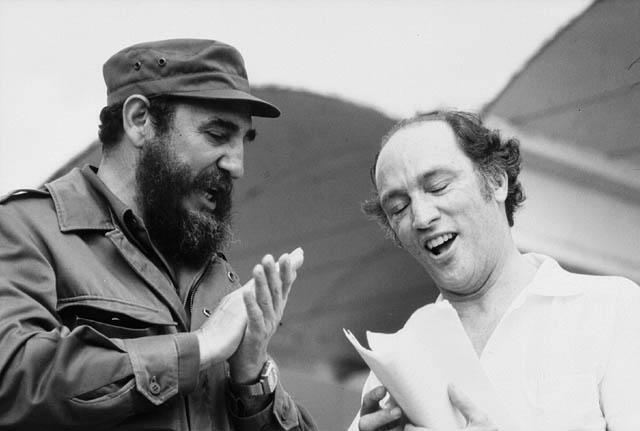
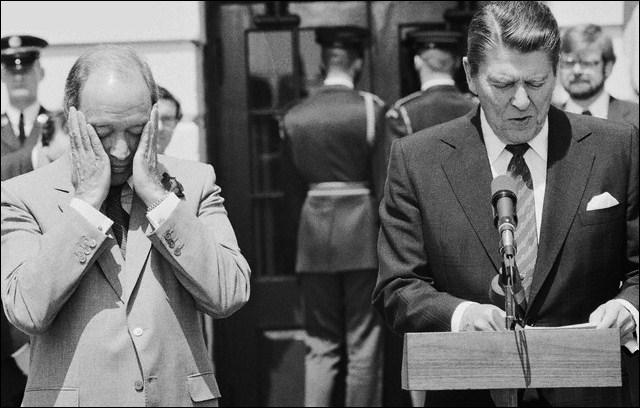
Pierre Trudeau dominated Canadian politics for more than 15 years beginning in 1968. A politican as rock star, he’s still the country’s Prime Minister best remembered outside of Canada and likely the most divisive one within the nation.

Trudeau responding to personal attacks, 1972:

Trudeau meets with John and Yoko, 1969 (no sound until :30):

Tags: , ,


From the September 15, 1901 Brooklyn Daily Eagle:

“An anarchist picnic which was to have been held at West Hoboken, N.J. to-day was abandoned, because the police gave notice that any person who participated in any public demonstration made by the anarchists would be promptly arrested.”

William F. Buckley, Jr. welcomes Phyllis Schlafly and Ann Scott to debate the Equal Rights Amendment, 1973.

Tags: , ,

When the Tea Party was red hot and the Birther movement was at its peak, an Esquire interviewer asked Chris Rock if he thought racism was returning–or had never declined–in America. He was undisturbed. “When I see the Tea Party and all this stuff,” Rock answered, “it actually feels like racism’s almost over. Because this is the last — this is the act up before the sleep.”

I think this national contraception brouhaha may be saying the same thing about sexism. On one level, it’s a just an awkward and desperate act of pandering to an extremist base by opportunistic politicians in the year of election. But there may be something more fundamental about it. Over the last decade, women have embraced higher education as men have fallen from it, and while education is no longer the definite path to success and power it once was, you would have to assume the numbers say women will be ascendant in business and politics in America for the next couple of decades.

And that shift may be disconcerting to some who still cling to a paternalistic vision of America. But those who feel this way tend to be on the higher end of the age scale and their numbers continue to thin.

Political power doesn’t shift quietly or easily, but the big picture tells us it’s going to shift in the favor of women in the near fiuture. That doesn’t mean there will never be sexism (or racism) any more, but that its viability as a means of political control is all but over. The clamor over reproductive rights sounds less like a clarion call than a death rattle.•

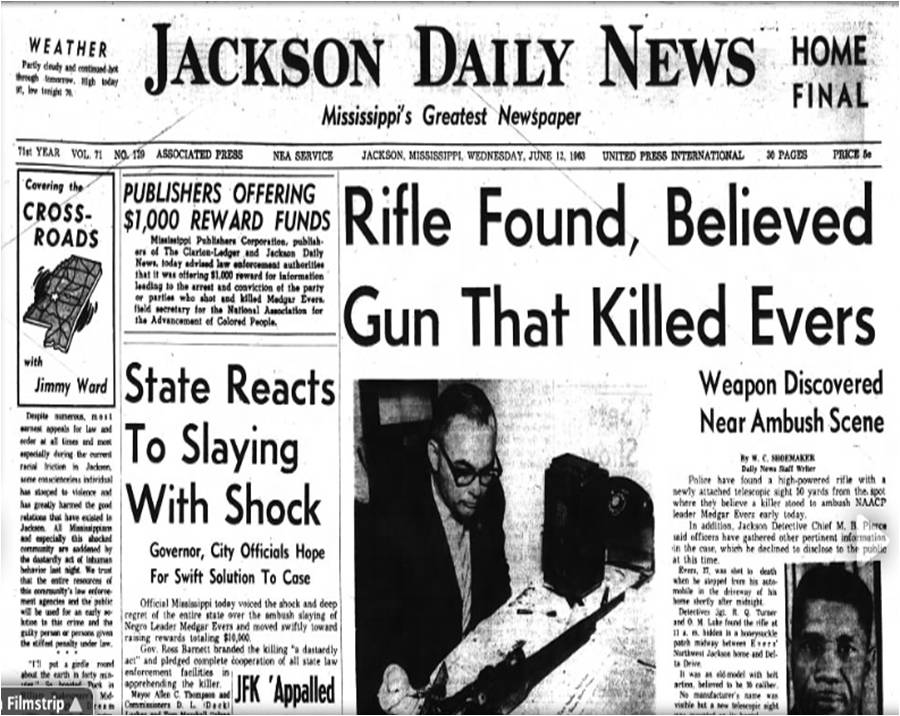
The opening of “He Said He Wouldn’t Mind Dying–If,” Myrlie Evers’ eloquent 1963 essay in Life, about the assassination of her husband, civil rights leader Medgar Evers:

“We all knew the danger was increasing. Threats came daily, cruel and cold and constant, against us and the children. But we had lived with this hatred for years and we did not let it corrode us.

Medgar was a happy man with a rich smile and a warmth that touched many people. He was never too busy to listen or too tired to to help. But beneath that gentle sympathy lay strength that could not be intimidated. Lord knows, enough people tried. But it never worked and that, I suppose, is why they killed him.

I don’t know what makes one man feel so passionately the needs of his people. It began for Medgar when he was a little boy in Decatur, Miss., where he was born. A family friend was lynched, and years later Medgar could still recall the shock with which he turned to his father.

‘Why did they kill him, Daddy?’ he asked.

‘Well, just because he was a colored man,’ his father said.

‘Could they kill you too?’

‘If I did anything they didn’t like, they sure could.’

Medgar never forgot that blunt statement of the facts of Negro life in Mississippi.”

•••••••••••

“A bullet from the back of a bush took Medgar Evers’ blood / A finger fired the trigger to his name”:

Tags: ,

What happens if President Obama gets another term? What about if the tax code changes so “job creators” are taxed like everyone else and the number of jobs don’t decrease? What if the Affordable Care Act improves our health and doesn’t bankrupt us? What if gay marriage is legalized at the federal level and has no ill effect whatsoever on society? What if women having access to free contraception actually improves our society?

What would those things mean? Is it permanently the end of 30 years of trickle-down economics? Is it the end of Reagan Republicanism? Is the time when the Right could exploit so-called value voters over? Thanks to shifting demographics, we may find out. From “2012 Or Never,” clear-eyed analysis of the political scene by New York‘s Jonathan Chait:

“‘America is approaching a ‘tipping point’ beyond which the Nation will be unable to change course,’ announces the dark, old-timey preamble to Paul Ryan’s ‘The Roadmap Plan,’ a statement of fiscal principles that shaped the budget outline approved last spring by 98 percent of the House Republican caucus. Rick Santorum warns his audiences, ‘We are reaching a tipping point, folks, when those who pay are the minority and those who receive are the majority.’ Even such a sober figure as Mitt Romney regularly says things like ‘We are only inches away from no longer being a free economy,’ and that this election ‘could be our last chance.’

The Republican Party is in the grips of many fever dreams. But this is not one of them. To be sure, the apocalyptic ideological analysis—that ‘freedom’ is incompatible with Clinton-era tax rates and Massachusetts-style health care—is pure crazy. But the panicked strategic analysis, and the sense of urgency it gives rise to, is actually quite sound. The modern GOP—the party of Nixon, Reagan, and both Bushes—is staring down its own demographic extinction. Right-wing warnings of impending tyranny express, in hyperbolic form, well-grounded dread: that conservative America will soon come to be dominated, in a semi-permanent fashion, by an ascendant Democratic coalition hostile to its outlook and interests. And this impending doom has colored the party’s frantic, fearful response to the Obama presidency.

The GOP has reason to be scared. Obama’s election was the vindication of a prediction made several years before by journalist John Judis and political scientist Ruy Teixeira in their 2002 book, The Emerging Democratic MajorityDespite the fact that George W. Bush then occupied the White House, Judis and Teixeira argued that demographic and political trends were converging in such a way as to form a ­natural-majority coalition for Democrats.”

Tags:

Eleanor Roosevelt for Good Luck Margarine, in 1959.

Tags:

Anthony Burgess joins William F. Buckley in 1972 to discuss radical students.

Tags: ,

"He doesn’t go out of his way to convince Republicans that he is one of them." (Image by R. DeYoung.)

Ron Paul has made only slight concessions to the mainstream, pretending he wasn’t responsible for the racist, extremist newsletters that funded his national political career, but in the last five years or so, the center has moved quite a ways to meet him. Rigidly doctrinaire to the point of absurdity, Paul has somehow captured the hearts and minds of a reasonably sizable portion of the American public. But he’s a Libertarian, not a Republican any more than a Democrat, which makes him even more of an odd duck in the GOP field. He’s a third-party candidate running for one of the first two. But is he the beginning of a serious strain of post-party politics?

Some of you read the New Yorker before you read Afflictor (bastids!), so you may have already taken in Kelefa Sanneh’s smart piece about Paul this week. But in case you haven’t gotten to it yet, here’s an excerpt:

“‘I think parties are pretty irrelevant,’ Paul says, and he doesn’t go out of his way to convince Republicans that he is one of them. He firmly opposed Obama’s health-care plan, and he might win a few more votes if he made this opposition the centerpiece of his stump speech. Instead, he tends toward arguments that are almost perversely nonpartisan—elaborating, say, the similarities between Bush’s war on terror and Obama’s. He asks, ‘Have you ever noticed that we change parties sometimes, but the policies never change?’ Even during that first Tea Party appearance, in Texas in 2007, Paul passed up a chance to reassure Republican voters. Skipping over the ‘United Nations’ and ‘I.R.S.’ barrels, he picked up one marked ‘Iraq War’ and heaved it into the river. He was seventy-two at the time, and surely relished the physical act as much as the symbolic one. ‘Start with that, and then we can solve the rest of the problems,’ he said.”

••••••••••

Paul on Morton Downey, Jr.’s screamfest, 1988:

Tags: ,

Whitey has already been on the moon, and now hackers want in. A note from Adam Clark Estes on Atlantic Wire about the increasingly outré plans of attention-seeking hackers, who are Anonymous but don’t wish to be anonymous:

“‘At the Chaos Communication Camp 2011 Jens Ohlig, Lars Weiler, and Nick Farr proposed a daunting task: to land a hacker on the Moon by 2034,’ Tom Hardy writes on The Powerbase. ‘The plan calls for three separate phases: 1. Establishing an open, free, and globally accessible satellite communication network, 2. Put a human into orbit, 3. Land on the Moon.’ 

Hackers on the moon? Promoting these crazy-sounding plans may be a way for older school hackers to steal back the spotlight from LulzSec and its sometimes meaningless website takedowns in 2011. Even their fellow hackers made fun of the group at the time of the assaults. ‘They were rampaging, and clearly not willing to stop,’ one hacker who calls himself Asherah told The New York Times last summer. ‘Despite the rumors, they’re not very accomplished hackers. They’re attention-drunk.'”

Tags:

Fifty years ago, the great John Glenn orbited the moon and America was on its way in the Space Race. Behind the scenes, things were murkier, as erstwhile Nazi Wernher von Braun was leading the program. The scientist collaborated with Walt Disney on the 1955 short film, “Man in Space.”

See also:

Tags: , ,

Paul Krugman is the subject of a new Playboy Interview conducted by Jonathan Tasini. Because a monthly magazine covering current events is completely crazy at this point, the two mostly stick to more general policy questions, and there’s some good stuff there. (If you click the link at work, be advised that there are bare boobs and butts all over the page, though none belong to Krugman.) An excerpt:

KRUGMAN: The point is there’s a tremendous amount of suffering. A lot of America is much worse off than it was four years ago. I think the main reason you should be angry about it is that it’s gratuitous. This doesn’t have to be happening. We actually have the tools to make most of this go away. If we could throw aside the political prejudices and bad ideas that are crippling us, in 18 months we could be back to something that feels like a much better economy.

PLAYBOY: So people in America today are suffering when they don’t have to be because of policy makers who won’t do the right thing?

KRUGMAN: That’s right. I’ve gotten some grief for my remark that if it were announced that we faced a threat from space aliens and needed to build up to defend ourselves, we’d have full employment in a year and a half. But that’s true. Why couldn’t we do that to repair our sewer systems and put an extra tunnel under the Hudson instead of to fight imaginary space aliens? Everybody in the world except us is doing a lot of investment in infrastructure and education. This is the country of the Erie Canal and the Interstate Highway System. The Erie Canal was a huge public infrastructure project financed with no private or public-private partnership. Can you imagine doing that in 21st century America? We really have slid backward for the past 200 years from the kinds of things we used to understand needed to be done now and then. And all of that because we are shackled to the wrong ideas.”

Tags: ,

How disgraceful!

I would never mock an American hero, Mavis.

Tags: ,

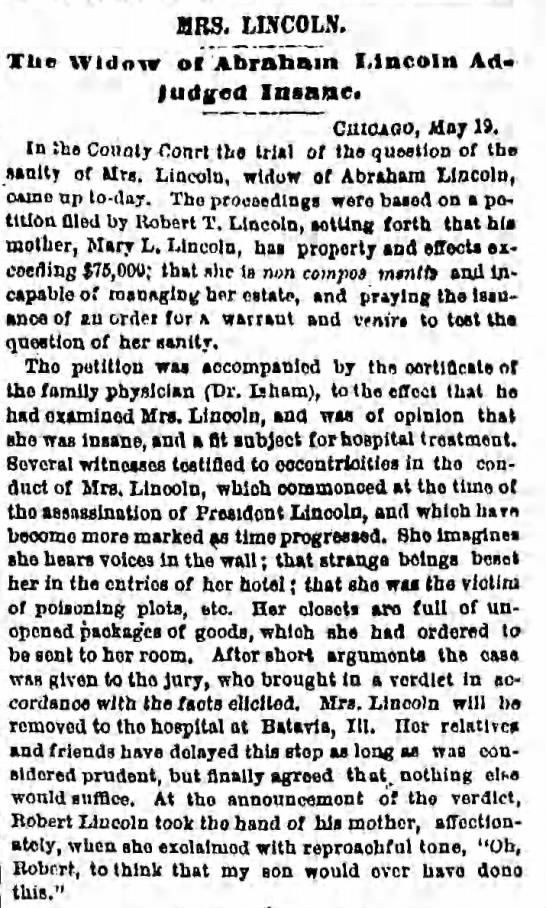
“She imagines she hears voices in the wall.”

A decade after President Lincoln was assassinated, his wife, Mary Todd Lincoln, who struggled emotionally from the death of not only her husband but three sons as well, was declared insane at the request of her only surviving son, Robert. A report follows from the May 20, 1875 Brooklyn Daily Eagle.

Tags: , , ,

A section from “Choice,” a 1964 campaign film for Barry Goldwater, the template for all culture warriors to follow.

Tags:

« Older entries § Newer entries »