
Excerpts

You are currently browsing the archive for the Excerpts category.

"A middle-aged woman known as SM blithely reaches for poisonous snakes..." (Image by JamieS93.)

A rare genetic disorder called Urbach-Wiethe disease obliterates the capacity for the amygdala portion of the brain to cause a person to feel fear. Someone with this congenital condition never becomes afraid, even when it’s the best thing for their well-being. (Thanks Reddit.) An excerpt about the condition from Laura Sanders’ Science News article:

“A middle-aged woman known as SM blithely reaches for poisonous snakes, giggles in haunted houses and once, upon escaping the clutches of a knife-wielding man, didn’t run but calmly walked away. A rare kind of brain damage precludes her from experiencing fear of any sort, finds a study published online December 16 inCurrent Biology.

SM has an unusual genetic disorder called Urbach-Wiethe disease. In late childhood, this disease destroyed both sides of her amygdala, which is composed of two structures the shape and size of almonds, one on each side of the brain. Because of this brain damage, the woman knows no fear, the researchers found.

Experiments have strongly implicated the amygdala in fear processing. Many of these were conducted on animals with amygdala damage. ‘But one thing we’ve never known for sure, because they’re animals, is whether they can consciously feel fear,’ says study coauthor Justin Feinstein of the University of Iowa in Iowa City. ‘So we said, Let’s take a human patient who has this same sort of damage, and for the first time, actually figure out how they’re feeling.’

Feinstein and his colleagues sifted through SM’s past, looking for instances when she should have been scared. SM said she never felt fear, even when threatened with a knife or a gun. The researchers gave SM an electronic diary that she carried for three months to record her emotional state. Fear didn’t make an appearance in the list of emotions. On a battery of questionnaires, SM wrote that she wasn’t afraid of public speaking, death, her heart beating too fast or being judged negatively in a social setting.”
Tags: ,

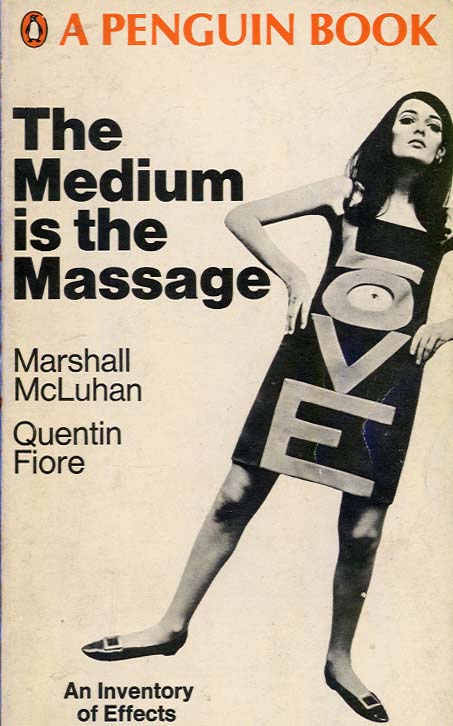
Quentin Fiore, the graphic designer who created the book's amazing look, is now 90.

Facebook wunderkind Mark Zuckerberg being named Time magazine’s Person of the Year made me recall an ominous passage from early in The Medium Is The Massage: An Inventory of Effects, from 1967. Not that I think that things are quite this dire, but Marshall McLuhan was pretty prophetic here. An excerpt:

“How much do you make? Have you ever contemplated suicide? Are you now or have you ever been…? I have here before me…Electrical information devices for universal, tyrannical womb-to-tomb surveillance are causing a very serious dilemma between our claim to privacy and the community’s need to know. The older, traditional ideas of private, isolated thoughts and actions–the patterns of mechanistic technologies–are very seriously threatened by new methods of instantaneous electric information retrieval by the electrically computerized dossier bank–that one big gossip column that is unforgiving, unforgetful and from which there is no redemption, no erasure of early ‘mistakes.’ We have already reached a point where remedial control, born out of knowledge of media and their total effects on all of us, must be exerted. How shall the new environment be programmed now that we have become so involved with each other, now that all of us have become the unwitting work force for social change? What’s that buzzzzzzzzzzzzzzzzzzzzzzzzzzzzzzzzing?”

Tags: , ,

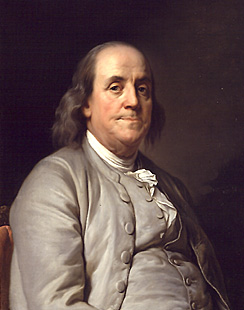
Even though he was reputed to really like orgies, Benjamin Franklin was careful about his body when it came to food and drink, experimenting with vegetarianism and preaching temperance. Franklin’s disregard for alcohol made him an oddball in an age when most folks were continually soused. An excerpt from Joyce Chaplin’s The First Scientific American:

“Fat though he grew, the adult Franklin’s much-noted coolness and detachment may have been the result, at least in part, of his measured consumption of alcohol. His sobriety was striking in an age when people drank steadily–to consume calories, to keep warm, and to avoid tainted water. Tipsiness was so common that it went unnoticed, even in small children, pious clerics, and pregnant women. We might call them drunk; but drunkenness at the time meant inability to stand.”

Tags: ,

"One of Jump’s first megaclients was Target, in 2001." (Image by David Weekly.)

David Segal’s Times article, “In Pursuit of the Perfect Brainstorm,” looks at the world of Ideas Entrepreneurs, individuals and companies that help corporations and government agencies solve problems and develop products. The field has its own Orwellian argot (e.g., “thought leaders”) and tries to overcome “highly ambiguous problems.” One such think tank is Jump in San Mateo, California. In this excerpt, Segal writes of how Jump helped Target defend its market niche:

“One of Jump’s first megaclients was Target, in 2001. Still early in its spiffy-design phase, Target was selling home products by the designers Michael Graves and Phillipe Starck. Kmart was teamed up with Martha Stewart. Robyn Waters, then Target’s vice-president of trend, design and product development, was worried that the company’s famous-designer-on-a-budget success was being mimicked in categories that Target considered strongholds. One such category was back-to-college. Using a variety of methods, including ‘Yes, and?’ brainstorming and having anthropologists analyze video footage of collegebound kids shopping for kitchenware, Jump helped devise a product called Kitchen in a Box, a collection of dozens of different utensils, pans, pots and a kettle, later designed by Todd Oldham. Sales took off. ‘It worked phenomenally well,’ Waters says.”

Tags: , , , , ,

Micky, taking a break form dish-washing duties. (Image by Michelle Reback.)

Queens Village was the place to be in 1949 if you needed your household chores done by a monkey. At least that was the case according to an article I found in Life magazine’s August 29, 1949 issue. The piece,Micky the Dishwashing Monkey,” recalls a simpler time in America, when capuchins were called upon to rinse silverware. It also recalls a time when everyone in the offices of Life magazine was apparently drunk.

In addition to his domestic talents, Micky liked waving to pretty girls from the apartment window and rubbing extinguished cigar butts on himself. He also once punched his owner in the foot so hard that she was unable to wiggle he toes for six months. The owners weren’t quadriplegics who needed assistance but apparently just lazy and bored middle-class people. A brief excerpt from the article, which was subtitled “A talented Long Island capuchin loves to work at the kitchen sink”:

“For the past few years Mrs. John Taral of Queens Village, N.Y. has been letting her pet monkey, Micky, wash the dishes for her without ever thinking there was anything special about having a monkey who washed the dishes. Then the newspapers found out about it and suddenly Micky and his mistress landed on the front pages. For days, Micky washed dishes for the press, and Mrs. Taral suddenly realized what a household gem she had.

‘You could put a million dollars on the table for my monkey and I wouldn’t take it,’ she told the Herald Tribune‘s animal story expert, John O’Reilly.”

Tags: , , ,

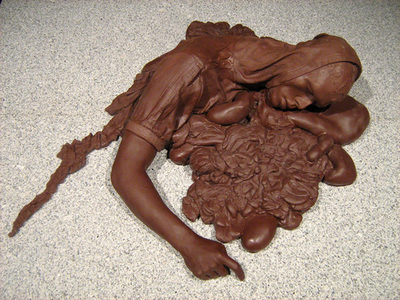
Stephen J. Shanabrook's chocolate sculpture of a mutiliated suicide bomber will be on display at MONA. (Image by Shanbrook.)

Cristina Ruiz has an interesting piece in the Utne Reader about the opening the Museum of Old and New Art (MONA) in Tasmania. It’s an eccentric  temple to secularism built by 49-year-old entrepreneur David Walsh. It sounds like an attempt to create a permanent version of the more pungent, button-pushing elements of Sensation. (Thanks Marginal Revolution.) An excerpt:

Finally, there is the international contemporary art. Walsh owns some 300 works, and more have been commissioned for the opening of MONA. These include an untitled 1998 installation by Jannis Kounellis that incorporates seven rotting beef carcasses and a new version of Wim Delvoye’s Cloaca. The machine, which simulates the human digestive process, creates excrement that is apparently indistinguishable from the real thing.

The smell of rotting beef and excrement may be too much for some visitors, but to Walsh they are important. ‘Aren’t we just machines for manufacturing shit?’ he asks.

Some visitors may find these displays shocking, a reaction Walsh welcomes. ‘There’s a lot of controversial stuff [that will go on display]. And, hopefully, it will cause a backlash because that’s how you attract visitors—and also I want to get some discussion going.’

Other works likely to produce strong responses include Stephen J. Shanabrook’s On the Road to Heaven the Highway to Hell, a chocolate sculpture depicting the mutilated body of a suicide bomber, and Gregory Green’s Bible Bomb #1854 (Russian style), a mixed media ‘bomb’ in a Bible.”

Tags: , , , ,

Because of marathon gaming sessions at Internet cafes in China, the gov’t banned all teens from the establishments. Image by Matthew Lyons/Game Gavel https://gamegavel.com.

Some parents in China became alarmed in recent years by their children overindulging in web-related activities, particularly marathon gaming sessions. That led to a market arising in Internet-addiction boot camps, and as often is the case, the cure was worse than the “disease.” Electroshock therapy was just the beginning of the madness. An excerpt from Christopher S. Stewart’s article on the topic  in Wired:

“One of the first signs that things had gotten out of hand in China’s Internet-addiction camps was the emergence of Uncle Yang — Yang Yongxin — a psychiatrist who opened a treatment center at a state-owned hospital in eastern Shandong Province in 2006. His camp was one of hundreds that had sprung up in China — many of them unregulated, uncredentialed, and relying on a grab bag of treatments: antidepressants, counseling, even intense physical exertion. (One sent its young clients on a 528-mile trek through Inner Mongolia.) What began as a fairly well-regarded and disciplined approach had spun into a growth industry, packed with untrained entrepreneurs.

Yang’s battery of therapies included electroshock — known as xing nao, or ‘brain waking.’ Electrodes were attached to his patients’ hands and temples, then shot through with 1 to 5 milliamps of electricity. One girl recalled wearing a mouth guard to prevent her from biting off her tongue. Some sessions apparently went on for a half hour; occasionally, a shock was said to leave burns. In an interview with a local paper, Yang defended the practice, saying, ‘It doesn’t cause any damage to the brain. But it is painful, quite painful!’

Yang was not a psychotherapist, nor was he licensed to administer electroshock. But that didn’t matter. He claimed to know what he was doing. ‘It will clear the mind,’ he promised. He charged almost $900 per month — a remarkable sum for a country in which the average monthly wage is around $400. Still, some 3,000 desperate parents sent their kids to him for four-month stints. The media hailed Yang as a ;national Web-addiction expert,’ recounting his heroic tales of life at his rehab center. Even after Yang’s methods were deemed excessive — in July, Chinese authorities banned electroshock as an Internet-addiction treatment, claiming the tactic required further study — his services were reportedly still in demand.”

Tags: ,

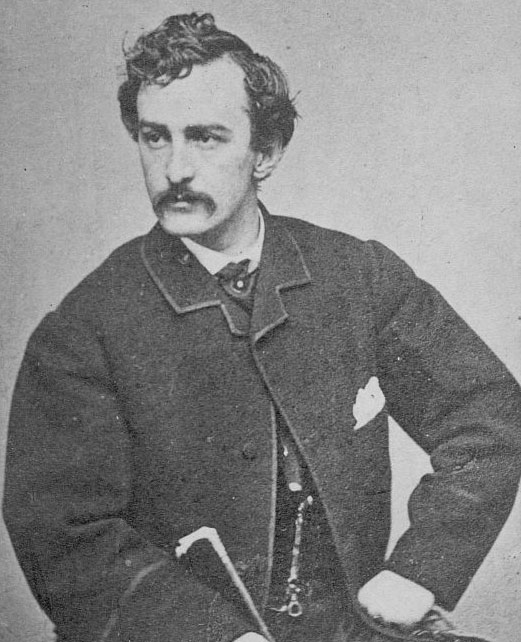
“He owned ‘that which is the grand constituent of all truly great acting, intensity.'”

Accounts from Gene Smith’s 1992 history, American Gothic, about a pair of times when President Lincoln watched performances by the noted actor and his future assassin, John Wilkes Booth, on stage in Washington D.C. The first “meeting” took place in 1863.

___________________________

John was about to turn twenty-five, and of a theatrical stature to set himself up as a more or less permanent resident star in a leading city. He chose Washington. The wartime capital was bursting with people, and entertainments of any type drew capacity crowds. He opened as Richard III at Grover’s Theatre, on April 11, 1863, billed as “The Pride Of The American People–The Youngest Tragedian In The World–A Star Of The First Magnitude–Son Of The Great Junius Brutus Booth–Brother And Artistic Rival Of Edwin Booth.” President Lincoln attended. The National Republican said he scored a “complete triumph” and “took the hearts of the people by storm.” A day later the paper added that his playing created a sensation. “His youth, originality, and superior genius have not only made him popular but have established him in the hearts of the Washington people as a great favorite.” The National Intelligencer said he owned “that which is the grand constituent of all truly great acting, intensity. We have only to say that this young actor plays not from stage rule, but from his soul, and his soul is inspired with genius. Genius is its own schoolmaster: It can be cultivated but not created.•

___________________________

Accompanying President Lincoln and his wife to the theater one night were the two daughters of Cassius M. Clay, U.S. Minister to Russia. Their mother was an old friend of Mary Todd Lincoln and when they sent in their cards to her she responded with the invitation. As the party drove, a piece of iron suddenly sprung up and pierced the carriage seat between the President and his wife. For a moment an alarmed Mary Lincoln thought it was an attack. Mary Clay asked the President what measures he took to be guarded–no czar of Russian would go through a St. Petersburg street without cavalry escort and with police, detectives, and plainclothesmen along the route, and for good reason–and the President said, “I believe when my time comes there is nothing that can prevent my going.”

The star performer played a villain and twice “in uttering disagreeable threats came very near” and appeared to point to the President. “When he came a third time I was impressed by it, and said, ‘Mr. Lincoln, he looks as if he meant that for you.'”

“‘Well,'” he said of John Booth, “‘he does look pretty sharp at me, doesn’t he?'”•

Tags: , ,

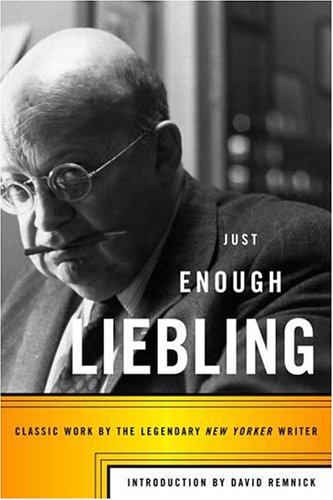
“Just Enough Liebling” has a foreword by current “New Yorker” editor David Remnick. (Image by North Pointe Press.)

An indifferent student from a wealthy Upper East Side family, A.J. Liebling had an endless curiosity of all things, especially French food, press criticism and pugilism. “The University of Eighth Avenue” is a piece from the latter category though not from the New Yorker. It’s a great two-part story from a pair of December 1955 issues of Sports Illustrated, about an old-school fighter named Billy Ray, who was soon to turn 90. In it, Ray recalls the raffish, cold-blooded side of the 19th-century Brooklyn sporting scene. (Read the full article, part one and part two.) An excerpt:

“Ray grew up in the gracious old Brooklyn of Henry Ward Beecher, in which prizefighting was as much against the law as cocking mains or dogfights, but less frowned upon, since there were no Humane Societies needling the police to stop the fist fighters. Left to their own devices the police were lenient. ‘A fellow named Hughie Bart ran a great place around 1882,’ Mr. Ray said. ‘It was right across the street from Calvary Cemetery and there would be dogfights in the basement, rooster fights on an upper floor, and we would be fighting on the ground floor, all at the same time. Mourners would stop in on their way back, to take their mind off their loss. The gravediggers were old tads with beards. They’d sit in Hughie’s drinking between jobs, and when they were watching a fight you dassn’t quit, because they would split your skull with a spade.'”

See also:

Tags: , , , ,

Edward Albee at the Miami Bookfair International in 1987. (Image by MDCarchives.)

This isn’t suprising at all, is it? From a new interview in Vice:

Do you have a specific writing space?

I do my writing in my head. There are tables around for whenever I feel like writing something down. I don’t care where I do it. It’s called a manuscript, so I write by hand.

That’s pretty old school.

I don’t believe in all those machines.

And the internet?

I know it exists. I don’t use it.

Do you have a cell phone?

No. It’s a waste of time. I might as well watch television. I walk along the streets of New York and I find people bumping into each other, bumping into things, and they have these things in their ears or in their face. They’re not seeing anything of the real world.”

Tags:

John S. Stokes III cuts one of his amazing puzzles. (Image by Stokes.)

I’ve never been a hobby shop enthusiast, so I didn’t realize how elaborate jigsaw puzzle making (or cutting) apparently is. It’s a highly specialized industry that has adults making insanely difficult puzzles for other adults. It seems a lot of tech people enjoy the puzzles as a lo-fi, tactile diversion.

Jennifer A. Kingson has a piece in the New York Times about the jigsaw subculture. In it, she profiles a San Diego puzzle cutter who does sinister and stunning work. An excerpt:

John S. Stokes III, of San Diego, who cuts dazzlingly intricate puzzles by hand, would agree. Sometimes he deliberately leaves wavy or irregular borders to thwart people who like to put the edge pieces together first.

‘By far the hardest-to-assemble puzzle I ever made was a transparent plastic puzzle with nearly identically shaped pieces,’ said Mr. Stokes, 60, who turned to puzzle cutting after a career in computer programming. ‘Also, you can’t tell which side is up.’

At age 4, Mr. Stokes said, he was putting together 500-piece puzzles. He turned professional about 10 years ago, spending long days guiding pieces of wood into the stationary blade of a scroll saw. ‘It’s very much like a sewing machine,’ he observed.

Among the more spectacular puzzles he has created was a map of the world that had 1,384 pieces and measured nearly three feet long; it took three weeks to cut, he said. His largest puzzle was a four-and-a-half-foot triptych of Hieronymus Bosch’s Garden of Earthly Delights, with 4,271 pieces. It sold on eBay for $25,100.”

Tags: ,

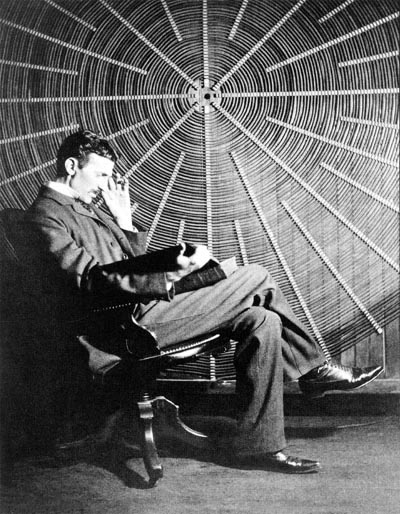
It was common knowledge in the 19th century: Thomas Edison was the far greater businessperson, but Nikola Tesla was the far greater genius. It must be noted, however, that Tesla wasn’t a genius at getting his ass to jury duty. A brief notice from the October 7, 1902 Brooklyn Daily Eagle:

For failing to answer to a summons for jury duty, Nikola Tesla, the electrician, was fined $100 by Judge Foster in General Sessions Manhattan this morning. Unless the electrician can give a good reason for his failure to appear in court he will have to pay the fine, the only other alternative being imprisonment in Ludlow street jail.”

Tags: ,

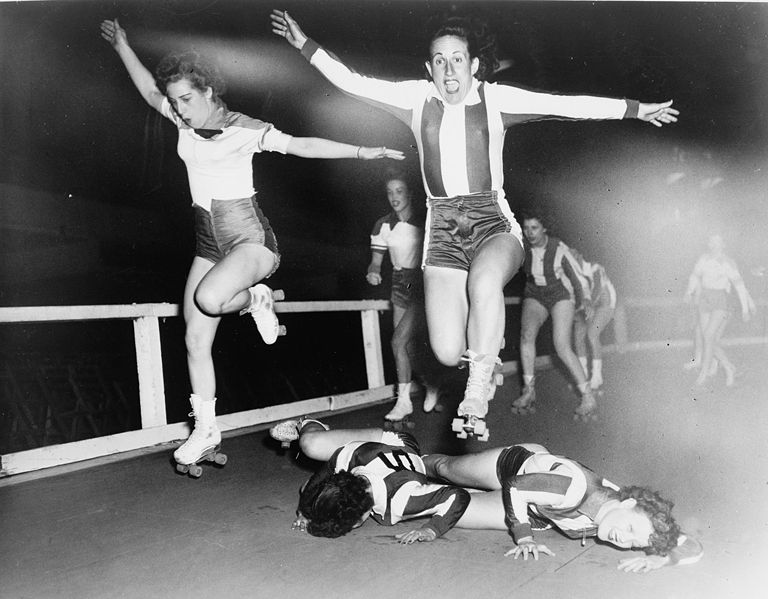
Derby women take a leap during the sport's first heyday in the 1950s, when it was a TV staple.

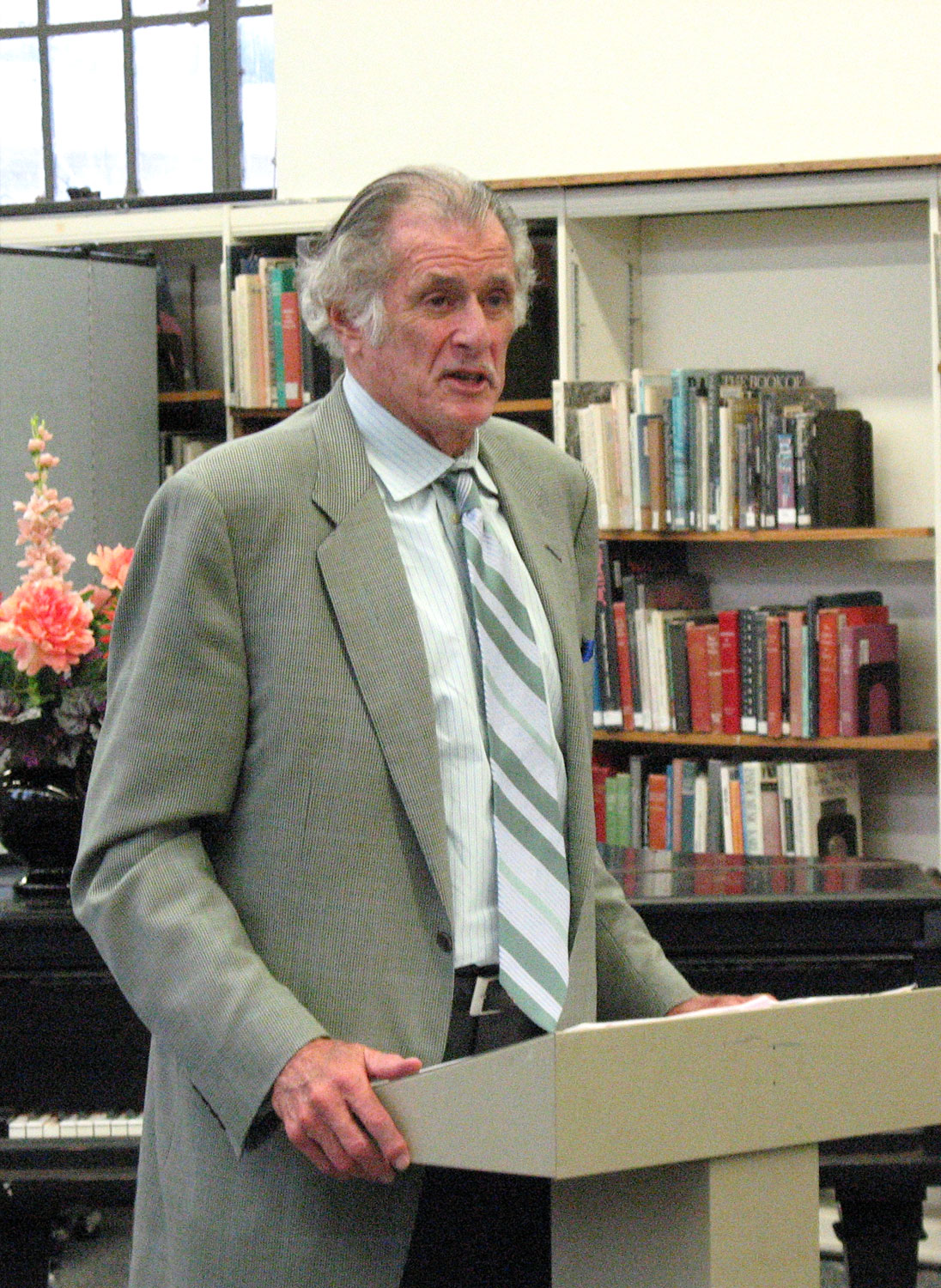
In addition to a million other things he’s done in his amazing career, the legendary journalist Frank Deford was a pioneering writer about roller derby. I’ve seen Five Strides on the Banked Track, his out-of-print book about the roller sport for sale online for anywhere from $55 to $700. That volume grew out of a 1969 Sports Illustrated article of the same name. Deford was fully aware of the feminist appeal of the pseudo-sport and its then-greatest star Ann Calvello, whom he profiled. An excerpt from the article about Calvello:

“‘The one time I really got hurt was in Honolulu. I was fighting this girl, and she must have gotten me with her fingernail. I didn’t even know it was my eye till all this blood came pouring out, so right away—this one time—I went to the doctor at the hospital, because eyes are the one thing I don’t want to fool around with. Well, the doctor took one look at me, with the blue hair, the blue lipstick, the red blood pouring out of my eye, the green-and-gold uniform, and he had to figure I was straight into Honolulu from outer space.’

Frank Deford was the editor of the short-lived, much-lamented sports daily, "The National." (Image by Bridgeport Public Library.)

Little escapes Calvello. The acid comment she spills forth is the product of her wit and is not related to the meanness that she exhibits on the track. She is certainly a leader by any standard, astrological or otherwise. As soon as she reaches the bar with her silver chalice she is in charge. She directs the conversation, sometimes two conversations at a time—the one she is dominating and the adjoining one that she overhears. She distributes nicknames to everybody. She outlaws shoptalk. ‘No skating talk while drinking’ is the first Calvello law.

While she is hardly just another pretty face, Calvello is still slim and attractively winsome after 20 years on the tour. She dresses exceptionally well and is able to get away with wearing youthful clothes that most women her age would be afraid of. Divorced many years ago from a former Derby referee, Ann also likes her men young. On the tour, in the company of Eddie Krebs, a wistful, temperamental Leo himself, Ann sparkled, particularly when the other skaters kidded Krebs that he was starting to look 40 and Calvello 20. Krebs, slim to start with, had lost almost 40 pounds on the tour. With his handsome, chiseled face, long page-boy hair and a haunting high-pitched giggle, he and the blue-haired, hoarse-throated Calvello made a couple that seemed straight out of an avant-garde French movie. It was the only tour romance.”

Tags: , ,

From the Voigt Lab site: "We are developing a basis by which cells can be programmed like robots to perform complex, coordinated tasks." (Image by Dr. Edwin P. Ewing, Jr. )

At Dailytech, Jason Mick has a smart article about scientists using E. Coli bacteria in the place of electriconic currents to operate microcomputers, which is the first time living organisms have been utilized in this way. An excerpt:

“In a newly published study in the journal NatureChristopher A. Voigt, PhD, and his colleagues at the University of California San Francisco, demonstrated how intercellular communications between genetically modified E. Coli bacteria could act as a crude computer.

The result is that bacteria can be enslaved to become part of a hive mind computer, performing the will of a central controller. Professor Voigt describes, ‘We think of electronic currents as doing computation, but any substrate can act like a computer, including gears, pipes of water, and cells.  Here, we’ve taken a colony of bacteria that are receiving two chemical signals from their neighbors, and have created the same logic gates that form the basis of silicon computing.’

Professor Voigt’s team is currently working towards building a bacteria computer capable of accepting commands in a formal language system, similar to how modern computers receive commands in assembly (translated to machine) language.”

Tags: ,

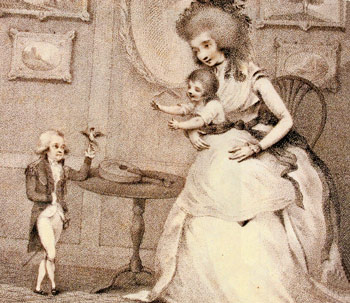
An undated rendering of the debonair Joseph Boruwlaski. He grew to be 39 inches tall.

From Armand Maire Leroi’s 2005 book, Mutants: On Genetic Variety and the Human Body, a brief biographical sketch of Joseph Boruwłaski (1739–1837), a Polish-born man with dwarfism (likely the pituitary kind) who became an unlikely fixture in European royal courts:

“Joseph Boruwlaski died in his sleep on 5 December 1837 in the quiet English cathedral town of Durham. He had had a happy life, a rich life. Born into obscurity, he had achieved dizzying social heights. Famed for his conversation and his skill with the violin, he had known most of the crowned heads of Europe. Ennobled by the King of the Poles, he had also won the patronage of the Prince of Wales. He could call the Duke and Duchess of Devonshire his friends. He was an ornament of Durham, its council paid him merely to live there. He had married a noble beauty, raised a family and, when he died at the distinguished age of ninety-eight, had outlived nearly all his contemporaries. It was a graceful end to a remarkable life. For Joseph, le Comte de Boruwlaski, was not merely any Continental aristocrat exiled from his homeland. He was the last of the court dwarfs.”

Tags:

“What’s wrong with education cannot be fixed with technology.” (Image by Matthew Yohe.)

In a 1993 Wired interview conducted by Gary Wolf, Steve Jobs discussed the intersection of technology and education. I think what he said then about education in America is just about as true now, which is sad because it speaks to how little progress we’ve made. An excerpt:

Wired: Could technology help by improving education?

Steve Jobs: I used to think that technology could help education. I’ve probably spearheaded giving away more computer equipment to schools than anybody else on the planet. But I’ve had to come to the inevitable conclusion that the problem is not one that technology can hope to solve. What’s wrong with education cannot be fixed with technology. No amount of technology will make a dent.

It’s a political problem. The problems are sociopolitical. The problems are unions. You plot the growth of the NEA [National Education Association] and the dropping of SAT scores, and they’re inversely proportional. The problems are unions in the schools. The problem is bureaucracy. I’m one of these people who believes the best thing we could ever do is go to the full voucher system.

I have a 17-year-old daughter who went to a private school for a few years before high school. This private school is the best school I’ve seen in my life. It was judged one of the 100 best schools in America. It was phenomenal. The tuition was $5,500 a year, which is a lot of money for most parents. But the teachers were paid less than public school teachers – so it’s not about money at the teacher level. I asked the state treasurer that year what California pays on average to send kids to school, and I believe it was $4,400. While there are not many parents who could come up with $5,500 a year, there are many who could come up with $1,000 a year.


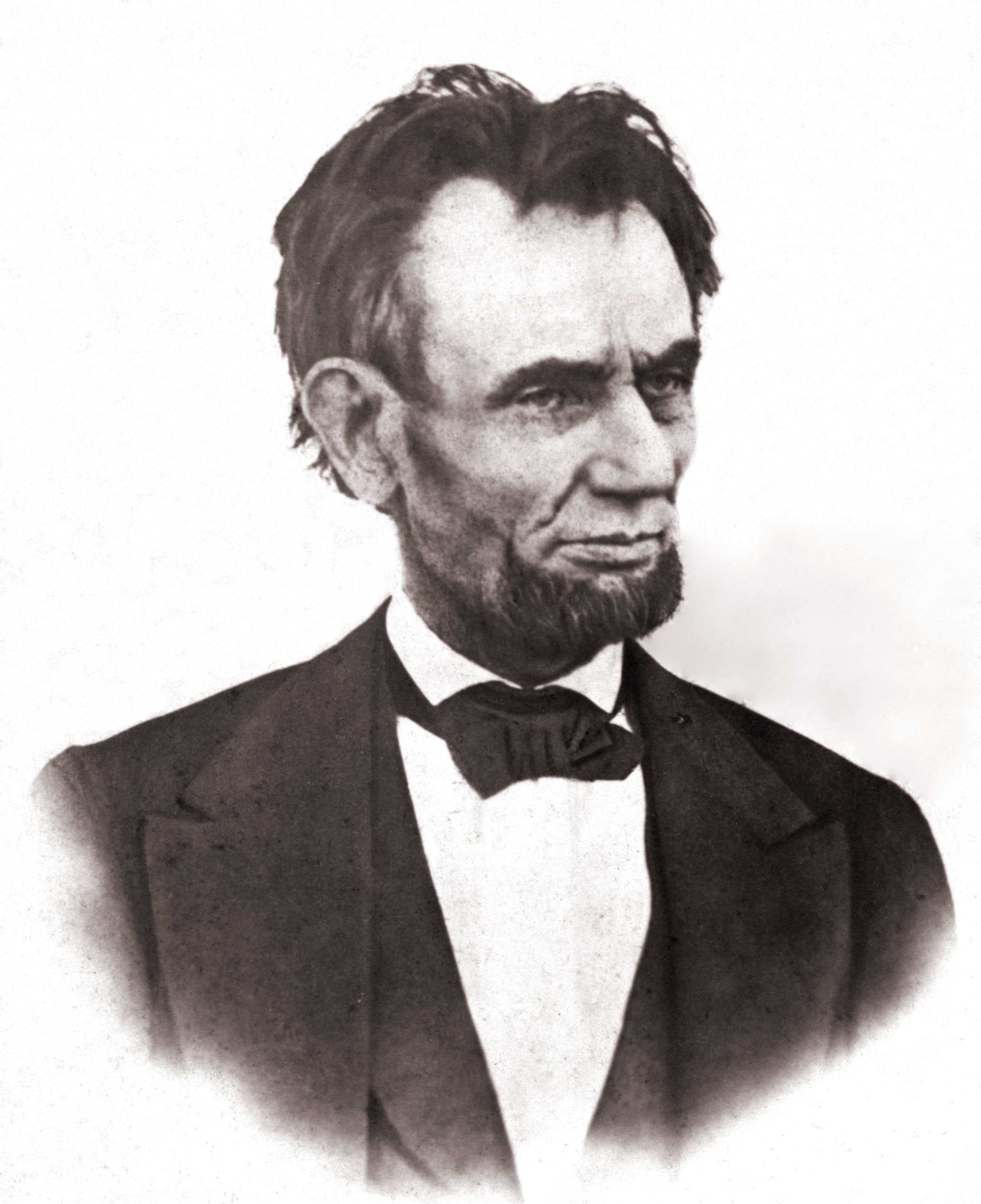
“Lincoln did not have a Web site at the log cabin where his parents home-schooled him, and he turned out pretty interesting.” (Image by Henry F. Warren.)

If we gave vouchers to parents for $4,400 a year, schools would be starting right and left. People would get out of college and say, ‘Let’s start a school.’ You could have a track at Stanford within the MBA program on how to be the businessperson of a school. And that MBA would get together with somebody else, and they’d start schools. And you’d have these young, idealistic people starting schools, working for pennies.

They’d do it because they’d be able to set the curriculum. When you have kids you think, What exactly do I want them to learn? Most of the stuff they study in school is completely useless. But some incredibly valuable things you don’t learn until you’re older – yet you could learn them when you’re younger. And you start to think, What would I do if I set a curriculum for a school?

God, how exciting that could be! But you can’t do it today. You’d be crazy to work in a school today. You don’t get to do what you want. You don’t get to pick your books, your curriculum. You get to teach one narrow specialization. Who would ever want to do that?

These are the solutions to our problems in education. Unfortunately, technology isn’t it. You’re not going to solve the problems by putting all knowledge onto CD-ROMs. We can put a Web site in every school – none of this is bad. It’s bad only if it lulls us into thinking we’re doing something to solve the problem with education.

Lincoln did not have a Web site at the log cabin where his parents home-schooled him, and he turned out pretty interesting. Historical precedent shows that we can turn out amazing human beings without technology. Precedent also shows that we can turn out very uninteresting human beings with technology.

It’s not as simple as you think when you’re in your 20s – that technology’s going to change the world. In some ways it will, in some ways it won’t.”

Tags: , ,

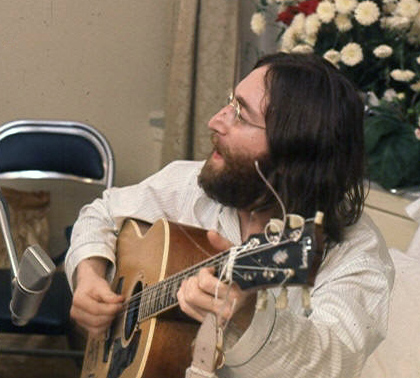
"I can't wake you up. You can wake you up." (Image by Roy Kerwood.)

Not long before he was murdered thirty years ago, John Lennon sat down along with wife Yoko Ono for a wide-ranging interview with Playboy. The couple had grown increasingly reclusive after nearly a decade of living a highly scrutinized public life. In the interview, Lennon comments on what he expected from life in the decade ahead. An excerpt:

“Playboy: What is the Eighties’ dream to you, John?

John Lennon: Well, you make your own dream. That’s the Beatles’ story, isn’t it? That’s Yoko’s story. That’s what I’m saying now. Produce your own dream. If you want to save Peru, go save Peru. It’s quite possible to do anything, but not to put it on the leaders and the parking meters. Don’t expect Jimmy Carter or Ronald Reagan or John Lennon or Yoko Ono or Bob Dylan or Jesus Christ to come and do it for you. You have to do it yourself. That’s what the great masters and mistresses have been saying ever since time began. They can point the way, leave signposts and little instructions in various books that are now called holy and worshiped for the cover of the book and not for what it says, but the instructions are all there for all to see, have always been and always will be. There’s nothing new under the sun. All the roads lead to Rome. And people cannot provide it for you. I can’t wake you up. You can wake you up. I can’t cure you. You can cure you.”

Tags:

The Yellow River has provided an unlikely livliehood for local fishermen. (Image by Thomas Kraus.)

Jo Ling Kent of CNN has a creepy, fascinating report about Chinese fishermen in the bustling Gansu Province who are literally fishers of men–or women or children. The fishermen trawl the Yellow River for dead bodies of suicides and murder victims that have found their way to the water. After the bodies are identified, they sell the corpses to the immediate families of the deceased so they can give them proper burials. It’s a brisk business, but the embarrassed government is doing what it can to shut it down. (Thanks Reddit.) An excerpt:

“Wei Jinpeng has retrieved nearly 100 bodies per year since he started in 2003. The former pear farmer and his two sons dragged bodies ashore in their modest boat until recently, when the government put a stop to their work. Spooked by media attention, the fishermen have been warned to dock their boats and stop fishing for bodies.

‘I can’t go out on the water anymore,’ Wei told CNN at his home. ‘The police have already fined me several times. They don’t like what we’re doing. As for the money I used to make, I just don’t make it anymore.’

But Lun Lun takes his chances. He says there is still potentially big money to be made.

‘If I turned the body over to the local authorities, I got less money,’ he said. ‘If I contact families directly, I can be paid about 3000 yuan, much more than the government would offer.'”

Tags: , ,

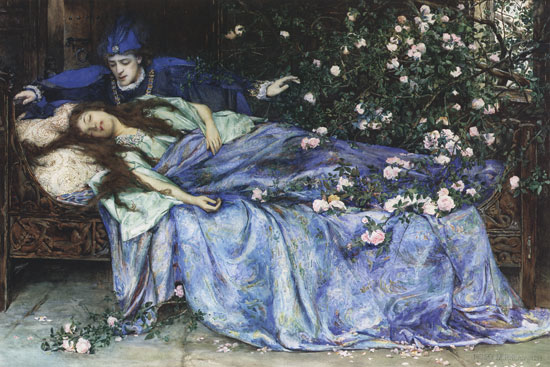
Kleine-Levin Syndrome is also known as "Sleeping Beauty Syndrome." (Image by Henry Maynell Rheam.)

It takes a lot more than a kiss to awaken Louise Ball, a 16-year-old British girl who suffers from a rare neurological disorder known as Kleine-Levin Syndrome, which causes her to sleep for ten days at a time. Her first episode of the illness, which more commonly afflicts males, occurred when she was 14. There is no cure. An excerpt from Frances Cronin’s BBC piece about her:

When she wakes up, it takes her a few days to fully come round, and her body is quite stiff so her dancing is affected for while.

‘I’ve never really got upset about it but I sometimes do think ‘why me’, because I’ve always been a normal healthy person. But all of a sudden it happened and there’s no reason why it happened and that sometimes frustrates me.

‘But I’ve got used to it now and learnt to live with it. I’m a special kid.’

The change in behaviour before and during a sleep episode is one of the most upsetting things for Louisa’s parents, who take it in turns to remain with her. Doctors have told the family it’s crucial to wake Louisa once a day to feed her and get her to the bathroom.

But Lottie admits it can take a while to get her to come round. ‘I’ve tried before to literally force her to wake up but she just starts swearing and gets so agitated and aggressive.'”

Tags: ,

Also from the article: "Hatfill has committed $1.5 million to building a floating genetic laboratory, a futuristic-looking vessel replete with a helicopter, an operating room to treat rural indigenous peoples, and a Cordon Bleu–trained chef."

Longform has chosen its favorite articles of 2010 and one them is David Freed’s very deserving, very horrifying, “The Wrong Man,” an account in the Atlantic of how an innocent person was wrongly suspected of the Anthrax attacks that occurred in the wake of 9/11. Dr. Steven J. Hatfill was a virologist and bioweapons expert who, in Kafka-esque fashion, had been traduced by hysteria, circumstance and incompetence. An excerpt:

“On the day al-Qaeda struck the World Trade Center and the Pentagon with hijacked jetliners, Hatfill was recovering from nasal surgery in his apartment outside the gates of Fort Detrick, Maryland, where USAMRIID is housed. We’re at war, he remembers thinking as he watched the news that day—but he had no idea that it was a war in which he himself would soon become collateral damage, as the FBI came to regard him as a homegrown bioterrorist, likely responsible for some of the most unsettling multiple murders in recent American history. His story provides a cautionary tale about how federal authorities, fueled by the general panic over terrorism, embraced conjecture and coincidence as evidence, and blindly pursued one suspect while the real anthrax killer roamed free for more than six years. Hatfill’s experience is also the wrenching saga of how an American citizen who saw himself as a patriot came to be vilified and presumed guilty, as his country turned against him.

‘It’s like death by a thousand cuts,’ Hatfill, who is now 56, says today. ‘There’s a sheer feeling of hopelessness. You can’t fight back. You have to just sit there and take it, day after day, the constant drip-drip-drip of innuendo, a punching bag for the government and the press. And the thing was, I couldn’t understand why it was happening to me. I mean, I was one of the good guys.'”

Tags:

"I don't believe I have the stomach for it." (Image by Ed Fitzgerald.)

From the Letters to the Editor section of the April 21, 1972 Life magazine:

“Sirs: Richard Schickel gives The Godfather a pretty darn good review (‘The Resurrection of Don Brando,’ March 31), one that would likely send me to see this movie. But then I read another opinion in the local paper (‘Somehow I don’t find rape entertaining, murder funny or violence acceptable’). I feel sure I would see The Godfather as this critic did and I don’t believe I have the stomach for it.–Claude Ash, Havertown, PA.

Tags: , ,

From a 1849 New York Herald report about that riffraff William Thompson, who ushered in the use of the term “confidence man”:

Arrest of the Confidence Man.—For the last few months a man has been traveling about the city, known as the ‘Confidence Man,’ that is, he would go up to a perfect stranger in the street, and being a man of genteel appearance, would easily command an interview. Upon this interview he would say after some little conversation, ‘have you confidence in me to trust me with your watch until to-morrow’; the stranger at this novel request, supposing him to be some old acquaintance not at that moment recollected, allows him to take the watch, thus placing ‘confidence’ in the honesty of the stranger, who walks off laughing and the other supposing it to be a joke allows him so to do.

In this way many have been duped, and the last that we recollect was a Mr. Thomas McDonald, of No. 276 Madison street, who, on the 12th of May last, was met by this ‘Confidence Man’ in William Street, who, in the manner as above described, took from him a gold lever watch valued at $110; and yesterday, singularly enough, Mr. McDonald was passing along Liberty street, when who should he meet but the ‘Confidence Man’ who had stolen his watch. Officer Swayse, of the Third Ward, being near at hand, took the accused into custody on the charge made by Mr. McDonald.

The accused at first refused to go with the officer; but after finding the officer determined to take him, he walked along for a short distance, when he showed desperate fight, and it was not until the officer had tied his hands together that he was able to convey him to the police office. On the prisoner being taken before Justice McGrath, he was recognized as an old offender by the name of Wm. Thompson, and is said to be a graduate of the college at Sing Sing. The magistrate committed him to prison for a further hearing. It will be well for all those persons who have been defrauded by the ‘Confidence Man’ to call at the police court Tombs and take a view of him.”

Tags: , ,

Salvador Dali brings surrealism to the masses at New York's 1939 World's Fair.

Elizabeth Lowry of the Wall Street Journal has a fun article about Jessica Kerwin Jenkins’ Encyclopedia of the Exquisite, a new book that seems right up the alley of language-loving, factoid-obsessed Afflictor readers. It’s an idiosyncratic reference book in which Jenkins, a writer for Vogue, offers histories on milk baths, the word “hello,” and cloud names, among other topics. An excerpt about what Lowry considers the book’s most offbeat entry:

Salvador Dali and friend in 1939. (Image by Carl Van Vechten.)

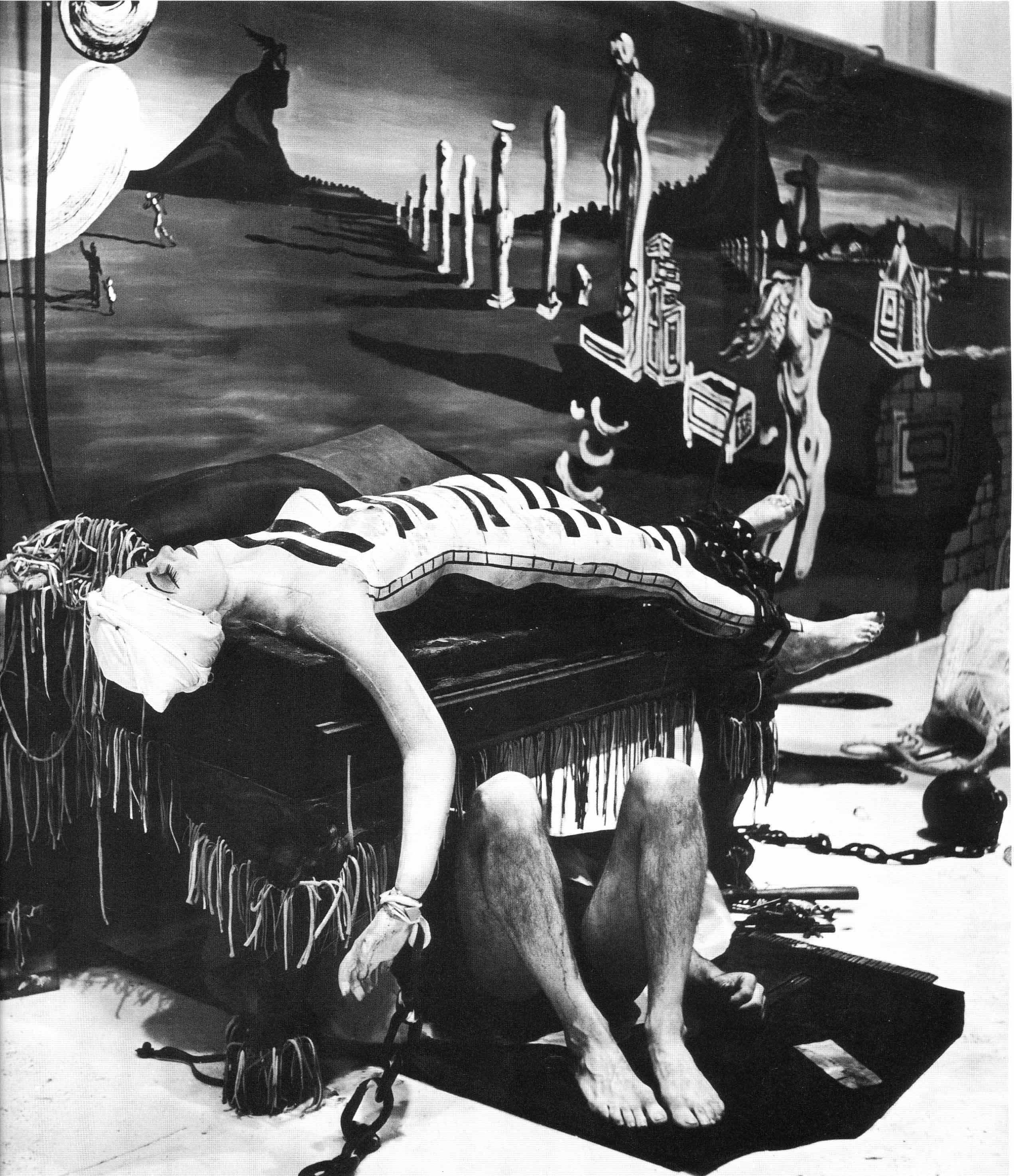
“The most outré entry of all, however, is the one on things ‘subaquatic,’ which includes a delirious description of Salvador Dalí’s deranged installation at the New York World’s Fair in 1939. Dalí’s underwater artwork, called the Dream of Venus, was a ‘panorama of the unconscious,’ the artist explained. Inside a grotto, visitors found a topless actress lying on a vast bed of red satin strewn with lobsters and champagne bottles. Behind her in a giant aquarium, glimpsed through a window, naked women posing as mermaids with rubber tail fins, the artist’s ‘living liquid ladies,’ played a woman-shaped piano and tapped away at floating rubber typewriters.

Time magazine dubbed the performers ‘Lady Godivers.’ When World’s Fair officials insisted that Dalí get rid of an image advertising the performance—a reworking of Botticelli’s Venus with a fish-head torso—he retaliated by hiring a plane and pelting the city with copies of a manifesto called the ‘Declaration of the Independence of the Imagination and the Rights of Man to His Own Madness.’ It is a man’s right, he wrote, ‘to love women with ecstatic fish heads.'”

Tags: , ,

It’s been 17 years since Wired sent sci-fi legend William Gibson to chronicle the spotless dystopia that is modern Singapore, but it’s hard to believe much has changed. The resulting article,Disneyland with the Death Penalty,” looks at a country that’s run with the brutal efficiency of a corporate theme park, and one that has disappeared any trace of its own history. An excerpt:

“Singapore is a relentlessly G-rated experience, micromanaged by a state that has the look and feel of a very large corporation. If IBM had ever bothered to actually possess a physical country, that country might have had a lot in common with Singapore. There’s a certain white-shirted constraint, an absolute humorlessness in the way Singapore Ltd. operates; conformity here is the prime directive, and the fuzzier brands of creativity are in extremely short supply.

The physical past here has almost entirely vanished.

There is no slack in Singapore. Imagine an Asian version of Zurich operating as an offshore capsule at the foot of Malaysia; an affluent microcosm whose citizens inhabit something that feels like, well, Disneyland. Disneyland with the death penalty.

But Disneyland wasn’t built atop an equally peculiar 19th-century theme park – something constructed to meet both the romantic longings and purely mercantile needs of the British Empire. Modern Singapore was – bits of the Victorian construct, dressed in spanking-fresh paint, protrude at quaint angles from the white-flanked glitter of the neo-Gernsbackian metropolis. These few very deliberate fragments of historical texture serve as a reminder of just how deliciously odd an entrepot Singapore once was – a product of Empire kinkier even than Hong Kong.

The sensation of trying to connect psychically with the old Singapore is rather painful, as though Disneyland’s New Orleans Square had been erected on the site of the actual French Quarter, obliterating it in the process but leaving in its place a glassy simulacrum. The facades of the remaining Victorian shop-houses recall Covent Garden on some impossibly bright London day. I took several solitary, jet-lagged walks at dawn, when a city’s ghosts tend to be most visible, but there was very little to be seen of previous realities: Joss stick smouldering in an old brass holder on the white-painted column of a shop-house; a mirror positioned above the door of a supplier of electrical goods, set to snare and deflect the evil that travels in a straight line; a rusty trishaw, chained to a freshly painted iron railing. The physical past, here, has almost entirely vanished.”

Tags: ,

Denis Johnson was paranoid about both the government and the anti-government militia movement in 1990s America when he wrote the chilling article “The Militia in Me,” which appears in his non-fiction collection, Seek. The violence of Ruby Ridge and Waco and the horrific Oklahoma City bombing had shocked the nation into realizing the terror within, so Johnson traveled the U.S. and Canada to find out how and why militias had come to be. Sadly, the unsettling subject is as timely as ever. Three brief excerpts from the piece.

••••••••••

The people I talked with seemed to imply that the greatest threat to liberty came from a conspiracy, or several overlapping conspiracies, well known to everybody but me. As a framework for thought, this has its advantages. It’s quicker to call a thing a crime and ask Who did it? than to call it a failure and set about answering the question What happened?

••••••••••

I’m one among many, part of a disparate–sometimes better spelled “desperate”–people, self-centered, shortsighted, stubborn, sentimental, richer than anybody’s ever been, trying to get along in the most cataclysmic century in human history. Many of us are troubled that somewhere, somehow, the system meant to keep us free has experienced a failure. A few believe that someone has committed the crime of sabotaging everything.

Failures need correction. Crimes cry out for punishment. Some ask: How do we fix it? Others: Who do we kill?

••••••••••

They told me they made furniture out of antlers and drove around anywhere and everywhere, selling it. For the past month I’d been reading about the old days, missing them as if I had lived in them, and I said, “You sound like free Americans.”

“No,” the smaller man said and thereafter did all the talking, while the other, the blond driver changed my tire. “No American is free today.”

“Okay, I guess you’re right, but what do we do about that?”

“We fight till we are,” he said. “Till we’re free or we’re dead, one or the other.”

“Who’s going to do the fighting?”

“A whole lot of men. More than you’d imagine. We’ll fight till we’re dead or we’re free.”

Tags:

« Older entries § Newer entries »