Excerpts

You are currently browsing the archive for the Excerpts category.

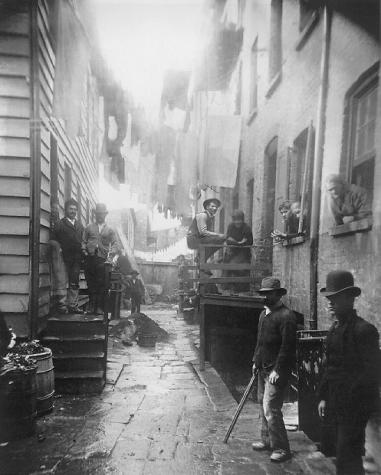
Fruit peddlers and hat stores were popular on this stretch of the Lower East Side in 1898.

This classic picture (photographer unknown) shows pedestrian traffic on the Lower East Side on Norfolk and Hester Streets in 1898. A few brief clips below from the Brooklyn Daily Eagle look at the raffish side of life on these streets during that era.

••••••••••

November 16, 1902: “Molly Marshall, 17 years old, giving her address as 327 Harrison avenue, Boston, and Solomon Rosenthal, 30, of 26 Norfolk street, Manhattan, were locked up at Police Headquarters last night as suspicious persons. The complainant is Max Singer of 24 Norfolk street, who claims to be the girl’s uncle. Singer says he received a letter two days ago from the girl’s mother, in Boston, notifying him that the girl had disappeared and that it was feared she had eloped with Rosenthal, who had not been seen since the girl’s departure. He said the woman asked him to watch New York for them.”

••••••••••

August 14, 1896: “Charles Leskowitz, 3 years old, of 113 Norfolk street, New York, was put to sleep on the fire escape on the second floor of the above house last night. Early this morning he rolled off and fell to the first floor, but was picked up a few minutes later uninjured.”

••••••••••

September 6, 1891: “Isaac Hoffer, 19 years old, who claims a residence at 58 Norfolk street, New York, was held for trial by Justice Smith at the Essex market police court yesterday charged with having stolen a baby carriage belonging to Mrs. Lina Sowden, from the hallway of her residence, 127 Rivington street. He was trying to sell it for 25 cents when he was arrested.”

••••••••••

November 22, 1890: “Joseph Thompson, charged by Frederick Wool, of 148 Norfolk street, New York, a wandering minstrel, with knocking him down, was held for examination on Monday.”

••••••••••

September 2, 1893: “Nathan Levine, 17 years old, of 32 Hester street, and Meyer Shubert, 13 years old, of 78 Norfolk street, were before Justice Meade, in the Tombs police court, New York, this morning, charged with stealing a horse and wagon belonging to Philip Ramburgh of this city. Ramburgh left the team at the Washington market for a few minutes, and when he returned it was gone. He afterward found the boys trying to sell the outfit for $20. In court this morning they were held for examination.”

A seasteading design by Andras Gyorfi.

Seasteading sounds ridiculous to me, but what do I know? Ray Kurzweil’s blog has a transcript of “How to Create a Startup Country,” a speech on building nations on the ocean, presented by Patri Friedman:

“A startup country could be the world’s first trillion dollar business.

Now for humanity, this is a huge problem, but with our entrepreneur hats on, what a business opportunity! A startup country could be the world’s first trillion dollar business. But right now, there’s no way for an entrepreneur with a great idea for a startup country to make it happen. Unlike the software industry, where you can get started with just a laptop, to enter the government industry, you need a open space, a physical place that allows political experiments. But there is no such place — every piece of land in the world is claimed.

So there are no startup countries, there’s no channel for innovation of entrepreneurs … no wonder it’s a such a sad industry.

So why don’t we see more innovation in politics? Now, politics is a pretty emotionally charged subject. You’re not supposed to talk about that, or religion. So let’s take a new perspective. Let’s forget about left and right and instead, put on our entrepreneur hats. Let’s think of government as an industry, where countries are firms and citizens are customers.

This is not just any industry. This is the world’s biggest industry. The leading firm had 2009 revenues of 2.5 trillion dollars. Strangely, it’s also an industry legendary for poor performance. That leading firm lost 1.4 trillion. And that’s a top company. The worst companies kill many of their own customers. It’s a pretty sad industry!

The seasteading solution: let a thousand nations bloom

So that’s how we come to seasteading — homesteading the high seas. What we need is a new frontier, an open space for political experiments…and the next frontier is the ocean. With a little technical innovation to make this new frontier accessible, we can unleash enormous political innovation. Let a thousand nations bloom on the high seas, trying diverse political systems — essentially, a startup sector for government.”

Tags: ,

Hammock weaving at the Twin Oaks community.

The opening of “The Other American Dream,” Tamara Jones’ 1998 article in the Washington Post about Twin Oaks, a 1960s Virginia commune that neither burned out nor faded away, but instead survived to confront its own midlife crisis:

“To get there, follow the winding road past shadowed woods and sunlit fields, past the tiny church with its tall steeple, past the eerie old mill and listless river, until finally you come upon the sign that taunts: ‘If you lived at Twin Oaks, you’d be home now.’ Venture through the gate, down the dirt driveway to the white clapboard farmhouse, which is precisely where the path ends and the journey began.

Kat Kinkade remembers being so excited that first day that she couldn’t decide where to start, so she grabbed an old broom and began sweeping the chicken house, making a compost pile of the filth. At 36, she was a bored secretary banking not just her future but her entire identity on a slim novel she had read in night school. Seven other people, including Kat’s new husband and her teenage daughter, moved with her that day to rural Louisa County, Virginia, where they had leased a modest farm. The year was 1967, and as Vietnam exploded and racial violence bloodied streets across America, this small, misbegotten group of dropouts, visionaries, drifters and seekers began working on an exquisitely detailed plan to change the world.

Twin Oaks was one of thousands of communes to sprout across a restive America in the ’60s and ’70s, emblems of hope and hubris. Most would disappear unnoticed. Twin Oaks was different, though. Against all odds, it managed to flourish, growing from eight people to nearly 100, becoming not merely self-sustaining but successful, a land trust sprawling across 450 efficiently managed acres to form what is surely one of the last bastions of pure communism in the modern world. From each according to ability, to each according to need. No one goes hungry or cold. Everyone is employed. The children are joyful. Competition, materialism and wastefulness are rare. Violence is forbidden; ambition quelled. Admirable goals have been achieved, and it would be easy to assume that happiness prevails. But reality is always more complex.

Which is why Twin Oaks, in its plump and improbable middle age, now finds itself searching so fervently for all the dreams that got lost, somehow, on the way to Utopia.”

Tags: ,

"Most people are fools, most authority is malignant, God does not exist, and everything is wrong." (Image by Tim Brailsford.)

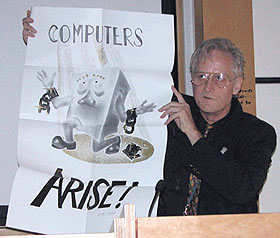
To dream big is to risk failing big, and nobody in the computer world dreamed bigger than visionary Ted Nelson. The information pioneer and philosopher coined the term “hypertext” in 1963 and spent the majority of his life frustratingly, unsuccessfully working on Project Xanadu, a system that attempted to link networked computers with a simple interface decades before the invention of the World Wide Web. Nelson’s tilting at virtual windmills was the subject of a devastating Wired article in 1995 by Gary Wolf. An excerpt:

Nelson’s life is so full of unfinished projects that it might fairly be said to be built from them, much as lace is built from holes or Philip Johnson’s glass house from windows. He has written an unfinished autobiography and produced an unfinished film. His houseboat in the San Francisco Bay is full of incomplete notes and unsigned letters. He founded a video-editing business, but has not yet seen it through to profitability. He has been at work on an overarching philosophy of everything called General Schematics, but the text remains in thousands of pieces, scattered on sheets of paper, file cards, and sticky notes.

The Hypertext Editing System (HES), seen here being used at Brown University in 1969, was developed by Ted Nelson and others. (Image by Greg Lloyd.)

All the children of Nelson’s imagination do not have equal stature. Each is derived from the one, great, unfinished project for which he has finally achieved the fame he has pursued since his boyhood. During one of our many conversations, Nelson explained that he never succeeded as a filmmaker or businessman because ‘the first step to anything I ever wanted to do was Xanadu.’

Xanadu, a global hypertext publishing system, is the longest-running vaporware story in the history of the computer industry. It has been in development for more than 30 years. This long gestation period may not put it in the same category as the Great Wall of China, which was under construction for most of the 16th century and still failed to foil invaders, but, given the relative youth of commercial computing, Xanadu has set a record of futility that will be difficult for other companies to surpass. The fact that Nelson has had only since about 1960 to build his reputation as the king of unsuccessful software development makes Xanadu interesting for another reason: the project’s failure (or, viewed more optimistically, its long-delayed success) coincides almost exactly with the birth of hacker culture. Xanadu’s manic and highly publicized swerves from triumph to bankruptcy show a side of hackerdom that is as important, perhaps, as tales of billion-dollar companies born in garages.”

Tags: ,

Symbols of the former Soviet empire linger in Transnistria. (Image by Marisha.)

From Alex Hoban and Henry Langston’s Vice article about Transnistria, an independent if unrecognized strip of the former Soviet Union which remains a pre-Glasnost gulag:

“Out on the fringes of the former USSR, in one little pocket of Eastern Europe, the trauma of the Soviet Empire’s collapse has never quite been shaken off. Since 1990 a little-known strip of land between Ukraine and Moldova has encased itself in an isolated world where Lenin still looms large. It has its own border control, passports, currency and everything else you normally need to be a real country – including a population that’s double the size of Iceland’s. Its Soviet credentials are impeccable: It’s being run as a corrupt leader-cult led by an elite of weapons smuggling crooks who’ll sooner gut your face than quote Marx. Yet its sovereignty is recognised by no-one and therefore, it isn’t a real country. Its name is Transnistria, but in the eyes of the world, it simply isn’t there.”

Tags: ,

Mark Vaccacio portrayed John Lennon in the original run of "Beatlemaniaa" at the Winter Garden Theatre.

Veteran Bronx Beatles impersonator Mark Vaccacio continues performing, and taking his mind off of his illness, as he slowly dies from terminal cancer. From Michael Wilson’s story about Vaccacio in the New York Times:

“For more than three decades, Mr. Vaccacio has switched his accent from Bronx offstage to Liverpool on, starting with the role of John Lennon in Beatlemania on Broadway in the late 1970s. Since the late 1990s, he has played with the tribute band Strawberry Fields at clubs, summer festivals, corporate parties, black-tie weddings, Caribbean bars and, for several years, at noon every Saturday at B. B. King’s.

But without the suit and wig and teeth, he is just another guy from Yonkers by way of Long Island, with two ex-wives, more ex-girlfriends, a daughter far lovelier than he, a father who died young of colon cancer, and a bunch of pals in bands.

A guy who, about a year ago, suddenly had no appetite and went to the doctor. ‘I had a tumor the size of a softball on this side and a tumor the size of a golf ball here,’ Mr. Vaccacio recalled, patting his flat lower belly. He felt no pain then, except to his pride: he should have known better.”

Tags: ,

Computer scientist Bill Joy despised the violence of the Unabomber as any sane person would, so he felt great disquiet when he read a passage written by Ted Kaczynski and agreed with the domestic terrorist’s concerns for the future of humankind. In his famous 2000 Wired article, “Why the Future Doesn’t Need Us,” Joy meditates on the unease caused by his sympathies for the ideas of a madman. An excerpt:

“Part of the answer certainly lies in our attitude toward the new – in our bias toward instant familiarity and unquestioning acceptance. Accustomed to living with almost routine scientific breakthroughs, we have yet to come to terms with the fact that the most compelling 21st-century technologies – robotics, genetic engineering, and nanotechnology – pose a different threat than the technologies that have come before. Specifically, robots, engineered organisms, and nanobots share a dangerous amplifying factor: They can self-replicate. A bomb is blown up only once – but one bot can become many, and quickly get out of control.

Much of my work over the past 25 years has been on computer networking, where the sending and receiving of messages creates the opportunity for out-of-control replication. But while replication in a computer or a computer network can be a nuisance, at worst it disables a machine or takes down a network or network service. Uncontrolled self-replication in these newer technologies runs a much greater risk: a risk of substantial damage in the physical world.”

Tags: ,

The late, great tree, Kiidk'yaas.

In 1997, Canadian forest engineer Grant Hadwin was unemployed but not unindustrious. That was bed news for a unique tree in British Columbia dubbed “Kiidk’yaas,” the only Golden Spruce in the world. In some sort of misguided political protest against the logging industry, Hadwin stealthily felled the tree and shocked a nation. The almost-mythical Hadwin, a seemingly indestructible man who was known for taking swims outdoors when temperatures reached 35 below, was the subject of John Baillant‘s excellent 2002 New Yorker article, “The Golden Bough.” An excerpt:

“Hadwin was well known for outdoing his co-workers. Paul Bernier, a longtime colleague and close friend of his, told me, ‘He was in the best condition of any man I’ve ever seen.’ Bernier was with Hadwin when he outwitted a pair of charging grizzly bears by dodging across a stream and feinting upwind, where they couldn’t smell him. In addition to consuming prodigious quantities of chewing tobacco, Hadwin was known for buying vodka by the case and going on spectacular binges that, even in freezing weather, would leave him unconscious in the back of his vintage Studebaker pickup or passed out in a snow-filled ditch, dressed only in slacks and shirtsleeves. There was a local joke: ‘Look, that snowbank is moving. Must be Grant.’

Early photographs of Hadwin show a fine-boned, handsome man, slightly less than six feet tall and built like a distance runner. People who knew him during his Gold Bridge days likened his lean, sharp-eyed appearance and remote manner to Clint Eastwood’s. Quiet and courteous though Hadwin usually was, he possessed an almost tangible intensity, a piercing, in-your-face conviction that some found alarming. ‘He always had to be the best, had to be first,’ his Aunt Barbara recalled. ‘It always had to be Grant’s way. There was never any room for compromise.'”

Tags: , ,

On his site, Kevin Kelly’s opines on “Seeking Sustainable Disequilibrium,” which seems to be happening whether we seek it or not, as we ride the wave of the great paradigm shift through the Information Age. An excerpt:

“In the industrial perspective, the economy was a machine that was to be tweaked to optimal efficiency, and once finely tuned, maintained in productive harmony. Companies or industries especially productive of jobs or goods had to be protected and cherished at all costs, as if these firms were rare watches in a glass case.

As networks have permeated our world, the economy has come to resemble an ecology of organisms, interlinked and coevolving, constantly in flux, deeply tangled, ever expanding at its edges. As we know from recent ecological studies, no balance exists in nature; rather, as evolution proceeds, there is perpetual disruption as new species displace old, as natural biomes shift in their makeup, and as organisms and environments transform each other.

Even the archetypal glories of hardwood forests or coastal wetlands, with their apparent wondrous harmony of species, are temporary federations on the move. Harmony in nature is fleeting. Over relatively short periods of biological time, the mix of species churns, the location of ecosystems drift, and the roster of animals and plants changes as they come and go.

So it is with network perspective: companies come and go quickly, careers are patchworks of vocations, industries are indefinite groupings of fluctuating firms.”

Tags:

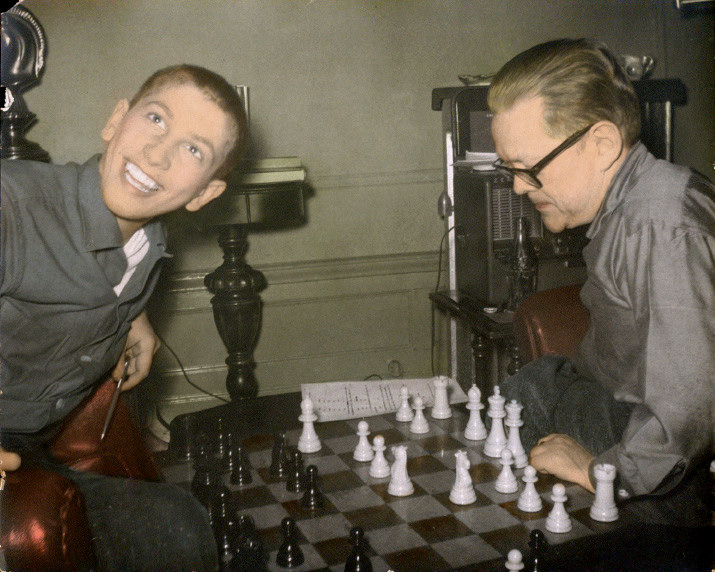
Bobby Fischer as the smiling, chess-playing child.

Before he became an unstable, ranting anti-Semitic hermit, Bobby Fischer was one of the most revered people on the planet. His legendary chess matches with Russian champion Boris Spassky during the height of the Cold War were televised to a rapt audience of millions. Victory meant the world was at Fischer’s feet, but he punted and disappeared from the game for two decades. He emerged for a big-money rematch against Spassky in 1992 which had none of the gravitas of the original contest–it was merely a cash grab by two players past their prime who were trading on nostalgia. In a new article in the New York Review of Books, Garry Kasparov, an excellent writer as well as a former world chess champion, opines on Fischer’s sad tale of being moved from king to pawn by mental illness. An excerpt about Fischer’s uneasy return to the spotlight in the ’90s:

“It was therefore quite a shock to see the real live Bobby Fischer reappear in 1992, followed by the first Fischer chess game in twenty years, followed by twenty-nine more. Lured out of self-imposed isolation by a chance to face his old rival Spassky on the twentieth anniversary of their world championship match—and by a $5 million prize fund—a heavy and bearded Fischer appeared before the world in a resort in Yugoslavia, a nation in the process of being bloodily torn apart.

The circumstances were bizarre. The sudden return, the backdrop of war, a shady banker and arms dealer as a sponsor. But it was Fischer! One could not believe it. The chess displayed by Fischer and Spassky in Svefi Stefan and Belgrade was predictably sloppy, although there were a few flashes of the old Bobby brilliance. But was this really a return, or would he disappear just as quickly as he had appeared? And what to make of the strange things Fischer was doing at the press conferences? America’s great champion spitting on a cable from the US government? Saying he hadn’t played in twenty years because he had been ‘blacklisted…by world Jewry’? Accusing Karpov and me of prearranging all our games? You had to look away, but you could not.

Even in his prime there were concerns about Fischer’s stability, during a lifetime of outbursts and provocations. Then there were the tales from his two decades away from the board, rumors that made their way around the chess world. That he was impoverished, that he had become a religious fanatic, that he was handing out anti-Semitic literature in the streets of Los Angeles. It all seemed too fantastic, too much in line with all the stories of chess driving people mad—or mad people playing chess—that have found such a good home in literature.”

Dick Cavett interviews Fischer in 1971, before the shocking decline:

Tags: , ,

Lord Martin Rees is president of the Royal Society.

Newmark’s Door pointed me to “Ten Questions Science Must Answer,” a cool Guardian article by astronomer Martin Rees,  in which he asked scientists to produce the most pressing questions the discipline should be trying to answer. Manchester physicist Brian Cox has an interesting one.

Can we make a scientific way of thinking all pervasive?

This would be the greatest achievement for science over the coming centuries. I say this because I do not believe that we currently run our world according to evidence-based principles. If we did, we would be investing in an energy Manhattan project to quickly develop and deploy clean energy technologies. We would be investing far larger amounts of our GDP in the eradication of diseases such as malaria, and we would be learning to live and work in space – not as an interesting and extravagant sideline, but as an essential part of our long-term survival strategy.

One only has to look at the so-called controversies in areas such as climate science or the vaccination of our children to see that the rationalist project is far from triumphant at the turn of the 21st century – indeed, it is possible to argue that it is under threat. I believe that we will only be able to build a safer, fairer, more prosperous and more peaceful world when a majority of the population understand the methods of science and accept the guidance offered by an evidence-based investigation of the challenges ahead. Scientific education must therefore be the foundation upon which our future rests.”

Tags: ,

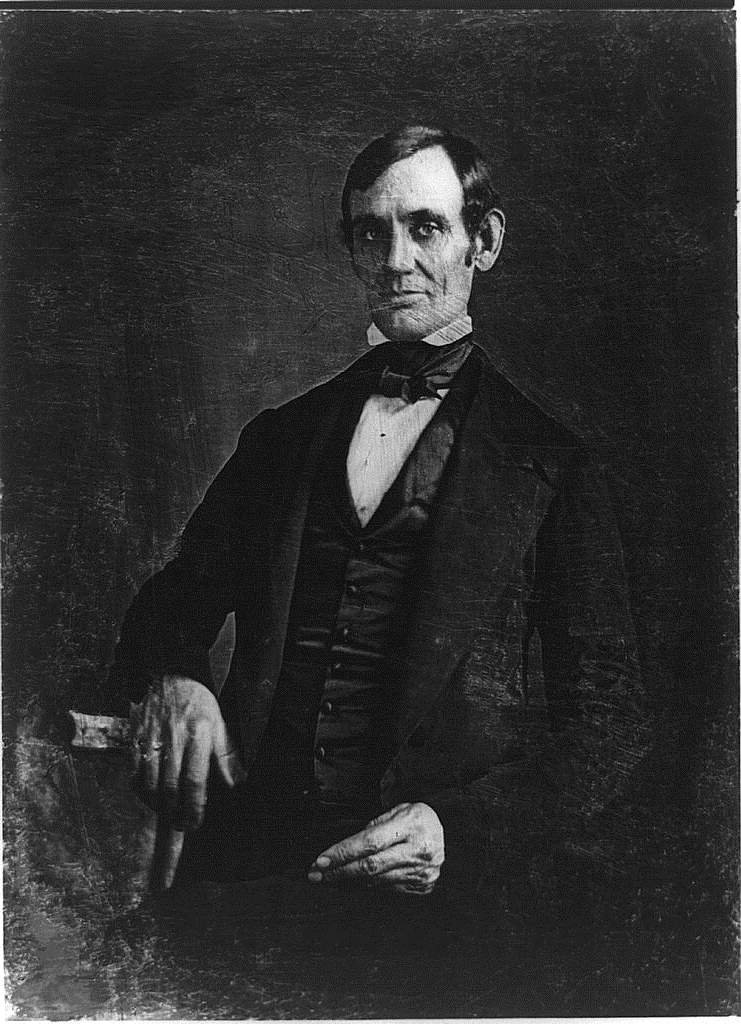
A daguerreotype of young Abe Lincoln, from 1846 or 1847.

Three passages from The Prairie Years, Part 1, the opening section of Carl Sandburg’s lyrical book about Abraham Lincoln’s life up until the Civil War.

••••••••••

“Offut talked big about Lincoln as a wrestler, and Bill Clary, who ran a saloon thirty steps north of the Offut store, bet Offut that Lincoln couldn’t throw Jack Armstrong, the Clary’s Grove champion. Sports from miles around came to a level square next to Offut’s store to see the match; bets of money, knives, trinkets, tobacco, drinks were put up, Armstrong, short and powerful, aimed from the first to get in close to his man and use his thick muscular strength. Lincoln held him off with long arms, wore down his strength, got him out of breath, surprised and ‘rattled.’ They pawed and clutched in many holds and twists till Lincoln threw Armstrong and had both shoulders to the grass.”

••••••••••

“The Clary’s Grove boys called on [Lincoln] sometimes to judge their horse races and cockfights, umpire their matches and settle disputes. One story ran that Lincoln was on hand one day when an old man had agreed, for a gallon jug of whisky, to be rolled down a hill in a barrel. And Lincoln talked and laughed them out of doing it. He wasn’t there on the day, as D.W Burner told it, when the gang took an old man with a wooden leg, built a fire around the wooden leg, and held the man down until the wooden leg was burned off.”

••••••••••

“When a small gambler tricked Bill Greene, Lincoln’s helper at the store, Lincoln told Bill to bet him the best fur hat in the store that he [Lincoln] could lift a barrel of whisky from the floor and hold it while he took a drink from the bunghole. Bill hunted up the gambler and made the bet. Lincoln sat squatting on the floor, lifted the barrel, rolled it on his knees till the bunghole reached his mouth, took a mouthful, let the barrel down–and stood up and spat out the whisky.”

••••••••••

Carl Sandburg on What’s My Line? in 1960:

Tags: , , , , ,

From “Secrets of Magus,” Mark Singer’s incredibly fun 1993 New Yorker profile of sleight-of-hand genius Ricky Jay:

“Jay has an anomalous memory, extraordinarily retentive but riddled with hard-to-account-for gaps. ‘I’m becoming quite worried about my memory,’ he said not long ago. ‘New information doesn’t stay. I wonder if it’s the NutraSweet.’ As a child, he read avidly and could summon the title and the author of every book that had passed through his hands. Now he gets lost driving in his own neighborhood, where he has lived for several years—he has no idea how many. He once had a summer job tending bar and doing magic at a place called the Royal Palm, in Ithaca, New York. On a bet, he accepted a mnemonic challenge from a group of friendly patrons. A numbered list of a hundred arbitrary objects was drawn up: No. 3 was ‘paintbrush,’ No. 18 was ‘plush ottoman,’ No. 25 was ‘roaring lion,’ and so on. ‘Ricky! Sixty-five!’ someone would demand, and he had ten seconds to respond correctly or lose a buck. He always won, and, to this day, still would. He is capable of leaving the house wearing his suit jacket but forgetting his pants. He can recite verbatim the rapid-fire spiel he delivered a quarter of a century ago, when he was briefly employed as a carnival barker: ‘See the magician; the fire ‘manipulator’; the girl with the yellow e-e-elastic tissue. See Adam and Eve, boy and girl, brother and sister, all in one, one of the world’s three living ‘morphrodites.’ And the e-e-electrode lady . . .’ He can quote verse after verse of nineteenth-century Cockney rhyming slang. He says he cannot remember what age he was when his family moved from Brooklyn to the New Jersey suburbs. He cannot recall the year he entered college or the year he left. ‘If you ask me for specific dates, we’re in trouble,’ he says.”

Tags: ,

“All Watched Over
by Machines of Loving Grace”

by Richard Brautigan, 1968.

I’d like to think (and
the sooner the better!)
of a cybernetic meadow
where mammals and computers
live together in mutually
programming harmony
like pure water
touching clear sky.
I like to think
(right now, please!)
of a cybernetic forest
filled with pines and electronics
where deer stroll peacefully
past computers
as if they were flowers
with spinning blossoms.

I like to think
(it has to be!)
of a cybernetic ecology
where we are free of our labors
and joined back to nature,
returned to our mammal brothers and sisters,
and all watched over
by machines of loving grace.

Tags:

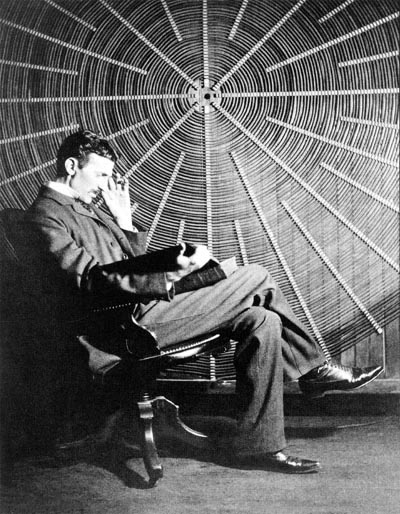
Nikola Tesla in his offices on East Houston Street in NYC.

Nikola Tesla prognosticating in the New York Times in 1909:

“It will soon be possible, for instance, for a business man in New York to dictate instructions and have them appear instantly in type in London or elsewhere. He will be able to call up from his desk and talk with any telephone subscriber in the world. It will only be necessary to carry an inexpensive instrument no bigger than a watch, which will enable its bearer to hear anywhere on sea or land for distances of thousands of miles. One may listen or transmit speech or song to the uttermost parts of the world. In the same way any kind of picture, drawing, or print can be transferred from one place to another. It will be possible to operate millions of such instruments from a single station. Thus it will be a simple matter to keep the uttermost parts of the world in instant contact with each other.”

Tags:

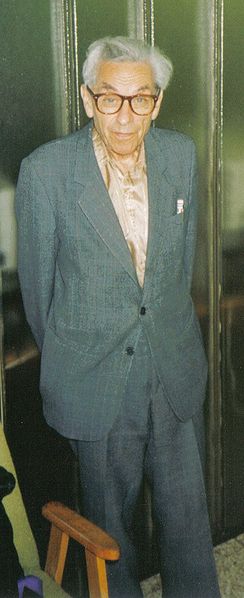
"He was a kind of mathematical troubadour." (Image by Kmhkmh.)

Even in a field marked by eccentricity, mathematician Paul Erdös was an odd number. The Hungarian published more papers than any other mathematician in history, even though he never really had an official post or a home or any money. He just traveled around the world, crashed with an array of academics and worked on seemingly unsolvable problems. He hardly slept or ate. This peripatetic pattern and self-abnegation continued until his death in 1996. An excerpt from Jeremy Bernstein’s 1998 Atlantic essay, which meditates on Paul Hoffman’s biography about the monomaniacal human computer, The Man Who Loved Only Numbers:

“Around 1950, when I was an undergraduate in mathematics at Harvard, my tutor George Mackey remarked that he was having a visitation from Paul Erdös.

I had never heard of Erdös (the correct pronunciation seems to have been ‘air-dish’ although I always used ‘air-dosh’), but Mackey explained that he was a kind of mathematical troubadour. He had no actual position — not because he was not offered them, but because they would interfere with his modus operandi.

Erdös migrated rapidly among 25 or so countries. He carried all his belongings in one small suitcase and a shopping bag, the greater part of which was filled with his mathematical papers and notebooks. He had no interest in clothes and even less in money. He needed three or four hours of sleep. He would arrive at a place and announce, ‘My brain is open,’ then proceed to collaborate with any and every mathematician who could keep up with him.

His collection of interesting unsolved problems in almost every field of mathematics, but especially in the theory of numbers where he probably did his most enduring work, seemed inexhaustible. What was exhaustible was the stamina of the mathematicians he landed on. Erdös would knock at a colleague’s door. ‘Hello’ he’d begin. ‘Let n be prime and letf(n) be defined as…’ After a few days of this, friends would be ready for a vacation.”

Paul Erdös tells an anecdote about a mathematician even odder than himself:

Tags: , , ,

"In this book are powerful satires to help restore your sanity."

This 35¢ Ballantine paperback collection of pieces by some of the most famous humorists of the 1950s is so out of print that even Amazon doesn’t seem to have a readily available bare listing for it. Within its 154 pages are essays, illustrations and song lyrics by Robert Benchley, S.J. Perelman, James Thurber and Ogden Nash, among others. Leading off the book is “The Night the Old Nostalgia Burned Down: My Own New York Childhood,” a ridiculous “memoir” by Frank Sullivan. He’s all but forgotten now, but Sullivan was a prominent humorist for the New York World and the New Yorker from the 1920s to the 1950s. A page about him on a website about Saratoga Springs (his hometown) recalls Sullivan as being “known for his gentle touch and for the collection of fictitious characters he created: Aunt Sally Gallup, Martha Hepplethwaite, the Forgotten Bach (a member of the Bach family who was tone deaf), and Mr. Arbuthnot, the cliché expert.” An excerpt from his piece in The Wild Reader:

“Father was very strict about the aristocratic old New York ritual of the Saturday-night bath. Every Saturday night at eight sharp we would line up: Father; Mother; Diamond Jim Brady; Mrs. Dalrymple, the housekeeper; Absentweather, the butler; Aggie, the second girl; Aggie, the third girl; Aggie, the fourth girl; and the twelve of us youngsters, each equipped with soap and a towel. At a command of our father, we would leave our mansion on East Thirtieth Street and proceed solemnly up Fifth Avenue in single file to the old reservoir, keeping a sharp eye out for Indians. Then, at a signal from Papa, in we’d go. Everyone who was anyone in New York in those days had a Saturday-night bath in the reservoir.”

Tags: , , , ,

Gregory Chudnovsky (pictured) and his brother, David, are Distinguished Industry Professors at NYU's Polytechnic Institute. (Image by Gregory Chudnovsky / NYU.)

The first two paragraphs of Mountains of Pi,” Richard Preston’s excellent 1992 New Yorker account of eccentric math geniuses, the Chudnovsky brothers, and their home-built supercomputer:

“Gregory Volfovich Chudnovsky recently built a supercomputer in his apartment from mail-order parts. Gregory Chudnovsky is a number theorist. His apartment is situated near the top floor of a run-down building on the West Side of Manhattan, in a neighborhood near Columbia University. Not long ago, a human corpse was found dumped at the end of the block. The world’s most powerful supercomputers include the Cray Y-MP C90, the Thinking Machines CM-5, the Hitachi S-820/80, the nCube, the Fujitsu parallel machine, the Kendall Square Research parallel machine, the nec SX-3, the Touchstone Delta, and Gregory Chudnovsky’s apartment. The apartment seems to be a kind of container for the supercomputer at least as much as it is a container for people.

Gregory Chudnovsky’s partner in the design and construction of the supercomputer was his older brother, David Volfovich Chudnovsky, who is also a mathematician, and who lives five blocks away from Gregory. The Chudnovsky brothers call their machine m zero. It occupies the former living room of Gregory’s apartment, and its tentacles reach into other rooms. The brothers claim that m zero is a ‘true, general-purpose supercomputer,’ and that it is as fast and powerful as a somewhat older Cray Y-MP, but it is not as fast as the latest of the Y-MP machines, the C90, an advanced supercomputer made by Cray Research. A Cray Y-MP C90 costs more than thirty million dollars. It is a black monolith, seven feet tall and eight feet across, in the shape of a squat cylinder, and is cooled by liquid freon. So far, the brothers have spent around seventy thousand dollars on parts for their supercomputer, and much of the money has come out of their wives’ pockets.”

Tags: , ,

"It is sent to Munich and made into wigs by girls." (Image by Charles S. Lillybridge.)


A lot of you have been requesting I post something from 1898 about doll hair, so here’s a note from the
Brooklyn Daily Eagle of that year:

“The hair on the heads of most of the hundreds of thousands of dolls exhibited in shop windows is made from the hair of the Angora goat. This product is controlled by an English syndicate, and is valued at £80,000 a year. After the hair is prepared it is sent to Munich and made into wigs by girls.”

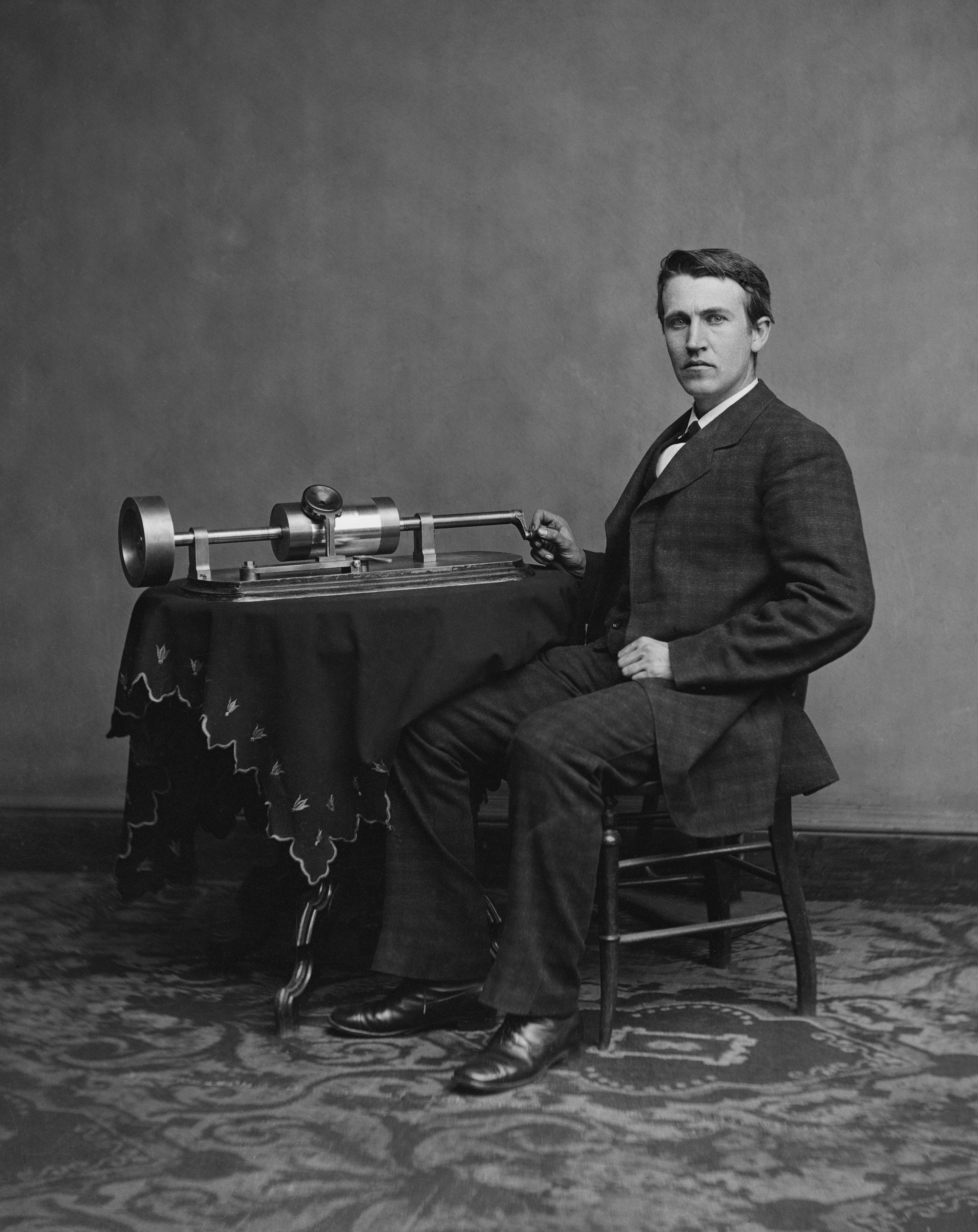
Thomas Edison with phonograph in 1868.

As we clasp hands and celebrate Thomas Edison’s birthday today, here’s a note about his modest beginnings in the December 1, 1898 issue of the Brooklyn Daily Eagle:

“When Thomas Edison was a boy he made a set of working telegraph instruments, not covering a small envelope in size, in his spare time. He fixed this on a line connecting the station at which he was at work and the town, using tenpenny nails for insulators; and in dry weather the tiny telegraph company worked very well, though things were apt to go wrong in rainy seasons. During the first months Edison and a boy friend who ran the line netted 31 cents from their venture–not a large amount, but enough to show that the instruments were of some use.”

Tags:

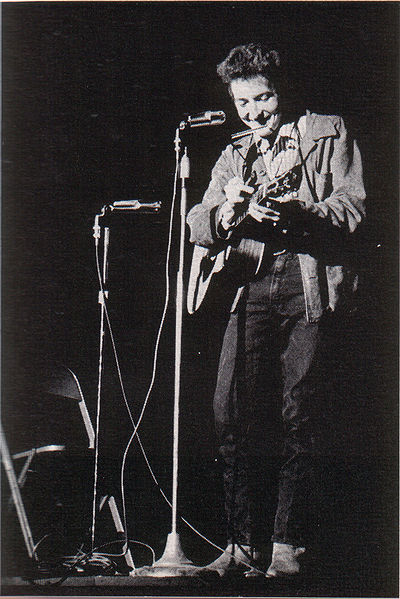
Bob Dylan in 1963, a couple of years before he went electric.

In the aftermath of his controversial shift from folk musician to rock star, Bob Dylan took the art of the non-answer to illogical but entertaining extremes during a 1966 Playboy interview, conducted by Nat Hentoff:

Playboy: Mistake or not, what made you decide to go the rock-‘n’-roll route?

Bob Dylan: Carelessness. I lost my one true love. I started drinking. The first thing I know, I’m in a card game. Then I’m in a crap game. I wake up in a pool hall. Then this big Mexican lady drags me off the table, takes me to Philadelphia. She leaves me alone in her house, and it burns down. I wind up in Phoenix. I get a job as a Chinaman. I start working in a dime store, and move in with a 13-year-old girl. Then this big Mexican lady from Philadelphia comes in and burns the house down. I go down to Dallas. I get a job as a ‘before’ in a Charles Atlas ‘before and after‘ ad. I move in with a delivery boy who can cook fantastic chili and hot dogs. Then this 13-year-old girl from Phoenix comes and burns the house down. The delivery boy – he ain’t so mild: He gives her the knife, and the next thing I know I’m in Omaha. It’s so cold there, by this time I’m robbing my own bicycles and frying my own fish. I stumble onto some luck and get a job as a carburetor out at the hot-rod races every Thursday night. I move in with a high school teacher who also does a little plumbing on the side, who ain’t much to look at, but who’s built a special kind of refrigerator that can turn newspaper into lettuce. Everything’s going good until that delivery boy shows up and tries to knife me. Needless to say, he burned the house down, and I hit the road. The first guy that picked me up asked me if I wanted to be a star. What could I say?

Playboy: And that’s how you became a rock-‘n’-roll singer?

Bob Dylan: No, that’s how I got tuberculosis.”

Tags: ,

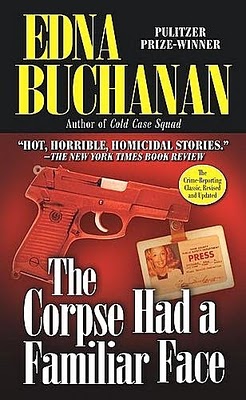
The opening paragraph ofCovering the Cops,” Calvin Trillin’s outstanding 1986 New Yorker profile of police reporter and mystery novelist Edna Buchanan:

“In the newsroom of the Miami Herald, there is some disagreement about which of Edna Buchanan’s first paragraphs stands as the classic Edna lead. I line up with the fried-chicken faction. The fried-chicken story was about a rowdy ex-con named Gary Robinson, who late one Sunday night lurched drunkenly into a Church’s outlet, shoved his way to the front of the line, and ordered a three-piece box of fried chicken. Persuaded to wait his turn, he reached the counter again five or ten minutes later, only to be told that Church’s had run out of fried chicken. The young woman at the counter suggested that he might like chicken nuggets instead. Robinson responded to the suggestion by slugging her in the head. That set off a chain of events that ended with Robinson’s being shot dead by a security guard. Edna Buchanan covered the murder for the Herald—there are policemen in Miami who say that it wouldn’t be a murder without her—and her story began with what the fried-chicken faction still regards as the classic Edna lead: ‘Gary Robinson died hungry.'”

Tags: , ,

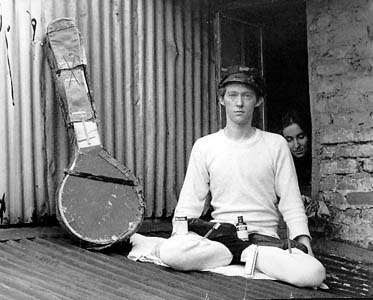
Mel Lyman, jug band player with a Christ complex, died of unknown causes in 1978.

I recently came acrossThe Lyman Family’s Holy Siege of America,” David Felton’s excellent 1971 exposé of Mel Lyman’s Massachusetts-based commune/cult. An erstwhile jug band musician, Lyman became convinced he was the messiah after dropping acid a few too many times with Timothy Leary’s Boston acolytes. His unbridled egomania would have been scary even if he hadn’t admired Charles Manson so much.

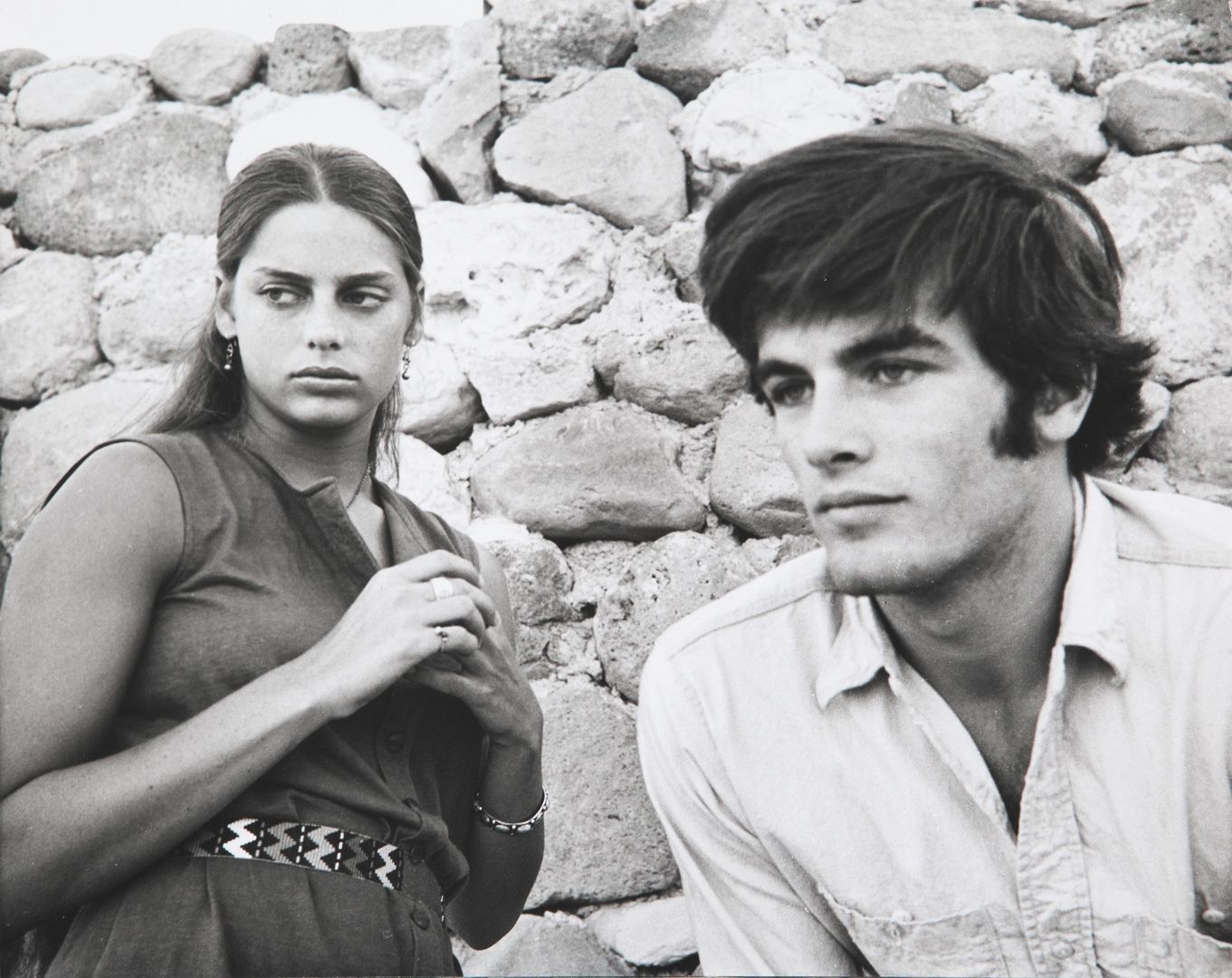
I was only familiar with the cult because as a fan of Michelangelo Antonioni’s flawed but fascinating 1970 drama, Zabriskie Point, I read somewhere that the film’s intense young leads, Daria Halprin and Mark Frechette, were members of the Lyman Family. But they had a lot of company at the commune when it came to intensity. A chilling excerpt from Felton’s piece:

“We believe that woman serves God through man,” said Lou, an attractive former nun now in her first stage of pregnancy. ‘I was sort of into women’s lib before I came up here, you know, “cause so many men are such piss-ants, such faggots. But when I came up here and started serving them breakfast, I really began looking up to them.”

She shoved a spoonful of strained vegetables into the squirming infant on her lap.

“The men here on the Hill are real men; the men out there are faggots, with their long hair and everything. If they weren’t, they wouldn’t let their women get away with the things they do.”

Lou learned about the true role of women from something Mel wrote in the Avatar. “If a woman is really a woman, and not just an old girl,” wrote Mel, “then everything she does is for her man and her only satisfaction is in making her man a greater man. She is his quiet conscience, she is his home, she is his inspiration and she is his living proof that his life, his labors, are worthwhile.

“A woman who seeks to satisfy herself is the loneliest being in God’s creation. A woman who seeks to surpass her man is only leaving herself behind. A man can only look ahead, he must have somewhere to look from. A woman can only look at her man…I have stated the Law purely and simply. Don’t break it.” 

zabirskiepoint789

Not that anyone does. Most of the Hill women, if they’re not holding down outside “female” jobs as waitresses or secretaries, spend their time cooking, sewing, cleaning house, tending the children and serving the men. They seem to do so with great relish, developing an almost worshipful attitude toward the men.

“I mean, couldn’t you feel it in those men at lunch?” asked Lou, “how strong they were? How simple. Life here is so simple. Of course, the more simple life is, the harder it is. Let me tell you, there’s a lot of hate and frustration up here. And pain.

“When I first came up here I was a bitch.’ Lou sneered at herself.

“A bitch, hah, that’s putting it mildly. I was a viper. I hated Mel Lyman, I hated everyone here. I resisted like hell. And the thing that shocked me was how much they still cared about me. I mean, with me my hatred was personal, ’cause I hated on such a low level. But they taught me how to hate on a higher level.”

Why did she first hate Mel? I asked.

“Because he was stronger than me. I guess I wanted to be God too. But finally I had to break down; he was so much stronger than me, I finally had to accept it.”

“Do you believe he’s God?”

“Yeah, in the sense that Jesus Christ came down on earth. But he’s dead, so Mel’s the son of God now.” As she said these last words, Lou raised her eyes in adoration toward a photograph of Mel on the opposite wall, the one on the cover of the Christ issue.

“When I first met Mel,” she continued, “it was really weird ’cause he was the most down-to-earth, easygoing guy I’d ever met. Until he looked at you, and then, oh God, his force just filled the room.

“Now I love him intensely, I’m his forever. I want to conquer the world for Mel. I get so mad at that world out there I want to kill, I want to shove Mel in their hearts. He’s the only one who knows how to deal with feeling, the feelings you have at the time, whether they’re love, or hate, or fear.”•

Tags: , , , ,

Hugo Gernsback may have been America’s first professional futurist, and while he wasn’t always right he was always interesting. Gernsback invented the first home radio kits right after the turn of the nineteenth century and sold his gadgets by mail order from his Brooklyn offices. He loved science fiction as much as science–saw them as complements, really–and published some of the earliest examples of the form in his publications, including Amazing Stories. The sci-fi Hugo Award is named for him.

Gernsback never stopped trying to amaze with outlandish inventions and predictions. Just four years before his death, the July 26, 1963 issue of Life profiled the man in “Barnum of the Space Age,” which reported his prophecies for the future. An excerpt:

A Hugo Gernsback print advertisement.

“Science is now so big, so flamboyant and so barnacled with politicians, press agents, generals and industrialists that Hugo Gernsback, who invented it back in 1908 (and has re-invented it, annually, since) can scarcely make himself heard above the babble of the late-comers. Although he is now 78, Gernsback is still a man of remarkable energy who raps out forecasts of future scientific wonders with the rapidity of a disintegrate gun. He believes that millions will eventually wear television eyeglasses–and has begun work on a model to speed the day. ‘Instant newspapers’ will be printed in U.S. homes by electromagnetic waves, in his opinion as soon as U.S. publishers wrench themselves out of the pit of stagnant thinking in which Gernsback feels they are wallowing at present. He also believes in the inevitability of teleportation–i.e., reproducing a ham sandwich at a distance by electronic means, much as images are now reproduced on a television screen.”

Tags:

Bandits Roost, an alleyway in the notorious slum known as the Bend. (Image by Jacob Riis.)

Muckraking newspaperman Jacob Riis wasn’t any sort of radical socialist, just a very humane police reporter who knew how to use his abundant writing talent for forces of good. His 1890 book, How the Other Half Lives: Studies Among the Tenements of New York, was a landmark work of photojournalism that sought to expose the well-to-do classes of the city to the incredible hardships (child labor, sweatshops, unsanitary conditions, etc.) endured by the denizens of its poorest quarters, who were out of sight and out of mind.

The book succeeded tremendously in alerting the city to its Dickensian lack of social safety nets, but it continues to be a great read because it’s a genuine work of art, beautifully written and photographed. An excerpt from the chapter, “The Bend”:

“WHERE Mulberry Street crooks like an elbow within hail of the old depravity of the Five Points, is ‘the Bend,’ foul core of New York’s slums. Long years ago the cows coming home from the pasture trod a path over this hill. Echoes of tinkling bells linger there still, but they do not call up memories of green meadows and summer fields; they proclaim the home-coming of the ragpicker’s cart. In the memory of man the old cow-path has never been other than a vast human pig-sty. There is but one ‘Bend’ in the world, and it is enough. The city authorities, moved by the angry protests of ten years of sanitary reform effort, have decided that it is too much and must come down. Another Paradise Park will take its place and let in sunlight and air to work such transformation as at the Five Points, around the corner of the next block. Never was change more urgently needed. Around ‘the Bend’ cluster the bulk of the tenements that are stamped as altogether bad, even by the optimists of the Health Department. Incessant raids cannot keep down the crowds that make them their home. In the scores of back alleys, of stable lanes and hidden byways, of which the rent collector alone can keep track, they share such shelter as the ramshackle structures afford with every kind of abomination rifled from the dumps and ash-barrels of the city. Here, too, shunning the light, skulks the unclean beast of dishonest idleness. ‘The Bend’ is the home of the tramp as well as the rag-picker.”

Mulberry Street: It was like "Our Gang" with lots of pulmonary tuberculosis.


Tags:

« Older entries § Newer entries »