Excerpts

You are currently browsing the archive for the Excerpts category.

"The decommissioned McNair US army barracks in Berlin is soon to be posh apartments.

Marginal Revolution pointed me toward this Financial Times piece about the (perhaps) coming trend of disused public buildings being repurposed as upscale abodes. An excerpt:

“In a suburb of Berlin, a German-American investment consortium is converting the disused McNair US army barracks into upmarket apartments. In the US, the original New Jersey Medical Center – a publicly funded hospital in the 1880s extended with art deco blocks in the 1930s – has now become apartments and a retirement community.

Such transformations are still relatively rare. Yet in the next few years they may become commonplace as western governments tackle budget deficits – and in doing so, free up a glut of public-sector buildings.

In some ways, the UK is ahead of the trend, thanks to two complementary tranches of legislation. First, planning policies have discouraged building on unspoilt ‘greenfield’ land, with the result that house builders have targeted old offices and warehouses for new developments. Secondly, health and safety laws have rendered many landmark public buildings effectively obsolete for their original purpose – making them so expensive to modernise that only residential conversion makes financial sense.”

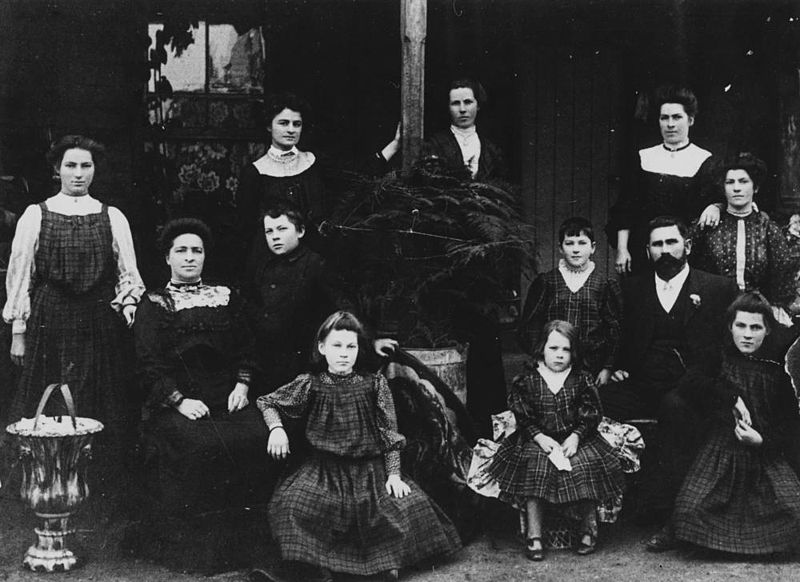
"From the tenth to the nineteenth-born the mortality was markedly greater."

“Vitality of Last Children: The old belief, still common among the laity, that first-born children are endowed by nature with greater vitality and logevity than last-born, has induced Doctor Alfred Ploetz of Munich, Germany, to make an exhaustive study to ascertain if this were true. He compiled the returns from a very large number of families of the nobility, and his figures show, generally speaking, that the vitality of the first to ninth-born children varied little, but that from the tenth to the nineteenth-born the mortality was markedly greater.”

•Taken from the 1915 World Almanac and Book of Facts.

Tags:

Amy Bishop's Harvard Ph.D. thesis was entitled, "The Role of Methoxatin (PQQ) in the Respiratory Burst of Phagocytes."

Being denied tenure was the motive bandied about in the wake of Professor Amy Bishop’s shooting spree in Huntsville, Alabama, last February, in which she murdered three fellow academics and wounded several others. The general feeling that higher education is somehow broken seemed to contribute to the acceptance of the refelxive explanation. Amy Wallace of Wired takes a deeper look at the tragic events in “What Made This University Professor Snap?” An excerpt:

“What makes a smart, well-educated mother of four go on a killing spree? In the more than 12 months since Bishop became the first academic in US history to be accused of gunning down fellow professors, many theories have been offered up. One is that she’s a lunatic. That suggestion came from her attorney.

Bishop’s court-appointed lawyer, Roy Miller, called her simply ‘wacko.’ Later he apologized for his word choice, but he has continued to press the point. ‘They’re going to try to show she’s sane, that she was just mean as hell,’ he tells me, referring to the prosecution, which is seeking capital murder charges against Bishop in the killings of department chair Gopi Podila and professors Maria Ragland Davis and Adriel Johnson. ‘If they seek the death penalty, which we have to assume they will, our only defense is mental.’

The Wacko theory is often accompanied by the Tenure Made Her Do It hypothesis, which posits that the grueling, years-long process of trying to win a permanent professorship—and the despair that accompanied being denied tenure by her peers—made Bishop snap. This explanation got a lot of traction right after the vicious slayings, in part because it seemed to open the door to a more general indictment of academia. Is the tenure process itself vicious? Some, like Katherine van Wormer, a blogger for Psychology Today who has herself been denied tenure, says it is. ‘I would describe the denial of tenure as an end to one’s career, to one’s livelihood,’ van Wormer wrote after the killings. ‘Being denied tenure, in effect, fired by your peers, is the ultimate rejection.’

But the Tenure Made Her Do It assertion is undermined by the calendar. Bishop learned she would not get tenure in March 2009, 11 full months before she transformed a routine faculty meeting into an execution chamber. She appealed the faculty’s decision, thus extending the process. But that appeal was denied for good in November 2009—still three months before her alleged crimes. What’s more, although tenure decisions are not public, university officials say Bishop had indicated she’d found out which colleagues had voted for and against her. Yet she shot some of the very people who had supported her. If this was tenure-related payback, it was carried out with less than surgical precision.” (Thanks Longreads.)

Tags: ,

Masdar City’s proposed podcars have been scrapped, a casualty of the economic slowdown. From David Hill on IEEE Singularity Hub:

Sounding like something out of a Robert Heinlein novel, Masdar City’s integrated transportation plan involves four initiatives, but it was the podcar system, designed by the Italian company Zagato and developed by Dutch firm 2getthere, that held the most promise. The plan proposed a driverless fleet of 3,000 free-moving, electric vehicles that could transport 2 to 6 passengers between 85 to 100 stations, tallying up to 135,000 trips a day along preprogrammed routes. This system of podcars was basically a replacement for taxis, providing privacy to passengers without the congestion common in other urban centers. A wi-fi network would maneuver the podcars through obstacles in real time as magnets along the path continuously pull the vehicle into alignment with little variance: if one is missed, the podcar continues but if two are missed, it comes to a stop. Ultimately, the podcars were to be powered by solar panel arrays on top of buildings (which was also axed from the budget) and thermal energy-storing molten salt technology allowing the vehicles to run 24 hours a day, seven days a week.•

Tags:


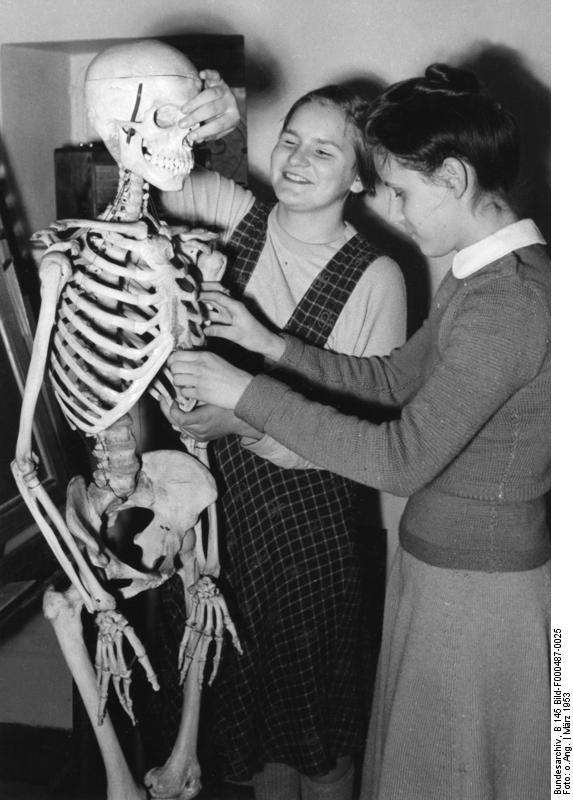
“Tests of Death: Hold mirror to mouth. If living, moisture will gather. Push pin into flesh. If dead the hole will remain. If alive it will close up. Place fingers in front of a strong light. If alive, they will appear red; if dead, black or dark. If a person is dead decomposition is almost sure to set in after 72 hours have elapsed. If it does not, then there is room for investigation by the physician. Do not permit burial of the dead until some certain indication of death is apparent.”

•From the 1902 World Almanac and Encyclopedia.

The Chernobly skies still choked in 2010. (Image by Piotr Andryszczak.)

In “Chernobyl, My Primeval, Teeming, Irradiated Eden,Outside writer Henry Shukman tours the site of the world’s worst nuclear power plant disaster 25 years after the massive meltdown. There are some signs of life, though you couldn’t really call them green shoots. An excerpt:

“Today, around 5,000 people work in the Exclusion Zone, which over the years has grown to an area of 1,660 square miles. For one thing, you can’t just switch off a nuclear power plant. Even decommissioned, it requires maintenance, as does the new nuclear-waste storage facility on site. The workers come in for two-week shifts and receive three times normal pay. Any sign of disease at the annual medical, however, and they lose their jobs.

There are also some 300 people living in the zone: villagers who’ve been coming home to their old farming lands since not long after the disaster and teams of radio ecologists from around the world who’ve come to study the effects of radioactive fallout on plants and animals. They’ve effectively turned the zone into a giant radiation lab, a place where the animals are mostly undisturbed, living amid a preindustrial number of humans and a postapocalyptic amount of radioactive strontium and cesium. On the outside the fauna seems to be thriving: there have been huge resurgences in the numbers of large mammals, including gray wolves, brown bears, elk, roe deer, and wild boar present in quantities not recorded for more than a century. The question scientists are trying to answer is what’s happening on the inside: in their bones, and in their very DNA.

ONCE YOU ENTER THE ZONE, the quiet is a shock. It would be eerie were it not so lovely. The abandoned backstreets of Chernobyl are so overgrown, you can hardly see it’s a town. They’ve turned into dark-green tunnels buzzing with bees, filled with an orchestral score of birdsong, the lanes so narrow that the van pushes aside weeds on both sides as it creeps down them, passing house after house enshrined in forest. Red admirals, peacock butterflies, and some velvety brown lepidoptera are fluttering all over the vegetation. It looks like something out of an old Russian fairy tale.

Ukraine officially opened Chernobyl up to tourism in January 2011, but small groups have been able to visit the zone for the past few years. There are small tour operators based in Kiev that take visitors on day trips. You don’t need Geiger counters or special suits; you just have to stay with the tour, pass through several checkpoints, and get tested for radiation on your way out. The tours will shuttle you around some of the main sites—the deserted city of Pripyat, a small park filled with old Soviet army vehicles used in the cleanup, various concrete memorials to the fire crews who lost their lives after the blast. Visitors are strictly confined to areas the author ities have scanned and declared safe.” (Thanks Longreads.)

Tags:

Jesus Christ: Q rating off the charts.

Which people who are currently famous will still be famous 10,000 years from now? It won’t be Gwyneth Paltrow, that’s for sure. Her singing at the Oscars last night nearly made Quadaffi surrender. But that very difficult question is taken on by the fertile mind of economist Tyler Cowen at Marginal Revolution. An excerpt:

“I’ll go with the major religious leaders (Jesus, Buddha, etc.), Einstein, Turing, Watson and Crick, Hitler, the major classical music composers, Adam Smith, and Neil Armstrong.  (Addendum: Oops!  I forgot Darwin and Euclid.)

My thinking is this. The major religions last for a long time and leave a real mark on history. Path-dependence is critical in that area.

Otherwise, an individual, to stay famous, will have to securely symbolize an entire area, and an area ‘with legs’ at that. The theory of relativity still will be true and it may well become more important. The computer and DNA will not be irrelevant. Hitler will remain a stand-in symbol for pure evil; if he is topped we may not have a future at all. Beethoven and Mozart still will be splendid, but Shakespeare and other wordsmiths will require translation and thus will fade somewhat. The propensity to truck and barter will remain and Smith will keep his role as the symbol of economics. Keynesian economics may someday be less true, as superior biofeedback, combined with markets in self-improvement, ushers in an era of flexible wages, while market-based expected nominal gdp targetingprevents a downward deflationary spiral.”

Tags: ,


From “For the Baby’s Amusement,” in the May 29, 1900 Brooklyn Daily Eagle:

“One way of amusing little children is to have a hook screwed in the ceiling over the middle of the bed or cot, attach a cord to it long enough for the baby to reach, tie either a soft worsted ball or a knitted doll and the baby will play with it.”

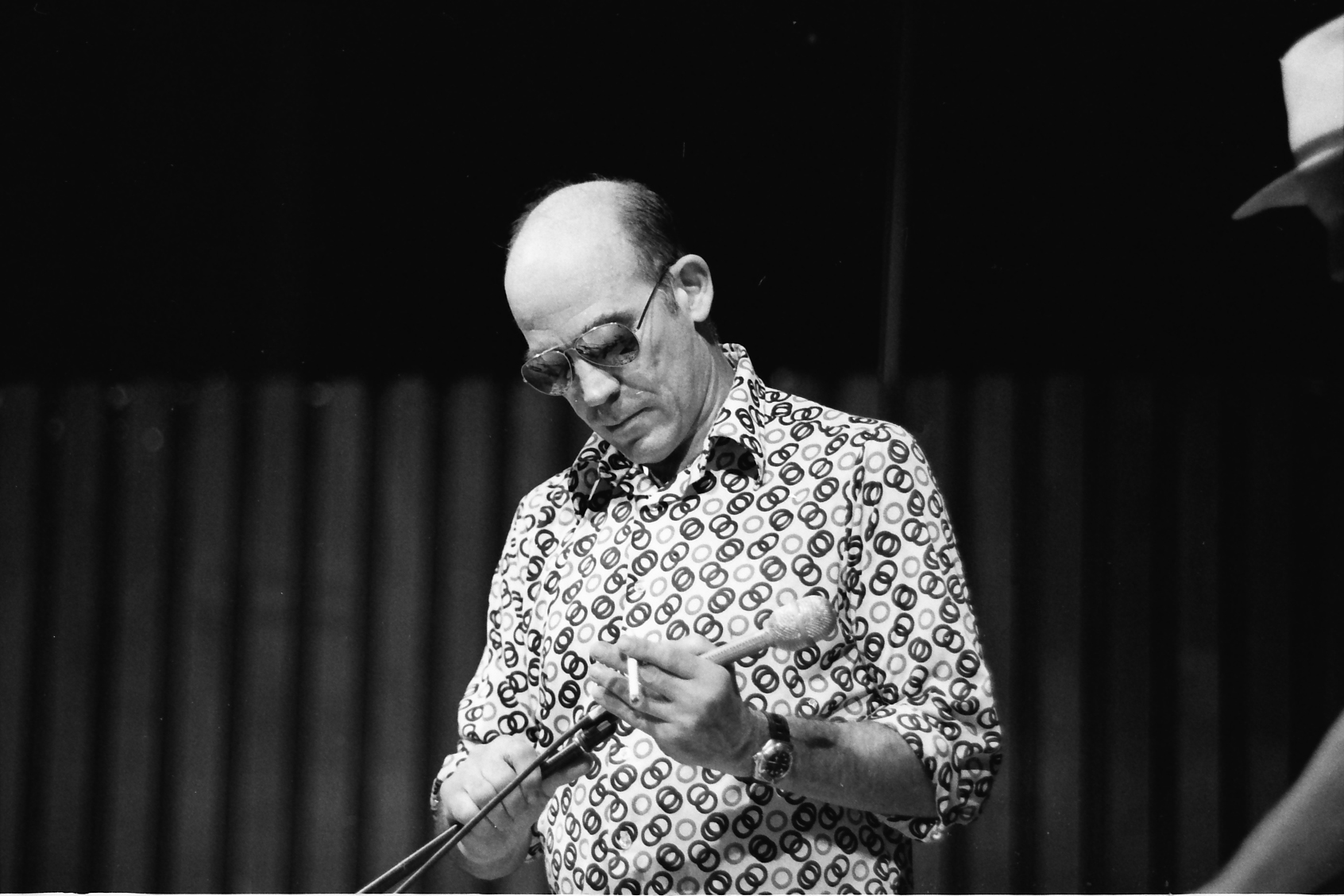
Hunter S. Thompson: great writer, tiresome fuck. (Image by MDC Archives.)

Hunter S. Thompson screwing around with a good ol’ boy at Churchill Downs as part of his 1970 Scanlan’s Monthly article, “The Kentucky Derby Is Decadent and Depraved“:

“I shook my head and said nothing; just stared at him for a moment, trying to look grim. ‘There’s going to be trouble,’ I said. ‘My assignment is to take pictures of the riot.’

‘What riot?’

I hesitated, twirling the ice in my drink. ‘At the track. On Derby Day. The Black Panthers.’ I stared at him again. ‘Don’t you read the newspapers?’

The grin on his face had collapsed. ‘What the hell are you talkin’ about?’

‘Well…maybe I shouldn’t be telling you…’ I shrugged. ‘But hell, everybody else seems to know. The cops and the National Guard have been getting ready for six weeks. They have 20,000 troops on alert at Fort Knox. They’ve warned us — all the press and photographers — to wear helmets and special vests like flak jackets. We were told to expect shooting…’

‘No!’ he shouted; his hands flew up and hovered momentarily between us, as if to ward off the words he was hearing. Then he whacked his fist on the bar. ‘Those sons of bitches! God Almighty! The Kentucky Derby!’ He kept shaking his head. ‘No! Jesus! That’s almost too bad to believe!’ Now he seemed to be sagging on the stool, and when he looked up his eyes were misty. “Why? Why here? Don’t they respect anything?’

I shrugged again. ‘It’s not just the Panthers. The FBI says busloads of white crazies are coming in from all over the country — to mix with the crowd and attack all at once, from every direction. They’ll be dressed like everybody else. You know — coats and ties and all that. But when the trouble starts…well, that’s why the cops are so worried.’

He sat for a moment, looking hurt and confused and not quite able to digest all this terrible news. Then he cried out: ‘Oh…Jesus! What in the name of God is happening in this country? Where can you get away from it?’

‘Not here,” I said, picking up my bag. ‘Thanks for the drink…and good luck.'”

••••••••••

And they’re off!:

Tags:

Crowds: very useful, but very creative?

I’m all in favor of the great utility of crowdsourcing and, for example, use Wikipedia, which is powered by a collaborative effort, on a daily basis. But those who laud Wikipedia as a creation of crowdsourcing are only half right: Wiki has been made possible by a collective, true, but it was created by two inventors: Jimmy Wales and Larry Sanger. The crowd can marshal great force to complete a task, but invention still doesn’t seem to me a domain of the many. Not that the people who toiled for no money to make Wikipedia such an amazing tool are less important than its creators, but the crowd needs an idea to rally around. It seems unlikely that the many can dream with the same sharp precision–let alone genius–as a Tesla, Tucker or Jobs. Joel West wondered about the same thing last month on the Open Innovation Blog:

“At the #BAexec event last week, one of the interesting questions from the floor was ‘could the iPhone have been produced via crowdsourcing?’

My immediate reaction was ‘no.’ What’s made Apple so special for the past 13 years has been the solitary, laser-focused vision of product design brought by its CEO. Of course, that’s just the supposition of a 35-year Apple-watcher.

What I think was more interesting was: what are the limits of crowdsourcing? Those who study crowdsourcing consider its advantages for accessing heterogeneous knowledge bases or sheer scale of ideas. But integrating that hodgepodge of ideas — no matter how good — can be daunting if not labor intensive.”

Tags: , ,

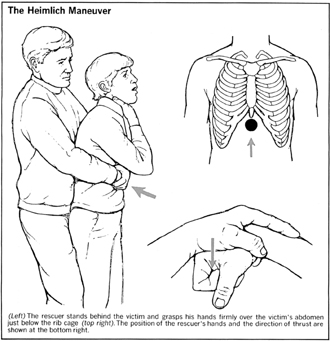
Longform pointed me to “The Choke Artist,” an interesting 2007 New Republic article by Jason Zengerle about Dr. Henry J. Heimlich, the creator of the anti-choking thrust, who’s searched, somewhat dubiously, for a second life-saving act in his career while being criticized for his methods. An excerpt:

“‘A serious matter has been brought to my attention,’ the letter began. Addressed to an official in the Office for the Protection of Research Subjects at the University of California at Los Angeles, it accused two UCLA medical researchers of participating in illegal human experiments on HIV patients in China. “These experiments consist of giving malaria to people already suffering from HIV and full-blown AIDS,” the letter alleged, before going on to make an even more startling claim: ‘[T]hese experiments have been conducted under the direction of Dr. Henry J. Heimlich, known for the Heimlich maneuver.’

The letter, which was sent via e-mail in October 2002 and was from a ‘Dr. Bob Smith,’ was merely the first in a series of epistolary attacks against Heimlich. A few months later, editors at more than 40 publications—ranging from The New York Times to the medical journal Chest—received missives from someone calling himself ‘David Ionescu’ that accused Heimlich of improperly taking credit for inventing a type of esophageal surgery. And then, in September 2003, the website heimlichinstitute.com went online. Its URL was almost identical to the official website of Henry Heimlich’s Heimlich Institute, heimlichinstitute.org, but, rather than being dedicated to burnishing the doctor’s legend, it was devoted to tearing it down. The site featured a long, angry indictment of Heimlich and accused him of all sorts of medical misconduct. The site’s proprietor was listed as ‘Holly Martins’—the protagonist in the 1949 film noir The Third Man.

The octogenarian Heimlich seemed an unlikely target of so many people’s ire. He had entered into the pantheon of medical history not for inventing a disease-eradicating vaccine or for isolating the DNA of a killer virus but, rather, for developing an anti-choking maneuver that even a child could perform. And, yet, it is the very simplicity of Heimlich’s lifesaving technique that makes it so ingenious; because anyone can perform the maneuver, anyone can save a life. Since its invention in 1974, it has become a standard First Aid procedure around the world; and, while it may have been hyperbole for Norman Vincent Peale to once declare that Heimlich ‘has saved the lives of more human beings than any other person living today,’ it was fair to say that, by the measure of name recognition at least, the maneuver had made Heimlich America’s most famous doctor.”

Tags: ,

A picture from earlier this month of the Shard under construction. (Image by George Rex Photography.)


The Digital Journal has an article about Romeo, a fox that made its way to the top of the Shard, an under-construction building which will be London’s tallest tower when completed. An excerpt:

“A young fox who was discovered living at the top of the 288 metre (945 foot) Shard building in London was captured and released.

The animal is believed to have gone up the stairwell at the Shard building, which is still under construction, and lived there for two weeks, surviving on food builders left for him.

The fox was called Romeo by council staff because he was captured shortly after Valentine’s Day.”  


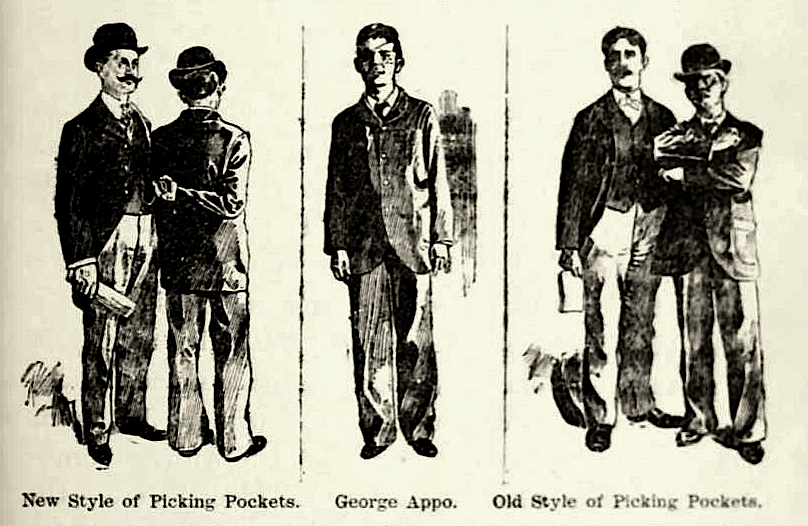
Joe Keohane has an interesting piece, “The Lost Art of Pickpocketing,” on Slate. An excerpt:

“Pickpocketing in America was once a proud criminal tradition, rich with drama, celebrated in the culture, singular enough that its practitioners developed a whole lexicon to describe its intricacies. Those days appear to be over. ‘Pickpocketing is more or less dead in this country,’ says Harvard economist Edward Glaeser, whose new book Triumph of the City, deals at length with urban crime trends. ‘I think these skills have been tragically lost. You’ve got to respect the skill of some pickpocket relative to some thug coming up to you with a knife. A knife takes no skill whatsoever. But to lift someone’s wallet without them knowing …'”

Tags: ,

"Employees are more productive when they're allowed to engage in 'Internet leisure browsing.'" (Image by Mateo Inurria.)

It’s obvious that creative thinking requires time to just space out, that your brain can’t connect the dots if it doesn’t have free moments to recognize they exist and understand the relation between them, but science backs up what’s intuitive in this case. An excerpt from Bother Me, I’m Thinking” in the Wall Street Journal, neuroscientist Jonah Lehrer’s article about the value of not focusing:

“Scientists have begun to outline the surprising benefits of not paying attention. Sometimes, too much focus can backfire; all that caffeine gets in the way. For instance, researchers have found a surprising link between daydreaming and creativity—people who daydream more are also better at generating new ideas. Other studies have found that employees are more productive when they’re allowed to engage in ‘Internet leisure browsing’ and that people unable to concentrate due to severe brain damage actually score above average on various problem-solving tasks.

A new study led by researchers at the University of Memphis and the University of Michigan extends this theme. The scientists measured the success of 60 undergraduates in various fields, from the visual arts to science. They asked the students if they’d ever won a prize at a juried art show or been honored at a science fair. In every domain, students who had been diagnosed with attention-deficit disorder achieved more: Their inability to focus turned out to be a creative advantage.”

Tags:

The classic Ronco product, the Pocket Fisherman.

From “The Pitchman,” Malcolm Gladwell’s great 2000 New Yorker profile of inventor and marketing maven Ron Popeil:

“In the last thirty years, Ron has invented a succession of kitchen gadgets, among them the Ronco Electric Food Dehydrator and the Popeil Automatic Pasta and Sausage Maker, which featured a thrust bearing made of the same material used in bulletproof glass. He works steadily, guided by flashes of inspiration. This past August, for instance, he suddenly realized what product should follow the Showtime Rotisserie. He and his right-hand man, Alan Backus, had been working on a bread-and-batter machine, which would take up to ten pounds of chicken wings or scallops or shrimp or fish fillets and do all the work–combining the eggs, the flour, the breadcrumbs–in a few minutes, without dirtying either the cook’s hands or the machine. ‘Alan goes to Korea, where we have some big orders coming through,’ Ron explained recently over lunch–a hamburger, medium-well, with fries–in the V.I.P. booth by the door in the Polo Lounge, at the Beverly Hills Hotel. ‘I call Alan on the phone. I wake him up. It was two in the morning there. And these are my exact words: ‘Stop. Do not pursue the bread-and-batter machine. I will pick it up later. This other project needs to come first.’ The other project, his inspiration, was a device capable of smoking meats indoors without creating odors that can suffuse the air and permeate furniture. Ron had a version of the indoor smoker on his porch–‘a Rube Goldberg kind of thing’ that he’d worked on a year earlier–and, on a whim, he cooked a chicken in it. ‘That chicken was so good that I said to myself’–and with his left hand Ron began to pound on the table–‘This is the best chicken sandwich I have ever had in my life.’ He turned to me: ‘How many times have you had a smoked-turkey sandwich? Maybe you have a smoked- turkey or a smoked-chicken sandwich once every six months. Once! How many times have you had smoked salmon? Aah. More. I’m going to say you come across smoked salmon as an hors d’oeuvre or an entrée once every three months. Baby-back ribs? Depends on which restaurant you order ribs at. Smoked sausage, same thing. You touch on smoked food’–he leaned in and poked my arm for emphasis–‘but I know one thing, Malcolm. You don’t have a smoker.'”

Tags: , ,

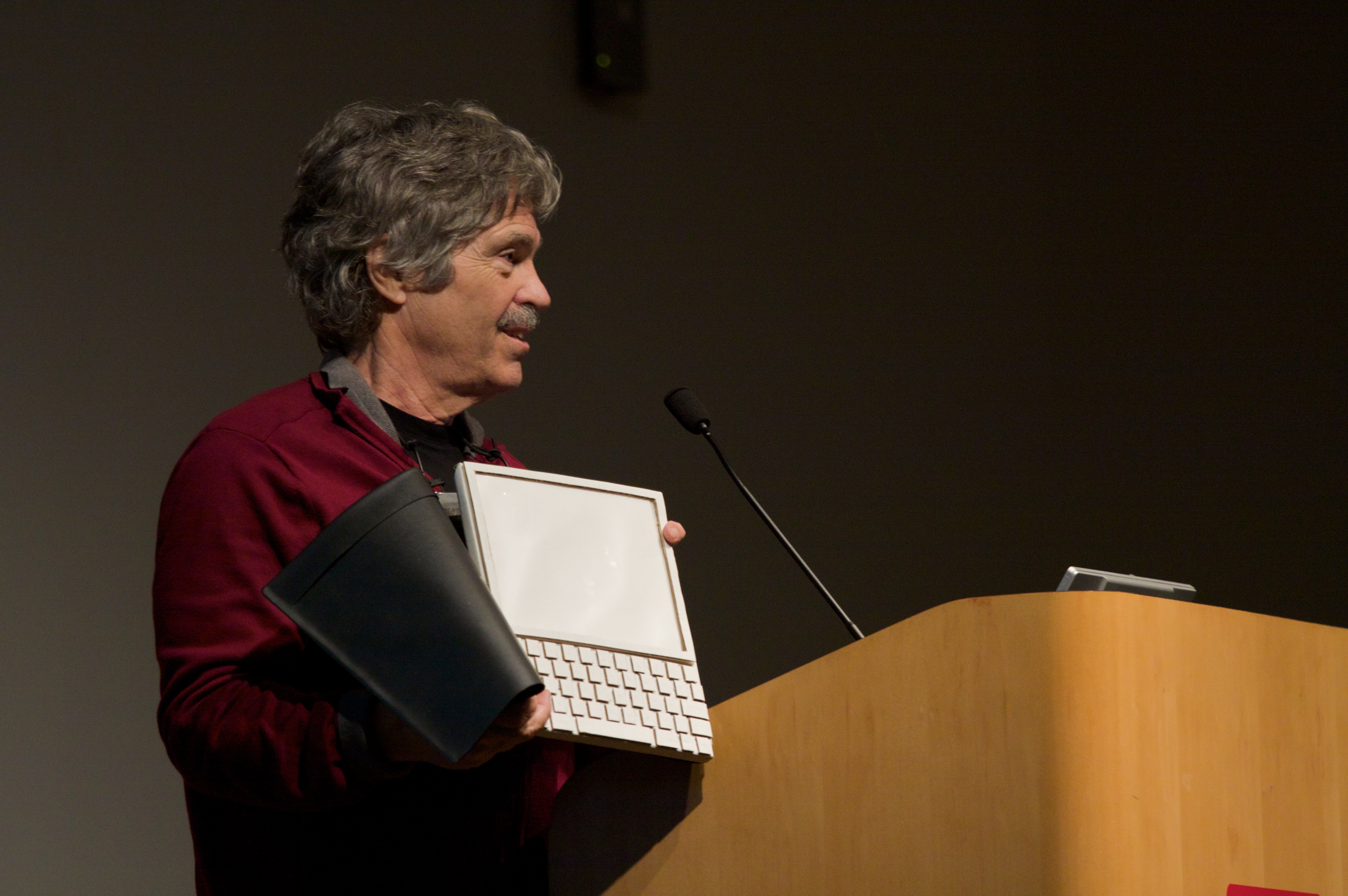
In 2008, Alan Kay presents the original 1960s Dynabook prototype, which was made of carboard.

Computer tablets became a big deal in 2010, but they weren’t anything new to Alan Kay. From “Space Wars: Fanatic Life and Symbolic Death Among the Computer Bums,” Stewart Brand’s 1972 Rolling Stone article about the emerging computer culture:

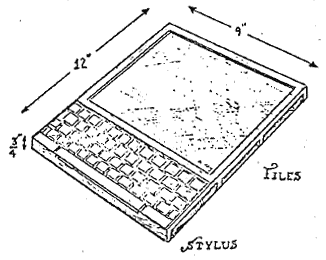
“Alan is designing a hand-held stand-alone interactive-graphic computer (about the size, shape and diversity of a Whole Earth Catalog, electric) called ‘Dynabook.’ It’s mostly high-resolution display screen, with a keyboard on the lower third and various cassette- loading slots, optional hook-up plugs, etc. His colleague Bill English describes the fantasy. thus:

‘It stores a couple of million characters of text and does all the text handling for you – editing, viewing, scanning, things of that nature. It’ll have a graphics capability which’ll let you make sketches, make drawings. Alan wants to incorporate music in it so you can use it for composing. It has the Smalltalk language capability which lets people program their own things very easily. We want to interface them with a tinker-toy kind of thing. And of course it plays Spacewar.’

"If Xerox Corporation decides to go with the concept, the Dynabooks could be available in two or three years."

The drawing capability is a program that Kay designed called ‘Paintbrush.’ Working with a stylus on the display screen, you reach up and select a shape of brush, then move the brush over and pick up a shade of half-tone-screen you like, then paint with it. If you make a mistake, paint it out with ‘white.’ The screen simultaneously displays the image you’re working on and a one-third reduction of it, where the dot pattern becomes a shaded half-tone.

A Dynabook could link up with other Dynabooks, with library facilities, with the telephone, and it could go and hide where a child hides. Alan is determined to keep the cost below $500 so that school systems could provide Dynabooks free out of their textbook budgets. If Xerox Corporation decides to go with the concept, the Dynabooks could be available in two or three years, but that’s up to Product Development, not Alan or the Research Center. Peter Deutsch comments: ‘Processors and memories are getting smaller and cheaper. Five years ago the idea of the Dynabook would have been a absolutely ridiculous. Now it merely seems difficult….'”

Tags: ,

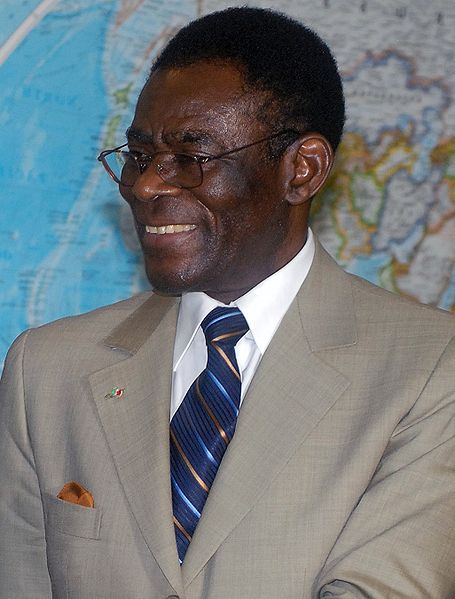
"His wardrobe was picked from the racks of Versace, Gucci, and Dolce & Gabbana, and he spared no expense on himself." (Image by Rodrigues Pozzebom.)

Someday Teodoro Nguema Obiang is likely to become dictator of oil-rich Equitorial Guinea, but for now he makes do in a $30 million Malibu compound stocked with Playboy bunnies. Considered the heir to his father, Teodoro Obiang Nguema Mbasogo, the nation’s current dictator who’s suffering from prostate cancer, Teodorin, as he is nicknamed, rules the sub-Saharan African nation’s media remotely, while spending lavishly and awaiting his iron throne. The opening of “Teodorin’s World,” Ken Silverstein’s fascinating article in the current Foreign Policy:

“The owner of the estate at 3620 Sweetwater Mesa Road, which sits high above Malibu, California, calls himself a prince, and he certainly lives like one. A long, tree-lined driveway runs from the estate’s main gate past a motor court with fountains and down to a 15,000-square-foot mansion with eight bathrooms and an equal number of fireplaces. The grounds overlook the Pacific Ocean, complete with swimming pool, tennis court, four-hole golf course, and Hollywood stars Mel Gibson, Britney Spears, and Kelsey Grammer for neighbors.

With his short, stocky build, slicked-back hair, and Coke-bottle glasses, the prince hardly presents an image of royal elegance. But his wardrobe was picked from the racks of Versace, Gucci, and Dolce & Gabbana, and he spared no expense on himself, from the $30 million in cash he paid for the estate to what Senate investigators later reported were vast sums for household furnishings: $59,850 for rugs, $58,000 for a home theater, even $1,734.17 for a pair of wine glasses. When he arrived back home — usually in the back seat of a chauffeur-driven Rolls-Royce or one of his other several dozen cars — his employees were instructed to stand in a receiving line to greet the prince. And then they lined up to do the same when he left.

The prince, though, was a phony, a descendant of rulers but not of royals. His full name is Teodoro Nguema Obiang Mangue — Teodorin to friends — and he is the son of the dictator of Equatorial Guinea, a country about the size of Maryland on the western coast of Africa. A postage stamp of a country with a population of a mere 650,000 souls, Equatorial Guinea would be of little international consequence if it didn’t have one thing: oil, and plenty of it. The country is sub-Saharan Africa’s third-largest producer of oil after Nigeria and Angola, pumping around 346,000 barrels per day, and is both a major supplier to and reliable supporter of the United States. Over the past 15 years, ExxonMobil, Hess Corp., and other American firms have collectively invested several billion dollars in Equatorial Guinea, which exports more of its crude to the U.S. market than any other country.” (Thanks Longform.)

Tags: , ,

Check your watch, smiley. Time's growing short. (Image by Marcello Casal Jr.)

Marginal Revolution pointed me to a blog post on the Monkey Cage by Graeme Robertson that wonders why protests can usurp the grip of authoritarian regimes. I think the points here are good, but I wonder if it applies to North Korea, or if that nation is just too much of an outlier? An excerpt:

“The key to answer this question, I think, is to understand the basic nature of authoritarian rule. While the news media focus on ‘the dictator’, almost all authoritarian regimes are really coalitions involving a range of players with different resources, including incumbent politicians but also other elites like businessmen, bureaucrats, leaders of mass organizations like labor unions and political parties, and, of course, specialists in coercion like the military or the security forces. These elites are pivotal in deciding the fate of the regime and as long as they continue to ally themselves with the incumbent leadership, the regime is likely to remain stable. By contrast, when these elites split and some defect and decide to throw in their lot with the opposition, then the incumbents are in danger.

So where do protests come in? The problem is that in authoritarian regimes there are few sources of reliable information that can help these pivotal elites decide whom to back. Restrictions on media freedom and civil and political rights limit the amount and quality of information that is available on both the incumbents and the opposition. Moreover, the powerful incentives to pay lip service to incumbent rulers make it hard to know what to make of what information there is. Rumor and innuendo thus play a huge role in all authoritarian regimes.

In this context, protests are excellent opportunities for communication. Broadly, there are two types of messages being sent. The one that gets the most scholarly attention is at the level of protesters trying to convince other citizens that “people like them” hate the incumbents and are willing to act.”

Tags:

An original Blue Box at the Computer History Museum. Al Gilbertson invented the first such box, which gave callers the same control over the phone system as an operator. (Image by RaD man.)

Before the World Wide Web allowed most of the planet to be readily connected, people were already using whatever techological gadget they had at hand to try to reach out-of-the-way places and obscure information. Phone phreaks were pre-computer revolution hackers who figured out ways to place free phone calls and learn the finer points about the phone company’s computer system. For phreaks (including the pre-Apple Steves, Jobs and Wozniak), this hacking was a training ground for future endeavors in the computer industry.

The phone company was not amused, however, so these phreaks hid behind aliases like “Captain Crunch” and “Legion of Doom.” It was a subculture that few knew about until 1971, when Ron Rosenbaum’s Esquire article, “Secrets of the Little Blue Box,” profiled hacker Al Gilbertson. An excerpt:

“There is an underground telephone network in this country. Gilbertson discovered it the very day news of his activities hit the papers. That evening his phone began ringing. Phone phreaks from Seattle, from Florida, from New York, from San Jose, and from Los Angeles began calling him and telling him about the phone-phreak network. He’d get a call from a phone phreak who’d say nothing but, ‘Hang up and call this number.’

When he dialed the number he’d find himself tied into a conference of a dozen phone phreaks arranged through a quirky switching station in British Columbia. They identified themselves as phone phreaks, they demonstrated their homemade blue boxes which they called ‘M-F-ers’ (for ‘multi-frequency,’ among other things) for him, they talked shop about phone-phreak devices. They let him in on their secrets on the theory that if the phone company was after him he must be trustworthy. And, Gilbertson recalls, they stunned him with their technical sophistication.

I ask him how to get in touch with the phone-phreak network. He digs around through a file of old schematics and comes up with about a dozen numbers in three widely separated area codes.

‘Those are the centers,’ he tells me. Alongside some of the numbers he writes in first names or nicknames: names like Captain Crunch, Dr. No, Frank Carson (also a code word for a free call), Marty Freeman (code word for M-F device), Peter Perpendicular Pimple, Alefnull, and The Cheshire Cat. He makes checks alongside the names of those among these top twelve who are blind. There are five checks.
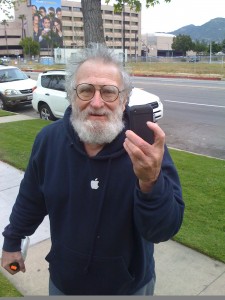
John T. Draper, the computer legend also known as "Captain Crunch." (Image by Aaron Getting.)

I ask him who this Captain Crunch person is.

‘Oh. The Captain. He’s probably the most legendary phone phreak. He calls himself Captain Crunch after the notorious Cap’n Crunch 2600 whistle.’ (Several years ago, Gilbertson explains, the makers of Cap’n Crunch breakfast cereal offered a toy-whistle prize in every box as a treat for the Cap’n Crunch set. Somehow a phone phreak discovered that the toy whistle just happened to produce a perfect 2600-cycle tone. When the man who calls himself Captain Crunch was transferred overseas to England with his Air Force unit, he would receive scores of calls from his friends and ‘mute’ them — make them free of charge to them — by blowing his Cap’n Crunch whistle into his end.)

‘Captain Crunch is one of the older phone phreaks,’ Gilbertson tells me. ‘He’s an engineer who once got in a little trouble for fooling around with the phone, but he can’t stop. Well, this guy drives across country in a Volkswagen van with an entire switchboard and a computerized super-sophisticated M-F-er in the back. He’ll pull up to a phone booth on a lonely highway somewhere, snake a cable out of his bus, hook it onto the phone and sit for hours, days sometimes, sending calls zipping back and forth across the country, all over the world….’

Back at my motel, I dialed the number he gave me for ‘Captain Crunch’ and asked for G—- T—–, his real name, or at least the name he uses when he’s not dashing into a phone booth beeping out M-F tones faster than a speeding bullet, and zipping phantomlike through the phone company’s long-distance lines.

When G—- T—– answered the phone and I told him I was preparing a story for Esquire about phone phreaks, he became very indignant.

‘I don’t do that. I don’t do that anymore at all. And if I do it, I do it for one reason and one reason only. I’m learning about a system. The phone company is a System. A computer is a System. Do you understand? If I do what I do, it is only to explore a System. Computers. Systems. That’s my bag. The phone company is nothing but a computer.'”

Tags: ,

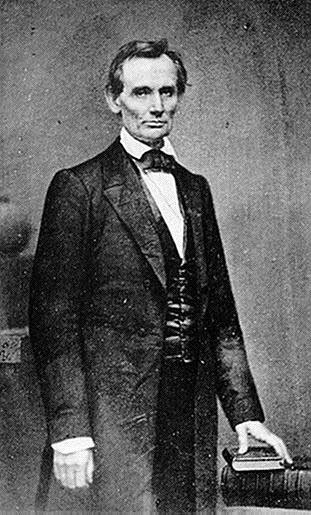
Thanks for ruining the ceiling, jackass. (Image by Mathew Brady.)

I recently posted about Abraham Lincoln’s less-than-graceful youth, using examples from Carl Sandburg’s great biography, The Prairie Years. Here’s another brief tale of Lincoln’s boorish behavior from that tome:

“He put barefoot boys to wading in a mud puddle near the home trough, pulled them up one by one, carried them to the house upside down, and walked their muddy feet across the ceiling. The stepmother came in, laughed at their foot tracks, told Abe he ought to be spanked–and he cleaned the ceiling so that it looked new.”

Tags:

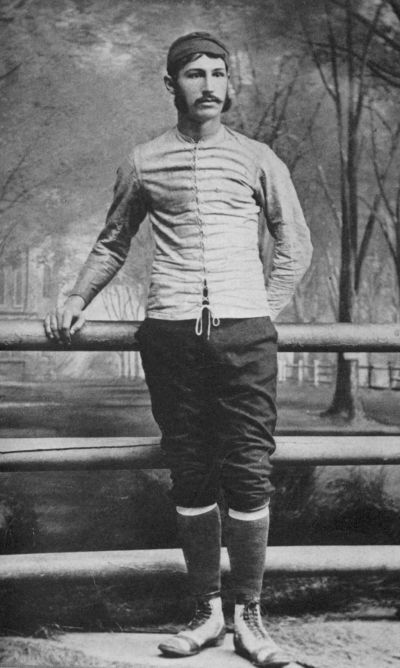
"He must be....of a hopeful or sanguine disposition."

Player, coach and writer Walter Camp describes the “Quarter-Back” position in his 1891 book, American Football:

“The quarter is, under the captain, the director of the game. With the exception of one or two uncommon and rare plays, there is not one of any kind, his side having the ball, in which it does not pass through his hands. The importance of his work it is therefore impossible to overrate. He must be, above all the qualifications of brains and agility usually attributed to that position, of a hopeful or sanguine disposition. He must have confidence in the centre himself, and, most of all, in the man to whom he passes the ball. He should always believe that the play will be a success. The coach can choose no more helpful course during the first few days, as far as the quarter is concerned, than that of persuading him repose confidence in his men. Many promising half-backs are ruined by the quarter. There is nothing that makes halves fumble so badly, get into such awkward positions, start so slowly, and withal play so halfheartedly, as the feeling that the quarter does not think much of them, does not trust them, or believe in their abilities. When he lacks confidence in his man, his passing is unsteady and erratic as well as slow.”

Tags:

Today T.G.I. Friday's is a ginormous chain and tourist trap. (Image by Americasroof.)

It may be difficult to believe considering the way T.G.I. Friday’s is viewed today, but the origin story of the first Friday’s restaurant in Manhattan on First Avenue and 63rd Street, which opened in 1965, is also the origin story of the singles bar in America. Founder Alan Stillman recalled his place in urban history for the New City Reader not long ago. An expanded version is now available at Edible Geography. An excerpt:

New City Reader: Explain how you went about recreating that cocktail party atmosphere in a public space.

Alan Stillman: All I really did was throw sawdust on the floor and hang up fake Tiffany lamps. I painted the building blue and I put the waiters in red and white striped soccer shirts. If you think that I knew what I was doing, you are dead wrong. I had no training in the restaurant business, or interior design, or architecture — I just have a feel for how to use all those things to create an experience.

I wanted T.G.I. Friday’s to feel like a neighbourhood, corner bar, where you could get a good hamburger, good french fries, and feel comfortable. At the time, it was a sophisticated hamburger and french fry place — apparently, I invented the idea of serving burgers on a toasted English muffin — but the principle involved was to make people feel that they were going to someone’s apartment for a cocktail party.

The food eventually played a larger role than I imagined it would, because a lot of the girls didn’t have enough money to stretch from one paycheque to the other, so I became the purveyor of free hamburgers at the end of the month.

I don’t think there was anything else like it at the time. Before T.G.I. Friday’s, four single twenty-five year-old girls were not going out on Friday nights, in public and with each other, to have a good time. They went to people’s apartments for cocktail parties or they might go to a real restaurant for a date or for somebody’s birthday, but they weren’t going out with each other to a bar for a casual dinner and drinks because there was no such place for them to go.

It took off extraordinarily quickly. In the first six to nine months, T.G.I. Friday’s got written up in Time, Newsweek, and the Saturday Evening Post. Then Maxwell’s Plum opened up across the street, which was another singles bar. It was really quite a phenomenon.

I believe that the first line in the history of bars, restaurants, and discos may have been at T.G.I. Friday’s. Inside of three months, we had to hire a doorman. One night I was tending bar, and he walked up to me and said, ‘Listen, there’s a dozen people standing outside, and we have no tables and no room at the bar. What do you want me to do?” And I said, “I tell you what. Why don’t you just tell them to wait, and when someone comes out, you’ll let them in.’ He said that he didn’t know whether they would wait or not, and I said I didn’t know what else to tell him, and so he went back.

Next thing you know, I came out from behind the bar to get something and I looked outside and there were forty people standing in line. The next week we ended up buying velvet ropes. There was nothing like that anywhere else. You would either have a reservation at a fancy restaurant or you would just go into a bar or diner — nobody would wait in line for food and drink.” (Thanks Long Form.)

Tags:

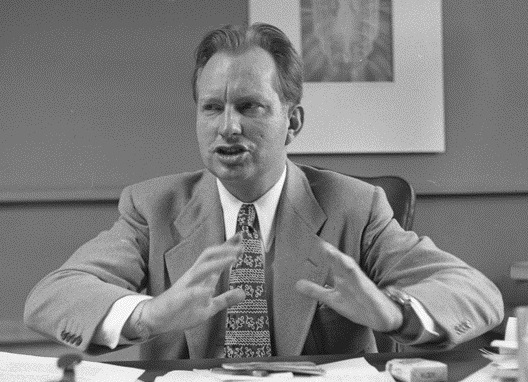
"The church is a hugely profitable global racket."

With the 1991 Time article, “The Thriving Cult of Greed and Power,” investigative reporter Richard Behar brought concerns about Scientology to the mainstream. The hard-hitting article’s opening:

“By all appearances, Noah Lottick of Kingston, Pa., had been a normal, happy 24-year-old who was looking for his place in the world. On the day last June when his parents drove to New York City to claim his body, they were nearly catatonic with grief. The young Russian-studies scholar had jumped from a 10th-floor window of the Milford Plaza Hotel and bounced off the hood of a stretch limousine. When the police arrived, his fingers were still clutching $171 in cash, virtually the only money he hadn’t yet turned over to the Church of Scientology, the self-help ‘philosophy’ group he had discovered just seven months earlier.

His death inspired his father Edward, a physician, to start his own investigation of the church. ‘We thought Scientology was something like Dale Carnegie,’ Lottick says. ‘I now believe it’s a school for psychopaths. Their so-called therapies are manipulations. They take the best and brightest people and destroy them.’ The Lotticks want to sue the church for contributing to their son’s death, but the prospect has them frightened. For nearly 40 years, the big business of Scientology has shielded itself exquisitely behind the First Amendment as well as a battery of high-priced criminal lawyers and shady private detectives.

The Church of Scientology, started by science-fiction writer L. Ron Hubbard to ‘clear’ people of unhappiness, portrays itself as a religion. In reality the church is a hugely profitable global racket that survives by intimidating members and critics in a Mafia-like manner.”

Tags: , , ,

Some Facebook, lots of porn.

In addition to slaughtering his own people, how is longtime nutbag Muammar el-Qaddafi spending his time during the Libyan revolution? An excerpt from an May 2010 Q&A in the German publication Spiegel provides a hint:

Spiegel: Where do you get your facts? Do you watch television? Do you read books?

Qaddafii: I get most of them from the Internet. I constantly sit at my computer. I read in Arabic, but now it is of course also possible to immediately get translations from English.”

Tags: ,

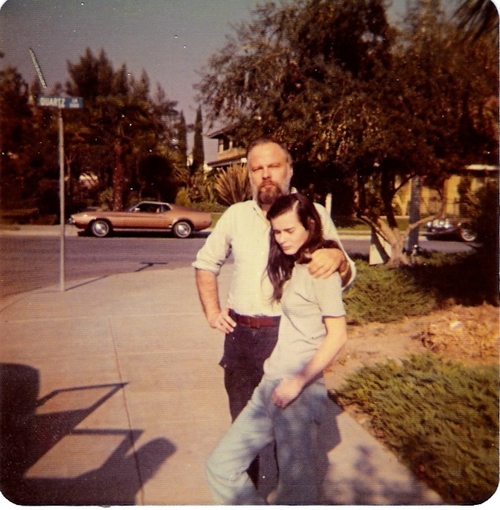
pkd89

Long Form pointed me to a great 1993 New Republic article by Alexander Star about Philip K. Dick. An excerpt:

A heavy man with an absent smile and an intent gaze, Philip Dick typed 120 words a minute even when he wasn’t on speed, drank prodigious quantities of scotch and completed five marriages and over fifty novels before the pills and the liquor conspired to kill him at 54. His busy life has been ably narrated by Lawrence Sutin in his biography, Divine Invasions, which appeared a few years ago. Born in 1928, Dick witnessed the Depression from inside a broken home. His father, an employee of the Department of Agriculture, left the family in 1931 and went on to host a radio show in Los Angeles called This is Your Government. Dick grew up with his mother on the fringes of Berkeley’s fledgling bohemia. A troubled student, he was often “hypochondriacal about his mental condition,” as one of his wives later put it. And like many troubled boys of the time, he became a voracious reader of the science fiction pulp magazines that were then at their peak. In Confessions of a Crap Artist, a novel written in 1959, he wryly portrayed himself as an awkward kid spouting oddball ideas from Popular Mechanics and adventure stores: “Even to look at me you’d recognize that my main energies are in the mind.”•

Tags: , ,

« Older entries § Newer entries »