Excerpts

You are currently browsing the archive for the Excerpts category.

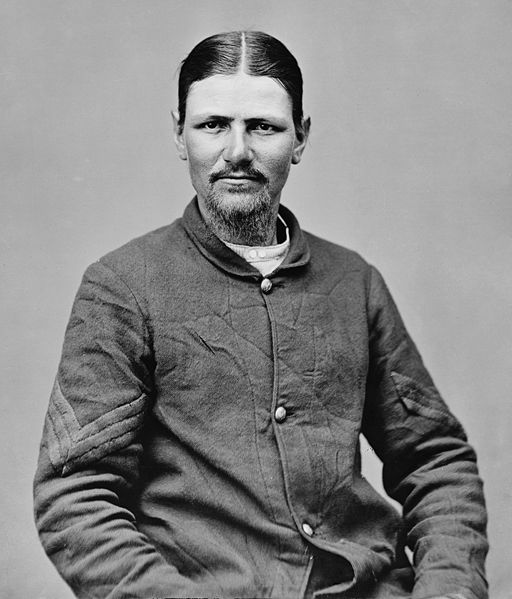
"Corbett told him that he was homeless, almost penniless, and headed to Kansas to stake a claim." (Image by Mathew Brady.)

The opening of “The Man Who Shot the Man Who Shot Lincoln,” Ernest B. Furgurson’s American Scholar account of the unusual life of Boston Corbett, the soldier who killed John Wilkes Booth:

“One morning in September 1878, a tired traveler, five feet four inches tall, with a wispy beard, arrived at the office of the daily Pittsburgh Leader. His vest and coat were a faded purple, and his previously black pants were gray with age and wear. As he stepped inside, he lifted a once fashionable silk hat to disclose brown hair parted down the middle like a woman’s. Despite the mileage that showed in his face and clothes, he was well kept, and spoke with clarity. He handed the editor a note from an agent at the Pittsburgh rail depot, which said: ‘This will introduce to you Mr. Boston Corbett, of Camden, N.J., the avenger of Abraham Lincoln. Mr. Corbett is rather bashful, but at my solicitation he concluded to call on the Leader editor as an old soldier.’

The newspaperman realized that this was no joke. He remembered the photographs of this man, spread across the North after he shot the assassin John Wilkes Booth 13 years earlier, in April 1865. He invited him to sit and talk. Corbett told him that he was homeless, almost penniless, and headed to Kansas to stake a claim. The railroad agent had suggested that he come to the newspaper to tell his story, on the chance that someone would help him on his way.” (Thanks Longform.)

Tags: , , ,

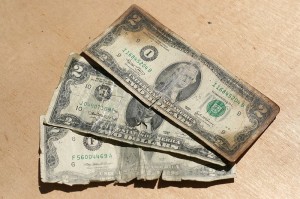
We’re headed further and further into a paperless currency world in the near future, but bills still have a role right now. Below is a list of the average lifespan for a number of denominations, which don’t last long. It’s taken from an Atlantic article, The Destruction of Money.

  • $1 bills: 3.7 years
  • $5 bills: 3.4 years
  • $10 bills: 3.4 years
  • $20 bills: 5.1 years
  • $50 bills: 12.6 years
  • $100 bills: 8.9 years


"He turned his head to see what was going on, and there was the steel grille of a black van heading straight toward him."

From “Lucky Jim,” Elizabeth Gilbert’s amazing 2002 GQ profile of Jim MacLaren, an incredibly accomplished athlete and actor who suffered two devastating accidents and passed away last year:

“Soon he could run a marathon in just over three hours, routinely finishing in the top third of able-bodied contenders. And then he took up triathlons. Yes, triathlons. Once he’d survived a few of those, he set out to conquer the Ironman, one of the most brutal organized sporting events ever imagined. Two and a half miles of swimming, 112 miles of biking and a full 26.2-mile marathon, all in one race, all in one day. And all on one leg. Which explains what Jim MacLaren was doing in Southern California on that cool June afternoon in1993. He was participating in an Ironman.Jim was excelling. He was speeding through the town of Mission Viejo on his bicycle, tearing ass at thirty-five miles per hour. The sidewalks were crowded with spectators, and he was dimly aware of their cheers. He had just pulled ahead of a thick snarl of cyclists. He was leading the pack. Suddenly, Jim heard the crowd gasp. He turned his head to see what was going on, and there was the steel grille of a black van heading straight toward him. He realized he was about to be hit by a goddamn car.It was supposed to have been a closed racecourse. But for some unknown reason,a cop guarding an intersection decided to let one car through, and he misjudged how fast the bicyclists were coming. As Jim MacLaren was approaching,the cop was gesturing to the driver of the van to hit the gas. The driver, a 50-year-old man on his way to church, was merely obeying orders. He floored it. He didn’t see Jim until Jim was on his windshield.This time Jim vividly remembers being hit. He remembers the screams from the crowd. He remembers his body flying across the street and smashing into a lamppost headfirst, snapping his neck. He remembers riding in the ambulance and being aware that he could not feel his limbs. He was put under anesthesia for emergency surgery on his spine, and when he woke up he was in the trauma ward. He could not move. His head was shaved. There was a bolt screwed into the back of his skull, preventing him from shifting his head even a millimeter. Jim remembers this well. But what he remembers most clearly is this image: All the nurses were in tears.’We’re so sorry,’ they kept saying. Jim MacLaren was now a quadriplegic. He was 30 years old. And this is where his story begins.” (Thanks Kevin Kelly.)

••••••••••

Tags: ,

"On Aug. 16, 1987, thousands of new age adherents following the lead of Arguelles." (Image by Luke Hancock.)

On August 18, 1987, people gathered in Central Park (and other locales all over the world) for an odd event called Harmonic Convergence, blowing conch shells and dancing, which would supposedly delay Earth’s doom. It was a bit of ridiculousness birthed (with sincerity) by a Minnesota art historian named Jose Arguelles, who just passed away. Here’s an excerpt from his obituary:

“Jose Arguelles, an art historian whose teachings about the Mayan calendar inspired the harmonic convergence event of 1987, has died at age 72.

His publisher and a statement from his foundation said he died March 23, in Australia. A spokeswoman for the publisher said Monday the cause was peritonitis.

On Aug. 16, 1987, thousands of new age adherents following the lead of Arguelles gathered at places such as the red rocks of Sedona, Ariz., Serpent Mound in Ohio and the Arthurian town of Glastonbury in England.

Arguelles was living in Boulder, Colo., and had written The Mayan Factor: Path Beyond Technology, which argued for replacing the Gregorian calendar, said Earth was in the last phases of a galactic beam of light it entered in 3113 B.C., and called for meditation to give humanity a chance to enter a new age in 2012.

At a mountain campsite, he blew a conch shell, and around the world others chanted, formed circles, held hands at dawn and danced in what one participant said was an attempt to change the worldwide consciousness. Debunkers ranged from academics to the Doonesbury comic strip.”

Tags:

Beatrice Wood came to art late but with gusto. (Thanks Documentarian.)

From Michael Kimmelman’s 1999 remembrance of Wood in the New York Times: “The time is summer 1917, the place, Coney Island. Beatrice Wood is seated on a fake ox while behind her, in an oxcart, against a painted backdrop, sit Marcel Duchamp and Francis Picabia. They have come from the roller coaster. ‘With Marcel’s arm around me,’ Wood recalled years later, ‘I would have gone on any ride into hell with the same heroic abandon as a Japanese lover standing on the rim of a volcano ready to take a suicide leap.’ In the photograph she looks more queasy than lovestruck, clutching her hat as if afraid it might still blow off.

Wood, who died this year a few days after her 105th birthday, flirtatious to the end, became a potter of luminescent talent, having taken up ceramics in her 40’s when she failed to find a teapot to match some plates she had bought in Holland. Her fame, which mostly came later in life, stemmed from a combination of her art, her longevity and her sheer verve.

When she was born, Cezanne was still a little-known painter and Grover Cleveland was President. When she died, she was, in a sense, just coming into her own, having had a full-scale museum retrospective in New York City a year earlier and having been named a ‘living treasure’ by the Governor of California a couple of years before that. Through a friend she’d lately been introduced to a film director who decided to base a character in a new movie on her. The director was James Cameron. The character was Rose in Titanic.

Tags: , , ,

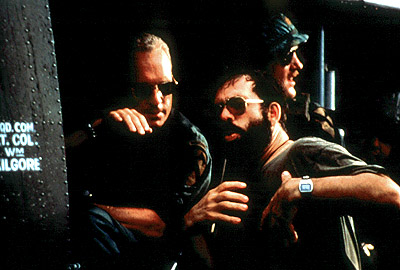
An inside look at the insane set of Apocalypse Now, reported with verve in 1977 in Newsweek by Maureen Orth:

“Life on the set – four different locations in the Philippines – also escalated quickly to apocalyptic dimensions. The young crew, composed largely of Americans, Filipions and Italians, weathered a typhoon, survived dysentery and sweated through day after day of relentless heat – alleviated by periodic R&R trips to Hong Kong. Stuntmen amused themselves by diving from fourth-story windows into the motel pool below. The prop man, Doug Madison, became adept at fabricating top secret CIA documents, thought nothing of driving 400 miles to fetch a special Army knife, and made a connection with a supplier of real corpses – before he was vetoed. At one point, Coppola asked Tavoularis to produce 1,000 blackbirds, which prompted the designer to consider making cardboard beaks for pigeons and dyeing them black. The film company retained a full-time snake man, who appeared every morning on the set with a sack full of pythons. The Italians brought in pasta and mozzarella from Italy in film cans. Did Coppola want a tribe of primitive mountain people living on the set in their own functioning village? He got it.” (Thanks Longform.)

••••••••••

Tags: ,

"But I wore the juice." (Image by Paoletta S.)

Idiocy is annoying but repeated idiocy is galling beyond belief. Why don’t we learn from our mistakes? Why do we repeat them? Perhaps we’re too stupid to know that we’re stupid? Errol Morris looks at this conundrum on his Times blog in the extravagantly titled 2010 post, “The Anosognosic’s Dilemma: Something’s Wrong but You’ll Never Know What It Is.” An excerpt:

“David Dunning, a Cornell professor of social psychology, was perusing the 1996 World Almanac.  In a section called “Offbeat News Stories” he found a tantalizingly brief account of a series of bank robberies committed in Pittsburgh the previous year.  From there, it was an easy matter to track the case to the Pittsburgh Post-Gazette, specifically to an article by Michael A. Fuoco:

ARREST IN BANK ROBBERY,
SUSPECT’S TV PICTURE SPURS TIPS

At 5 feet 6 inches and about 270 pounds, bank robbery suspect McArthur Wheeler isn’t the type of person who fades into the woodwork.  So it was no surprise that he was recognized by informants, who tipped detectives to his whereabouts after his picture was telecast Wednesday night during the Pittsburgh Crime Stoppers Inc. segment of the 11 o’clock news.

At 12:10 a.m. yesterday, less than an hour after the broadcast, he was arrested at 202 S. Fairmont St., Lincoln-Lemington.  Wheeler, 45, of Versailles Street, McKeesport, was wanted in [connection with] bank robberies on Jan. 6 at the Fidelity Savings Bank in Brighton Heights and at the Mellon Bank in Swissvale. In both robberies, police said, Wheeler was accompanied by Clifton Earl Johnson, 43, who was arrested Jan. 12.

Wheeler had walked into two Pittsburgh banks and attempted to rob them in broad daylight.  What made the case peculiar is that he made no visible attempt at disguise.  The surveillance tapes were key to his arrest.  There he is with a gun, standing in front of a teller demanding money.  Yet, when arrested, Wheeler was completely disbelieving.  ‘But I wore the juice,’ he said.  Apparently, he was under the deeply misguided impression that rubbing one’s face with lemon juice rendered it invisible to video cameras.

In a follow-up article, Fuoco spoke to several Pittsburgh police detectives who had been involved in Wheeler’s arrest.  Commander Ronald Freeman assured Fuoco that Wheeler had not gone into ‘this thing’ blindly but had performed a variety of tests prior to the robbery.  Sergeant Wally Long provided additional details — ‘although Wheeler reported the lemon juice was burning his face and his eyes, and he was having trouble (seeing) and had to squint, he had tested the theory, and it seemed to work.’  He had snapped a Polaroid picture of himself and wasn’t anywhere to be found in the image.  It was like a version of Where’s Waldo with no Waldo.  Long tried to come up with an explanation of why there was no image on the Polaroid.  He came up with three possibilities:

(a) the film was bad;

(b) Wheeler hadn’t adjusted the camera correctly; or

(c) Wheeler had pointed the camera away from his face at the critical moment when he snapped the photo.

As Dunning read through the article, a thought washed over him, an epiphany.  If Wheeler was too stupid to be a bank robber, perhaps he was also too stupid to know that he was too stupid to be a bank robber — that is, his stupidity protected him from an awareness of his own stupidity.”

••••••••••

A Morris commercial for Miller beer:

Tags: , , ,

Poem published in 1897.


RICHARD CORY:

Whenever Richard Cory went downtown,
We people on the pavement looked at him:
He was a gentleman from sole to crown,
Clean favored, and imperially slim.

And he was always quietly arrayed,
And he was always human when he talked;
But still he fluttered pulses when he said,
“Good morning,” and he glittered when he walked.

And he was rich — yes, richer than a king,
And admirably schooled in every grace:
In fine, we thought that he was everything
To make us wish that we were in his place.

So on we worked, and waited for the light,
And went without the meat, and cursed the bread,
And Richard Cory, one calm summer night,
Went home and put a bullet through his head.

••••••••••

As reimagined by Simon & Garfunkel in 1966:

Tags:

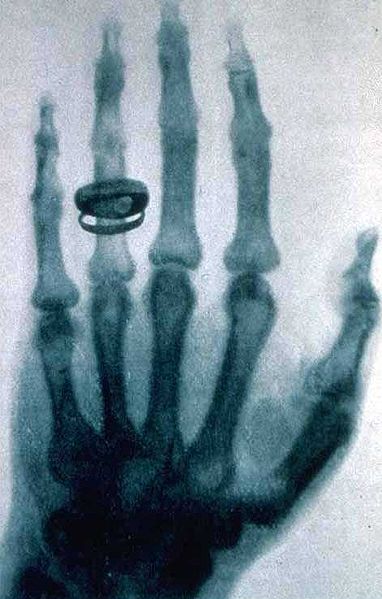
X-ray.

Xanthippe: The irascible wife of the Greek philosopher, Socrates, and the type of the scolding wife. Allowance must be made for a woman whose husband brought home company for dinner and nothing else. She mourned sincerely for him at his death.

Yard: A standard measure of 36 inches, the word being derived from the Saxon gyrd, or rod. The yard was anciently regarded as the circumference of the body, but Henry I decided it should be the length of his arm.

Yawning: Deep inspiration of breath with widely opened mouth, a natural effort for nervous relief when exhausted.

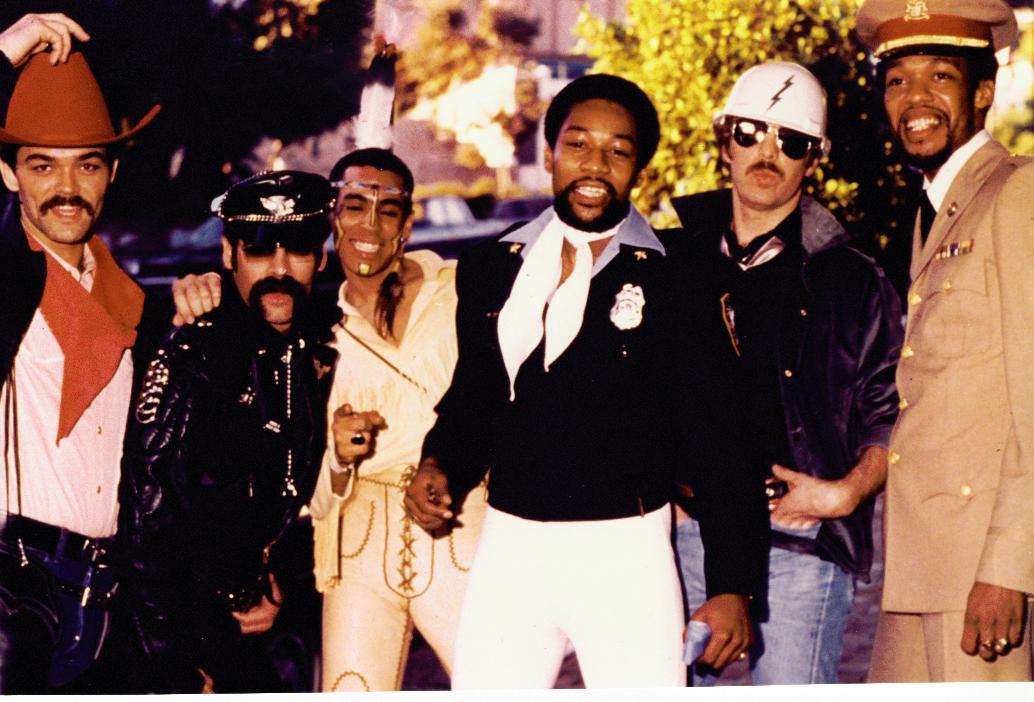
"Y-M-C-A" (Image by Cod.)

Young, Brigham: The famous Mormon leader, and the head of the Latter Day Saints of Salt Lake City. He was the Governor of the Territory, a position from which he was removed by President Buchanan, but not convicted. At his death he had seventeen wives. He was originally a house-builder’s workman in New York State, but embraced Mormonism in 1831 and became first elder, then apostle, amid finally president in 1844, in succession to Joseph Smith.

Zzzzzzzzzzzzzz...

Zenana: The portion of a dwelling in India where the female members of the family are kept, and to which strangers are not admitted.

•Taken from the 1912 Standard Illustrated Book of Facts.

See also:

From “Typewriter Man,” Ian Frazier’s 1997 Atlantic profile of Martin Kenneth Tytell, a manual keyboard whiz in an age when people had all but given up typing words in favor of processing them:

“The Manhattan Yellow Pages has so many listings under ‘Typewriters’ that you might think getting someone to fix a manual would not be hard. The repair places I called were agreeable enough at first; but as I described the problem (Fixing an e, for Pete’s sake! How tough can that be?), they began to hedge and temporize. They mentioned a scarcity of spare parts, and the difficulty of welding forged steel, and other problems, all apparently my own fault for not having foreseen. I took my typewriter various places to have it looked at, and brought it home again unrepaired. This went on for a while. Finally, approaching the end of the Yellow Pages listing, I found an entry for ‘TYTELL TYPWRTR CO.’ It advertised restorations of antiques, an on-premises machine shop, a huge inventory of manuals, and sixty-five years of experience and accumulated parts. The address was in lower Manhattan. I called the number, and a voice answered, ‘Martin Tytell.’ I told Mr. Tytell my problem, and he told me he certainly could fix it. I said I would bring the typewriter in next week. ‘You should bring it in as soon as possible,’ he advised. ‘I’m an old man.'”

••••••••••

From the 2008 obituary for Tytell in the New York Times: “When he retired in 2000, Mr. Tytell had practiced his recently vanishing craft for 70 years. For most of that time, he rented, repaired, rebuilt, reconfigured and restored typewriters in a second-floor shop at 116 Fulton Street in Lower Manhattan, where a sign advertised ‘

When he retired in 2000, Mr. Tytell had practiced his recently vanishing craft for 70 years. For most of that time, he rented, repaired, rebuilt, reconfigured and restored typewriters in a second-floor shop at 116 Fulton Street in Lower Manhattan, where a sign advertised ‘Psychoanalysis for Your Typewriter.’

There, at the Tytell Typewriter Company, he often worked seven days a week wearing a white lab coat and a bow tie, catering to customers like the writers Dorothy Parker and Richard Condon, the newsmen David Brinkley and Harrison Salisbury, and the political opponents Dwight D. Eisenhower and Adlai E. Stevenson. Letters addressed only to ‘Mr. Typewriter, New York’ arrived there, too.

There, at the Tytell Typewriter Company, he often worked seven days a week wearing a white lab coat and a bow tie, catering to customers like the writers Dorothy Parker and Richard Condon, the newsmen David Brinkley and Harrison Salisbury, and the political opponents Dwight D. Eisenhower and Adlai E. Stevenson. Letters addressed only to ‘Mr. Typewriter, New York’ arrived there, too.”

Tags: ,

Ewe. (Image by Don Crowley.)

Umbilicus: The navel. During pregnancy a mass of vessels called placenta or afterbirth (as it is ejected after the birth of the child), is formed on the inner surface of the womb, and conveys the mother’s blood to the child by an artery in the umbilical cord which enters the child by the navel and maintains a circulation, the venous blood returning to the mother by another blood vessel. As soon as the child is born respiration establishes itself, the umbilical cord is cut (it contains no nerves) and the navel bandaged. Children born after seven months of pregnancy are capable of life. With animals the mother usually devours the afterbirth.

Vaudeville: A form of theatrical entertainment extremely popular in the United States and Europe. Large circuits of theatres are devoted to it, and a great number of small theatres showing moving pictures give vaudeville acts also. Vaudeville originated in France and described a short play; but the word in the United States has superseded the word “variety” as a means of indicating a theatrical show composed of various features. In vaudeville, the acts, each lasting from ten to thirty minutes, but mostly twenty minutes, are of all kinds; short plays, farces, operettas, protean plays. sketches, singers, teams of comedians who dance, sing and tell jokes, sister teams, all sorts of players on musical instruments; an endless number of athletic feats, such as bicycle riding, juggling, tight rope walking, skating, and bag punching; sleight-of-hand performers; performing animals; appearances of persons temporarily notorious; all kinds of spectacular and trick dancing; lightning changes of costume, lightning pictorial and plastic artists, thought-reading, hypnotism, in fact everything of any possible interest. As a form of amusement, it is not regarded highly, and is chiefly patronized by “the general public”–those looking for amusement only.

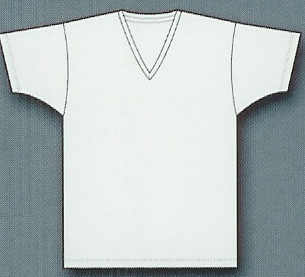
V-Neck.

Warfare in the Air: A subject which has developed to the point of international discussion, and by many it is prophesied that the next great war will see the aeroplane fleet an important adjunct of the opposing forces. By means of these commanders of hostile armies can inform themselves of each other’s movements, and shells dropped from an aeroplane can do most effective damage; whereas it is difficult for the enemy to secure an accurate range on an aeroplane because a shot “wild” in the air gives no indication of how far it went wild as on land or water. Besides an aeroplane only 1,000 feet in the air is an inconspicuous object and can only be hit by accident. Some progress toward warfare in the air has already been made. The Germans have done considerable work in perfecting aeroplane guns, but only practical experience will show their efficacy and aviators do not at present look for great results from them. Aerial warfare is the most uncertain of all developments; and the probabilities are that the very proportions to which the subject will advance will operate to put an end to international wars altogether.

W. (Image by Eric Draper.)

Werewolf: According to an Old World superstition, a human being changed into a wolf, but preserving its original intelligence. Numerous men charged in the Middle Ages with crimes were deemed of the Werewolf category. The superstition prevailed in many parts of Europe to a comparatively recent time, and some such belief is prevalent amongst the most savage races at the present day.

Windows: Originally apertures for the admission of the wind into dwellings, began to be made of glass and used only for the admission of light in very early times. There is evidence of glass windows having been used at Pompeii, but they did not become common in England before the twelfth century. A window tax was imposed in 1695, and again at later dates for special revenue purposes. As late as 1850, the sum of over $9,000,000 was obtained from the tax. It was repealed in 1851.

See also:


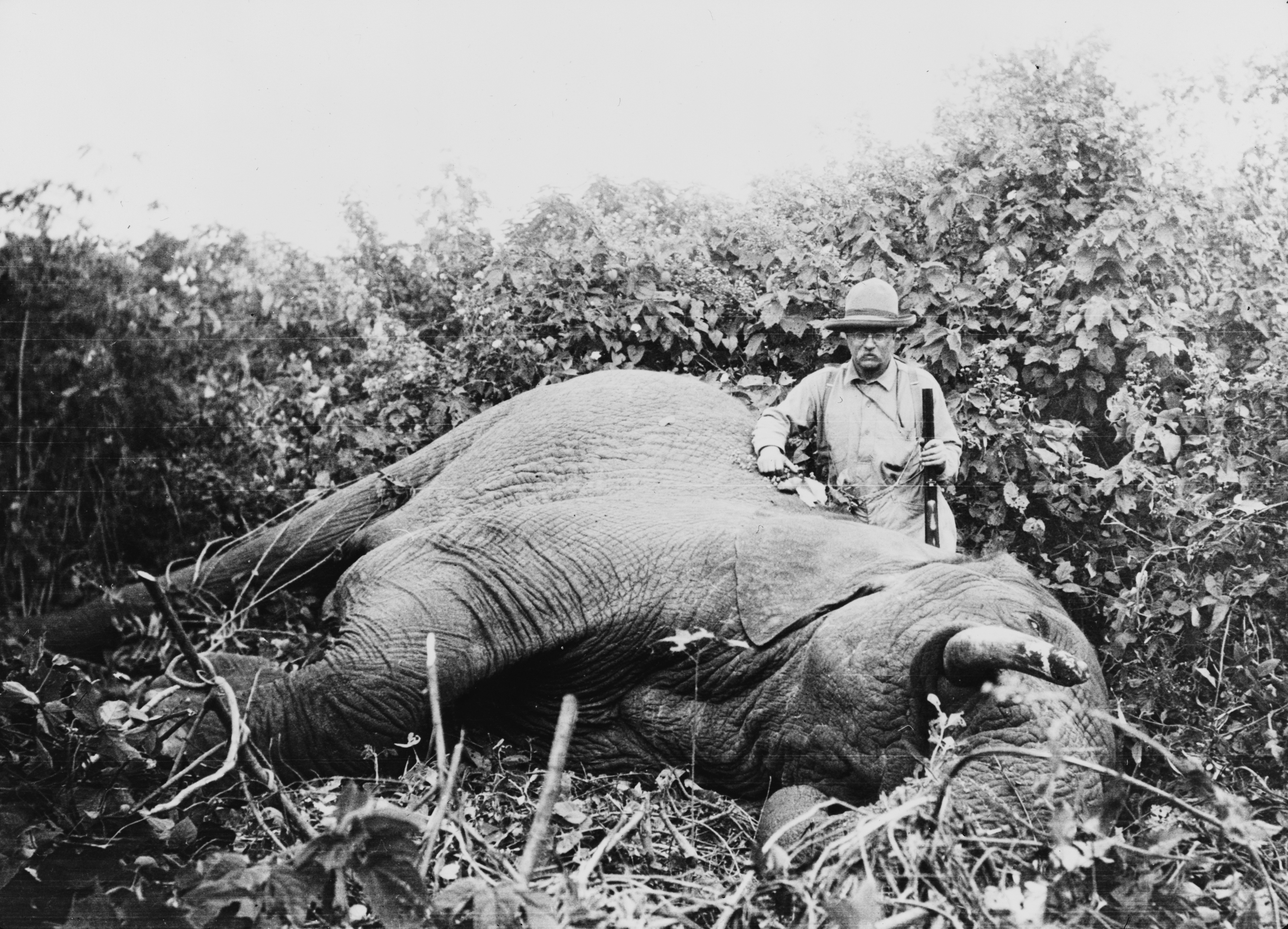
Theodore Roosevelt, after bagging an elephant. Not even President Palin could get away with this today. (Image by Edward Van Altena.)

The Essayist posted a link to George Orwell’s classic 1936 essay, “Shooting an Elephant.” An excerpt:

“One day something happened which in a roundabout way was enlightening. It was a tiny incident in itself, but it gave me a better glimpse than I had had before of the real nature of imperialism–the real motives for which despotic governments act. Early one morning the sub-inspector at a police station the other end of the town rang me up on the phone and said that an elephant was ravaging the bazaar. Would I please come and do something about it? I did not know what I could do, but I wanted to see what was happening and I got on to a pony and started out. I took my rifle, an old .44 Winchester and much too small to kill an elephant, but I thought the noise might be useful in terrorem. Various Burmans stopped me on the way and told me about the elephant’s doings. It was not, of course, a wild elephant, but a tame one which had gone ‘must.’ It had been chained up, as tame elephants always are when their attack of ‘must’ is due, but on the previous night it had broken its chain and escaped. Its mahout, the only person who could manage it when it was in that state, had set out in pursuit, but had taken the wrong direction and was now twelve hours’ journey away, and in the morning the elephant had suddenly reappeared in the town. The Burmese population had no weapons and were quite helpless against it. It had already destroyed somebody’s bamboo hut, killed a cow and raided some fruit-stalls and devoured the stock; also it had met the municipal rubbish van and, when the driver jumped out and took to his heels, had turned the van over and inflicted violences upon it.”

Tags: ,

"The first building to overcome these sensitivities was Richard Morris Hunt’s Stuyvesant Apartments." (Image by John Singer Sargent.)

From “Sardine Life,” a smart essay in New York magazine by Justin Davidson about the evolution of apartment living in NYC, which was considered déclassé until one elegant building changed all that:

“The first building to overcome these sensitivities was Richard Morris Hunt’s Stuyvesant Apartments at 142 East 18th Street, a luxurious behemoth by 1870 standards. This structure defeated doubters with a two-pronged argument of aesthetics and pragmatism. The architecture oozed dignity: Five stories high and four lots wide, it had an imposing mass, an overweening mansard roof with yawning dormers, wrought-iron balconies, and ornamental columns. Even more persuasively, compared with the cost of building, furnishing, cleaning, and repairing a private home, all this respectability came as a bargain. Within a few years, the Times announced that a ‘domiciliary revolution’ had taken place: a happy epidemic of flats had beaten back a plague of sinister boardinghouses. Young couples could now afford a bright new place in town; families no longer needed to fan out to the villages that lay miles from Union Square. The change represented the triumph of pragmatism over prejudice. ‘Anglo Saxons,’ the Times reported, ‘are instinctively opposed to living under the same roof with other people, and it is doubtful if [that resistance] would have been overcome had not the earliest flats been of an elegant kind, in the best quarters of the town, and therefore, expensive and fashionable.’ The rich made the apartment safe for the middle class.”

Tags: ,

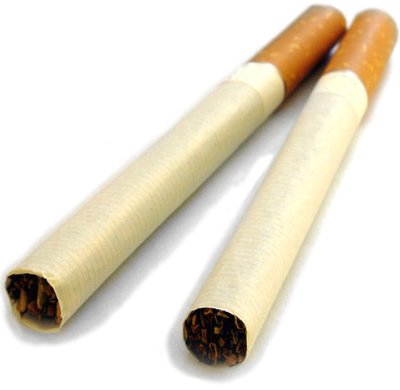
Known to cause cancer. (Image by Geierunited.)

Lonnie Warner, a.k.a. Lonnie Loosie, is a genial entrepreneur who sells untaxed tobacco in Manhattan a full pack or a single coffin nail at a time, frequently getting arrested. Joseph Goldstein of the New York Times profiles the small businessman:

“In the four years since he began selling cigarettes, Mr. Warner recalls being arrested 15 times, generally on the charge of selling untaxed tobacco. He has been arrested so often that he can recognize 10 different plainclothes police officers, he claims. The ever-present risk of arrest makes working with partners valuable — ‘we have six eyes on this block,’ he explained.

Over many court appearances, Mr. Warner has made a favorable impression on the lawyers in Midtown Community Court, who know him as Lonnie Loosie and consider him better company than the typical misdemeanor defendant.

‘There are people who are known bad guys, and then there’s him,’ said Russell S. Novack, the Legal Aid lawyer who represents many of Midtown’s hustlers, prostitutes, shoplifters and public drunks. ‘He’s like the goodwill ambassador of Eighth Avenue. And when he comes into court, he says hello to everybody.'”

Tags: , ,

Tarantula: A large hairy kind of spider common in some parts of Italy, Southern California, Texas, and Mexico and other sub-tropical countries, and at one point thought to be poisonous and perhaps are occasionally so. Music was supposed to be the only cure for its sting, which superstition gave the Tarantula dance, an ancient Bacchanalian amusement. The Church banned it, and it was ascribed to the hateful spider.

Tattooing: The practice of pricking patterns or designs in the skin, with indelible pigments. It is in vogue among the brown and yellow races and sailors the world over. Among savages a matter of primitive taste and custom, or means of identification. It is a habit, says Lombroso, distinguishing the criminal type.

Taximeter: An ingenious contrivance by which the strictly legal fare chargeable for a cab journey is indicated. It is only recently that it has been adopted on a large scale in London and New York, although in Berlin and Paris it has been successfully working for many years. It is now in use extensively in this country both for motor cabs and ordinary cabs. It gives its name to the Taxicab, in which the number of wheel revolutions and consequently distance traveled and fare due, are automatically recorded on the dial of the taximeter, to avoid disputes.

Thugs: A secret organization of Indian fanatical assassins. They strangled their victims, and buried their bodies with a consecrated pick-axe, and set apart one-third of their plunder to the goddess Kali. These assassins were difficult to suppress, but vigorous measures ultimately, after twenty years’ effort, secured their extermination in about 1830.

Trance: An abnormal psychical state. In waking trance the thoughts are fixed on one subject, often religion, and other perception ceases. In trance coma and death trance pulsation, respiration and vitality appear to cease, all the nature being concentrated on interior thought or vision. It can be distinguished from death only by absence of decay and may last for weeks.

•Taken from the 1912 Standard Illustrated Book of Facts.

See also


“The next day Willig met with Mayor Abraham Beame, who settled for a fine of $1.10—a penny for each of the tower’s 110 stories.”

From “The Only Way to Go Is Up,” Sam Moses’ 1977 Sports Illustrated profile of George Willig, a Queens toy designer and mountain climber known as the “Human Fly,” who scaled the South Tower of the the World Trade Center that year:

“At 10:05 a.m., 3 1/2 hours after he began, admittedly very excited by now, but not tired, Willig lifted himself over a ledge at the top and crawled, feet first, into an inspection hatch on the roof. He was none the worse for wear, except for blistered hands and insteps. He was greeted by policemen, who congratulated him, requested his autograph, then handcuffed him and served him with a summons for disorderly conduct, criminal trespass and scaling a building without a permit. In addition, it was announced that the city was going to sue Willig for $250,000 for the trouble and expense he had put it to. The next day Willig met with Mayor Abraham Beame, who settled for a fine of $1.10—a penny for each of the tower’s 110 stories. In return, Willig readily agreed not to reveal the details of his climbing apparatus, to forestall imitators from attempting similar climbs.

Of course, Willig was asked why he did it. He responded with the expected answer, the classic and clichéd ‘Because it’s there’—which at the time was the easiest way to reply to a simple question that in truth has such a complex answer. Another reply might have been what Louis Armstrong said when asked to define jazz, ‘If you don’t know, I can’t tell you.’

Nonetheless, Thursday night, before he took his phone off the hook and went to bed at about 1 a.m., Willig tried again to answer the question. ‘A couple of times during the year I planned this climb I thought. ‘What the heck is in me that makes me want to do this?’ I guess it’s just a love of excitement and adventure, an appetite for action. Maybe it has a lot to do with asserting my life, just to myself—feeling more alive.

‘I did wonder, at times, if I should go through with it. But I never at all seriously considered not doing it, never from the first time I got the idea.'”

Tags: , ,

Sea-sickness: Disturbance of the nerves and stomach produced by the pitching of a ship at sea, resulting in pallor, cold sweat, vomiting, exhaustion, and, in exceptional cases, in death. It varies greatly in individuals, may be either annoyance or wretchedness, and usually passes away after a few hours or days. It is constitutional, runs in families, and seems dependent on the brain’s inability to balance and accommodate itself to the new condition, communicated through the spine and the solar plexus. Those who suffer from car-sickness are sure to have it. It is nervousness, for women are more subject than men, and young children, without rigidity of nerve, rarely suffer. It is well to keep on deck, recumbent if possible, and live sparingly on shipbread while it lasts. If the patient takes to the berth, mustard plasters on the stomach, cocaine in the mouth and bromo-caffein afford relief. Shutting the eyes to avoid the sight of moving objects is sensible, and sleep is the best of all.

Seldel, Emil: A Socialist mayor of Milwaukee, distinguished as the first of his party to be elected to such an office (April, 1909). His victory was due in part to the popular discontent with the open corruption of previous administrations, and partly to the fact that other Socialist officials before him, in minor offices, had made excellent records. Nearly all the candidates with him were workingmen. He himself is a pattern-maker by trade and can show evidences of the handiwork in the public places of the city. He was born in Germany, but has long been a resident of Milwaukee.

Shakers and Euthanasia: The Kissimmee Colony of Shakers, founded 1894, near Aston, Florida, acquired notoriety, September 1911, through the giving of a “quieting medicine,” to Sister Sadie Elizabeth Sears. When questioned, the administrators of the drug said that “whatever was done, was done to alleviate her sufferings, and to make it easy for her to pass out of the body without severe pain, not to take life.” The event shocked the whole country and a wide discussion on “Euthanasia” followed. The subject was revived a short time later, when the physicians of the County Hospital, Chicago, announced that they had chloroformed a seven-year-old victim of hydrophobia. They said, “They would not kill him, but they would do nothing to prolong his life of suffering.” The child was placed under an anaesthetic; not to be permitted to come from under its influence and “was put to sleep from which he would not wake.”

Shoes: As coverings for the human foot they have been worn from the earliest times. They are referred to in the Bible and early historical records. The shoes of the Jews were made of wood, rush, linen or leather. Pythagoras directed his followers to wear shoes made from the bark of trees. The Romans were the first to set the example of costly shoes, and introduced various decorative adornments of ivory and precious stones. In the Middle Ages fashion played some fantastic tricks with shoes, and in England, about the middle of the fifteenth century, shoes with such long points were worn that they had to be tied to the knees for convenience in walking, the dandies using silver chains for the purpose. It was about 1633 when shoes of the present form were introduced, and in 1668 the buckle came into use as an ornament. These continued in vogue up to the nineteenth century, before which period shoes were not made “rights” and “lefts.”

Swimming: The art of floating upon or in the water, and of progressing therein; a very desirable accomplishment indeed, as well as a pleasant and healthful pastime.

•Taken from the 1912 Standard Illustrated Book of Facts.

See also
"The Executive Committee ...had chosen my poem, from a multitude, to be entered in its seventh annual poetry convention, which would be held...in Reno, Nevada.

The opening of “What Is Poetry? And Does It Pay?” Jake Silverstein’s smart-acre 2002 Harper’s essay about an asinine poetry convention in Reno, Nevada, that’s run by a vanity press:

“Summer in New Orleans is a long slow thing. Day and night, a heavy heat presides. Waiters stand idle at outdoor cafés, fanning themselves with menus. The tourists have disappeared, and the city’s main industry has gone with them. Throughout town the pinch is on. It is time to close the shutters and tie streamers to your air conditioner; to lie around and plot ways of scraping by that do not involve standing outside for periods of any length.

I was so occupied one humid afternoon when I came across a small newspaper notice that announced in large letters, ‘$25,000 poetry contest.’ ‘Have you written a poem?’ the notice began. I had written a poem. I had even considered submitting it to contests, but the prizes offered never amounted to much—a university might put up $100 in the name of a dead professor—and I hadn’t sent it off. This was a different proposition. With $25,000 I could pay off my debts, quit my jobs, and run the air on hi cool for a while. I submitted my poem that very day.

Two weeks later I had in my hands a letter from something calling itself the Famous Poets Society, based in Talent, Oregon. The Executive Committee of its distinguished Board of Directors, the letter informed me, had chosen my poem, from a multitude, to be entered in its seventh annual poetry convention, which would be held September 16–18 at John Ascuaga’s Nugget hotel and casino in Reno, Nevada. ‘Poets from all over the world will be there to enjoy your renown,’ the letter boasted, ‘including film superstar Tony Curtis.’

This was not exactly what I had imagined.”

Tags:

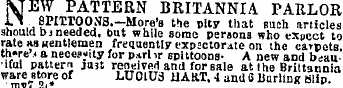
Spittoon under bench, because ladies also enjoy spitting.


“New Pattern Britannia Parlor Spittoons–More the pity that such articles should be needed, but while some persons who expect to rate as gentlemen frequently expectorate on the carpets, there’s a necessity for parlor spittoons. A new and beautiful pattern just received at the Brittannia hardware store of Lucius Hart, 4 and 6 Burling Slip.”


Tags:

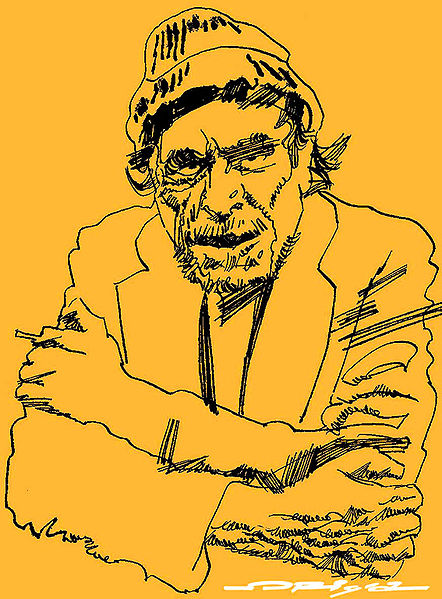
THE LAUGHING HEART

your life is your life
don’t let it be clubbed into dank submission.
be on the watch.
there are ways out.
there is a light somewhere.
it may not be much light but
it beats the darkness.
be on the watch.
the gods will offer you chances.
know them.
take them.
you can’t beat death but
you can beat death in life, sometimes.
and the more often you learn to do it,
the more light there will be.
your life is your life.
know it while you have it.
you are marvelous
the gods wait to delight
in you.

•••••••••

“You are marvelous…the gods wait to delight in you.”

Tags: ,

"The upper 1 percent of Americans are now taking in nearly a quarter of the nation’s income every year."

From “Of the 1%, by the 1%, for the 1%,” a cogent takedown in Vanity Fair of the rising wealth inequality by economist Joseph Stiglitz:

“It’s no use pretending that what has obviously happened has not in fact happened. The upper 1 percent of Americans are now taking in nearly a quarter of the nation’s income every year. In terms of wealth rather than income, the top 1 percent control 40 percent. Their lot in life has improved considerably. Twenty-five years ago, the corresponding figures were 12 percent and 33 percent. One response might be to celebrate the ingenuity and drive that brought good fortune to these people, and to contend that a rising tide lifts all boats. That response would be misguided. While the top 1 percent have seen their incomes rise 18 percent over the past decade, those in the middle have actually seen their incomes fall. For men with only high-school degrees, the decline has been precipitous—12 percent in the last quarter-century alone. All the growth in recent decades—and more—has gone to those at the top. In terms of income equality, America lags behind any country in the old, ossified Europe that President George W. Bush used to deride. Among our closest counterparts are Russia with its oligarchs and Iran. While many of the old centers of inequality in Latin America, such as Brazil, have been striving in recent years, rather successfully, to improve the plight of the poor and reduce gaps in income, America has allowed inequality to grow.”

Tags:

"No matter how tightly they clung to the surrogate mothers, however, the monkeys remained psychologically abnormal."

A note about an important shift in child rearing that occurred during the 1950s from “Hellhole,” a 2009 New Yorker article about solitary confinement by the Brooklyn-born surgeon and excellent writer Atul Gawande:

“Well into the nineteen-fifties, psychologists were encouraging parents to give children less attention and affection, in order to encourage independence. Then Harry Harlow, a professor of psychology at the University of Wisconsin at Madison, produced a series of influential studies involving baby rhesus monkeys.

He happened upon the findings in the mid-fifties, when he decided to save money for his primate-research laboratory by breeding his own lab monkeys instead of importing them from India. Because he didn’t know how to raise infant monkeys, he cared for them the way hospitals of the era cared for human infants—in nurseries, with plenty of food, warm blankets, some toys, and in isolation from other infants to prevent the spread of infection. The monkeys grew up sturdy, disease-free, and larger than those from the wild. Yet they were also profoundly disturbed, given to staring blankly and rocking in place for long periods, circling their cages repetitively, and mutilating themselves.

At first, Harlow and his graduate students couldn’t figure out what the problem was. They considered factors such as diet, patterns of light exposure, even the antibiotics they used. Then, as Deborah Blum recounts in a fascinating biography of Harlow, Love at Goon Park, one of his researchers noticed how tightly the monkeys clung to their soft blankets. Harlow wondered whether what the monkeys were missing in their Isolettes was a mother. So, in an odd experiment, he gave them an artificial one.

In the studies, one artificial mother was a doll made of terry cloth; the other was made of wire. He placed a warming device inside the dolls to make them seem more comforting. The babies, Harlow discovered, largely ignored the wire mother. But they became deeply attached to the cloth mother. They caressed it. They slept curled up on it. They ran to it when frightened. They refused replacements: they wanted only ‘their’ mother. If sharp spikes were made to randomly thrust out of the mother’s body when the rhesus babies held it, they waited patiently for the spikes to recede and returned to clutching it. No matter how tightly they clung to the surrogate mothers, however, the monkeys remained psychologically abnormal.”

Tags: ,

Raccoon: A plantigrade carnivorous mammal, common to the American continent. Is about two feet long, with a bushy ringed tail, and sharp snout. Its skin is valuable. The raccoon has the peculiar habit of dipping its food in water before eating it.

Race Suicide: A term that came into popular use, referring to the view of Ex-President Roosevelt and others in regard to the willful limitation of offspring by married couples, which has been denounced as a great crime against the nation. Ex-President Roosevelt asserts that the average family should consist of four children, while others have demanded that the mother should produce, during her natural maternal period, eight children. Those who inveigh against race suicide, however, make no allowance for the necessity of limiting the human product to those who are fitted for the perpetuation of normal specimens of the race–which is the real crux of the whole question of raising the desirable citizens and so conserving the nation’s most valuable natural asset in its infant product.

Rachel: Properly Elise Rachel Félix (1820-1858), she is a celebrated French tragic actress of Jewish birth. Singing for coppers on the streets of Paris, when ten years old, she attracted attention, was educated, and became queen of the tragic stage. In character, she was neither exemplary nor amiable. Her immense popularity enabled her to dictate her own terms to managers and she used this power without scruple. Many stories are told of her greed and rapacity, nor was she ever known to make a present that she did not afterwards take back.

Rowing: A popular sport and useful art. One of its chief advantages is that it affords uniform exercise to the entire muscular system. Those who have access to a suitable boat on any safe water should cultivate it, for good oarsmanship not only affords much gratification but brings much physical benefit.

Rinks, Roller Skating: They began to be popular in 1875, and in the course of the next ten years many rinks were started all over the country, but died down after a few years, to witness a revival, more recently.

•Taken from the 1912 Standard Illustrated Book of Facts.

See also

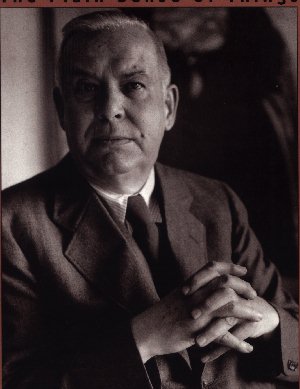
The Emperor of Ice-Cream

Call the roller of big cigars,
The muscular one, and bid him whip
In kitchen cups concupiscent curds.
Let the wenches dawdle in such dress
As they are used to wear, and let the boys
Bring flowers in last month’s newspapers.
Let be be finale of seem.
The only emperor is the emperor of ice-cream.

Take from the dresser of deal,
Lacking the three glass knobs, that sheet
On which she embroidered fantails once
And spread it so as to cover her face.
If her horny feet protrude, they come
To show how cold she is, and dumb.
Let the lamp affix its beam.
The only emperor is the emperor of ice-cream.

Tags:

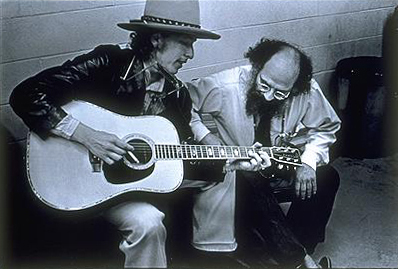
Bob Dylan and Allen Ginsberg get attuned in 1975. (Image by Elsa Dorfman.)

Great find by the Essayist, which uncovered an online version of “The Great Marijuana Hoax,” Allen Ginsberg’s 1966 Atlantic essay in defense of the illegal herb, which was then vilified to hysterical proportions. An excerpt:

“This essay, conceived by a mature middle-aged gentleman, the holder at present of a Guggenheim Fellowship for creative writing, a traveler on many continents with experience of customs and modes of different cultures, is dedicated to those who have not smoked marijuana, who don’t know exactly what it is but have been influenced by sloppy, or secondhand, or unscientific, or (as in the case of drug-control bureaucracies) definitely self-interested language used to describe the marijuana high pejoratively. I offer the pleasant suggestion that a negative approach to the whole issue (as presently obtains in what are aptly called square circles in the USA) is not necessarily the best, and that it is time to shift to a more positive attitude toward this specific experience. If one is not inclined to have the experience oneself, this is a free country and no one is obliged to have an experience merely because friends, family, or business acquaintances have had it and report themselves pleased. On the other hand, an equal respect and courtesy are required for the sensibilities of one’s familiars for whom the experience has not been closed off by the door of Choice.”

Tags:

« Older entries § Newer entries »