
Excerpts

You are currently browsing the archive for the Excerpts category.

Carl Zimmer writes in the New York Times of scientists using the city as laboratory, examing the evolutionary changes wrought by the necessities of urban life. An excerpt:

“To study evolution, Jason Munshi-South has tracked elephants in central Africa and proboscis monkeys in the wilds of Borneo. But for his most recent expedition, he took the A train.

Dr. Munshi-South and two graduate students, Paolo Cocco and Stephen Harris, climbed out of the 168th Street station lugging backpacks and a plastic crate full of scales, Ziploc bags, clipboards, rulers and tarps. They walked east to the entrance of Highbridge Park, where they met Ellen Pehek, a senior ecologist in the New York City Parks and Recreation Department. The four researchers entered the park, made their way past a basketball game and turned off the paved path into a ravine.

They worked their way down the steep slope, past schist boulders, bent pieces of rebar, oaks and maples, hunks of concrete and freakish poison ivy plants with leaves the size of a man’s hands. The ravine flattened out at the edge of Harlem River Drive. The scientists walked north along a guardrail contorted by years of car crashes before plunging back into the forest to reach their field site.

‘We get police called on us a lot,’ said Dr. Munshi-South, an assistant professor at Baruch College. ‘Sometimes with guns drawn.’

Dr. Munshi-South has joined the ranks of a small but growing number of field biologists who study urban evolution — not the rise and fall of skyscrapers and neighborhoods, but the biological changes that cities bring to the wildlife that inhabits them. For these scientists, the New York metropolitan region is one great laboratory.”


Tags: ,

Ivan Illich was a radical priest, who, during the ’60s and ’70s, was embraced by liberals and conservatives alike, each group able to read their ideology into his sharp critiques of institutional education. Illich didn’t always seem to know what he wanted by way of an alternative, but he knew what he didn’t like. Apart from rigidly structured education, Illich also had his doubts about technology, concerned that we would interpret the world around us first and foremost through tools. In that sense, he was certainly prescient. Largely forgotten by the time of his death in 2002, Illich was eulogized by longtime friend Jerry Brown, former and future California Governor, in the Whole Earth Catalog. An excerpt:

“In the Seventies, facing sharp criticism from the Vatican, Illich withdrew from the active priesthood and refrained from speaking ever again as a Catholic theologian. Instead, he focused on the nature of technology and modern institutions and their capacity for destroying common sense and the proper scale for human activity. Illich identified the ‘ethos of non-satiety’ as ‘at the root of physical depredation, social polarization, and psychological passivity.’ Instead of welfare economics and environmental management, Illich emphasized friendship and self-limitation.”

Tags: ,

I’m not a gamer, but Dwarf Fortress seems fascinating. The most complex and organic video game ever created, it’s the work of brothers Zach and Tarn Adams, who plan on continually and gradually improving it, like painters who expand on a single mural their whole lives. An excerpt from Jonah Weiner’s New York Times Magazine article about the game designers and their creation:

Dwarf Fortress may not look real, but once you’re hooked, it feels vast, enveloping, alive. To control your world, you toggle between multiple menus of text commands; seemingly simple acts like planting crops and forging weapons require involved choices about soil and season and smelting and ores. A micromanager’s dream, the game gleefully blurs the distinction between painstaking labor and creative thrill.

‘Playing Dwarf Fortress is like taking the controls of a plane right as it’s taking off,’ says Chris Dahlen, editor in chief of the gaming magazine Kill Screen. And, he added, ‘flying a jet is a lot more interesting than just riding in a jet.’

Dwarf Fortress is too willfully noncommercial to have any discernible influence on gaming at large, but it is widely admired by game designers. Programmers behind The Sims 3 reportedly played Dwarf Fortress when they were making their game, and several homages to Dwarf Fortress appear in the blockbuster fantasy game World of Warcraft. Richard Garfield, who created the hit card game Magic: The Gathering, once attended a Dwarf Fortress fan meet in Seattle to introduce himself to Tarn. ‘I told him there’s nothing out there quite like it,’ Garfield recalled. He suggested ways of broadening the game’s appeal, but ‘that stuff didn’t matter to Tarn. The charm of it is that he’s making exactly the game he wants to make.’

After nine years of development, Dwarf Fortress is, from the perspective of game play, perhaps the most complex video game ever made. And yet it is still only in ‘alpha’ — the most recent release is version 0.31. By version 1.0, Tarn says, the game will include military campaigns and magic, along with scores of other additions. He showed me a four-inch stack of index cards, color-coded and arranged into umbrella categories, to keep track of his goals. ‘I like being able to hold the game in my hands,’ he says.

I asked Tarn when he thought he and Zach would reach version 1.0. ‘Twenty years from now,’ he replied. ‘That’s the number we talk about.’ He chuckled at the prospect, adding that even when that milestone arrived, Dwarf Fortress would keep growing. ‘This is going to be my life’s work.'”

••••••••••

Let’s play Dwarf Fortress:

Tags: , ,

Marshall McLuhan was born on July 21, 1911, and to celebrate his century mark I present the following excerpt from Jane Howard’s 1966 Life magazine article, “Oracle of the Electric Age“:

No people in the history of humanity, McLuhan insists, ever faced demands as grueling as those that confront us. We are witnessing simultaneously the end of what he calls the Mechanical, or Gutenberg, Era, dominated by movable type and later mechanical forms, and the birth pangs of the new and entirely different Electric Age, which he sometimes calls the Age of Circuitry, or of Information. As his books The Gutenberg Galaxy and Understanding Media explain, the change is the most traumatic since the transition 9,000 years ago, from the paleolithic culture to the neolithic, from hunting to agriculture.

The change, says McLuhan, is making movable type obsolete and with it books, newspapers, magazines–in fact all kinds of printed matter, including the sentence you are now reading. We will also have to junk the by-products of the Gutenberg invention which, says, McLuhan, have created our culture’s visual, literary, detached, linear approach to life. This dooms a lot more linear by-products than you might think, including railways, clotheslines, stocking seams, the grid system in city planning and stag lines at dances. Even points of view must go–“because it’s no longer possible to take a fixed position for more than a single moment.” So must jobs, which are fragmentary in nature and do not suit the new age in which people crave roles with depth involvement.•

Tags: ,

On Boing Boing, neurobiologist David J. Linden pushes back on futurist Ray Kurzweil’s vision of nanobots being introduced into our brains in the near term, making it possible for us to communicate with external hardware and extend our memory and intellect almost infinitely. An excerpt:

“Don’t get me wrong. I do believe that the fundamental and long-standing mysteries of the brain will ultimately be solved. I don’t hold with those pessimists who claim that we can never understand our minds by using our brains. I also share Kurzweil’s belief that technological advancement will be central to unlocking the enduring mysteries of brain function. But while I see an exponential trajectory in the amount of neurobiological data collected to date, the ploddingly linear increase in our understanding of neural function means that an idea like mind-uploading to machines being usefully deployed by the 2020s or even the 2030s seems overly optimistic.” (Thanks Browser.)

Kurzweil’s take:

“Still not within the nervous system, you got 20 years, 25 years, these nanobots, these blood cell size devices will be going in our bodies keeping us healthy from inside. We’ll have some go inside our brains to the capillaries not invasively, there would be interacting with our biological neurons so it’ll extends our memory, our decision making faculties, put our brains on the internet and they also enable us to enter virtual reality environment from within the nervous system.

So, for on to go in the virtual reality environment, the nanobots will shut down the signals coming from I realize in my real skin and create the signals that will be appropriate for the virtual environment and that will feel like I’m in that environment and I’ll have a virtual body and those environment could be the same body I have in real reality, it could be a different body, a couple could become each other, experience relationship from the others perspective, teacher could design a student to become Ben Franklin in the virtual constitutional congress not just dress up as him but become that character and this virtual environments would be like websites, you’ll have millions to choose from and some will be recreations are beautiful earthly environments like the Taj Mahal or the Mediterranean Beach.”

Tags: ,

This amazing classic photograph, taken in 1906 by G.K. Gilbert, shows the Point Reyes Station in Marin County, in the wake of the San Francisco earthquake. (Click on the photo to see a much larger version.) Because of the girl in the skirt staring into the heavens and the presence of the dog, it gives off a Wizard of Oz vibe. An excerpt from a 2008 San Francisco Chronicle article about the death of Irma Mae Weule, likely the final survivor of the 1906 quake:

“Mrs. Weule had vivid memories of growing up in the horse-and-buggy era and clearly recalled the 1906 earthquake, which she experienced as a child. She was one of 11 earthquake survivors who attended a centennial commemoration in 2006 and was interviewed on national television.

She was living at the time of the earthquake with her parents in a portion of the Bayview district called Butchertown, an area so far out that the family kept a cow in the backyard.

Her father, Louis Nonnenmann, ran a wholesale meatpacking business. The family home was large enough to have a social hall in the basement, and Mrs. Weule remembered that her father took in whole families of earthquake refugees.”

Tags: ,

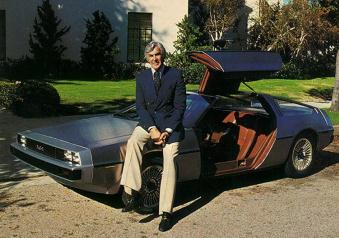
"John Zachary DeLorean certainly doesn't smile much. He can't. Not just yet, anyway."

In 1979, John Z. DeLorean was poised for greatness or disaster, having left behind the big automakers to create his own car from scratch, a gigantic gambit that required huge talent and hubris. Esquire writer William Flanagan profiled DeLorean that year, capturing the gambler in mid-deal, still bluffing, soon to be folding. The opening:

“For a man who looks like Tyrone Power, is married to the stunning young model in the Virginia Slims and Clairol ads, and earns six figures a year, John Zachary DeLorean certainly doesn’t smile much. He can’t. Not just yet, anyway. The reason is simple: The most important project in his life has yet to be accomplished. DeLorean wants to make a monkey out of General Motors. He is on the verge of doing it, but he has a way to go.

There will be no rest for DeLorean until he finishes doing what no one else in the history of modern business has dared attempt–to design, build, and sell his very own automobile from scratch, an automobile the world’s largest car company wouldn’t, couldn’t, and probably shouldn’t build.

By mid-1980, either DeLorean will be smiling at last or he’ll be a shattered man. At stake are thousands of jobs for unemployed Catholics in Belfast; the wisdom and reputation of the British government, which, amid howls of protest, has bet about $106 million on the flamboyant engineer; and about another $40 million posted by several hundred U.S. car dealers and other investors, ranging from Merrill Lynch stockbrokers to Johnny Carson.

But most important, John DeLorean’s pride is at stake. If his DMC-12 sports cars roll off the assembly line–and if they sell–he will have been avenged. He will have shown the bastards that they were wrong, goddammit, that General Motors was wrong about him and what you can do with an auto company. He will have shown that you can make a virtually rustproof car with a stainless steel skin and underbody, with air bags, with a reinforced plastic frame–a car that won’t kill you in a sixty-mile-an-hour, head-on crash, a car that can last twenty-five years or more. And he will have shown that you can sell that car, even at about $14,000 a copy. And if the platoons of pinstriped, cordovan-shod executives of GM doubt it, they can go and stick their noses up its tail pipe.”

••••••••••

John DeLorean speaks at the DeLorean Car Show in Cleveland  in 2000:

Another John DeLorean post:

Tags: ,

Professor Leonard Kleinrock, in 1969. (Image by UCLA.)

The first host-to-host message sent over the nascent Internet occurred in 1969 at UCLA, which has belatedly created a shrine to the place where it all started. An excerpt from a story on the topic by Southern California Public Radio:

“In a small computer lab in a forgotten building at UCLA, Professor Leonard Kleinrock and a group of graduate students sent the very first message over what would become the Internet, back in 1969. Since that milestone, the room was in continuous use as a classroom, and its significance to history was all but forgotten. But now the room has been transformed into a re-creation of the ARPA lab, complete with the original equipment from the ’60s and period furnishings to match.

The Interface Message Processor, or IMP as engineers fondly call it, stands in the same spot in 3420 Boelter Hall today as it did in 1969. It functioned much like a modem, sending messages from the host computer, an SDS Sigma 7, through the network to an IMP in a remote location, which relayed it to another host computer.

During the ’60s, UCLA was chosen as the first node of what was known as ARPANET, a precursor to the Internet funded by the Defense Department’s Advanced Research Project Agency (DARPA). UCLA set up the very first network connection between their IMP and the IMP at Stanford Research Institute in northern California.

On October 29, 1969, Kleinrock and his team undertook a simple task to test the network – sending a login request from their host computer to the host computer at SRI.”

••••••••••

Leonard Kleinrock recalls the birth of the Internet:

Tags:

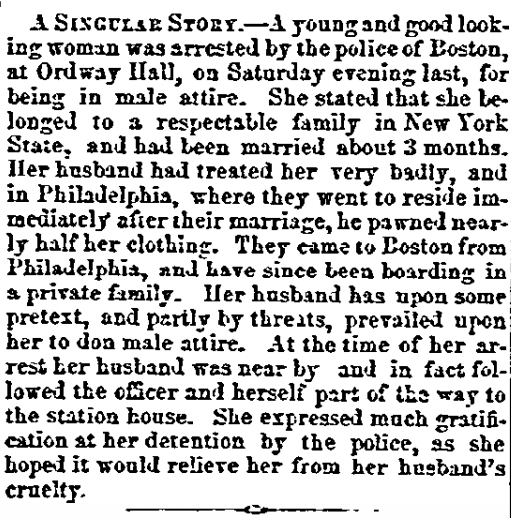
From the May 5, 1860 Wisconsin Daily Patriot:

From a 1969 Life piece about the interlocutor Oriana Fallaci, who recalls introducing a young Muhammad Ali to her aggressive interviewing style:

Question:

Has anyone actually threatened to break your nose off for something you wrote?

Oriana Fallaci:

Something like it happened with Cassius Clay. I had seen him a couple of times, and I went back to his house in Miami to finish the interview. He was eating a melon. I said, Good Morning, Mr. Clay. He keeps on eating the melon and suddenly belches very loud. I think he is just being impolite and I sit down with my tape recorder. And then oooaaagh. He belches again. A big one. Well, I said, let’s go on anyway. And just at that moment, buurp, buurp, whoops, whoops. I turned to him and shouted, I am not going to stay with an animal like you. And I was undoing my recorder, when he took the microphone and threw it against the wall. My microphone! I saw it flying past my head and I took my fists and bam, bam. Went against him. He stood there. So enormous. So tall. And he watched me in a way an elephant watches a mosquito. Black Muslims suddenly came out of all the doors into the room. Evil. Evil. They began to chant. You came for evil. It was like a nightmare. I backed out to my cab, trying to keep my dignity, but really afraid, and went straight to the airport. After the interview was published, Cassius Clay said he was going to break my nose if he ever saw me again. I said, we’ll see, if he breaks my nose, he is going to jail and we will have beautiful news in the papers. I saw him later in New York. I passed with my nose in the air, and he went by without looking at me.”

Tags: , ,

"Dalio appeared to compare Bridgewater to a pack of hyenas feeding on a young wildebeest."(Image by JerryFriedman.)

From John Cassidy’s New Yorker article about the odd inner workings of Bridgewater Associates, the world’s largest hedge fund, and its kingpin Ray Dalio:

“Dalio’s philosophy has created a workplace that some call creepy. Last year, Dealbreaker, a Wall Street Web site, picked up a copy of the Principles and made fun of a section in which Dalio appeared to compare Bridgewater to a pack of hyenas feeding on a young wildebeest. In March, AR, a magazine that covers hedge funds, quoted a former colleague of Dalio’s saying, ‘Bridgewater is a cult. It’s isolated, it has a charismatic leader and it has its own dogma.’ The authors of the article noted that Dalio’s ’emphasis on tearing down an individual’s ego hints at the so-called struggle groups of Maoism,’ while his search for “human perfection devoid of emotion resembles the fantasy world in Ayn Rand’s The Fountainhead.’

Dalio doesn’t pretend that Bridgewater is a typical workplace, but he is sensitive to criticism. The recent media attention irked him, because, in his view, it misrepresented and trivialized Bridgewater’s culture, which he insists is central to the firm’s success. ‘It is why we made money for our clients during the financial crisis when most others went over the cliff,’ he wrote to me in an e-mail. ‘Our greatest power is that we know that we don’t know and we are open to being wrong and learning.'”

Tags: ,

Dead Letter Office, most likely in Washington D.C., 1922.

Above is a classic 1922 photograph of a dead letter office, a way-station where misaddressed missives went to get back on the right track. An excerpt from an 1878 New York Times article in which the staff of a Manhattan dead letter office was profiled:

“The deparment is in charge of Mr. John H. Hallett, a white-haired, white-bearded, bright-eyed old gentleman, 65 and upward, but still as lively and business-like as a man of 30. He has seen just half a century of service in the Post Office, and he is a perfect encylopedia of New-York history. What he does not know about misdirected, badly written, mutilated, and unmailable letters, it would be useless for anybody to try to find out. Assisting Mr. Hallett in straightening the address of badly directed letters are two experienced clerks, whose intuition into things is little less than marvelous. They handled last month 11,800 imperfectly or wrongly directed letters, and sent to their destination all except 217. They have handled an average of 500 letters a day for the last two months, and the blunderers are increasing at a steady rate.”

Tags:

The opening of Tom Junod’s excellent 1994 GQ article, “The Abortionist,” a profile of Dr. John Bayard Britton, who was murdered several months after this piece was published:

“The abortionist makes house calls. The abortionist’s patient, Mr. Beazley, is dying, and the abortionist has made a habit of visiting his house after work, to steer him to his end. Mr. Beazley is an old man, dying in his bed. He is beyond speech, beyond seeing and hearing. His lips are blue, and his gray tongue hangs out of his mouth. His wife and daughters stroke his arm, his leg. A drip bag, suspended over his bed, feeds him. The abortionist adjusts the rate of the drip. There is nothing else he can do. He cannot save Mr. Beazley. He cannot do anything but deaden his pain and console his family, and for this the Beazleys love him. ‘Oh, Doc, I can’t tell you how much we brag on you,’ Mrs. Beazley says to him in her weary smoker’s voice, and every few minutes a little blonde girl in an orange skirt -Mr. Beazley’s granddaughter-hands him, with a curtsy, a fresh drawing of the sun. The abortionist puts the drawings in his pocket and bows. The abortionist has a weakness for children. Some years ago, he delivered babies. The abortionist is a family doctor, and he understands that what he is doing -drawing out Mr. Beazley’s death- is simply a gesture for the family’s sake: an exercise that enables the Beazleys to believe they have done all they can, and to get a head start on their grief. The abortionist would rather let Mr. Beazley go. He is not, as he says, ‘sentimental,’ and he is ready to withhold the medicines that allow Mr. Beazley his scant purchase on existence. As a physician, he has decided that Mr. Beazley is already gone, and it is this-his willingness to make decisions, to answer questions of life and death-that permits Dr. John Bayard Britton to believe that one day, should his enemies come to kill him, he will find the courage to kill them first.”

Another Tom Junod post:

Tags:

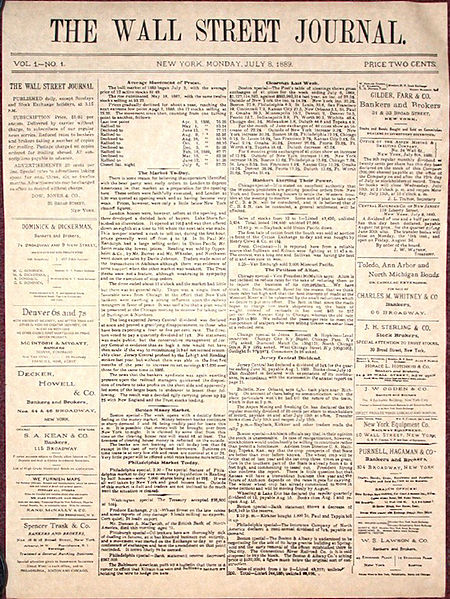
The Wall Street Journal, a newspaper with some amazing reporters, today runs a “defense” of its parent company that would make Fox & Friends hosts cringe. The one News Corp. paper that you’d hope would come out of this ever-growing scandal unscathed is now stained by it. The tone-deaf opening:

“When News Corp. and CEO Rupert Murdoch secured enough shares to buy Dow Jones & Co. four years ago, these columns welcomed our new owner and promised to stand by the same standards and principles we always had. That promise is worth repeating now that politicians and our competitors are using the phone-hacking years ago at a British corner of News Corp. to assail the Journal, and perhaps injure press freedom in general.

***

At least three British investigations into phone-hacking and payments to police and others by the now-shuttered News of the World tabloid are underway, with 10 arrests so far. News Corp. and its executives have apologized profusely and are cooperating with authorities. Phone-hacking is illegal, and it is up to British authorities to enforce their laws. If Scotland Yard failed to do so adequately when the hacking was first uncovered several years ago, then that is more troubling than the hacking itself.”

Also:

In a 1993 Wired interview conducted by Gary Wolf, Steve Jobs, who was then doing his walkabout at NeXT, spoke cautiously about the World Wide Web. He thought it would be great for commerce but maybe not landscape-altering in essential ways. He was right in that all the connectivity and information hasn’t stopped wars or thinned the ranks of ignorant politicians.

One interesting thing that Jobs said was that the Web wouldn’t have the same awesome immediate impact that radio and TV had, that it would creep up on people. I think that’s true. Because the Web is controlled to a good extent by users, its wow factor is revealed incrementally, as people continue to tinker with it and grow it out. Ultimately, it will have much greater consequence for change than earlier technologies that made a bigger initial splash but were hampered by central control. An excerpt from the Q&A:

“What’s the biggest surprise this technology will deliver?

Steve Jobs: The problem is I’m older now, I’m 40 years old, and this stuff doesn’t change the world. It really doesn’t.

That’s going to break people’s hearts.

Steve Jobs: I’m sorry, it’s true. Having children really changes your view on these things. We’re born, we live for a brief instant, and we die. It’s been happening for a long time. Technology is not changing it much – if at all.

These technologies can make life easier, can let us touch people we might not otherwise. You may have a child with a birth defect and be able to get in touch with other parents and support groups, get medical information, the latest experimental drugs. These things can profoundly influence life. I’m not downplaying that. But it’s a disservice to constantly put things in this radical new light – that it’s going to change everything. Things don’t have to change the world to be important.

The Web is going to be very important. Is it going to be a life-changing event for millions of people? No. I mean, maybe. But it’s not an assured Yes at this point. And it’ll probably creep up on people.

It’s certainly not going to be like the first time somebody saw a television. It’s certainly not going to be as profound as when someone in Nebraska first heard a radio broadcast. It’s not going to be that profound.

Then how will the Web impact our society?

Steve Jobs: We live in an information economy, but I don’t believe we live in an information society. People are thinking less than they used to. It’s primarily because of television. People are reading less and they’re certainly thinking less. So, I don’t see most people using the Web to get more information. We’re already in information overload. No matter how much information the Web can dish out, most people get far more information than they can assimilate anyway.”

••••••••••

The William Morris Agency gets NeXT computers in 1990:

Italian novelist Paolo Giordano went to Disneyland all by his lonesome and filed a report for the Wall Street Journal. An excerpt:

“I take no rides in Disneyland, not even one, but I go into the reassuring auditorium where they show the return of ‘Captain EO’ in amazing 3-D and the temperature change is severe. Mothers extract sweaters from their bags, but the children have no intention of wearing them. They are thinking how funny they look with those big 3-D glasses on their faces, even though 3-D is no innovation for them; it’s nothing special, like this place Disneyland is nothing special. It looks a little old and there’s much more future in the Nintendo DSs, iPods, PlayStation Portables they’re carrying in their pockets.

Only small children still marvel—the Asian girl sitting at my left side, for example, she’s terrified by the dark and the wild assault of people trying to get the best seats and by Captain EO himself who—I’m discovering now—is Michael Jackson, close to his original color and surrounded by a group of tiny farting monsters. He has a mission to accomplish that later results in him dancing amid androids and repeating ‘We are here to change the world,’ which more or less is what he’d said throughout his career. When the seats start bouncing to the beat of the bass drum, I think that one of the ways Michael Jackson changed the world was to build a place similar to this one, a colorful trap for children where he decided to live, and the reason why he did it appears to me at once to be clear, tender, dreadful and incomprehensible.”

••••••••••

A little Captain EO:

Other Disney-related posts:

Tags:

I don’t know why, but I would rather read newspapers and magazines online but still prefer to read old-fashioned, non-virtual books. Maybe it has to do with the length of time we spend with an article as opposed to a longer work. I think it’s something I’ll get over soon, though I probably won’t have a choice. But I’m all in favor of digitization of printed materials of value (and even of dubious value) and the democratization of scholarship that it allows. James Gleick speaks to this issue a new Op-Ed piece in the New York Times. An excerpt:

“Where some see enrichment, others see impoverishment. Tristram Hunt, an English historian and member of Parliament, complained in The Observer this month that ‘techno-enthusiasm’ threatens to cheapen scholarship. ‘When everything is downloadable, the mystery of history can be lost,’ he wrote. ‘It is only with MS in hand that the real meaning of the text becomes apparent: its rhythms and cadences, the relationship of image to word, the passion of the argument or cold logic of the case.’

I’m not buying this. I think it’s sentimentalism, and even fetishization. It’s related to the fancy that what one loves about books is the grain of paper and the scent of glue.

Some of the qualms about digital research reflect a feeling that anything obtained too easily loses its value. What we work for, we better appreciate. If an amateur can be beamed to the top of Mount Everest, will the view be as magnificent as for someone who has accomplished the climb? Maybe not, because magnificence is subjective. But it’s the same view.”

Another James Gleick post:


Tags:

I blogged recently about an excellent thumbnail description of Ben Katchor’s artistic heritage which ran on the Los Angeles Review of Books site, and that same site just published the first part of “The Ghost of Wrath,” a revisionist nine-part series about eminent (and hated) Angeleno Harrison Gray Otis that was written by Mike Davis. Otis is the original force behind the Los Angeles Times, and one of the chief “inventors” of modern L.A. The first few paragraphs:

“General Harrison Gray Otis is the wrathful gargoyle with a walrus moustache and Custer goatee who glowers down on us from the battlements of Los Angeles’s Open Shop era. The proprietor of Times-Mirror Company from 1882 to 1917, he was recently hailed in a PBS documentary as the ‘inventor’ of modern Los Angeles, both as an individual and via his descendants, the Chandler family.

Yet his eminence in the city’s history is cast almost entirely as shadow. Five or six serious books have been written about the Los Angeles Times and the Chandlers, but there is no published biography of the dynasty’s founder and leviathan. This is a major missing thread in the narrative tapestry of the current renaissance of Los Angeles history, but given the archival and literary obstacles in any potential biographer’s path, it is not surprising.

First, no one has yet excavated the pharaoh’s tomb. Rumors abound, especially in the tearoom of the Huntington Library, about family archives kept in a San Marino vault. But it is also possible that son-in-law and successor, Harry Chandler, destroyed many of Otis’s private papers when he ordered his own files burned after his heart attack in 1944. (Chandler might have been reacting to the literary and cinematic assaults on fellow-publisher and chief competitor, William Randolph Hearst.)

Second, any biographer has to tackle the fact that Otis was probably the most hated man in Ragtime America. His enemies ecumenically spanned a spectrum from evangelists to citrus growers, socialists to robber barons. Although chiefly remembered for his relentless crusade to destroy the labor movement in Los Angeles, Otis waxed most savage in his attacks on reformers within his own Republican Party. Progressive Republicans, in turn, repaid his vitriol with eloquent interest.”

Tags: ,

Debbie Bramwell: Holy fuck. (Image by Lukascb.)

In the future, Bill James’s 2009 statement about performance-enhancing drugs will likely be proven right:

“If we look into the future, then, we can reliably foresee a time in which everybody is going to be using steroids or their pharmaceutical descendants. We will learn to control the health risks of these drugs, or we will develop alternatives to them. Once that happens, people will start living to age 200 or 300 or 1,000, and doctors will begin routinely prescribing drugs to help you live to be 200 or 300 or 1,000. If you look into the future 40 or 50 years, I think it is quite likely that every citizen will routinely take anti-aging pills every day.”

Tags:

In her 2009 New Yorker article about neuroenhancers, Margaret Talbot explains the concept of “mission creep,” whereby a pharmaceutical created for one purpose is pushed into other more suspect treatment areas by drug companies looking to further monetize a product:

“The Lynches said that Provigil was a classic example of a related phenomenon: mission creep. In 1998, Cephalon, the pharmaceutical company that manufactures it, received government approval to market the drug, but only for ‘excessive daytime sleepiness’ due to narcolepsy; by 2004, Cephalon had obtained permission to expand the labelling, so that it included sleep apnea and ‘shift-work sleep disorder.’ Net sales of Provigil climbed from a hundred and ninety-six million dollars in 2002 to nine hundred and eighty-eight million in 2008.

Cephalon executives have repeatedly said that they do not condone off-label use of Provigil, but in 2002 the company was reprimanded by the F.D.A. for distributing marketing materials that presented the drug as a remedy for tiredness, ‘decreased activity,’ and other supposed ailments. And in 2008 Cephalon paid four hundred and twenty-five million dollars and pleaded guilty to a federal criminal charge relating to its promotion of off-label uses for Provigil and two other drugs. Later this year, Cephalon plans to introduce Nuvigil, a longer-lasting variant of Provigil. Candace Steele, a spokesperson, said, ‘We’re exploring its possibilities to treat excessive sleepiness associated with schizophrenia, bipolar depression, traumatic injury, and jet lag.’ Though she emphasized that Cephalon was not developing Nuvigil as a neuroenhancer, she noted, “As part of the preparation for some of these other diseases, we’re looking to see if there’s improvement in cognition.'”

Another post about Nuvigil:

Tags:

If we seem to be forgetting more, it’s only because there’s much more to remember. Unsurprisingly, our brains have begun to use the Internet as our key external memory system, not retaining information that we know we can look up. It’s inevitable since our memories have never been incredibly elastic and more information than ever is available. Memory augmentation of some sort is also probably inevitable. From a New York Times story about memory research:

“The scientists, led by  Betsy Sparrow, an assistant professor of psychology at Columbia, wondered whether  people were more likely to remember information that could be easily retrieved from a computer, just as students are more likely to recall facts they believe will be on a test.

Dr. Sparrow and her collaborators, Daniel M. Wegner of Harvard and Jenny Liu of the University of Wisconsin, Madison, staged four different memory experiments. In one, participants typed 40 bits of trivia — for example, ‘an ostrich’s eye is bigger than its brain’ — into a computer. Half of the subjects believed the information would be saved in the computer; the other half believed the items they typed would be erased.

The subjects were significantly more likely to remember information if they thought they would not be able to find it later. ‘Participants did not make the effort to remember when they thought they could later look up the trivia statement they had read,’ the authors write.”

"They viewed humans as essentially good, influenced by rational deliberation, and tending towards co-operation."

From Evgeny Morozov’s concise history of the Internet at Prospect: 

“But studying the history of the internet is impossible without studying the ideas, biases, and desires of its early cheerleaders, a group distinct from the engineers. This included Stewart Brand, Kevin Kelly, John Perry Barlow, and the crowd that coalesced around Wired magazine after its launch in 1993. They were male, California-based, and had fond memories of the tumultuous hedonism of the 1960s.

These men emphasised the importance of community and shared experiences; they viewed humans as essentially good, influenced by rational deliberation, and tending towards co-operation. Anti-Hobbesian at heart, they viewed the state and its institutions as an obstacle to be overcome—and what better way to transcend them than via cyberspace? Their values had profound effects on the mechanics of the internet, not all of them positive. The proliferation of spam and cybercrime is, in part, the consequence of their failure to predict what might happen as a result of the internet’s open infrastructure. The first spam message dates back to 1978; now, 85 per cent of all email traffic in the world is spam.

Perhaps the cheerleaders’ greatest achievement was in wresting dominance of the internet from the founding engineers, whose mentality was that of the Cold War. These researchers greatly depended on the largesse of the US department of defence and its nervous anticipation of a nuclear exchange with the Soviet Union. The idea of the ‘virtual community’—the antithesis of Cold War paranoia—was popularised by the writer and thinker Howard Rheingold. The term arose from his experiences with Well.com, an early precursor to Facebook.”

•••••••••

Evgeny Morozov argues that the Internet strenghtens dictatorial regimes, in his contrarian TED Talk:

Tags:

Always loved the deeply funny and deeply humanistic short story, “Sea Oak,” by George Saunders. Included in the Pastoralia collection, it uses the B-movie trope of the reanimation of the dead, as recently deceased Aunt Bernie rises from the grave to bring some order to her dysfunctional, at-risk family. Read the whole story here. An excerpt

“Where the grave used to be is just a hole. Inside the hole is the Amber Mist, with the top missing. Inside the Amber Mist is nothing. No Aunt Bernie.
      ‘What the hell,’ says Jade. ‘Where’s Bernie?’
      ‘Somebody stole Bernie?’ says Min.
      ‘At least you folks have retained your feet,’ says Father Brian. ‘I’m telling you I literally sat right down. I sat right down on that pile of dirt. I dropped as if shot. See that mark? That’s where I sat.’
      On the pile of grave dirt is a butt-shaped mark.
      The cops show up and one climbs down in the hole with a tape measure and a camera. After three or four flashes he climbs out and hands Ma a pair of blue pumps.
      ‘Her little shoes,’ says Ma. ‘Oh my God.’
      ‘Are those them?’ says Jade.
      ‘Those are them,’ says Min.
      ‘I am freaking out,’ says Jade.
      ‘I am totally freaking out,’ says Min.
      ‘I’m gonna sit,’ says Ma, and drops into the golf cart.
      ‘What I don’t get is who’d want her?’ says Min.
      ‘She was just this lady,’ says Jade.
      ‘Typically it’s teens?’ one cop says. ‘Typically we find the loved one nearby? Once we found the loved one nearby with, you know, a cigarette between its lips, wearing a sombrero? These kids today got a lot more nerve than we ever did. I never would’ve dreamed of digging up a dead corpse when I was a teen. You might tip over a stone, sure, you might spray-paint something on a crypt, you might, you know, give a wino a hotfoot.’
      ‘But this, jeez,’ says Freddie. ‘This is a entirely different ballgame.’
      ‘Boy howdy,’ says the cop, and we all look down at the shoes in Ma’s hands.'”

••••••••••

Another George Saunders post:

Tags:

How incredibly disingenuous of key Wall Street Journal stockholders to state publicly that they never would have sold the vaunted publication to Rupert Murdoch and News Corp. if they had known the company was involved in telephone hacking. Bullshit. While they didn’t know the company was hacking phones, they absolutely knew that it was built on sleazy, dishonest practices, intent on misinforming the public and promoting a warped political agenda. That should have been enough. They simply did at the time what they felt was in the best interests of their stockholders, themselves, and, I suppose, the paper. But feigning disgust over News Corp. business practices now is nonsense.

From the Lede blog at the New York Times:

“‘If I had known what I know now, I would have pushed harder against’ the Murdoch bid, said Christopher Bancroft, a member of the family which controlled Dow Jones & Company, publishers of The Wall Street Journal. Bancroft said the breadth of allegations now on the public record ‘would have been more problematic for me. I probably would have held out.’ Bancroft had sole voting control of a trust that represented 13 percent of Dow Jones shares in 2007 and served on the Dow Jones Board.”

Tags:

A 1981 interview with famed street photographer Garry Winogrand.

Winogrand’s shooting style, as recalled by a former student: “We quickly learned Winogrand’s technique–he walked slowly or stood in the middle of pedestrian traffic as people went by. He shot prolifically. I watched him walk a short block and shoot an entire roll without breaking stride. As he reloaded, I asked him if he felt bad about missing pictures when he reloaded. ‘No,’ he replied, ‘there are no pictures when I reload.’ He was constantly looking around, and often would see a situation on the other side of a busy intersection. Ignoring traffic, he would run across the street to get the picture.

Incredibly, people didn’t react when he photographed them. It surprised me because Winogrand made no effort to hide the fact that he was standing in way, taking their pictures. Very few really noticed; no one seemed annoyed. Winogrand was caught up with the energy of his subjects, and was constantly smiling or nodding at people as he shot. It was as if his camera was secondary and his main purpose was to communicate and make quick but personal contact with people as they walked by.”

Tags:

« Older entries § Newer entries »