Excerpts

You are currently browsing the archive for the Excerpts category.

In a Spiegel interview, Swedish crime writer Henning Mankell discusses Norwegian mass murderer Anders Breivik and the nature of evil. To counter Mankell somewhat, I do think that some people may have a greater proclivity to violence based on biological makeup, and there may be neurogical reasons that arise which can trigger violent impulse. But, yes, these probably are exceptions, and extreme environments can certainly lead to extreme behaviors. An excerpt from the interview:

SPIEGEL: Does our consternation over the mystery of evil also stem from the fact that Breivik, as the police put it, literally came out of nowhere?

Mankell: We want to recognize the characteristics of evil early on, and we search for marks of Cain and stigmata, the warning signs of the horrific before it occurs. But that kind of thinking is based on magic.

SPIEGEL: But it isn’t just a question of the banality of evil, but also of our fascination with evil.

Mankell: You address an important aspect. What I fear most of all is that a new discussion will emerge about the concept of innate evil. That was the way people thought 500 years ago. No one is born evil. People become evil through external circumstances, which provoke evil behavior.

SPIEGEL: But everyone has the inherent capability to be evil?

Mankell: In the Balkan wars, following the breakup of Yugoslavia, neighbors who had lived together in peace until then suddenly began attacking one another. I saw child soldiers in Africa, 14 and 15-year-old boys, who slaughtered their parents after someone had held a gun to their heads. I’m not sure what I would have done, as a child, in their situation. The explanation for evil lies in its circumstances and conditions, not in its diabolical nature. That is what Hannah Arendt taught us.”

••••••••••

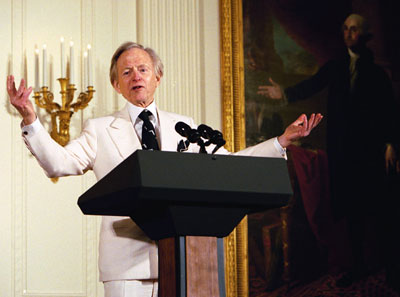
Mankell at the Strand Book Store in Manhattan in 2010:

Tags:

KFC in Lagos, Nigeria. (Image by Qasamaan.)

From “Megacity,” an excellent 2006 New Yorker article by George Packer which deflated the recent romantic reconsideration of large-scale slums by Western intellectuals:

“When I first went to Lagos, in 1983, it already had a fearsome reputation among Westerners and Africans alike. Many potential visitors were kept away simply by the prospect of getting through the airport, with its official shakedowns and swarming touts. Once you made it into the city, a gantlet of armed robbers, con men, corrupt policemen, and homicidal bus drivers awaited you.

Recently, Lagos has begun to acquire a new image. In the early years of the twenty-first century, the Third World’s megacities have become the focus of intense scholarly interest, in books such as Mike Davis’s Planet of Slums, Suketu Mehta’s Maximum City, and Robert Neuwirth’s Shadow Cities. Neuwirth, having lived for two years in slum neighborhoods of Rio de Janeiro, Nairobi, and other cities, came to see the world’s urban squatters as pioneers and patriots, creating solid communities without official approval from the state or the market. ‘Today, the world’s squatters are demonstrating a new way forward in the fight to create a more equitable globe,’ he wrote. What squatters need most of all, he argued, is the right to stay where they are: ‘Without any laws to support them, they are making their improper, illegal communities grow and prosper.’

Stewart Brand, the founder of the Whole Earth Catalog and a business strategist based in Marin County, California, goes even further. ‘Squatter cities are vibrant,’ he writes in a recent article on megacities. ‘Each narrow street is one long bustling market.’ He sees in the explosive growth of ‘aspirational shantytowns’ a cure for Third World poverty and an extraordinary profit-making opportunity. ‘How does all this relate to businesspeople in the developed world?’ Brand asks. ‘One-fourth of humanity trying new things in new cities is a lot of potential customers, collaborators, and competitors.’

In the dirty gray light of Lagos, however, Neuwirth’s portrait of heroic builders of the cities of tomorrow seems a bit romantic, and Brand’s vision of a global city of interconnected entrepreneurs seems perverse. The vibrancy of the squatters in Lagos is the furious activity of people who live in a globalized economy and have no safety net and virtually no hope of moving upward.” (Thanks TETW.)

Tags:

Leon Theremin playing his namesake instrument.

From a 1967 New York Times interview with Theremin: “He ushered the visitor into a room in which a small dance floor had been constructed. Mr. Theremin stood on the floor, raised his arms, made motions, and started to play the Massenet Elegy on nothing at all.

The room was filled with sound, and it was positively spooky. No wires, no gadgets, nothing visible. Merely electromagnetic sorcery,

‘I made my last public appearance in 1938,’ Mr. Theremin said. ‘I sometimes think it would be nice to come back once more to United States and show my latest instruments.'”

Tags: ,

One of the best opening sentences I have read in a while comes from Avi Steinberg’s excellent new Paris Review piece about a ventriloquist convention in Kentucky. Here’s that opening line plus the rest of the first two paragraphs:

“I’m waiting for the elevator in a medieval-themed hotel in Fort Mitchell, Kentucky, when the elevator doors open to reveal a heated exchange between a bald man in a Hawaiian shirt and a puppet shaped like a toucan. My presence brings an uncomfortable end to their private imbroglio. Both stare at me silently as I enter the elevator, and for five awkward floors I’m brought into direct contact with what George Bernard Shaw described as the “unvarying intensity of facial expression” of puppets, an attribute he believed makes them more compelling actors than humans.

I’m at the Vent Haven ConVENTion where, each July, hundreds of ventriloquists, or “vents,” as they call themselves, gather from all over the world. For four days, they attend lectures on the business, getting advice on AV equipment, scriptwriting, or creating an audience through social networking. They listen to a keynote address by Comedy Central’s ventriloquist-in-residence, Jeff Dunham, who exhorts his notoriously defensive colleagues to ‘quit complaining that people say we’re weird. We talk to dolls. We are weird, ok. Just own it.’ They eat at a Denny’s off the highway and visit the creationist museum down the road. And they don’t go anywhere without the accompaniment of their alter egos.”

•••••••••

Magic trailer, 1978:


Dumbstruck,
a documentary about Vents:

Tags: ,

From the Escapist comes a report about Brewster Kahle’s Herculean effort to collect every book every published, in original dead-tree form:

“Kahle, a computer scientist with a degree from MIT, is most famous as the creator of the Internet Archive, a non-profit group formed in 1996 with a goal of preserving every web page ever created.

In that same archival spirit, Kahle has recently set his sights on preserving the existing written history of mankind, and he’s off to a pretty solid start.

To date, Kahle’s warehouse in Richmond, California houses 500,000 books. That’s a drop in the bucket compared to the 130 million tomes collected by Google in its efforts to digitize the entirety of our literature, but Kahle is heartened by the speed at which his group has been able to accrue their half-million books.

The existence of Google’s aforementioned project also causes one to question Kahle’s motivations. After all, if we’ve got the text available online, why keep their archaic dead tree iterations?

‘There is always going to be a role for books,’ Kahle says. ‘We want to see books live forever.'”

•••••••••

Kahle discusses his work in digital archiving at TED:

Tags:

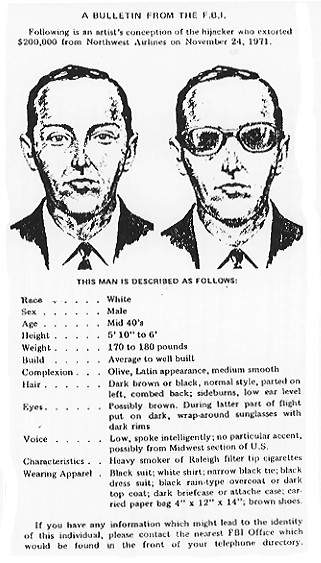
Four decades after his brazen crime and complete disappearance made the inscrutable man known as D.B. Cooper into an American folk hero, the FBI has credible evidence as to his identity. The opening of a well-written new article by Katharine Q. Seelye and Charlie Savage in the New York Times:

“He smoked Raleigh cigarettes, wore a black clip-on tie and drank whiskey, and when zero hour came, he was one cool cat.

From Seat 18C on a Northwest Orient flight from Portland, Ore., to Seattle, he passed a note to the stewardess — this was 1971, pre-‘flight attendant’ era. She slipped it in her pocket, unread.

‘Miss, you’d better look at that note,’ the passenger calmly advised. ‘I have a bomb.’ He opened his briefcase and showed her what could have been a bomb, nestled in a mass of wires.

With that, the man known as D. B. Cooper hijacked the plane, later parachuting out of it and into the unknown. His body was never found. Mr. Cooper became a folk hero, and the case remains the only unsolved hijacking in American history.

Now, 40 years later, comes what seems like a tantalizing new tip. The Federal Bureau of Investigation says it has a new suspect, one whose name has never surfaced in the ocean of tips that has washed in over four decades.”

••••••••••

Treat Williams as D.B. Cooper:

Tags: , ,

From Steven Levy’s new book about Google, In the Plex, comes this conversation between company co-founders Larry Page and Sergey Brin:

“It will be included in people’s brains,” said Page. “When you think about something and don’t really know much about it, you will automatically get information.”

“That’s true,” said Brin. ‘Ultimately I view Google as a way to augment your brain with the knowledge of the world. Right now you go into your computer and type a phrase, but you can imagine that it could be easier in the future, that you can have just devices you talk into, or you can have computers that pay attention to what’s going on around them.”

Page said, “Eventually you’ll have the implant, where if you think about a fact, it will just tell you the answer.” (Thanks NYRB.)•

Tags: , ,

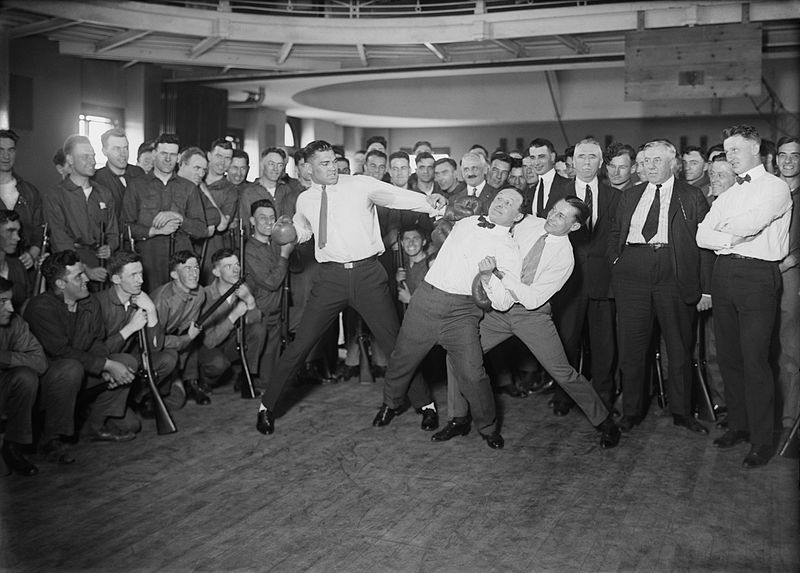
This classic undated picture captures Jack Dempsey and Harry Houdini engaged in a mock fight for a photo op. Even though its tangential to this photo, I’ve been eager for awhile to share an insane 1930 New York Times obituary of a colorful character nicknamed “John the Barber,” who was Dempsey’s first manager. An excerpt from “Jack Dempsey’s First Manager Succumbs To Infection Of His Finger”:

“‘John the Barber,’ in private life John J. Reisler, known on Broadway for many years as a barber, fight manager and friend of the street’s great and near-great, died yesterday morning in Lebanon Hospital, the Bronx, of an infection caused by an ingrown hair on his finger. He had been in the hospital for three weeks and was surrounded by his family, including his wife, Mrs. Minnie Reisler, with whom he had been reconciled recently after a long separation. He was 53 years old.

Also at the bedside was Morris Reisler, his son, whose sentence of twenty years to life in 1923 was commuted by Governor Roosevelt last March. Morris had been sent to Sing Sing for killing his aunt, Miss Bertha Katz, whose death climaxed a family feud in which Mrs. Reisler had accused Miss Katz, her younger sister, of stealing Reisler’s affections. When Morris was released his father, whom he had seen in 1927 when he was permitted to visit the elder Reisler, who lay ill in a Bronx hospital, met him at the prison gate and escorted him back to New York.

As a prizefight manager Reisler was one of Jack Dempsey’s first managers. That was in 1915 and 1916. Although the two parted and later Reisler sued Dempsey for breach of contract, he always was proud of having known and handled Demspey in the days before he was champion.

Born in Austria, he came to New York as a young boy. He became a barber, and in that capacity shaved some of the best-known chins on Broadway. He ran several athletic clubs at various times and knew many celebrities. One of his latest fighters was Vincent Serici. Recently he had handled his three boxing sons, Johnny, Georgie and Sid.

Reisler first came into prominence, however, in 1912, when Herman Rosenthal, the gambler, was murdered early on the morning of July 16 in front of the Hotel Metropole, in Forty-third Street, east of Broadway. Reisler was one of the first on the scene, and it reached the ears of District Attorney Charles S. Whitman that he had seen something. He was subpoenaed, and told Mr. Whitman that has had seen ‘Bridgey’ Webber, one of those accused of the murder, running from the scene.

Put on the stand at Coroner Feinberg’s hearing, Reisler, who had known for years Rosenthal, Webber and others involved in the affair, recanted his story. He was fearful that gunmen in the crowd would ‘put him on the spot.’ Mr. Whitman had him arrested  for perjury and after a night in a cell he decided to tell his original story. Webber, who turned informer, was freed later, as was Reisler, after his testimony. Police Lieutenant Charles A. Becker and four gunmen, ‘Gyp the Blood’ Horowitz, ‘Lefty Louie’ Rosenberg, ‘Whitey’ Lewis and ‘Dago Frank’ Cirofici, went to the electric chair for the crime.”

••••••••••

Young Dempsey demolishes a washed-up Jess Willard in 1919:

Related post:

Tags: , ,

Ray Bradbury voices his frustrations about space travel and politics  in his 1996 Playboy interview:

Playboy: When you talk about the future, you tend to talk about space travel. Do you really think it’s in our future?

Ray Bradbury: It must be. First of all, it’s a religious endeavor to be immortal. If the earth dies, we must be able to continue. Space travel will give us other planets to live on so we can continue to have children. It’s that simple, that great and that exciting.

Playboy: Will we really be forced to escape earth? Will we be able to in time?

Ray Bradbury: We are already on our way. We should back on the moon right now. And we should be going off to Mars immediately.

Playboy: Yet there doesn’t seem to be a rush into space anymore. NASA’s budget is being whittled away as we speak.

Ray Bradbury: How come we’re looking at our shoes instead of at the great nebula in Orion? Where did we mislay the moon and back off from Mars? The problem is, of course, our politicians, men who have no romance in their hearts or dreams in their heads. JFK, for a brief moment in his last year, challenged us to go to the moon. But even he wasn’t motivated by astronomical love. He cried, “Watch my dust!” to the Russians, and we were off. But once we reached the moon, the romance started to fade. Without that, dreams don’t last. That’s no surprise – material rewards do last, so the history of exploration on earth is about harvesting rich lodes. If NASA’s budgeters could be convinced that there are riches on Mars, we would explode overnight to stand on the rim of the Martian abyss. We need space for reasons we have not as yet discovered, and I don’t mean Tupperware.

Playboy: Tupperware?

Ray Bradbury: NASA feels it has to justify everything it does in practical terms.
And Tupperware was one of the many practical products that came out of space travel. NASA feels it has got to flimflam you to get you to spend money on space. That’s b.s. We don’t need that. Space travel is life-enhancing, and anything that’s life-enhancing is worth doing. It makes you want to live forever.”

Tags:

Kurzweil reports on a new spying device from China:

“A new aquatic microrobot that mimics the water-walking abilities of the water strider has been developed by researchers at the Harbin Institute of Technology in China.

The robot is about the size of a quarter, with ten water-repellent, wire legs and two movable, oar-like legs propelled by two miniature motors. Because the weight of the microrobot is equal to that of about 390 water striders, one might expect that it would sink quickly when placed on the water surface. But it stands effortlessly on water surfaces and also walks and turns freely.

It imitates water striders, mosquitoes, and water spiders, who are able to walk on water due largely to their highly water-repellent (superhydrophobic) legs.”

Tags:

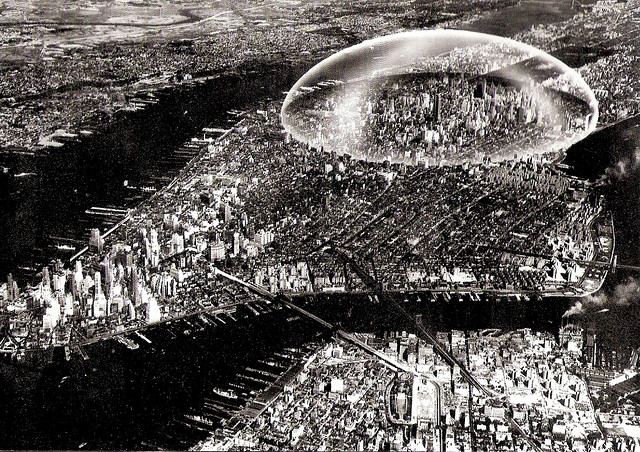
From a new New York Times article about smart cities comes this recollection about Buckminster Fuller, that dreamer, who somehow thought it would be good idea to build a geodesic dome over a large swath of Manhattan:

“At a time before urban planning was formally taught in universities, Mr. Fuller — a Harvard dropout turned inventor, engineer, architect and philosopher — directed his attention to cities.

He perfected and popularized the geodesic dome, and after building several smaller ones in the 1950s, he teamed up with the architect Shoji Sadao in 1960 to propose a dome with a width of two miles, or 3.2 kilometers, above Midtown Manhattan. The dome would have covered the island from the East River to the Hudson River, with one axis running along 42nd Street. It would have reached from 21st Street to 64th Street, covering the southern lip of Central Park.

During a time when air-conditioning was coming to many U.S. homes and businesses, Mr. Fuller said the giant dome would greatly reduce cooling costs in summer and heating costs in winter by reducing the ratio of surface to volume. Instead of each building’s having to be heated or cooled separately, the entire dome would be kept at a ‘very moderate temperature level’ throughout the year.

The glass would be threaded by a heating wire — much like the rear window of many cars — so that snow and ice accumulation would not become a problem. Melted snow and rain would be collected in catch basins and used for things like irrigation and cleaning.

The scalable dome, according to Mr. Fuller, became stronger and sturdier as it was built larger.”

••••••••••

Six minutes of non-stop, unabashed Bucky Fuller:

Tags:

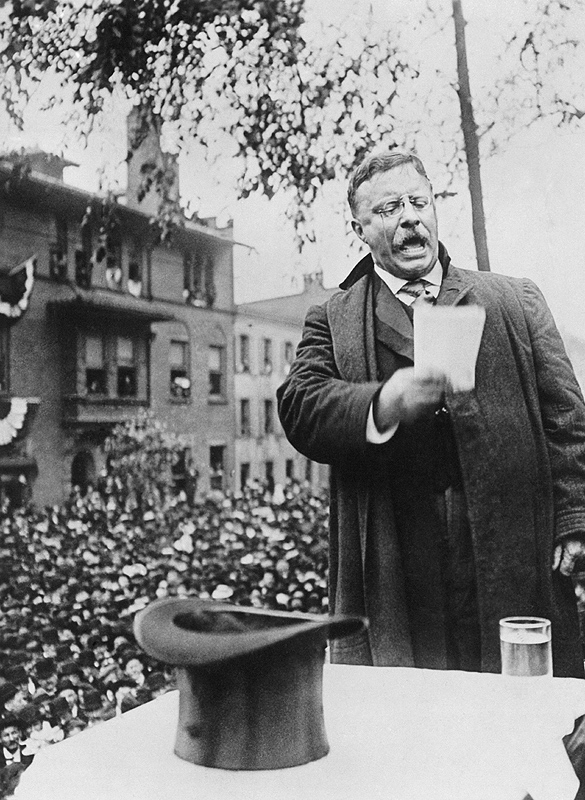
Theodore Roosevelt stumps for votes, 1912.

This classic 1912 picture of Theodore Roosevelt on the stump originally appeared in the New York Times, though the photographer is unknown. Roosevelt was trying to regain the White House, as he split from the Republicans and formed the Bull-Moose Party. His efforts, of course, failed.

With the upturned hat on the table, Roosevelt gives the impression of a magician. Some critics, however, wanted the politician and his domineering personality to disappear. Mark Twain was one such detractor, and he wrote the following text in 1908 when Roosevelt was exiting the White House:

“Astronomers assure us that the attraction of gravitation on the surface of the sun is twenty-eight times as powerful as is the force at the earth’s surface, and that the object which weights 217 pounds elsewhere would weight 6,000 pounds there.

For seven years this country has lain smothering under a burden like that, the incubus representing, in the person of President Roosevelt, the difference between 217 pounds and 6,000. Thanks be we got rid of this disastrous burden day before yesterday, at last. Forever? Probably not. Probably for only a brief breathing spell, wherein, under Mr. Taft, we may hope to get back some of our health – four years. We may expect to have Mr. Roosevelt sitting on us again, with his twenty-eight times the weight of any other Presidential burden that a hostile Providence could impose upon us for our sins.

Our people have adored this showy charlatan as perhaps no impostor of his brood has been adored since the Golden Calf, so it is to be expected that the Nation will want him back again after he is done hunting other wild animals heroically in Africa, with the safeguard and advertising equipment of a park of artillery and a brass band.”

••••••••••

Silent clip of Roosevelt with some fellow Rough Riders:

Tags: ,

As noted on Ray Kurzweil’s site, a small but fiunctional aircraft was created for the first time using a 3-D printer:

“Engineers at the University of Southampton have designed and flown the world’s first ‘printed’ aircraft, which could revolutionize the economics of aircraft design, the engineers say.

The SULSA (Southampton University Laser Sintered Aircraft) plane is an unmanned air vehicle (UAV), with its entire structure printed. This includes wings, integral control surfaces, and access hatches. It was printed on an EOS EOSINT P730 nylon laser sintering machine, which fabricates plastic or metal objects, building up the item layer-by-layer.

It took only 48 hours to print. No fasteners were used and all equipment was attached using ‘snap fit’techniques so the entire airframe could be put together without tools in about 30 seconds, according to Prof. Andy Keane. The aircraft took around 8 person weeks. It passed tests for speed, maneuverability, and climb rates.”

••••••••••

Getting airborne:

Tags:

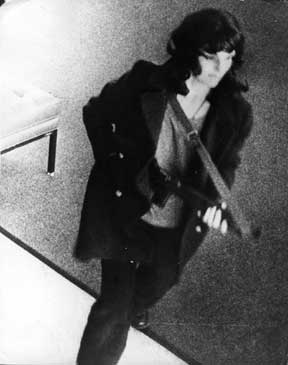
"Hunter insisted on meeting an imprisoned Hearst, the granddaughter of newspaper publisher William Randolph Hearst."

On Grantland, Jonathan Abrams profiles current NBA players’ union executive director Billy Hunter, who enjoyed a fascinating legal career even before being at loggerheads with league commisioner David Stern:

“President Jimmy Carter appointed Hunter as the U.S. Attorney for Northern California in 1977. He was one of the youngest lawyers to ever hold the position and became entangled in several historic moments. He brought the first major federal cases against the Hells Angels and Black Panther Party.

Hunter also prosecuted the surviving members who aided Jim Jones’ cult after the mass suicide of more than 900 people in Jonestown, Guyana, in 1978. Hunter visited Jonestown following the assassination of U.S. Rep. Leo Ryan.

‘We got there just on the eve of the Guyanese Army evacuating all the bodies,’ Hunter said. ‘The bodies had blown up because of the heat and all the bodies up there. It’s hot as hell there.’

Hunter also recommended Patty Hearst’s sentence be commuted and visited Hearst while she was imprisoned. At first, Hunter perceived that his bosses simply wanted him to sign off on the decision. Hunter insisted on meeting an imprisoned Hearst, the granddaughter of newspaper publisher William Randolph Hearst, who was first kidnapped by the Symbionese Liberation Army and later sympathized with the militant group.

They talked about life, and Hunter noted the irony of how he, a poor kid from New Jersey, was holding the key to the freedom of one of the country’s most wealthy heiresses. At the end of the three-hour conversation, Hearst plainly asked Hunter of his intentions. ‘I told her that I would recommend getting her out of here.'”

••••••••••

The SLA has a gunfight with the LAPD the year before Hearst’s arrest:

Tags: ,

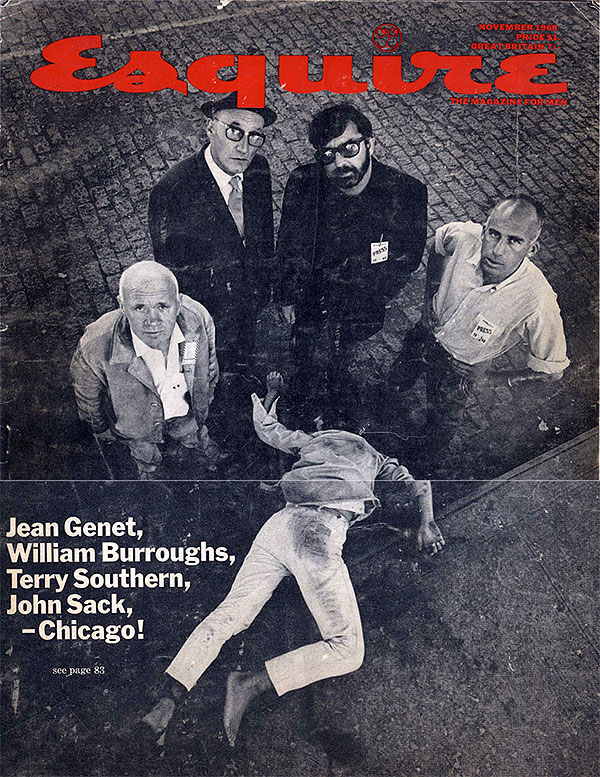
Cover of November 1968 "Esquire": "Jean Genet, William Burroughs, Terry Southern, John Sack--Chicago."

Late literary journalism legend John Sack filed a report for Esquire in 2001 about a California convention of Holocaust deniers, which he was invited to despite being Jewish and having a far firmer grasp on history than his hosts. An excerpt from “Daniel in the Deniers Den“:

“I’m sure many antisemites say the Holocaust didn’t happen (even as they take delight that it really did) but I met none that weekend. The only debatably antisemitic comment that I heard was on Friday night, when I dined in the downstairs restaurant with a prominent denier in a NO HOLES? NO HOLOCAUST! shirt, an Alabama man whose name is Dr. Robert Countess. A gangling scholar of Classical Greek and Classical Hebrew, he had taught history at the University of Alabama and had retired to a farm outside of Huntsville, where he played major-league ping-pong and he collected old Peugeots—he had twenty-two, some dating back to the Crash. While scarcely cranky, he had a cranky-sounding voice, and in the open-aired restaurant he was practically grinding gears as he discoursed on the Septuagint and as I, not Countess, brought up the Jewish sacred scrolls the Talmud. ‘What’s called the Talmud,’ Countess lectured, ‘Talmud being the participle form of lamad, in Hebrew learn, developed in Babylonia as rabbis reflected on certain passages in the Torah. Some of these rabbis engaged in a syncretism, a bringing together, of Babylonian paganism with the religion of Abraham, Isaac and Jacob. So if you read much of the Talmud, and Elda will tell you her favorite story—’

‘No,’ said Elda, Countess’s wife, who was dining with us.

‘It’s unbelievable, but it’s in the Talmud,’ said Countess.

‘No no. I don’t want to tell it,’ said Elda, embarrassed.

‘Go ahead and tell it,’ Countess entreated.

‘Well,’ said Elda, blushing, ‘iit’s in the Talmud that if a Jewish man’s repairing the roof, and if his sister-in-law is down below, and if he falls onto her and she becomes pregnant—’

‘He falls off the roof in such a way—’ Countess laughed.

‘Can you picture it? Then the child won’t be a bastard,’ said Elda. The tale would be antisemitic rubbish if it weren’t indeed in the Talmud (in Yebamoth, and again in Baba Kama) and if the Countesses were just amused and not also appalled. ‘You and I laugh about this,’ said Countess, ‘but I sit in stark amazement saying, Jews aren’t stupid people! How can they go along with this?’

‘The answer is, We don’t,’ I explained. By bedtime on Friday, my impression of the Countesses was like my impression of UFO devotees. Everyone in America believes in one or another ridiculous thing. Me, I belong to the International Society for Cryptozoology and I firmly believe that in Lake Tele, in the heart of the Congo, there is a living, breathing dinosaur. Fifteen years ago, I even went there to photograph it—I didn’t, I didn’t even see it, but I still believe in it. Other people believe other things, and the Countesses and the other deniers believe that the Holocaust didn’t happen. Like me in the Congo, they’re wrong, wrong, wrong, but to say that emphatically isn’t to say (as some people do) that they’re odious, contemptible, despicable. To say that they’re rats (as does the author of Denying the Holocaust) is no more correct than to say it of people who, in their ignorance, believe the less pernicious fallacy that Oswald didn’t kill Kennedy. Oh, did I hit a sore spot there?'”

Tags: ,

In a new article in Wired, Clive Thompson interviews Microsoft’s principal researcher, Bill Buxton, about the “long nose” theory, which holds forth that innovations that seemingly come out of nowhere are actually incubated for a long time. At the piece’s conclusion, Thompson predicts which technology is ready to dominate in the next decade. An excerpt:

“Using a ‘long nose’ analysis, I have a prediction of my own. I bet electric vehicles are going to become huge—specifically, electric bicycles. Battery technology has been improving for decades, and the planet is urbanizing rapidly. The nose is already poking out: Electric bikes are incredibly popular in China and becoming common in the US among takeout/delivery people, who haul them inside their shops each night to plug them in. (Pennies per charge, and no complicated rewiring of the grid necessary.) I predict a design firm will introduce the iPhone of electric bikes and whoa: It’ll seem revolutionary!”

••••••••••

Prodeco Technologies introduces the next generation of electric bikes:

Tags: ,

The Prime Minister of Norway refuses to overreact to shocking politicized violence. From the New York Times: 

“‘It’s absolutely possible to have an open, democratic, inclusive society, and at the same time have security measures and not be naive,’ Prime Minister Jens Stoltenberg told reporters in Oslo. ‘I think what we have seen is that there is going to be one Norway before and one Norway after July 22,’ he said. ‘But I hope and also believe that the Norway we will see after will be more open, a more tolerant society than what we had before.’

David Foster Wallace, completely unburdened by political office, took things a step further in response to 9/11. From the Atlantic in 2007:

“Are some things still worth dying for? Is the American idea one such thing? Are you up for a thought experiment? What if we chose to regard the 2,973 innocents killed in the atrocities of 9/11 not as victims but as democratic martyrs, ‘sacrifices on the altar of freedom’? In other words, what if we decided that a certain baseline vulnerability to terrorism is part of the price of the American idea? And, thus, that ours is a generation of Americans called to make great sacrifices in order to preserve our democratic way of life—sacrifices not just of our soldiers and money but of our personal safety and comfort?

In still other words, what if we chose to accept the fact that every few years, despite all reasonable precautions, some hundreds or thousands of us may die in the sort of ghastly terrorist attack that a democratic republic cannot 100-percent protect itself from without subverting the very principles that make it worth protecting?

Is this thought experiment monstrous? Would it be monstrous to refer to the 40,000-plus domestic highway deaths we accept each year because the mobility and autonomy of the car are evidently worth that high price? Is monstrousness why no serious public figure now will speak of the delusory trade-off of liberty for safety that Ben Franklin warned about more than 200 years ago? What exactly has changed between Franklin’s time and ours? Why now can we not have a serious national conversation about sacrifice, the inevitability of sacrifice—either of (a) some portion of safety or (b) some portion of the rights and protections that make the American idea so incalculably precious?”

Tags: ,

"He is also loaded with facile junk, as all personal journalists have to be."

In 1965, when he was still known as Kurt Vonnegut Jr., the sci-fi novelist wrote, “Infarcted! Tabescent!” for the New York Times, a review of Tom Wolfe’s The Kandy-Colored Tangerine Flake Streamline Baby. An excerpt:

“Wolfe comes on like a barbarian (as Mark Twain did), like a sixth Beatle (Murray the K being the fifth), but he is entitled to call himself ‘Doctor Wolfe,’ if he wants to. He has a Ph.D. in American studies from Yale, and he knows everything. I do not mean he thinks he knows everything. He knows all the stuff that Arthur Schlesinger Jr., knows, keeps picking up brand new, ultra-contemporary stuff that nobody else knows, and arrives at zonky conclusions couched in scholarly terms. I wish he had headed the Warren Commission. We might then have caught a glimpse of our nation.

He is also loaded with facile junk, as all personal journalists have to be–otherwise, how can they write so amusingly and fast? His language is admired, but a Wolfe chrestomathy would drive one nuts with repetitions, with glissandi and tin drummings that don’t help much. The words ‘tabescent’ and ‘infarcted’ appear again and again, and, upon investigation, turn out to be not especially useful or piquant. Young breasts (‘Mary Poppins’)–point upward again and again like antiaircraft batteries, and women’s eyes are very often like decals, and transistors are very often plugged into skulls; and feet very often wear winkle-picker shoes.

Then again, America is like that. And maybe the only sort of person who can tell us the truth about it any more is a Ph.D. who barks and struts himself like Murray the K, the most offensive of all disk jockeys, while feeding us information. Advanced persons in religion have been trying this approach for some time. Who can complain if journalists follow?”

••••••••••

Vonnegut profiled in the 1970s:

More Tom Wolfe posts:


Tags: ,

Even before his steep fall from grace, John Edwards always seemed a mealymouthed charlatan who had all the slickness of Bill Clinton without any of the prodigious political talent. But even the best and brightest can sometimes look at a situation and completely misread it. I was looking up some articles by Barbara Ehrenreich and was reminded of this:

“For my money, John Edwards is the best candidate out there. Clinton has Iraqi and American blood on her hands; Obama has yet to lay out clear economic alternatives; and, although they might once have been Republican moderates, McCain and Giuliani are shamelessly snuggling up to the Christianist Right. I like Edwards because he’s taken up the banner of the little guy and gal in America’s grossly one-sided class war. He’s laid out a plan for universal health insurance; he wants to repeal Bush’s tax cuts for the rich; he shows up at workers’ picket lines.” 

Barbara Ehrenreich

Not Modesto, but possessing a stunning likeness. (Image by Hans Hillewaert.)

Ciudad Juarez in Mexico has been a hyperviolent hotbed of crime and murder for so long that locals have been forced to remain inside as much as possible, which, of course, makes those who do venture out even more unsafe. Could an increasing number of people visiting a park to see a giraffe be a sign that things are changing? From Damien Cave’s well-written article about the significance of Modesto the Giraffe in the New York Times:

” Oblivious to crime, nearly 20 feet tall and tough enough to withstand wild temperature swings, Modesto the giraffe has become more than just another oddity in this bizarre borderopolis of malls and murders. He has become a magnet for people trying to escape fear and the cooped-up life caused by violence.

‘We need places that are peaceful,’ said Eduardo Ponce, 44, an elementary school teacher whose 2-year-old son was entranced by Modesto on a recent afternoon. ‘I try to think positive.’

That seems to be a little more common these days. Several parks here in Ciudad Juárez have been attracting crowds again, residents say, because of a desire that often emerges after several years of war or widespread crime — a desire to get out, to stop hunkering down, to believe that things are better, or will be.

It is far from clear that this hope is yet realized. Murders in Ciudad Juárez appear to be down compared with last year, but the past few weeks have been especially bloody, with 21 people killed in a single day this month. No one here seems to think the struggle against the city’s rampant drug violence is over. Many are just tired of letting it rule their lives.”

••••••••••

Modesto la jirafa:

Tags: , ,

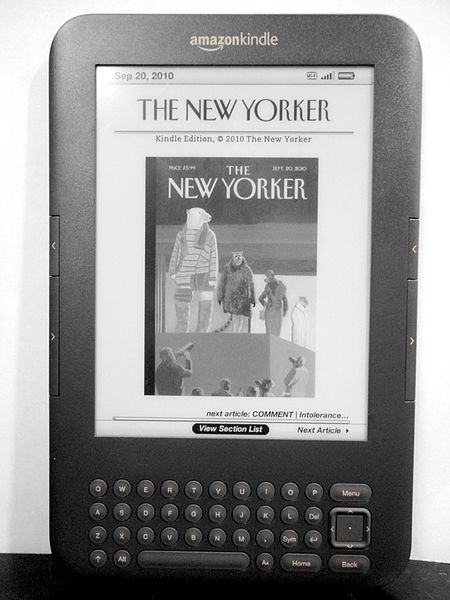
On Singularity Hub, David Hill argues that Borders going bust is good for writers and the book business. It may seem counterintuitive, but it’s really not. An excerpt:

“So with the loss of one of the key spots for authors to promote their work and for book publishers to make sales, how in the world is the end of Borders good for writers? The main reason is that it is accelerating massive change in the publishing industry by putting authors, and not publishers, in control of creative works.

For years, books have been entirely controlled by big print publishers. They’ve decided which authors get published and what readers get to read as well as when they get to read it. Furthermore, what gets published has had to fit into specific compartments that have been defined by marketing departments. The timeliness of print has also been a problem as it’s no secret that the traditional publishing route takes years from the manuscript to stock.

But e-books change all of that as authors can now dictate just about every aspect of production and marketing on top of generating the manuscript. Publishers have been slow to recognize that the power has shifted away from them to the writers themselves.”

••••••••••

Where will Kat Von D go to sign copies of her tattoo books now?

Tags:

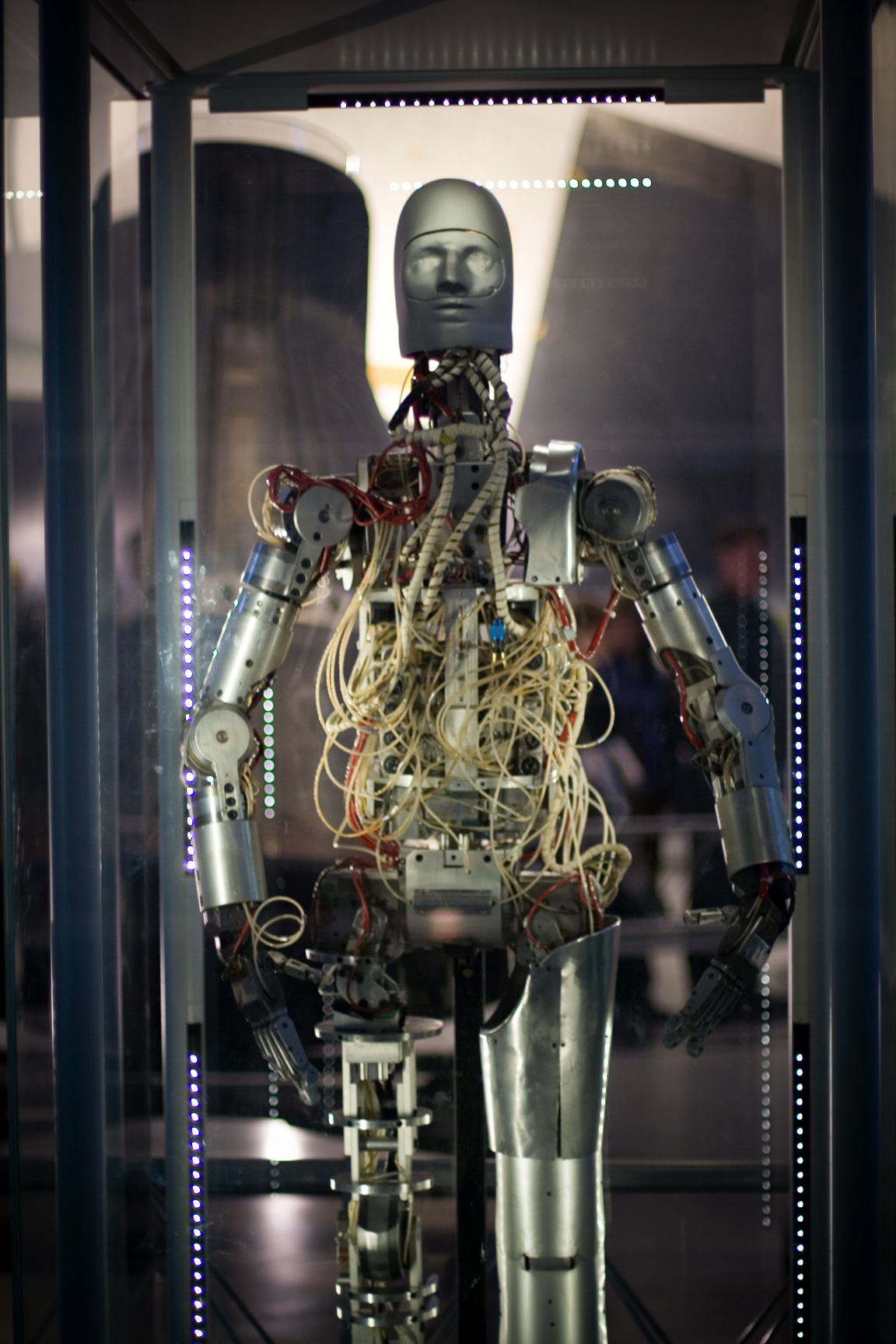
In Philip K. Dick’s too-bleak 1972 essay,The Android and the Human,” there is, unsurprisingly, some truth:

“I would like then to ask this: what is it, in our behavior, that we can call specifically human? That is special to us as a living species? And what is it that, at least up to now, we can consign as merely machine behavior, or, by extension, insect behavior, or reflex behavior? And I would include, in this, the kind of pseudo-human behavior exhibited by what were once living men — creatures who have, in ways I wish to discuss next, become instruments, means, rather than ends, and hence to me analogs of machines in the bad sense, in the sense that although biological life continues, metabolism goes on, the soul — for lack of a better term — is no longer there or at least no longer active. And such does exist in our world — it always did, but the production of such inauthentic human activity has become a science of government and such-like agencies, now. The reduction of humans to mere use — men made into machines, serving a purpose which although ‘good’ in an abstract sense has, for its accomplishment, employed what I regard as the greatest evil imaginable: the placing on what was a free man who laughed and cried and made mistakes and wandered off into foolishness and play a restriction that limits him, despite what he may imagine or think, to the fulfilling of an aim outside of his own personal — however puny — destiny. As if, so to speak, history has made him into its instrument. History, and men skilled in — and trained in — the use of manipulative techniques, equipped with devices, ideologically oriented, themselves, in such as way that the use of these devices strikes them as a necessary or at least desirable method of bringing about some ultimately desired goal.

I think, at this point, of Tom Paine’s comment about or another party of the Europe of his time: ‘They admired the feathers and forgot the dying bird.’ And it is the ‘dying bird’ that I am concerned with. The dying — and yet, I think, beginning once again to revive in the hearts of the new generation of kids coming into maturity — the dying bird of authentic humanness.”

Tags:

It’s always curious to me that negotiators, whether politicians or the opposing sides of sports leagues, so often delay working on an agreement in earnest until they place themselves under severe time constraints, which would seem to be the worst time for those in disagreement to reach a compromise. The reliably lucid James Surowiecki explains why negotiations go bonkers under time pressure, in his article on the debt-ceiling debacle in the New Yorker. 

“You might think that there are benefits to putting negotiators under the gun. But, as the Dutch psychologist Carsten de Dreu has shown, time pressure tends to close minds, not open them. Under time pressure, negotiators tend to rely more on stereotypes and cognitive shortcuts. They don’t consider as wide a range of alternatives, and are more likely to jump to conclusions based on scanty evidence. Time pressure also reduces the chances that an agreement will be what psychologists call ‘integrative’—taking everyone’s interests and values into account.

In fact, by turning dealmaking into a game of chicken, the debt ceiling favors fanaticism. As the economist Thomas Schelling showed many years ago, ‘It does not always help to be, or to be believed to be, fully rational, coolheaded, and in control of oneself’ when it comes to brinksmanship.”

••••••••••

A dramatic interpretation of the American economy, with Slim Pickens in the role of John Boehner:

Tags: ,

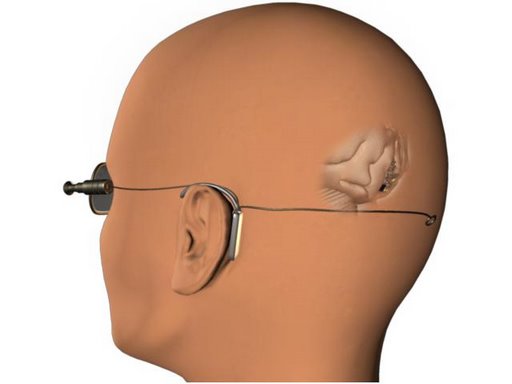
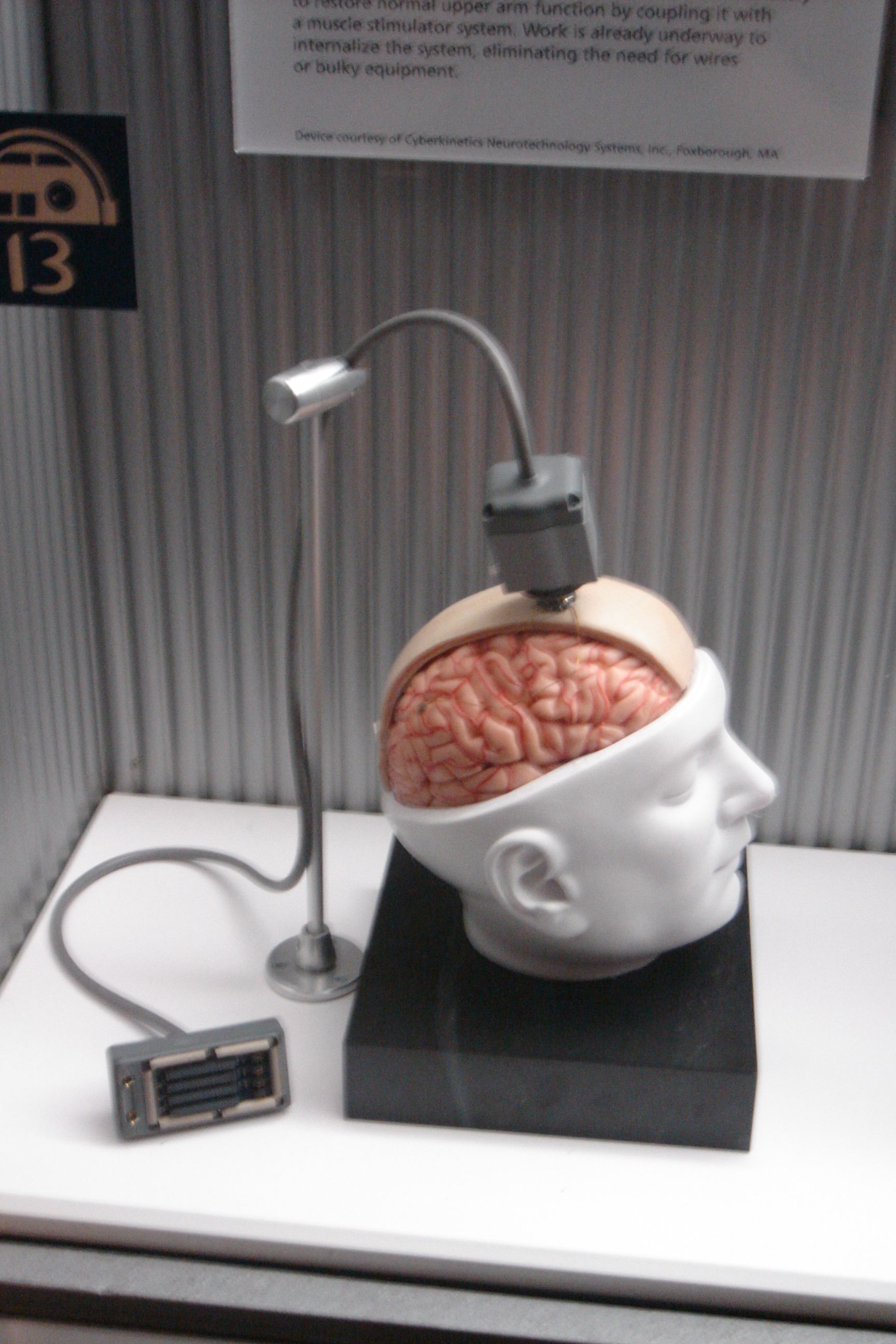
"Synthetic telepathy, as the technology is called, is getting closer to battlefield reality." (Image by PaulWicks.)

Discover has an article by Adam Piore about the U.S. military’s plans to develop a thought-helmet which would allow soldiers to wordlessly communicate with one another in the battlefield through synthetic telepathy. An excerpt:

“The mind reader is Gerwin Schalk, a 39-year-old biomedical scientist and a leading expert on brain-computer interfaces at the New York State Department of Health’s Wads worth Center at Albany Medical College. The 
Austrian-born Schalk, along with a handful of other researchers, is part of a $6.3 million U.S. Army project to establish the basic science required to build a thought helmet—a device that can detect and transmit the unspoken speech of soldiers, allowing them to communicate with one another silently.

As improbable as it sounds, synthetic telepathy, as the technology is called, is getting closer to battlefield reality. Within a decade Special Forces could creep into the caves of Tora Bora to snatch Al Qaeda operatives, communicating and coordinating without hand signals or whispered words. Or a platoon of infantrymen could telepathically call in a helicopter to whisk away their wounded in the midst of a deafening firefight, where intelligible speech would be impossible above the din of explosions.”

••••••••••

More about the brain-computer interface from the good people at IntendiX:

Tags: ,

Solar cells. (Image by Georg Slickers.)

In10 Technologies That Will Change The World In The Next 10 Years,” an article by Julie Bort on CIO, one number jumped out at me. Is it really possible that a city with one million inhabitants will be built somewhere in the world every month over the next two decades? Seems high, but I could be wrong. In any event, we should be expanding our use of solar power as fast as possible. An excerpt:

No. 6: The power of power

The human population also continues to grow, and [Cisco’s Chief Futurist Dave] Evans estimates that a city with 1 million inhabitants will be built every month over the next two decades. More efficient methods to power those cities are becoming a necessity, particularly solar energy.

‘Solar alone can meet our energy needs. In fact, to address today’s global demand for energy, 25 solar super sites — each consisting of 36 square miles — could be erected. Compare this to the 170,000 square kilometers of forest area destroyed each year,’ says Evans. Such a solar farm could be completed in just three years.

Technologies to make this more economically pragmatic are on their way. In June, Oregon State University researchers showed off a novel, relatively affordable, low-impact method to ‘print’ solar cells using an inkjet printer.”

Related post:

Tags: ,

« Older entries § Newer entries »