2013

You are currently browsing the yearly archive for 2013.

So-called anticipatory systems bring Big Data to a micro-level, providing you with near-term knowledge you couldn’t find on your own in exchange for you handing over all your personal info so that companies can better target you for ads and who knows what else. It’s convenience at a cost. From Antonio Regalado at MIT’s Technology Review:

“Would you trade your personal data for a peek into the future? Andreas Weigend did.

The former chief scientist of Amazon.com, now directing Stanford University’s Social Data Lab, told me a story about awakening at dawn to catch a flight from Shanghai. That’s when an app he’d begun using, Google Now, told him his flight was delayed.

The software scours a person’s Gmail and calendar, as well as databases like maps and flight schedules. It had spotted the glitch in his travel plans and sent the warning that he shouldn’t rush. When Weigend finally boarded, everyone else on the plane had been waiting for hours for a spare part to arrive.

For Weigend, a fast-talking consultant and lecturer on consumer behavior, such episodes demonstrate ‘the power of a society based on 10 times as much data.’ If the last century was marked by the ability to observe the interactions of physical matter—think of technologies like x-ray and radar—this century, he says, is going to be defined by the ability to observe people through the data they share.”

Tags:

The emotional cost of robocar accidents will probably be high, much in the same way that airplane crashes, seldom though they occur, cause panic and terror while run-of-the-mill lethal car accidents are accepted as normal. That’s because airplanes (and driverless cars, eventually) are beyond our control. Such accidents don’t happen because of us, but to us. It’s something we have to constantly arrange and rearrange in our minds.

But beyond the emotional questions, who (or what) will actually be legally liable when automatic autos collide? From Brad Templeton’s answer to that question:

“People often ask who would get sued in a robocar accident. They wonder if it will be the occupant/passenger/driver, or the car company, or perhaps the software developer or some component maker. They are concerned that this is the major ‘blocking’ issue to resolve before cars can operate on the road.

The real answer, at least in the USA and many other countries, is that in the early years, everybody will get sued. There will be no shortage of lawyers out to make a reputation on an early case here, and several defendants in every case. It’s also quite probable that it will be the occupant of a robocar suing the makers of the car, with no 3rd party involved.

One thing that’s very likely to be new about a robocar accident is that the car will have made detailed sensor recordings of the event. That means a 360 degree 3-D view of everything, as well as some video. That means the ability to play back the accident from any viewpoint, and to even look inside the software and see what it was doing. Robocar developers all want these logs, at least during the long development and improvement cycle. Eventually owners of robocars should be able to turn off logging, but that will take some time, and the first accidents will be exquisitely logged.

This means that there will be little difficulty figuring out which parties in the accident violated the vehicle code and/or were responsible in the traditional sense for the accident. Right away, we’ll know who was where they should not have been, and as such, unlike regular accidents, there will be no argument on these points.

If it turns out that the robocar was in the wrong, it is likely that the combination of parties associated with the car, in association with their insurers, will immediately offer a very reasonable settlement. If they are doing their job and reducing accidents, and meeting their projections for how much they are reducing them, the cost of such settlements will have been factored into the insured risk projections, and payment for this reduced number of accidents will be done as it always is by insurers, or possibly a self-insured equivalent.

That’s why the question of ‘who is liable?’ is much less important than people imagine.”

Tags:

Chestnut trees, with artificially adjusted genes, are now being planted in America, where they’ve been besieged by fungus for decades. From the Economist:

“ONCE upon a time, according to folklore, a squirrel could travel through America’s chestnut forests from Maine to Florida without ever touching the ground. The chestnut population of North America was reckoned then to have been about 4 billion trees. No longer. Axes and chainsaws must take a share of the blame. But the principal culprit is Cryphonectria parasitica, the fungus that causes chestnut blight. In the late 19th century, some infected saplings from Asia brought C. parasitica to North America. By 1950 the chestnut was little more than a memory in most parts of the continent.

American chestnuts may, however, be about to rise again—thanks to genetic engineering. This month three experimental patches will be planted, under the watchful eye of the Department of Agriculture, in Georgia, New York and Virginia. Along with their normal complements of genes, these trees have been fitted with a handful of others that researchers hope will protect them from the fungus.”

According to Jonathan Alter’s forthcoming book on the 2012 Presidential election, Steve Jobs, who loathed Fox News, personally ordered all Apple advertising from the truth-challenged cable station. From Paul McNamara at Network World:

As relates to his previously documented loathing of Fox News, it’s now known that the late Steve Jobs backed up his harsh words by wisely withholding Apple’s advertising dollars, according to an upcoming book about the 2012 presidential campaign.

The book’s author, Jonathan Alter, a Bloomberg political columnist and contributor to MSNBC, tells of Jobs ‘personally ordering that Apple ads be removed from Fox News,’ according to a blog post in the New York Times over the weekend. Alter’s book, The Center Holds: Obama and His Enemies, is scheduled to hit stores June 4.

That the Apple co-founder held Fox News in low regard has been publicly known since the publication of Walter Isaacson’s authorized biography in October 2011. Here’s the key passage recounting a conversation Jobs had with Rupert Murdoch, chairman and CEO of News Corp., which owns Fox News:

‘You’re blowing it with Fox News,’ Jobs told him over dinner. ‘The axis today is not liberal and conservative, the axis is constructive-destructive, and you’ve cast your lot with the destructive people. Fox has become an incredibly destructive force in our society. You can be better, and this is going to be your legacy if you’re not careful.’ Jobs said he thought Murdoch did not really like how far Fox had gone too far.”

Tags: , , ,

Marshall McLuhan thought traditional education was dead as soon as the Industrial Age began changing into a Digital one, thanks to TV’s potential to bring answers more directly to students of all ages. While his contemporary Ivan Illich thought we should shutter the schools, McLuhan favored a modernized Socratic method rather than repetition and memorization. Television turned out to be largely a false god, but the Internet is the real deal, both holy and unholy–abundant and interactive and interconnected and always quietly taking as much as it gives. What will become of the classrooms?

Tags: ,

From the September 3, 1903 New York Times:

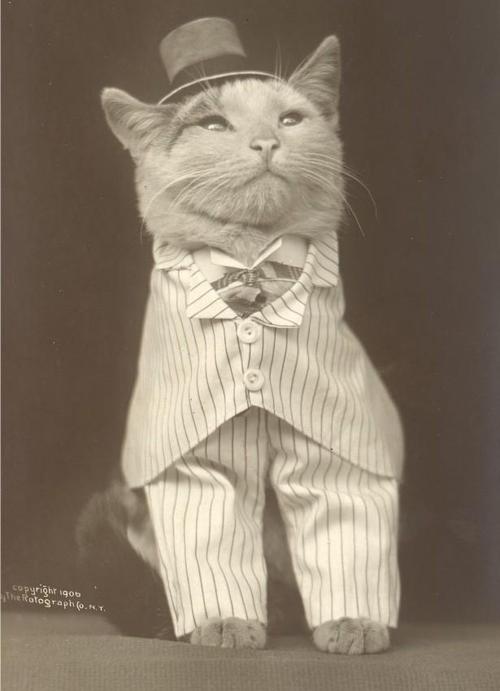
London–A little pink Persian kitten sat for its photograph to-day in the studio of a well-known animal photographer wearing a gold crown on its head and a gold order around its neck. The pink Persian came from the Windsor Castle and now belongs to Mrs. Anita Comfort Brooks, President of the Gotham Club of New York, who is on a visit to London. This crowned kitten enjoys a perfumed bath every morning and one of its favorite pastimes is to paw the keys of a grand piano.

‘I was the first cat lover to think of giving a cat diamond earrings,’ said Mrs. Brooks to-day. ‘Bangles and necklaces had become so very hackneyed, and I wanted my cat to be unlike any one else’s, so I had the ears pierced and bought my cat a pair of fine diamond earrings.’

Mrs. Brooks always names her cat’s after celebrities. President Roosevelt was the one who rejoiced in jeweled ears. Governor Hughes, another pet, wears pink corsets, pink shoes, and pink stockings, and Admiral was a fine figure in a navy blue coat, striped trousers, and an Admiral’s hat.”

Tags:

"Never eat her cooking. She is unsanitary and you will be crapping liquid for days."

“She is unsanitary and you will be crapping liquid for days.”

My Grandma… (Westchester)

I would like to barter my Grandma. Currently I am living with her. She is independent and does not need to be taken care of. Just be prepared for her ignorant rants about how everyone is stupid and things used to be so much better. You will hear about how she is glad her husband is dead and probably some racist stuff also. She will be nice to you and everyone else’s face but will badmouth everyone behind their back in the six hours she spends on the phone a day. She will do gross stuff like use your kitchen sponge to wash everywhere and put it back in the sink. Also never eat her cooking. She is unsanitary and you will be crapping liquid for days. She does stuff like dipping raw chicken in bread crumbs and then putting the remainder back in the box to be used again. Grandma is a pack-rat who blows through money recklessly and then complains she is poor but uses the excuse that the bible says the world will end soon. And speaking of the bible if you ever cross her she will say you have the demons in you. She believes that she was diagnosed with MS in her thirties and overcame it. (First case I ever heard of) Dont try and argue with her. She is always right. If you have any type of headache ever she will insist you are a drunk even though you never drink.

Doesn’t sound too great huh. Maybe we can barter for some yard work exchange for the next sixty years and you could maybe just push her down the stairs. Be creative…will entertain all offers.

I prefer not to, said Bartleby, the Scrivener, a dead-letter-office employee burdened by apathy, perhaps possessing the most horrible truth. But Bartleby wouldn’t have the option of refusal today. He’s been replaced by a machine that never says ‘no,’ not so far at least. The opening of an article by Ron Nixon of the New York Times about the death of the dead letter office:

SALT LAKE CITY — Inside a plain warehouselike office building filled with rows of cubicles, Melissa Stark stares at the image of an envelope on a computer screen. The handwriting is barely legible and appears to be addressed to someone in the ‘cty of Jesey.’

‘Is that a 7 or a 9 in the address?’ Ms. Stark said to no one in particular. Then she typed in a few numbers and a list of possible addresses popped up on her screen. ‘Looks like a 9,’ she said before selecting an address, apparently in Jersey City. The letter disappears and another one appears on the screen.

‘That means I got it right,’ Ms. Stark said.

Ms. Stark is one of the Postal Service’s data conversion operators, a techie title for someone who deciphers unreadable addresses, and she is one of the last of a breed. In September, the post office will close one of its two remaining centers where workers try to read the scribble on envelopes and address labels that machines cannot. At one time, there were 55 plants around the country where addresses rejected by machines were guessed at by workers aided with special software to get the mail where it was intended.

But improved scanning technology now allows machines to ‘read’ virtually all of the 160 billion pieces of mail that moved through the system last year. As machines have improved, workers have been let go, and after September, the facility here will be the post office’s only center for reading illegible mail.”

Tags: ,

Alec Ash of the Los Angeles Review of Books has an interview with science-fiction author Fei Dao of China, arguably the most sci-fi place on Earth right now, a nation careering wildly into its future, though oddly mostly utilizing pieces of the Western industrial past to get there. So far, at least. An excerpt:

Question: 

What is unique or particular about Chinese science fiction?

Fei Dao:

Chinese sci fi has about a hundred years of history. When it started, in the late Qing dynasty around 1902, it was chiefly concerned with the problem of bringing ancient China into modernity. At that time, Liang Qichao [translated sci fi] because he thought it would be beneficial for China’s future … as something that could popularize scientific knowledge. And Lu Xun thought that if you gave ordinary people scientific literature to read, they would fall asleep. But if you blended scientific knowledge into stories with a plot, it would be more interesting. [He thought that] in this way, the people could become more modern.

So at that time science fiction was a very serious thing to do in China that could allow ordinary people to get closer to modern scientific knowledge, and serve as a tool for transforming traditional culture into modern culture. It played a very important role, and had a serious mission to accomplish.

Today, there is a commercial publishing market for sci fi, and people don’t have such weighty expectations of literature, yet authors are still discussing serious topics. Three Body by Liu Cixin or Subway (地铁) by Han Song both have many reflections about the direction of this country and of humanity. So this kind of writing can convey concerns about the future, or discuss the current situation in China.

For example, Han Song’s Subway is about a subway station. In China, subway systems are an emblem of modernization. Many cities in China are building huge subway systems, because to have one or not is the standard of a city’s modernity and development. So in discussing this symbol, Han Song seized on a sensitive point. After publishing Subway, he wrote another book called Highspeed Rail (高铁), another emblem of technological innovation. So Han Song is consistently concerned with the potential catastrophes of the process of modernization.

Liu Cixin, on the other hand, is expressing a more grand feeling of the universe in the tradition of Western sci fi. In doing so, he wants Chinese people to look up at the sky, and not just be concerned with earthly matters. The mainstream of Chinese literature is about real-world subject matter, such as the countryside or urban life. Very few people are concerned with the fate of humankind, the future of the universe, or even aliens. These things are themselves alien to Chinese readers, but can be introduced through this kind of writing.

I think that the key theme of Chinese science fiction, no matter how it develops, is how this ancient country and its people are moving in the direction of the future.”

Gerrymandering has allowed an out-of-favor political party to control Congress, to stem the flow of economic revival for all but a few in an extremely top-heavy American economic recovery. From Gillian Tett is the Financial Times:

“A few weeks ago, when I was chatting with the head of one of America’s largest food and drink companies, he made a revealing comment about data flows. Like most consumer groups, this particular company is currently spending a lot of money to monitor its customers with big data.

But it is not simply watching what they do or do not buy. These days it is increasingly scrutinizing the micro-level details of pay and benefit cycles in every district in America. The reason? Before 2007, this executive said, consumer spending on food and drink was fairly stable during the month in most US cities. But since 2007, spending patterns have become extremely volatile. More and more consumers appear to be living hand-to-mouth, buying goods only when their pay checks, food stamps or benefit money arrive. And this change has not simply occurred in the poorest areas: even middle-class districts are prone to these swings. Hence the need to study local pay and benefit cycles.

‘We see a pronounced difference between how people are shopping today and before the recession,’ the executive explained. ‘Consumers are living pay check by pay check, and they tend to spend accordingly. Then you have 50 million people on food stamps and that has cycles too. So for our business it has become critical to understand the cycle – when pay [and benefit] checks are arriving.'”

Tags:


10 search-engine keyphrases bringing traffic to Afflictor:

  1. coma 1978 film review
  2. donald trump fuckface
  3. edgar allan poe mental state before death
  4. frank rich obituary about wendy wasserstein
  5. cult leader krishna venta who was like charles manson
  6. are there more trees now than during the middle ages?
  7. i directed him to the bathroom
  8. is a front yard a waste of space?
  9. marciano ali fight decided by computer
  10. can you die from a nosebleed?
Afflictor: Thinking that in a more enlightened America, mothers doing sex tapes wouldn't be limited to teen moms.

Afflictor: Thinking that in a more enlightened America, all mothers, not just teen moms, would have the opportunity to release sex tapes.

  • Algorithms, not hunches, tell us who are bankable movie stars.
  • Robots look and act even more like flying insects now.
  • Automation has ultimately made people richer in the past.

About a decade ago, I was forced at gunpoint to write a magazine article about pornography entering the American cultural mainstream, which had been a trope of glossies for a few decades but seemed particularly relevant at that moment. Looking back on it, I know I missed one of the main points. Writers, photographers and filmmakers explained to me why porn stars and obscene art were becoming more commonplace and acceptable, but almost all of them told me that there were limits, that we would never see anything X-rated on television, the most important medium.

Of course, in retrospect, they may have been right that porn wouldn’t enter prime time on TV, but the larger, unstated  point was that television wasn’t going to be anywhere close to the dominant medium for much longer because it was so centrally controlled. The Internet and online video and streaming were greatly reducing the importance of TV, and soon it would always be prime time and whatever you wanted, blue or otherwise, would be available at every second.

From a Telegraph article in which Eric Schmidt points out the obvious–that TV has already replaced by freer and more interactive platforms:

“Speaking at a gathering of digital advertisers in New York City last night, Mr Schmidt refused to forecast when internet video would displace television, instead declaring: ‘That’s already happened.’

‘It’s not a replacement for something that we know,” he added. “It’s a new thing that we have to think about, to program, to curate and build new platforms.”

YouTube recently surpassed the milestone of a billion unique users a month. Only the Google search engine and social network Facebook are frequented more often by those browsing the internet worldwide.”

Tags:

For people with systemic issues, there’s little hope apart from the short-term. Give a lot of money to someone who spends compulsively and is in debt and pretty soon they’ll have spent compulsively and been returned to indebtedness. But if you’re free from these issues, a little luck–or a lot of it–can make you into the thing you know you are in your head, because the only resources you lack are external. From Joe Drape’s New York Times article about Conor Murphy, a racehorse stablehand with a hunch–five hunches, actually:

GOSHEN, Ky. — Last spring, Conor Murphy was a hired hand who spent his days galloping racehorses, combing knotted manes and shoveling manure in a stable in Berkshire, England.

Mr. Murphy, 29, knew his horses well. He was able to tell which ones were on their toes and which ones needed a little more care. He also knew his way around a betting window. On a hunch, he bet $75 on five of his favorites. It was the sort of desperate stab that only a man who loves horses would make.

But he won — big. His $75 bet paid more than $1.5 million, enough to put down the shovel and become his own boss.

Now he lives in Kentucky, training horses for some of the most prominent figures in racing. On Saturday, he will be at the Kentucky Derby, rooting for Lines of Battle, a horse owned by one of his clients.

“Pure luck,” Mr. Murphy said of his life-changing wager. His past year reads like something out of a movie script, and his big bet has become the stuff of lore for gamblers from the backsides of American racetracks to the training yards of England and Ireland.”

Tags: ,

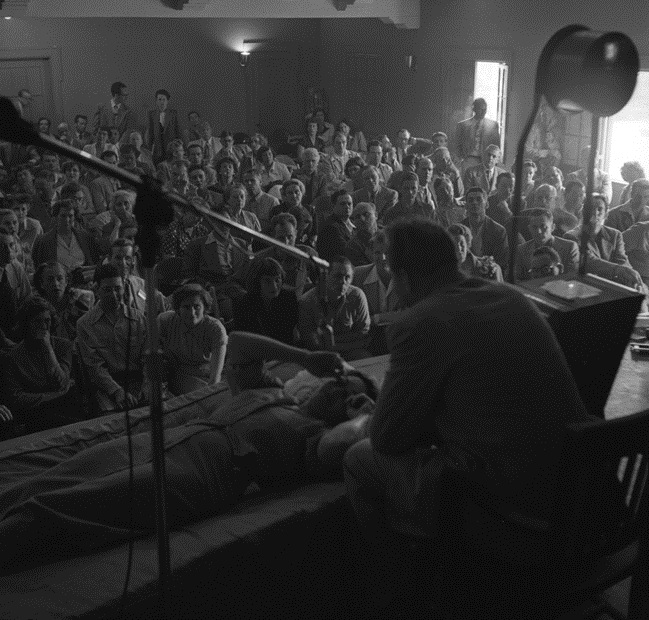
The opening of “A Growing Cult Reaches Dangerously Into The Mind,” Alan Levy’s November 15. 1968 Life investigation into Scientology:

“The lights in the hall go dim, leaving the bronzed bust of the Founder spotlighted at center stage. From the loudspeakers comes L Ron Hubbard’s voice, deep and professional. It is a tape called ‘Some Aspects of Help, Part 1,’ a basic lecture’ in Scientology that Hubbard recorded nearly 10 years ago.

No one in the intensely respectable Los Angeles audience of 500 — some of whom paid as much as $16 to get in — thought it odd to be sitting there listening to a disembodied voice. Among believers, Scientology and its founder are beyond frivolous question. Scientology is the Truth, it is the path to ‘a civilization without insanity, without criminals and without war . . .’ and ‘for the first time in all ages there is something that ….delivers the answers to the eternal questions and delivers immortality as well.’

So much of a credo might be regarded as harmless — practically indistinguishable from any number of minor schemes for the improvement of Man. But Scientology is scary — because of its size and growth, and because of the potentially disastrous techniques it so casually makes use of. To attain the Truth, a Scientologist surrenders himself to “auditing,” a crude form of psychoanalysis. In the best medical circumstances this is a delicate procedure, but in Scientology it is undertaken by an ‘auditor’ who is simply another Scientologist in training, who uses an ‘E-meter,’ which resembles a lie detector. A government report, made to the parliament of the State of Victoria in Australia three years ago, called Scientology ‘the worlds largest organization of unqualified persons engaged in the practice of dangerous techniques which masquerade as mental therapy.’ As author Alan Levy found out by personal experience ‘pages 100B – 114’, the auditing experience can be shattering.

How many souls have become hooked on Scientology is impossible to say precisely. Worldwide membership — England, South Africa, Canada, New Zealand, Australia, France, Germany, Japan and the U.S. — is probably between two and three million. In the U.S. offices in Washington, New York, Los Angeles and seven other cities, the figure may now be more than several hundred thousand. What is astonishing — and frightening — is the rate of growth in the U.S.: membership has probably tripled or quadrupled in the past three years.

Recruits to Scientology are most often young, intelligent and idealistic. They become fanatics on the subject, impervious to argument, quick to cut themselves off from doubters. Many young people have been instructed by their Scientology organizations ‘orgs,’ they are called to ‘disconnect’ from their families. ‘Disconnect’ means exactly that: sever all relations. Such estrangements can be deep and lasting, leaving heartsick parents no longer able to speak rationally with their children.

Scientology is expensive.”

Tags: ,

Piers Morgan; Asks question, continues talking.

Piers Morgan: What if Morton Downey Jr. had been British?


The 5 foreign nations sending the most traffic to Afflictor in April:

  1. Great Britain
  2. China
  3. Germany
  4. France
  5. Australia

From the August 1, 1890 New York Times:

Plainfield, N.J.–Mary Goldsmith, who died near Plainfield a day or two ago in consequence, it is supposed, of a too free drinking of milk, was a cook employed on Gen, Schwenck’s large dairy farm, Holly Grove, on the Park Avenue Road. She was a middle-aged woman and had been in Gen. Schwenck’s service for some time.

She became very fond of the fresh milk, and drank it warm as it came from the cows morning and evening. The family cannot say how much she drank a day, but they think she must have consumed three or four gallons. She grew stout, but seemed to be in perfect health till within a day or two of her death. Then she complained of pains around her heart. She finally suffered so much that she was forced to her bed, and died a few hours later.”

Tags: ,

Because the word’s highest cancer rates aren’t killing citizens at a fast-enough pace, China may be in the midst of importing American football. NFL Commissioner Roger Goodell has at least 99 problems–many of them-concussion-related–but he gets breathless over the thought of cracking the world’s biggest market. The opening of “Hard Knocks: Shanghai,” Hua Hsu’s new Grantland article:

“The National Football League currently maintains four offices around the world. There is an office in Mexico City. The NFL has been popular in Mexico since at least the 1970s, and some of the largest-ever crowds to watch preseason and regular-season games were recorded in the nation’s capital, where the league has staged games since 1994. There’s another office in Toronto, where the league claims a fan base of nearly 1 million, the most die-hard among them along the border. NFL Europa shut down operations in 2007 but an office continues to thrive in London, where an annual regular-season game is played at Wembley Stadium. Commissioner Roger Goodell has even mused, carefully and obliquely, about one day placing a franchise there.

The last office is in Shanghai.

How does one begin to explain how unlikely NFL China is? Anything you want to assume about a nation that constitutes nearly 20 percent of the world’s population is probably true. China is whatever you want it to be: Massive and diverse and black-hair sameness, ancient and postmodern and blink-of-an-eye changing, it requires a different scale of description. But it’s probably not the riskiest generalization to suggest that China does not conform to anyone’s vision of a hotbed for American football. When I arrived in Shanghai, I was offered a litany of reasons, ranging from the cultural to the genetic, for why the sport would never catch on among locals. For example: There isn’t a deeply ingrained sports culture in China, and what little energies were devoted to following such things usually involved international competition. Team sports aren’t big in China, either, and the one-child policy has made parents more averse than ever to subjecting their kids to potential harm. And beyond all this, there’s football itself, which has never been an intuitive product for American export. Even nations with an appetite for American things have traditionally found football exotic and inscrutable, one of those aspects of the culture that simply doesn’t translate well.

But something unusual is happening throughout China’s major cities, where football is one of the fastest-growing sports. ocal Chinese kids are buying cleats and pads and starting teams and football clubs.”

Tags: ,

Fitting dementia patients with a GPS so that they can be monitored and recovered doesn’t seem like such a bad idea to me, but Sussex police have gotten a strong reaction to such a scheme. From the Guardian:

“Police have defended a ‘barbaric’ decision to buy GPS locating devices to trace people with dementia who disappear.

Sussex police have bought six battery-powered locators as part of a attempt to save money and time spent on searching for dementia patients.

The National Pensioners Convention described the introduction of the devices as ‘barbaric’ and suggested people could be stigmatized and made to feel like criminals.

But Sergeant Suzie Mitchell said: ‘The scheme is only costing Sussex police a few hundred pounds but, comparing this to police time, resources, potential risk to the missing person, let alone the anxiety and worry for their family, it is, in my opinion, a few hundred pounds well spent.'”

Tags:

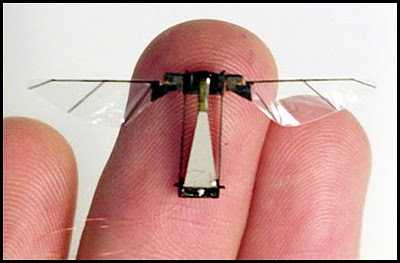
How can privacy be a thing anymore when robots look like insects, when they can be programmed to fly into any open window? And that’s not even considering actual insects being controlled remotely, being genetically modified to follow orders. The opening of a story at Harvard’s site about a robotic insect making its first controlled flight:

“Last summer, in a Harvard robotics laboratory, an insect took flight. Half the size of a paper clip, weighing less than a tenth of a gram, it leapt a few inches, hovered for a moment on fragile, flapping wings, and then sped along a preset route through the air.

Like a proud parent watching a child take its first steps, graduate student Pakpong Chirarattananon immediately captured a video of the fledgling and emailed it to his adviser and colleagues at 3 a.m. — subject line: ‘Flight of the RoboBee.’

‘I was so excited, I couldn’t sleep,’ recalls Chirarattananon, co-lead author of a paper published this week in Science.”

Tags:

Sen. Ted Cruz of Texas, a paranoid and evil wackjob, has formed an exploratory committee to see if he should run for President in 2016.

Sen. Ted Cruz, a McCarthy-esque wackjob, has formed an exploratory committee to see if he should run for President in 2016.

But so has his left testicle.

But so has his left testicle.

Who can forget the great job the testicle did during the hearings to weed out imaginary communists from our military?

Who can forget the great job the testicle did during the hearings to weed out imaginary traitors in our government?

General, I'm going to need you to name names.

General, I’m going to need you to name names.

Wait, am I being interrogated by part of somebody's junk?

Wait, am I being interrogated by part of somebody’s junk?

You are, General.

You are, General.

Wait, am I being interrogated by part of somebody's junk?

What happened to the peen?

You are, General.

Never mind, you traitor!

Ted Cruz's left testicle has also been tough on undocumented workers.

Ted Cruz’s left testicle has also been tough on undocumented workers.

¿por qué me odias, Senor Ballo?

¿por qué me odias, Senor Ballo?

Ted Cruz's left testicle just needs a solid running mate and he has a clear path to the nomination.

Ted Cruz’s left testicle just needs a good running mate.

Perhaps Allen West's right nut might be interested.

Perhaps Allen West’s right nut might be interested.

I'm Ted Cruz's left nut and I approved this message.

I’m Ted Cruz’s left testicle and I approve this message.

More fake crap that seemed funny at the time:

Tags:

Hunger artists, professionals fasters who would display themselves before dime-museum audiences as they gradually starved over many weeks, were once popular in sideshows and with Kafka, That “entertainment” died out, but fasting is in vogue again, this time for health rather than curiosity. At Aeon, S. Abbas Raza investigates the new no-food trend. The opening: 

“It all began in March last year when I read an article by Steve Hendricks in Harper’s magazine titled ‘Starving Your Way to Vigour’. Hendricks examined the health benefits of fasting, including long-term reduced seizure activity in epileptics, lowered blood pressure in hypertensives, better toleration of chemotherapy in cancer patients, and, of course, weight loss. He also mentioned significantly increased longevity in rats that are made to fast. Most interesting was his tale of undertaking a 20-day fast himself, during which he shed more than 20 pounds and kept it off for the two years since. I was fascinated, and I started reading more about fasting afterwards, although at the time I had no intention of doing it myself.

The benefits of fasting have been much in the news again lately, in part due to a best-selling book from the UK that is also making waves in the US: The Fast Diet: Lose Weight, Stay Healthy, Live Longer (2013) by Dr Michael Mosley and Mimi Spencer. Mosley is a BBC health and science journalist who extols the benefits of ‘intermittent fasting’. There are many versions of this type of fasting that are currently the subject of various research programs, but Mosley settled on the 5:2 ratio — in every week, two days of fasting, and five days of normal eating. Even on the fasting days, one may eat small amounts: 600 calories maximum for men, 500 for women, so about a quarter of a normal day’s intake. Mosley’s claim is that such a ‘feast or famine’ regime closely matches the food consumption patterns of pre-modern societies, and our bodies are designed to optimize such eating. Drawing on various research projects studying intermittent fasting and weight loss, cholesterol levels and so on, he argues that even after quite short periods of fasting, our bodies turn off fat-storing mechanisms and switch to a fat-burning ‘repair-and-recover’ mode. Mosley says that he himself lost 20lbs in nine weeks on the diet, bringing his percentage of body fat from 28 to 20 per cent. He says his blood glucose went from ‘diabetic to normal’, and that his cholesterol levels also declined from levels that needed medication to normal. He also says that he feels much more energetic since.”

Tags:

"

“While on the table the body showed signs of life.”

No one in a Massachusetts insane asylum was going to believe the story of Estelle Newman. They would just assume she was crazy. An article about her predicament from the December 11, 1884 New York Times:

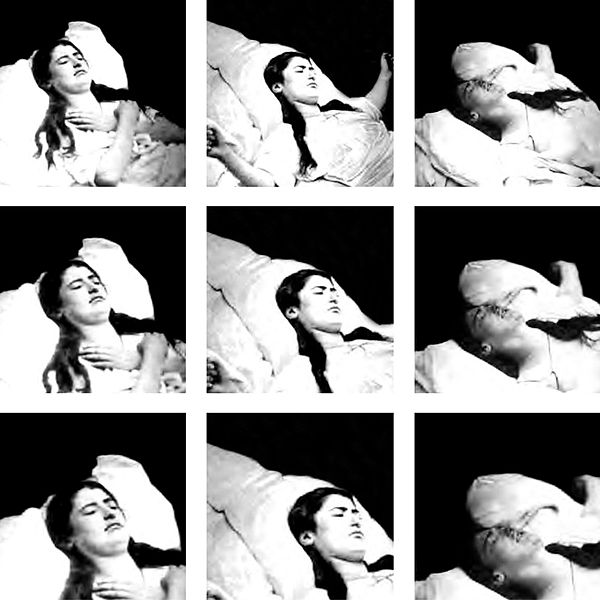
Springfield, Mass.–A strange story has come from Egremont, among the Berkshire hills, near the New-York line. The town and the surrounding villages are in great excitement. The story runs that Estelle Newman, about 30 years old, died in Egremont in 1878, and, after the funeral services in the little Methodist church was buried in the town cemetery and forgotten. The sensation comes from the dying testimony of H. Worth Wright, in Connecticut, who is said to have confessed to his brother that he, being a student in the Albany Medical College, was present at the funeral with other students, lay in wait near the cemetery till the burial was over and graveyard was deserted, and then helped disinter the body and carry it in a sack to the medical college. They at once went to work on it in a dissecting room. While on the table the body showed signs of life, and was resuscitated by the students. Finding the woman alive on their hands the authorities of the college had her taken to an insane asylum in Schoharie County, N.Y. This is the last that Wright is said to have known of her whereabouts. The Newman woman’s grave will probably be opened to see what the story amounts to.”

Tags: ,

\

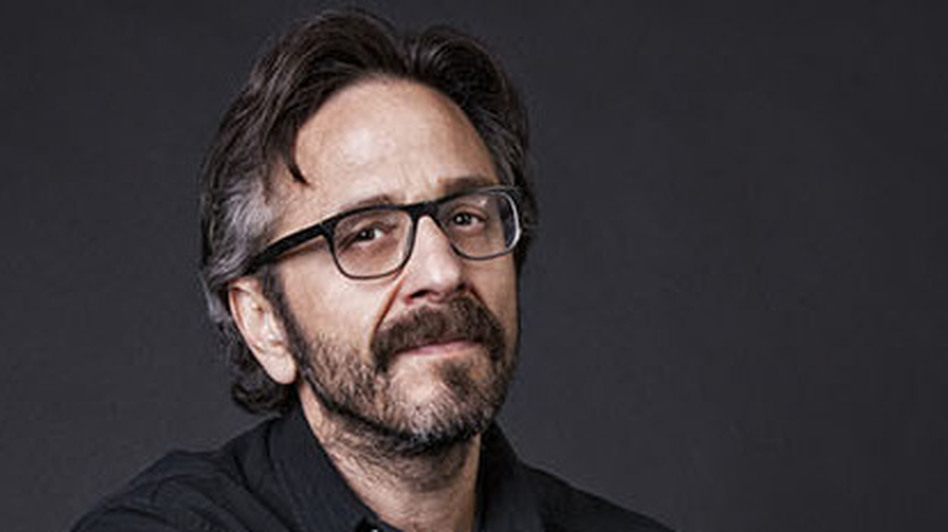
Stand-up comedian Marc Maron, frenemy of Louis C.K., is having a big week, releasing a new book and debuting an IFC TV show. It’s interesting the people we connect to at a distance: I have no patience for bitter people who scream at others a lot, so I likely wouldn’t tolerate someone like Maron if I knew him personally. But I love his stage work and podcast. The comic just did an Ask Me Anything on Reddit. A few exchanges follow.

_________________________

Question:

If you could interview 5 dead comics, who would they be?

Marc Maron:

Kinison, Hicks, Pryor, Lenny and Carlin.

_________________________

Question:

Who is that one comedian that will not come on the show? You mentioned him in passing in the early days but not recently. I think I had it figured out to be Adam Sandler, but I can’t remember. Is there anyone you pissed off so bad back in the day that they will never do your show?

Marc Maron:

Tosh doesn’t want to because he doesn’t want to. Not for any anger reasons. I don’t know… wait. You’re thinking of Jon Stewart. He won’t do it.

Question:

Is there a reason Stewart won’t do it? I’d like nothing more than to hear you two geniuses talk.

Marc Maron:

I was a dick to him, a lot, when we were younger. He remembers that and doesn’t like me. I get it.

_________________________

Question:

Do you miss hating George W Bush?

Marc Maron:

No.

_________________________

Question:

How do you imagine your life turning out had you had 20 years ago the success you’re having now?

Marc Maron:

Probably dead before the 20-year mark or I would’ve ruined it somehow.

_________________________

Question:

Can you tell us about any of the times you drunkenly made out with Louis CK?

Marc Maron:

Wow. I have no recollection of that. You better ask him.•


Tags:

Richard Brautigan 1084

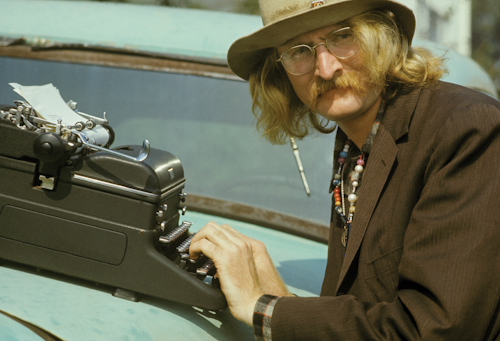
A miscast spokesperson of drugged-out hippies, the writer Richard Brautigan wasn’t enamored with narcotics nor the wide-eyed, bell-bottomed set. He wrote two things I love: The 1967 novel Trout Fishing in America and the 1968 poem “All Watched Over by Machines of Loving Grace.” The opening of “King of the Granola Heads” Michael LaPointe’s Times Literary Supplement review of a new book about the iconoclastic author:

“Richard Brautigan, the Love Generation’s prickly and whimsical poet-novelist, died what the sheriff’s report termed an ‘unattended death’ on September 16, 1984. Having committed suicide with one of his beloved Smith & Wesson revolvers, Brautigan was not discovered in his home in Bolinas, California until October 25, at which point he needed to be ‘scooped up with a shovel.’ Why did Brautigan, the author of bestselling, generation-defining novels such as Trout Fishing in America and In Watermelon Sugar, die so alone? In Jubilee Hitchhiker, William Hjortsberg maps the rocketing rise and disastrous decline of this most quixotic American author.

Born in 1935 to a single mother in Tacoma, Washington, Richard Gary Brautigan was destined for a life on the fringes. He was even, at first, estranged from his own name, his mother borrowing the surname Porterfield from one of his many stepfathers. Unmoored from ancestry, Brautigan would always be a self-mythologizer, complicating the biographer’s task, but in the early, ‘Dick Porterfield’ chapters of Jubilee Hitchhiker, Hjortsberg disentangles events from their embellishments. ‘Imagination feeds on the irrational,’ he writes, and Brautigan’s young mind was given a steady diet. The midcentury Pacific Northwest has the larger-than-life dimensions of legend, complete with a near-apocalyptic flood, which the Porterfield family was the last to escape, ‘watching the highway fold up behind them ‘like scrambled eggs.’

After the deluge, Brautigan acquired his major trope: ‘Fishing consumed [his] life.’ With his towering height, white-blond, soup bowl haircut and overalls, the young Brautigan resembled Tom Sawyer, ‘hitchhiking up the McKenzie in the rain with a fly rod under his arm and a peanut butter sandwich in his pocket.’ Brautigan would always retain an anachronistic quality. By the age of twelve, he was collecting cans, blackberries and nightcrawlers to help the family make ends meet. In 1956, he hitchhiked down to San Francisco and never saw or spoke to his family again.” (Thanks Browser.)

See also:

Tags: ,

« Older entries § Newer entries »