New DVD: Dogtooth

Incredibly upsetting and wholly mesmerizing, Giorgos Lanthimos’ 2009 absurdist drama, Dogtooth, is a unique vision about a trio of children approaching adulthood who’ve been cut off from the outside world since birth by their disturbed parents. It’s a perverse parable and one that never fails to convince.

Trained their whole lives to believe that dangers lurking in the world will kill them if they step outside the gate of the family compound, three siblings (Aggeliki Papoulia, Mary Tsoni and Hristos Passalis) have stayed put and been miseducated by their insane parents. They’ve been taught that a salt shaker is called a “telephone,” so that’s what they call it. The only films they’ve ever seen are home movies and they’re allowed no interaction with anyone but their parents and each other. Only Father (Christos Stergioglou) leaves the grounds, and he drives straight to his job as a middle manager in a factory and returns home as soon as he can. While dad is the leader of the ruse, Mother (Michele Valley) goes along wholeheartedly, convincing her dull-faced, damaged children that she can give birth to dogs.

But when Father brings home the female security guard from his plant to relieve the burgeoning sexual urges of his son, the dynamic begins to change and the balance of power becomes unmoored. As hormones rage and natural curiosity blooms, the children grow increasingly violent under their suppression. Soon they’re slashing one another with kitchen knives, clubbing each other with bats, taking hedge clippers to stray cats and performing all manner of unnatural acts.

You could accuse Lanthimos of trafficking in oddness for the sake of oddness, with no greater desire than to shock or titillate, but that wouldn’t be giving this amazing film the credit it deserves. As the movie reminds, we live to some extent by the tenets that we receive whether they be elements of nationalism, religious fundamentalism, political ideology or the ones we learn in our homes behind closed doors. Even if those lessons are irrational, they’re real to us and effect they way we behave with others who’ve been informed by different standards. And the violence and perversity in this fictional crazy home is nothing compared to the horrors that go on in our allegedly sane world.•

Tags: , , , ,

From second-degree burns to completely healed in 96 hours.

"Cash only." (Image by Richiek.)

Baseball Team – $750 (Flushing)

For sale: one baseball team, one highly financed stadium, one cable program and one owner’s idiot son for sale. Team is about 50 years old and in poor condition. Cash only.

"I closed the window and sat there on the edge of the bed holding my club, thinking somebody fucking crazy from the lobby was going to come up." (Photo by David Shankbone.)

Before he was reborn, Mickey Rourke was a huge mess and before that a huge star. Before all of it, he lived in New York on no money during a time when the city had begun offering only the coldest shoulder possible to starving artists. In an interview in the February 1987 issue of Playboy, Rourke, then in the first great flowering of his career, recalled his hard-knock life as a young actor in NYC. A few excerpts follow.

••••••••••

“Down the hall, a little guy was opening the grille, peeking in; you couldn’t even jerk off in private. It was one of those welfare hotels with nut jobs walking up and down, you know, fucking crazies and killers and guys who were truck drivers who thought they were women. The first night, there was this loud fucking music coming up from somewhere, man. And I kept hearing these voices and shit from downstairs. I closed the window and sat there on the edge of the bed holding my club, thinking somebody fucking crazy from the lobby was going to come up and bust into the room. ‘Cause at the time, you know, I had left a lifestyle where I was a little wary of that kind of shit. The slightest sound at the door or whatever and I was jumpy. And there were a lot of strange sounds at that joint, believe me. I put a fucking chair next to the door with a can propped right on the edge, and another can on the window ledge. Anybody tries to break in, you know, I’m gonna hear it.”

••••••••••

“When I moved to the Marlton Hotel, I remember I was walking down the street, man, and I saw these dudes down on Christopher Street, and they were all wearing motorcycle jackets. With all the leather, all dressed in black, the whole thing. They kept looking at me, and I’m thinking, Fuck, man, where can I go? What fucking gang is that? None of my boys were with me. This wasn’t Miami. I kept thinking, What the fuck is this guy looking at me like that for, man? ‘Cause you didn’t eyeball somebody back home in Miami unless you wanted to get down, you know—unless you were ready to fight. What I didn’t realize was that they were sissies, all dressed up in leather.”

••••••••••

“It was funny, in a way. In the wintertime, I was really, really lonely. And I used to work down by the water, moving furniture in this warehouse where Lee Marvin, Steve McQueen, Gene Hackman and a bunch of other guys had all worked, too. The guy who ran it was an old actor or something and used to tell me stories about them. Anyway, I used to walk home during the night, and I was so fucking lonely, you know, I’d pretend I had a girlfriend waiting for me in my room, waiting to have a cup of coffee with me or go to the movies. As I walked home, I was still daydreaming. Same way I daydreamed in school. I’d say to myself, ‘Oh, now I’m going home; she’ll be waiting for me.’ Because I couldn’t talk to girls. It’s easier now. They come running.”

Tags:

Scott Brusaw’s solar-powered glass-based roadways trap the sun’s power and melt snow. (Thanks Bioscholar.)

Tags:

“See a baby doll take a bubble bath in a coffee can,” says the announcer of this trailer for Attack of the Puppet People. I can’t say it was on the agenda, but sure, why not, I’ll have a look.

Architect Gunnar Birkerts, Sven's father, designed the Corning Museum of Glass in Corning, NY.

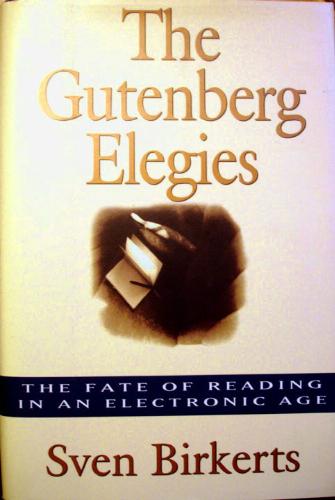
Mule Variations has a new interview with Sven Birkerts and it touches on the author’s prophetic 1994 work, The Gutenberg Elegies, which examined the fate of reading in the age of Internet. An excerpt:

“Mule Variations: In 1994, in the days before widespread use of the Internet or cell phones, you wrote inThe Gutenberg Elegies, ‘We will all spend more and more of our time in cyberspace producing, sending, receiving, and responding, and necessarily less time interacting in a ‘hands on’ way with the old material order.  Similarly, we will establish a wide lateral interaction, dealing via screen with more and more people at the same time our face-to-face encounters diminish.  It will be harder and harder – we know this already – to step free of our mediating devices.’  At the time, this observation was far from readily apparent to the public at large.  Now that it has played out as you predicted, do you ever feel like The Gutenberg Elegies was too far ahead of its time?  That if you had published it, say, five years later in 1999 more people would have understood what you were talking about?

Sven Birkerts: I think it came out at a time when the people who tend to think about these things were thinking about them, even though it hadn’t entered the wider public consciousness.  I think it was a wonderfully opportune time to start the debate.  And it was very coincidental, the publication of that book, because it came out at the very same time as Being Digital by Nicholas Negroponte, who runs the MIT media labs.  And his was this raving, ‘Here’s the new world!  All solutions are in hand!  We’re all digital!’  And so the books were reviewed over and over and over again together.  And he and I did a couple things where we’d go on talk shows together.  To me, it said we’d come to a moment where it could be talked about.  What’s interesting to me now is that the wave’s falling back a little.  Some of the people were so gung ho about it, for instance Jaron Lanier who published a book this year.  Here’s this wild-haired Silicon Valley computer visionary suddenly starting to find the problems with the current situation.  He’s coming back from his raving enthusiasm.  He saw where the digits were going, but he didn’t see what would happen when the digits got tied up with the economy, etc.”

Tags:

Julie and child, 1983. (Image by Darcy Padilla.)

Photographer Darcy Padilla’s amazing 18-year photo series, The Julie Project, follows a deeply troubled woman named Julie Baird through her life, beginning in 1993 in a flophouse in San Francisco. It’s heartbreaking and important work, though it’s not for the faint of heart. An excerpt below from the story’s introduction (Thanks to Kottke and Dooce):

“I first met Julie on February 28, 1993. Julie, 18, stood in the lobby of the Ambassador Hotel, barefoot, pants unzipped, and an 8 day-old infant in her arms. She lived in San Francisco’s SRO district, a neighborhood of soup kitchens and cheap rooms. Her room was piled with clothes, overfull ashtrays and trash. She lived with Jack, father of her first baby Rachael, and who had given her AIDS. She left him months later to stop using drugs.

Her first memory of her mother is getting drunk with her at 6 and then being sexually abused by her stepfather. She ran away at 14 and became drug addict at 15. Living in alleys, crack dens, and bunked with more dirty old men than she cared to count.

For the last 18 years I have photographed Julie Baird’s complex story of multiple homes, AIDS, drug abuse, abusive relationships, poverty, births, deaths, loss and reunion. Following Julie from the backstreets of San Francisco to the backwoods of Alaska.”

Tags: ,

He emerges drunk, surly and ready to watch some football. No, he’s not going to your sister’s house. (Thanks Reddit.)

According to the Virtual Dime Museum, J.B. Johnson entertained East River bathers in 1874 by smoking a cigar and drinking milk underwater. (Image by Underwood & Underwood.)

The only place in America where it’s not currently snowing is Arizona, and you can’t live in that state because even babies there carry handguns. But at least we can think about the warmer weather that will hopefully, mercifully, eventually arrive. While it’s almost unimaginable for anyone in 2011 to equate summertime fun with swimming in the dirty, murky East River, there was a time when overheated working-class locals used it as a watering hole.

In 1870, a bathhouse was built along the East River to serve the needs of the swimmers and to set up competitive races. According to the Virtual Dime Museum, the bathhouse was condemned in 1912 because city officials were alarmed by how polluted the waters had become. That didn’t stop folks on view in this 1921 photo from taking a dip, but the building of public pools eventually ended the practice. Even during the relatively cleaner pre-1900 days, you never really knew what you would find in the East River. A brief article from the August 15, 1897 Brooklyn Daily Eagle makes that clear:

“A GRUESOME HOAX. Henry Buck of the 174 Vernon avenue, and Herman Seelig of 41 Ninth street, while in swimming in the East River at the foot of Nott avenue, this afternoon, saw a bundle floating in the water under the dock and notified the police. Examination showed that the bundle contained the remains of some animal.

Dr. P.J. McKeown of 145 Fifth street and Dr. P.H. Bumater of 143 Fifth street both looked at the remains and said that the bones were too large to be those of a human being. The end of one bone looked like the double joint in the foreleg of a cow, while another bone looked like the hip bone of a cow sawed lengthwise. Coroner Strong, who was summoned, said the thing was doubtless a hoax.”

Tags: , , , , ,

"Can't afford to pay out the nose."

Help me get married! (NYC)

Hey. I know this is probably inappropriate and there’s probably some stigma that goes along with it, but I am looking for an engagement ring. The thing is, I’m a student and can’t afford to pay out the nose for one. So if you have one that you’re not using for whatever reason (cold feet, jilted lover, just feel like being charitable) and feel like parting with it and making a little money on the side, you’d be doing me a great favor! I figure there’s enough stories of broken engagements out there that someone must have a ring that they’re willing to part with, especially if it means bringing happiness to someone else. If you have one, please send me some info on it and what you would like for it.

Only 54 miles per hour but still pretty cool. (Thanks Open Culture.)

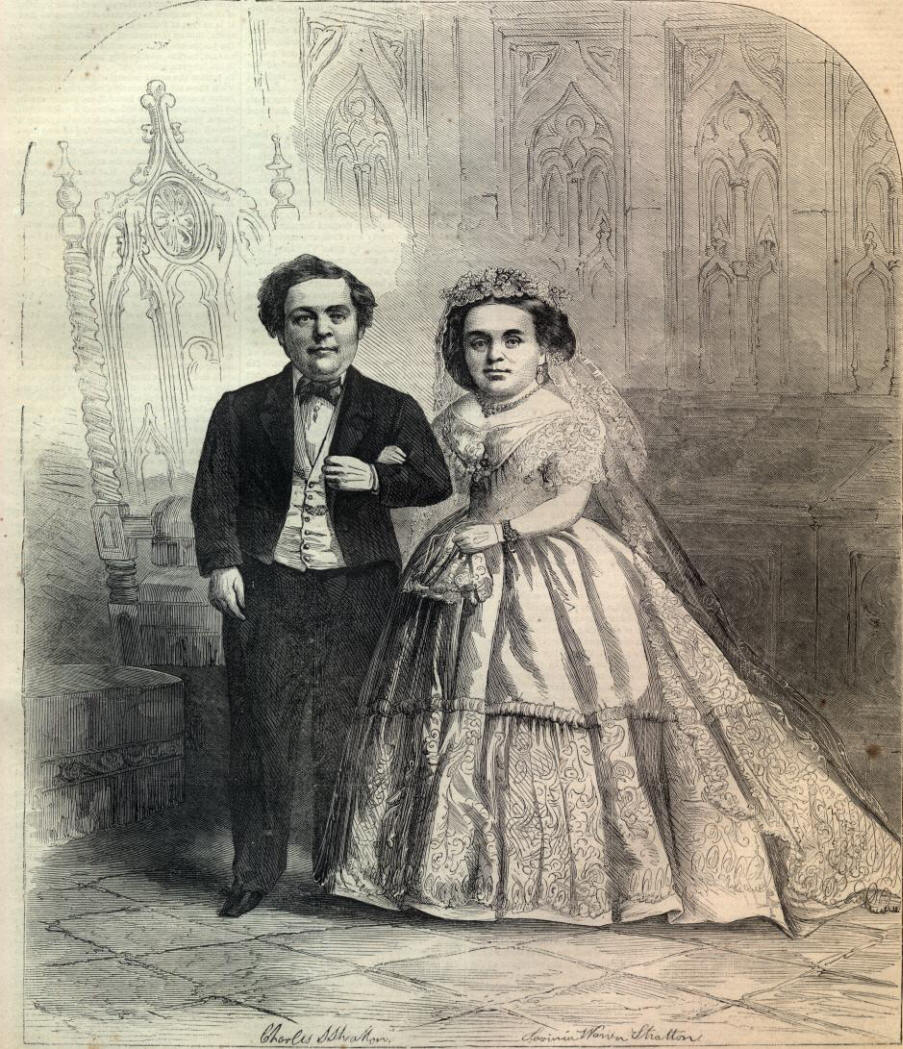
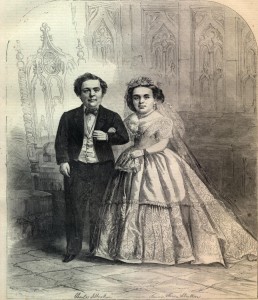
The loving couple as they appeared on the cover of "Harper's Weekly." They were much more attractive than this depiction suggests.

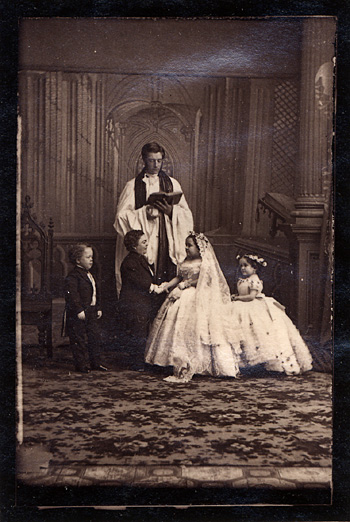
Two of New York’s tiniest residents were the principals of one of the largest weddings in the history of the city. It was in 1863 that Charles Stratton, better known as diminutive P.T. Barnum attraction General Tom Thumb, took a bride in the form of fellow little person performer Queen Lavinia Warren. The ceremony was held at Grace Episcopal Church and Barnum made certain that it was the social event of the year.

The New York Times was on the scene to file a breathless 5,000-word article in its February 11, 1863 edition, which was subtitled: “Marriage of General Tom Thumb and the Queen of Beauty. Who They Are, What They Have Done, Where They Came from, Where They Are Going. Their Courtship and Wedding Ceremonies, Presents, Crowds of People.” A few excerpts about the insane scene follow.

••••••••••

“Those who did and those who did not attend the wedding of Gen. Thomas Thumb and Queen LAVINIA WARREN composed the population of this great Metropolis yesterday, and thenceforth religious and civil parties sink into comparative insignificance before this one arbitrating query of fate — Did you or did you not see Tom Thumb married?

The Scriptures tell us that a little matter kindleth a great flame, and that being the case, no one need be surprised that two little matters should create such a tremendous hullabaloo, such a furore of excitement, such an intensity of interest in the feminine world of New-York and its neighborhood, as have the loves of our Lilliputians. We say ‘feminine world,’ because there were more than twenty thousand women in this City yesterday morning up and dressed an hour and a half before their usual time, solely and simply because of the approaching nuptials of Mr. STRATTON and Miss WARREN. They didn’t all have cards of admission, oh no, but it wasn’t their fault. Fathers were flattered, husbands were hectored, brothers were bullied and cousins were cozened into buying, begging, borrowing, in some way or other getting tickets of admission to the grand affair.

The marriage of Gen. Tom Thumb cannot be treated as an affair of no moment — in some respects it is most momentous. Next to LOUIS NAPOLEON, there is no one person better known by reputation to high and low, rich and poor, than he.”

••••••••••
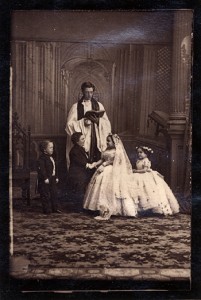
Barnum was a very distant relation of the General and taught him how to sing, dance, mime and do imitations. (Image by Mathew Brady Studio.)

“Long before the hour appointed for the ceremony, a great concourse had gathered OUTSIDE THE CHURCH, and that portion of Broadway between Union-square and Ninth-street was literally crowded, if not packed, with an eager and expectant populace. All classes of society were represented, not excluding the ‘spectacle man’ and the woman retailer of apples. As the time approached for the ceremony of the nuptials, the crowd increased in density, every one exhibiting the most impatient desire to catch a glimpse at the happy pair when they should arrive. All the buildings in the vicinity of the church were made subservient to the general curiosity, and not a door, or window, or balcony, which would in the least facilitate view, but was put into practical service. The smiling faces of the thousands of fair ladies thus assembled contributed not a little to the attractiveness and joyfulness of the occasion. The system of police was admirably executed. Order was preserved throughout the entire proceedings, and a general good feeling seemed to exist among the people. Stages, and all vehicles excepting the carriages which contained invited guests and holders of tickets, were turned off Broadway at Ninth-street below the church, and at Twelfth-street above. In the intermediate space, and near each sidewalk, were stationed lines of policemen, who succeeded in maintaining their position until nearly noon, when the multitude became so vast that they were obliged to form new lines nearer the centre of the street. The open space was then hardly of sufficient width to admit of the free passage of carriages, but the drivers threaded their way through, notwithstanding the slight inconveniences which opposed them. To place a correct estimate upon the number of carriages that passed through the line, unless a person stood by and counted them one by one, would be impossible. There was one unbroken chain of them for over two hours preceding the arrival of the ‘little couple.’

••••••••••

Not even Harry Potter and Lady Middlemarch will have such a wedding.

“Policemen were detailed to preserve order in the vicinity of the hotel, as well as of the church. Vehicles were turned off the main thoroughfare at Houston and Spring streets, and the long line of carriages which was noticed at the church, came pouring down toward the place of reception. The crowd followed, and in less than fifteen minutes the street in front of the hotel block was completely choked with human beings. Upon each side of the hotel entrance was displayed the American colors, as was also the National flag upon the roof of the building. The inmates of the carriages, as they alighted, were closely scrutinized by the outsiders, many of whom naturally envied the good fortune which entitled their inferior, perhaps, in social standing to congratulate the married party. Pickpockets, as usual, were busy plying their avocation. Two of that ‘genteel profession,’ however, were discovered in the act, and taken to the station-house.”

••••••••••

“THE RECEPTION WAS A SUCCESS, as, of course, it was expected to be when BARNUM was the head and front of the offending. The brilliant assemblage, the delicious music, the merry laughter, the surging sea of laces, tulle, silk, satin, broadcloth, moire antique, muslin, velvet, furs and fine feathers of every imaginable hue and material, have been unsurpassed even in the gorgeous halls of the Metropolitan. All that the Messrs. LELANDS could do for the guests was done, and if a hundred or so did accidentally stray into the dining room, it seemed to be considered in the programme. All was hilarity, jocularity, fun, amusement and the acme of enjoyment, down to the happy moment when the twain retired.”

Tags: , , ,

The twisted geniuses at Found Footage Festival uncovered this inexplicable 1993 movie which tells the story of life on Earth in 2013. Dropping dead in 2012 has never looked so good. Also: Nut-punches will survive the apocalypse.

"Miami" was originally spelled "Mayaimi."

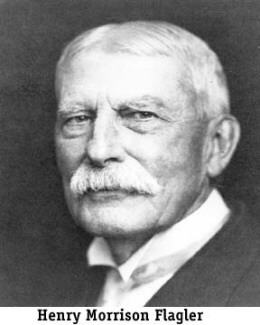
Henry Flagler dreamed the impossible dream and actually got to live it, if only for a while. A founding partner of Standard Oil, Flagler amassed amazing wealth by 1885 when he decided to transform Florida from swampland into an American Riviera. Soon, his grand hotels dotted places like St. Augustine and West Palm Beach, and he built the Florida East Coast Railroad, which extended all the way down to the city that would become Miami.

But in 1898 Flagler wanted more. To fulfill his plans, he would have to further extend the railroad from Biscayne Bay to Key West, which was roughly 125 miles off the coast. That would require a miracle of engineering. It didn’t happen overnight, but in 1912 Flagler’s Florida Overseas Railroad was completed. The visionary didn’t have much time to bask in his success, however. Flagler died the following year at 83 years old, after a fall in his home. In 1935, a hurricane destroyed the Key West railroad, which was never rebuilt.

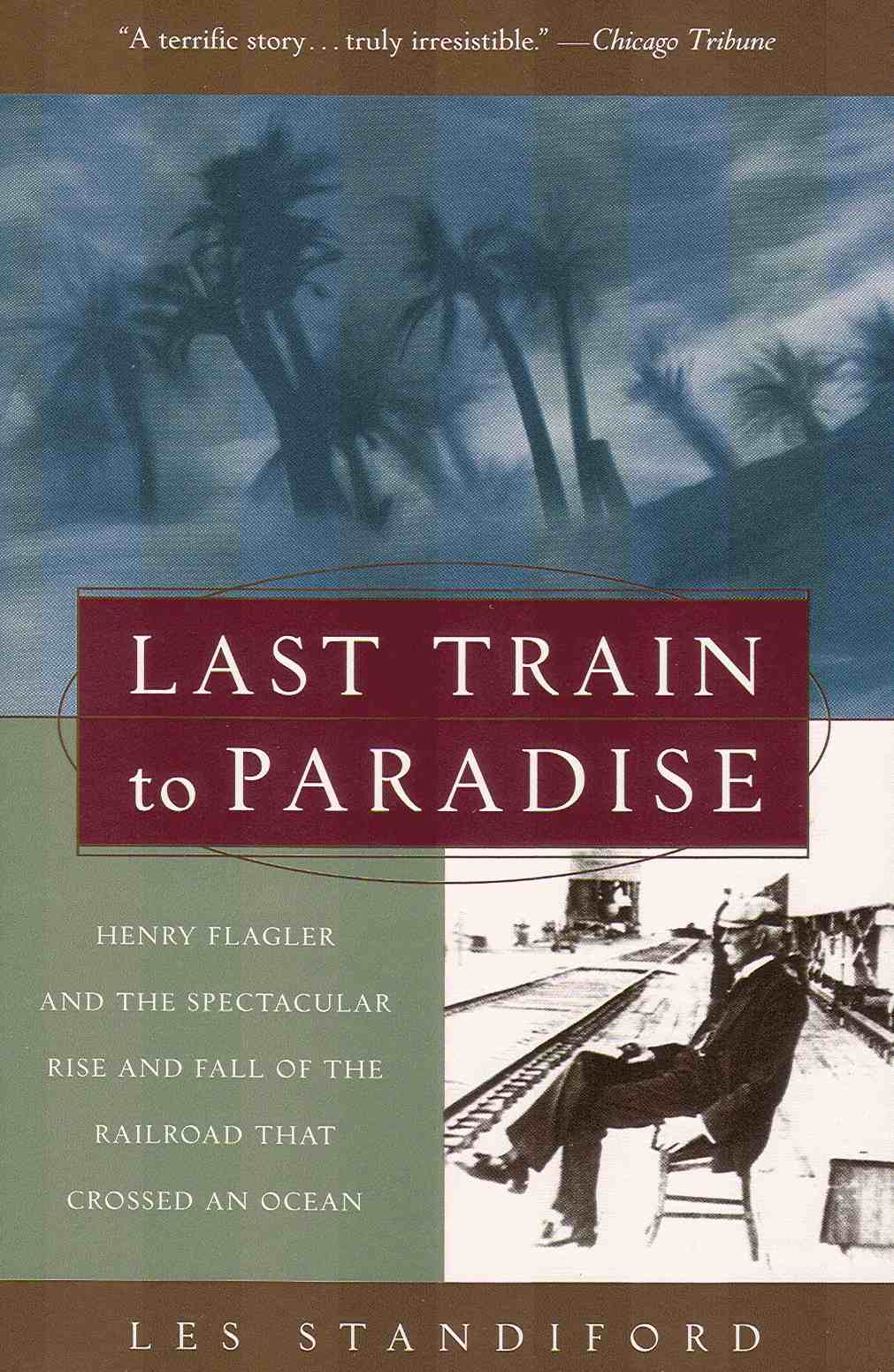
An excerpt from Lee Standiford’s Last Train to Paradise about the day the Florida Overseas Railroad opened:

“THE EIGHTH WONDER OF THE WORLD, headlines now bannered, such epithets as ‘Flagler’s Folly’ long forgotten. He had arrayed before him thousands of grateful citizens, along with a multitude of foreign dignitaries and government officials come to pay homage to what had been accomplished solely because of his vision and his unswerving devotion to that objective. Few people in history have accomplished so great a task or lived to experience such a moment as Flagler did.

The man he hired to bring his dream to fruition had died on the job and hundreds of other men had lost their lives as well, and despite all bromides otherwise, some weight of their passing had to have rested upon Flagler’s shoulders. Storms weathered, court fights fought, political enemies bested, impossible engineering problems solved, good men buried, rails joined at last. So many currents, so many thoughts and notions to meld and comprehend, after eighty-two years of life.

There’s no way to fathom how much of this had passed through his mind that day, but on his way off the platform Flagler placed a hand on Parrott‘s shoulder and whispered, ‘Now I can die happy. My dream is fulfilled.'”

Tags:

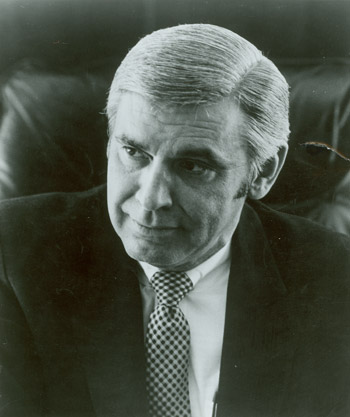
Congressman Leo Ryan was an inveterate reformer, critical of conditions in slums and prisons and an early opponent of Scientology.

David Isay’s excellent StoryCorps site, which allows people to share oral histories, has new audio from Erin Ryan, whose father, Congressman Leo Ryan, was assassinated during a 1978 fact-finding mission in Guyana as prelude to the Jonestown massacre. She was recorded in Washington D.C. in the days after the attempt on Congresswoman Gabrielle Giffords’ life. An excerpt:

“The night before he went on the trip to Jonestown, he had had dinner at my apartment. I was going to college at Georgetown University, trying to teach myself how to cook, and it was just a chance to hang out with my dad. Dad had done a lot of adventurous things in hid life, and everything had always turned out well, so we didn’t talk a lot about the trip. You know, I think looking back if I had known more I might have been more concerned. I heard the news around eight or nine o’clock in the evening, and there was a flash news report on the television that said that a congressman has been shot and possibly killed…pretty much that was it. It was gut-wrenching to not know what was happening. I mean, I can still feel it to this day when I think about it. It was brutal, and we struggled then for a very long time. You know, my message to the families of the victims of this tragedy with Congresswoman Giffords and those who were killed…for me it’s been 32 years and it can still bring me to tears, but you can’t make that a defining moment of your life. I’ve always said to myself that I was lucky that he was my dad, and that I was lucky to have had him for the years that I had him…and that’s what you have to hold on to.”

Tags: , , ,

"Now is your chance to get rid of that ugly thing without feeling guilty." (Image by Cassius Marcellus Coolidge.)

UGLY Paintings Wanted! (Bergen County, NJ)

Remember that gross old painting hanging above granny’s sofa? Well I need it!

2 of them actually.

If you are throwing out medium to large size worthless, somewhat unattractive or very ugly paintings in frames, please contact me! Landscapes are a plus!

My friend and I want to use them for an art project.

Now is your chance to get rid of that ugly thing without feeling guilty about throwing it in the trash. It will be put to good use!

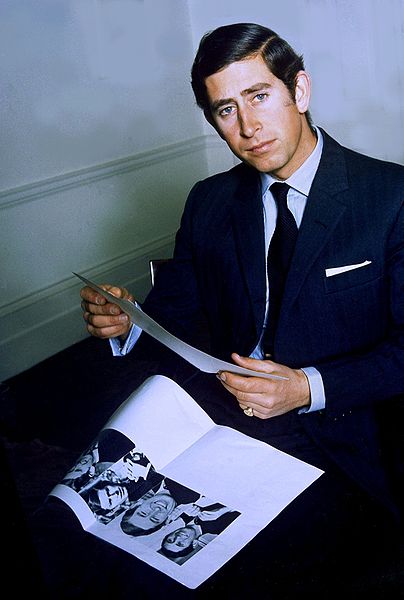
Prince Charles, before he completely stopped caring. (Image by Allan Warren.)

In January, the former empire known as Great Britain knocked cold-as-fuck Canada off its perch as Afflictor Nation champion, sending us the most unique visitors of any foreign country.  Here are the top five finishers:

  1. Great Britain
  2. Canada
  3. Germany
  4. Netherlands
  5. India

Tags:

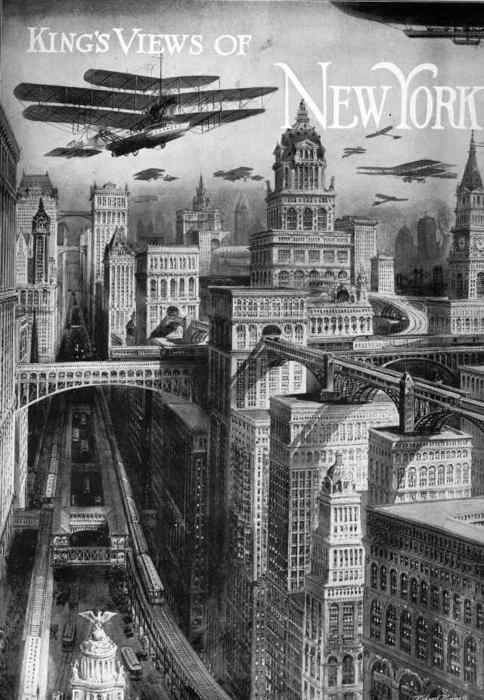
The cover of a 1911 Moses King guidebook predicted New York City's future pretty accurately.

David W. Dunlap has an incredibly fun slideshow on the New York Times site, which recalls urban planning from NYC’s past that was wildly bold and wholly unrealistic. An excerpt:

“Sobersided planners and wide-eyed visionaries thought this astonishing pace of transformation would never abate. A dreamer named W. Parker Chase proposed in 1932 that the 50 million people living in New York City 50 years on would ride vacuum-tube escalators and take air taxis to their 250-story office towers. The Regional Plan Association envisioned a 1,200-foot-long bathhouse complex at Great Kills Park on Staten Island. Robert Moses, who usually had the power to get things done, tried to persuade the United Nations to build a Brasília-like center at Flushing Meadow Park in Queens. (Midtown Manhattan, he warned in 1946, would by then ‘not be a proper, dignified and practical location’ for the United Nations.)

Dr. John A. Harriss, a distinguished expert on traffic control, went as far as to propose damming and draining the East River, before replacing it with a five-mile-long network of vehicular and train tunnels topped by boulevards and promenades. Pure folly? Not to the advocates of Westway, a highway that would have tunneled through landfill in the Hudson River until the plan was scuttled in 1985.”

Tags: , ,

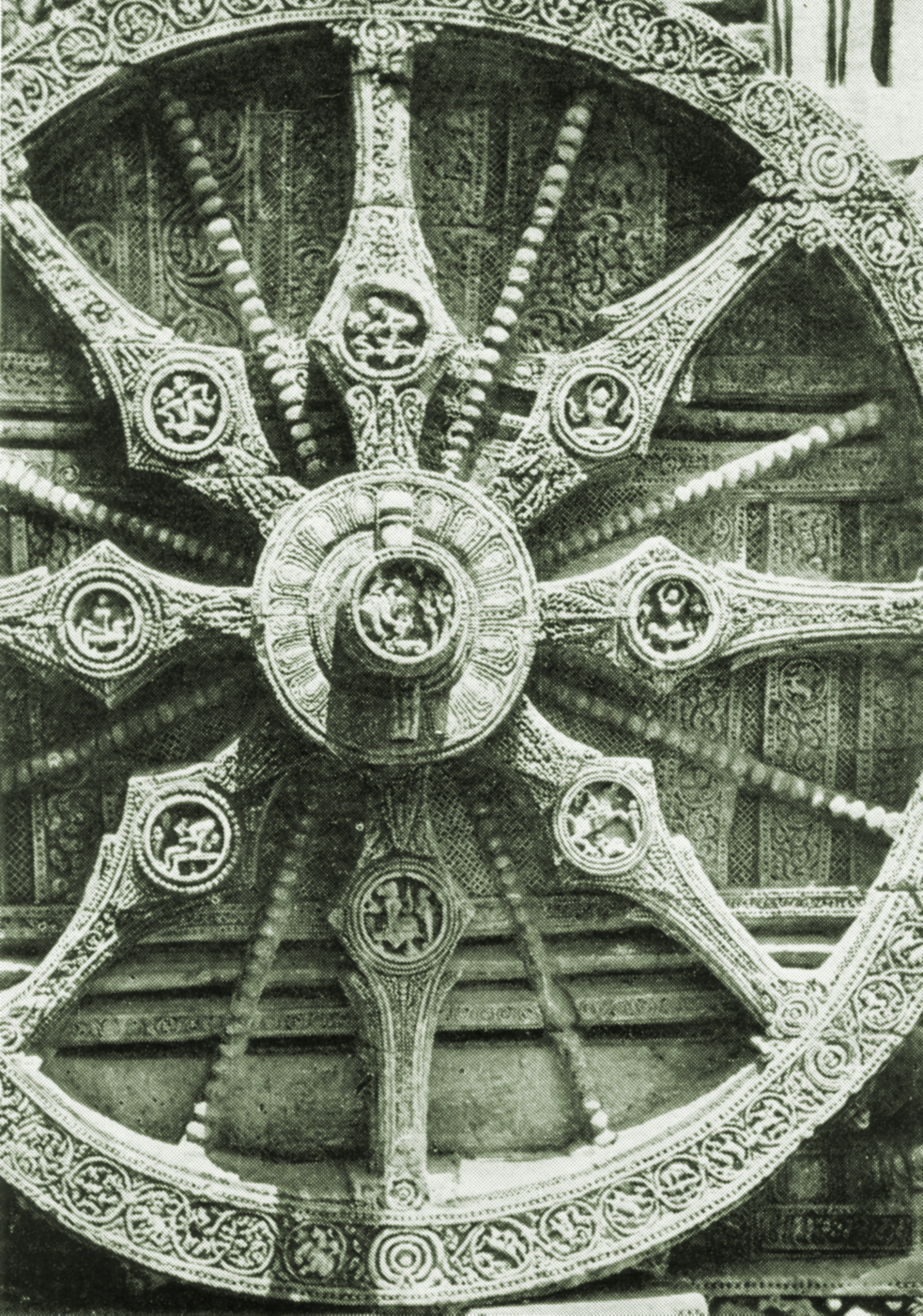
The wheel, still in use.

NPR’s Robert Krulwich had an interesting conversation with Kevin Kelly of Wired. Kelly claimed to the disbelieving host that no tool or technology in the history of the Earth has ever gone extinct on a global scale. Krulwich can’t believe the assertion but has yet to disprove it. An excerpt:

“He said, ‘I can’t find any [invention, tool, technology] that has disappeared completely from Earth.’

Nothing? I asked. Brass helmets? Detachable shirt collars? Chariot wheels?

Nothing, he said.

Can’t be, I told him. Tools do hang around, but some must go extinct.

If only because of the hubris — the absolute nature of the claim — I told him it would take me a half hour to find a tool, an invention that is no longer being made anywhere by anybody.

Go ahead, he said. Try.

If you listen to our Morning Edition debate, I tried carbon paper (still being made), steam powered car engine parts (still being made), Paleolithic hammers (still being made), 6 pages of agricultural tools from an 1895 Montgomery Ward & Co. Catalogue (every one of them still being made), and to my utter astonishment, I couldn’t find a provable example of an technology that has disappeared completely.”

Tags: ,

Julius Fromm died in London from a heart attack just days after the Allies' won WWII.

Julius Fromm was a German chemist who improved the condom, democratized its use and built a fortune from rubber. But he was Jewish so his empire was subsumed by the Nazis in 1938. An excerpt from an article about his life in the Berlin Review of Books (Thanks Instapaper):

“Julius Fromm then hit upon the idea of making condoms. The early condoms from the eighteenth century were generally made of animal intestines, and were used primarily by wealthy men – like Giacomo Casanova, who referred to them as ‘English riding coats’ – to protect against the incurable syphilis. These condoms were difficult to use, diminished pleasure, frequently broke, and offered only limited protection against venereal diseases. In 1893 the American industrialist Charles Goodyear developed rubber vulcanisation. When the sap of the rubber tree is formed into rubber, then treated with sulphur and heated to high temperatures, it forms an elastic and durable material that can be used to make raincoats, shoes, tyres and condoms which rather looked like bicycle inner tubes with bulging seams. Later a dipping method was invented that made possible the production of thinner and seamless condoms. Julius Fromm saw a market he could tap into and founded his company in 1914, opening a small workshop in the Bötzow area in the Prenzlauer Berg district of Berlin. With World War I and the liberalisation of sexual values in the Weimar Republic, the demand for condoms exploded and Fromm’s business quickly expanded, and he established factories near the Spree River in Berlin-Mitte.”

Tags: , ,

As this 15-minute video shows, Silicon Valley emerged as the center of the tech world due to a dispute about semiconductor research among scientists in 1957. A mutiny of sorts by eight employees of transistor inventor William Shockley paved the way for the area to become the nonpareil computing community. An excerpt from a New York Times article about the scuttlebutt:

SEPT. 18, 1957: Revolt of the Nerds

Fed up with their boss, eight lab workers walked off the job on this day in Mountain View, Calif. Their employer, William Shockley, had decided not to continue research into silicon-based semiconductors; frustrated, they decided to undertake the work on their own. The researchers — who would become known as ‘the traitorous eight’ — went on to invent the microprocessor (and to found Intel, among other companies). ‘Sept. 18 was the birth date of Silicon Valley, of the electronics industry and of the entire digital age,’ says Mr. Shockley’s biographer, Joel Shurkin.”

Tags:

"I haven't ever been to a therapist before, but my fiance has."


ARTIST hoping to barter for couple’s counselling (manhattan)

I haven’t ever been to a therapist before, but my fiance has.

I want this to last, and I want to trade art or other labor for sessions to give us the tools to make a lasting relationship.

please help.

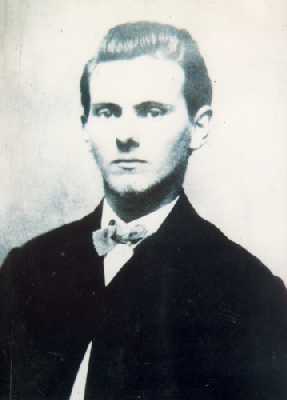
"...memories of slavery, the Civil War and Jesse James."

Some people tell a certain story at a particular time and everyone wants to believe it, even though it couldn’t possibly be true. Usually, these tall tales have something to do with unattainable wealth of one kind or another and our deep desire to possess it. Charlie Smith was just such a storyteller and his wealth was longevity. No one will argue that he didn’t have a very good run, but Smith didn’t make it as close to 137 as he wanted people to believe.

Smith became something of a minor celebrity in the 1960s-70s with his “memories” of life on plantations and on the frontier, claiming to have been born in 1842 (though documents uncovered later put lie to these assertions). His renown grew to the point that he was invited to watch the moon launch at the Kennedy Space Center. He doubted aloud (without irony) that the space mission was anything but a hoax.

Life magazine took Smith very seriously in its October 13, 1972 issue, providing an interesting story if not a factual one. An excerpt from the article:

“A researcher from the Martin Luther King Center in Boston traveled to Barstow, Florida, late last month to stick a microphone into the deeply furrowed face of Charlie Smith. The purpose was to add Smith’s recollections to the center of the black oral history bank.

What could this retired candy store owner from backwoods Florida have to offer? Among other things, memories of slavery, the Civil War and Jesse James.

Charlie Smith has become the object of historical research because he has obtained the incredible age of 130. He is the oldest living American. For three hours Smith talked into the tape recorder, and even sang a couple of frontier ballads. He described being lured onto a slave ship in Liberia by tales of ‘fritter trees’ in far-off America, then being put on an auction ship in New Orleans. He wound up on a Texas plantation owned by a Charlie Smith, whose name he adopted. Freed during the Civil War, Smith told of years as a cowpuncher, gambler, bootlegger and outlaw.”

Tags:

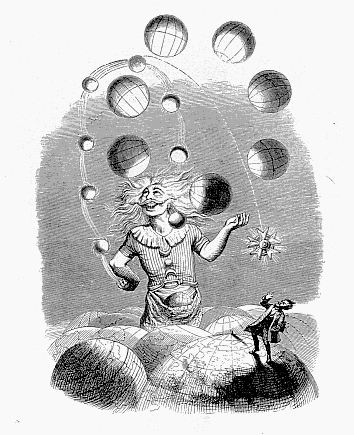
"Alvini appeared on the stage in a flowing Japanese gown and tossed balls in the air." (Image by J. J. Grandville.)

In the years right around 1900, there was no bigger miscreant than the professional juggler, as the following trio of articles from the Brooklyn Daily Eagle attests.

••••••••••

“Nerve of a Juggler” (August 25, 1893) “Every one has heard that a juggler must have a steady nerve. The popular belief is that he never dissipates. That is incorrect. A juggler doing his turn each day at a concert hall in Chicago of ten goes on stage carrying a heavy ‘load,’ yet he performs his feats with as much certainty as when he is sober. Sometimes he becomes joyous and gives free entertainments. The other day he stepped up to a soda fountain for a glass of seltzer. While the young man was drawing the beverage the juggler picked up four silver glass holders and began a little exercise, keeping all four in the air at the same time. A girl who was eating an ice cream soda dropped her spoon and ran into the street. The boy with the apron simply said: ‘Please don’t.’ The juggler begged pardon in a thick and unsteady voice, drank his seltzer, and, after solemnly winking at the female cashier, departed.”

••••••••••

“Juggler Alvini Arrested” (April 22, 1889) “William D. Alvini, the juggler who was arrested last night while performing at a sacred concert at the Park Theater, New York, was held for trial in $300 bail by Justice O’Reilly at Jefferson Market Court to-day. Alvini appeared on the stage in a flowing Japanese gown and tossed balls in the air. Roundsman Coughlan thereupon arrested the juggler for violation of the Amusement law.”

••••••••••

“Think He Is Crazy” (February 1, 1901) “John Weston, 33 years old, who said that he was a physician and had a home at 311 East Fourteenth street, Manhattan, was sent to jail this morning by Magistrate Brenner pending an investigation into his mental condition. He was arrested late last night on Myrtle avenue, apparently very tipsy and acting strangely. When he was locked up he changed his occupation and declared that he was a prize fighter. Then, after a while he asserted that he was an actor.

“I never fought but once on my life,’ he said to the doorman. ‘That was when I had four whiskies and two beers and had to fight for a cigar.’

Then he laughed the weird laugh of a man out of his wits. This morning he said to Magistrate Brenner that his business was juggling with Indian clubs. ‘I’m only waiting now for the executive committee,’ he added.

‘The executive committee may get you yet,’ commented to the Magistrate as he wrote out the commitment for the prisoner’s removal to the jail.”

Tags: , , ,

« Older entries § Newer entries »