Crowdsourcing is now at the service of scientific inquiry into intelligence and memory, as reported in an article by Benedict Carey in the New York Times. The opening:

“In the largest collaborative study of the brain to date, scientists using imaging technology at more than 100 centers worldwide have for the first time zeroed in on genes that they agree play a role in intelligence and memory.

Scientists working to understand the biology of brain function — and especially those using brain imaging, a blunt tool — have been badly stalled. But the new work, involving more than 200 scientists, lays out a strategy for breaking the logjam. The findings appear in a series of papers published online Sunday in the journal Nature Genetics.

‘What’s really new here is this movement toward crowd-sourcing brain research,’ said Paul Thompson, a professor of neurology at the University of California, Los Angeles, and senior author of one of the papers. ‘This is an example of social networking in science, and it gives us a power we have not had.'”

••••••••••

An earlier, less-clinical group memory study:

Tags:

Christian Marclay cuts and combines records, plays them off center, etc.

Tags:

Because robotics has lacked, above all, a Marxist perspective, here’s the opening of a manifesto by Communist Robot which believes that tin machines can free the masses:

“If not within our lifetime, than within the lifetime of our children there will be a revolution in robotics that will change every aspect of human society as we know it. Will we be ready for it? We are just now settling into the information age; enjoying the luxuries of the industrial revolution while sharing prosperity around the world, but in this age not everyone lives a life of luxury. Everyone can’t, because if everyone did who would clean the toilets? Who would do the farming? Who would make our Nike shoes? The prosperity of the modern world is dependent on the unfortunate unskilled workers living in poverty locally and throughout the world.

The rich of the world don’t physically labor; their work is to manage the resources they’ve attained that make them wealthy. Those resources, textiles or commodities are intrinsically dependent on the people paid to manufacture and distribute them. It is in the interest of the business owner to pay those people as little as possible to insure maximum returns and increase wealth. Obviously. Less obviously is the bare bones necessity of maintaining the monetary divide between wealth controlling business owners and the laboring masses. A business owner’s personal incentive for furthering financial growth is only a catalyst that preserves a more fundamentally important economic truth: The rich need the poor.

If you work out of necessity to support yourself you are poor. The middle class is just the fancy poor living in prosperous countries where even the poor are often richer than the richest of poor nations. The rich are dependent on the poor for their productive value, they need workers and the rich don’t labor so they need the poor to work for them. The poor spend their money buying the commodities the rich control, which means anything they were paid is just going back to their employer. Ultimately it’s not about the money; it’s about getting people to work for you.”

There are probably lots of ways to improve your tennis game, but I doubt listening to long-playing records is one of them. From the idiots at K-Tel, 1974.

Tags:

One of the things that interests me most about human beings is our tendency to self-delusion, those moments when we take a path so far afield, so confidently that it’s stunning. I don’t mean when we’re basing our decisions on faulty or incomplete information or when there’s a Taleb-ian black swan at play. I mean those times when we should certainly know better but our brains convince us otherwise. I would suggest that maybe it’s an evolutionary survival mechanism, except that such behavior can get us killed. And we all possess this ability to be block out the truth. We are wrong though we think we are right.

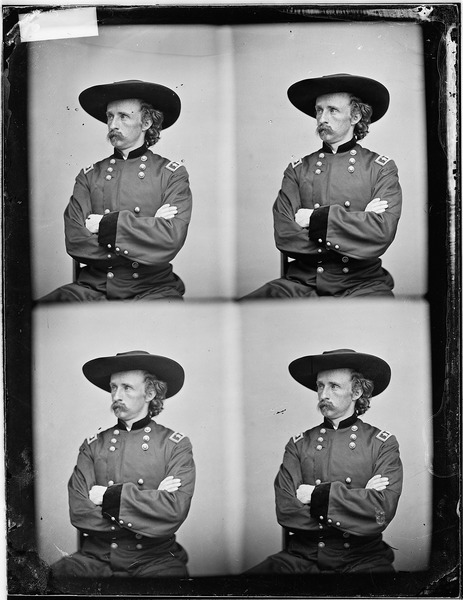
George Armstrong Custer, for instance, knew he was correct. From “It Was Only 75 Years Ago,” Life magazine’s 1951 retrospective of the Battle of the Little Bighorn:

He pressed forward although his men were weary and his supply train far behind.

Even when, on the morning of June 25, his force sighted a huge smoke haze on the other side of the Little Bighorn, indicating an enormous Indian camp, Custer disregarded warnings of his officers and scouts that a great mass of enemy was near. (It was, in fact, the biggest Indian mobilization in U.S. history.)

Inexplicably Custer divided his small force into three. He sent 120 men under Captain Frederick Benteen on patrol of the south. He then ordered Major Marcus Reno and 112 men to move toward what he still stubbornly believed was only 1,500 Sioux. Benteen encountered nothing. Reno ran into several thousand Sioux, made a desperate stand, then retreated with hideous losses to the other side of the river. There, joined by Benteen, he was able to re-form. Custer, to the perennial mystification of historians, never came to Reno’s support but, after trying to cross the river, proceeded north. He sent back a last message: ‘Benteen: Come on. Big Village. Be quick. Bring packs.’

Knowledge of what happened after that exists only in the misty minds of a few old Indians. Some 20 miles from where he separated his command, Custer and his 225 men were overwhelmed by almost 6,000 vengeful Sioux. From battlefield evidence they attacked from the southwest, drove the cavalrymen up a little mound and there killed them, including Mark Kellogg, a Bismarck, N. Dak. Tribune correspondent whom Custer brought along (against orders) to chronicle his new triumph and whose dispatches were later found in his pouch. Some of the dead were horribly mutilated; most were stripped. But George Custer, shot through the temple, was found with a peaceful expression on his face. He looked like a man who, hungry for glory all his life, had finally found it.”

Pile of bones remaining on the Little Bighorn battlefield, 1877.

Tags: , , ,

Print encyclopedias had grand ambitions–collecting and standardizing all human knowledge, encouraging rationalism, etc.–but there was a huge downside. As good as their intentions may have been, those editing the volumes were guided by their own prejudices and that narrowness was reflected in the books. Our current free-for-all of information assemblage is an improvement. It was a lie to begin with to believe that we could somehow neatly place all knowledge in a few orderly volumes. Instead this delusion has passed away and been replaced by far greater depth and navigability, thanks to our online culture. But inWhat We’ve Lost With The Demise Of Print Encyclopediasin the New Republic, David A. Bell sees a dark cloud: the expungment of a coherent throughline of knowledge. An excerpt:

“Yet with the disappearance of paper encyclopedias, a part of the Western intellectual tradition is disappearing as well. I am not speaking of the idea of impartial, objective, and meticulously accurate reference. There is no reason this cannot be duplicated in digital media. Even Wikipedia, despite its amateur, volunteer authors, has emerged as an increasingly important and accurate reference tool, reaping respectful commentary last month from no less an authority than William Cronon, president of the American Historical Association. And I am not speaking of the pleasures that come from the serendipitous browsing of handsome encyclopedia volumes, in which the idle flip of a finger takes one from Macaroni to Douglas MacArthur, and thence to Macao, Macbeth, and the Maccabees. The internet provides its own opportunities for serendipitous discovery.

But the great paper encyclopedias of the past had other, grander ambitions: They aspired to provide an overview of all human knowledge, and, still more boldly, to put that knowledge into a coherent, logical order. Even if they mostly organized their articles alphabetically, they also sought ways to link the material together thematically—all of it. In 1974, for instance, the editors of the Encyclopedia Britannica added to the work a one-volume ‘Propaedia,’ which sought to provide a detailed outline of human knowledge, while referencing the appropriate articles of the encyclopedia itself. Large headings such as ‘Life,’ ‘Society,’ and ‘Religion’ were subdivided into forty-odd ‘divisions’ and then further into hundreds of individual ‘sections.'” (Thanks Browser.)

••••••••••

Jiminy Cricket, who caused considerable damage to the crops due to his herbivorous feeding habits, encourages your children to be less gormless:

Tags: ,

B.F. Skinner, who could not stop messing with pigeons, makes a boid do a 360.

Tags:

From the October 26, 1893 Brooklyn Daily Eagle:

“Robert Ritter of Hempstead, who caused the arrest of his wife on a charge of assault the day after she horsewhipped him in the street, has withdrawn the charge and the couple has wept, kissed and made up. The reconciliation was effected by a conference between counsel representing them in the assault case. Ritter and his wife have again established themselves in the Centre Street house, and it is stated that Mr. Clemments, Mrs. Ritter’s father, has agreed to keep away from them. To his interference the whole trouble is attributed.”

Tags: , ,

"Very reasonable."

availible male (queens)

available white male here for the working ladies make me offers very reasonable

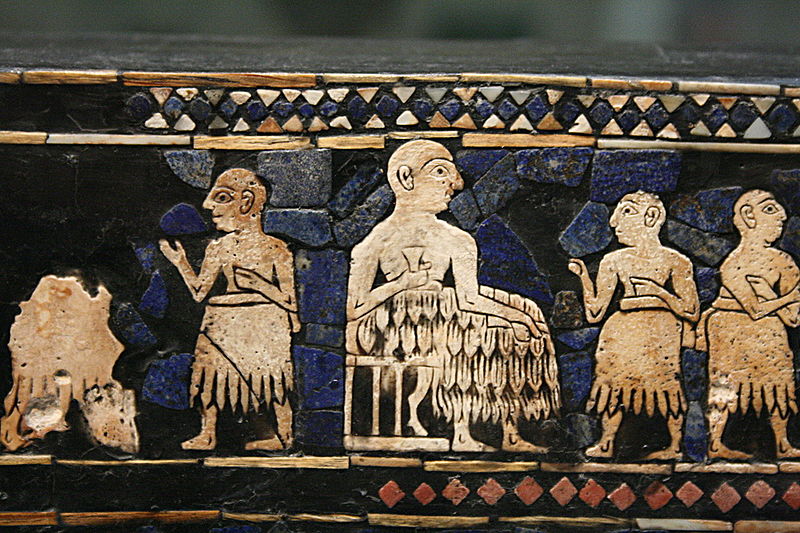
People will go to almost any length today for status, sacrificing whatever it takes for a brush with fame, for the chance to appear special. But that’s nothing new, not a product of media saturation or any other sort of modern condition. Desperation didn’t start with us. Earlier today, I came across this 2009 New York Times article about palace attendants in the ancient city of Ur, who angled for jobs that would provide them with a fleeting sense of importance before resulting in their brutal deaths. An excerpt:

“A new examination of skulls from the royal cemetery at Ur, discovered in Iraq almost a century ago, appears to support a more grisly interpretation than before of human sacrifices associated with elite burials in ancient Mesopotamia, archaeologists say.

Palace attendants, as part of royal mortuary ritual, were not dosed with poison to meet a rather serene death. Instead, a sharp instrument, a pike perhaps, was driven into their heads…There were two round holes in the soldier’s cranium and one in the woman’s, each about an inch in diameter. But the most convincing evidence, Dr. Monge said in an interview, were cracks radiating from the holes. Only if the holes were made in a living person would they have produced such a pattern of fractures along stress lines. The more brittle bones of a person long dead would shatter like glass, she explained.

Dr. Monge surmised that the holes were made by a sharp instrument and that death ‘by blunt-force trauma was almost immediate.’

Ritual killing associated with a royal death was practiced by other ancient cultures, archaeologists say, and raises a question: Why would anyone, knowing their probable fate, choose a life as a court attendant?

‘It’s almost like mass murder and hard for us to understand,’ Dr. Monge said. ‘But in the culture these were positions of great honor, and you lived well in the court, so it was a trade-off. Besides, the movement into the next world was not for them necessarily something to fear.'”

Even though Joni Mitchell wrote the most famous song about Woodstock, she had to skip the festival because her managers were afraid she might get stuck in traffic and not make it back to Manhattan in time for her scheduled performance the next day on the Dick Cavett Show. This is that performance.

At the 6:00 mark:

Tags: ,


Some search-engine keyphrases bringing traffic to Afflictor this week:

Afflictor: Thinking you should file your taxes this weekend and avoid an audit.

  • Hoarders are actually just trying to deny death.

Young Adult
The new technologies haven’t just connected us to one another but also to the past. We’ve always been emotionally attached to what was, of course, but now we are practically as well. Every day is a high school reunion, a scrapbook stuffed with memories that look inviting from a distance. It’s comforting, sure, but is that how things should be? Is a revolving door between now and then our healthiest option? Should the past be something in our appointment schedules or largely in our minds?

The second Jason Reitman-Diablo Cody collaboration centers on a former teen queen who’s now a soused writer of young-adult fiction (Charlize Theron). The YA series is in decline, as is the author, who returns to her stifling Minnesota hometown seeking consolation from a former high-school flame who is now married with children. “He knew me when I was at my best,” she says, confusing a time of lesser self-knowledge for one of greater happiness. Things soon get messy. Even if you have Google Maps on that shiny screen in your pocket, you still can’t go home again. Watch trailer.

••••••••••

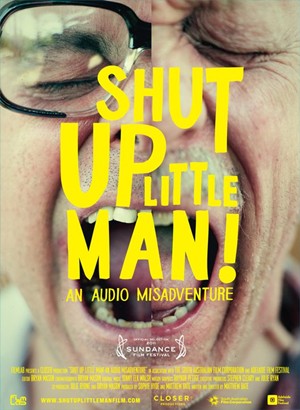
Shut Up, Little Man!: An Audio Misadventure
In Matthew Bate’s telling documentary, two Midwest punks, Mitchell Deprey and Eddie Lee Sausage, moved to a dumpy San Fran apartment building during the 1980s, unaware that their new neighbors were a loud, drunk, violent Odd Couple–an embittered redneck homophobe, Raymond Huffman, and his gay, surly roommate, Peter Haskett. When one punk confronts Ray about the noise, the “Cro-Magnon looking man with the neck muscles of a newborn” tells him to shove it. The punks moved on to plan B: popping a cassette into a boom box and recording the insane arguments. The mixtapes were shared with friends and gradually became an underground sensation, with playwrights, comic-book artists and filmmakers appropriating the very raw material to turn it into art (and profit). It was an analog precursor to our viral digital culture.

Questions abound in regards to intellectual property law and the nature of art, but perhaps the most revealing moment occurs during one of the “recording sessions,” when the punks snake a microphone outside Ray and Peter’s window to get better sound. The frenemies notice the device. “Oh, the neighbors are recording us,” one says, taking a brief break from swears and punches. But they quickly return to their brawl, disregarding the intrusion on their privacy. A couple decades later, their lack of inhibiton has become the norm. Watch trailer.

••••••••••

More recent films I liked now on home video:

Tags: , , , , , , ,

The human body is so much more resilient than we suppose, but it was not made for ultra-running, at least not in the long term. Leaving marathons in the dust, ultra-running competitions don’t just tax the body, they repossess it, as they stretch for dozens of miles across unforgiving terrain. Micah True, nicknamed “Caballo Blanco,” one of the competition’s pioneers, was found dead two weeks ago, enveloped in the shocking beauty of New Mexico’s Gila Wilderness. From his obituary in the Telegraph:

“A former prizefighter who once lived in a cave in Hawaii, True regularly ran distances of more than 50 miles over steep and rocky trails and, under the name Caballo Blanco (‘White Horse’) was a central character in Christopher McDougall’s book Born to Run (2009). As McDougall told it, the mysterious ‘Caballo’ became an almost mythic figure in the villages of Mexico’s Sierra Madre when he moved to live there in the mid-1990s: ‘Some said Caballo Blanco was a fugitive; others heard he was a boxer who’d run off to punish himself after beating a man to death in the ring. No one knew his name, age or where he was from.’ A village schoolmaster McDougall spoke to recalled that some of his pupils had been herding goats in the mountains when a ‘weird creature” with the shape of a man, but taller than any man they had ever seen and ‘deathly pale and bony as a corpse… with shocks of flame-coloured hair jutting out of his skull.’ had darted through the trees above them. The village elders thought it must be a dead soul, out to clear up some unfinished business.

On one matter, however, all accounts of Caballo Blanco concurred. He had come to northern Mexico in the 1990s and trekked deep into the wild, impenetrable Barrancas del Cobre, the ‘Copper Canyons,’ to live among the Tarahumara Indians, an enigmatic desert tribe famous for their ability to keep going over long distances. McDougall described how True had overcome athletic injuries to his ankles after learning a new way to run wearing the simple thin-soled sandals favoured by the Tarahumara. While testing them out ‘he’d slip-scramble sprint downhill for miles, barely in control, relying on his canyon-honed reflexes but still awaiting the pop of knee cartilage, the rip of a hamstring, the fiery burn of a torn Achilles tendon he knew was coming any second.’ But it never came.” (Thanks Browser.)

 ••••••••••

Micah True, Pack Burro Race, Colorado, 2011:

Tags:

VCRs will murder your children. Pre-Internet scare-mongering.

Dick Cavett interviewing Ingmar Bergman in 1971, before the filmmaker put himself on an island, literally and figuratively. Bibi Andersson joins the latter half of the discussion.

Tags: , ,

"They may be the Shadow-seer and the Earth-master foretold to bring about the beginning of the end."

Readers needed

I am an aspiring author and while some people close to me have read my book in progress and are excited I need outside feedback. This is a work in progress and is in no way complete. I merely want some readers to read the book and just point out the small mistakes that always bug me in a published book or give your input when something doesn’t make sense. This way I can ensure that I am putting out something that is worth it and not just another book that won’t be read.

Email with your information, why you want to help me with this and I will get back to you as soon as possible. Thank you.

Book description:

The prophecy contained in the scroll wasn’t widely known because of the future it foretold. It was a future filled with war, death, magic and the destruction of an ancient civilization.

They may be the Shadow-seer and the Earth-master foretold to bring about the beginning of the end but only if they can overcome all that has been forbidden.

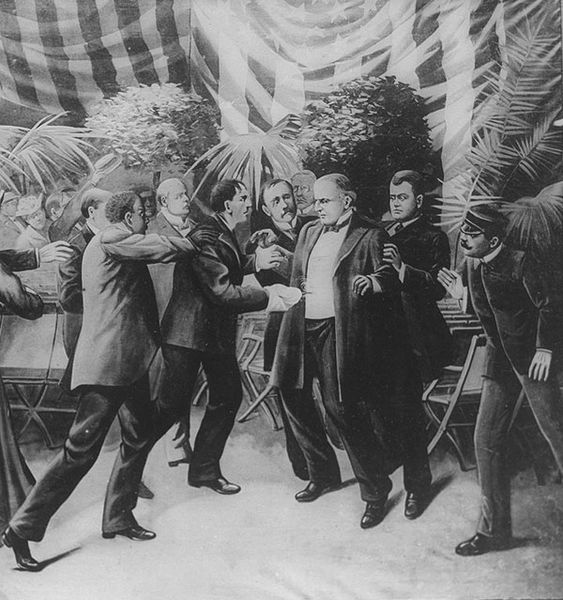
The 1901 assassination of President William McKinley in Buffalo, New York, had a bizarre and tragic echo in Muncie, Indiana, soon thereafter. A short article from the September 20, 1901 Brooklyn Daily Eagle:

Muncie, Ind.–Omer Peolee, aged 10, was fatally shot at Winchester last evening while posing as President McKinley at Buffalo for Emil Miller of the same age, who was the pretended anarchist in the case.

The lads were playmates and undertook to enact the Buffalo tragedy. Miller secured his brother’s rifle for the work. The ball passed almost through the child’s stomach and he will die. The parents are distracted.”

•••••••••

McKinley inauguration, 1901:

Tags: , ,

Are we so different than pigeons, you and I? By B.F. Skinner, of course.

Tags:

Two decades before Dan Okrent invented fantasy baseball at the Rotisserie restaurant in New York in 1980, there was John Burgeson, an IBM worker in Akron who figured out computer sports leagues long before there was an infrastructure to support them. Bess Kalb tells his story in an excellent new Grantland article. An excerpt:

‘The common narrative holds that the journalist Dan Okrent invented fantasy baseball in 1980 — and cleaving to the widely accepted definition of ‘fantasy baseball,’ it’s true. In Okrent’s vision, any fan could be the owner of a team in a fantasy league. Fantasy gamers would draft active MLB players based on whatever instincts and intangibles a real GM would take into consideration and they’d follow each player’s performance throughout the season to compete against other fantasy teams in the league. The concept was infectiously straightforward. By the end of the decade, a half million people throughout the country were deep into roto. Okrent’s version became a craze, and his game, not John’s, is why the modern incarnation of all fantasy sports exists.

While Okrent is indisputably the game’s father, John is its genetically distant forebear, and for the sake of historical correctness he recently decided to claim great-grand-paternity. In January 2009, just shy of his 80th birthday, John Burgeson logged on to Wikipedia and edited the entry for fantasy baseball to include this: ‘An early form of fantasy baseball was coded for an IBM 1620 computer in 1960 by John Burgeson, IBM Akron.’ He appended some scanned documents confirming the game’s existence, and with them, he wrote himself into history. Of course, neither Burgeson nor Okrent profited from their inventions, but on that day, John earned a bit of credit for an idea lost in a filing cabinet for 50 years.

In 1960, nobody cared about a computer wonk in Akron tinkering at his desk for his own amusement, and John’s game never caught on. “

••••••••••

Atari Baseball, 1979:

Read also:

Tags: ,

You cannot escape him now. Made with loving care by Boston Dynamics.

Arizona kids who hid from the desert heat in their temperature-controlled middle-class homes, gorging on all manner of television, the Tubes eventually emerged from the conditioned air to regurgitate on stage everything they’d been fed in their formative years, not necessarily drawing lines to separate the teachings of Bob Barker, Billy Graham and Bugs Bunny, because they all had fit so snugly inside the very same box in the living room.

A good 1978 doc about the media-saturated group:

Tags:

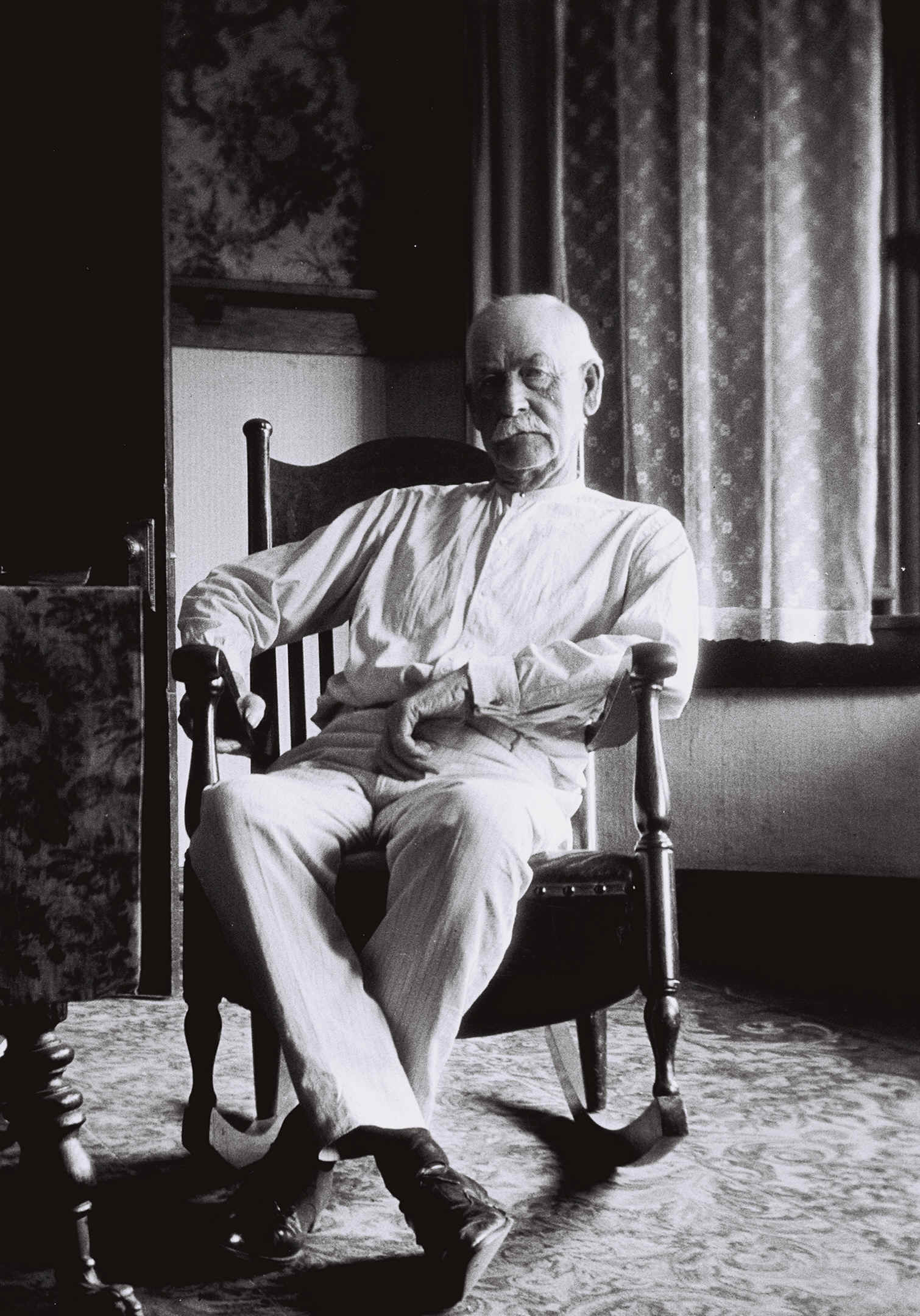
This classic photograph of legendary American frontier lawman Wyatt Earp in his dotage, shows a gunslinger at rest six years before his death, but nearly three decades earlier he was anythng but calm, having gotten himself into quite a fix in the Bay Area. Earp was brought in to referee the Bob Fitzsimmons-Tom Sharkey heavyweight prizefight in San Francisco on December 2, 1896, to be the strong arm to make sure that order ruled both inside the ring and out. But he caused a near-riot.

Earp walked into the ring with a Colt .45 strapped to him and that was the least crazy thing that occurred. The Wild West legend disqualified Fitzsimmons in the 8th round on a phantom foul. Plenty of people felt the call was crooked. The ring was nearly torn down and lawsuits were filed. Before long, Earp was jeered out of town. An excerpt from “Earp Has No Fears,” which ran in the December 4, 1896 Brooklyn Daily Eagle:

“San Francisco, Cal.–Wyatt Earp, the most talked about man of the hour, takes a philosophical view of the criticisms that are being heaped upon him for his decision Wednesday night, and says he will wait for the time to set him right with the public.

‘If I had any fears that I erred in my decision they would have disappeared when I saw Sharkey to-day,’ said he last night. ‘Sharkey did not strike a foul blow to my mind. At the break he struck Fitzsimmons as soon as his arm was free, but that is following Queensbury rules. It is true that it was agreed that there was to be no fighting at the break, but my instructions from the club were not to be technical, but to give the audience a good fight for their money.’

When Wyatt Earp appeared in the ring to act as referee, he wore a large sized pistol. Last night Earp was arrested on a charge of carrying concealed weapons. He was released on bail.

Police Commissioner Gunst is satisfied that the fight was jobbed. So disgusted is he with the general result that he has announced that there will be no more prize fighting in San Francisco if his influence can prevent it.”

••••••••••

Shockingly, Earp was hired to manage security for Fitzsimmons’ next match three months later in Carson City, Nevada, versus “Gentleman” Jim Corbett:

Tags: , , ,

someone sell me a guillotine (anywhere just give it to me)

will you just give me a damn guillotine jESUS CHRIST

« Older entries § Newer entries »