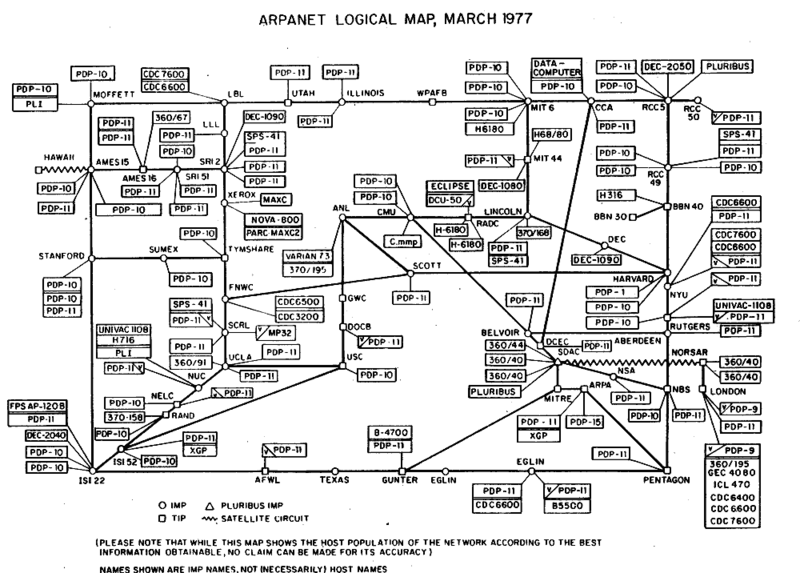
Vint Cerf, one of the fathers of our interconnected digital world, answering a Wired query about how he shepherded the Internet from proprietary to public:

Wired: So how did the internet get beyond the technical and academic community?

Cerf: Xerox invented the Alto machine which was a $50,000 personal computer given to every employee of Xerox PARC — so they’re living twenty years in the future for all practical purposes. They were even inventing their own internet. They had a whole suite of protocols. Some of the students that worked with me in Stanford went to work with Xerox PARC, so there was a lot of cross-fertilization.

It’s just that they decided to treat their protocol as proprietary, and Bob and I were desperate to have a non-proprietary protocol for the military to use. We said we’re not going to patent it, we’re not going to control it. We’re going to release it to the world as soon as it’s available, which we did.

So by 1988, I’m seeing this commercial phenomenon beginning to show up. Hardware makers are selling routers to universities so they can build up their campus networks. So I remember thinking, ‘Well, how are we going to get this in the hands of the general public?’ There were no public internet services at that point.

And there was a rule that the government had instituted that said you could not put commercial traffic on government-sponsored backbones, and, in this case, it was the ARPANET run by ARPA or for ARPA; the NSFNet run for the National Science Foundation, and there were others. The Department of Energy has ESnet and NASA had what was called the NASA Science Internet. The rule was no commercial traffic on any of them. So I thought, ‘Well, you know, we’re never going to get commercial networking until we have the business community seeing that commercial networking is actually a business possibility.’

So I went to the US government, specifically to a committee called the Federal Networking Council since they had the program managers from various agencies and they had been funding internet research. I said, ‘Would you give me permission to connect MCI Mail, a commercial e-mail service, to the internet as a test?’

Of course, my purpose was to break the rule that said you couldn’t have commercial traffic on the backbone.

And so they kind of grumbled for a while and they said, ‘Well, OK. Do it for a year.’”

••••••••••

A 1974 demo of the Xerox Alto:
Tags:

Americans loved gadgets before WWII, but the money wasn’t there to invest in machines during the Great Depression. A good part of the American postwar dividends was spent on machinery to ease life’s toil and just amaze, from kitchen appliances to bowling alley pinsetters. They had utility, but they were also fun to watch. Was our desire to see machines do their magic rooted in P.T. Barnum’s chicanery? Probably not. It’s probably an innate thing. But it’s an interesting theory. From Edward Tenner’s Atlantic essay, “The Pleasures of Seeing Machines Work“:

“The cultural historian Neil Harris has coined a phrase for this fascination with seeing things work, the Operational Aesthetic. One of the pleasures of bowling for postwar generations was the introduction of the automated pinspotter, the Roomba of the 1950s, which helped the sport’s explosive growth in the decade.

Who started it all? Harris has suggested it was none other than P.T. Barnum, whose American Museum in New York was widely (and rightly) suspected of fakery. But that helped build business. Visitors wanted to see for themselves, scrutinize the exhibits closely, and detect just how each illusion was accomplished. Barnum’s success was based not on cynicism about ‘suckers,’ but to the contrary, in appealing to critical intelligence to detect how it all was done.”

••••••••••

The history of Brunswick pinsetters:

Tags: , ,

A bunch of rich guys, including James Cameron, Ross Perot, Larry Page, Eric Schmidt and Peter H. Diamandis, may be announcing tomorrow that they are getting into the business of asteroid mining, extracting precious resources from zooming space rocks. From Forbes:

“Diamandis has been interested in asteroid mining for a long time, and it sounds like this might be his time to put a plan into action. There are staggering amounts of gold in them thar asteroids, even if they are sort of far away.

‘The earth is a crumb in a supermarket of resources,” Diamandis told Forbes earlier this year. “Now we finally have the technology to extract resources outside earth for the benefit of humanity without having to rape and pillage our planet.'”

••••••••••

Hyperspace, not free of risk, is nonetheless a handy option:

Tags: , , , ,

No surprise that there’s been a marked spike in usage of stimulants by American soldiers with our military taxed by wars on two fronts for a decade. From “Why Are We Drugging Our Soldiers?” by Richard A. Friedman in the New York Times:

“But there is another factor that might be playing a role in the increasing rates of the disorder, one that has escaped attention: the military’s use of stimulant medications, like Ritalin and Adderall, in our troops.

There has been a significant increase in the use of stimulant medication. Documents that I obtained in late 2010 through the Freedom of Information Act, and have recently analyzed, show that annual spending on stimulants jumped to $39 million in 2010 from $7.5 million in 2001 — more than a fivefold increase. Additional data provided by Tricare Management Activity, the arm of the Department of Defense that manages health care services for the military, reveals that the number of Ritalin and Adderall prescriptions written for active-duty service members increased by nearly 1,000 percent in five years, to 32,000 from 3,000.

Stimulants are widely used in the civilian population to treat attention deficit hyperactivity disorder because they increase focus and attention. Short of an unlikely epidemic of that disorder among our soldiers, the military almost certainly uses the stimulants to help fatigued and sleep-deprived troops stay alert and awake. (A spokesman for Tricare attributed the sharp rise to ‘the increased recognition and diagnosis of A.D.H.D. by medical providers.’ However, while there is greater recognition of the disorder, the diagnoses are concentrated in children and adolescents.)

Stimulants do much more than keep troops awake. They can also strengthen learning. By causing the direct release of norepinephrine — a close chemical relative of adrenaline — in the brain, stimulants facilitate memory formation. Not surprisingly, emotionally arousing experiences — both positive and negative — also cause a surge of norepinephrine, which helps to create vivid, long-lasting memories. That’s why we tend to remember events that stir our feelings and learn best when we are a little anxious.”

Tags:

Jools Holland interviews Eno, 1986.

Have you seen this movie? I’d like to see this movie.

Tags: ,

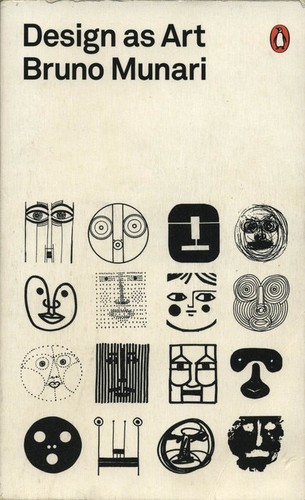
Picture 3 in the third row from the top looks like a precursor to Shepard Fairey's Obey the Giant.

On the gorgeous, newly redesigned Los Angeles Review of Books site, Hua Hsu writes about the history of office chair designs. In his piece, he mentions the legendary Italian designer Bruno Munari’s 1966 book, Design as Art. An excerpt from the book about the house of the future:

“The private house of the future (some are already lived in) will be as compact and comfortable as possible, easy to run and easy to keep clean without the trouble and expense of servants. A lot of single pieces of furniture will be replaced by built-in cupboards, and maybe we shall even achieve the simplicity, the truly human dimensions, of the traditional Japanese house, a tradition that is still alive.

In the house of the future, reduced as it will be to minimum size but equipped with the most practical gadgets, we will be able to keep a thousand ‘pictures’ in a box as big as a dictionary and project them on our white wall with an ordinary projector just as often as we please. And I do not mean colour photographs, but original works of art. With these techniques visual art will survive even if the old techniques disappear. Art is not technique, as everyone knows, and an artist can create with anything that comes to hand.”

••••••••••

Munari sharing design lessons with schoolchildren on Italian TV, 1976:

Tags: ,

The Earth will be fine without us; we’re only capable of killing ourselves. So, the phrase “Save the Earth,” while driven by great intentions, has always been something of a misnomer. We need to save ourselves from our own destruction. And if we do that, we’ll eventually need to rescue ourselves from a dying sun and other ominous sounds ringing out from the reaches of the universe. But let’s not pretend we’re doing it for someone or something else.

Notes on the topic by the funniest American ever, George Carlin:

Read also:

Tags:

Connectivity doesn’t guarantee closeness. In fact, we may seem closer together and actually be further apart than ever. From “The Flight From Conversation,” Sherry Turkle’s New York Times essay:

“Over the past 15 years, I’ve studied technologies of mobile connection and talked to hundreds of people of all ages and circumstances about their plugged-in lives. I’ve learned that the little devices most of us carry around are so powerful that they change not only what we do, but also who we are.

We’ve become accustomed to a new way of being ‘alone together.’ Technology-enabled, we are able to be with one another, and also elsewhere, connected to wherever we want to be. We want to customize our lives. We want to move in and out of where we are because the thing we value most is control over where we focus our attention. We have gotten used to the idea of being in a tribe of one, loyal to our own party.

Our colleagues want to go to that board meeting but pay attention only to what interests them. To some this seems like a good idea, but we can end up hiding from one another, even as we are constantly connected to one another.”

••••••••••

Turkle, talking to people about how we don’t talk to people:

Tags:

Long before American Idol, K-Tel provided an outlet for those who dreamed of pop stardom. The music industry, which somehow manages to be even worse than Hollywood, is the center of this 1973 board game. Oddly missing from the strategic options: consenting to sex with repellent record execs and banning the drummer from sharing your huge bowl of cocaine.

"No, not the bees!" (Image by Kirk Weaver.)

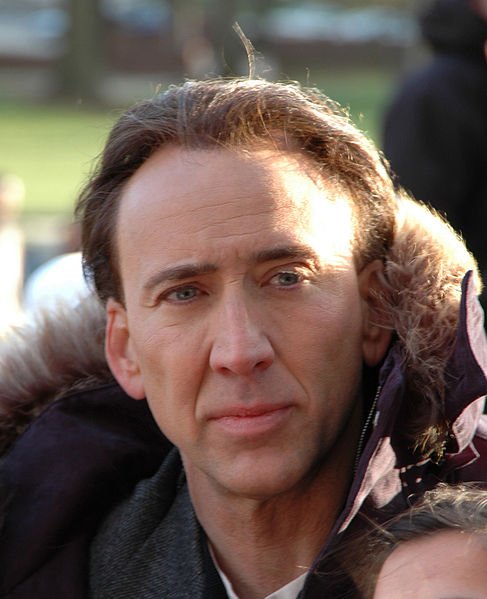
Attn: Nic Cage – Book Proposal

Dear Mr. Cage,

I recently read that you have developed your own school of acting, which you call ‘Nouveau Shamanic,’ and that you would like to write a book in which you explain this style and the philosophy behind it. I know that you are a busy man and may not have the time to make this dream a reality, so I would like to offer you my services. As a professional writer with experience in the media industry as well as a longtime fan of your work who has seen almost every film you have appeared in, I believe I am the right person for this task. I will be able to bring to life your unique voice. Every page of this book will scream with all the vividness of the voice that begged “No, not the bees!” in The Wicker Man, the righteousness of the man who asked “Why didn’t you just put the bunny down?” in Con Air, and the three-dimensionality of the man who made love while firing a sawed-off shotgun in Drive Angry 3-D.

I understand that you have experienced some financial difficulty in the last few years. I assure you I don’t need a dinosaur skull or German castle. The honor of working with you will be enough.

If this letter does not reach you promptly, I will print it out on the reverse side of copies of the Declaration of Independence and leave a copy in every cocktail bar in the French Quarter, as I understand that is the best way to reach you. 

"It is simply delicious."

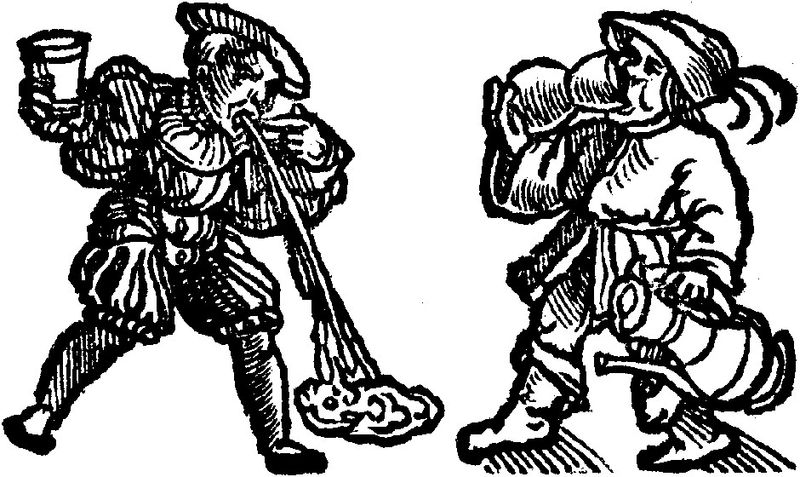
If we are to believe what journalism tells us, people in Albany during the 19th century would go to slaughterhouses to drink the blood of freshly killed animals for its salubrious effects. From the September 18, 1881 Brooklyn Daily Eagle:

“A reporter of the Albany Evening Journal who has visited the abattoirs in that city, writes as follows of the persons who gather there to drink blood:

Several people, as soon as the throat was cut with sleeves uprolled and grasping a glass, hurried over to the hanging carcass and holding the goblets in turn under the ruby stream, filled their glasses and then drank of the steaming liquid. One, a middle aged man, seemed old in the business, for he threw the contents of the glass off at one draught. Another threw some salt in his glass before drinking, while another could hardly make up his mind whether or not to drink it. At last he shut his eyes and then after three or four efforts succeeded in downing about half a glassful. The reporter approached one of the butchers after he had finished dressing the carcass on which he was at work, and asked, ‘Do the same persons come every day?’ ‘No, they come two or three times a week on the average,’ was the reply. ‘Do any women ever come?’ ‘Yes, there used to be one young girl, but the last I saw of her she seemed to be getting fleshy and has stopped coming altogether.’

"It is richer than the richest of cream."

One of the invalids was then approached and asked, ‘How do you like blood drinking?’ ‘Well, I’ll tell you. At first when the doctor told me I would have to drink warm bullock’s blood or die, I told him that I preferred the latter, but I reconsidered my thought and came up to the slaughterhouse. I thought at first I could not touch it, and the sight of killing sickened me. But I soon overcame that feeling, and when I raised the first glass to my lips I spilt the contents over me. Next time I shut my eyes and drank it down. It tasted like rich milk, and if I kept my eyes shut, I would have not the known the difference.’ Another one of the drinkers was asked how it tasted. ‘How does it taste?’ said he. ‘It is richer than the richest of cream. It is simply delicious and a drink not to be compared with any potion extant. It is simply the elixir of life. You can feel its strength as it spreads through your veins. If it hadn’t been for its strengthening qualities I would have been dead three years ago.'”

Marshall McLuhan knew already in 1965 that the world was becoming virtual.

Tags:


Some search-engine keyphrases bringing traffic to Afflictor this week:

Afflictor: Happy to see the Secret Service hard at work.

  • Dude who likes having sex with trees answers questions.

Although they’re dressed like sheiks rather than spacemen, the 14 robed figures in this classic photograph had just completed the grueling three-day Astronaut Desert Survival School near the Stead Air Force base in Nevada. Mercury and Apollo astronauts were brought not only to the scorched sands of Nevada but transported all around the nation to prepare them for the rigors of outer space. An excerpt from Fallen Astronauts: Heroes Who Died Reaching for the Moon

“There was some heavy and intense training to be carried out. The men had to condition their bodies to withstand multiple stresses such as those associated with weightlessness and acceleration, vibration, immobilization and disorientation, noise, and heat and cold. They had become proficient in the use of dozens of training devices and rescue aids, to simulate a number of incidents and learn how to avoid or survive them.

Just as they had undergone contingency training in the Panamanian jungle, the astronauts could not exclude a landing in the ferocious heat and isolation of the desert, so after the classroom studies it was back on the road again. They were transported to a survival-training group near Stead AFB in the dry sagebrush country of western Nevada. Once again they could use only the equipment they would have at hand after an emergency landing as their survival gear. 

Apart from survival training, field trips saw the astronauts conveyed to all corners of the country, where they were acquainted with geological compositions similar to those they might encounter on the moon’s surface. They descended into the mile-deep grandeur of the Grand Canyon, scouted the Big Bend country of the Rio Grande, visited the Valley of Ten Thousand Smokes in the Katmai Monument in Alaska, and crunched over black lava flows in Arizona’s Sunset Crater.”

During the gas crisis of 1979, American car owners alternated days they could fill their tanks based on whether they had an odd or even number at the end of their license plates. What it looked like in Los Angeles.

Racism is not always a black-and-white thing. There are shades of gray in the minds of racists, allowing them to convince themselves that, no, they aren’t bigots. Some can accept people of other races in a lesser social position but not those in a superior one. Others can write off members of another race who’ve excelled as exceptions, while still believing “the rule.” We’re all prone to believe generalizations without holding ourseves to account. From Touré in Time:

“Racism is a mental tumor. It’s an acceptance of stereotypes, of otherness, of fear, of racial hierarchies. It requires embracing the concept of constants about certain racial groups even though there are no biological certainties about the races. Scientifically, there is only the human race. Race as we know it is a social construct and, in the sweep of human history, a relatively recent concept invented in America to justify having both “liberty for all” and slavery. Racism has long had sub-ideas protecting it like bodyguards—the idea that blacks were lesser human beings with inferior brain power and morality and criminal proclivities aided in the perpetuation of slavery, Jim Crow and the current wave of criminalization in which young black men are considered synonymous with criminals—some have captured this via the term “criminalblackman.”

Some people suggest that the multiracial embrace of Barack Obama, Oprah Winfrey, Michael Jordan, Will Smith and others portends the end of racism. But this, as the writer Arundati Roy says, is like the President pardoning one turkey before Thanksgiving and then eating another—and America eats thousands. The human mind is complex enough to integrate hypocrisy and contradictions. There have long been extraordinary blacks who succeeded far more than the vast majority and were accepted as special. The racist mind need not hate every black person it encounters, and indeed not hating all may serve as a valuable safety valve, releasing pressure and proving to the mind itself that it is not racist. Few people want to think of themselves as bad or evil.”

Tags:

Howard Katz, in charge of NFL scheduling, has trillions of options to consider when figuring out which matchups will best serve the league during any given season. And no schedule he designs will completely satisfy networks, players and fans. From Judy Battista in the New York Times:

“After recalling what he thought was a coup last year — putting a game between the New Orleans Saints and the Indianapolis Colts on the Sunday night opposite the World Series, only to watch the Saints obliterate a Peyton Manning-less Colts team, 62-7 — Katz summed up the snap judgments of the schedule that are as quick to change as a channel.

‘We’re geniuses one day and absolute morons the next,’ he said.

For the networks that pay billions of dollars to carry N.F.L. games, they have been mostly geniuses. N.F.L. games were watched by an average of 17.5 million viewers last season, the second most since 1989, and off slightly from 2010. N.F.L. games accounted for 23 of the 25 most-watched television shows among all programming, and the 16 most-watched shows on cable last fall.

Designing a schedule that generates those ratings, while also guaranteeing competitive fairness, is more complicated than ever, even though a computer program in use for eight years now does some of the work that was once done entirely by hand — spitting out 400,000 complete or partial schedules from a possible 824 trillion game combinations.”

Tags: ,

New IBM lithium-air car batteries can go for 500 miles without recharge:

Sweet William preferred a gas guzzler, 1970s:

Tags:

sparring club opening (medford)

Im looking for fighters who want to train and beat the shit out of each other…period. controlled sparring. must be atleast 18.

There’s a full version online of Jean-Luc Godard’s 1968/72 collaboration with D.A. Pennebaker and Richard Leacock. Filmed originally as 1 A.M. (as in “One American Movie”), it was planned as Godard’s understanding of U.S. culture during the Vietnam age. (Though perhaps “misunderstanding” would be the more accurate term.) The project went uncompleted, was shelved and later reedited by Pennebaker into 1 P.M. (as in “One Parallel Movie”). A fascinating failure, the film features Rip Torn, Jefferson Airplane, Eldridge Cleaver and Tom Hayden, among others. (Thanks Dangerous Minds.)

Tags: , ,

"Going viral like this requires massive connections of friends." (Image by Gilberto Santa Rosa.)

Can we, in this wired and connected age, have privacy as well as intimacy? Are we to break free from the shackles of Zuckerberg and allow the rise of networks that afford us more control of our lives? Or will we obediently create the content for channels that others program? From Ben Kunz’s new Businessweek article about the rise of “unsocial” networks:

“For nearly a decade, marketers have been agog over the promise of social networks to provide free advertising, a cascade of word-of-mouth in which consumers act as advocates for a brand or product. The dream is based in part on Robert Metcalfe’s law—the concept by the inventor of the Ethernet that in any networked system, value grows exponentially as more users join. Like the old 1970s shampoo commercial, you tell a customer about your product, and she tells two friends, and so on, and so on, until the world is knocking on your hair-products door. Going viral like this requires massive connections of friends.

Trouble is, Metcalfe was wrong, at least with human networks. In a landmark 2006 column in IEEE Spectrum, researchers Bob Briscoe, Andrew Odlyzko, and Benjamin Tilly showed mathematically that networks have a fundamental flaw if all nodes are not created equal. The authors pointed primarily to Zipf’s law, a concept by 1930s linguist George Zipf that in any system of resources, there exists declining value for each subsequent item. In the English language, we use the word ‘the’ in 7 percent of all utterances, followed by ‘of’ for 3.5 percent of words, with trailing usage of terms ending somewhere around the noun ‘floccinaucinihilipilification.’ On Facebook, your connections work the same way from your spouse to best friend to boss to that old girlfriend who now lives in Iceland.

Human networks, like words in English, have long tails of diminishing usage.”

••••••••••

“And so on and so on and so on…”:

Tags:

Non-invasive diagnostics that tell you about illnesses in your zip code and in your body. From Scanadu.

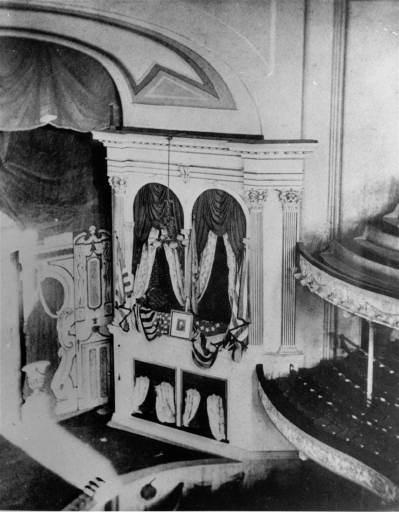
The recent Secret Service fiasco in Colombia made me think about John Frederick Parker, one of the original Washington D.C. police officers, who was fired in 1868 for literally sleeping on the job. (He had earlier been acquitted of charges of dereliction of duty and visiting prostitutes.) It was in 1865, however, when Parker had the costliest lapse of his stumblefuck career. From an article about his death in the July 20, 1890 Brooklyn Daily Eagle:

“The one man in the world who could have prevented the assassination of President Lincoln is dead. John Fredrick Parker, born in Winchester, Va., came to Washington some time before the firing upon Fort Sumter and soon found employment upon the metropolitan police force. When in 1862 it was decided to strengthen the regular force of doorkeepers and watchmen at the White House with a squad of policemen, Parker was one of those selected. It thus happened that when President Lincoln and party entered the old Ford Theater on the night of Good Friday, 1865, they were accompanied by Parker as guard. He took the position at the door to the private box from which President Lincoln watched the performance, where he was expected to remain and prevent the entrance of every one except the members of the party. As the play proceeded Parker from his post could hear just enough of what was said on the stage to arouse his curiosity, and it was not long before he left the door and edged his way toward the auditorium. He finally took a seat in the orchestra, or ‘pit’ as it was then called, where he had scarcely settled himself when the whole audience was surprised by the report of a pistol shot. The assassin, Booth, had stealthily approached the door of the president’s private box, where, finding no one to challenge him, he entered unannounced and fired the fatal shot. There is no question in the minds of those who are familiar with the details that had Parker remained at his post Booth could never had taken President Lincoln unawares.”

Tags: ,

The newest breed of information companies (Google excluded) create wealth, not jobs. That’s not an accusation, just a fact. Economist Brian Arthur refers to this dynamic as the “Second Economy,”–new technology shrinking the American workforce in an inversion of how railroad technology increased it during the 19th century. From Bill Davidow’s smart, recent article about the Second Economy at the Atlantic:

“When the disappointing jobs numbers were reported last week (employers added 120,000 jobs in March, about half the number reported in the two previous months), analysts tripped over themselves looking for an explanation. Of course, jobs numbers are bound to vary, but in my view the long-term trend calls for more jobs to disappear, and the reason is clear as day: the exploding Second Economy.

The Second Economy — a term the economist Brian Arthur  uses to describe the computer-intensive portion of the economy — is, quite simply, the virtual economy. One of its main byproducts is the replacement of low-productivity workers with computers. It’s growing by leaps and bounds, brimming with optimistic entrepreneurs, and spawning a new generation of billionaires. In fact, the booming Second Economy will probably drive much of the economic growth in the coming decades.

Unfortunately, the Second Economy will not create many jobs.”

••••••••••

“Assembly lines that fix themselves”:

Tags: ,

« Older entries § Newer entries »