Wow. Original Beatles manager Brian Epstein on What’s My Line? in 1964. Host John Daly mistakenly identifies him as “Barry.” Epstein was allegedly the inspiration for Baby, You’re a Rich Man, the song used so effectively at the conclusion of The Social Network.
“How does it feel to be one of the beautiful people?”:
That amazing 1970s Schaefer Beer commercial featuring a Moog synthesizer reminded me of this 1969 Tomorrow’s World segment introducing Robert Moog’s great contribution to music.
The great Memphis photographer William Eggleston was at the vanguard of color photos as a legitimate aesthetic. An inveterate drinker who somehow functions at a very high level, he’s appropriately on display in the Cat Power video, Lived in Bars. Eggleston can be seen most clearly at the 2:14 mark when he gives the singer a kiss on the side of the head.
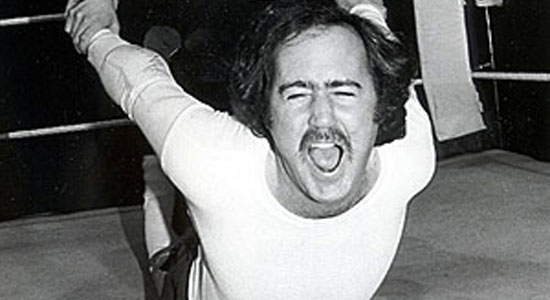
Never knew that Laurie Anderson was a running partner–and wrestling partner–of Andy Kaufman back in the day, until I read this passage from a Believer Q&A conducted by Amanda Stern:
“BLVR:
Did he talk about why he was doing what he was doing?
Laurie Anderson:
He didn’t have to. The hardest part was wrestling with him, because he would be doing these club shows where he was very abusive to women, very abusive: ‘Those broads think they are… Who do they think they are?’ You know, ‘I will not respect a woman until she comes up here and wrestles me down,’ and that was my cue to come up there and wrestle him down, and I’m like on my third whiskey—I don’t usually drink, but trying to get up the nerve—and he would fight, and he wasn’t pretending. He’d twist my arm.
BLVR:
Did you ever get really hurt?
Laurie Anderson:
No, he wouldn’t break my arm, but he would really twist it around, and I fought back. It was definitely not pretend-wrestling. He wasn’t acting, and neither was I, but at the same time it was a game. There are plenty of ways you can play the game of fighting and really seem to be fighting without going for the jugular. Anyway, he was just curious about taboos. To be playing bongos and sobbing—I mean, everyone in the club is looking at that and going, ‘My god, this is so embarrassing.’ You’re not supposed to cry while you sing or play. That’s our job as the audience. We get to have a tear roll quietly down our cheeks, but not the performer.”
______________________
Andy was Intergender Wrestling Champion, back when that title still meant something:
Laurie looked at the viral nature of language in 1984, before all communication went in that direction:
Another moral failing in the recent history of the Catholic Church came in response to the death sentence imposed on Salman Rushdie by Ayatollah Khomeini after the publication of The Satanic Verses. From a 1989 New York Times piece by Michael T. Kaufman:
“In the United States, 17 Roman Catholic writers, including William Kennedy, Maureen Howard, Garry Wills and the Rev. Andrew Greeley, wrote a letter critical of statements by John Cardinal O’Connor, the Archbishop of New York. The letter noted the statement Sunday by the Cardinal in which he said that he would not read the book but that he proclaimed ‘his sympathy for the aggrieved position’ of Muslims.
The Catholic writers said they ‘deplore the moral insensitivity to the plight of Mr. Rushdie and an ecumenical zeal that would appear to support repression.’
Gara LaMarche, the head of the freedom-to-write program of American PEN, an international writers’ group, acknowledged that ‘for a short period of time immediately after the death threat there was a great deal of discussion about what was the best way to help Salman Rushdie.’ He said that this may have ‘given an impression of reluctance,’ but he added that in recent days writers have been calling from all over the world to offer their help with petitions and readings.”
••••••••••
Christopher Hitchens addresses the non-defense of Rushdie, 1989:
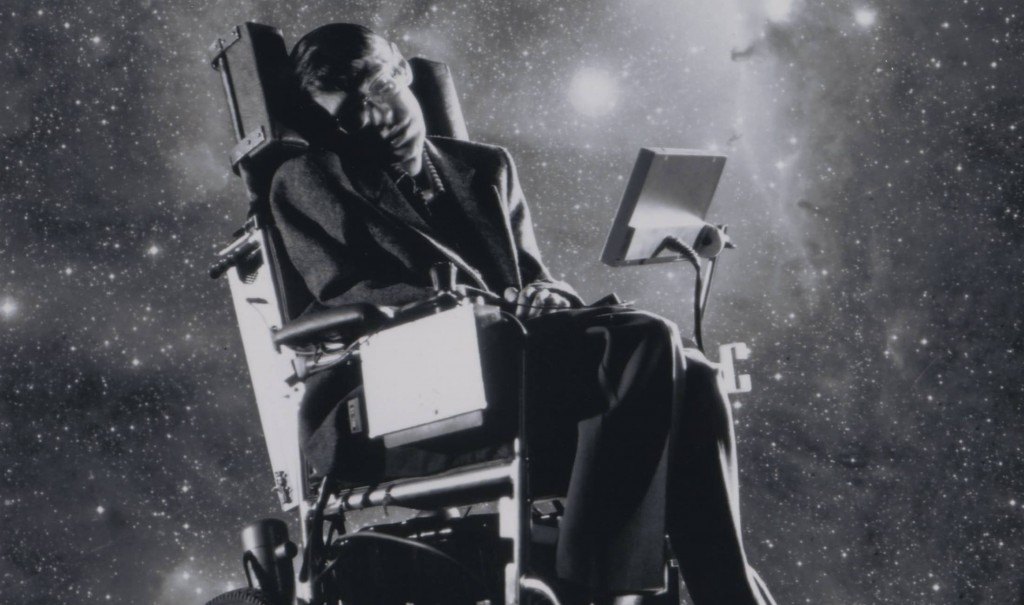
"It wouldn't be Stephen's voice any more" (Image by Errol Morris.)
From “The Man Who Saves Stephen Hawking’s Voice,” a New Scientist Q&A conducted by Catherine de Lange with the phsyicist’s personal technician, Sam Blackburn, who is soon leaving his post:
“Stephen’s voice is very distinctive, but you say there might be a problem retaining it? I guess the most interesting thing in my office is a little grey box, which contains the only copy we have of Stephen’s hardware voice synthesiser. The card inside dates back to the 1980s and this particular one contains Stephen’s voice. There’s a processor on it which has a unique program that turns text into speech that sounds like Stephen’s, and we have only two of these cards. The company that made them went bankrupt and nobody knows how it works any more. I am trying to reverse engineer it, which is quite tricky.
Can’t you update it with a new synthesiser? No. It has to sound exactly the same. The voice is one of the unique things that defines Stephen in my opinion. He could easily change to a voice that was clearer, perhaps more soothing to listen to – less robotic sounding – but it wouldn’t be Stephen’s voice any more.”
This is tremendous. During the 1970s, at the height of prog rock popularity, Schaefer Beer had multitalented musician Edd Kalehoff make a commercial in which he played the company’s jingle on a Moog synthesizer. Kalehoff is a legend in the TV biz, having created the cues for The Price Is Right and the Monday Night Football theme song. But here he rocked at his most progressive.
From Kevn Kelly’s comments on the Technium about copyright law and the public commons:
“It is in the interest of culture to have a large and dynamic public domain. The greatest classics of Disney were all based on stories in the public domain, and Walt Disney showed how public domain ideas and characters could be leveraged by others to bring enjoyment and money. But ironically, after Walt died, the Disney corporation became the major backer of the extended copyright laws, in order to keep the very few original ideas they had — like Mickey Mouse — from going into the public domain. Also ironically, just as Disney was smothering the public domain, their own great fortunes waned because they were strangling the main source of their own creativity, which was public domain material. They were unable to generate their own new material, so they had to buy Pixar.
A tragedy of the commons occurs when members behave selfishly and deny the commons what is due. As Disney shows, when members keep their creations out of the common pool for others to exploit, their gain is only short lived. Mickey Mouse, Superman, and eventually Darth Vader and Luke Skywalker all belong in the commons. The world will be a better place when they are.
We should repeal unreasonable intellectual property laws, to keep the incentives for a period no longer than the life of its creators (how can you be invented if you are dead?). But in the meantime, imagine what the creative public could do with these works, and weep — because nothing like that will happen for a very long time.”
"Such uncertainty was once unthinkable at Kodak." (Image by Doug Coldwell.)
A former blue-chip bleeding red, Kodak is preparing to file bankruptcy. From a WSJ piece about the fall of a giant, by Mike Spector and Dana Mattioli:
“That Kodak is even contemplating a bankruptcy filing represents a final reversal of fortune for a company that once dominated its industry, drawing engineering talent from around the country to its Rochester, N.Y., headquarters and plowing money into research that produced thousands of breakthroughs in imaging and other technologies.
The company, for instance, invented the digital camera—in 1975—but never managed to capitalize on the new technology.
Casting about for alternatives to its lucrative but shrinking film business, Kodak toyed with chemicals, bathroom cleaners and medical-testing devices in the 1980s and 1990s, before deciding to focus on consumer and commercial printers in the past half-decade under Chief Executive Antonio Perez.
None of the new pursuits generated the cash needed to fund the change in course and cover the company’s big obligations to its retirees. A Chapter 11 filing could help Kodak shed some of those obligations, but the viability of the company’s printer strategy has yet to be demonstrated, raising questions about the fate of the company’s 19,000 employees.
Such uncertainty was once unthinkable at Kodak, whose near-monopoly on film produced high margins that the company shared with its workers. On ‘wage dividend days,’ a tradition started by Kodak founder George Eastman, the company would pay out bonuses to all workers based on its results, and employees would use the checks to buy cars and celebrate at fancy restaurants.
Former employees say the company was the Apple Inc. or Google Inc. of its time.”
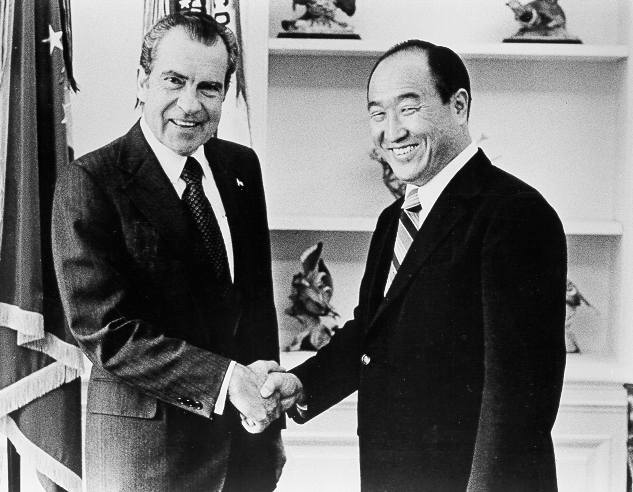
As much as conservative cartoonist Al Capp hated Rev. Sun Myung Moon, he deplored John Lennon and Yoko Ono even more. From Capp’s brief, belligerent visit to the Bed-In for Peace in Montreal in 1969.
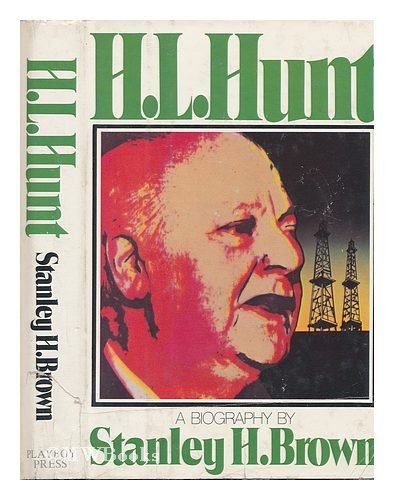
When you possess $5 billion and several families full of highly ambitious people, you bequeath a great deal of drama along with great wealth when you die. H.L. Hunt, an oilman with a backstory as large as Texas itself, left just that sort of a messy arrangement in 1974 when he succumbed to cancer. His descendants behaved in such a manner that they reputedly were the inspiration for the melodramatic TV series, Dallas. From a1974 People:
“Haroldson Lafayette Hunt was 32 and broke when he sat down to a game of five-card stud in the Arkansas boom town of El Dorado and won his first oil well. By the time he died of cancer two weeks ago at age 85, H.L. Hunt had pyramided his poker winnings into a global oil empire that made him one of the world’s half-dozen wealthiest men. Long before ‘Popsie’ Hunt’s death, however, an ugly struggle had already begun within his family over the disposition of the Texas tycoon’s personal fortune, estimated at $5 billion.
The issue is between Hunt’s children by his first wife and those of his second. His first marriage to Lyda Bunker Hunt produced four sons and two daughters—Mrs. Al Hill, 59, H.L. Jr., 57, Mrs. Hugo W. Schoellkopf Jr., 52, Nelson Bunker, 48, Herbert, 46, and Lamar, 42. Hunt’s second wife was Ruth Ray Wright, a former Hunt company secretary, who married H.L. two years after Lyda’s death in 1955. She had four children, whom H.L. immediately adopted: Ray, 30, June, 29, Helen, 26, and Swanee, 23. (Friends say members of the family have told them H.L. was their actual as well as adoptive father.)
The internecine intrigue began, H.L. confidant Paul Rothermel told a federal grand jury, when he convinced the patriarch in 1969 to leave 51% of Hunt Oil to the ‘second family.’ The first six children, recalled Rothermel, had already amassed many millions of their own. However, the other four children had ‘only’ about $3 million all-told in trust funds. Two years later, private detectives working for Nelson Bunker and Herbert were convicted of tapping the phones of Rothermel and four other Hunt Oil executives believed sympathetic to the younger set of Hunts. Themselves now under federal indictment for ordering the wiretaps, Nelson Bunker and Herbert have pleaded not guilty, arguing that they simply wanted to investigate unaccountable company losses of $62 million over two years. Should the two Hunts be convicted, they could be fined up to $10,000 or be sentenced to five years, or both. For his part, Rothermel has come to an undisclosed out-of-court settlement with the Hunts over the wiretap. “
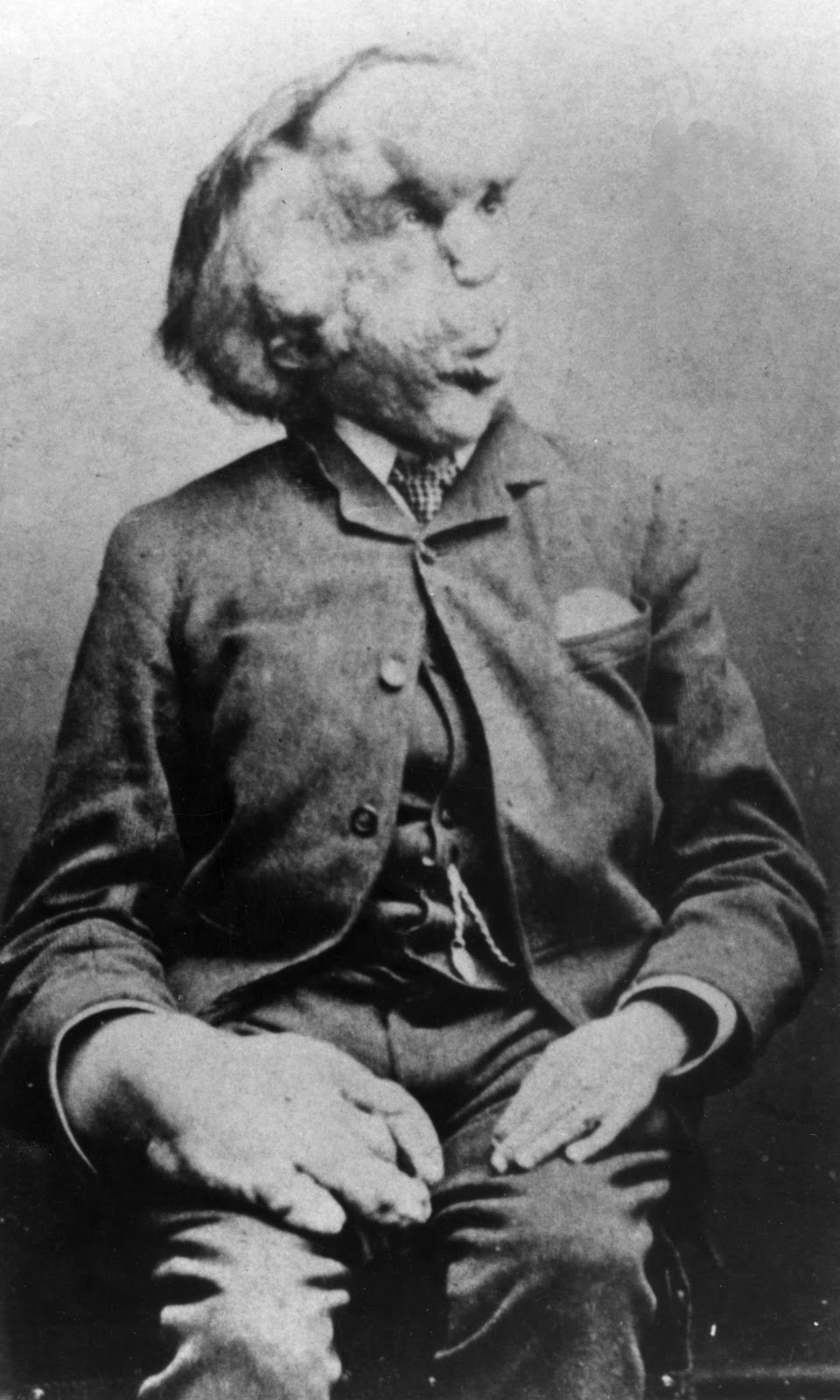
How cool. The first part of a 1980 episode of Friday Night…Saturday Morning featuring an interview with David Bowie, who was giving a stunning performance on Broadway in The Elephant Man at the time. Embedding is disabled on Youtube, but go here:
If we lived to 200 or 300 years old, would the world be less noisy? Would a lack of urgency give humanity a quietist nature? I doubt it, but Douglas Coupland thinks so.
I got the flu a number of years ago while reading Gina Kolata’s excellent book about the 1918 influenza pandemic, but I’m not pointing fingers. The opening of “Power in Numbers,” her new New York Times profile of Eric Lander, a brilliant mathematician who made the unlikely career switch to genome-mapping without the benefit of a biology background:
“His Ph.D. is in pure mathematics, in a subfield so esoteric and specialized that even if someone gets a great result, it can be appreciated by only a few dozen people in the entire world. But he left that world behind and, with no formal training, entered another: the world of molecular biology, medicine and genomics.ounding director of the Broad Institute of Harvard and M.I.T., he heads a biology empire and raises money from billionaires. He also teaches freshman biology (a course he never took) at M.I.T., advises President Obama on science and runs a lab.
Eric Lander — as a friend, Prof. David Botstein of Princeton, put it — knows how to spot and seize an opportunity when one arises. And he has another quality, says his high school friend Paul Zeitz: bravery combined with optimism.
‘He was super smart, but so what?’ said Dr. Zeitz, now a mathematics professor at the University of San Francisco. ‘Pure intellectual heft is like someone who can bench-press a thousand pounds. But so what, if you don’t know what to do with it?’
Eric Lander, he added, knew what to do. And he knew how to carry out strong ideas about where progress in medicine will come from — large interdisciplinary teams collaborating rather than single researchers burrowed in their labs.
So how did he end up at the Broad Institute, going from the most solitary of sciences to forging new sorts of collaborations in a field he never formally studied? What sort of person can make that journey?
Dr. Lander’s story can be told as a linear narrative of lucky breaks and perfect opportunities. But he doesn’t subscribe to that sort of magical thinking. To him, biography is something of a confection: ‘You live your life prospectively and tell your story retrospectively, so it looks like everything is converging.'”
••••••••••
Back to the 1918 flu pandemic for a moment: “Grotesque and ugly in their influenza masks, the people of San Francisco celebrate.”
Rolltop, the laptop you can roll up. Just a concept at this point. Now if they can just teach the guy in the video how to remove the stick from his ass.
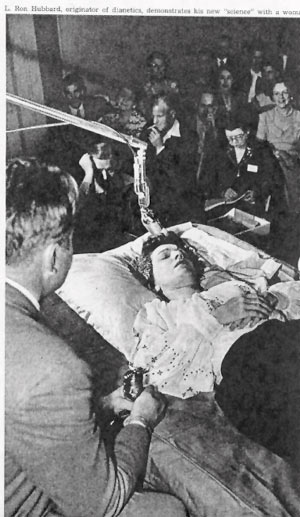
Before we fully descended into the Age of Celebrity, People magazine used to do hard-hitting journalism along with its fluff and risk all sorts of legal hazards in the process. From the 1978 article, “The Bizarre Cult of Scientology“:
“Perhaps no critic of the church has suffered more than New York free-lance writer Paulette Cooper, author of a 1971 book titled The Scandal of Scientology–and the target of the church operation code-named ‘Freak Out.’ Her publisher withdrew Scandal and destroyed most copies almost as soon as it was printed–in the face of defamation suits in five countries seeking $15 million damages. But according to a suit Cooper plans to file after the federal indictments are announced, the church continued for years afterward to press a smear campaign bent on putting her ‘in a mental institution [or] in jail.’ To that end, she charges, that church members followed her, stole her diary, threatened her with a gun, lifted files for her psychiatrist and her lawyer, wrote anonymous ‘Dear Fellow Tenant’ letters saying she was a sexual deviant with venereal disease–and framed her on federal charges of making bomb threats against the church. (They wrote the threats themselves on her stationery, which they had stolen.) Charges were eventually dropped when she passed a seven-hour sodium-pentothal test, but she had to spend $28,000 to defend herself and $4,000 on psychotherapy to cope with the stress. ‘At one point I was down to 83 pounds,’ she remembers. The recently seized church documents may well support her latest suit against the church–for $40 million damages–but she still lives like a fugitive, using the service elevator in her New York apartment and wearing dark sunglasses and disguises.”
Tom Schiller and Albert Brooks were among those who created short films and videos for SNL in the early days. I’ve had a couple of chance meetings with Schiller, who also directed anamazing documentary about Henry Miller. For some reason, he spoke with an incredibly fake Russian accent on both occasions. I guess he was just screwing with the world because he wasn’t crazy about the way it was. And who could blame him? Here’s “Java Junkie,” Schiller’s 1979 SNL short about caffeine madness.
I’ve never met Brooks, that standoffish jerk. Here’s his 1976 SNL film, “The Famous Comedians School”:
“Tyson first saw the Milky Way when he was nine, projected across the ceiling of New York’s Hayden Planetarium. He thought it was a hoax. From the roof of the Skyview Apartments in the Bronx, where he grew up, he could only see a few bright stars. When Tyson turned eleven, a friend loaned him a pair of 7×35 binoculars. They weren’t powerful enough to reveal the Milky Way in the Bronx sky. But they did let him make out the craters on the moon. That was enough to convince him that the sky was worth looking at.
He began to work his way up through a series of telescopes. For his twelfth birthday, he got a 2.4-inch refractor with three eyepieces and a solar projection screen. Dog walking earned him a five-foot-long Newtonian with an electric clock for tracking stars. Tyson would run an extension cord across the Skyview’s two-acre roof into a friend’s apartment window. Fairly often, someone would call the police. He charmed the cops with the rings of Saturn.
Tyson took classes at the Hayden Planetarium and then began to travel to darker places to look more closely at the heavens. In 1973, at age fourteen, he went to the Mojave Desert for an astronomy summer camp. Comet Kahoutek had appeared earlier in the year, and Tyson spent much of his time in the Mojave taking pictures of its long-tailed entry into the solar system. After a month he emerged from the desert, an astronomer to the bone.” (Thanks Longform.)