Allen Ginsberg in London in 1967, talking about how communication via technology changes the meaning, alters the context. And as the screens have gotten smaller and more ubiquitous, we’re not just lost in our own surroundings but in our own heads as well.
You are currently browsing the archive for the Videos category.
Tags: Allen Ginsberg
In 1981, actor Sterling Hayden, who began looking like Tom Waits’ hobo uncle a decade earlier, visits with Tom Snyder. In part one, Hayden discusses his failed attempts at writing an article for Rolling Stone about the funeral of Yugoslavia’s late dictator Marshal Tito.
Tags: Sterling Hayden, Tom Snyder
Chico Marx, an inveterate gambler, blew through all his motion-picture money and was forced in his later years to play small clubs and do guest appearances on TV shows. Here’s part of his final such television shot, in 1960, on Championship Bridge. He looked like hell.
Tags: Chico Marx
Omni magazine was the fascinating science journal turned out by pornographer Bob Guccione, whose face and pants were both made of leather. The singular publication was by turns brilliant and bullshit and batshit. Claire Evans of Vice recently got to visit an awe-inspiring archive of the defunct mag and filed a report. An excerpt:
“When I was given, offhandedly, in an email, a shot at poking through this collection, I’d imagined long tables stacked with documents and boxes brimming with unpublished science-fiction gems. I was told it was an archive, and, to me, the word ‘archive’ implied something academic, a facility staffed by white-gloved attendants. Instead, the OMNI archive is a nebulous assortment of filing cabinets, piles of paintings, folders haphazardly stuffed with printing acetates and doodles—all strewn about a medical-supply sales office in Englewood, New Jersey. There are attendants, but they aren’t librarians; they’re employees of Jeremy Frommer, a financier and fast-talking entrepreneur who came upon the collection accidentally, when a storage locker he bought on a whim last November happened to contain a sizable chunk of the estate of Bob Guccione, lord and master of the Penthouse empire and, less famously, publisher of OMNI magazine.
Guccione, if he is remembered at all, is usually mythologized as a kitsch tycoon dripping with gold chains, shirt open practically to his waist. His 27,000-square-foot home in Manhattan was the largest private residence in the city. He collected Van Gogh and Picasso paintings and filled his homes with busts of Caesar, Napoleonic sphinxes, and hand-molded brick shipped from Italy. He was a recluse, by some accounts. He shot the early Penthouse pictorials himself. And he loved science fiction. Jane Homlish, Bob’s personal assistant for 37 years, who I met in Englewood, explained it to me this way: ‘He always said that people with genius minds—and his mind was established as genius—were always as fascinated with sex as they were science.’
Bob Guccione died in 2010, by which point OMNI magazine was long gone—but in Englewood, they both live on. Sheet after sheet of slides are being dusted off, examined, and photographed. Original cover artwork from the magazine is being hunted down. Paintings are being uncrated. People like me are being brought in, simply to marvel at the goods. In one afternoon, I found cover drafts with greasy pencil notations, thousands of 35-mm slides, large-format chromes, magazines bundled with stapled paperwork, production materials, and untold amounts of photos and artwork. It’s chaos. Everything is still being fussed through and tossed around; after his storage unit mother lode, Jeremy got the bug, and the OMNI collection keeps growing. He has but one goal: to own the most complete collection in the world of ephemera relating to this largely forgotten magazine. ‘I don’t think there is anything like this collection,’ Jeremy told me. ‘I don’t even think it exists for a specific magazine, let alone the coolest geek sci-fi magazine of the 80s and 90s.'”
•••••
Guccione discusses Omni and other topics. Crappy footage but worth it.
Omni commercial from 1978, with a voiceover by the Gooch:
Tags: Bob Guccione, Claire Evans, Jane Homlish, Jeremy Frommer
From a Telegraph article by Jeevan Vasagar about Germany automaker’s plans to gradually sway drivers into giving up the wheel:
“Devised by a team at the Free University of Berlin, the self-driving VW Passat is a highly advanced autonomous car, capable of navigating a safe path through unpredictable city traffic.
It sees the world through a spinning silver cylinder mounted on the roof, a laser scanner, which generates one million data points per second to give the car’s computer a real-time map of its surroundings.
Cameras and radar sensors provide a further wealth of detail, alongside an ultra-precise GPS based on the navigation systems used in aircraft.
It will be many years before a car this sophisticated is commercially available. But Germany’s luxury car makers have begun introducing an array of autonomous features which enable some of their leading models to drive and steer themselves.
Rather than the sudden advent of robot vehicles, car makers believe autonomous driving will be introduced gradually.
Daimler, which owns Mercedes Benz, predicts that at low speeds – such as in traffic jams or parking – cars will operate with full autonomy ‘in a matter of years.’ At higher speeds, several manufacturers plan for highly automated driving within the structured environment of the motorway.”
•••••
The great Peter Stormare, representing Deutschland:
Tags: Jeevan Vasagar
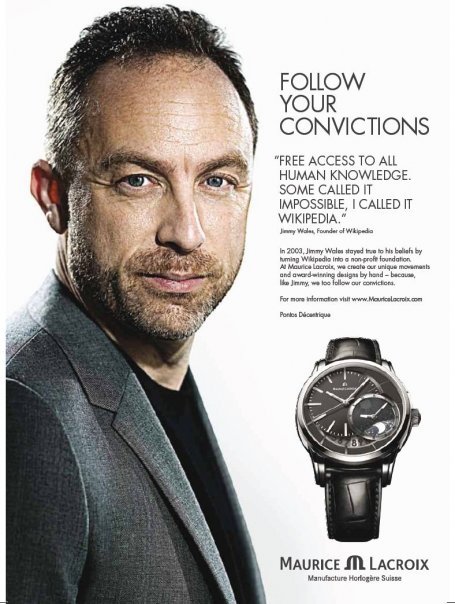
“Jimmy Wales Is Not an Internet Billionaire” is the title of Amy Chozick’s short, sharp New York Times Magazine portrait of the Wikipedia founder, a singular figure in the Information Age, who was right about crowdsourcing knowledge when almost everyone else thought he was wrong, when he was treated like a punchline. The collective nature of the virtual encyclopedia made it impossible for Wales to cash in, but somehow I think he’ll slide by. Let’s weep for others. An excerpt:
“Wikipedia, which is now available in 285 languages, gets more than 20 billion page views and roughly 516 million unique visitors a month. It is the fifth-most-visited Web site in the world behind Google, Yahoo, Microsoft and Facebook; and ahead of Amazon, Apple and eBay. Were Wikipedia to accept banner and video ads, it could, by most estimates, be worth as much as $5 billion. But that kind of commercial sellout would probably cause the members of the community, who are not paid for their contributions, to revolt. ‘The paradox,’ says Michael J. Wolf, managing director at Activate, a technology-consulting firm in New York and a member of the Yahoo! board, ‘is that what makes Wikipedia so valuable for users is what gets in its way of becoming a valuable, for-profit enterprise.’
Wales suffers from the same paradox. Being the most famous traveling spokesman for Internet freedom brings in a decent living, but it’s not Silicon Valley money. It’s barely London money. Wales’s total net worth, by most estimates, is just above $1 million, including stock from his for-profit company Wikia, a wiki-hosting service. His income is a topic of constant fascination. Type ‘Jimmy Wales‘ into Google and ‘net worth’ is the first pre-emptive search to pop up. ‘Everyone makes fun of Jimmy for leaving the money on the table,’ says Sue Gardner, the executive director of the Wikimedia Foundation, the nonprofit that runs Wikipedia.
Wales is well rehearsed in brushing off questions about his income. In 2005, Florida Trend magazine reported that he made enough money in his brief stint as an options-and-futures trader in Chicago, before starting Wikipedia, that he would never have to work again. But that was before he had to pay child support and rent for homes in Florida and London. When I brought up the topic recently, Wales seemed irritated. ‘It rarely crosses my mind,’ he said. ‘Reporters ask me all the time and expect me to say: ‘I’m heartbroken. Where’s my billion dollars?’ On two occasions, he compared himself to an Ohio car salesman. ‘There are car dealers in Ohio who have far more money than I’ll ever have, and their jobs are much, much less interesting than mine,’ he said during one conversation. When his net worth came up again, he brought up Ayn Rand. ‘Can you imagine Howard Roark saying, ‘I just want to make as much money as possible?’ Wales asked rhetorically.
Wales likes to invoke the higher purpose of Wikipedia.“
•••••
Encyclopedia Britannica infomercial, 1992:
Tags: Amy Chozick, Jimmy Wales
Nissan has entered an electric car into competition at Le Mans, which is, of course, a great thing. But I have a further question about such races.
You know I’ve said before that it’s difficult for me to wrap my brain around people surrendering the wheel to computers, no matter how amazing an improvement robocars would be, no matter how much safer. But what if it happens? What if the large majority of autos in the future are driven by software? Would auto races be remote control affairs, the winner being the team with the best programmers and engineers? Would the driver, that mythopoeic figure, be disappeared? Would he or she go the way of the horse that used to pull the cart?
Look at this amazing person, Andrew “Cyber AJ” Johnson, who’s had electrodes implanted in his brain to mitigate the motor symptoms of his Parkinson’s. (Thanks Krulwich.)
Mason Peck, NASA’s chief technologist, did a smart Ask Me Anything at Reddit about a month ago. He’s back doing another one right now, this time focusing on asteroid exploration. A few exchanges follow.
_________________________
Question:
What is the actual chance of an asteroid large enough to do some serious damage actually hitting us anytime soon?
Mason Peck:
Very low. None of the asteroids we have found are expected to impact the earth in the foreseeable future. And we have found most of the largest asteroids. There are still many smaller ones that remain undetected. That’s the current challenge: where are those asteroids, and do they pose a threat?
_________________________
Question:
When is it estimated that NASA will be able to send people to an asteroid?
Mason Peck:
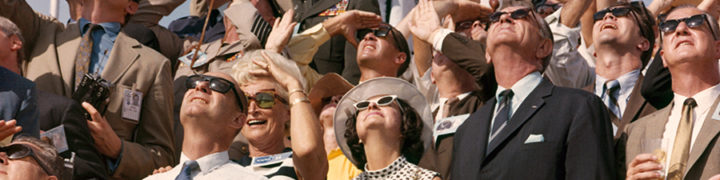
The President’s goal is for NASA to do so by 2025. If we find the right asteroid, we’ll be able to do so as early as 2021. We’ll use mostly hardware we’ve already got and are already working on, including the SLS launch vehicle and the Orion multi-purpose crew vehicle.
_________________________
Question:
I’m an idiot on this subject, and please forgive me. So are you guys going to… blowup asteroids? Like with a missile or something?
Mason Peck:
The asteroid initiative includes plans to send a robotic spacecraft to move a small asteroid into an orbit near the moon. It also includes a Grand Challenge in which we ask for the world to engage with NASA to identify the threats asteroids pose to human populations and then know what to do about them. The Grand Challenge addresses your question. There are many ideas about how to keep an asteroid from hitting the Earth, but the best offense is a good defense: know where they are, and the sooner we know, the easier it will be to deflect them.
_________________________
Question:
What is the point/what can be gained from moving a small asteroid into orbit near the moon?
Mason Peck:
So much! We’ll learn how to send humans beyond Earth orbit, using technologies that will take us to Mars in the following decade. The moon is relatively convenient and safe, compared to trying out these systems for the first time in Mars orbit. So, this is a very cost-effective and yet ambitious way to make a lot of progress towards exploring Mars.
We’re going to send the first, robotic spacecraft under the power of solar-electric propulsion (SEP). So, this mission will be a technology demonstration of a technique that is broadly applicable across NASA’s portfolio and will help the commercial space industry as well. Our plans are to use a 30-50 kW SEP system here, which is traceable to at least 10x that level. This is a bold move, depending on a technology demo. That audacity recalls Apollo and the other work that has made NASA great.
The President’s goal is for NASA to do so by 2025. If we find the right asteroid, we’ll be able to do so as early as 2021. We’ll use mostly hardware we’ve already got and are already working on, including the SLS launch vehicle and the Orion multi-purpose crew vehicle.
Tags: Mason Peck
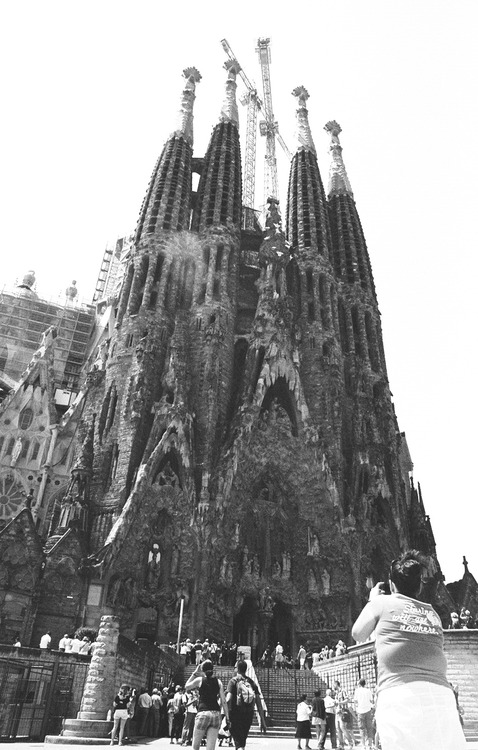
As you might have noticed from the Google Doodle, today is the 161st birthday of architect Antoni Gaudi, who designed buildings that often seem to be haunting, hiding, falling, melting–like old women weeping because they’ve been exposed to the sun for too long. And some of his other work looks like a future too good to ever arrive.
From National Geographic: “The Sagrada Família has always been revered and reviled. The surrealists claimed Gaudí as one of their own, while George Orwell called the church ‘one of the most hideous buildings in the world.’ As idiosyncratic as Gaudí himself, it is a vision inspired by the architect’s religious faith and love of nature. He understood that the natural world is rife with curved forms, not straight lines. And he noticed that natural construction tends to favor sinewy materials such as wood, muscle, and tendon. With these organic models in mind, Gaudí based his buildings on a simple premise: If nature is the work of God, and if architectural forms are derived from nature, then the best way to honor God is to design buildings based on his work.”
Here’s the “Casa Batlló” section from Antonio Gaudí, an almost wordless 1985 cine-essay by Hiroshi Teshigahara, who made several genius films, including this one.
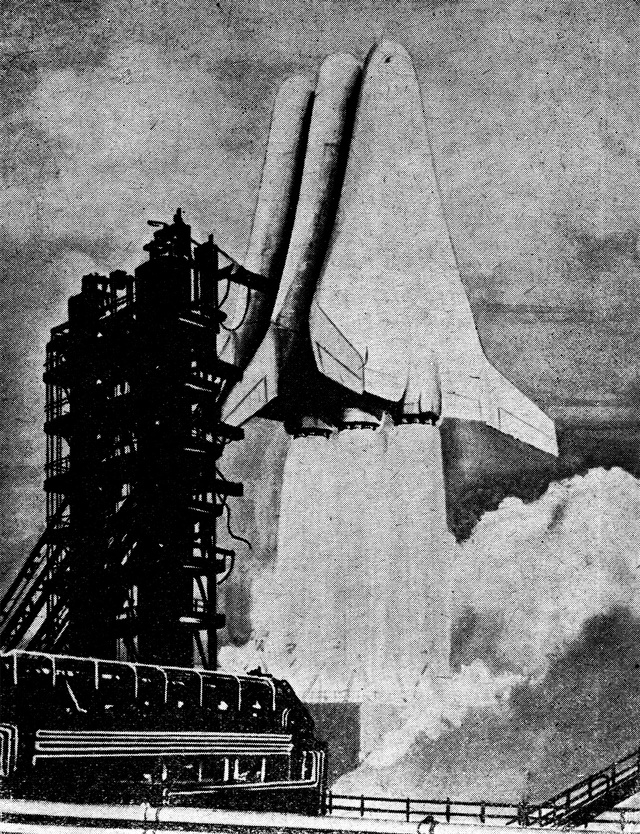
From an Economist article about newly released archives which detail futuristic tech projects in Britain that never reached fruition, a brief bit from 1968 about the MUSTARD (the Multi-Unit Space Transport And Recovery Device) space shuttle:
“READERS of a certain age may remember Gerry and Sylvia Anderson’s sci-fi puppet shows—Supercar, Fireball XL5, Stingray, Thunderbirds and Captain Scarlet—filmed, as the Andersons put it, in “Supermarionation”. Those who remember Captain Scarlet in particular may find one of the pictures here eerily familiar. English Electric’s Fighter Jet Take-Off Platform, a flying airfield, is not quite the Cloudbase from which the immortal captain operated. But it was intended, like its fictional counterpart, to launch and receive planes while itself airborne. It would have taken off and landed vertically in, say, a jungle clearing otherwise inaccessible to the aircraft piggybacking on it.
English Electric was one of the firms merged into what eventually became BAE Systems, and BAE has recently been through its archives and publicised some of the projects dreamed up in the glory days of the 1960s, when designers’ imaginations were allowed to run riot with little consideration of practicality or budget. MUSTARD (the Multi-Unit Space Transport And Recovery Device), for example, was designed by the British Aircraft Corporation (BAC). It could pass for something out of Fireball XL5 or Supercar—though it also resembles Virgin Galactic’s SpaceShipTwo which will, Virgin hopes, soon be taking paying passengers to the edge of space. It would have been a three-stage space-plane, though only one stage would have made it into orbit. The other two were reusable boosters.”
•••••
“This man will be our hero, for fate will make him indestructible. His name: Captain Scarlet.”
The opening of “Man of the Future,” a very well-written article by Alex Mar at the Believer, about the death–perhaps temporary–of Iranian transhumanist Fereidoun Esfandiary:
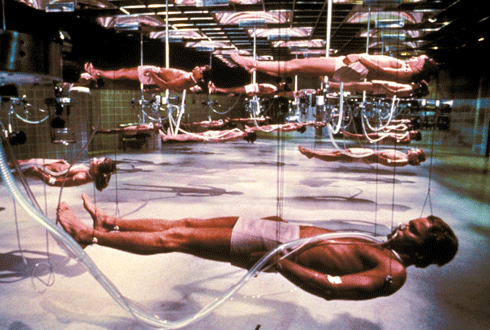
“On July 8, 2000, a man was loaded into an ambulance, packed in with dozens of Ziploc bags of ice cubes, and rushed onto the long flight from New York City to Scottsdale, Arizona. Several hours earlier, he’d been pronounced clinically dead, but on the ground a team of technicians had rallied around his cancer-riddled cadaver with great optimism.
At the Alcor Life Extension Foundation, they laid out the body—now patient A-1261—on an operating table encased in a coffin-shaped Plexiglas box. To keep the temperature down, the technicians pumped the box full of hyper-cold nitrogen gas, maintaining A-1261 in what they believed to be a liminal state—on pause. They worked so feverishly to preserve the body because it belonged to one of their champions. A-1261 was (and, they hoped, would someday become again) one of the world’s most celebrated transhumanists, a prominent member of a loose collective of futurists working in philosophy, science, and technology to realize humankind’s full potential, with the ultimate goal of shrugging off the shackles of aging and death. At Alcor, the Holy See of cryonics, the attendants were of the same tribe, and this is how you die if you’re one of them: an impermanent death, your mind and all the radical ideas contained therein ‘cryopreserved’ until a distant, far more evolved Future is ready to grow you a new body and embrace you as your Phase Two, cyborg self. A transhumanist’s death is merely a pit stop on the way to his inevitable resurrection.
The surgeons inserted their bright blue rubber-gloved hands through mail-slot openings in the Plexiglas to tend to the vessel. They cut deeply with the scalpel, then identified the precise spot—between the sixth and seventh vertebrae—and with a chisel and a mallet lopped off the head of Fereidoun Esfandiary.”
•••••
Now you can tweet forever:
Tags: Alex Mar, Fereidoun Esfandiary
Mae West, a great and dirty writer as well as a stage and screen icon, is visited by Dick Cavett on a Hollywood backlot in 1976.
Tags: Dick Cavett, Mae West
If you thought Google Glass couldn’t get any more annoying, how about listening to Noam Chomsky complain about Google Glass? That’s the sound of my brain exploding.
Tags: Noam Chomsky
From a fascinating, brief portrait by Andrew E. Kramer of the New York Times of a space-age city in decline, a remnant of the collapsed Soviet Union that maintains vital importance as one of two active space-launch sites in the world:
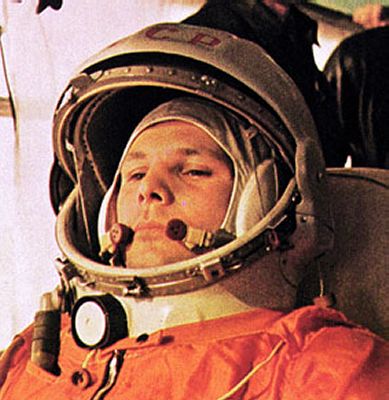
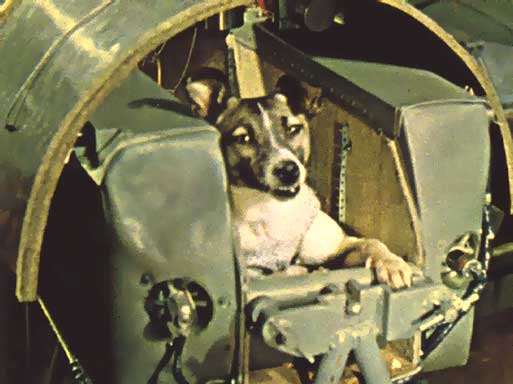
“Baikonur, in remote western Kazakhstan, was once the pride of the Soviet Union, the home of the Baikonur Cosmodrome, the launching site of Sputnik, the dog Laika and the first man in space, Yuri Gagarin. But today, nomadic herders from the nearby steppe are moving into abandoned buildings.
That is just one of the signs of the city’s long fade into the sunset of post-Soviet social and economic problems, which are all the more remarkable given that much of the world, including the United States, still relies on Baikonur for manned space launchings. The only other site for such liftoffs is in Jiuquan, in the Gobi Desert in China.
‘It’s painful for me to think of my town,’ Anna Khodakovskaya, the editor of the local newspaper, said of its glum state. The first cellphones appeared here in 2004; the first M.R.I. machine in 2011. ‘We are not ahead of the planet in anything but space,’ she said.”
•••••
A video about Laika, the first animal to orbit Earth. She did not have a happy return like Ham the AstroChimp.
Swiss researchers have produced a robot that runs like a cat, to be used in rescue missions.
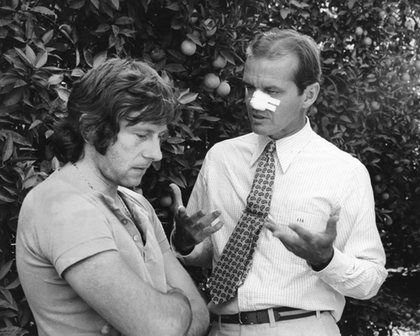
Roman Polanski–wanted, desired and, now, Skyped. This April 2013 interview took place between the fugitive director and the Roxie Theater in San Francisco. In 1997, while vacationing in Paris, I was seated in a cinema on the Champs-Élysées waiting for the beginning of Howard Stern’s Private Parts. Who walked in just as the credits were about to start but Roman Polanski and an angelic-looking blond, who was either a woman who looked like a girl or a girl who looked like a woman. Polanski laughed aloud during the scene about Howard’s Bergman-esque college film.
Tags: Howard Stern, Roman Polanski
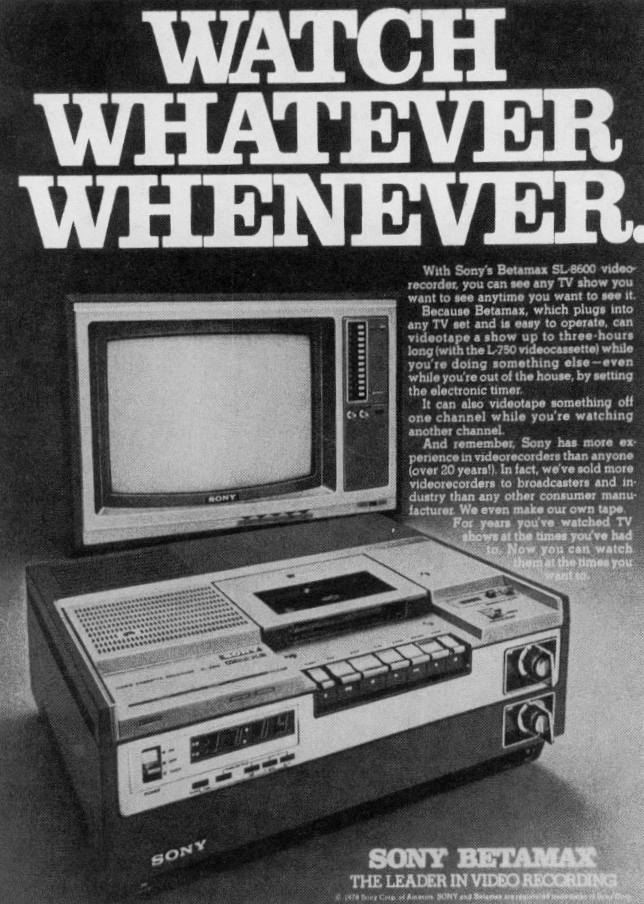
Time-shifting, largely an excellent thing, all began with the simple VHS vs. Betamax format war. From an Ars Technica article about the most disruptive recent technologies:
“Time-shifting (or why Jack Valenti is spinning in his grave)
Time-shifting content has been with us for a long time, driving the media industry nuts ever since the invention of the video cassette recorder. In 1982, Jack Valenti—then president of the Motion Picture Association of America—testified before Congress, saying, ‘The VCR is to the American film producer and the American public as the Boston strangler is to the woman home alone.’ (See the Ars series on TV for more Valenti rage.)
But Betamax and VHS were just the beginning. It was a shaky beginning at that, as I can tell you firsthand from years of prying my kids’ mangled copy of half a season’s worth of Power Rangers episodes out of the maw of a VCR tape slot. When hard drives were eventually married to video recording, it did a lot more than just change the recording mechanism. Digital recording moved time-shifting of TV and other content off tapes, virtualizing and outsourcing the recording process to the point that broadcast times are almost irrelevant.
So in some ways, Jack Valenti was right about time-shifting, or at least prescient. The virtualization of broadcast content—its separation from the tyranny of network time slots and from recording media itself—has changed the acts of viewing and listening. It’s accelerated the disintegration of network television and hastened the creation of new media outlets made purely for the Internet. If it weren’t for the move from analog VCR to bits on a disk, things like Netflix’s on-demand service and its all-at-once release of the original series House of Cards would never have happened.”
••••••••••
Time-shifting in 1977:
Tags: Jack Valenti
Tags: Gilda Radner
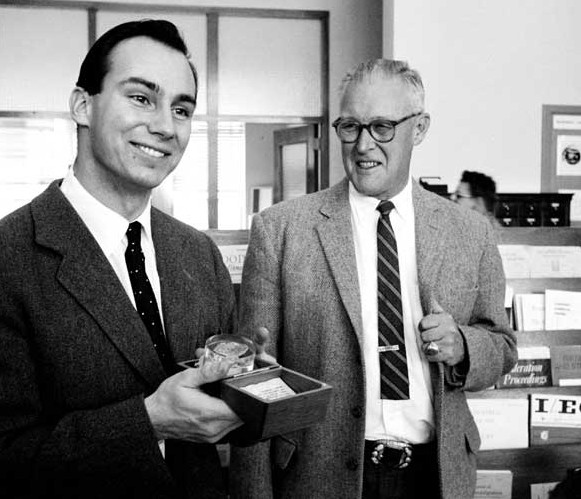
Aga Khan IV, spiritual leader and one of the world’s richest royals, cut quite a cosmopolitan, dashing figure in his younger days, marrying models, skiing competitively, racing horses and posing for photo ops. Here’s a hypnotic documentary about him from 1964.
Tags: Aga Khan IV
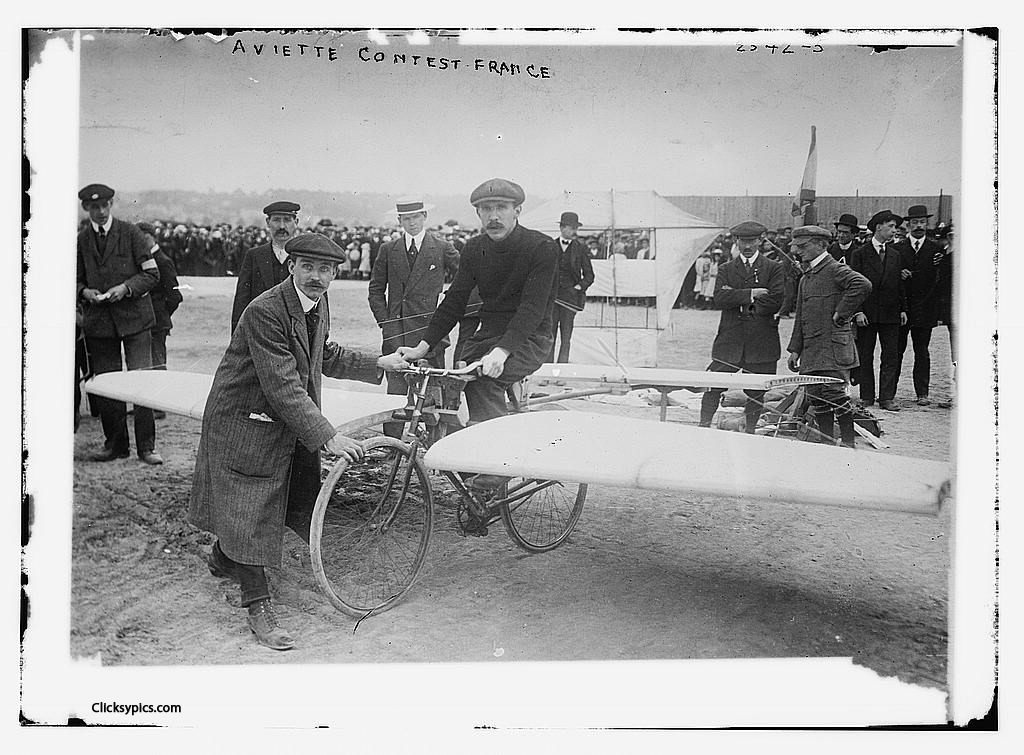
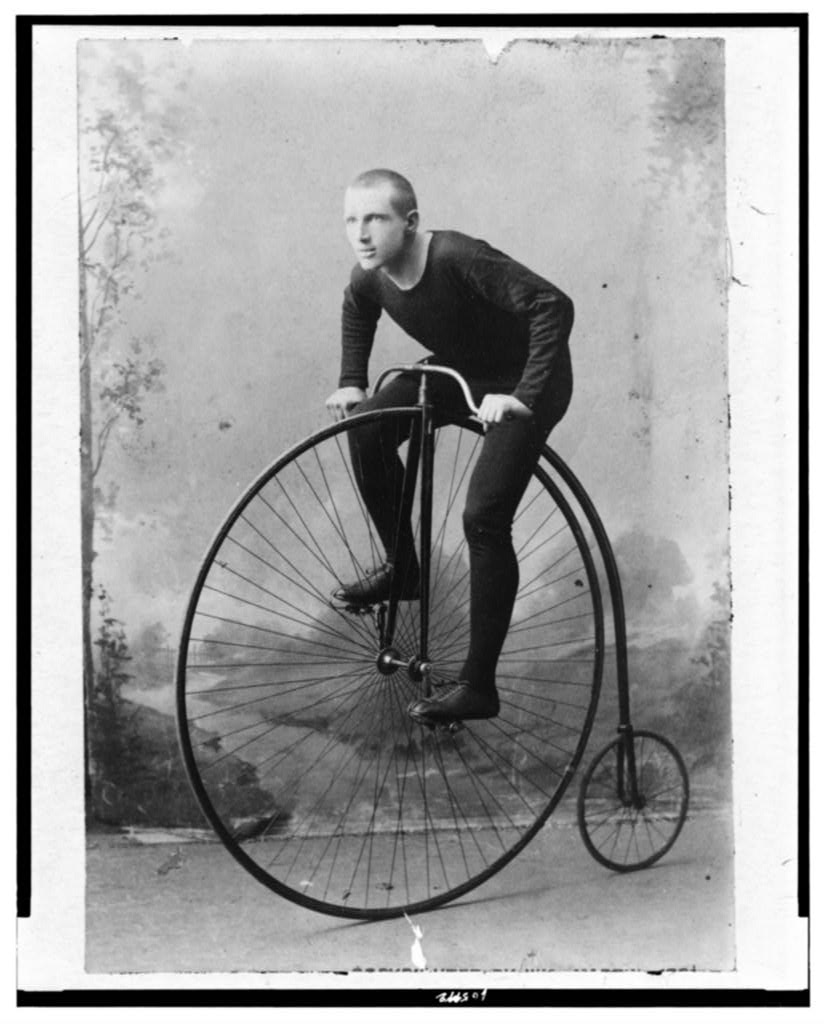
The dream of dying by telephone-wire decapitation lives on in Czechoslovakia. Information about a flying bicycle from Digital Trends: “The radio-controlled flight was made possible by the bicycle’s six battery-powered propellors, which makes the contraption look a bit like an enormous RC quadcopter. Though the bicycle looked pretty stable during its flight, its large propellors make it look cumbersome to ride and its size means such a bike would face limitations as to where it could go, especially in urban areas. And then there’s all those aforementioned overhead hazards to think about.
Speaking about the project to local news site Ceske Noviny, project participant Ales Kobylik said, ‘Our main motivation in working on the project was neither profit nor commercial interest, but the fulfillment of our boyish dreams.’
The team said they hope to stick a real life human in the saddle this fall, doing away with the need for a radio controller.”