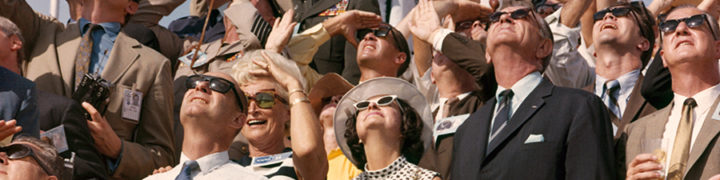
Rock + Flag + Eagle. Happy 4th!
You are currently browsing the archive for the Urban Studies category.
Tags: Charlie Day

From “Hacking,” a 1996 Wired article by the excellent reporter Ted Conover about Roy Eric Wahlberg, a Minnesota drug dealer who surreptitiously became a tech millionaire while spending 17 years in prison for a vicious murder:
“The year was 1975 and the place was Ely, Minnesota, near the Canadian border in the region known as the Iron Range. Cold and insular, the range is a land of deep woods and open-air mines, brought down from boom times by the decline of American steel. Wahlberg, 23, sold milk during the day for his parents’ dairy distribution company and at night sold drugs: LSD, speed, cocaine, PCP, tranquilizers. ‘I celebrate every Saturday night,’ he told the court during his trial; that Saturday in March he celebrated with beer, rum and Coke, speed, marijuana, and, right before attending a party in a trailer home with his girlfriend, Roxanne Ahlstrand, some LSD.
The LSD annoyed Roxanne, who said it left Wahlberg ‘hard to get along with … hard to communicate with.’ His drug use occasionally led to rages-smashed windshields (usually his own) and trashed apartments (sometimes Roxanne’s). Roy and Roxanne argued at the party, and after several mixed drinks, he left with her younger sister. Fights between them were common, in part because Wahlberg fooled around on the side-often with underage girls. Once, caught naked in the back of a car with a minor, he had been thrown into jail.
At one point that evening Wahlberg passed through a local bar at the same time as a recent high school graduate named Jeff Goedderz (pronounced GED-derz). It was Goedderz’s 19th birthday, and he, too, had been drinking, beginning with a celebration before dinner at his sister’s house in nearby Babbitt. Trial testimony indicated that Goedderz had made a date that night with an Ely woman but it skipped his mind; at the jukebox in the bar he was soon making time with a college student home for the weekend from Duluth. When they and another couple went for pizza down the street at 1 a.m., Goedderz offered her his class ring.
No one remembers whether Goedderz and Wahlberg spoke at the bar; it is uncertain whether they even knew each other. But sometime after 2:30 a.m. they met up on the streets of Ely, two of the last people still awake on a cold night in winter. Goedderz, in poor condition to drive with a blood alcohol level later measured at 0.17 percent (almost twice the limit allowed by many states), let Wahlberg take the wheel of his Plymouth Gold Duster and climbed in back to sleep. They were joined by Wahlberg’s friend Red Nelson, a shoplifter and vandal who sold drugs to kids. The police theory was that Wahlberg murmured to Nelson his suspicion that Goedderz, who declined to take drugs besides alcohol, was a narc. (Nelson also suggested, years later, that Wahlberg was jealous of Goedderz, the outsider who was starting to date local girls.) As Goedderz slept, the two friends picked up a hatchet at Wahlberg’s truck and a stolen bowie knife at Nelson’s house. They drove to a remote logging road 8 miles north of town; the killing began when Goedderz stepped out of the car to pee. His last words, according to Nelson, were ‘Oh, no! Don’t do that!’
Goedderz’s car was found six days later under melting snow in the parking lot of the Ely Co-Op. Police noticed blood dripping into a puddle beneath the car and popped open the trunk to find Jeff Goedderz. Almost no blood remained in his body. According to officials, Goedderz died of loss of blood from multiple wounds. There were two long gashes to the head, both of which penetrated the brain, made by a hatchet. There were knife wounds to the face, arm, and neck. A knife blow to the left cheek had entered in front of the ear, broken the jaw, and knocked out two front teeth. And, in what the pathologist called a ‘defensive wound,’ Goedderz’s left thumb was missing: hair stuck to the hand indicated that Goedderz had probably had his hand to his head, trying to ward off blows. He said Goedderz had been alive when placed in the trunk.
As the people last seen with Goedderz, Wahlberg and Nelson were prime suspects in the murder, but it took 17 months of investigation before the case went to a grand jury. During those months Wahlberg freely talked with the lead investigator; parrying with the police as they tried to trip him up was like playing ‘mental chess,’ he later said. But Wahlberg lost the game when things he told the investigator confiicted with statements he made to others. Based on strong circumstantial evidence, Wahlberg was convicted of first-degree murder and sentenced to life in prison.”
••••••••••
In 2000, Conover discussed working as a Sing Sing prison guard with that kindly warden Charlie Rose:
Americans have always been paranoid about intruders, believing that there are Russians, Martians and Kenyans among us. Maybe the burden of an immigrant nation is that we’re never completely sure about our neighbors–or maybe it just gives us a handy scapegoat for what ails us internally, as individuals and collectively. Certainly the paranoia has only increased post-9/11, when it became clear that there really were malignant sleeper cells.
On a 1977 episode of In Search Of…, Leonard Nimoy looked at U.S. citizens who believed they’d sighted flying saucers. The host wonders if there really are UFOs. Of course there aren’t, you fucking idiot. Incredibly ridiculous and amusing. And some awesome incidental music.
Tags: Leonard Nimoy
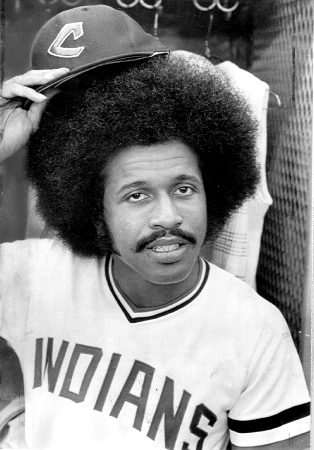
"I will pay top of the market prices for your hair."
Your hair needed (NYC)
I am a professional wig and toupee designer and I need your help. I will pay top of the market prices for your hair. All lengths and colors are welcome, but hair over six inches in length will receive bonus pay. I will send you a prepaid hair collection kit that you will use to ship the hair to me after it is cut. No dyes please. Please call Scott to discuss.

"The cannon exploded, tearing off Kaiser's leg." (Image by Joseph Furttenbach.)
A quartet of cautionary tales about July 4th, a wonderful and dangerous holiday, from the pages of the Brooklyn Daily Eagle.
••••••••••
“The Cannon Exploded” (July 5, 1889): “La Grange, Tex.–The Fourth of July celebration at Round Top was marred by a terrible accident. J.G. Kaiser and two other men named Schiege and Gingel were firing off a cannon. It seems they loaded it with seven pounds of powder and filled it with wet clay and moss so as to make a loud report when fired. The cannon exploded, tearing off Kaiser’s leg and seriously wounding Schiege and Gingel. Kaiser is not expected to live.”
••••••••••
“Died of Lockjaw” (July 12, 1900): “The Fourth of July celebration claimed another victim yesterday, when Frederick Detlefsen of 6 Sullivan Street died of lockjaw, at his home. He was the son of Charles Detlefsen, a well known builder, of the Twelfth Ward. The boy was not quite 16 years old, but was powerfully built. On the evening of the Fourth he received a wound in his left forefinger from the premature explosion of a blank pistol cartridge. A local physician dressed the injury and nothing further was thought of the matter until Tuesday morning, when the boy complained of a soreness in his throat. That became worse rapidly and when a physician was summoned, he at once diagnosed the case as tetanus. The wound in the finger was opened and disclosed two greased wads embedded in the flesh. Spasms soon developed and and despite frequent injections of morphine, the boy suffered the most intense agonies. Death terminated his sufferings at noon yesterday.”
••••••••••
“Inspected a Giant Cracker” (June 30, 1902): “The Fourth of July celebration was inaugurated in Greenpoint last evening by a small number of boys, who set off fireworks during every intermission of the rain. Naturally both pyrotechnics and boys became damp. James Connolly, 10 years old, of 70 Sutton Street, finally found himself endeavoring to light a giant firecracker which refused to explode. At last he put his eye at one end of the cracker, with the result which might be expected. It went off then. Young Connolly will probably lose the sight of his left eye, while his features will be disfigured for life with powder marks. He is recuperating in the care of Dr. Detsch at the Eastern District Hospital and receiving all the care and attention due the first hero of the fire cracker season.”
••••••••••
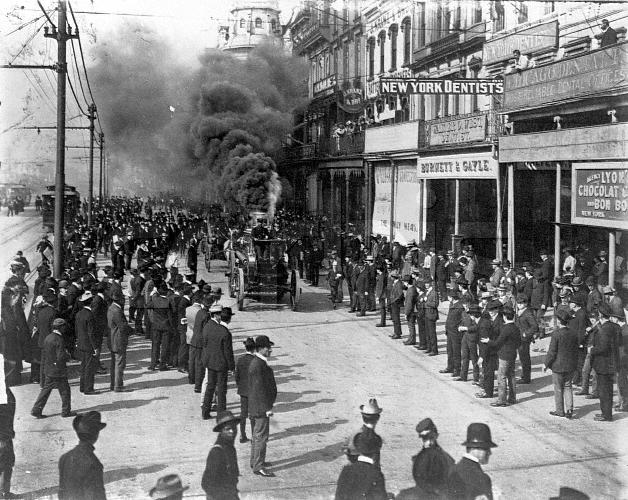
"The body of little Conrad was found behind the counter burned to a crisp."
“Baby Con’s Fatal Fun” (July 2, 1893): “A shocking accident, the exact cause of which will probably never be known, occurred at 4:30 o’clock yesterday afternoon in the store kept by Frank Winkenbach, at 899 Liberty Avenue, in the Twenty-sixth Ward. Mr. Winkenbach keeps a small candy shop, but in anticipation of a busy Fourth of July had stocked his place with fireworks. Yesterday afternoon about the time indicated Mr. Winkenbach had occasion to visit the rooms above the store and he left his 4 year old boy Conrad downstairs. He had no idea that the child would have access to any matches. Suddenly the father was startled by the noise of a loud explosion and hastening downstairs, he found the store on fire. The entire stock of fireworks were exploding. Firecrackers were sputtering and Roman candles and pinwheels were wasting their substance all around. He did not see the child as he looked into the store, but, fearful that he was there, he attempted to reach the place where he was supposed to be. It was impossible to do so.
The neighbors sent out a fire alarm and soon the engines were on the ground. It seemed as if the entire front of the store was in flames. The firemen were rapidly at work and soon the fire was extinguished. The body of little Conrad was found behind the counter burned to a crisp. His clothing had been entirely consumed, and all that remained was the charred corpse with the little shoes still adhering to the child’s feet. The body was taken to the living rooms of the family and Coroner Creamer was notified to hold an inquest. The flames had consumed the front of the shop and it was boarded up last night. A crowd of curious neighbors hung around. A rosette of white crepe and streamers on the door told of the tragedy.
From the fact that there was a loud explosion at the outset it is believed that the child had dropped a lighted match among some gunpowder which formed part of the stock. The front windows were blown out by the shock and the store was utterly wrecked. It was impossible when the fire broke out to rescue the child, but Mr. Winkenbach had hoped that Conrad had escaped. It was only when his disfigured body was found that the father abandoned the idea that the boy had managed to reach the street.”
In 1979, only 12 people at a time were able to use mobile phones in New York City. But in Chicago an experiment was under way.

"A screwball comedy featuring a transsexual, a gorilla, two drag queens, a Metro-sexual, and a Slovenian actress with penis envy."
Screenplay Option For Sale – $2000 (Midtown)
I am looking to sell an option to the following screenplay for $2,000. It is a briskly-paced 102 pages and can be produced very cheaply. This option would apply to all media, worldwide, in perpetuity. If interested, please send an email and I’ll send along the script, and if you like it we’ll work out our agreement from there. Only SERIOUS inquiries, please. Am looking for someone who reads and moves quickly so that other prospects are not kept waiting. Thank you and I look forward to being in touch.
REPLY ALL
A screwball comedy featuring a transsexual, a gorilla, two drag queens, a Metro-sexual, and a Slovenian actress with penis envy.
Many of us have, at some point or another, had the horrible experience of writing an intimate email, hitting the “reply all” button by accident, and ended up sharing our thoughts with half the world. Now three unfortunate individuals are about to learn what happens after hitting that dreaded button. A hotshot lawyer and ladies man accidentally reveals to the entire office that he likes getting manicures. A teenage girl ends up telling the entire faculty that she thinks her teacher is effeminate. And an event organizer reveals to everyone that she thinks her boss is a criminal…which may turn out to be true.
Reply All is a madcap comedy in the style of The Hangover, A Fish Called Wanda, and My Cousin Vinny.
Coke’s Bicentennial year ad.
Dan Sandin, computer pioneer, doing his magic in 1973. (Thanks Reddit.)
Tags: Dan Sandin
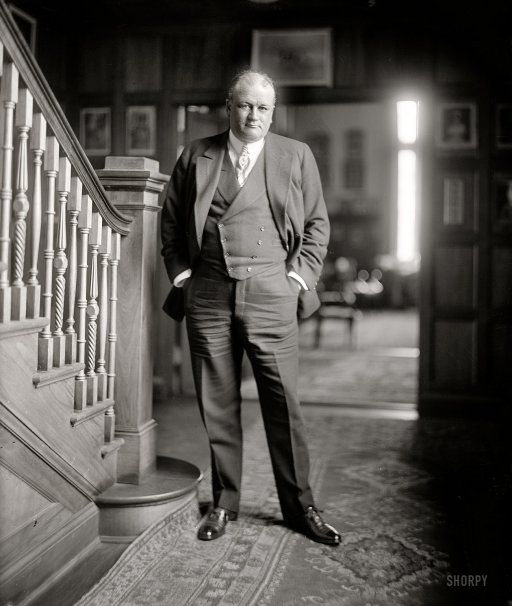
"The honors of the evening went to the 200-pound brother-in-law of the young hostess, Joseph Leiter, who appeared in a fascinating little frock modeled after those work by his own two-year-old son."
This one is just odd. In 1912, President Taft’s daughter, Helen, was honored with a slew of society parties in Washington D.C. In order to break up the monotony, everyone was asked to dress like babies at one gathering, including 200-pound wheat speculator Joe Leiter, as the New York Times dutifully noted in its February 18, 1912 issue. An excerpt:
“The cry of textile manufacturers that more material be used in the fashionable frocks of the coming season has been heeded by at least one of Washington’s social leaders, as shown by a recent dinner party in honor of Miss Helen Taft at the home of Col. and Mrs. John R. Williams.
To vary the monotony of the six nights in a week programme that has been offered the President’s daughter all Winter, Miss Dorothy Williams, daughter of the hosts, conceived the idea of making this occasion unique, and requested her friends to make this a baby party, the babies to range from the cradle to the kindergarten class.
The honors of the evening went to the 200-pound brother-in-law of the young hostess, Joseph Leiter, who appeared in a fascinating little frock modeled after those work by his own two-year-old son, but containing something like two pieces of French muslin, five times the usual number of pieces of valenciennes lace and insertion, and nobody knows how many bolts of baby ribbon.
The entire costume, which was complete in every detail from the shoulder knots to the bows on his shoes, was furnished to order and fitted with care by one of the society modistes whose ‘children’s clothes’ have made her a reputation as a business woman as enviable as that she formerly enjoyed as a Washington belle in the navy circle.”
More posts about strange social gatherings:
Tags: Helen Taft, Joe Leiter, William Howard Taft
 I’m happy people use cell phones and BlackBerrys non-stop. It distracts them the way shiny necklaces distract monkeys, and they have less time to try to stab me in the head with a box cutter. But Jonathan Franzen isn’t so sanguine about the intrusion of cell phones into public space. From his new essay (free registration required) on the topic in Technology Review:
“The technological development that has done lasting harm of real social significance–the development that, despite the continuing harm it does, you risk ridicule if you publicly complain about today–is the cell phone.
Just 10 years ago, New York City (where I live) still abounded with collectively maintained public spaces in which citizens demonstrated respect for their community by not inflicting their banal bedroom lives on it. The world 10 years ago was not yet fully conquered by yak. It was still possible to see the use of Nokias as an ostentation or an affectation of the affluent. Or, more generously, as an affliction or a disability or a crutch. There was unfolding, after all, in New York in the late 1990s, a seamless citywide transition from nicotine culture to cellular culture. One day the lump in the shirt pocket was Marlboros, the next day it was Motorola. One day the vulnerably unaccompanied pretty girl was occupying her hands and mouth and attention with a cigarette, the next day she was occupying them with a very important conversation with a person who wasn’t you. One day a crowd gathered around the first kid on the playground with a pack of Kools, the next day around the first kid with a color screen. One day travelers were clicking lighters the second they were off an airplane, the next day they were speed-dialing. Pack-a-day habits became hundred-dollar monthly Verizon bills. Smoke pollution became sonic pollution. Although the irritant changed overnight, the suffering of a self-restrained majority at the hands of a compulsive minority, in restaurants and airports and other public spaces, remained eerily constant. Back in 1998, not long after I’d quit cigarettes, I would sit on the subway and watch other riders nervously folding and unfolding phones, or nibbling on the teatlike antennae that all the phones then had, or just quietly clutching their devices like a mother’s hand, and I would feel something close to sorry for them. It still seemed to me an open question how far the trend would go: whether New York truly wanted to become a city of phone addicts sleepwalking down the sidewalks in icky little clouds of private life, or whether the notion of a more restrained public self might somehow prevail.
Needless to say, there wasn’t any contest. The cell phone wasn’t one of those modern developments, like Ritalin or oversized umbrellas, for which significant pockets of civilian resistance hearteningly persist. Its triumph was swift and total. Its abuses were lamented and bitched about in essays and columns and letters to various editors, and then lamented and bitched about more trenchantly when the abuses seemed only to be getting worse, but that was the end of it. The complaints had been registered, some small token adjustments had been made (the ‘quiet car’ on Amtrak trains; discreet little signs poignantly pleading for restraint in restaurants and gyms), and cellular technology was then free to continue doing its damage without fear of further criticism, because further criticism would be unfresh and uncool.”
Tags: Jonathan Franzen
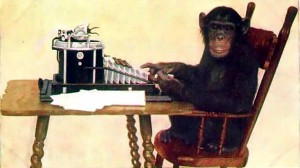
Working Typewriter Wanted (ANY)
I am looking for a working typewriter and ribbon. Any help is appreciated. Thank you. Please call if you have one.
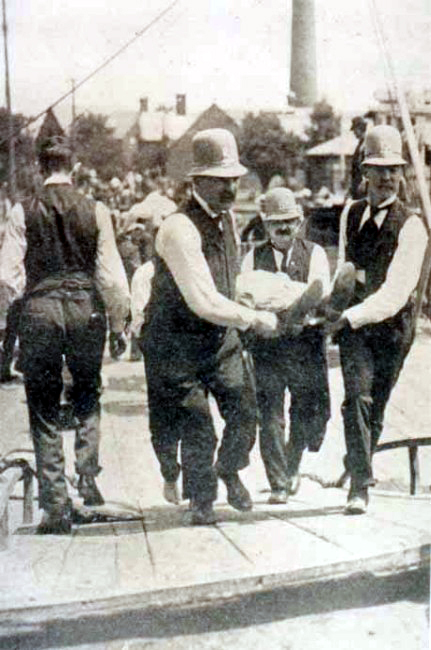
The greatest loss of life in the New York City area prior to September 11th was caused by the 1906 disaster of the General Slocum, a steamer carrying approximately 1400 souls to a Sunday school picnic on Long Island. The classic photo above shows the aftermath of a fire, which began somehow in the Lamp Room, creating a conflagration which soon engulfed the ship. More than 1000 people perished. The last survivor of the calamity was Adella Wotherspoon, a baby at the time who lived to see her hundredth birthday. An excerpt from her 2004 New York Times obituary:
“On June 15, 1904, a sunny Wednesday morning, Mrs. Wotherspoon, then the 6-month-old called Adele Liebenow, was part of the 17th annual Sunday school picnic of St. Mark’s Evangelical Lutheran Church, on the heavily German Lower East Side. The church had chartered a paddle-wheel, 264-foot-long steamboat, for $350 from the Knickerbocker Steamboat Company to go to Locust Grove Picnic Ground at Eaton’s Neck on Long Island.
The Liebenow party included Adele’s parents, her two sisters, three aunts, an uncle and two cousins. When the boat left the East River pier at Third Street at 9:40 a.m., a church band on board played, ‘A Mighty Fortress Is Our God.’
Forty minutes later, the joy turned to abject terror. Smoke started billowing from a forward storage room. A spark, most likely from a carelessly tossed match, had ignited some straw. Soon, the boat was an inferno. The captain ignored cries to steam for shore and proceeded at top speed through the perilous waters known as Hell Gate to North Brother Island, a mile ahead.
The inexperienced crew, which had not had a single fire drill, provided scant help. Lifeboats were wired or glued to the deck with layers of paint, cork in the life jackets had turned to dust with age and fire hoses broke under water pressure.
By the time the General Slocum reached the island, it was too late. The death toll among the estimated 1,331 passengers was 1,021, according to most sources. The dead included Adele’s sisters, Anna, 3, and Helen, 6. Munsey’s Magazine, a periodical of the time, wrote, ‘Children whom the flames had caught on the forward decks rushed, blazing like torches to their mothers.'”
Tags: Adele Liebenow, Adella Wotherspoon
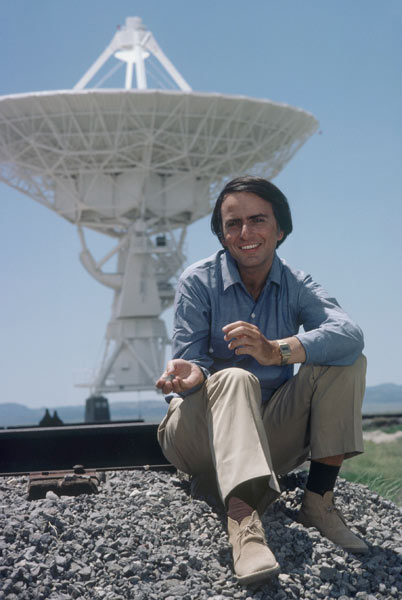
In “Mr. X,” an article written in 1969 and published two years later, Carl Sagan wrote about his use of marijuana, which apparently was a part of his life for more than four decades. The opening:
It all began about ten years ago. I had reached a considerably more relaxed period in my life – a time when I had come to feel that there was more to living than science, a time of awakening of my social consciousness and amiability, a time when I was open to new experiences. I had become friendly with a group of people who occasionally smoked cannabis, irregularly, but with evident pleasure. Initially I was unwilling to partake, but the apparent euphoria that cannabis produced and the fact that there was no physiological addiction to the plant eventually persuaded me to try. My initial experiences were entirely disappointing; there was no effect at all, and I began to entertain a variety of hypotheses about cannabis being a placebo which worked by expectation and hyperventilation rather than by chemistry. After about five or six unsuccessful attempts, however, it happened. I was lying on my back in a friend’s living room idly examining the pattern of shadows on the ceiling cast by a potted plant (not cannabis!). I suddenly realized that I was examining an intricately detailed miniature Volkswagen, distinctly outlined by the shadows. I was very skeptical at this perception, and tried to find inconsistencies between Volkswagens and what I viewed on the ceiling. But it was all there, down to hubcaps, license plate, chrome, and even the small handle used for opening the trunk. When I closed my eyes, I was stunned to find that there was a movie going on the inside of my eyelids. Flash . . . a simple country scene with red farmhouse, a blue sky, white clouds, yellow path meandering over green hills to the horizon. . . Flash . . . same scene, orange house, brown sky, red clouds, yellow path, violet fields . . . Flash . . . Flash . . . Flash. The flashes came about once a heartbeat. Each flash brought the same simple scene into view, but each time with a different set of colors . . . exquisitely deep hues, and astonishingly harmonious in their juxtaposition. Since then I have smoked occasionally and enjoyed it thoroughly. It amplifies torpid sensibilities and produces what to me are even more interesting effects, as I will explain shortly.•
Tags: Carl Sagan
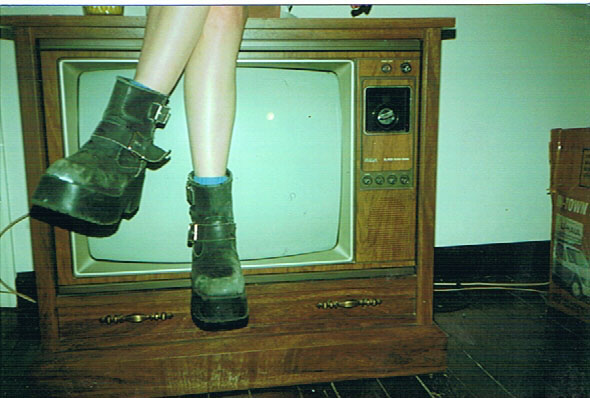
Let’s hope the following statement about TV from the 1993 David Foster Wallace essay, “E Unibus Pluram: Television and U.S. Fiction,” isn’t true anymore. Perhaps the marginalization of TV in a multi-platform media world has made programmers more desperate, more willing to give us bread and circuses in a desperate attempt to attract viewers. But what if it still is true? What then?
••••••••••
“If we want to know what American normality is – what Americans want to regard as normal – we can trust television. For television’s whole raison is reflecting what people want to see. It’s a mirror. Not the Stendhalian mirror reflecting the blue sky and mud puddle. More like the overlit bathroom mirror before which the teenager monitors his biceps and determines his better profile. This kind of window on nervous American self-perception is just invaluable, fictionwise. And writers can have faith in television. There is a lot of money at stake, after all; and television retains the best demographers applied social science has to offer, and these researchers can determine precisely what Americans in 1990 are, want, see: what we as Audience want to see ourselves as. Television, from the surface on down, is about desire. Fictionally speaking, desire is the sugar in human food.”
••••••••••
Tags: David Foster Wallace
Death by clowning is now the third leading killer of Americans, trailing only brain fat and monkey bites. (Thanks Found Footage Festival.)

Hairless lab mice, 1975.
MIT is building mind-control helmets for mice, hoping to eventually have domain over brain functions in humans in order to control disease. An excerpt from a Discover article:
“Christian Wentz from MIT has designed a hat that wouldn’t look out of place at a horse race or a royal wedding. It consists of two circuit boards and an antenna, and it’s being modelled by a mouse. Wentz has wired the hat directly to the mouse’s brain and he can use it to control the animal’s behaviour with flashes of light. And most importantly, he can do it from afar.
The wireless helmet is the latest innovation in the exciting field of optogenetics, where scientists can use light to control the behaviour of both cells and entire animals. The typical set up involves loading cells – usually neurons – with a light-sensitive gatekeeper protein. When the protein sees the light, it opens up and allows ions to enter the neuron, making it fire.
By introducing the proteins into the right spot, scientists can switch on specific parts of the brain, or even individual neurons. They can turn on aggressive or sexual behaviour or make animals walk in circles. The technique promises to revolutionise our understanding of the way the brain works. It could even help to develop treatments for diseases.”
Tags: Christian Wentz
Springer, Russian-style. Kick to bride’s stomach early. (Thanks Reddit.)

The tennis player Renée Richards caused a sensation in 1976 when she revealed that she had been born a man and undergone a sex-change operation. She was quickly lambasted by critics who thought she had an unfair advantage over her female opponents, but it seemed like an excuse to unload on someone who made much of America uncomfortable. Michael Weinreb of Grantland has a smart new interview with Richards, who is today a septuagenarian Manhattan opthamologist conflicted about being a public figure. An excerpt:
“‘No, no, no, no,’ she says now, at age 76, sitting in her cozy examining room. Her voice is a rasp; her sweater is pink. She is surrounded by autographed photos of Martina Navratilova and Virginia Wade. ‘That was not my intention. It’s not so much the idea that I wanted to be a pioneer and a standard-bearer. It was a much more selfish reason. I’d gone through such an upheaval in my life, and they’re telling me I can’t play tennis? Suddenly I said to myself, ‘I can do anything any other woman is entitled to do. How dare they?’
‘I was a quiet person. I mean, I’m not a shrinking violet, but I was a very private person. I was very well-liked, and I was very well-respected. And a lot of that was thrown away because I became a caricature, a public notorious figure. I was undressed in front of the world.'”
••••••••••
A new documentary about Richards:
The opening of the September 6, 1976 Sports Illustrated article about the Richards revelation: “At first, it seemed like a put-on. A transsexual tennis player? A 6’2” former football end in frilly panties and gold hoop earrings pounding serves past defenseless girls? A 42-year-old Yale graduate, Navy veteran, devoted father and respected eye surgeon reaching the semifinals of the $60,000 Tennis Week Open in South Orange, N.J. and demanding to play in the U.S. Open at Forest Hills? In women’s singles? Who ever heard of such a thing?
In the past month, practically everyone. And certainly last week there was no escaping the extraordinary spectacle of Renee Richards, nee Richard Raskind, and her assertion that ‘anatomically, functionally, socially, emotionally and legally I am a female.’ While conceding that her action might be ‘mind-boggling,’ Richards proclaims that she is embarked on a crusade for human rights, a quest ‘to prove that transsexuals as well as other persons who are fighting social stigmas can hold their heads up high.’
If tennis seems a rather fragile or inappropriate vehicle for carrying such a weighty message, it nonetheless provides, as Richards is well aware, the kind of exposure that attracts disciples. After one match last week, Dr. Roberto Granato, the urologist who performed the ‘sex-reassignment operation’ on Richards a year ago, rushed onto the court, embraced his former patient and exclaimed, ‘Oh, Renee, this is going to help so many people!’
Not everyone is so enthralled.”
Tags: Michael Weinreb, Renée Richards

"WTF?"
thigh length socks with pink butterflies (L train)
L train to Manhattan, 8:30AM, brunette with headphones, brown back pack, hair in bun, black shirt, cuffed short shorts, bare legs, thigh length socks with pink butterflies. WTF?

"The bundle was found to contain a coat trimmed with Persian lamb's wool and two shot guns."
Howard Anderson, a.k.a. Andrew Andrews, was a fin-de-siècle British-born burglar run amok in New York City, a second-story man with sticky fingers and a ready alibi. He resolutely lived the grifter’s life, as the following story from the January 10, 1901 Brooklyn Daily Eagle illustrates. An excerpt:
“Howard Anderson, alias Andrew Andrews, 44 years old, said by the police to be an English crook, was arraigned before Magistrate Meade in the Harlem Police Court to-day as a suspicious person. At 1 o’clock this morning Policeman Powers of the East One Hundred and Twenty-sixth street and Third Avenue with a bundle. Powers asked the man what he had. Anderson said that he was a purchaser of pawnbroker’s tickets and had just takent something out of a pawn.
Powers took the man to the station and the bundle was found to contain a coat trimmed with Persian lamb’s wool and two shot guns. The Sergeant happened to have at the station a police alarm relative to the burglary of the summer home of Charles W. Dickel, who keeps a riding school in Fifty-sixth street, between Sixth and Seventh Avenues, and who has his summer home at Scarsdale, which is just beyonmd White Plains.
On the night of January 2 last Dickel was awakened by hearing some one move about the house. He went through the house and scared the burglar off, but he had gotten away with the coat and two shotguns.
 So soon as the articles were identified Chief of Police Carpenter of White Plains was notified and he came to this city. He was in court when Anderson was arraigned.
Detective Frank Prince, who was in court identified Anderson as Howard Andrews, a well known English crook and worker of suburban houses and second story thief . Detective Prince said he had served six and a half years of a ten years’ sentence for stealing $10,000 worth of silverware from a millionaire’s residence in Hmepstead, L.I.
Magistrate Meade dismissed the case against Anderson and turned him over to Chief Carpenter of White Plains, warning Caroenter to look out and not let him go.”
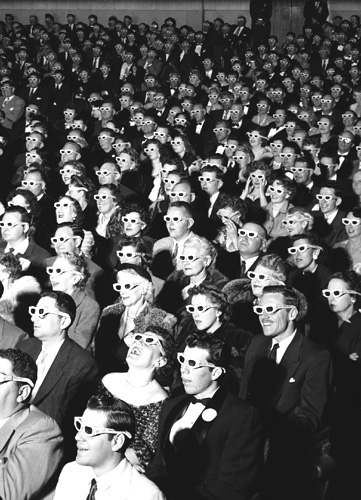
In addition to the elimination of late fees and a long-tail inventory, Netflix was a category killer for video stores because it offered a flat-fee buffet-style arrangement. Yes, there was “toggling” that delayed the heaviest users from seeing the most desirable movies first, but you got quantity and quality for your money. In a new Wired.com article, Angela Watercutter looks at how theater chains are introducing a similar model to try to increase profits:
“MoviePass, a new $50-per-month service for film fans, will let subscribers watch unlimited movies in theaters using their smartphones as tickets.
Using an HTML5 application (native smartphone apps coming soon), MoviePass will let users search for a film, find a local show time, check in to the theater and go straight to the ticket-taker.
The all-you-can-watch service, announced Monday with a private beta starting in the San Francisco Bay Area just in time for the Fourth of July blockbuster weekend, is looking to shake up the theater business in much the same way Netflix has changed the DVD-rental game.
‘Even with online ticketing, this side of the business is still a 75-year-old business and there’s not a lot of innovation,’ MoviePass co-founder Stacy Spikes said in an interview with Wired.com. ‘Getting your tickets, how you do that, how you interact with the theater, how you interact with the studio, none of that has really changed. We’re giving the viewer a lot more power and also allowing [studios and moviegoers] to speak with each other.'”
Tags: Angela Watercutter
While I have never had any interest whatsoever in J.R.R. Tolkien’s work–as a child or adult–I know I’m in the small minority. For the rest of you. (Thanks Open Culture.)
Tags: J.R.R. Tolkien
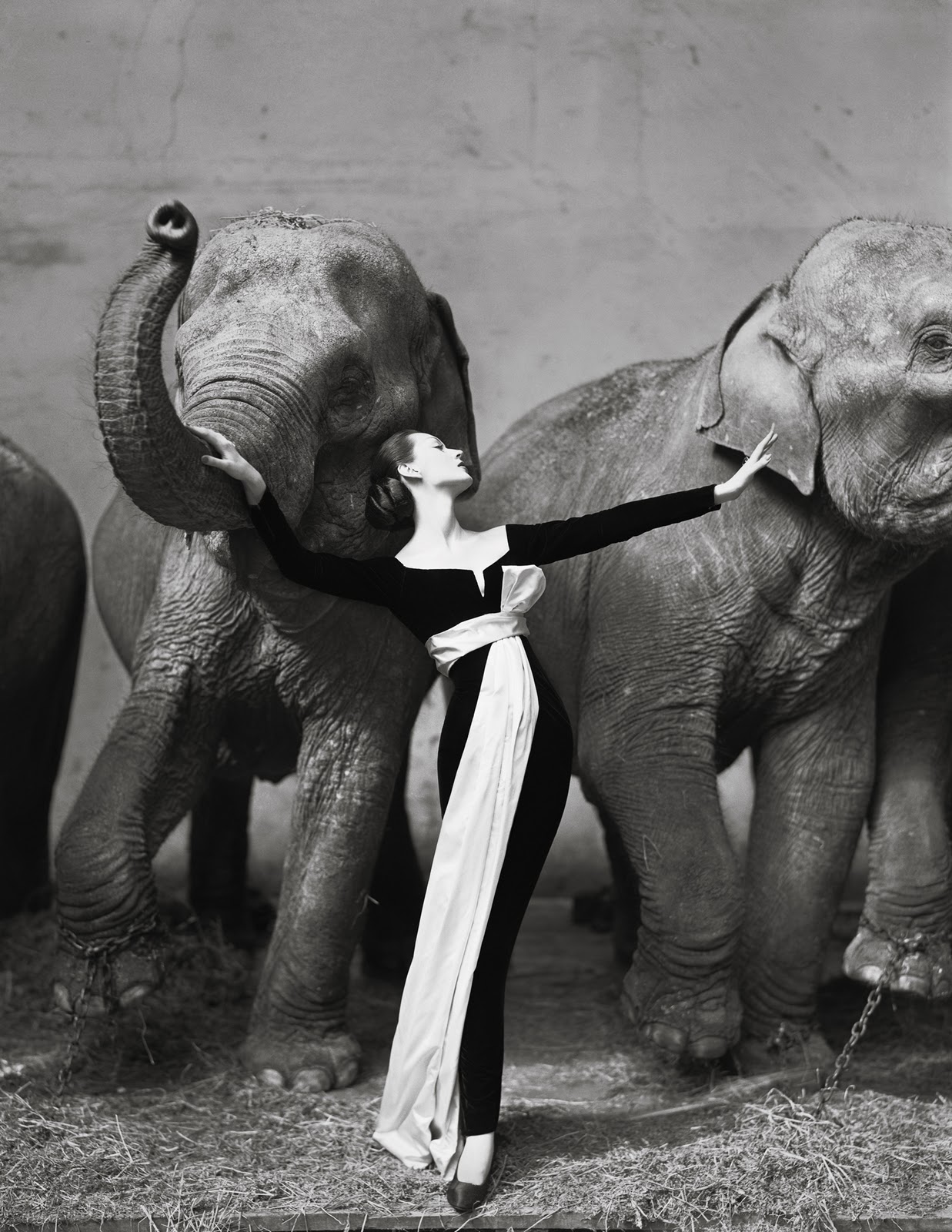 From Winthrop Sargeant’s 1958 New Yorker profile of a young Richard Avedon, who used his camera to reimagine the fashion photograph, which lacked blithe spirit before he enlivened the scene:
About twelve years ago, this approach to fashion photography began to be subtly undermined by a sprightly and ingenious photographer for Harper’s Bazaar named Richard Avedon. As far as he was concerned, the statues and mummies went out the window. The model became pretty, rather than austerely aloof. She laughed, danced, skated, gambolled among herds of elephants, sang in the rain, ran breathlessly down the Champs-Elysées, smiled and sipped cognac at café tables, and otherwise gave evidence of being human. Whether she thereby sold more clothes is open to question. But the new trend certainly brightened the page of Harper’s Bazaar, and Avedon was widely conceded to have reached a previously unattained artistic level in fashion photography. A good deal of this accomplishment can be attributed to his imagination and resourcefulness in handling a camera, but some of it undoubtedly stems from the fact that his primary interest is not in fashion but in women.
The Avedon photograph—or, more broadly, the Avedon photographic style—has by now become a lively contribution to the visual poetry of sophisticated urban life. Nearly everybody is familiar with it, for it has long since overflowed the pages of Harper’s Bazaar and influenced the advertising in most of the slick-paper periodicals. It has been imitated by other photographers, but the imitations have seldom approached the animation of the originals; in any case, as soon as the imitators have mastered at least the surface elements of one of Avedon’s innovations, he has always popped up with some entirely new departure, for he has never been one to stand still. The world he depicts is an artificial one; his polished and rather romantic art flatly contradicts the bromide that the camera never lies. Avedon’s camera unquestionably lies, but it does so in such a poetic and ingratiating manner that the photographic fiction it produces has become a sort of folklore of the world in which fashionable elegance counts. The characters in this fiction are women of unbelievable beauty and grace, moving about in an environment that exists largely in the imagination. This is a composite of mists, glowing lights, the moods of nocturnal revellers, nostalgic memories of bars and gaming tables and theatres, and such ephemeral minutiae as the feeling of enchantment at the sight of a taxi in the rain whose door is opened to receive a suave and mysterious beauty, or the moment of gaiety when some lovely girl decides to throw dignity aside, or the magical second in which the casual motions of a beautiful woman are observed secretly across a restaurant table—all fragments of a metropolitan fairyland, glimpsed by ordinary mortals only at times of heightened illusion.•
_______________________________
In 1999, Avedon is interviewed by that agreeable robot Charlie Rose.
Tags: Richard Avedon, Winthrop Sargeant