In writing about the new Steven Soderbergh film, Contagion, Alex Tabarrok of the Marginal Revolution points out an unintended benefit of the war against bio-terrorism that arose after 9/11:
“That is exactly right. Fortunately, under the umbrella of bio-terrorism, we have invested in the public health system by building more bio-safety level 3 and 4 laboratories including the latest BSL3 at George Mason University, we have expanded the CDC and built up epidemic centers at the WHO and elsewhere and we have improved some local public health centers. Most importantly, a network of experts at the department of defense, the CDC, universities and private firms has been created. All of this has increased the speed at which we can respond to a natural or unnatural pandemic.
In 2009, as H1N1 was spreading rapidly, the Pentagon’s Defense Threat Reduction Agency asked Professor Ian Lipkin, the director of the Center for Infection and Immunity at Columbia University’s Mailman School of Public Health, to sequence the virus. Working non-stop and updating other geneticists hourly, Lipkin and his team were able to sequence the virus in 31 hours. (Professor Ian Sussman, played in the movie by Elliott Gould, is based on Lipkin.) As the movie explains, however, sequencing a virus is only the first step to developing a drug or vaccine and the latter steps are more difficult and more filled with paperwork and delay. In the case of H1N1 it took months to even get going on animal studies, in part because of the massive amount of paperwork that is required to work on animals.”
You’ve seen your country knocked sideways for several years by the worst of its citizens and politicians and media.
You’ve seen a centrist President undermined each and every step by those who wish to bring him down at the expense of the American people. No, he hasn’t done all you desire, but being an adult, you realize that no President will. You’ve seen him accomplish a litany of important things, domestically and internationally, while dealing with a nihilistic Congress. You realize that after our near-Depression, no one was going to make the jobs instantly reappear, no Democrat, no Republican, no Independent.
You know that those who claim to wish the government had no power while they seek that very power themselves are liars. You know that both the government and the free-market system are vital to our interests. That the government nurtured the Internet for decades until it was favorable enough for venture capital to carry it. You know that the stimulus money given to lithium battery factories in Michigan has brought life to a burgeoning industry that would have not otherwise gotten off the ground. You know that the government saved the auto industry at minimal cost by acting decisively and quickly.
You know that when Teapublicans claim that restoring fair tax levels on the wealthy is tantamount to class warfare, that, in fact, class warfare has been waged by the Right on the middle class for three decades, by people who came wrapped in flags and crosses. They claim to love children while their policies have caused the country to fall to 41st in global rankings of infant mortality rate. You’ve seen Teapublicans, so allergic to taxes on those with the most, fighting to remove the President’s payroll tax breaks on working class people. You’ve seen the richest 1% of the country grow ever richer because the system has been rigged.
You know that the Tea Party members are just useful stooges for venal politicans, the way Born Again Christians were before them. You know that a group of white people who realized that Washington was imperfect the moment a black person become President is, at best, dubious.
You’ve seen your country hijacked by the venal, the prejudiced, the loud, the ignorant, the wrongminded, the loony, the corrupt and the monied. And all along they’ve been outnumbered by rational, peaceful, progressive people, greatly outnumbered, but their disgraceful behavior has gone unchallenged, unanswered.
You are out there and you are waiting to speak. You wait and wait to be born, and it continues until the moment you realize that you aren’t just the child of that movement but the parent of it as well.•
Albany, New York, is the site of experimentation that may allow us to control computing devices with minds instead of hands. From a newNew York Times articleby Pagan Kennedy:
“Now Schalk can get all the human brains he wants within walking distance of his office. In 2007, he discovered that the Albany Medical Center houses an epilepsy center, and he set up shop in his hometown, working closely with Anthony Ritaccio, a professor of neurology and neurosurgery at Albany Medical College.
When I met Ritaccio in front of the hospital, he also talked about the problems with fingers. ‘We’re always interested in doing things faster,’ he said. ‘I remember the transition to an electric typewriter. We’re addicted to speed. But obviously the way we communicate with computers is rather comical. The way we interact with this blazing fast machine is to poke at it with a finger.’
Schalk and Ritaccio’s research has been underwritten by a $2.2 million Department of Defense grant. The project is part of a $6.3 million Army initiative to invent devices for telepathic communication — for instance, a ‘telepathy helmet‘ that would allow soldiers to beam thoughts to one another. Schalk seemed untroubled by the military applications. He said the grant allows him to do research that could, one day, let us all — civilians included — merge with our machines.”
As Hollywood’s studio system collapsed in the 1960s and the anti-hero indie Easy Rider showed a new path to riches, mavericks like Dennis Hooper could do anything they wanted. That freedom, of course, wasn’t the best thing for Hopper’s health or sanity. One of the least self-lacerating things he did during that era was to read a Rudyard Kipling poem for Johnny Cash in 1970.
I don’t agree with the great Esquire writer Tom Junod that Jon Stewart has lost his sense of humor over the years, but here’s an excerpt from his interesting new profile of TV’s most-lauded truth-teller:
“Now, you have to understand Jon Stewart is just like everybody else: He can be a dick. His father took off when he was a kid, leaving a hole in his heart approximately the old man’s shoe size. He’s damaged and is capable of doing damage in return, especially in close quarters. There are plenty of Daily Show staffers, present and former, who love and revere their boss for his difficult brilliance. There are also plenty — mostly on the former side — who have been, well, fucked up by him and his need to dominate. When he arrived at The Daily Show in 1999, its humor was goofy and improvisational, based on the interplay between the fake-news host and the fake-news correspondents and dependent on whimsy and happenstance. But Stewart knew what he wanted right away, and it wasn’t that. He wanted the show to be more competitive, almost in a news-gathering sense, and he wanted it to have a point of view, which happened to be his own. There are writers and producers from the first five years of the show, both male and female, who are described as ‘battered wives’; hell, there are people who used to work for him who are scared to talk about him because they’re scared of not being able to work again. And before he pushed out the show’s cocreator, he notoriously threw a newspaper at her in a story meeting and then, according to a staffer, apologized to her later with the words ‘Sorry, that was the bad Jon — I try not to let him out…'”
From Aaron Saenz’s Singularity Hub post about Apple’s planned futuristic Cupertino offices, designed by Steve Jobs and scheduled to open in 2015: “Apple Campus 2, nicknamed ‘the Mothership,’ is set to break ground in 2012 and it looks simply stunning. Part flying saucer, part hadron super collider, part Dr. No’s lair, the Mothership will be a 2.8 million square foot facility located on a 175 acre lot off Highway 280 in Cupertino. Featuring a 1000 seat auditorium, 300,000 square feet of research space, and its own power plant, the new campus will house Apple and 12,000 in house employees in glorious style.”
At theAtlantic,Alexis Madrigal looks anew book by Shelley Adlerwhich comes to unusual conclusions about the mysterious cluster of deaths among Hmong men who had emigrated to America in the 1980s. The piece’s opening:
“They died in their sleep one by one, thousands of miles from home. Their median age was 33. All but one — 116 of the 117 — were healthy men. Immigrants from southeast Asia, you could count the time most had spent on American soil in just months. At the peak of the deaths in the early 1980s, the death rate from this mysterious problem among the Hmong ethnic group was equivalent to the top five natural causes of death for other American men in their age group.
Something was killing Hmong men in their sleep, and no one could figure out what it was. There was no obvious cause of death. None of them had been sick, physically. The men weren’t clustered all that tightly, geographically speaking. They were united by dislocation from Laos and a shared culture, but little else. Even House would have been stumped.
Doctors gave the problem a name, the kind that reeks of defeat, a dragon label on the edge of the known medical world: Sudden Unexpected Nocturnal Death Syndrome. SUNDS. It didn’t do much in terms of diagnosis or treatment, but it was easier to track the periodic conferences dedicated to understanding the problem.
Twenty-five years later, Shelley Adler’s new book pieces together what happened, drawing on interviews with the Hmong population and analyzing the extant scientific literature. Sleep Paralysis: Night-mares, Nocebos, and the Mind Body Connection is a mind-bending exploration of how what you believe interacts with how your body works. Adler, a professor at the University of California, San Francisco, comes to a stunning conclusion: In a sense, the Hmong were killed by their beliefs in the spirit world, even if the mechanism of their deaths was likely an obscure genetic cardiac arrhythmia that is prevalent in southeast Asia.”
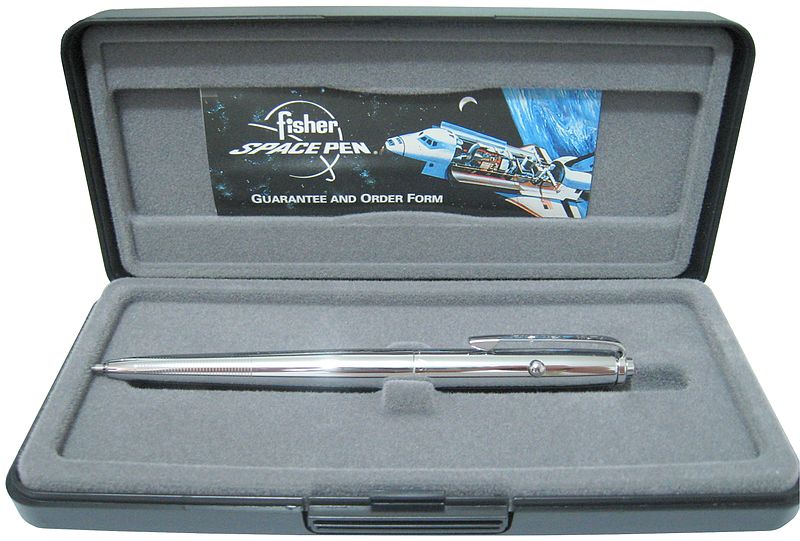
“There’s a popular myth that NASA spent ‘millions’ of dollars developing a pen for astronauts to use in the weightless environment of a space ship — while their sensible Russian counterparts were happy to use the low-tech pencil. Alas, for all its appeal and plausibility, this is not true. Initially, astronauts and cosmonauts were both equipped with pencils, but there were problems: if a piece of lead broke off, for example, it could float into someone’s eye or nose. A pen was needed, one that would defy gravity, write in extreme heat or cold, and be leak proof: blobs of ink floating around the cabin would be more perilous than a stray pencil lead. A long-time pen maker named Paul C. Fisher patented the ‘space pen’ in 1965 (which he had developed at the cost of a million dollars, at the request of but not under the auspices of NASA.) NASA bought four hundred of them at $6 each, and, after a couple of years of testing, the pens were put into space.”
Steven Johnson, who wroteThe Ghost Map,a fascinating account of amateur epidemiology in Victorian England,shares his recollectionsof the mind-altering, game-changing effect of the Macintosh computer, in the Wall Street Journal. An excerpt:
“But that first Macintosh did much more than expand my data storage needs. It also fundamentally changed my relationship to technology—and in doing that, ultimately changed the course of my life.
It’s hard to remember now, but in the mid-1980s—before Wired Magazine, Pixar, dot-com start-ups, celebrity tweeting—being obsessed with your computer had almost no cultural cachet. You were just a nerd, full stop. The computers of the day had all the playfulness of a tax audit, and the creative people who used them did so begrudgingly.
But one look at the Mac and you could tell something was different. The white screen alone seemed revolutionary, after years of reading green text on a black background. And there were typefaces! I had been obsessed with typography since my grade-school years; here was a computer that treated fonts as an art, not just a clump of pixels. The then-revolutionary graphic interface made the screen feel like a space you wanted to inhabit, to make your own. To paraphrase Le Corbusier, the Mac was a machine you wanted to live in.” (Thanks Browser.)
••••••••••
Steven Johnson revisits the cholera outbreak of 1854 during his TED Talk:
"Dr. Holmes died January 8 of softening of the brain."
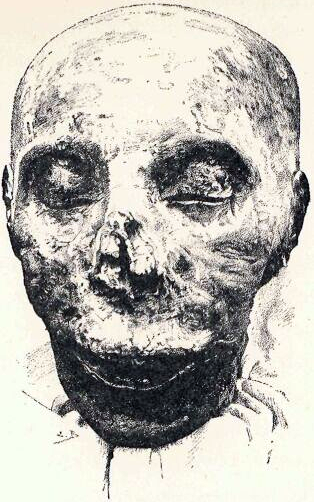
A shockingly ghoulish chapter from the annals of American medicine was recorded following the death of New York coroner Dr. Thomas Holmes, who had stealthily been using unclaimed child cadavers to experiment with the mummification process. An excerpt from a story about his dark science which ran in the November 2, 1900 Brooklyn Daily Eagle:
“Dr. Holmes died January 8 of softening of the brain. He was at the time experimenting with embalming gas. The other day, through the Board of Health, the police removed all the specimens from the basement. They had been put in a box and had lain there almost untouched since Dr. Homes’ death. Their miscellaneous nature may be judged from the following report made by Dr. Wuest after an examination of the specimens of the morgue.The remains are: The mummified body of a male child, apparently 11 years old, with head, shoulders and arms missing. Had evidently been severed from the body with a saw and body was as hard as wood. Sections of skin cut. Whole length of remains, 39 1/2 inches. The body was mummified to such an extent that a crosscut saw went through it like pine wood. The consistency as of dry leather. The body was sawed across the bottom and then between the legs and spine. The remains were evidently many years old. With these remains were those of three other children. There was also removed from the place at the same time two mummified bodies of monkeys and one head of a monkey.
"There was also removed from the place at the same time two mummified bodies of monkeys and one head of a monkey."
The late Dr. Holmes was born at 42 Forsyth Street, Manhattan, in 1842. He studied medicine and graduated from the University of the City of New York. He soon afterward came to practice in the Eastern District, where he amassed considerable wealth. Shortly before the Civil War he bought about twelve lots on the east side of Marcy Avenue, between South Eighth Street and Division Avenue, and other property, and was at one time said to be worth $100,000. During the Civil War he volunteered as an embalmer and embalmed with a fluid which he prepared himself the bodies of 28,400 soldiers.
According to his widow, the doctor first attracted the attention of President Lincoln by embalming the body of Captain Ellsworth.
After the war Dr. Holmes returned to his home in the Eastern District. He at first resumed the practice of medicine, but as years went by began to devote more and more attention to the study of the embalming processes. At one time he thought he could preserve fresh beef and purchased for purposes of experiment an entire cargo of beefs from Texas. By this purchase the doctor lost nearly $17,000 because the beef all had to be destroyed.
After severe losses Dr. Holmes began to devote himself more exclusively to embalming human subjects, trying to invent what he described as the dry process–that is, embalming or preserving by use of gas. He claimed for his invention that it was superior to that used by the Egyptians four thousand years ago. On this process, it is said, he secured letters of patent. He obtained all the human subjects the remains of which have been found in the cellar from Bellevue Hospital, in Manhattan, where he was well known among students. The monkeys were given to the doctor by friends. Some years ago the doctor began to show decided signs of eccentricity. He put some of the stuffed animals in the windows of his home and this began to excite the curiosity of children going to school.
"At one time he thought he could preserve fresh beef and purchased for purposes of experiment an entire cargo of beefs from Texas."
One winter night two years ago, Dr. Holmes wrote a long incoherent letter to the city editor of the Eagle, in which the doctor hinted that he would divulge the secret of his discovery which he had at last perfected. A reporter called at the house and chatted with the doctor for over two hours. Whenever any question was put to him in regard to his invention, however, he evaded it. He would occasionally refer to the preservation of bodies and then divert to some meaningless narrative in regard to the war.”
Akinori Ito has created a machine that transforms plastic back into oil. Maybe someday the millions of tons of plastics that are accidentally dropped into the oceans from recycling barges each year will be sought the way oil is now.
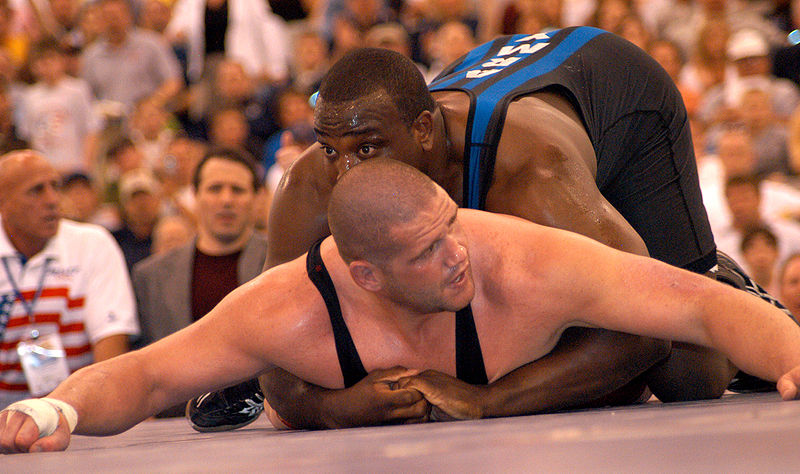
"There was no way for Ru to moderate his frenetic relentlessness. He pushed everything to the max." (Image by Tim Hipps.)
From frostbite to a broken neck to a plane crash to morbid obesity, Greco-Roman wrestler Rulon Gardner has famously cheated death so many times it’s difficult to remember that the farmboy scored one of the greatest upsets in Olympic history just a little more than a decade ago. From a 2007 GQ profile by Michael Paterniti:
“After defeating Karelin—in a match that became known as Miracle on the Mat—Ru appeared on Leno, Oprah, Letterman. He showed up at the Espy Awards and was photographed with Tiger Woods and Lara Flynn Boyle. He befriended heroes like Garth Brooks and Jason Giambi. He won the prestigious Sullivan Award, given to the country’s best amateur athlete. There were parades and city keys, more awards and gifts, including a waverunner from Rosie. He showed up in a ‘Got Milk?’ ad, hoisting buckets of milk while wearing a creamy white mustache. He went on tour, giving inspirational speeches to corporate clients willing to pay up to $15,000 a speech. He wrote his autobiography, titledNever Stop Pushing.
If he didn’t entirely believe his own legend yet, if he approached everyone as if he were still the old affectless Rulon Gardner, the farm boy from Star Valley seeking a little love and approval, he had seen through to a life beyond the Valley. And that life included proving he was no fluke by winning World Championships the following year and then preparing to defend his gold medal at the 2004 Games.
Where he once clandestinely sold the Cuban cigars he’d collected at an international meet in Havana in order to support himself, his new-won fame now turned on a spigot of income flow. His father had once lived over him, always on the verge of bankruptcy, and here he was, Rulon Gardner, a national treasure having made $250,000 the year after he won his gold—and the number was climbing. (‘He spent nine minutes on the mat with that ugly man from Russia,’ Reed Gardner jokingly told a reporter. ‘I spent fifty to sixty years on the farm, and I don’t have nothin’.’) So, he’d begun to accumulate toys, to live a grown-up version of the childhood he’d missed, with motorcycles and guns and a shiny snowmobile he took into the mountains near Star Valley. Of course there was no way for Ru to moderate his frenetic relentlessness. He pushed everything to the max.
Extreme snowmobiling can be as harrowing as any sport invented, man and machine against the mountain, finding aggressive routes up pitched faces, jumping rivers, riding into deep powder, and searching for perfect isolation. There are breakdowns and strandings, sudden submersions in icy water and the constant challenge of righting a 500-pound machine after having fallen chest-deep in snow—all in quest of some banana-cream vision out there through the trees, up on the ridge, gazing all those silver miles over Wyoming. In other words, it combines all the ingredients that make someone like Rulon Gardner tick: high-octane risk-taking, brute physicality, farm-boy ingenuity, nimble coordination, and conflict reduced to its simplest denominator, survival.
In February 2002, Ru went out snowmobiling with two friends in the Bridger-Teton National Forest, in Wyoming, thirty minutes from his home. They cruised the high peaks and winding valleys for a couple of hours until Ru peeled off, alone, into a gully of virgin snow near the head of the Salt River, ‘to play a little,’ as he put it. Shooshing down into the gully, he had no inkling that he wouldn’t be able to get out for seventeen hours. He was wearing a T-shirt, sweatshirt, and fleece pullover, having left his jacket behind. The sun had begun to dip in the sky; the temperature, which had been twenty-five degrees, began to plummet. Over the course of the next hours, Rulon tried to work his way out of the gully. His machine didn’t have the power necessary to take him back up the route he’d just dropped down. Worse, as he crisscrossed the Salt River in an increasing panic, occasionally submerging his sled, he found himself in a narrow gully where, ultimately, his machine became stuck between two boulders. During the journey, he had to repair a belt and fell four times into the river, soaking his clothes. (‘Once I got wet, I knew I had about an hour before frostbite and hypothermia,’ he said.) Finally, as night fell, he dug out a spot among the trees and waited for his own inevitable death. Sometime around 2 a.m., he heard the roar of snowmobiles, but then the sound faded. ‘I thought I was rescued,’ he said. ‘They came within 200 yards, and I was yelling, but they couldn’t hear me over their engines—and then they just turned away.’ He slipped in and out of consciousness, having visions: first of Jesus and then of his brother Ronald, who died at the age of 14 of a rare blood disease. (When his leg had to be amputated because of gangrene, Ronald said, ‘It’s okay, Dad, I can wrestle with one leg.’) Time crawled. What helped keep him alive was the thought of his family and friends finding him frozen there, a lifeless face with eyes open like Jack Nicholson in The Shining.
The next morning he was spotted by a search plane, and two hours later a helicopter landed, and he was able to crawl across the snow and climb in. His core body temperature had dropped into the 80s, and both his feet were so badly frostbit it would take four surgeries and three months before he could walk.” (Thanks TETW.)
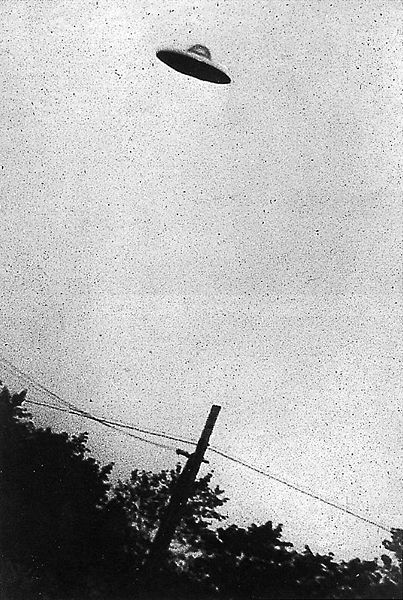
Did anyone see the ufo hovering over NY harbor near the statue of liberty and governor’s Isl. The thing stood there about 40 seconds then shot straight up like a rocket faster than anything I’ve ever seen before. about a hour ago
At the New York Times, David Plotz, a really talented writer and editor, weighs in on the positive side of the utter lack of regulations overseeing America’s fertility business. An excerpt:
“The American fertility business has long been a cowboy enterprise — cavalier about rules, casual about paperwork, irritated by government interference. Its strange place on the political spectrum shielded it from the regulation that guides other kinds of medicine, or real estate, or even used car sales. Conservatives, skeptical of regulation, were glad to leave fertility alone, and let it grow into a profitable marketplace. Liberals, normally fond of regulation, were leery of doing anything to dictate women’s reproductive choices. The result was an open field.
And there’s no doubt that the American fertility business has been way too chaotic: Sperm banks run by unqualified cranks, unscrupulous egg donation schemes, and practically no way to keep track of who’s fathering whom. (In my reporting, I’ve met numerous sperm donors who travel from bank to bank to bank, spawning uncounted numbers of kids, and leaving virtually no paper trail.) It’s certain that more regulation, and an end to donor anonymity, would clean up the industry, soothe customers, and help donor offspring.
Still, we’ll miss the lawless fertility business when it’s gone. Its lack of rules spurred innovation, and transformed fertility from a prudish, conservative corner of medicine into a consumer-driven business.”
About 5% of Americans believe that they are “allergic” to the electromagnetic waves that allow our seemingly endless communications connectivity. Some have begun taking refuge in a Radio Quiet Zone in West Virginia. From a BBC report:
“Diane Schou is unable to hold back the tears as she describes how she once lived in a shielded cage to protect her from the electromagnetic radiation caused by waves from wireless communication.
‘It’s a horrible thing to have to be a prisoner,’ she says. ‘You become a technological leper because you can’t be around people.
‘It’s not that you would be contagious to them – it’s what they’re carrying that is harmful to you.’
Ms Schou is one of an estimated 5% of Americans who believe they suffer from Electromagnetic Hypersensitivity (EHS), which they say is caused by exposure to electromagnetic fields typically created by mobile phones, wi-fi and other electronic equipment.”
David Packard's garage, Palo Alto, the birthplace of Silican Valley.
America’s Dream Factory used to be Hollywood, but it’s Silicon Valley now, a place where science and tech push furiously toward the future, untouched even by severe global economic woes. From “Bubble Boys,” Christopher Beam’s smart New York magazine article about a world of big ideas and even bigger money:
“Right this minute, Silicon Valley is America’s opposite: House prices are soaring and demand for young talent far outstrips supply. The ongoing cyberspace race between Facebook, Apple, and Google, among others, means computer engineers enjoy more freedom—and power—than ever before. The barriers to entry for web programming are almost nonexistent. Angel investors are blessing start-ups left and right, and launching a software company is cheaper than ever. Do I take the offer from Google, or take the venture capital to start my own thing? Only in this one little quadrant do people have the luxury to ask such questions. For Feross [Aboukhadijeh], the son of a schoolteacher and a Syrian-born electrical engineer, the forecast is bright, though indistinct. He may become the next Mark Zuckerberg or Steve Jobs; he may not. But while most of the country is in economic darkness, the American Dream is beaming bright in Palo Alto.”