In 1981, William F. Buckley and Diana Trilling investigated the ramifications of the murder of Dr. Henry Tarnower by his longtime companion, Jean Harris, a slaying which awakened all sorts of emotions about the dynamics between men and women.
From “Jean Harris: Murder with Intent to Love,” the 1981 Time article by Walter Isaacson and James Wilde: “Prosecutor George Bolen, 34, was cold and indignant in his summation, insisting that jealousy over Tarnower‘s affair with his lab assistant, Lynne Tryforos, 38, was the motivating factor for murder. Argued Bolen: ‘There was dual intent, to take her own life, but also an intent to do something else . . . to punish Herman Tarnower . . . to kill him and keep him from Lynne Tryforos.’ Bolen ridiculed the notion that Harris fired her .32-cal. revolver by accident. He urged the jury to examine the gun while deliberating. Said he: ‘Try pulling the trigger. It has 14 pounds of pull. Just see how difficult it would be to pull, double action, four times by accident.’ Bolen, who was thought by his superiors to be too gentle when he cross-examined Harris earlier in the trial, showed little mercy as he painted a vivid picture of what he claims happened that night. He dramatically raised his hand in the defensive stance he says Tarnower used when Harris pointed the gun at him. When the judge sustained an objection by Aurnou that Bolen‘s version went beyond the evidence presented, the taut Harris applauded until her body shook.”
In the European, science historian George Dyson, son of physicist Freeman Dyson, is interviewed about evolution and innovation. An excerpt from the Q&A:
“The European: Is the Internet increasing the innovative potential of mankind?
Dyson: It is very easy to be a pessimist: There is no good music anymore, no good art. But maybe we have to recognize that innovation is still happening, albeit in very different ways. We might feel that all that time people spend on Facebook is a great loss for the creativity of the human species, but maybe that is not true.
The European: I expected a somewhat different answer: We used to have only human intelligence, and now that has been supplemented by computational intelligence. So we would expect the potential for innovation to become supplemented as well.
Dyson: Yes and no. The danger is not that machines are advancing. The danger is that we are losing our intelligence if we rely on computers instead of our own minds. On a fundamental level, we have to ask ourselves: Do we need human intelligence? And what happens if we fail to exercise it?
The European: The question becomes: What progress is good progress?
Dyson: Right. How do we maintain our diversity? It would be a great shame to lose something like human intelligence that was developed at such costs over such a long period of time. I spent a lot of my life living in the wilderness and building kayaks. I believe that we need to protect our self-reliant individual intelligence—what you would need to survive in a hostile environment. Few of us are still living self-reliant lives. That is not necessarily a bad thing, but we should be cautious not to surrender into dependency on other forms of intelligence. I am a historian of science, I believe in preserving the past.
The European: Are there any predictions for the future we can make, based on these lessons from the past?
Dyson: The universe is a probability space in which possible things can happen. Over the last fifty years, we have developed a combined human-computational intelligence that is able to search that space at a tremendous rate. But we have no way to predict what might happen in the future to that space of possibilities. The whole idea of species might be called into question. Darwin called his book On the Origin of Species, but evolution really isn’t limited to species. The next step might be the end of distinct species and the beginning of a more symbiotic life.” (Thanks Browser.)
••••••••••
In 2002, George Dyson recalls the spectacular Project Orion:
need asap can not have any drugs in your urine, except benzos if you take that its okay,, no weed or any opiates or blow, and no pain pills whats so ever quick easy 10 bucks if you live in cobble hill or carroll gardens please contact me asap, this is not for probation just so you know, serious replys only this evening please we can meet
“Alabama’s reputation has also taken a huge hit just when it is trying to lure international businesses. No matter how officials may try to tempt foreign automakers, say, with low taxes and wages, the state is already infamous as a regional capital of xenophobia.
If Alabama succeeds in driving out all of its estimated 120,000 unauthorized immigrants, restrictionists will surely cheer. They will have only 49 states and 11 million more people to go.
There is another more humane and realistic path in which immigrants could earn the right to stay — if Congress would accept its responsibility and move ahead with serious immigration reform. America’s history shows that assimilation works better than deportation — for everyone. If first-generation immigrants don’t all learn English, their children and grandchildren invariably do. They may be poor, but their children grow up to be productive citizen taxpayers. Unless, of course, you frighten and oppress them, and forbid them to work, live and go to school.”
In this season of vitriolic debate, here’s the famously uncomfortable meeting of comedians Ricky Gervais and Garry Shandling. The latter has claimed that the whole thing was some sort of cerebral exercise on his part. Perhaps.
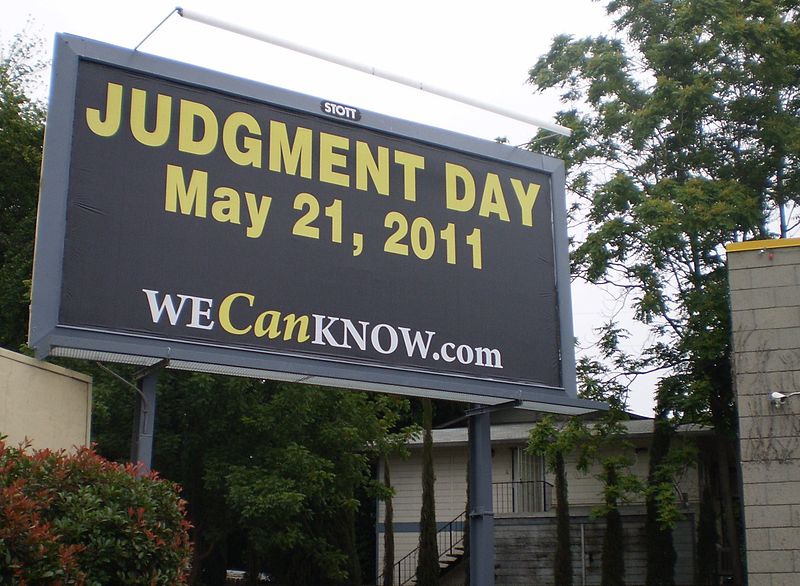
Betrayed by a stubborn Rapture that refused to abide his calculations, California-based televangelist Harold Camping was seemingly silenced in May when the Earth remained unscorched. But like any resilient prophet, Camping has dusted himself off and is doubling down on doom. An exceprt from Dan P. Lee’s smart new New York magazine article about the prognosticating preacher:
“By Monday, in a development he could not have previously fathomed, Camping found himself sitting back in his chair in his wood-paneled studio before a scrum of television cameras. His rail-thin body was clad in an old JCPenney suit, and in his lap he held a massive leather-bound Bible. Though ancient-looking, Camping came across surprisingly confident. After calling ‘this last weekend a very interesting weekend,’ he cut to the chase: ‘And so, the first question is, ‘Camping, what about you? Are you ready to shoot yourself, or are you ready to go on a booze trip, or whatever?’ ’ he asked rhetorically. ‘Well, I can tell you very candidly that when May 21 came and went, it was a very difficult time for me.’
As God had it, an answer began forming and was furthered along via some ideas in a letter he’d received that very morning from a listener. He realized, he explained, he’d been taking some of the end-time verses in the Bible too literally. ‘Suddenly it dawned on me, Oh, I see what happened,’ he said. God had indeed returned to Earth on May 21, he explained, but His return—and the earthquakes and terror that were to accompany it—was for now spiritual, not physical. It was, Camping said, necessary for it to be this way; if God had let Camping realize there would be no fire and brimstone, then his warnings might have been less vigorous. Most important, the timeline he’d parsed from the Bible was no less accurate. The Final Judgment was already occurring. It would last for five months—153 days—and we were already two days in.
‘And it will continue right up until October 21, 2011, and at that time the whole world will be destroyed,’ Camping said calmly. ‘This is why we don’t have to talk about this anymore. The world is under judgment. We are not going to be passing out any more tracts; all billboards are coming down. Our work is done. The world has been warned. My! How they have been warned.'”
I’d be really happy if New York Times film critics A.O. Scott and Manohla Dargis were awarded Pulitzers in the same year. The quantity and quality of their writing is pretty stunning. The pair teamed up for a discussion about the legendary Pauline Kael, an influential scribe in her day (and ours, still) who was a thorny character, to say the least. An excerpt from Dargis about the erstwhile celebrity status of film critics:
“If she still casts a shadow it’s less because of her ideas, pugilistic writing style, ethical lapses and cruelties (and not merely in her reviews), and more because she was writing at a time when movies, their critics and, by extension, the mainstream media had a greater hold on American culture than they do now. In his book Easy Riders, Raging Bulls Peter Biskind relates a story from the mid-’80s when Kael turned to Richard Schickel at a meeting of film critics and said, ‘It isn’t any fun anymore.’ Mr. Schickel asked her why and she replied: ‘Remember how it was in the ’60s and ’70s, when movies were hot, whenwe were hot? Movies seemed to matter.’ The thing is, they did matter and still do, just differently.
One thing that changed was the role of the film critic, who by the mid-’80s no longer had to persuade a skeptical, sometimes hostile general audience that it was necessary to take movies seriously. In 1967, though, Kael had to explain in The New Yorker why and how Bonnie and Clyde was important (and in 9,000 words!). She was part of a critical vanguard spreading the new film gospel in reviews, books, talk shows, everywhere. They were true pop cultural figures. The critic Judith Crist even shilled for a feminine-hygiene spray. She later said that she did the ad because Richard Avedon took the photos, she could write most of the text and the ad would reach more than 100 million readers. Also: she got $5,000.”
•••••••••
Kael and other film critics were famous enough in 1977 to be spoofed by SCTV:
"So you FUCKEN DELETE ME AS YOUR FRIEND." (Image by Raphaël Labbé.)
WOW Could have at least been HONEST with me (my inbox)
I see you deleted me as your FB friend whats the point I must CREEP you out or some dumb shit LIKE WTF I ask you to help me out with another Mix you “say” sure and that you’ll get to work on it over and over and over again only to flake on it. And U just could of said “steve I dont have the time anymore to do it Im sorry” and that would have been that hell im not even mad about it. But why add me as a FB friend to just delete me I post a come about how I too made some good grub and miss chatting so you FUCKEN DELETE ME AS YOUR FRIEND sorry I was putting up playful banter. SORRY if my FB status my have been a bit down trodden My mother has CANCER AND IM GETTING EVICTED I MIGHT BE HOMELESS MY MONDAY but today to find out someone whom I thought was at least a decent humanbeing was at least my Music Buddy was no more then a fraud. I knew some cool ass ppl and bands going to NYC was going to ask for some advice but you know what it dont matter. People like you make me sick Your the reason Hipster a derogatory word. Thanks A lot for your help in past I don’t think I’ll ever ask anything upon you again.
Community organizer Saul Alinsky became an enemy of the American Right all over again three decades after his death, thanks to a posthumous link to President Obama. Amusingly enough, Alinsky pretty much predicted the American drift into Conservatism and the Presidency of anti-government traliblazer Ronald Reagan and the more extreme iterations that followed him. From a 1972 Playboy interview with Alinsky, which was conducted just months before he died in California from a heart attack.
“Saul Alinsky: The middle class actually feels more defeated and lost today on a wide range of issues than the poor do. And this creates a situation that’s supercharged with both opportunity and danger. There’s a second revolution seething beneath the surface of middle-class America — the revolution of a bewildered, frightened and as-yet-inarticulate group of desperate people groping for alternatives — for hope. Their fears and their frustrations over their impotence can turn into political paranoia and demonize them, driving them to the right, making them ripe for the plucking by some guy on horseback promising a return to the vanished verities of yesterday. The right would give them scapegoats for their misery — blacks, hippies, Communists — and if it wins, this country will become the first totalitarian state with a national anthem celebrating ‘the land of the free and the home of the brave.'”
"Mooney was placed on the ship while drunk by a vessel man."
People who didn’t get waylaid during the 19th century got shanghaied, as proven by the following articles from the Brooklyn Daily Eagle.
••••••••••
“She Shanghaied a Sailor” (December 30, 1891): “Mrs. Amanda Hermanson, who keeps a sailors’ boarding house at 256 Van Brunt Street, was held by Justice Tighe this morning to await the action of the grand jury on the charges made by Steffano Valeno. She is the woman whom Valeno had arrested a fortnight ago for shipping him to China against his will and stealing $50 and a trunk from him while he was gone. Valeno brought witnesses to support his statements. After this hearing Mrs. Hermanson was arrested for keeping a sailors’ boarding house without a license, was convicted and sentenced to pay a fine of $100.”
••••••••••
“For Being Shanghaied” (December 6, 1897): “Vancouver, B.C.–News comes from Shanghai that Lawrence Mooney, an American citizen who went to Shanghai from Victoria on the lumber bark St. Catharine, has been awarded damages against the ship by a United States consul general. Mooney was placed on the ship while drunk by a vessel man who became notorious through his connection with the San Francisco smuggling ring.”
••••••••••
"He was first drugged into unconsciousnes, how, he cannot say, or at what place, and then placed in the hold of the vessel."
“Return of a Missing Man” (April 5, 1872): “About six weeks since Robert Seymour, a tinman, having a small store in South Fifth, married and the father of two children, left his home and place of business to perform a job of work on board of a vessel said to be then lying at the foot of Rutgers Street, New York, and up to yesterday nothing had been heard from him, although every effort had been exerted to obtain a clue to his whereabouts.
Among his friends most earnest in hunting Mr. Seymour was Mr. E. Gateson, a plumber, who was more than surprised at seeing the missing man, whom he had given up for dead, walk into his store at Broadway, and salute him, as of yore, by the title of ‘Boss.’ To Mr. Gateson the appended account was substantially related by Seymour, concerning his extended absence, from which it will be seen that an old-time practice of seizing men and shipping them against their will still prevails to some extent in the metropolis of the State.
In other words, Seymour was shanghaied, to accomplish which he was first drugged into unconsciousnes, how, he cannot say, or at what place, and then placed in the hold of the vessel, which was probably ready to sail at a moment’s notice. The first he knew he found himself in a dark and confined space, in company with three other men, and on the succeeding day was with them taken on deck, and asked to sign a paper binding him for a whaling voyage. He and his three companions refused to accede to this proposition, and upon their promising not to make any stir about this matter, nor inform upon their captors, they were taken ashore on a small boat to the mouth of the Chesapeke Bay, from where they made their way to Baltimore. From thence they were passed to New York, where the party arrived yesterday morning, overjoyed at once more finding themselves at home and among friends. He further stated that it was not the vessel upon which he was at work in which he was carried off to sea, and is unable to give either its name or that of the captain, as he had no communication with any one on board, neither did he know a single one of the crew.
Mr. Seymour still bears traces of the hardship endured by him, and says he has not yet recovered from the effects of the drug partaken of by him.”
Farhad Manjoo has an excellent new article in Fast Company, “The Great Tech War of 2012,” which looks at the quartet of dominant American technology companies poised to do battle with one another. An excerpt:
“To state this as clearly as possible: The four American companies that have come to define 21st-century information technology and entertainment are on the verge of war. Over the next two years, Amazon, Apple, Facebook, and Google will increasingly collide in the markets for mobile phones and tablets, mobile apps, social networking, and more. This competition will be intense. Each of the four has shown competitive excellence, strategic genius, and superb execution that have left the rest of the world in the dust. HP, for example, tried to take a run at Apple head-on, with its TouchPad, the product of its $1.2 billion acquisition of Palm. HP bailed out after an embarrassingly short 49-day run, and it cost CEO Léo Apotheker his job. Microsoft’s every move must be viewed as a reaction to the initiatives of these smarter, nimbler, and now, in the case of Apple, richer companies. When a company like Hulu goes on the block, these four companies are immediately seen as possible acquirers, and why not? They have the best weapons–weapons that will now be turned on one another as they seek more room to grow.”
••••••••••
Majoo on living in the post-fact digital world, 2008:
"Guys who have enough money to randomly go to outer space."
thanks a lot asshole – you know who you are!
i fucking hate you. you make me angry. you ruined my life and now everything makes me angry. puppies make me angry. stupid hipster baristas piss me off. yoga makes me angry. people who wear leg warmers. people who wear arm warmers. facebook status updates. gluten-free labels. stores that don’t take $50 bills. atm’s that keep handing them out. vegetarians. vegans. people who don’t like fur. ugly people. fat people. skinny bitches. people who use bad grammar and make up words like refudiate. throwing up in my mouth a little and then having to swallow it. dropped calls on my iphone. waiting for the bus. paying for the bus. being ass grabbed on the bus. paying too much for cable. rainbows and fucking unicorns. children who at the age of 4 already feel entitled to give the world attitude. the asshole parents who make them like that. tim horton’s coffee. emails from nigerian princes and british estate lawyers. cel phone ringbacks. detox diets. thanksgiving. black friday. christmas. easter. valentine’s day. jesus. solar calculators. solar panels. saving planet earth. hippies. sorting my fucking garbage even though half the recycling still goes into landfill. guys who have enough money to randomly go to outer space. corn poo. tickle me elmo. endless voicemail options. the alarm clock. shitty take out. good take out. warm beer. creepy ass earwigs. god damn birds chirping in the morning. people who steal. and most of all these gorgeous awesome smelling tulips that were my favourite flower make me fucking angry!!!!!!!
Theater talker Mike Daisey has a particularly timely monologue with The Agony and the Ecstasy of Steve Jobs, in which he investigates the dark side of the modern miracle of consumer electronics, which stared squarely at him in the ginormous Chinese factories where the gadgets are manufactured at a high human cost. An excerpt from Ben Brantley’s New York Times review:
“For Mr. Daisey, as for many others, affection for Apple products evolved into reverence for Mr. Jobs, the Apple co-founder whose identification with the company and its products has been much remarked upon, and worried over, since his illness made news several years ago.
Mr. Daisey has been performing this show since July of last year, and while the death of Mr. Jobs lends the evening a certain eerie timeliness, it also means that many in the audience will be familiar with the life and career of Mr. Jobs from reading obituaries and tributes.
The hippie-meets-tech-geek ethos, the founding of and then ouster from Apple, the triumphant return and the revolutionary series of consumer products that followed: Mr. Daisey covers this material fluently and with amiable humor, mixing obvious hero worship with some pointed skepticism. (Mr. Jobs, he notes, was the kind of imperious guy who divided the world’s population into ‘geniuses and bozos.’)
But the show is most engrossing, and most disturbing, when Mr. Daisey delves into the grim realities of workers’ lives in Shenzhen, a city that he memorably describes as looking as if ‘Blade Runner threw up on itself.'”
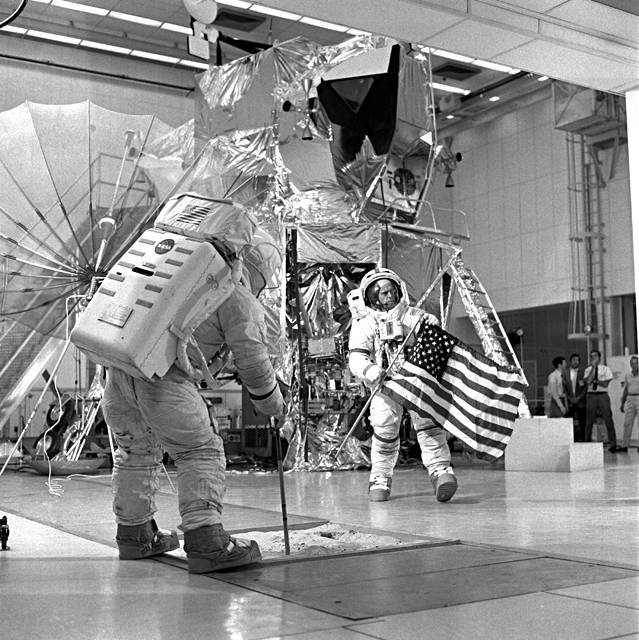
This classic NASA image chronicles the training of astronauts for 1971’s Apollo 14 mission, the third time we reached the moon. The astronauts had to practice everything, even that moment when they would plant the U.S. flag on our natural satellite. According to theApollo 14 press kit, the astronauts spent approximately three weeks in quarantine after returning to Earth, being the final U.S. moonwalkers to be quarantined when they returned home.
••••••••••
Planting the flag:
Alan Shepardmakes the moon his driving range during Apollo 14:
“Persi Diaconis‘s unlikely scholarly career in mathematics began with a disappearing act.
He was 14 years old and obsessed with magic, spending much of his free time in or around Tannen’s Magic Store, on Times Square, where sleight-of-hand masters regularly gathered to show off tricks and to gossip. There, one of the most influential magicians of the past century, a card maestro named Dai Vernon, saw Diaconis’s prodigious trick dealing and invited the young man to leave New York and join him on the road.
Diaconis vanished from his regular life, dropping out of school and cutting ties with his family. ‘I packed a little bag—I took some decks of cards and some socks,’ remembers Diaconis, now 66 with unruly tufts of white hair, in his office at Stanford University, where he is a professor of mathematics and statistics. ‘I was sort of his assistant.’ And his student. Vernon, then in his 60s, promised that if his apprentice advanced far enough in his studies, he would reveal secrets of magic he had never shared with anyone else.
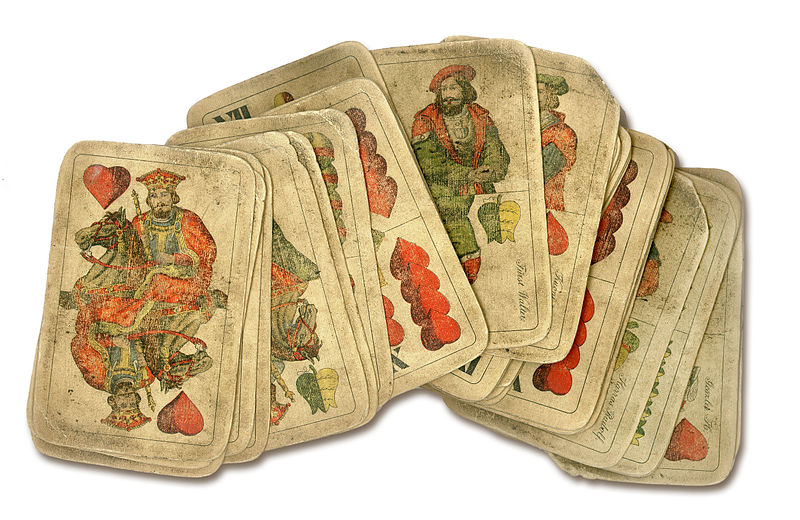
It was this search for the hidden workings of magic that led Diaconis to math. During a few years on the road doing his own magic act, he came to think of the hearts, diamonds, spades, and clubs in a deck of cards as variables that followed predictable formulas as he shuffled them. He could code the cards as binary numbers in his head and perform mental calculations as audience members cut the deck, so that when they picked a card, any card, Diaconis could name it.” (Thanks Browser.)
In a Financial Times article in which he elaborately kisses the ass of President Bill Clinton, historian Simon Schama also elicits some fine political analysis from 42. An excerpt about the Tea Party:
“‘The Tea Party,’ Clinton says, ‘is the most extreme incarnation of the 30-year cycle that began when Ronald Reagan said in his first inaugural that government isn’t the answer, government is the problem. But the real issue is not that the Tea Party is in control of the country, has captured the airwaves or represents a majority of public sentiment; the problem is that something [the deal-making system] that has worked for the American people in the past isn’t working now.’
And the ideologues haven’t had their ‘Waterloo moment to break the fever,’ such as the two shut-downs of the federal government engineered by Speaker Newt Gingrich and the incoming House Republicans in 1995. That triumphant phalanx assembled beneath the banner of the Contract with America to which they vowed to remain uncompromisingly faithful. But the public hated the shut-downs and blamed Republicans to the point when it became apparent they had actually taken out a contract on themselves. It was Gingrich, not Clinton, who was ousted, the president winning re-election a year later. The manufactured spat earlier this year over raising the debt ceiling had Waterloo-moment promise, but the prospect of the US defaulting for the only time in its history and the risk of sending the already stressed bond market over the cliff meant that Obama, unlike Clinton, couldn’t call the naysayers’ bluff.
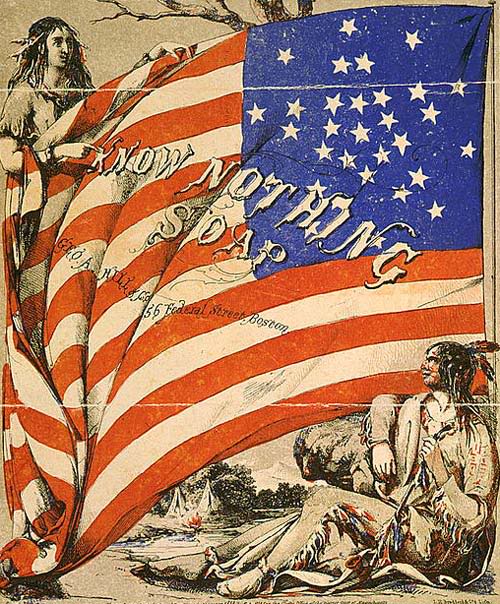
So what can be done about this latest edition of Know-Nothings? ‘You can’t convert the ideologues because they don’t care what the facts are. With the world as it is, you have to fight the fight you can win, and the fight you can win is economics.’ He gets intense at this point. ‘There isn’t a single example of a successful country on the planet today – if you define success as lower rates of unemployment, higher rates of job growth, less income inequality and a health system that produces the same or better care at lower cost – that doesn’t have both a strong economy and effective government that find some way to work in harness with each other … If you don’t do that, if you don’t have a system by which the poor can work their way into it, then you lose the social cohesion necessary to hold the country together and that is a big problem.”
••••••••••
Schama discusses slavery in America with perpetually exhausted Charlie Rose:
The de facto theme song of the feminist movement of the 1970s, Helen Reddy’s “I Am Woman” was a giant radio hit and a huge target of derision. In 1975, the United Nations chose the song to officially represent International Women’s Year. Great slowed-down live version:
Reddy and Alice Cooper share scripted banter at the Grammys, 1974: