Science/Tech

You are currently browsing the archive for the Science/Tech category.

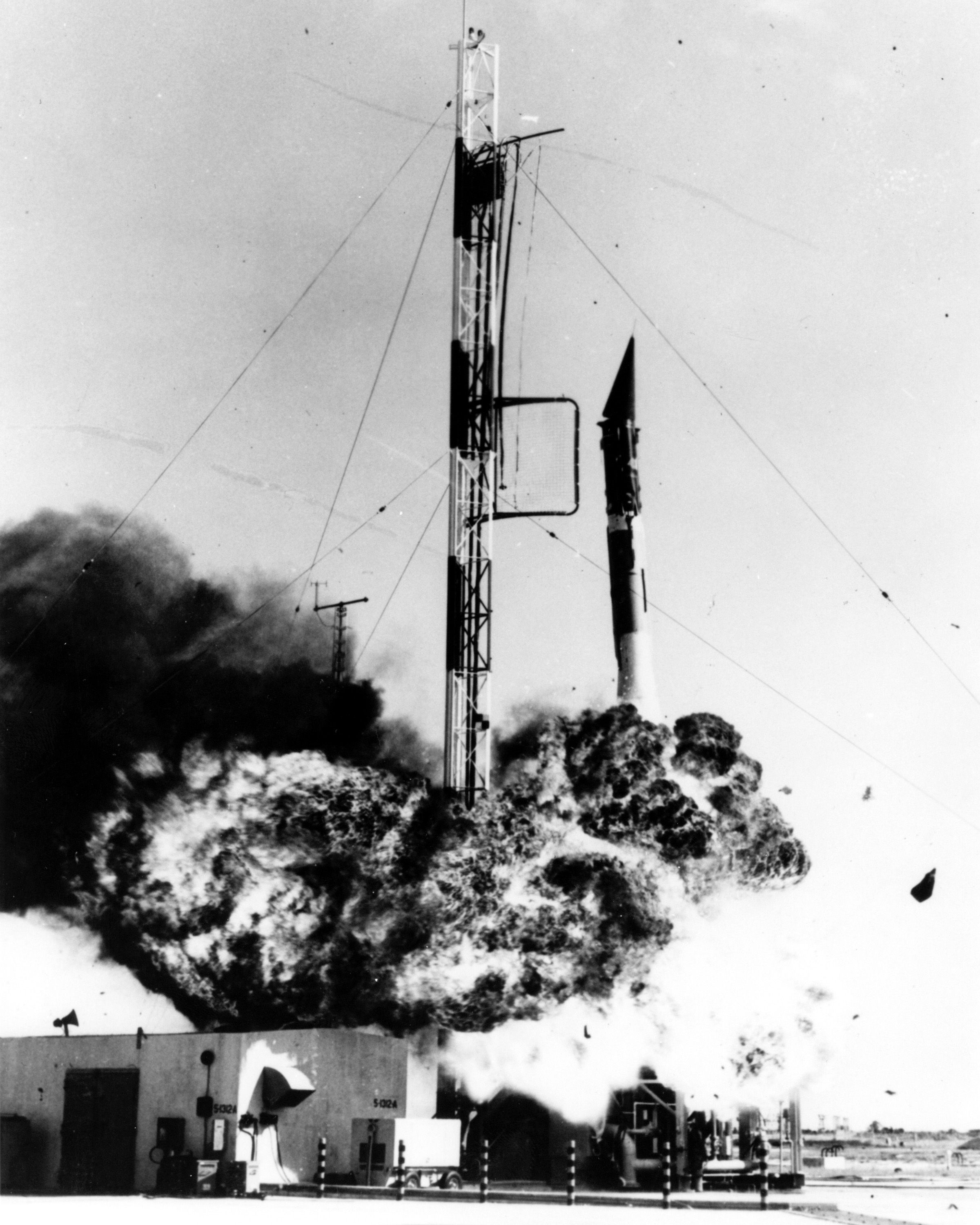
A failed launch during IGY saw the Vanguard malfunction in December 1957.

In 1957-58, 64 nations from both sides of a Cold War that would continue for three more decades came together to perform large-scale scientific research as part of an alliance known as International Geophysical Year. It was an unprecedented display of global information sharing, with satellites launched and knowledge of space travel gained. Life magazine covered the outset of the project with the article, “The World Studies the World.” An excerpt:

“Through the top of a strange sheet-metal shack at Ft. Churchill, Manitoba, a powerful research rocket last week streaked into the upper air to perform one of the first major experiments of the newly launched International Geophysical Year. While the rocket is radioing its data from 160 miles up, a team of seismologists deep in a Chilean tunnel were taking data from earthquake recorders. A pair of oceanographers on the remote Pacific island of Jarvis were collecting samples of ocean water. And in the South Pole Americans were observing the fluctuations of a rare red aurora.
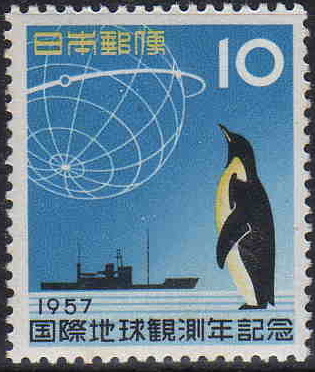
Japanese stamp commemorating IGY.

In hundreds of other places and ways, 8,000 scientists of 64 nations were starting history’s most ambitious scientific research program. In the IGY, says Dr. Joseph Kaplan, chairman of U.S. IGY committee, ‘scientists of the world are going to take a long and special look at our earth –at its wrinkled crust, its hot heart, its deep seas, its envelope of air, its mighty magnetism, its relationship to outer space.’

IGY, which will last for 18 months through December 1958, will cost half a billion dollars. Its end results should be of extreme practical value; vastly improved communications, more accurate navigation for ships and planes, billions of dollars and many lives saved with improved weather forecasting, and further progress toward mastery of polar regions and outer space.”

••••••••••

Donald Fagen sings a hopeful 1982 song which he wrote from the vantage point of those involved in IGY: “Here at home we’ll play in the city / Powered by the sun / Perfect weather for a streamlined world / There’ll be spandex jackets, one for everyone.”

Tags: ,

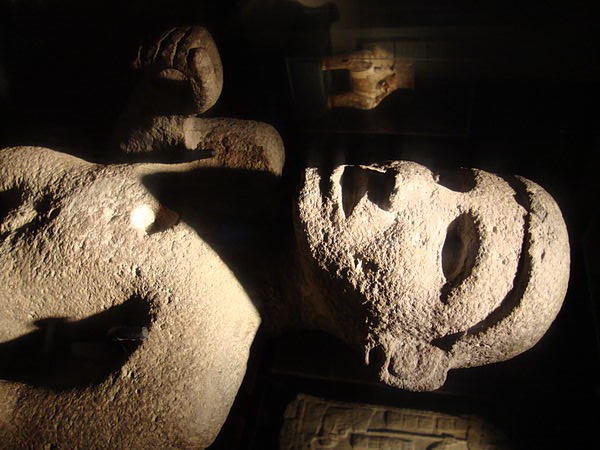
"Does anybody believe that a race of gigantic men, who were 12 to 30 feet high, ever lived in these United States of America?"

While the following article from the May 16, 1900 Brooklyn Daily Eagle, which was repinted from the Prescott Prospect, doesn’t prove that a race of 20-foot giants once roamed America, it is conclusive evidence that the newspaper’s editors had been drinking heavily. An excerpt:

“Does anybody believe that there ever has been a race of giants in the world? Does anybody believe that a race of gigantic men, who were 12 to 20 feet high, ever lived in these United States of America? And yet the proof that such a race of people did live in this country is to be found in the Grand Canyon of the Colorado River in northern Arizona. This proof consists of, first, footprints in the red sandstone, footprints that appear to have been made by the moccasined feet of gigantic men, men whose tracks measured twenty inches in length and who stepped five feet at a stride.

The second proof is that there is the petrified body of such a man likewise in the red sandstone of the Grand Canyon district. This body was of a living, breathing man, but after death the flesh was replaced by lime or silica, held in solution in the water. There is ample evidence that nature was able to perform this feat, as the petrifying process is being carried on in the canyon to this day. The third fact is that there is and was a strong and almost universal tradition among the ancient people of Mexico and Peru that such a race of giants lived in their country.

Perhaps it is almost too much to call this proof, but it is at least corroborative testimony. Last June I visited the Grand Canyon as a tourist. There I met Mr. Hull, who was acting as a guide into the canyon and who was a pioneer of northern Arizona. He told me the following story, and with apologies for my credulity, I believe him.

"Outstretched on this slab was the body of a gigantic man turned into stone."

Three years ago he and a companion named Jim Lavelle had been prospecting in this part of the country. They found a ledge which they thought was valuable and had started out of the canyon with samples of the ore, expecting to return in a few days. One of the Indians was with them. Mr. Hull speaks the Indian language fluently, and the Indians have a great admiration for him. The Indian said, ‘Have you ever seen the big Indian up here?’ volunteering to show it. They followed him up a foot trail, which led through a crevice in the red wall, thence on to the bench like formation above but still in the midst of the red sandstone.

They came to a place where a projecting rock formed a shelter over a sloping table like slab of stone which was covered with a white incrustation of lime. Outstretched on this slab was the body of a gigantic man turned into stone. The body was entirely nude and lay face downward. They estimated his height at 18 or 20 feet. They looked at it 10 or 20 minutes and then continued their journey, intending to return and make a more complete investiagtion. Plans changed and they failed to return.

This was startling information, but I had been in a measure prepared for it. It had always seemed reasonable to me that the prehistoric, primeval hunting savages should have been of large stature.”

Tags: ,

And then it celebrates. (Thanks Singularity Hub.)

••••••••••

Hungarian architect Ernő Rubik discusses his famous puzzle in 1981:

“Of course you can’t give the exact time of an idea’s birth, it seems impossible to me, to me particularly, for who time, from this point of view, has very little interest. It can have been in spring, 1974 that the idea came to me, as a noteworthy possibility. I have a nature attached to experiences, so, since the beginning, I studied variations of a 2x2x2 cube. I was immediately struck by the wealth that could be sensed only from this start. The final technical solution, which is the simplest form 3x3x3, the most easily workable in models, after a few tries, came to me toward the end of autumn, 1974. Several models ready to work were made for me and my friends, it has been exciting to play with them for the first time. We were all surprised to discover gradually that we had made something original, new.The question of the patent of the invention was immediately raised, so I began the necessary process the 30 January, 1975. Almost at the same, sensing something of the importance of the invented game, of its possibilities and of its real value, I began searching for a partner for the manufacturing and by an extraordinary chance, I indeed found one. The following is rather simple : after its launch on the market (1977) the game became, rapidly and as if by magic, very popular in Hungary, then, from 1980 in the whole world. I feel like the story only begins, and that we can’t predict the end, as well as nobody, I think, could have guessed its future.”

Tags:

Hanna Rosin’s 2010 Atlantic article, “The End Of Men,” concerns American males falling further and further behind women in education, employment, etc. The opening focuses on biologist Ronald Ericsson, who caused a media-stoked panic in the 1970s when he created a method that purportedly allows parents to choose the sex of their offspring. This development led some feminists to  fear that women would be doomed in America. An excerpt:

“IN THE 1970s the biologist Ronald Ericsson came up with a way to separate sperm carrying the male-producing Y chromosome from those carrying the X. He sent the two kinds of sperm swimming down a glass tube through ever-thicker albumin barriers. The sperm with the X chromosome had a larger head and a longer tail, and so, he figured, they would get bogged down in the viscous liquid. The sperm with the Y chromosome were leaner and faster and could swim down to the bottom of the tube more efficiently. Ericsson had grown up on a ranch in South Dakota, where he’d developed an Old West, cowboy swagger. The process, he said, was like ‘cutting out cattle at the gate.’ The cattle left flailing behind the gate were of course the X’s, which seemed to please him. He would sometimes demonstrate the process using cartilage from a bull’s penis as a pointer.

Dr. Ericsson's property was used for this 1980 Marlboro Country print ad.

In the late 1970s, Ericsson leased the method to clinics around the U.S., calling it the first scientifically proven method for choosing the sex of a child. Instead of a lab coat, he wore cowboy boots and a cowboy hat, and doled out his version of cowboy poetry. (People magazine once suggested a TV miniseries based on his life called Cowboy in the Lab.) The right prescription for life, he would say, was “breakfast at five-thirty, on the saddle by six, no room for Mr. Limp Wrist.’ In 1979, he loaned out his ranch as the backdrop for the iconic ‘Marlboro Country’ ads because he believed in the campaign’s central image—’a guy riding on his horse along the river, no bureaucrats, no lawyers,’ he recalled when I spoke to him this spring. ‘He’s the boss.’ (The photographers took some 6,500 pictures, a pictorial record of the frontier that Ericsson still takes great pride in.)

Feminists of the era did not take kindly to Ericsson and his Marlboro Man veneer. To them, the lab cowboy and his sperminator portended a dystopia of mass-produced boys. ‘You have to be concerned about the future of all women,’ Roberta Steinbacher, a nun-turned-social-psychologist, said in a 1984 People profile of Ericsson. ‘There’s no question that there exists a universal preference for sons.’ Steinbacher went on to complain about women becoming locked in as ‘second-class citizens’ while men continued to dominate positions of control and influence. ‘I think women have to ask themselves, ‘Where does this stop?’ she said. ‘A lot of us wouldn’t be here right now if these practices had been in effect years ago.’

Ericsson, now 74, laughed when I read him these quotes from his old antagonist. Seldom has it been so easy to prove a dire prediction wrong.” (Thanks to The Electric Typewriter.)

Tags: ,

Fun short 1976 documentary about Lillian Schwartz, an artist who was an early adapter of digital technology and pioneered a merging of computer graphics and fine art.

Tags:

From an 1895 edition of the Brooklyn Daily Eagle:

“Members of the Fifteenth ward citizens’ association for the abolishment of Newtown Creek nuisances are complaining that stenches from the creek at night have increased steadily since April 17, and that the air was so filled with foul smelling vapor at 4 o’clock yesterday morning that sleep was out of the question for people living in the Fifteenth and Eighteenth wards. The members of the citizens’ association insist that fat rendering and bone boiling establishments and fertilizer manufactories on the shores of the creek empty foul smelling material stored during the day into the creek at night, and they believe that if the proprietors of stench emitting factories who are indicted are not speedily brought to trial the nuisances will soon become as intolerable as ever.”

From “World’s Largest Wooden Structure,” a photo essay on Yatzer.com about Seville’s recently completed Metropol Parasol, which was designed by J. Mayer H. Architects:

“The Metropol Parasol scheme with its imposing timber structure offers a range of attractions and amenities to be used by the public.  Such functions include an archaeological museum, a farmers market, an elevated plaza, and multiple bars and restaurants underneath and inside the parasols, as well as a panorama terrace on the upper level of the parasols. Realized as one of the largest and most innovative bonded timber-constructions with a polyurethane coating, the parasols grow out of the archaeological excavation site into a contemporary landmark, thus defining a distinctive relationship between the historical medieval city and the contemporary city beat!  Metropol Parasols mix-used multicultural program sets off a dynamic development for culture and commerce in the heart of Seville and beyond.”

The great Gil Scott-Heron, being critical of Space Race myopia back in the day.

Tags:

Immanuel Velikovsky’s theories about our planet’s history, which came into vogue during the 1970s, are catastrophist nonsense but a whole lot of fun if you recognize they’re fictional. Philip Kaufman realized this and used them to forward the plot of his excellent version of Invasion of the Bodysnatchers, which was released in 1978, the year before the scientist died at age 84. Below is an amusing 1972 BBC doc about the Velikovsky phenomenon.

A 1950 Popular Science note about Velikovsky: “Astronomers at Harvard consider the sensational theory of Dr. Immanuel Velikovsky that the earth stood still a couple of times in Biblical days sheer nonsense.”

Tags: ,

The opening of “Mind vs. Machine,” Brian Christian’s recent Atlantic article about the author’s particpation in the Turing Test, an annual event in which computers compete to exhibit intelligent behavior that can pass for human:

“BRIGHTON, ENGLAND, SEPTEMBER 2009. I wake up in a hotel room 5,000 miles from my home in Seattle. After breakfast, I step out into the salty air and walk the coastline of the country that invented my language, though I find I can’t understand a good portion of the signs I pass on my way—LET AGREED, one says, prominently, in large print, and it means nothing to me.

I pause, and stare dumbly at the sea for a moment, parsing and reparsing the sign. Normally these kinds of linguistic curiosities and cultural gaps intrigue me; today, though, they are mostly a cause for concern. In two hours, I will sit down at a computer and have a series of five-minute instant-message chats with several strangers. At the other end of these chats will be a psychologist, a linguist, a computer scientist, and the host of a popular British technology show. Together they form a judging panel, evaluating my ability to do one of the strangest things I’ve ever been asked to do.

I must convince them that I’m human.

Fortunately, I am human; unfortunately, it’s not clear how much that will help.” (Thanks to The Electric Typewriter.)

••••••••••

Tags: ,

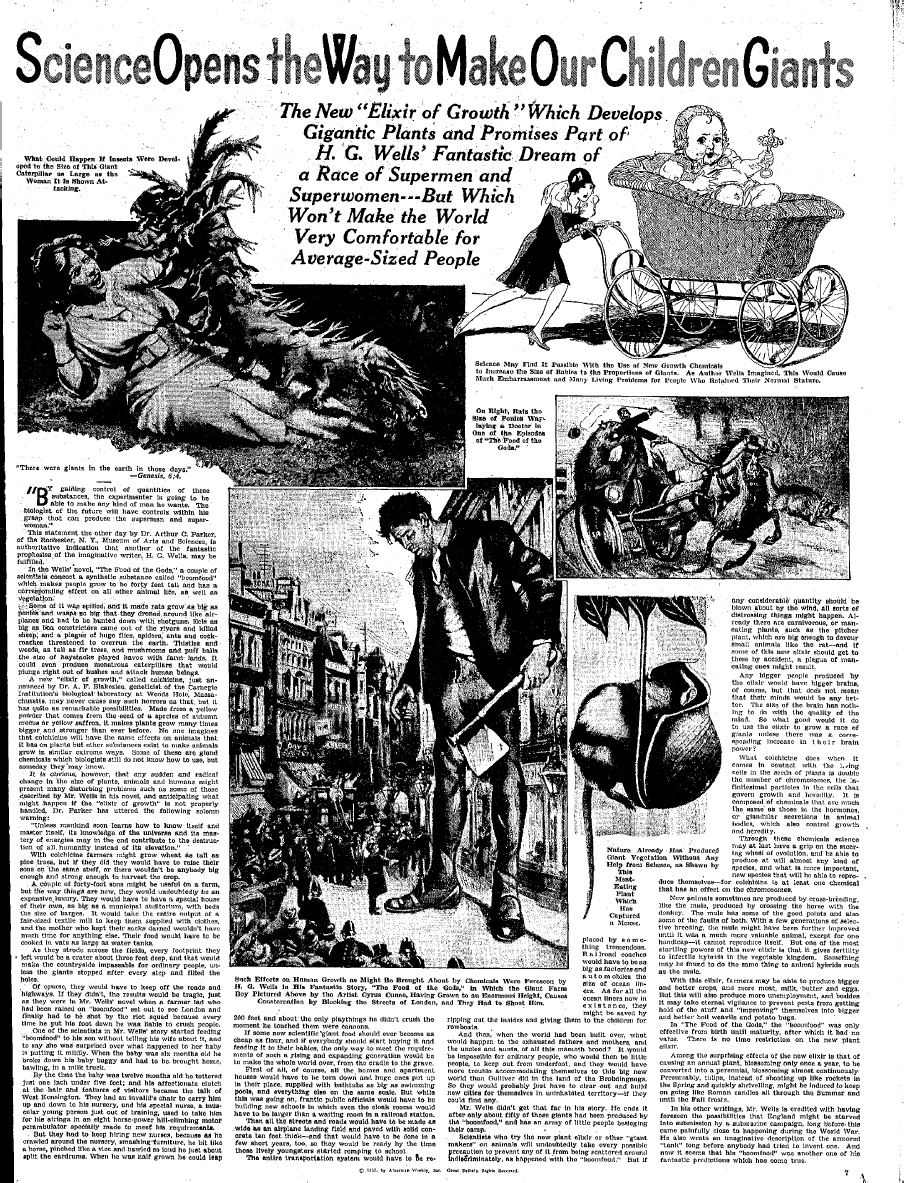
Retro-Futurist expert Matt Novak uses his amazing PaleoFuture site to catalog wild predictions from the past that never panned out. For instance: The article below from a 1937 San Antonio Light opined that advances in chemistry would make gigantic babies a reality in the near term. Sadly, that hasn’t happened. Not yet, anyhow. It seems like anything we dream, no matter how unlikely, can come true given enough time. (Thanks Marginal Revolution.)

••••••••••

“Giant Baby” by Ron Mueck:

Tags: ,

The likley future of phones and tablets. (Thanks CNET.)

Retronaut dug up this fun print ad for the first commercially successful laptop microcomputer, the 1981 Osborne 1.

From the ad copy: “The guy on the left has two file folders, a news magazine, and a sandwich. The guy on the right has the Osborne 1, a fully functional computer system in a portable package the size of a briefcase. Also in the case are the equiva;lent of 1600 typed pages. stored on floppy diskettes. The owner of the Osborne 1 is going to get more work done–and better work done with less time and with less effort.”

Very cute neurowear in action. (Thanks Reddit.)

Recalling the voyage into space by Ham, the first astrochimp, in 1961.

Tags:

The best science book I read during the aughts was Alan Weisman’s 2007 theoretical tome, The World Without Us. Weisman, a journalist not a scientist, imagines what would happen to all we’ve built if human beings suddenly disappeared from the face of the Earth. What would become of oil wells and subways and bridges and apartment buildings if they were untended? Weisman’s findings are fascinating.

mmmmm


An excerpt about New York City sans people from the book: “In the first few years with no heat, pipes burst all over town, the freeze-thaw cycles move indoors, and things start to seriously deteriorate. Buildings groan as their innards expand and contract; joints between walls and rooflines separate. Where they do, rain leaks in, bolts rust, and facing pops off, exposing insulation. If the city hasn’t burned yet, it will now. Collectively, New York architecture isn’t as combustible as, say, San Francisco’s incendiary rows of clapboard Victorians. But with no firemen to answer the call, a dry lightning strike that ignites a decade of dead branches and leaves piling up in Central Park will spread flames through the streets. Within two decades, lightning rods have begun to rust and snap, and roof fires leap among buildings, entering panel offices, filled with paper fuel. Gas lines ignite with a rush of flames that blows out windows. Rain and snow blow in, and soon even poured concrete floors are freezing, thawing, and starting to buckle. Burnt insulation and charred wood add nutrients to Manhattan’s growing soil cap. Native Virginia creeper and poison ivy claw at walls covered with lichens, which thrive in the absence of air pollution. Red-tailed hawks and peregrine falcons nest in increasingly skeletal high-rise structures.”

Tags: ,

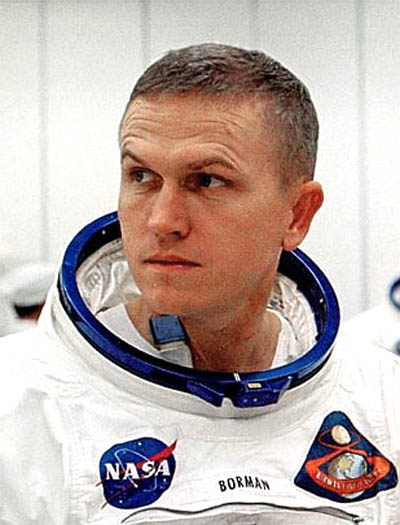
Borman: Felt the scorn of the longhairs.

I never knew until recently that astronaut Frank Borman, after completing his Apollo 8 mission in 1968, became a target of anti-authority campus radicals. A post-mission tour of American universities didn’t go splendidly for Borman, and Carl Sagan apparently didn’t help matters when the spaceman made his way to Cornell. An excerpt from Collect Space about the ill-fated meeting:

“After Borman returned from Apollo 8 NASA sent him on a good will tour of colleges and universities across the country. Borman took his wife Susan along so she could share in the event. At Columbia no sooner than Borman started to talk, the audience started pelting him with marshmallows and two students dressed in gorilla costumes climbed onto stage with him to reenact the opening of the movie 2001.

But as Borman said, ‘Then there was Cornell.’

At Cornell Borman and his wife Susan were guests of Carl Sagan. Sagan invited them to his house for the evening so that they could meet some of the students from Students for a Democratic Society. Sagan explained that he was their faculty advisor.

As Borman explains it, they spent the evening sitting on the floor of Sagan’s living room where Sagan orchestrated an attack, egging the students on when they asked questions such as, ‘Col. Borman, were you aware that on such and such a date American troops massacred hundreds of helpless Vietnamese woman and children? Just what is your opinion of this heinous atrocity? Surely you must have some thoughts on the subject!’

I always wondered why Sagan (a very well-loved man) set Borman and his wife up like that. The best answer I have been able to come up with is Sagan saw Borman as a trespasser. Sagan made no secret of the fact that as a university professor he saw himself as superior to any military officer.”

••••••••••

Apollo 8 crew reads biblical passages from space on Christmas Day 1968:

Tags: ,

Orson Welles picked up some wine money for his participation in the 1975 documentary, “Who’s Out There.” It features cool interviews with Americans who were scared to death by Welles’ famous radio hoax about an alien invasion, War of the Worlds. Welles also explores, with the help of Carl Sagan, among others, whether actual extraterrestrials exist.

Tags: ,

Most amusing. (Thanks Singularity Hub.)

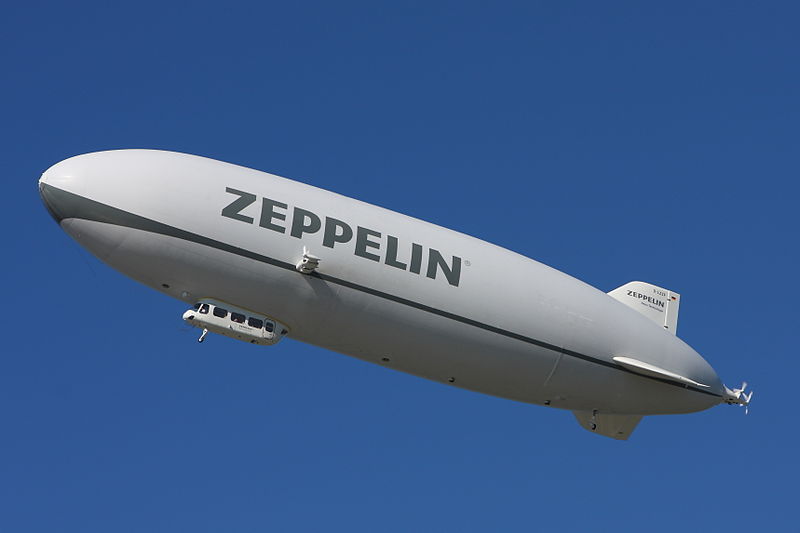
"They can loft enormous payloads." (Image by AngMoKio.)

From “Is There a Future for Airships?a new Scientific American article wondering whether the past can become prelude:

“The notion that airships represent the future of air cargo is being revived by a new generation of entrepreneurs some 75 years after a catastrophic fireball brought the industry to a screeching halt.

Far safer than the Hindenburg, whose tragic 1937 docking remains an icon of aerospace gone wrong, these modern airships are a hybrid of lighter-than-air and fixed-wing aircraft. They can loft enormous payloads without requiring the acres of tarmac or miles of roadway necessary for conventional air and truck transport. And they do so at a fraction of the fuel and cost of aircraft.

Airships ‘give you access and much larger payloads at much lower costs,’ said Peter DeRobertis, project leader for commercial hybrid air vehicles at Lockheed Martin’s Aeronautics and Skunk Works division in Fort Worth, Texas. ‘It’s also a green aircraft; you’re not polluting.'”

••••••••••

Famously haunting summation by Herbert Morrison: “Oh, the humanity.”

Tags: ,

Millions of tons of plastic recyclables fall into our oceans from barges each year, sinking beneath the water’s surface, out of sight and out of mind. But what about plastic encroaching on nature in plain sight, why don’t we take notice of that? The always observant Ian Frazier, a proud tree hugger, does. In “Tilting at Tree Bags,” his 2001 Mother Jones article, Frazier tells of his very personal quest to relieve New York City trees of plastic bags that attached to their branches, An excerpt:

“Sometimes when we snagged an unusually pesky high bag, windows at a nearby apartment house would fly open and people would stick their heads out and applaud. Once an old woman invited us in and gave us lunch. Sometimes people came up to us and thanked us, and once a guy handed me a dollar bill. Mostly, though, people looked at us with mystication, or smiled and shook their heads in a ‘what a crazy city’ way. Once, in Brooklyn’s Prospect Park, a jogger stopped and watched us for a minute or two as we tried to remove a complicatedly entangled bag. ‘That’s a lot of trouble to go through for just a bag,’ he said. I said to him, “Is it any more pointless than running in a big circle back to your apartment?’

Bag snagging was our exercise, our companionship, our hobby, our impromptu community action program. Its aesthetic pleasures were large: A tree from which one or more plastic bags has been removed is, oddly, more beautiful than a tree which never had any bags in it to begin with. In the past, some of our outdoor activities — hitting golf balls at passing ships — had bordered on vandalism, but bag snagging gave some of vandalism’s thrill while actually being its opposite. Throughout the city we went where we wanted without asking permission, improving the landscape. Now I understood, a bit, how people felt who had worked on the construction of some major public landmark like the Empire State Building. Sometimes when I’d go by a park in a taxicab I would point out the window and say with pride, ‘You see that tree? We took an extra-large pair of green stretch pants out of it the other day.'” (Thanks Kevin Kelly.)

••••••••••

Frazier on the Colbert Report:

www.colbertnation.com


Tags:

Just a simulation–for now! (Thanks Big Think.)

Biochemist Mark Roth presents a TED Talk about slowing down the biological processes of trauma victims so that they can receive life-saving treatment.

••••••••••

The other Mark Roth converts the 7-10 split, the rarest shot in bowling:

Tags:

The Dainese D-Tec, available this year. (Thanks Reddit.)

From a 2000 Popular Mechanics article about Dainese getting involved with the design of space suits: “Dainese may be known for its luxe motorcycle helmets and leathers, but the Italian company recently displayed two pieces of decidedly futuristic apparel at the 2008 Legend of the Motorcycle Concours d’Elegance.

In anticipation of NASA’s down-the-road Mars landing missions, Dainese has teamed up with MIT for an ambitious project that intends to pressurize an astronaut’s body without the usual bubble of air that creates bulky spacesuits. We’ve seen the suit concept before, but bringing on these bike gurus is just cool—and smart.

Ditching the old-school ‘Moon Man’ image, Dainese’s futuristic space duds feature a fitted design strung with intertwining black-and-gold filaments. It may look like a sleek bodysuit by Armani, but the filaments actually serve a crucial purpose: They run along Lines of Non Extension (LoNEs) on the human body, which according to chairman Lino Dainese ‘remain stationary even when we move. If these points are united,’ he explains, ‘the same pressure is established throughout the body.’

Oddly enough, Dainese insists that this concept of ‘adherent suits’ originated in the 1950s, but was abandoned because prototypes were too stiff. While the suit has been in development for several years, Dainese hopes the suit will be used when NASA finally sets foot on the Red Planet sometime around the year 2030.”

Tags:

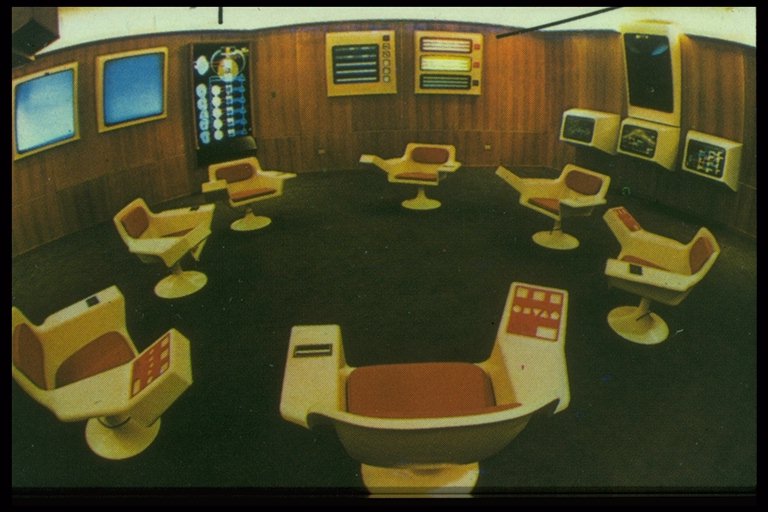
Lost in the collateral damage of the 1973 coup d’etat in Chile that toppled Salvador Allende was Project Cybersyn, a singular computerized business control management system set up by British organizational guru Stafford Beer. “Cybersyn,” a portmanteau for Cybernetic Science, was an odd mélange of socialism, biology, business dynamics, computer science and space-age accoutrements. Telex machines in a Santiago-based control room (which seemed straight out of Star Trek) were used to sync up Chilean factories and provide real-time management for them. Its goal was no less than to regulate the entire national economy. It seems like a terrible and fascinating idea.

The control center was destroyed during the coup, but Beer’s influence went far beyond Chile or the business world; Brian Eno, an acolyte, wrote the forward to a collection of Beer essays. The following is an excerpt of Beer’s writing about Project Cybersyn at its outset:

“Dear friends, I should like to greet you personally to this place, in the development of which I have taken enormous personal interest, and for this reason I am asking you to take a special interest in it. What you see is the outcome of 18 months of hard work on the part of a group of extremely professional Chilean engineers who have devoted their efforts to solving corporate management problems. They have created for us  a series of tools to help us in the task of controlling the economy. Modern science, and specifically electronic  computer science, offers the Government a new opportunity to address modern economic problems. We have seen that the power of this science has not  yet been used in the so-called developed countries. We have developed a system on our own. What you are about to hear today is revolutionary – not only because this is the first time that this is applied in the world –  it is revolutionary because we are making a deliberate effort to give the people the power that science gives to us, enabling them to use it freely.”

••••••••••

Beer briefly explains feedback:

Tags: , ,

« Older entries § Newer entries »