
Politics

You are currently browsing the archive for the Politics category.

Sometimes notions about Japan can be generalized too much, but it would be tough to argue that the population isn’t graying, nationalistic and homogenous. Further, its economic and diplomatic position in the world is uneasy, in part because of the rise of an open and ambitious China. Two exchanges from Hiroki Manabe’s new Asahi Shimbun interview with Joseph Caron, the former Canadian ambassador to Japan.

____________________________

“Question:

Do you have any recommendations for Japan in regards to dealing with China?

Joseph Caron:

This is where I see interesting parallels between Canada and Japan, even though the situations are very different. Canada was created in 1867, and Japan’s Meiji Restoration was in 1868. At almost the same time, we in Canada were faced with a continental country emerging from civil war and considering taking over the continent, while Japan had opened to an international environment that promised opportunity and threats.

Many Canadians did not like the idea of being closely associated with the U.S., because they themselves, their parents or grandparents were from Britain. Most Canadians even then lived within 100 kilometers of the U.S. border, so we had to find ways to adjust. It was a real struggle.

Similarly, Japan needs to find ways to adjust to its international situation with China. Japan, South Korea and every other country in the region has to contend with China. Japan is struggling with this reality. What we are seeing in China is what we saw from the United States from the 1880s through the 1920s. There are parallels in the kind of challenges Japan is facing.”

____________________________

“Question:

Why do you think young Japanese today are reluctant to go abroad?

Joseph Caron:

When I was in China I spoke at universities in both English and French, and I was blown away by the quality of the students I encountered. The students could clearly ask good questions in either English or French. In the same way, the next generation of Japanese have to become truly cosmopolitan.

Even though Japan has 127 million people, its population is shrinking, so the next generation is going to need greater skills and become truly international. The last frontier is in our heads. And one thing that can be done to bridge that final frontier is to have more Japanese students go abroad, and for more international students to go to Japan.”

Tags: ,

Do those working on Wall Street really have to break the law to do things they shouldn’t, things that can hurt us all? It seems like money influencing elected (and non-elected) officials can make malfeasance beyond prosecution–legal, even. And because rules governing such behaviors are so complicated, if you’re not working in that industry or reporting on it, you really don’t have the time to understand the fine print. That allows enough wiggle room to bring down an economy. Jesse Eisinger, Pulitzer Prize-winning financial reporter, tried to break down big finance during an Ask Me Anything at Reddit. A few exchanges follow.

___________________________

Question:

Is the criminal behavior limited to theft/fraud, or are there specific types of financial transactions corporations engage in that are/should be outlawed?

Jesse Eisinger:

Fraud writ large yes. There were many misrepresentations to the public that I think were worth deeper, more aggressive investigation. I write about the Lehman Brothers executives’ representations of their liquidity in the weeks and months leading up to their collapse, which was clearly factually and materially inaccurate. Did they know it at the time? I don’t believe the DoJ adequately investigated that question. And Lehman isn’t alone.

___________________________

Question:

What do you foresee as the next bubble/crisis? What can be done now to stop it?

Jesse Eisinger:

Always dangerous to predict the next bubble. But we have febrile debt markets now, with junk bonds yielding too little for the risks. We are starting to see M&A overheat. Tech and biotech stocks sported absurd valuations, esp earlier this year. Greek sovereign debt seems to have recovered way too much. We have bubbly pockets almost everywhere in the capital markets. I would worry about China and the European banks as the nexus of the next crisis.

__________________________

Question:

What would you consider the biggest mistake of your career?

Jesse Eisinger:

I have made so many mistakes, I’ve given speeches about them. Fortunately, I’ve never made the kind of huge factual error that meant the story required retraction. Thank God.

One of my best stories was also one of my biggest mistakes. In Oct 2007, I wrote for Conde Nast Portfolio that the Wall Street investment banks were going to fail. I wrote that it would be Bear Stearns first, then Lehman Bros, and maybe even Merrill, Morgan Stanley and even Goldman. Pretty good, right? But I didn’t follow up on it, probe deeper, write more. So I kind of blew the opportunity of a lifetime to really own the story of the biggest financial crisis since the Great Depression. Oh well.

___________________________

Question:

What are your thoughts on Bitcoin and its potential to eliminate the socialization of risk by the taxpayer that corporations have taken advantage of?

Jesse Eisinger:

Bitcoin is a mad, technoutopian fever dream that will end in tears, if it hasn’t already.•

Tags:

Have not yet read Thomas Piketty’s Capital in the Twenty-First Century, so I have to reserve judgement, though I’m always skeptical about anyone who believes they’ve cracked the code of economics, which, like nature, seems almost beyond understanding–just too many variables and black swans. But I’m still looking forward to it. Here’s an excerpt from Paul Mason at the Guardian explaining why the economist believes the relative equality of the postwar period is unlikely to recur:

“For Piketty, the long, mid-20th century period of rising equality was a blip, produced by the exigencies of war, the power of organised labour, the need for high taxation, and by demographics and technical innovation.

Put crudely, if growth is high and the returns on capital can be suppressed, you can have a more equal capitalism. But, says Piketty, a repeat of the Keynesian era is unlikely: labour is too weak, technological innovation too slow, the global power of capital too great. In addition, the legitimacy of this unequal system is high: because it has found ways to spread the wealth down to the managerial class in a way the early 19th century did not.

If he is right, the implications for capitalism are utterly negative: we face a low-growth capitalism, combined with high levels of inequality and low levels of social mobility. If you are not born into wealth to start with, life, for even for the best educated, will be like Jane Eyre without Mr Rochester.”

Tags: ,

No one should confuse the challenges of abundance with those of poverty, but Qatar, which has no true winter but a good deal of discontent, is a great case study in human psychology. When the earth unexpectedly offers up everything we could ever want, does it become clear that what we need is something else? From Matthew Teller in BBC Magazine:

“From desperate poverty less than a century ago, this, after all, has become the richest nation in the world, with an average per-capita income topping $100,000 (£60,000).

What’s less well understood is the impact of such rapid change on Qatari society itself.

You can feel the pressure in Doha. The city is a building site, with whole districts either under construction or being demolished for redevelopment. Constantly snarled traffic adds hours to the working week, fuelling stress and impatience.

Local media report that 40% of Qatari marriages now end in divorce. More than two-thirds of Qataris, adults and children, are obese.

Qataris benefit from free education, free healthcare, job guarantees, grants for housing, even free water and electricity, but abundance has created its own problems.

‘It’s bewildering for students to graduate and be faced with 20 job offers,’ one academic at an American university campus in Qatar tells me. ‘People feel an overwhelming pressure to make the right decision.’

In a society where Qataris are outnumbered roughly seven-to-one by expatriates, long-term residents speak of a growing frustration among graduates that they are being fobbed off with sinecures while the most satisfying jobs go to foreigners.

The sense is deepening that, in the rush for development, something important has been lost.”

Tags:

Larry King, who continues, just did an Ask Me Anything at Reddit. Three exchanges follow; the JFK anecdote might be true or it might be a tall tale like a lot of King’s yarns.

_____________________________

Question:

If you could interview just one person from world history, who would it be and why?

Larry King:

Currently living it would be Fidel Castro. From World History, Christ, Lincoln, Hitler.

______________________________

Question:

What do you think about the Donald Sterling decision the commissioner just made?

Larry King:

I completely agree with what Adam Silver did today. He was outstanding. I am a Clipper fan, I wasn’t going to let my children go to the game tonight, but now they will go. I know Donald Sterling, I’m embarrassed for him, I like his wife very much and she deserves better. This was a great decision. Great for the league, great for society. This is a historic day. Go Clippers!

______________________________

Question:

Larry, I read that you once crashed your car into John F. Kennedy before he was President. What’s the story behind this?

Larry King:

It was a Sunday morning, and I was a young disc jockey in Miami Beach. Me and 3 friends of mine were going to drive up to Palm Beach, in 1958, we rolled up to Palm Beach in a convertible, I was driving, and it was a beautiful Sunday morning. And I was looking up, looking at all the beautiful homes, and suddenly I bumped into a car stopped at a red light. I was only going about 10 miles an hour. The guy in the car jumped out, walked over to me, and said “how could you hit me!? there’s nobody on the road, it’s a beautiful day, how could you hit me?!” and I said “I’m sorry, we were looking up, I apologize, do you want my license.” And he said “no, I’m Senator Kennedy, I’m going to run for President in 2 years, and I want the 4 of you to raise your hands and swear you’ll vote for me.” Which we did. So that’s the story.

Tags: ,

Nothing chills my heart more than listening to two hardcore Libertarians discuss how things should be. They seem blissfully unaware that their ideology would devastate so many people, and they get very whiny when you point this out. And they love discussing unintended consequences, as if it were the greatest evil. It’s just an excuse to never try to improve things and pretend ownership of the moral high ground. 

From “A Libertarian Utopia,” Livian Gershon’s Aeon article about those aspiring to create a laissez-faire Shangri-La in New Hampshire, if they can ever come to a consensus among themselves:

“If you really want to talk about what it means to oppose the government, the place to start isn’t with Republicans. It’s with the one group in the US political landscape that absolutely promises to take our rhetoric about freedom seriously: libertarians. Libertarians really do believe that government is the problem, as Ronald Reagan said back in 1981, and they’ve decided to get rid of it, or at least shrink it dramatically.

Enter Liberty Forum – an annual conference organised by the Free State Project, a group of activists who are trying to get 20,000 libertarians to move to the state of New Hampshire, where I live. These are people who gladly pit themselves not just against the welfare state or the regulation of business, but against military spending, state-funded schools, federal highways and government-issued money.

The Free State Project began life in 2001 with a call-to-arms by Jason Sorens, then a political science PhD student at Yale. Sorens suggested that a few thousand activists could radically change the political balance in the small state. ‘Once we’ve taken over the state government, we can slash state and local budgets, which make up a sizeable proportion of the tax and regulatory burden we face every day,’ he wrote. ‘Furthermore, we can eliminate substantial federal interference by refusing to take highway funds and the strings attached to them.’

Sorens’ views — which focus on problems with taxes and regulations and don’t dispute the government’s role in protecting commerce and conducting foreign policy – suggest a more-Republican-than-the-Republicans sort of outlook. But some people who’ve responded to his call subscribe to an entirely different ideology: an anarchism that sees government as a tool of wealthy capitalists. The rest fall somewhere in between. Free Staters say that what brings them together is a common belief that government is the opposite of freedom.”

Tags: ,

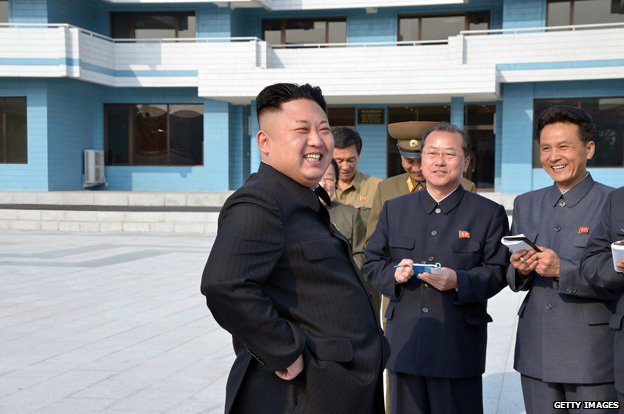
Kim Jong-un, a dipshit throwback to last-century tyrants, is probably most interesting for his propaganda and media control. In time, he will get his, but until then his every word is recorded by a cadre of men with antiquated tools (pens and notepads), who are assigned the task of recording his every word. They’re not journalists but players upon a world stage. Like umbrella holders for a movie star, these minions are as much form as function, meant to establish the despot’s importance. From Kathryn Westcott’s BBC explanation of this spectacle:

“In the photographs – from the country’s official Central News Agency (KCNA) – Kim Jong-un observes a unit of women conducting a multiple-rocket launching drill. He strides around a fishery station. He gives a pilot on flight training a pep talk. He enjoys the facilities at a renovated youth camp.

But who are those men meticulously taking notes? They’re not journalists, but soldiers, party members or government officials, says Prof James Grayson, Korea expert at the University of Sheffield. What is happening is a demonstration of the leader’s supposed power, knowledge, wisdom and concern, says Grayson. It’s ‘on-the-spot guidance,’ something instigated by his grandfather Kim Il-sung in the 1950s. ‘It’s part of the image of the great leader offering benevolent guidance,’ says Grayson.”

Tags: , ,

I put up a post just a couple of weeks ago about Thomas Piketty’s Capital in the Twenty-First Century, and since then it’s quickly become an unlikely blockbuster, sold out in brick-and-mortar stores and ranked #1 on Amazon, the latest green shoot in the Occupy mindset which blossomed in these scary financial times. At Foreign Affairs, economist Tyler Cowen provides a well-written review of the work, which he finds impressive but (unsurprisingly) disagrees with in fundamental ways. The opening:

Every now and then, the field of economics produces an important book; this is one of them. Thomas Piketty’s tome will put capitalist wealth back at the center of public debate, resurrect interest in the subject of wealth distribution, and revolutionize how people view the history of income inequality. On top of that, although the book’s prose (translated from the original French) might not qualify as scintillating, any educated person will be able to understand it — which sets the book apart from the vast majority of works by high-level economic theorists.

Piketty is best known for his collaborations during the past decade with his fellow French economist Emmanuel Saez, in which they used historical census data and archival tax records to demonstrate that present levels of income inequality in the United States resemble those of the era before World War II. Their revelations concerning the wealth concentrated among the richest one percent of Americans — and, perhaps even more striking, among the richest 0.1 percent — have provided statistical and intellectual ammunition to the left in recent years, especially during the debates sparked by the 2011 Occupy Wall Street protests and the 2012 U.S. presidential election.

In this book, Piketty keeps his focus on inequality but attempts something grander than a mere diagnosis of capitalism’s ill effects. The book presents a general theory of capitalism intended to answer a basic but profoundly important question. As Piketty puts it:

‘Do the dynamics of private capital accumulation inevitably lead to the concentration of wealth in ever fewer hands, as Karl Marx believed in the nineteenth century? Or do the balancing forces of growth, competition, and technological progress lead in later stages of development to reduced inequality and greater harmony among the classes, as Simon Kuznets thought in the twentieth century?’

Although he stops short of embracing Marx’s baleful vision, Piketty ultimately lands on the pessimistic end of the spectrum. He believes that in capitalist systems, powerful forces can push at various times toward either equality or inequality and that, therefore, ‘one should be wary of any economic determinism.’ But in the end, he concludes that, contrary to the arguments of Kuznets and other mainstream thinkers, ‘there is no natural, spontaneous process to prevent destabilizing, inegalitarian forces from prevailing permanently.’ To forestall such an outcome, Piketty proposes, among other things, a far-fetched plan for the global taxation of wealth — a call to radically redistribute the fruits of capitalism to ensure the system’s survival. This is an unsatisfying conclusion to a groundbreaking work of analysis that is frequently brilliant — but flawed, as well.”

Tags: ,

Corporations don’t just nudge–they push hard. Trying to get us to consume products that are often injurious to us, they attack with constant messages to trigger our behavior. That’s considered freedom. But it’s stickier when governments try to influence us with sin taxes, default agreements and helpful reminders. That’s called a nanny state. Sometimes I like such initiatives (cigarette taxes) and sometimes I don’t, but they influence us less and to healthier ends than corporations do. From Cass Sunstein’s new Guardian article about nudging:

“The beauty of nudges is that when they are well chosen, they make people’s lives better while maintaining freedom of choice. Moreover, they usually don’t cost a lot, and they tend to have big effects. In an economically challenging time, it is no wonder that governments all over the world, including in the US and UK, have been showing a keen interest in nudging.

Inevitably, we have been seeing a backlash. Some people object that nudges are a form of unacceptable paternalism. This is an objection that has intuitive appeal, but there is a real problem with it: nudging is essentially inevitable, and so it is pointless to object to nudging as such.

The private sector nudges all the time. Whenever a government has websites, communicates with its citizens, operates cafeterias, or maintains offices that people will visit, it nudges, whether or not it intends to. Nudges might not be readily visible, but they are inevitably there. If we are sceptical about official nudging, we might limit how often it occurs, but we cannot possibly eliminate it.

Other sceptics come from the opposite direction, contending that in light of what we know about human errors, we should be focusing on mandates and bans. They ask: when we know people make bad decisions, why should we insist on preserving freedom of choice?

Tags:

Americans have always viewed technology (and anti-technology) in romantic terms. In a New Atlantis piece, Benjamin Storey argues that Alexis de Tocqueville didn’t give tech in the U.S. the short shrift but instead viewed it as a poetic impulse as much as an economic one. An excerpt: 

For Tocqueville, technology is not a set of morally neutral means employed by human beings to control our natural environment. Technology is an existential disposition intrinsically connected to the social conditions of modern democratic peoples in general and Americans in particular. On this view, to be an American democrat is to be a technological romantic. Nothing is so radical or difficult to moderate as a romantic passion, and the Americans Tocqueville observed accepted only frail and minimal restraints on their technophilia. We have long since broken many of those restraints in our quest to live up to our poetic self-image. Understanding the sources of our fascination with the technological dream, and the distance between that dream and technological reality, can help revitalize the sources of self-restraint that remain to us.

That Tocqueville presents much of his commentary on technology in the chapter of Democracy in America entitled ‘Of Some Sources of Poetry among Democratic Nations‘ already indicates why his analysis of technology has been less well received than his analysis of town government or the tyranny of the majority. What, after all, does technology have to do with poetry? Wouldn’t Tocqueville have done better to offer a systematic analysis of ‘the material bases of American life,’ in the manner of an economic or industrial historian, as Garry Wills suggests?

To see what exactly poetry has to do with technological progress, we must first seek to understand Tocqueville’s account of the nature of poetry and the human need for it. We must then turn to his account of the appeal of the poetry of technology to the psychic passions of democratic man. Finally, we must consider his analysis of why democratic peoples would take an argument about the hard facts of economics or industry more seriously as a mode of understanding the question of technology than his own reflections on poetry. By doing so, we can understand something about our typical mode of self-understanding and the distinctive kind of blindness to ourselves to which we are most prone.”

Tags: ,

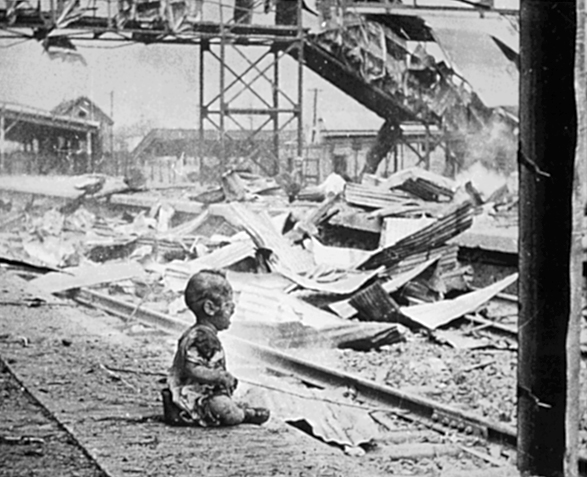
Shanghai during WWII.

Shanghai during WWII.

NPR Shanghai correspondent Frank Langfitt just did an excellent Ask Me Anything on Reddit. A few exchanges follow.

______________________

Question:

How “free and open” does the regular Chinese citizen feel? I remember talking to some older Chinese people who had immigrated to Canada who were still a little worried about being openly critical about the Chinese government. In other words, do regular citizens feel safe in being able to speak openly about government policy and issues or is there still a feeling of paranoia?

Frank Langfitt:

With friends and even strangers Chinese are much more open with their political views than they were a generation ago. On a 20 minute taxi ride in Shanghai, you can get a very thoughtful deconstruction of Chinese politics and the party. But if you take out your tape recorder, everything changes.

______________________

Question:

What kinds of things do regular Chinese citizens think about the USA that isn’t correct?

Frank Langfitt:

Chinese know America much better than we know China and their knowledge is improving. One question i get a lot of in recent years is will the U.S. and China go to war. There is a fear that a conflict between China and Japan over the islands in the East China Sea will draw in the U.S. I’ve found this sort of talk really unsettling and revealing about how some ordinary Chinese sea the geopolitics of their country’s rise.

Question:

Do you think, China and Japan will go to a war of some type?

Frank Langfitt:

i really hope not. it would be a disaster. #2 and #3 economies at war in north asia. And #1 economy has defense treaty with #3. Yikes.

______________________

Question:

What is the most disgusting thing you have seen in China (I heard kids take shit directly on the street)?

Frank Langfitt:

Not sure what is most disgusting thing i’ve seen, but kids do relieve themselves on the streets sometimes and this has become a really interesting phenomenon. As more Chinese travel, occasionally this will happen on a subway outside the country, say Hong Kong or Taiwan and it goes viral and creates a big controversy inside and outside the country.

_______________________

Question:

How bad is the smog really? Have you had to do a lot to adjust to it?

Frank Langfitt:

It depends on where you are. Beijing is at times not habitable for creatures with lungs. there is no way to exaggerate conditions there. Shanghai is much better, largely because we are on the East China Sea and the winds clear out the smog. We have lots of blue sky days and all the glass and steel shimmers and the city looks great. Back in December, though, we had terrible air and we stayed inside the apartment for four days and just blasted the air filters.

_______________________

Question:

Why does China’s ruling single party still call themselves Communist when they are so clearly anything but? They still have Mao on bank notes, yet their modern society is an ongoing contradiction of the values he espoused. How do everyday Chinese people and the elites reconcile their hypercapitalist current system with their “communist” party government?

Frank Langfitt:

Great, great question. The Communist Party knows it is not Communist, but can’t dump the name because it is key to its legitimacy. There is a story — perhaps apocryphal — in which the former premier Zhu Rongji asked an American politician what was the one thing the Communist Party could do to change its image in the eyes of Americans. The politician said: “change the name.” Zhu shook his head and said they just couldn’t do that. Chinese people are supremely pragmatic, much to their credit, and they are happy to take advantage of a capitalist-style economy that helps them improve their lives and are less hung up on what things are called.•

Tags:

Edward Snowden’s participation in a recent dog-and-pony show about government surveillance with Vladimir Putin confirms what has long been apparent: He’s not the most astute fellow who thinks things through in advance of his actions. Russia under Putin isn’t just a place that spies on journalists but one where they mysteriously wind up dead. But even if Snowden is his own worst enemy, that doesn’t necessarily mean he’s an enemy of the state. In his new Foreign Affairs piece, “Live and Let Leak,” Jack Shafer acknowledges that whistleblowers can be dangerous but not nearly as dangerous as a government not held to account by them. An excerpt:

“With little or no public input, the U.S. government has kidnapped suspected terrorists, established secret prisons, performed ‘enhanced’ interrogations, tortured prisoners, and carried out targeted killings. After the former National Security Agency contractor Edward Snowden pilfered hundreds of thousands of documents from the NSA’s computers and released them to journalists last summer, the public learned of additional and potentially dodgy secret government programs: warrantless wiretaps, the weakening of public encryption software, the collection and warehousing of metadata from phones and e-mail accounts, and the interception of raw Internet communications.

The secrecy machine was originally designed to keep the United States’ foes at bay. But in the process, it has transformed itself into an invisible state within a state. Forever discovering new frontiers to patrol, as the Snowden files indicate, the machine molts its skin each season to grow ever larger and more powerful, encountering little resistance from the courts or Congress.”

Tags: ,

Brad Templeton, a consultant to Google’s driverless-car division, explaining why he thinks delivery robots, which will transport goods and not people, shouldn’t be governed by the same restrictions as autonomous cars:

“Delivery robots are world-changing. While they won’t and can’t carry people, they will change retailing, logistics, the supply chain, and even going to the airport in huge ways. By offering very quick delivery of every type of physical goods — less than 30 minutes — at a very low price (a few pennies a mile) and on the schedule of the recipient, they will disrupt the supply chain of everything. Others, including Amazon, are working on doing this by flying drone, but for delivery of heavier items and efficient delivery, the ground is the way to go.

While making fully unmanned vehicles is more challenging than ones supervised by their passenger, the delivery robot is a much easier problem than the self-delivering taxi for many reasons:

  • It can’t kill its cargo, and thus needs no crumple zones, airbags or other passive internal safety.
  • It still must not hurt people on the street, but its cargo is not impatient, and it can go more slowly to stay safer. It can also pull to the side frequently to let people pass if needed.
  • It doesn’t have to travel the quickest route, and so it can limit itself to low-speed streets it knows are safer.
  • It needs no windshield or wheel, and can be small, light and very inexpensive.

A typical deliverbot might look like little more than a suitcase sized box on 3 or 4 wheels. It would have sensors, of course, but little more inside than batteries and a small electric motor. It probably will be covered in padding or pre-inflated airbags, to assure it does the least damage possible if it does hit somebody or something. At a weight of under 100lbs, with a speed of only 25 km/h and balloon padding all around, it probably couldn’t kill you even if it hit you head on (though that would still hurt quite a bit.)

The point is that this is an easier problem, and so we might see development of it before we see full-on taxis for people.”

Tags:

One really easy way to reduce the American penitentiary population would be to decriminalize drugs except for instancess in which someone has sold them to minors. Legalize the less-dangerous ones (marijuana) and sentence pushers to workfare and users to out-patient rehab and education for harder ones (heroin).

Even if that unlikely scenario were to play out, the prisons would still be too crowded and parole would remain a problem. If incarceration is meant to keep offenders from recommiting crimes and not merely as a punitive measure, how do we know which convicts to release and when? Parole has long been an inexact science, but perhaps Big Data can help. Perhaps. An excerpt from the Economist:

“Help may be at hand, in the form of ‘risk-assessment’ software, which crunches data to estimate the likelihood a prisoner will re-offend. Such software tends to increase the proportion of applicants who are granted parole while also reducing the proportion who re-offend. Two such programmes, LSI-R and LS/CMI, appear to reduce parolee recidivism by about 15%. Developed by Multi-Health Systems, a Canadian firm, they were used to assess 775,000 parole applications in America in 2012. Four-fifths of parole boards now use similar technology, says Joan Petersilia of Stanford University.

The data that matter include the prisoner’s age at first arrest, his education, the nature of his crime, his behaviour in prison, his friends’ criminal records, the results of psychometric tests and even the sobriety of his mother while he was in the womb. The software estimates the probability that an inmate will relapse by comparing his profile with many others. The American version of LS/CMI, for example, holds data on 135,000 (and counting) parolees.

It is better to be guided by software than one’s gut, says Olivia Craven, head of the Idaho Commission of Pardons and Parole. Donna Sytek of the New Hampshire Parole Board agrees. Unaided, parole board members rely too much on their personal experiences and make inconsistent decisions, she says.

Tags:

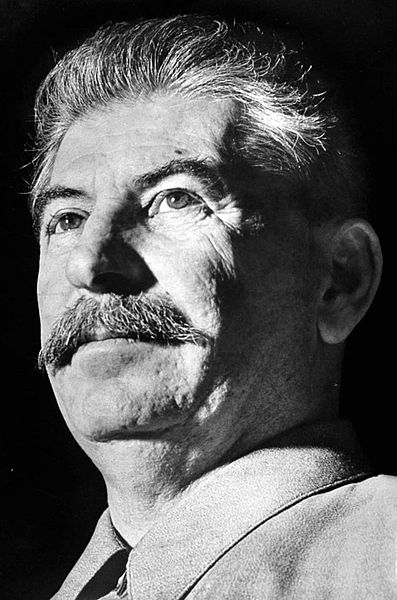
Here’s a good rule: If you’re interviewing someone who holds sway over the life and death of others, don’t do it unless you’re free to ask them pertinent, probing questions. Otherwise monsters can be made to seem moderate. Case in point: In 1934, Joseph Stalin, one of the most evil bastards ever, was given the velvet glove treatment by none other than H.G. Wells, who enjoyed conversing with other great men. I’m not saying that Wells could have known everything about Stalin’s terror, but he should have known enough. While it’s interesting from an historical perspective because of the principals, it’s also disquieting for its lack of discernment. The opening of the discussion, which has been republished in the New Statesman:

Wells:

I am very much obliged to you, Mr Stalin, for agreeing to see me. I was in the United States recently. I had a long conversation with President Roosevelt and tried to ascertain what his leading ideas were. Now I have come to ask you what you are doing to change the world . . .

Stalin:

Not so very much.

Wells:

I wander around the world as a common man and, as a common man, observe what is going on around me.

Stalin:

Important public men like yourself are not ‘common men.’ Of course, history alone can show how important this or that public man has been; at all events, you do not look at the world as a ‘common man.’

Wells:

I am not pretending humility. What I mean is that I try to see the world through the eyes of the common man, and not as a party politician or a responsible administrator. My visit to the United States excited my mind. The old financial world is collapsing; the economic life of the country is being reorganised on new lines.

Lenin said: ‘We must learn to do business,’ learn this from the capitalists. Today the capitalists have to learn from you, to grasp the spirit of Socialism. It seems to me that what is taking place in the United States is a profound reorganisation, the creation of planned, that is, Socialist, economy. You and Roosevelt begin from two different starting points. But is there not a relation in ideas, a kinship of ideas, between Moscow and Washington?

In Washington I was struck by the same thing I see going on here; they are building offices, they are creating a number of state regulation bodies, they are organising a long-needed civil service. Their need, like yours, is directive ability.”

Tags: ,

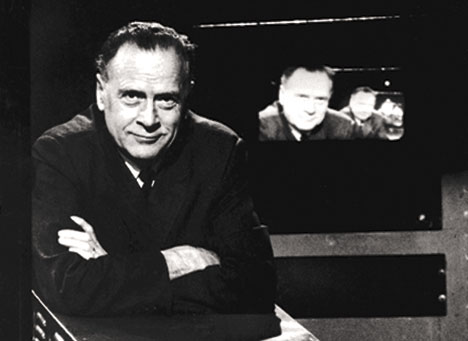
Marshall McLuhan and artist and ace typographer Harley Parker enjoyed a bull session in 1967′s “Picnic in Space,” a 28-minute experiment informed by Warhol, Lichtenstein and Godard.

There’s no corporation, including Google, that should be trusted with our private information. Of course, there’s no way to avoid such a faustian bargain in this world of clouds. Everything is free, but it still costs a lot. There’s the rub.

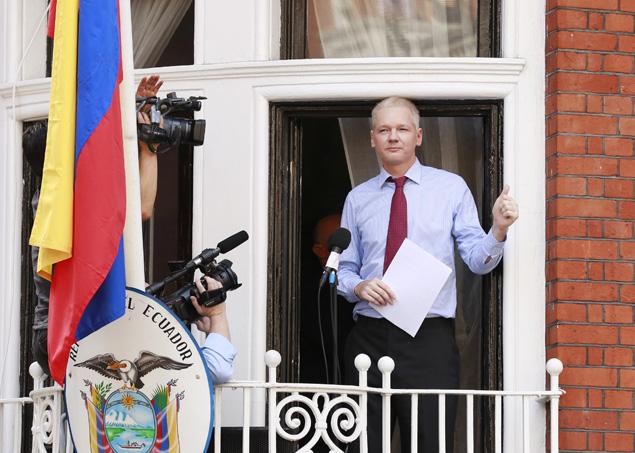
Later this year, Julian Assange is to release a book, When Google Met WikiLeaks, the description of which sounds bombastic, grandiose and borderline crazy, like Assange himself. But that’s not to say it won’t contain truth. Just because the messenger is deeply flawed doesn’t mean the message is completely wrong. Sometimes, it’s only the truly damaged person who’ll step forward. From Alison Flood in the Guardian:

‘Julian Assange is writing a ‘major’ new book, in which the Wikileaks founder details his vision for the “future of the internet’ as well as his encounter in 2011 with Google chairman Eric Schmidt – a meeting which his publisher described as ‘an historic dialogue’ between ‘the North and South poles of the internet.’

The book, When Google Met WikiLeaks, will be published in September this year, announced publisher OR Books this morning. It will recount how, in June 2011 when Assange was living under house arrest at Ellingham Hall in Norfolk, Schmidt and ‘an entourage of US State Department alumni including a top former adviser to Hillary Clinton’ visited for several hours and ‘locked horns’ with the Wikileaks founder.

‘The two men debated the political problems faced by human society, and the technological solutions engendered by the global network – from the Arab Spring to Bitcoin. They outlined radically opposing perspectives: for Assange, the liberating power of the internet is based on its freedom and statelessness. For Schmidt, emancipation is at one with US foreign policy objectives and is driven by connecting non-western countries to American companies and markets. These differences embodied a tug-of-war over the internet’s future that has only gathered force subsequently,’ said OR Books in its announcement.

The title will include an edited transcript of the conversation between Schmidt and Assange, as well as new material written by Assange, who has been confined to the Ecuadorian embassy, in London, for the last 18 months.”

Tags: , ,

Barbara Ehrenreich was an early supporter of John Edwards’ debacle of a 2008 Presidential campaign, seduced by the populist message without realizing the messenger was hollow, that he had all of the slickness of Bill Clinton without any of the prodigious political gifts. But she’s been right about so much regarding the fear of falling in America, and long before the disruption of the Internet Age or the recent economic collapse. While doing an Ask Me Anything at Reddit to promote her new book, she answered a couple of questions about minimum wage. The exchanges follow.

__________________________

Question:

Do you think we’re getting any closer to minimum wage being a living wage as well?

Barbara Ehrenreich:

Well, there’s a lot of talk about raising the minimum wage and I think it will probably happen. That’s something most people agree with. The opposition is coming from, well, Republicans, employers, and especially the so-called hospitality industry like restaurants and hotels which employ a lot of low-wage people. But even if we get the national minimum to about $10.50 an hour which Obama’s talked about, that’s not going to be a living wage in most places. The living wage that you need for various cities, states, etc. is something that is constantly being calculated by a group at MIT for example, and they do it by reason. They give you the amount you need for a bare-bones existence for various family sizes, and certainly where I am sitting in Northern Virginia, $10.50 is not going to do it. It would need to be more like $20 an hour.

Question:

What do you think of raising the minimum wage and if you think it should be raised why wouldn’t it create a surplus of labor?

Barbara Ehrenreich:

This is the argument that is made all the time against raising the minimum wage, that it will lead to unemployment. There is no empirical evidence for it. Obviously if we raise the minimum wage to the living wage, there might be some difficulty, but you can look at places like the state of Washington, which has one of the highest minimum wages in the country, and compare its economy to that of Idaho, right across the border, and Washington does better.

I would say to that argument is: I don’t care. This is a moral issue. If you are paying people less than they can live on, you are in effect expecting them to make a charitable contribution TO YOU. If someone says “Well I’m a small business person, and I can’t afford to pay more than $8 an hour” then maybe you don’t have a business plan. You have a plan to exploit the desperation of certain people. With all this talk of a minimum wage, how come there is so little complaint when we see a CEO or hedge fund manager when they add $10 million to their pay? Yet we don’t. We get all bent out of shape going from $7 to $10 an hour. And that’s crazy to me.•

Tags:

Writer and former eco-activist Paul Kingsnorth believes he’s seen the future and thinks it’s murder. He no longer dreams of averting an environmental collapse, the doom of us all, as traditional green activists and next-wave biotechnologists do, but believes it’s a foregone conclusion. His best-case scenario is that some can scrape by using the random parts of an exploded machine. From a Daniel Smith’s New York Times profile of Kingsnorth:

“Instead of trying to ‘save the earth,’ Kingsnorth says, people should start talking about what is actually possible. Kingsnorth has admitted to an ex-activist’s cynicism about politics as well as to a worrying ambivalence about whether he even wants civilization, as it now operates, to prevail. But he insists that he isn’t opposed to political action, mass or otherwise, and that his indignations about environmental decline and industrial capitalism are, if anything, stronger than ever. Still, much of his recent writing has been devoted to fulminating against how environmentalism, in its crisis phase, draws adherents. Movements like Bill McKibben’s 350.org, for instance, might engage people, Kingsnorth told me, but they have no chance of stopping climate change. ‘I just wish there was a way to be more honest about that,’ he went on, ‘because actually what McKibben’s doing, and what all these movements are doing, is selling people a false premise. They’re saying, ‘If we take these actions, we will be able to achieve this goal.’ And if you can’t, and you know that, then you’re lying to people. And those people . . . they’re going to feel despair.’

Whatever the merits of this diagnosis (‘Look, I’m no Pollyanna,’ McKibben says. ‘I wrote the original book about the climate for a general audience, and it carried the cheerful title The End of Nature’), it has proved influential. The author and activist Naomi Klein, who has known Kingsnorth for many years, says Dark Mountain has given people a forum in which to be honest about their sense of dread and loss. “Faced with ecological collapse, which is not a foregone result, but obviously a possible one, there has to be a space in which we can grieve,’ Klein told me. ‘And then we can actually change.’

Kingsnorth would agree with the need for grief but not with the idea that it must lead to change — at least not the kind of change that mainstream environmental groups pursue. ‘What do you do,’ he asked, ‘when you accept that all of these changes are coming, things that you value are going to be lost, things that make you unhappy are going to happen, things that you wanted to achieve you can’t achieve, but you still have to live with it, and there’s still beauty, and there’s still meaning, and there are still things you can do to make the world less bad? And that’s not a series of questions that have any answers other than people’s personal answers to them. Selfishly it’s just a process I’m going through.’ He laughed. ‘It’s extremely narcissistic of me. Rather than just having a personal crisis, I’ve said: ‘Hey! Come share my crisis with me!’’

In 2012, in the nature magazine Orion, Kingsnorth began to publish a series of essays articulating his new, dark ecological vision. He set his views in opposition to what he called neo-environmentalism — the idea that, as he put it, ‘civilization, nature and people can only be ‘saved’ by enthusiastically embracing biotechnology, synthetic biology, nuclear power, geoengineering and anything else with the prefix ‘new’ that annoys Greenpeace.’ Or as Stewart Brand, the 75-year-old ‘social entrepreneur’ best known as the publisher of the Whole Earth Catalog, has put it: ‘We are as gods and have to get good at it.’

For Kingsnorth, the notion that technology will stave off the most catastrophic effects of global warming is not just wrong, it’s repellent — a distortion of the proper relationship between humans and the natural world and evidence that in the throes of crisis, many environmentalists have abandoned the principle that ‘nature has some intrinsic, inherent value beyond the instrumental.’ If we lose sight of that ideal in the name of saving civilization, he argues, if we allow ourselves to erect wind farms on every mountain and solar arrays in every desert, we will be accepting a Faustian bargain.”


Tags: ,

The latest screams from those who hate government (yet work in government) came during the bungled rollout of the Affordable Care Act. The public sector is incapable of doing such things correctly, they said, only private business can execute such projects correctly. Except…having worked for some free-market companies, I can tell you that new Internet platforms and offerings are a mess initially (and sometimes permanently) more often than not. The Obamacare site, fixed fairly quickly, did a better job than many private concerns would have.

The idea that government is incompetent and the free market is perfect is a tired and false argument. Either can be good or bad. The Internet was birthed by the government and only when developed was it able to survive and thrive on venture capital. DARPA regularly churns out amazingly creative inventions (though they often give me nightmares). And let’s recall that Mitt Romney lambasted President Obama during a debate for having the foolishness to invest stimulus money in Tesla Motors, which has since paid back the loan with interest. He stuck to a narrative based on an ideology. The truth would serve us better.

From Jeff Madrick’s New York Review of Books piece on the subject:

Both government research and entrepreneurial capital are necessary conditions for the advance of commercial innovation. Neither is sufficient. But the consensus among many economists and politicians doesn’t seem to acknowledge an equal role for government. Resistance to acknowledging government’s fundamental contribution to American scientific and technical innovation became especially vigorous when the federal government’s solar energy project, Solyndra, to which it had lent more than $500 million, went bankrupt. The investment was part of President Obama’s 2009 stimulus package, which included a substantial program of loans for clean energy, run by a successful former hedge fund and venture capital manager. But the solar energy company was undermined when the high price of silicon, on which an alternative technology to Solyndra’s was based, fell sharply, enabling competition, especially from China’s solar companies, to underprice the American start-up.

Solyndra’s 2011 bankruptcy led to a Republican congressional investigation, and a bill to end the loan program altogether. Although venture capital funds, such as Argonaut Ventures, controlled by Obama fund-raiser George Kaiser, were among the major investors in Solyndra, critics saw the failure as proof that government couldn’t and shouldn’t invest in such new ventures at all. ‘Governments have always been lousy at picking winners, and they are likely to become more so, as legions of entrepreneurs and tinkerers swap designs online,’ wrote The Economist in 2012. But including Solyndra, only roughly 2 percent of the projects partly financed by the federal government have gone bankrupt.”

Tags:

The new freedoms of the Internet Age are great and in the aggregate we’re wealthier, but the dollars themselves are in far fewer hands than before we were wired. Astra Taylor, who’s made two excellent full-length documentaries (this one and this one), has a new book, The People’s Platform: Taking Back Power and Culture in the Digital Age, which talks about the current wave of inequality fostered in part by the emergence of the web. Gawker’s Michelle Dean interviewed Taylor on the topic. The opening exchange:

Question:

Can you boil down for me the main reason you think the internet isn’t the ‘democratizing’ force we were promised?

Astra Taylor:

Because of money. It makes no sense to talk about the internet as separate from the economy. In the mainstream pundit world, there are two camps. One would say the internet is ruining everything, or distracting, or addictive. The other camp would say the internet’s amazing, we’re all connected, and it’s going to bring about a new age of democratization of culture, and creativity.

It’s not [that I have] some revolutionary theory. But there was a disconnect between this chatter from a fundamental characteristic of our world, just sitting there, and I just felt like somebody had to address it. No one was talking about the role of finance and the way business imperatives shape the development of tech.

The web is not an even playing field. There are economic hierarchies, and there’s this rich-get-richer phenomenon. And it’s emergent of these massive digital corporations, you know, Google and Apple. They’re not the upstarts they position themselves as.”

Tags:

Kubla Khan decreed his stately pleasure dome, but he couldn’t escape the voices of the dead. China is building its top-down insta-cities, believing it can forgo organic development, but large swaths of these developments don’t echo with life. If they’re a dream, it’s a dream that may never be fulfilled. The opening of Jonathan Kaiman’s Guardian article about Tianjin Eco-city, which is green in more ways than one:

“Wang Lin needed a change. The crushing air pollution and gridlock traffic in his hometown Hangu, an industrial district in China’s northern metropolis of Tianjin, made him anxious and sometimes sick.

Then he heard about the Sino-Singapore Tianjin Eco-city. According to its marketing, the £24bn development – a joint venture between the governments of China and Singapore – will one day be a “model for sustainable development” only 40km from Tianjin’s city centre and 150km from central Beijing. To Wang, it sounded like paradise.

Last year, the 36-year-old moved into an inexpensive flat in one of the city’s half-occupied apartment blocks. As a freelance translator, he doesn’t mind that most viable employers are at least half an hour away by car. He loves the relatively clean air and the personal space. But he also has his complaints.

By the time the city is complete – probably by 2020 – it should accommodate 350,000 people over 30 square kilometres. Five years into the project, however, only about three sq km have been completed, housing 6,000 permanent residents. There are no hospitals or shopping malls. Its empty highways traverse a landscape of vacant mid-rises and dusty construction yards.

‘This place is like a child – it’s in a development phase,’ Wang says. ‘But it’s chasing an ideal. It’s the kind of place where people can come to pursue their dreams.'”

Tags: ,

Drones are made not only to deliver what you ordered but to stop by unannounced. The opening of Robert Wall’s WSJ article about this technology getting ahead of regulation in Europe:

“The U.K. has a history in unmanned aviation spanning almost 100 years. It added to that this month when a court in northern England issued the country’s first-ever fine for the dangerous and illegal use of an unmanned aircraft.

The drone’s owner flew his craft in restricted airspace, over where Britain builds its nuclear submarines. The fine came in at £800 ($1,340.) Legal fees were another $3,500. And the aircraft crashed in the water.

Europe, which has trailed the U.S. and Israel in the development of unmanned military aircraft, is now beginning an effort to avoid falling behind on commercial drones, too. The European Union plans to spell out rules to govern a market it suggests could reach around 15 billion euros ($20.7 billion)per year.

Europe’s challenge is that several countries have embarked on permitting commercial drone operations, but there has been no effort to harmonize standards across the region.

‘Remotely piloted aircraft, almost by definition, are going to cross borders,’ Siim Kallas, the European Commission for Transport said in a statement last week.

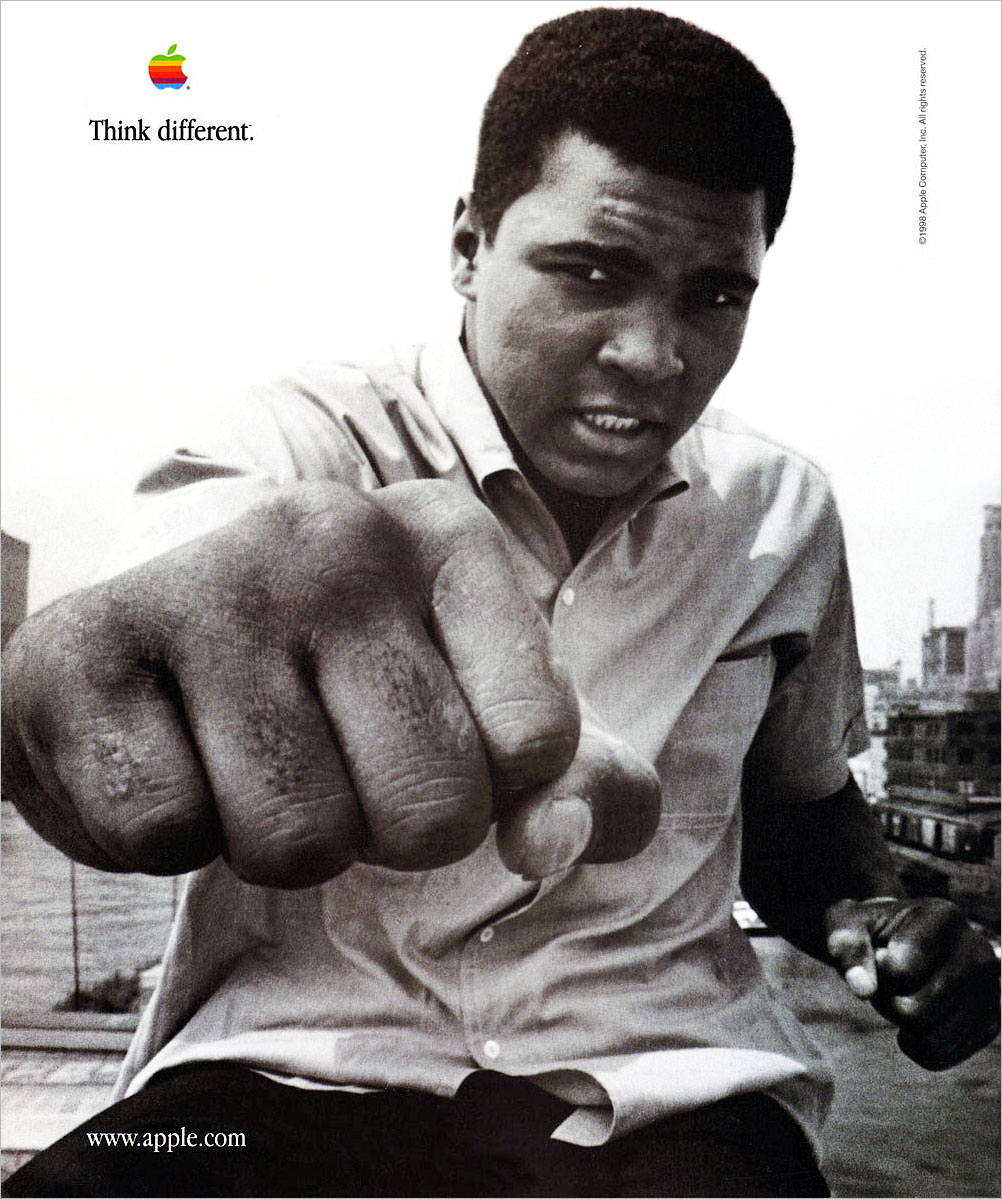
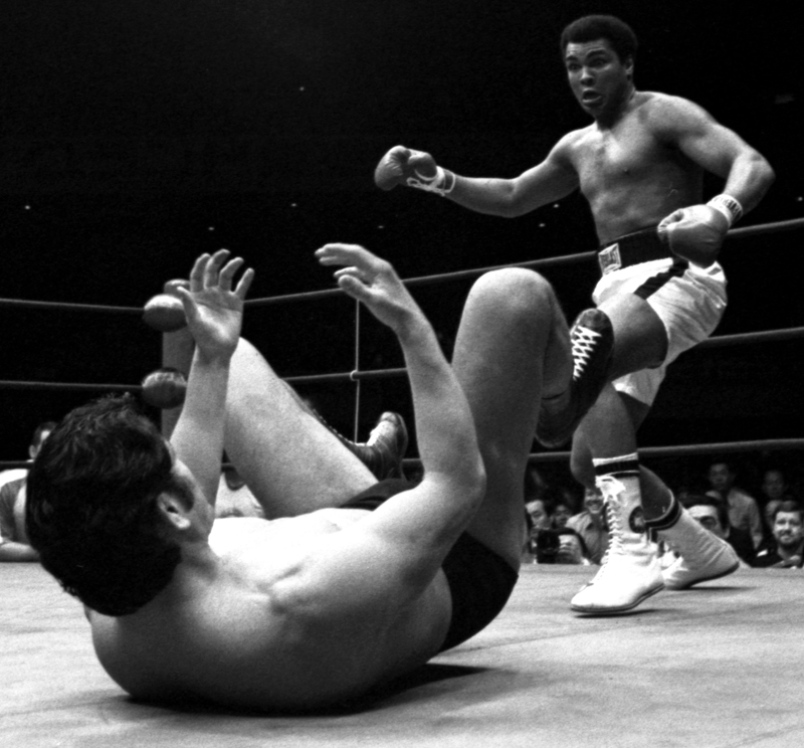
In 1976, when he was already showing the early, subtle signs of Parkinson’s Syndrome, Muhammad Ali sat for a wide-ranging group interview on Face the Nation, in which he was mostly treated as a suspect by a panel of people who enjoyed privileges that were never available to the boxer. Fred Graham, the Arkansas-born correspondent who’s distinguished himself in other ways during his career, doesn’t come across as the most enlightened fellow here. Ali is even ridiculously criticized for a planned “bout” against Japanese wrestler Antonio Inoki.

Tags: , ,

The Philosopher’s Beard has a post which calls for the internationalization of history, treating it in the same manner as science which has largely accepted universal rules. It would probably be no easier to pull off than world peace, even if it might make world peace more attainable. The opening:

“History too important to be left to national politicians as a social engineering project for their ideological or ethnic visions of national identity.

First, the principle. The idea of ‘national histories’ should be replaced with the unitary ideal of international history, that all official histories should be compatible with each other as literal facts must be. History is about matters of fact and their true explanation just as science is. Yet, while more or less the same science is taught in schools all over the world (with the exception of a few theocracies), national histories are very often self-serving opinion taught as fact, i.e. propaganda. The result is the dangerous cultivation by governments of the ignorance and resentment of their citizens.

Second, there should be a grievance mechanism that reflects the moral fact that the way history is taught is a matter not only for national governments – democratic or otherwise – but of human rights below and international relations above.”

« Older entries § Newer entries »