
Politics

You are currently browsing the archive for the Politics category.

Peggy Noonan, who will tell you how to be an American, you stupid, loves reading the tea leaves or some such bullshit, explaining how the nation feels, based on her own ideology and false narratives. Her latest WSJ opinion piece is a real spectacle, calling for making boys into men by teaching them how to toxify the country, a place which is home, after all, to the skeleton of Ronald Reagan. Having a federal job program for unemployed people that builds or rebuilds infrastructure would be great, humanistically and economically, but it needn’t shouldn’t revolve around a certain pipeline. From Simon Malloy at Salon:

“Noonan also shared her thoughts on the Keystone XL pipeline, which … well, here, just read it:

And there is the Keystone XL pipeline and the administration’s apparent intent to veto a bill that allows it. There the issue is not only the jobs the pipeline would create, and not only the infrastructure element. It is something more. If it is done right, the people who build the pipeline could be pressed to take on young men—skill-less, aimless—and get them learning, as part of a crew, how things are built and what it is to be a man who builds them.

On top of that, the building of the pipeline would show the world that America is capable of coming back, that we’re not only aware of our good fortune and engineering genius, we are pushing it hard into the future. America’s got her hard-hat on again. America is dynamic. ‘You ain’t seen nothin’ yet.; Not just this endless talk of limits, restrictions, fears and ‘Oh, we’re all going to melt in the warm global future!’

I am completely at a loss for why Keystone XL, among the many construction jobs available to young men (but not women, apparently), would be uniquely capable of transforming ‘skill-less, aimless’ young men into real American manly men of manly valor. Apparently the pipeline will carry not just horribly toxic tar-sands oil, but also good old-fashioned American gumption (imported from Canada).

And I’m absolutely baffled at the suggestion that the world will stand up and take notice of American engineering and dynamism because we successfully built a long metal pipe.”
Tags: ,

I’m really going to enjoy the Buckwild Obama of the last two years of his Administration. The President has always been playing the long game, and though some announced his Presidency as “over” even before the Democratic losses in the recent mid-terms, he’s continued moving forward with his policies and now really has no reason to listen to the shouting people on the TV box. With immigration reform, he’s also put his opponents on their heels. From Noam Schrieber at The New Republic:

“Intellectually, of course, conservatives understand the importance of sticking to procedural objections even here. They can read polls as well as the rest of us. And the polls say that while Americans overwhelmingly favor the substance of Obama’s preferred immigration reforms, they also oppose enacting the reform by way of executive fiat.

No surprise then that the conservative message machine has gone on at length about the ‘constitutional crisis’ the president is instigating. The right has compared Obama to a monarch (see here and here), a Latin American caudillo, even a conspirator against the Roman Republic. (Ever melodrama much?) The rhetoric gets a little thick. But if you boil it down, the critique is mostly about Obama’s usurpation of power and contempt for democratic norms, not the substance of his policy change. Some Republicans no doubt believe it. 

And yet, try as they might to stick to the script, there’s something about dark-skinned foreigners that sends the conservative id into overdrive. Most famously, there’s Iowa Congressman Steve King’s observation last year that for every child brought into the country illegally ‘who’s a valedictorian, there’s another 100 out there who weigh 130 pounds and they’ve got calves the size of cantaloupes because they’re hauling 75 pounds of marijuana across the desert.’

While King tends to be especially vivid in his lunacy, he’s no outlier.”

Tags: ,

Income inequality may not end up being the primary economic challenge of these automated times, but it certainly is a glaring symptom of a lot of problems. From Suzanne McGee at the Guardian:

“Which would you think would be larger for Ford Motor, a company that last year reported revenues of $139.4b: the taxes it pays the US federal government or the compensation it pays its CEO?

If you picked option B, congratulations – you may be cynical, but you’re right. Alan Mulally, Ford’s CEO, pocketed a compensation package that totaled $23.2m while Ford itself got a US federal tax refund of $19m.

And Ford isn’t the only company to pay its CEO more than it forked over to Uncle Sam.

Seven of the country’s 30 largest corporations paid more to their CEOs than they did in taxes last year, according to a just-released study by the Center for Effective Government and the Institute for Policy Studies.

At the same time, Citigroup qualified for a $260m tax refund from the IRS, thanks to a special waiverthat enabled it to capture the full tax benefits of buying unprofitable businesses. This could be a tax gift that keeps on giving, as the bank has been on a tear to keep earning more to take full advantage of the provision.

The rift between tax burden and executive pay for big companies is ‘getting worse,’ says Scott Klinger, director of revenue and spending policies at the Center for Effective Government.”

Tags: , ,

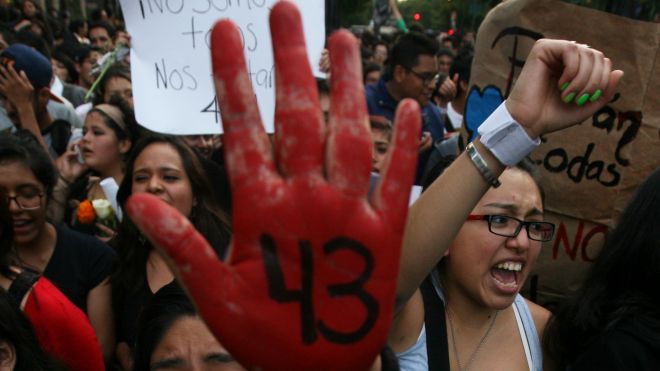
A strong central government is often made out to be the enemy in America, but I doubt Mexicans would agree. Our neighboring nation isn’t all bad news–there are some positive economic signs–but an illicit and decrepit system of governance, oftentimes merely a marriage of politicians on the make and men with guns, has allowed for horrors. From Marian Blasberg and Jens Glüsing’s Spiegel article about the disappeared 43 student teachers who were likely killed by gangsters on the orders of a local mayor:

“After more than an hour, they reach a remote village where a roadblock brings the convoy to a halt. A dozen armed men approach and indicate that they should get out of their vehicles.

[Civilian militia leader Cristóforo] García turns off the engine and he and his group suddenly find themselves standing at an intersection surrounded by men with a distrustful look in their eyes. And once again, nobody knows who is behind the masks worn by the others.

“What do you want here?” demands an older man in a sombrero who appears to be their leader.

García explains that they are looking for the disappeared students but the man doesn’t believe him. Just a few minutes ago, the man says, a military convoy rolled through the village and points to a helicopter circling overhead. It looks as though they are carrying out an operation nearby. Perhaps they are once again looking for mass graves.

‘What do you have to do with them?’ the leader demands.

‘With this government?’ García asks. ‘Nothing. We don’t have a government. Do you?’ 

The man in the sombrero shakes his head. His village is called Tianquizolco and is home to a couple hundred indigenous farmers. As in other villages in Guerrero, they have founded their own police force. Someone has to protect us, the man in the sombrero says, adding that people disappear from here all too often as well.

Then, suddenly, the situation changes. The distrust between the two groups vanishes at the moment that the military convoy tries to pass through the village a second time. Together, the two groups block the way and stop the vehicles. The entire village is now in an uproar. The man in the sombrero demands that the military present identification, but they don’t have any documents with them.”

Tags: , ,

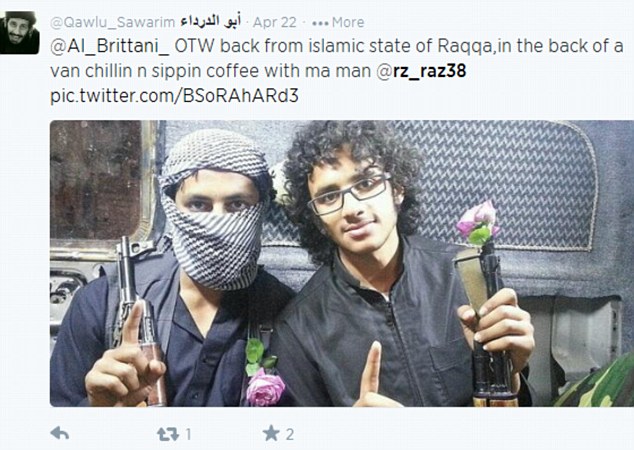
A little more insight into the online recruitment methods of the Islamic State, which employs both medieval barbarism and new-school social networks, from Britta Sandberg’s Spiegel interview with former FBI agent Ali Soufan:

Spiegel: 

Do you know how many people are working in the IS propaganda department?

Ali Soufan:

We do know that a whole army of bloggers, writers and people who do nothing else other than to watch social media are working for IS. According to our research, most are based in the Gulf region or North Africa. The program was started by Abu Amr Al-Shami, a Syrian born in Saudi Arabia. And we know that at one point more than 12,000 Twitter accounts were connected to IS. This is one of the unique tactics used by this group: the decentralization of its propaganda work. The Islamic State has maximized control of its message by giving up control of its delivery. This is new.

Spiegel:

What does that mean in reality?

Ali Soufan:

They use, for example, these so-called ‘Twitter bombs’ by following the most popular hashtags on the social media service, like the one for the 2014 World Cup. They send out messages using those hashtags so that everybody following the hashtag #worldcup will receive messages from IS, even if they aren’t interested in it.

Spiegel:

And this method is successful? They are recruiting among World Cup football fans?

Ali Soufan:

There are millions and millions of people around the world who will get the message. They have amazing reach, but only hope to have an impact on 1 or 2 percent of the targeted population. In June 2014 they had only 12,000 foreign fighters, but today there are 16,000 foreign fighters within IS. They include recruits from China, Indonesia and, of course, Europe as well. They send their messages in many different languages, even Dutch.”

Tags: ,

At his Financial Times blog, Andrew McAfee talks about the plunging “red line” of Labor’s portion of earnings, accelerating in the wrong direction as automation permeates the workplace. Robotics, algorithms and AI will make companies more profitable and shareholders richer, but job seekers (and holders) will suffer. And going Luddite will help no one in the long run. An excerpt:

“I expect the red line to continue to fall as robots, artificial intelligence, 3D printing, autonomous vehicles, and the many other technologies that until recently were the stuff of science fiction, permeate industry after industry. Policies intended to keep these advances out of a country might halt the decline of the labour share for a while, but they’d also halt competitiveness pretty quickly, thus leaving both capital and labour worse off.

I think the continued decline of the labour share, brought on by tech progress, will be a central dynamic, if not the central dynamic, of the world’s economies and societies in the 21st century. It’s a story much more about what will happen to the livelihood of the 50th percentile worker than to the wealth of the 1 per cent. And a much more important story.”

Tags:

As beautiful as the plans are, it’s concerning that a billionaire like Barry Diller can decide to build by fiat (and with $40 million in public funds) a lavish park off Manhattan at the pier where Titanic survivors came to shore, and for that reason it’s dubious. Just as interesting: Dial back just a little over two years ago to another waterlogged disaster, when Hurricane Sandy struck the city, and imagine such an island scheme even being suggested then. The wonder at that point was whether Manhattan was long for this world. I guess, in some ways, it’s good we can forget tragedy, but we don’t want to forget entirely. From Oliver Wainwright at the Guardian:

“There’s a combination, it seems, of trees and water and fairytale stories told by a charming inventor, that persuades people to part with many millions – and allows conventional urban planning to be gleefully suspended.

No sooner has the cloud of fairydust surrounding London’s garden bridge proposal begun to settle – after Lambeth council granted half of it planning permission last week (Westminster, across the river, has yet to decide) – than Thomas Heatherwick has sown the seeds for a second magical park to sprout from a river, this time in New York.

It is another vision that could come straight from the set of Avatar – fecund flowerbeds erupting from mushroom-shaped columns, their canopies joining to support parkland above the water. But instead of two toadstools spanning the Thames, there will be a thicket of 300 fungi rising from five to 20 metres above the Hudson River to form an undulating platform of parks and performance spaces.

Replacing the crumbling ruin of Pier 54, where survivors of the Titanic landed, Heatherwick’s Pier 55 park promises to be a ‘place of discovery, where visitors can wander and wonder,’ with ‘places to lounge, eat lunch, or just lie in the grass,’ building on the appetite for al fresco lazing proven by the success of the nearby High Line park.”

Tags: , ,

Michael Lewis has a different kind of take on wealth disparity in the U.S. In a New Republic review of Darrell M. West’s book Billionaires, Lewis remains circumspect that ridiculously prosperous Americans can win elections or influence issues, even in a nation defined by Citizens United and growing income inequality. (I don’t know that we’ve yet arrived at the endgame on that issue.) But he still thinks superwealth may make people assholes, or at the very least, uncaring and unhappy–that apart from money, they aren’t very rich. It’s a generalization, sure, though it’s difficult to imagine that being cosseted by a fortune wouldn’t alter a person’s worldview, wouldn’t allow them to arrange their reality as they wish, minus that helpful friction the rest of us encounter when we want our own way regardless of how it effects others. At any rate, Lewis comes armed with a trove of research by social scientists, psychologists and neuroscientists. An excerpt:

“What is clear about rich people and their moneyand becoming ever cleareris how it changes them. A body of quirky but persuasive research has sought to understand the effects of wealth and privilege on human behaviorand any future book about the nature of billionaires would do well to consult it. One especially fertile source is the University of California, Berkeley, psychology department lab overseen by a professor named Dacher Keltner. In one study, Keltner and his colleague Paul Piff installed note-takers and cameras at city street intersections with four-way stop signs. The people driving expensive cars were four times more likely to cut in front of other drivers than drivers of cheap cars. The researchers then followed the drivers to the city’s cross walks and positioned themselves as pedestrians, waiting to cross the street. The drivers in the cheap cars all respected the pedestrians’ right of way. The drivers in the expensive cars ignored the pedestrians 46.2 percent of the timea finding that was replicated in spirit by another team of researchers in Manhattan, who found drivers of expensive cars were far more likely to double park. In yet another study, the Berkeley researchers invited a cross section of the population into their lab and marched them through a series of tasks. Upon leaving the laboratory testing room the subjects passed a big jar of candy. The richer the person, the more likely he was to reach in and take candy from the jarand ignore the big sign on the jar that said the candy was for the children who passed through the department.

Maybe my favorite study done by the Berkeley team rigged a game with cash prizes in favor of one of the players, and then showed how that person, as he grows richer, becomes more likely to cheat. In his forthcoming book on power, Keltner contemplates his findings: 

If I have $100,000 in my bank account, winning $50 alters my personal wealth in trivial fashion. It just isn’t that big of a deal. If I have $84 in my bank account, winning $50 not only changes my personal wealth significantly, it matters in terms of the quality of my lifethe extra $50 changes what bill I might be able to pay, what I might put in my refrigerator at the end of the month, the kind of date I would go out on, or whether or not I could buy a beer for a friend. The value of winning $50 is greater for the poor, and, by implication, the incentive for lying in our study greater. Yet it was our wealthy participants who were far more likely to lie for the chance of winning fifty bucks.

There is plenty more like this to be found, if you look for it. A team of researchers at the New York State Psychiatric Institute surveyed 43,000 Americans and found that, by some wide margin, the rich were more likely to shoplift than the poor. Another study, by a coalition of nonprofits called the Independent Sector, revealed that people with incomes below twenty-five grand give away, on average, 4.2 percent of their income, while those earning more than 150 grand a year give away only 2.7 percent. A UCLA neuroscientist named Keely Muscatell has published an interesting paper showing that wealth quiets the nerves in the brain associated with empathy: if you show rich people and poor people pictures of kids with cancer, the poor people’s brains exhibit a great deal more activity than the rich people’s.”

Tags: , , , ,

Sure, it’s nice that Tim Cook and Mark Zuckerberg and the like are philanthropic, but you have to pause and wonder why there’s such a desperate demand for CEO largesse. How much do corporate tax loopholes lead to the need? From Suzanne McGee at the Guardian:

“How liberal, really, are these boardroom liberals?

Mind you, these are the same people who squawk, very loudly, at any suggestion that the fees they collect for managing their funds should be taxed as ordinary income, instead of as capital gains.

They’ve been fighting for years any suggestion that their primary source of income should be taxed at the same higher rates as those people whom their philanthropy helps.

If the tax rate changes, those millionaires and billionaires would be paying an effective rate of 39%, rather than 20%. With that kind of tax revenue, perhaps the government wouldn’t be slashing away at social programs that now have to come, cap in hand, to the Robin Hood Foundation to ask for some of those refrigerator-sized checks. Then the philanthropists can make their decisions based on whatever personal criteria they find most compelling.

That’s not to take away from what the Robin Hood Foundation’s do-gooders accomplish. Without them, life would be a lot tougher for New York’s poorest citizens. Being a boardroom liberal may very well be better than being a boardroom tyrant, terrorizing your staff from the chief financial officer down to the guy in the mailroom.

But the reason boardroom liberals need to exist at all is the fact that the social safety net that once existed has collapsed, and while some of that can probably be traced to waste and mismanagement, another giant chunk is simply due to lack of resources.

Consider: US tax revenues are at their lowest rate since 1950, which means less money to fund government programs. At the same time, US income inequality is at its highest point since the Great Depression, meaning the rich are richer than they were even a few years go.”

Tags:

Despite the best efforts of the Immortality-Industrial Complex, I think it very likely that you and I and Ray Kurzweil and Hans Moravec and Michio Kaku and Marshall Brain and Aubrey de Grey will pass away this century, without the opportunity to choose forever. But that doesn’t mean that an everlasting arrangement of some sort–of many different sorts?–won’t be possible in the future. That might get interesting. From John G. Messerly at Salon:

Now more than ever, the topic of death is marked by no shortage of diverging opinions. 

On the one hand, there are serious thinkers — Ray Kurzweil, Hans Moravec, Michio Kaku, Marshall Brain, Aubrey de Grey and others — who foresee that technology may enable humans to defeat death. There are also dissenters who argue that this is exceedingly unlikely. And there are those like Bill Joy who think that such technologies are technologically feasible but morally reprehensible.

As a non-scientist I am not qualified to evaluate scientific claims about what science can and cannot do. What I can say is that plausible scenarios for overcoming death have now appeared. This leads to the following questions: If individuals could choose immortality, should they? Should societies fund and promote research to defeat death?

The question regarding individuals has a straightforward answer: We should respect the right of autonomous individuals to choose for themselves. If an effective pill that stops or reverses aging becomes available at your local pharmacy, then you should be free to use it. (My guess is that such a pill would be wildly popular! Consider what people spend on vitamins and other elixirs on the basis of little or no evidence of their efficacy.) Or if, as you approach death, you are offered the opportunity to have your consciousness transferred to a younger, cloned body, a genetically engineered body, a robotic body, or into a virtual reality, you should be free to do so.

I believe that nearly everyone will use such technologies once they are demonstrated as effective. But if individuals prefer to die in the hope that the gods will revive them in a paradise, thereby granting them reprieve from everlasting torment, then we should respect that too. Individuals should be free to end their lives even after death has become optional for them.

However, the argument about whether a society should fund and promote the research relevant to eliminating death is more complex.•

Tags:

In writing disapprovingly in the New York Review of Books of Naomi Klein’s “This Changes Everything: Capitalism vs. the Climate,” Elizabeth Kolbert points out that the truth about climate change isn’t only inconvenient, it’s considered a deal-breaker, even by the supposedly green. An excerpt follows.

_____________________________

What would it take to radically reduce global carbon emissions and to do so in a way that would alleviate inequality and poverty? Back in 1998, which is to say more than a decade before Klein became interested in climate change, a group of Swiss scientists decided to tackle precisely this question. The plan they came up with became known as the 2,000-Watt Society.

The idea behind the plan is that everyone on the planet is entitled to generate (more or less) the same emissions, meaning everyone should use (more or less) the same amount of energy. Most of us don’t think about our energy consumption—to the extent we think about it at all—in terms of watts or watt-hours. All you really need to know to understand the plan is that, if you’re American, you currently live in a 12,000-watt society; if you’re Dutch, you live in an 8,000-watt society; if you’re Swiss, you live in a 5,000-watt society; and if you’re Bangladeshi you live in a 300-watt society. Thus, for Americans, living on 2,000 watts would mean cutting consumption by more than four fifths; for Bangladeshis it would mean increasing it almost by a factor of seven.

To investigate what a 2,000-watt lifestyle might look like, the authors of the plan came up with a set of six fictional Swiss families. Even those who lived in super energy-efficient houses, had sold their cars, and flew very rarely turned out to be consuming more than 2,000 watts per person. Only “Alice,” a resident of a retirement home who had no TV or personal computer and occasionally took the train to visit her children, met the target.

The need to reduce carbon emissions is, ostensibly, what This Changes Everything is all about. Yet apart from applauding the solar installations of the Northern Cheyenne, Klein avoids looking at all closely at what this would entail. She vaguely tells us that we’ll have to consume less, but not how much less, or what we’ll have to give up. At various points, she calls for a carbon tax. This is certainly a good idea, and one that’s advocated by many economists, but it hardly seems to challenge the basic logic of capitalism. Near the start of the book, Klein floats the “managed degrowth” concept, which might also be called economic contraction, but once again, how this might play out she leaves unexplored. Even more confoundingly, by end of the book she seems to have rejected the idea. “Shrinking humanity’s impact or ‘footprint,’” she writes, is “simply not an option today.”

In place of “degrowth” she offers “regeneration,” a concept so cheerfully fuzzy I won’t even attempt to explain it. Regeneration, Klein writes, “is active: we become full participants in the process of maximizing life’s creativity.”

To draw on Klein paraphrasing Al Gore, here’s my inconvenient truth: when you tell people what it would actually take to radically reduce carbon emissions, they turn away. They don’t want to give up air travel or air conditioning or HDTV or trips to the mall or the family car or the myriad other things that go along with consuming 5,000 or 8,000 or 12,000 watts. All the major environmental groups know this, which is why they maintain, contrary to the requirements of a 2,000-watt society, that climate change can be tackled with minimal disruption to “the American way of life.” And Klein, you have to assume, knows it too. The irony of her book is that she ends up exactly where the “warmists” do, telling a fable she hopes will do some good.•

Tags: ,

The most coveted international free agent in baseball right now is 19-year-old Yoan Moncada of Cuba, who seemingly didn’t defect, didn’t flee via flotilla, but was allowed to leave freely through the nation’s “front door” and can come and go as he pleases in the future. What does it all mean? Is it a political shift or a singular occurrence or is the story some sort of ruse? From Kiley McDaniel at Fangraphs:

“I was told by Moncada’s agent last week that he was allowed by the Cuban government to leave the country, that Moncada has a Cuban passport and can fly back to the country whenever he wants to. I haven’t been able to formally confirm this, but there’s no reason for the agent to lie about it, and multiple high ranking club executives told me this is how they understand the situation at this point as well.

Take a moment and let that sink in. Countless dozens of ballplayers and hundreds of normal citizens have risked their lives to leave the island on makeshift boats and under the cover of darkness. The government apparently just let one of their best ballplayers in a long time just leave on a flight to Central America. There’s been plenty of unfounded speculation about how and why this happened, with some prominent executives still unclear on how it was even possible.

There are no indications what this could mean for the next wave of players that want to defect. Players were defecting in the old style just months ago, so it’s not like people knew this shift was happening. It could also not be a shift at all, as the story could be much more complicated than we know right now. Or it could just be a one-time deal. We don’t know. I didn’t want to report this until I had something concrete, but teams are debating how many tens of millions of dollars they want to spend on this phenom and they still don’t know how this happened or what it means, so it seems reasonable to report the confusion.”

Tags: ,

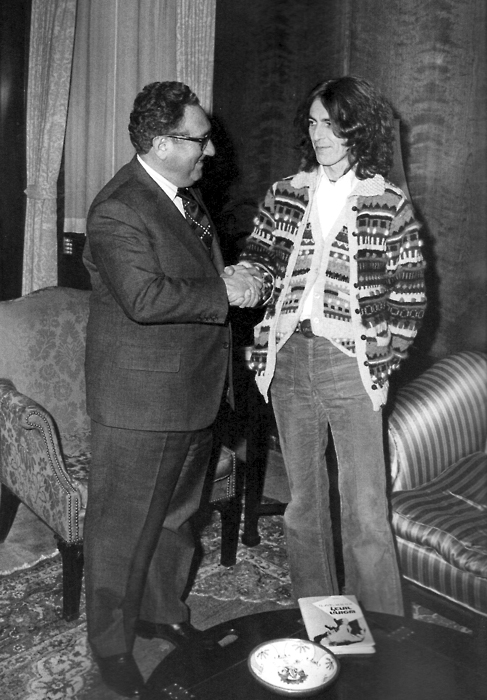
Aleksandr Solzhenitsyn gave Vladimir Putin his blessing for engagement in Ukraine twenty years in advance, and while Henry Kissinger doesn’t go that far, he is seriously sympathetic to the embattled Russian leader, who seems a twentieth-century figure unfortunately cast into the future, a man out of time. From a Q&A with the former Secretary of State conducted by Juliane von Mittelstaedt and Erich Follath of Spiegel:

Spiegel:

So let’s talk about a concrete example: How should the West react to the Russian annexation of Crimea? Do you fear this might mean that borders in the future are no longer incontrovertible?

Henry Kissinger: 

Crimea is a symptom, not a cause. Furthermore, Crimea is a special case. Ukraine was part of Russia for a long time. You can’t accept the principle that any country can just change the borders and take a province of another country. But if the West is honest with itself, it has to admit that there were mistakes on its side. The annexation of Crimea was not a move toward global conquest. It was not Hitler moving into Czechoslovakia.

Spiegel:

What was it then?

Henry Kissinger:

One has to ask one’s self this question: Putin spent tens of billions of dollars on the Winter Olympics in Sochi. The theme of the Olympics was that Russia is a progressive state tied to the West through its culture and, therefore, it presumably wants to be part of it. So it doesn’t make any sense that a week after the close of the Olympics, Putin would take Crimea and start a war over Ukraine. So one has to ask one’s self why did it happen?

Spiegel:

What you’re saying is that the West has at least a kind of responsibility for the escalation?

Henry Kissinger:

Yes, I am saying that. Europe and America did not understand the impact of these events, starting with the negotiations about Ukraine’s economic relations with the European Union and culminating in the demonstrations in Kiev. All these, and their impact, should have been the subject of a dialogue with Russia. This does not mean the Russian response was appropriate.

Spiegel:

It seems you have a lot of understanding for Putin. But isn’t he doing exactly what you are warning of — creating chaos in eastern Ukraine and threatening sovereignty?

Henry Kissinger:

Certainly. But Ukraine has always had a special significance for Russia. It was a mistake not to realize that.”

____________________________

At the 15:40 mark of this episode of The Baseball of World of Joe Garagiola, we see Kissinger, who could only seem competent when standing alongside that block of wood Bowie Kuhn, being honored at Fenway Park before the second game of the sensational 1975 World Series.

Tags: , ,

Staying the same is surest prescription for falling behind. Nations that didn’t enter the Industrial Age largely did not turn out well and still are playing catch-up. (To be fair, they also didn’t contribute to environmental devastation like the rest of us.) The countries that master the Digital Age will ensure themselves of wealth in the aggregate, though disparity may continue, technological unemployment and wage suppression might accelerate. At the far end of the dream is a better world, but how do we get there?

In his 1964 “Automation Song,” Phil Ochs, a singing journalist of sorts, greeted the roboticized future with alarm. At first blush, he seems to be communicating nostalgia for the past, but he’s also subtly calling for political solutions for tomorrow.

Tags:

In a Spiegel interview conducted by Christoph Scheuermann, novelist Hilary Mantel discusses the state of contemporary Britain, which opted for austerity in the wake of the world economic crisis, a move which seems to have been penny wise and pound foolish, costing the country some political sanity. An excerpt:

Spiegel:

How is the Britain of today different from the country you grew up in?

Hilary Mantel:

I was born into a working class family in a village near Manchester. My grandmother worked as a weaver in a mill when she was 12, my mother at 14. That was what you did: As soon as you left school, you had to work in the mill. By the time I was a child, the mills were closing and I was lucky to get a government grant for university. In the years after the war, both big parties, Labour and the Conservatives, were becoming ever-more centrist, drawing together on a social democratic path — a period known as the postwar consensus. Maybe it couldn’t have lasted, but we perceive Ms. Thatcher as the person who knocked it down. Going to university is a seriously expensive business now.

Spiegel:

It seems as though Britain today wants to retreat from the world, as though it has become war-weary, disinterested in global affairs and obsessed with immigration. Where does this come from?

Hilary Mantel:

It’s a retreat into insularity, into a mood of harshness. When people feel they’re being mistreated, they lash out against people who are weaker than themselves, immigrants for example. What’s happening here at the moment is really ugly. The government portrays poor and unfortunate people as being morally defective. This is a return to the thinking of the Victorians. Even in the 16th century, Thomas Cromwell was trying to tell people that a thriving economy has casualties and that something must be done by the state for people out of work. Even back then, you saw the tide turning against this idea that poverty was a moral weakness. Who could have predicted that it would come back into style? It’s myth making on a grand scale, and it’s poisonous.

Spiegel:

Is there a new form of nationalism emerging?

Hilary Mantel:

I’m not sure it’s nationalism pure and simple. But there is certainly a big turn to the right in government. The populist party UKIP (eds. Note: UKIP is demanding that Britain secede from the European Union.) is on the rise; it’s the party at the moment for people who are angry. They may not know what they’re angry about, but they’re going around declaring their intention to vote for UKIP as if that’s going to make everyone terrified. It’s like, I’m holding a hand grenade, can you see it?

Spiegel:

Where does this anger come from?

Hilary Mantel:

Many people are poorer than they were five or six years ago. The last few years of austerity after the banking crisis have opened up a wider gap between rich and poor. It has taken quite a while for people to see that it wasn’t just a matter of a year or two. Transport, gas, electricity, housing: All those things that one must have are significantly more expensive. Wages remain low while the government is freezing and cutting benefits. Traditionally, working class voters would have turned to the Labour Party for remedy. But at the moment, they don’t feel that they can do that. There’s a mood of disaffection.”

Tags: ,

Following up on my argument that Kansans are what’s the matter with Kansas, and perhaps the awfulness of the state’s economy should be laid at their feet rather than those of Democratic or Republican politicians, here’s the opening of Luke Brinker’s Salon piece about state finances at the dawn of Brownback 2.0:

“Less than one week after Kansas voters narrowly reelected Gov. Sam Brownback despite the disastrous budgetary consequences of his massive tax cuts for the wealthy, state analysts announced Monday that the state’s fiscal outlook is even more dire than initially realized.

We’ve known for some time that Brownback’s supply-side experiment has been a big budget-buster. Thanks to the governor’s tax cuts, Kansas collected $330 million less revenue than expected for fiscal year 2014 — $700 million below revenue for fiscal 2013. Despite the Brownback administration’s assurances that the state’s fiscal picture would improve — any day now! — the state’s revenue from July to September came up an astonishing 10 percent short of expectations.

The numbers released yesterday are even worse.”

Tags: ,

President Lincoln was an early adopter of technology, but so unconnected were we in 1865, it took a dozen days for the news of his assassination to reach London. Reuters–then spelled “Reuter’s”–got the scoop, but there was no byline. What a byline that would have been to have.

From the Reuters site:

“After 12 days crossing the Atlantic, a Reuters report of the assassination of President Lincoln reaches London first, throwing European financial markets into turmoil. Reuter intercepted the mail boat off Ireland and telegraphed the news to London.”


Tags:

Timothy Wu, the Columbia law professor who coined the term “net neutrality,” spoke on the topic with Nancy Scola of the Washington Post on the day President Obama strongly urged the FCC to treat the Internet as a public utility. An excerpt:

Question:

Even if you accept that Title II reclassification has the clearest legal runway, the politics of it have always seemed especially tricky for the FCC.

Timothy Wu:

Oh yeah. The law’s not hard. The politics are hard.

Question:

So what does Obama’s statement do to the politics?

Timothy Wu:

The FCC was leaning toward a slightly more compromised approach, and I suppose having the White House do this could leave them feeling like they have no allies and are unwilling to act for a while. I imagine they’re not very happy over there.

Question:

Chairman Wheeler’s statement on Obama’s move actually, seemed, well, pretty sassy. It emphasized how the FCC is an independent agency…

Timothy Wu:

I think the FCC had settled, and may still be settled, on a different way of using Title II. And without the White House on its side and with Congress against it, they’re kind of in that middle of the road area where you get run over. Politically, they’re stranded right now, and I’m not sure what that means from them. Wheeler seems to be indicating that they’re going to push the hold button on net neutrality, which could be a disappointing outcome if that hold button stays there for a very long time.

Question:

Their argument seems to be that they haven’t developed the record to be able to defend a Title II-based approach in court. But Title II has been around for 80 years.

Timothy Wu:

‘We don’t have the record yet’ is agency-speak for, ‘we gotta figure out what to do next.’ They can act without the White House and without Congress, but no one one in Washington likes to go it alone. It’s very precarious.”

Tags: , ,

On the face of it, the Sharing Economy is a conservative wet dream, subverting regulations and damaging unions. But politics on the granular level is never quite that simple, and so far Blue States have been somewhat friendlier to Uber and others. The deciding factor seems to not be ideology but population density and consumer demand, so Los Angeles, blue as can be, has embraced such services while some red enclaves have not. From Josh Barro at the New York Times’ Upshot:

“The R.N.C. chairman, Reince Priebus, probably doesn’t get a lot of phone calls from taxi medallion owners, or car dealers, or other businesspeople who want to be insulated from competition.

But local politicians do; Republicans may be especially likely to hear from them because small business owners are a constituency that skews Republican.

As a result, in practice, it’s not clear Republicans are any more pro-market than Democrats when it comes to business regulation.

Andrew Moylan, a senior fellow at the R Street Institute think tank, has examined ride-sharing regulations around the country and doesn’t see a clear partisan divide. On Monday, R Street and Engine, a group advocating policies that support start-ups, will release a report card rating the 50 largest cities on their friendliness to ride sharing. The eight cities receiving failing grades include ones in blue areas (Philadelphia and Portland, Ore.) and red ones (Omaha, Phoenix and San Antonio).

‘There didn’t seem to be any obvious ideological trends,’ Mr. Moylan said. ‘It may have something more to do with population density and consumer demand.’

In the case of Uber, the cities with the most to gain from innovation tend to be large and dense, and often Democratic. So at the local level, the leaders in welcoming Uber are often Democrats. Conservatives like to mock California as anti-business, but the state is one of just two to have enacted a comprehensive, statewide regulatory framework that is friendly to ride sharing. The other is Colorado, also run by Democrats.”

Tags: ,

Before departing for a trip to China, President Obama sent more troops to Iraq, and Russia reportedly dispatched additional soldiers to Crimea. Of these three regions, China is almost definitely the biggest challenge to U.S. in the long term, if more economically than militaristically presently. In a Financial Times column, Gideon Rachman argues that Russia, not the Middle East, is the greater short-term threat, which is not the conventional wisdom. An excerpt:

“The darkest scenarios, being discussed behind closed doors, include Russian escalation up to and including the use of tactical nuclear weapons. If that were to happen it would, of course, be the biggest international security crisis in decades – far more significant and dangerous than another round in the 25 years of fighting in Iraq.

Most experts still dismiss the nuclear scenarios as far-fetched. It is more common to worry that Mr Putin may launch an all-out conventional war in Ukraine – or encourage uprisings by Russian-speakers in the Baltic states, which are members of Nato. If Russia then intervened in the Baltic states and Nato did not respond, the Kremlin would have achieved the huge prize of demonstrating that the western military alliance is a paper tiger.

Some hope that the growing pressure on the Russian economy and the rouble might dissuade the Kremlin from escalation. But an economic crisis could also make Russian behaviour more unpredictable and reckless.

Amid all this angst, President Obama has set off for a summit in China. For believers in America’s ‘pivot to Asia’ it remains true that – over the longer term – the biggest challenge to US power is still a rising China, rather than a declining Russia or a disintegrating Middle East.”

Tags: ,

Although better education, particularly at the primary and secondary levels, would be a great thing in America, I don’t really believe that such an improvement would reverse wealth inequality in the country, as Thomas Piketty has suggested. We seem to be in a spiral with no easy answers. From the Economist:

“AMONG the most controversial of Thomas Piketty’s arguments in his bestselling analysis of inequality, Capital in the Twenty-First Century is that wealth is increasingly concentrated in the hands of the very rich. Rising wealth inequality could presage the return of an 18th century inheritance society, in which marrying an heir is a surer route to riches than starting a company. Critics question the premise: Chris Giles, the economics editor of the Financial Times, argued earlier this year that Mr Piketty’s data were both thin and faulty. Yet a new paper suggests that, in America at least, inequality in wealth is approaching record levels.

Earlier studies of American wealth have tended to show only small increases in inequality in recent decades. A 2004 study of estate-tax data by Wojciech Kopczuk of Columbia University and Emmanuel Saez of the University of California, Berkeley, found an almost imperceptible rise in the share of wealth held by the top 1% of families, from about 19% in 1976 to 21% in 2000. A more recent investigation of the Federal Reserve’s data on consumer finances, by Edward Wolff of New York University showed a continued but gentle increase in inequality into the 2000s. Mr Piketty’s book, which drew on this previous work, showed similarly modest rises in wealth inequality in America.

A new paper by Mr Saez and Gabriel Zucman of the London School of Economics reckons past estimates badly underestimated the share of wealth belonging to the very rich. It uses a richer variety of sources than prior studies, including detailed data on personal income taxes (which the authors mine for figures on capital income) and property tax, which they check against Fed data on aggregate wealth. The authors note that not every potential source of error can be accounted for; tax avoidance strategies, for instance, could cause either an overestimation of the wealth share of the rich (if they classify labour income as capital income in order to take advantage of lower rates) or an underestimation (if they intentionally seek out lower yielding investments for their tax advantages). Yet they believe their estimates represent an improvement over past attempts.

The results are enough to make Mr Piketty blush.”

Tags: , , ,

Financial Times reporter Caroline Daniel covered the waterfront of technology with Peter Thiel at the Web Summit 2014 in Dublin, discussing monopolies, immortality, AI, etc. On Artificial Intelligence, he states that the creation of truly intelligent AI, something he estimates to be a century in the future, would be the equivalent of extraterrestrials landing on Earth.

Tags: ,

The unemployment rate is falling in America, but wages aren’t rising in most sectors, which is counterintuitive. Two explanatory notes about U.S. employment in the aftermath of the 2008 economic collapse, one from Eric Brynjolfsson and Andrew McAfee’s The Second Machine Age, and the other from Derek Thompson’s Atlantic article “The Rise of Invisible Unemployment.”

____________________________

From Brynjolfsson and McAfee:

“A few years ago we had a very candid discussion with one CEO, and he explained that he knew for over a decade that advances in information technology had rendered many routine information-processing jobs superfluous. At the same time, when profits and revenues are on the rise, it can be hard to eliminate jobs. When the recession came, business as usual obviously was not sustainable, which made it easier to implement a round of streamlining and layoffs. As the recession ended and profits and demand returned, the jobs doing routine work were not restored. Like so many other companies in recent years, his organization found it could use technology to scale up without the workers.”

____________________________

From Thompson:

“3. The rise of invisible work is too large to ignore.

By ‘invisible work,’ I mean work done by American companies that isn’t done by Americans workers. Globalization and technology is allowing corporations to expand productivity, which shows up in earnings reports and stock prices and other metrics that analysts typically associate with a healthy economy. But globalization and technology don’t always show up in US wage growth because they often represent alternatives to US-based jobs. Corporations have used the recession and the recovery to increase profits by expanding abroad, hiring abroad, and controlling labor costs at home. It’s a brilliant strategy to please investors. But it’s an awful way to contribute to domestic wage growth.

Tags: , ,

A more extreme way of looking at wealth inequality is not within nations but among them. In a Financial Times piece, Tim Harford argues the biggest lottery to win in life isn’t genetics or parentage but a fortunate patch of the map. An excerpt:

“I’ve been a lucky boy. I could start with the ‘boy’ fact. We men enjoy all sorts of privileges, many of them quite subtle these days, but well worth having. I’m white. I’m an Oxford graduate and I am the son of Oxbridge graduates….

Imagine lining up everyone in the world from the poorest to the richest, each standing beside a pile of money that represents his or her annual income. The world is a very unequal place: those in the top 1 per cent have vastly more than those in the bottom 1 per cent – you need about $35,000 after taxes to make that cut-off and be one of the 70 million richest people in the world. If that seems low, it’s $140,000 after taxes for a family of four – and it is also about 100 times more than the world’s poorest people have.

What determines who is at the richer end of that curve is, mostly, living in a rich country. Branko Milanovic, a visiting presidential professor at City University New York and author of The Haves and the Have-Nots, calculates that about 80 per cent of global inequality is the result of inequality between rich nations and poor nations. Only 20 per cent is the result of inequality between rich and poor within nations. The Oxford thing matters, of course. But what matters much more is that I was born in England rather than Bangladesh or Uganda.”


Tags: ,

The prison population in the United States is finally declining, thankfully, and at the Washington Post, Patricia O’Brien has a modest proposal for thinning that crowd even more: Stop incarcerating women, no matter the crime. Her suggestion is extreme, and we’d probably be better off just eliminating sentencing for most drug-possession crimes for both genders, though she does make some good points. An excerpt:

“Could women’s prisons actually be eliminated in the United States, where the rate of women’s incarceration has risen by 646 percent in the past 30 years? The context is different, but many of the arguments are the same.

Essentially, the case for closing women’s prisons is the same as the case for imprisoning fewer men. It is the case against the prison industrial complex and for community-based treatment where it works better than incarceration. But there is evidence that prison harms women more than men, so why not start there?

Any examination of the women who are in U.S. prisons reveals that the majority are nonviolent offenders with poor education, little employment experience and multiple histories of abuse from childhood through adulthood. Women are also more likely than men to have children who rely on them for support — 147,000 American children have mothers in prison.

Prison nation

The United States is a prison nation. More than 1.5 million people are incarcerated in the country. And this obsession with punishment is expensive. Cumulatively, states spend more than $52 billion a year on their prison systems. The federal government also spends tens of billions to police, prosecute and imprison people, though research demonstrates that incarceration harms individual well-being and does not improve public safety.

What purpose is served by subjecting the most disempowered, abused and nonviolent women to the perpetually negative environment of prisons?”

Tags:

« Older entries § Newer entries »