Politics

You are currently browsing the archive for the Politics category.

Long-range space exploration plans know their limitations, as changing politics lead to shifting priorities. In a 2007 New York Times essay, Dennis Overbye fretted about the failure of the Space Age to stretch much further than boots on the moon, but he also presciently realized that new-millennium geopolitics and technologist gazillionaires would likely help us shoot for Mars. An excerpt:

Our machines have gone ahead of us. But someday people will hike through the canyons of Mars. I just don’t know when or how or who. Maybe it will be the Chinese, who seem to still feel that they have something to prove as a nation. Maybe it will be billionaire adventurers — like the Google founders who just put up a $25 million prize for the first private Moon lander, who are free to risk their own money and don’t have to answer to Congress when things go wrong, as they sometimes will — who make the dream come true, for at least a few.

There will always be someone willing to ride a pillar of fire into the unknown, but it won’t be me. I don’t want to go to Mars anymore. I no longer have the stuff — if in fact I ever did — to camp out in a tin can for two years. I’d be afraid to be so far from the Earth and my family for so long.

I don’t want my daughter to go either, for the same reason. When our children do go off forever across the void then we will have a chance to find out if we are as strong as our ancestors who bundled their children onto ships in the hope they would reach a better world across the ocean. Someday, somebody will go and not come back, and humans will have escaped their nest, for better or for worse.

There is no galactic immortality. Everything we are and have done, the whole Milky Way with its billions of stars, is eventually destined to be swallowed up in a black hole. Neither ourselves nor our works will survive the end of the universe, if dark energy eventually blows it apart, no matter what we do. All we own is the present, so it behooves each of us to live each moment impeccably, guided by whatever lights we choose. Speaking only for myself, while we are around we might as well embrace the light and the unknown, the violence and vastness that terrify us.

My sci-fi dreams are dead, but Sir Richard Branson and his fellow space entrepreneurs say they have business plans. If Mr. Branson manages to get the cosmologist Stephen Hawking into space and back, he will have done more for the cause of space exploration than 25 years of space shuttles going around in circles.

Watching the Apollo astronauts recount their travels to the Moon in the documentary In the Shadow of the Moon, I was wiping away tears for a time when we had bold dreams and leaders who, for whatever motives, could make them happen. Neil Armstrong’s footprints on the Moon are as crisp as the day he made them.

I will always be glad I was alive when he took that small step, even if we are still waiting for the next big leap.•

 

Tags:

Via the wonderful Browser, I came across David Cay Johnston’s Al Jazeera essay, “America Should Be More Like Disneyland,” which suggests the U.S. invest in infrastructure and our future like Walt did with his walled-in world. It’s not the first time a thinker has suggested we look to a corporation for tips on saner public governance. In the 1990s, Los Angeles sci-fi writer Ray Bradbury, worried by the Rodney King riots and crime against his own family members, thought American cities were becoming hyper-violent and needed to turn themselves over to corporations which would make large-scale malls of metropolises. He had, of course, missed the macro picture: Crime was actually diminishing in the U.S. at a remarkable rate. It still is. Johnston’s ideas are far more reasonable. An excerpt:

“At the park’s grand opening on July 17, 1955, Walt Disney said, ‘This happy place’ is ‘dedicated to the ideals, the dreams and the hard facts that have created America.’

To raise the $17 million ($150 million in today’s money) needed to turn Anaheim’s orange groves into the Magic Kingdom, Disney mortgaged his home and created a Sunday night television show on ABC. Today the Disney Co. owns ABC, because Walt Disney’s vision of a richer future paid off beyond even his imagination.

But as a people, we disinvest in America. Even though the country could borrow at extremely low interest rates, we refuse to take the risk. Instead, we let infrastructure deteriorate, cut school budgets, close libraries, raise college tuition and pay ever more for police and security even though crime has been declining for decades.

In an era when human knowledge is expanding at a rapidly accelerating rate, Congress cuts budgets for basic research, thereby encouraging smart young scientists to go overseas because they can get funding abroad. And of course the countries that receive them will reap the benefits of their discoveries.

Disney’s brother Roy and other critics thought Disneyland was too audacious and costly an idea to succeed. Yet it not only prompted a wave of theme parks around the world, including the complete remake of Las Vegas, starting in 1989 with the Mirage, a themed casino resort on the Disneyland model.

Creating a happy place

Imagine if we applied that same vision of a better world from infrastructure to education and scientific research or even to just having public restrooms — and clean ones at that.”

Tags: ,

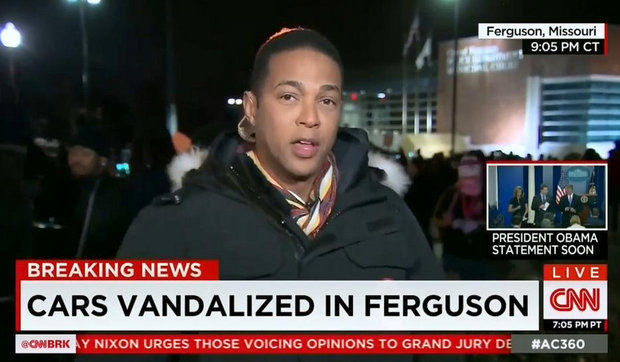
The problem with CNN giving a dum-dum like Don Lemon a microphone is that words matter, and when he announces to American viewers that Ferguson smells like marijuana “obviously,” he’s reinforcing a racial stereotype that plays out with real consequences. From the Economist:

“DC is only the most extreme example of a national trend. Smoking pot is fairly common, even though it remains illegal in most parts of the country. Around a fifth of 18-to-25 year-olds have taken a hit in the past month. But while the effects of the drug are more or less the same for all tokers, the punishments are not. In all regions of the country, black people were nearly four times more likely to be arrested for marijuana possession, on average, than white people between 2001 and 2010, according to the ACLU. The racial disparity increased considerably over the evaluated period, even though blacks and whites use marijuana at similar rates.  

The costs of these arrests, prosecutions and convictions are heady. Marijuana possession charges make up nearly half of all drug arrests. States spent over $3.61 billion combined enforcing them in 2010. But the collateral damage may be even dearer. Drug arrests break up homes and potentially harm whole communities. Convictions often affect a person’s eligibility for jobs, student financial aid and public housing. The fact that whites often use marijuana without legal consequence while blacks must worry about getting arrested naturally breeds mistrust of police officers, and of the criminal justice system as a whole.”

I put up a post last month about taxi commissions needing to compete with Uber at its own game, creating an app that will allow medallion owners and their drivers to offer customers the best of ridesharing (smartphone hailing, digital payments) without the negative (surge pricing, unethical business and labor practices), and it seems that NYC and Chicago were already thinking along those lines. Now it will come down to properly executing the system. From Mike Isaac at the New York Times:

“If you can’t beat them, join them.

Regulators in Chicago have approved a plan to create one or more applications that would allow users to hail taxis from any operators in the city, using a smartphone. In New York, a City Council member proposed a similar app on Monday that would let residents ‘e-hail’ any of the 20,000 cabs that circulate in the city on a daily basis.

It is a new tack for officials in the two cities, a reaction to the surging use of hail-a-ride apps like Uber and Lyft.

Regulators in New York have not yet voted on the bill on the e-hail app, which was first proposed by Benjamin Kallos, a councilman who represents the Upper East Side and Roosevelt Island.

In Chicago, the plan to create such apps is part of the so-called Taxi Driver Fairness Reforms package, a plan backed by a taxi union and City Council members that would update regulations around taxi cab lease rates and violations like traffic tickets, among others. The city is expected to solicit third-party application developers to build the official app or set of apps. The City Council gave no further details on its selection criteria, nor did it give information on how the initiative would be financed.

‘These reforms represent what is necessary to further modernize this growing industry,’ Rahm Emanuel, Chicago’s mayor, said in a statement.”

Tags:

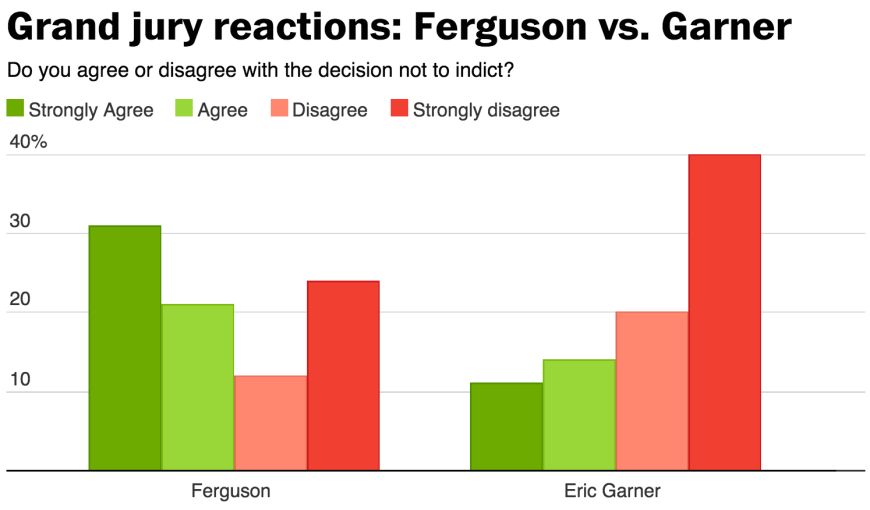
I’ll use the graph below, from a post by Andrew Sullivan at the Dish, as possible proof of my contention that although police body-cameras may not instantly bring about a higher degree of justice, the images will effect public consciousness, which may in turn be brought to bear on race and policing.

Tags:

China has quietly surpassed the U.S. this year as the world’s largest economic power, and that’s not a situation likely to reverse itself anytime soon, even if that nation should suffer a large-scale financial downturn. But what is the significance of America being number two? From Joseph Stiglitz at Vanity Fair:

Now China is the world’s No. 1 economic power. Why should we care? On one level, we actually shouldn’t. The world economy is not a zero-sum game, where China’s growth must necessarily come at the expense of ours. In fact, its growth is complementary to ours. If it grows faster, it will buy more of our goods, and we will prosper. There has always, to be sure, been a little hype in such claims—just ask workers who have lost their manufacturing jobs to China. But that reality has as much to do with our own economic policies at home as it does with the rise of some other country.

On another level, the emergence of China into the top spot matters a great deal, and we need to be aware of the implications.

First, as noted, America’s real strength lies in its soft power—the example it provides to others and the influence of its ideas, including ideas about economic and political life. The rise of China to No. 1 brings new prominence to that country’s political and economic model—and to its own forms of soft power. The rise of China also shines a harsh spotlight on the American model. That model has not been delivering for large portions of its own population. The typical American family is worse off than it was a quarter-century ago, adjusted for inflation; the proportion of people in poverty has increased. China, too, is marked by high levels of inequality, but its economy has been doing some good for most of its citizens. China moved some 500 million people out of poverty during the same period that saw America’s middle class enter a period of stagnation. An economic model that doesn’t serve a majority of its citizens is not going to provide a role model for others to emulate. America should see the rise of China as a wake-up call to put our own house in order.

Second, if we ponder the rise of China and then take actions based on the idea that the world economy is indeed a zero-sum game—and that we therefore need to boost our share and reduce China’s—we will erode our soft power even further. This would be exactly the wrong kind of wake-up call. If we see China’s gains as coming at our expense, we will strive for “containment,” taking steps designed to limit China’s influence. These actions will ultimately prove futile, but will nonetheless undermine confidence in the U.S. and its position of leadership. U.S. foreign policy has repeatedly fallen into this trap.•

Tags:

The whole world is a city, or becoming one, we’ve been told repeatedly, but a new Economist report pushes back at the idea, arguing that China, India and Brazil, three ascendant powers, are embracing the sprawl. Measures must be taken to ensure that the environmental costs of non-density are minimized. The opening:

“IN THE West, suburbs could hardly be less fashionable. Singers and film-makers lampoon them as the haunts of bored teenagers and desperate housewives. Ferguson, Missouri, torched by its residents following the police shooting of an unarmed black teenager, epitomises the failure of many American suburbs. Mayors like boasting about their downtown trams or metrosexual loft dwellers not their suburbs.

But the planet as a whole is fast becoming suburban. In the emerging world almost every metropolis is growing in size faster than in population. Having bought their Gucci handbags and Volkswagens, the new Asian middle class is buying living space, resulting in colossal sprawl. Many of the new suburbs are high-rise, though still car-oriented; others are straight clones of American suburbs (take a look at Orange County, outside Beijing). What should governments do about it?

The space race

Until a decade or two ago, the centres of many Western cities were emptying while their edges were spreading. This was not for the reasons normally cited. Neither the car nor the motorway caused suburban sprawl, although they sped it up: cities were spreading before either came along. Nor was the flight to the suburbs caused by racism. Whites fled inner-city neighbourhoods that were becoming black, but they also fled ones that were not. Planning and zoning rules encouraged sprawl, as did tax breaks for home ownership—but cities spread regardless of these. The real cause was mass affluence. As people grew richer, they demanded more privacy and space. Only a few could afford that in city centres; the rest moved out.

The same process is now occurring in the developing world, but much more quickly.”

In a piece at the Los Angeles Review of Books about Tyler Cowen’s Average Is Over, a meditation on meritocracy run amok, Guy Patrick Cunningham compares tomorrow’s potentially technologically divided society, a sci-fi-ish dystopia few people would find acceptable, to life in the Middle Ages. An excerpt:

“Though Cowen doesn’t see it, the future he lays out seems rife with obvious, intrinsic structural inequalities that will make it very hard for anyone born outside the elite to actually show enough ‘merit’ to rise into it. And when he breezily asserts, ‘The more that the high earners pull in, the more people will compete to serve them, sometimes for high wages, and sometimes for low wages,’ and that, ‘making high earners feel better in just about every part of their lives will be a major source of job growth in the future […] Better about the world. Better about themselves. Better about what they have achieved,’ it becomes hard not to see this as a new form of aristocracy — one where people born with certain advantages are able to leverage them even further than today’s wealthy. Certainly, a smart, capable aristocracy, one theoretically open to talented outsiders, but an aristocracy all the same.

Cowen is careful to note that this system ‘is not necessarily a good and just way for an economy to run,’ but he certainly sees it as a given. Interestingly, he is also keen to emphasize the autonomy of the individual in the hyper-meritocracy. This isn’t itself surprising. But Cowen’s efforts to square the system he anticipates with humanistic ideas about individual agency fall flat. When he defends the possibility of building third-world style slums in the United States, he insists, ‘No one is being forced to live in these places […] I might prefer to live there if my income was low enough.’ Cowen essentially defines choice down to the absence of force. But this is meaningless — after all, no one chooses to live in a slum, unless the alternative is homelessness. Choice only matters when there are real alternatives to pick from. When Cowen compares a hyper-meritocratic society to the Middle Ages, he does so merely to point out that it is possible for a deeply unequal society to remain stable over a long period of time. But the comparison brings to mind another thought instead — that the values that underlie hyper-meritocracy are as un-humanist as those of the Medieval period.”

Tags: ,

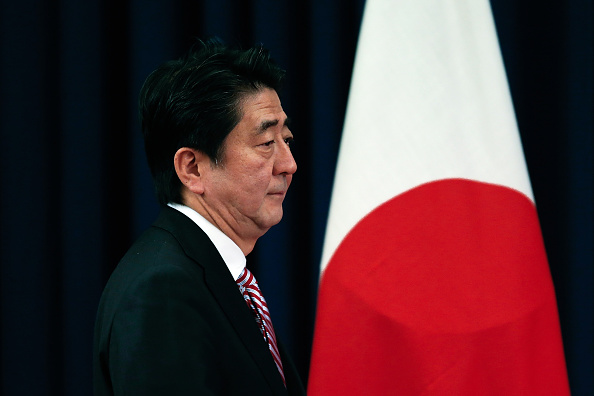
The opening question from an Economist interview with Japanese Prime Minister Shinzo Abe, a man in a hurry trying to manage the challenging future of a graying nation:

The Economist:

Recently you seem to have been a whirlwind of activity. You’ve done a lightning tour of the Asia-Pacific region, three major summits in three different cities. You broke the ice with President Xi Jinping in Beijing, and in Brisbane you had a trilateral meeting with the leaders of Australia and the United States. No sooner were you back than you declared the date for a snap election and you dissolved the Diet. It seems, and this has often struck us at The Economist, that you think of yourself as a man in a hurry, a man with a mission.

Shinzo Abe:

We don’t have much time—that’s how I see it. The world is moving fast, in the context of a globalised economy. In East Asia, China is indeed rising, and many other countries around the world are trying to up their competitiveness.

In that context, two years ago Japan’s competitive position looked lost. Japan was about to fall off the world stage. Fertility rates are falling, and our population is ageing. We’re now seeing the absolute level of our population actually shrinking. That’s a very big challenge, and meanwhile Japan is confronted with a huge national debt. As I see it, Japan had to catch up, moving at the speed of the world, which is to say, very fast. And so we needed to speed up our reform of Japan as well.

Now, the 21st century is the one in which Japan really must regain economic strength as well as competitiveness. We are a democratic country, we feel that we cherish the value of freedoms and the rule of law and so forth. And as a democratic country—and as a pacifist nation—we really would like to make a contribution to the region as well as the rest of the world. This is something that I really want to say as a clear message to the rest of the world. This is the firm determination I have, and I am going ahead with reforms, sometimes in the face of severe opposition, but I am determined to do it. In order to do it more resolutely, I decided to dissolve the lower house of the Diet so that we can have strength in holding a solid majority.”

Tags:

In a post for the “Upshot” section of the New York Times, economist Tyler Cowen suggests a variety of ways technology may begin to reverse the income inequality it has lately helped grow. Many of the ideas are modest and incremental, but there’s one giant one: The rising fortunes of emerging powers like China may eventually also help enrich Americans when such nations lose interest in making knockoff Apple products and create original companies as innovative as Apple. An excerpt:

“A final set of forces to reverse growing inequality stem from the emerging economies, most of all China. Perhaps we are living in a temporary intermediate period when America and many other developed nations bear a lot of the costs of Chinese economic development without yet getting many of the potential benefits. For instance, China and other emerging nations are already rich enough to bid up commodity prices and large enough to drive down the wages of a lot of American middle-class workers, especially in manufacturing. Yet while these emerging economies are keeping down the costs of manufactured goods for American consumers, they are not yet innovative enough to send us many fantastic new products, the way that the United States sends a stream of new products to British or French consumers, to their benefit. 

That state of affairs will probably end. Over the next few decades, we can expect China, India and other emerging nations to supply more innovations to the global economy, including to the United States. This shouldn’t be a cause for alarm. It will lead to many good things.

Since the emerging economies are relatively poor, many of these innovations may benefit relatively low-income Americans.”

Tags:

  1. Did the millions of Americans newly receiving health insurance via the Affordable Care Act create well-paying jobs?
  1. Did the sanctions against Putin cause countries to buy products from the U.S. that they normally got from Russia, leading to our companies hiring more workers?

Tags: ,

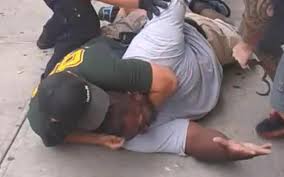
Something significant happened between the mind-boggling grand jury decisions in the Michael Brown and Eric Garner cases, and that was President Obama determining that police-officer body cameras needed to be dispersed across the country. After the brutal Garner homicide, which was captured fully on tape, brought back no indictment, there were pundits who said this was proof that Obama’s initiative wouldn’t help in any meaningful way.

Perhaps. But Eric Garner’s contorted face and cries for mercy are not going to go away thanks to that footage, and those images and sounds have convinced a large number of conservative politicians and editorialists to take an unusual stand, calling on Eric Holder and Congress to further investigate the murder of a victim who will remind us of injustice on an infinite loop. From Ed O’Keefe at the Washington Post:

“House Speaker John A. Boehner (R-Ohio) said Thursday that he still has ‘unanswered questions’ about the recent deaths of Michael Brown and Eric Garner, two African Americans killed during confrontations with police officers.

‘Clearly both of these are serious tragedies that we’ve seen in our society,’ he said in response to a question at his weekly press conference. ‘I think the American people want to understand more of what the facts were. There are a lot of unanswered questions that Americans have, and frankly I have.’

Boehner said he wouldn’t rule out having House committees hold hearings into the matter. ‘I do think that the American people deserve more answers about what really happened here and was our system of justice handled properly,’ he said.

Boehner’s comments a few hours after Rep. Cathy McMorris Rodgers (R-Wash.), the fourth-ranking House Republican, said she ‘absolutely’ thinks the House should hold hearings into the matter.”

Tags: , , ,

Norman Mailer, no stranger to politics himself, sincerely wanted the Democrats to draft Ernest Hemingway, who liked to fucking fish, as their nominee for President in 1956, encouraging such a move in an open letter to the party in the Village Voice. Not quite as bad an idea as liberating Jack Henry Abbott, but not his best one, either. An excerpt from Mailer’s original article republished at the Penguin Random House Medium site:

YES, IT MAY SEEM a trifle fantastic at the first approach, but the man I think the Democrats ought to draft for their presidential candidate in 1956 is Ernest Hemingway.

I have had this thought in mind for some months, and have tried to consider its merits and demerits more than once. You see, I am far from a worshipper of Hemingway, but after a good many years of forever putting him down in my mind, I came to decide that like him or not, he was one of the two counterposed aesthetic forces in the American novel today — the other being Faulkner of course — and so his mark on history is probably assured.

Now, what I think of Hemingway as a writer would be of interest to very few people, but I underline that I am not a religious devotee of his work in order to emphasize that I have thought about him as a presidential candidate without passion or self-involvement (or at least so I believe it to be). As for his merits and even more important his possibilities for victory, I will try to discuss them quickly in the limits of this column.

To begin with, the Democratic Party has the poorest of chances against Eisenhower, and whether it be Stevenson, Kefauver, or some other political half- worthy, the candidate’s personality would suffer from his unfortunate resemblance to a prosperous undertaker. There is no getting around it — the American people tend to vote for the candidate who gives off the impression of having experienced some pleasure in his life, and Eisenhower, whatever his passive vicissitudes, looks like he has had a good time now and again. I would submit that this is one of the few healthy aspects of our unhealthy country — it is indeed folk wisdom.

A man who has had good times has invariably also suffered (as opposed to the unfortunate number of people who have avoided pain at the expense of avoiding pleasure as well), and the mixture of pain and pleasure in a man’s experiences is likely to give him the proportion, the common sense, and the charm a president needs.

Hemingway, I would guess, possesses exactly that kind of charm, possesses it in greater degree than Eisenhower, and so he would have some outside chance to win.•

Tags: ,

Almost as surprising as the seemingly sudden acceptance of gay marriage in America has been the GOP turnabout on warehousing nonviolent criminals, creating a massive prison state, a policy equally morally bankrupt and financially expensive. Former David Cameron speechwriter Danny Kruger visited Texas and reported for the BBC on the shuttering of prisons in a red state. An excerpt:

“Texas, for instance, has half the population of the UK but twice its number of prisoners.

Then something happened in 2007, when Texas Republican Congressman Jerry Madden was appointed chairman of the House Corrections Committee with the now famous words by his party leader: ‘Don’t build new prisons. They cost too much.’

The impulse to what has become the Right on Crime initiative was fiscal conservatism – the strong sense that the taxpayer was paying way too much money to fight a losing war against drugs, mental ill-health and petty criminality.

What Madden found was that too many low-level offenders were spending too long in prison, and not reforming. On the contrary, they were getting worse inside and not getting the help they needed on release.

The only response until then, from Democrat as well as Republican legislators, was to build more prisons. Indeed, Mr Madden’s analysis suggested that a further 17,000 prisoners were coming down the pipe towards them, requiring an extra $500m for new prisons. But he and his party didn’t want to spend more money building new prisons. So they thought of something else – rehab.”

Tags: ,

New York City is apparently a place where a black man can be choked to death with impunity for selling loose cigarettes, but white-collar criminals are bailed out by feds and gifted with bonuses for bringing down the nation’s economy. On the day of the non-indictment in the Eric Garner homicide, the New York Times Magazine published a piece by Chip Brown which examines the virtues of Manhattan D.A. Cyrus Vance Jr.’s data-rich approach to crime reduction. The thing is, the new system doesn’t move us beyond the crudity of the dubious Broken Windows Theory, only serving as a complement to it, and may actually exacerbate inequity and further profiling. Striving for fewer violent attacks is great, though that should include the kind Garner suffered. Numbers, ultimately, are only as good as the system they feed. An excerpt:

“C.S.U. ‘violence timelines’ reveal patterns around certain housing developments and neighborhoods, including shooting incidents that didn’t generate a police report but that prosecutors were able to substantiate through debriefings or reports on social media. Probably the most comprehensive database is the Crime Prevention System, which targets violent crimes and gathers on one spreadsheet the sort of information that used to be scattered on legal pads or parked in some retired detective’s head — details about a defendant, including nicknames, which can be linked to additional information: friends, tattoos, telltale scars, Facebook entries, geo-coded street addresses, debriefing tips, excerpts from jailhouse phone calls.

‘It’s the ‘Moneyball’ approach to crime,’ [Vance’s executive assistant D.A. Chauncey] Parker told me. ‘The tool is data; the benefit, public safety and justice — whom are we going to put in jail? If you have 10 guys dealing drugs, which one do you focus on? The assistant district attorneys know the rap sheets, they have the police statements like before, but now they know if you lift the left sleeve you’ll find a gang tattoo and if you look you’ll see a scar where the defendant was once shot in the ankle. Some of the defendants are often surprised we know so much about them.’

In speeches praising intelligence-driven prosecution, Vance often cites the case of a 270-pound scam artist named Naim Jabbar, who for more than a decade made a living in the Times Square area bumping into pedestrians and then demanding money, saying they had broken his glasses. Convicted 19 times on the misdemeanor charge of ‘fraudulent accosting,’ Jabbar never served more than five months in jail until he was flagged by the C.S.U. His next arrest, in July 2010, triggered an alert. Instead of being offered a plea bargain, he was indicted and subsequently convicted on a felony robbery charge, and sentenced to three and a half to seven years in prison. With time served before his conviction, he was soon paroled and then arrested again, in July 2014, for another broken-eyeglasses incident and charged with robbery and grand larceny. 

More broadly, working with the Police Department and following a plan based on information developed by the C.S.U., the Violent Criminal Enterprises Unit, which Vance created in his first term, began taking down the most violent of Manhattan’s roughly 30 gangs; since 2011, 17 gangs have been dismantled, including three broken up last June at the Manhattanville and Grant housing projects, resulting in the largest number of gang indictments in a single operation. ‘There’s a reason murders in Manhattan went from 70 in 2010 to 29 so far this year,’ Karen Friedman Agnifilo, former chief of the Trial Division, told me late last year. (In January, Vance promoted Friedman Agnifilo to the No. 2 job, chief assistant district attorney.) ‘We figured out who are the people driving crime in Manhattan, and for four years we focused on taking them out.’”

Tags: , ,

There are reasons to be wary of the U.S. government, but there’s also cause to fear the people, and though the two are supposed to be indivisible, you would be hard-pressed to convince the more paranoid among us that such a thing ever be considered. Disney World, that authoritarian state, was host in October to the initial “Coins in the Kingdom” conference, a gathering of cryptocurrency enthusiasts which delivered, among others, all manner of government-hating, Bitcoin-loving Libertarians to Walt-ville. They’re pioneers of a virtual kind, though they want to leverage online might to reconfigure the physical realm. Sam Biddle of Gawker decamped to Orlando to assess the damage:

“‘There are those who just want to be left alone, there are those that just won’t leave ’em alone! It’s no more complicated than that. You think it is, but it’s not.’

Podcaster Ernie Hancock, who takes credit for Ron Paul’s ‘rEVOLution’ campaign logo and once brandished a weapon at an Obama rally, provided Saturday’s opening remark before an audience of about 12. If you’ve ever wondered where the carpet that was removed from your parents house wound up, it appears to be in a Disney conference ballroom now.

Hancock delivered his comments urgently, as if stormtroopers from the Federal Reserve would storm the room at any moment. ‘What we want to do,’ he went on, with the lilt of a carny, ‘is try to make sure that bitcoin develops in such a way that it is supportive of the rights of the individual.’

I would hear this again, and again, and again: bitcoin is a weapon for liberty that we dearly need to wield against government. Bitcoin isn’t just a way to buy gift cards online, but an act of civil disobedience, a democratization of the global financial system. There’s no denying how radical that idea is.

But before we resisted them, we needed to be scared of them.

‘Can they?’ Hancock asked the audience, invoking every conceivable form of big government malice. ‘Then they are.’ It was up to all of us in the uncomfortable chairs to stop this. ‘If it’s technologically possible to advance the interest of those with coercive power, then it will eventually become politically inevitable.’ The audience nodded along—it starts with regulation, with Wall Street acceptance, and before you know it, a prison state. Or something. If anyone disputed the notion that the very concept of government was just one fat obstacle in the way of unobstructed bullion exchange paradise, they kept quiet.

Hancock was in good company at the Magic Kingdom. Down the orange-tinted hall from his orange-tinted conference room was another chasm of hellish textiles, set up with folding chairs and tables as an exhibitor hall. At one table stood Mark Edge and Carla Mora from the Free State Project, a campaign to get 20,000 people who hate and fear government to move to New Hampshire and live near each other. Carla, asking me if I were ‘liberty-minded’ (the actual word ‘libertarian’ was rarely heard), touted New Hampshire’s permissive laws about bar closing times.

I wasn’t ready to commit to a new life in a liberty-minded colony, but I was curious what any of this had to do with bitcoin. Orlando was a long way from Manchester.

Edge provided a cheery answer with his radio host’s tenor: ‘Wide [bitcoin] adoption needs to happen to decimate the state.’ Edge always said the word ‘state’ with finger air-quotes. ‘The state is the most killing-minded thing,’ he explained. As a pacifist, he saw bitcoin as his best means to hurt the U.S. government back, by ditching its dollars.

Edge’s outlook may have sounded fringe-y, but in this particular magic kingdom, there is no lunatic fringe.”

Tags: ,

Robert Reich, complete mensch, asking Peter Diamandis of Singularity University about technological unemployment and how such a thing, if it were to become widespread, would shape political systems. Like a lot of Singularitarians, Diamandis is a Libertarian and capitalist at heart but a realist by nature.

Tags: ,

Justice only works if the people implementing it are just, the impulse to protect the most vulnerable among us useful only if there’s a sense of history and proportion. Some who see themselves as noble, who self-identify as put-upon, are not protecting people but merely a sense of privilege.

Two reactions to Ferguson follow, the first from Manny Fernandez and Alan Blinder of the New York Times about an armed militia that’s descended on the embattled town to protect the “weakest” and the second an exchange from an interview conducted by Frank Rich of New York with Chris Rock, who somehow keeps getting more brilliant and perceptive.

_____________________________

FERGUSON, Mo. — When Sam Andrews awoke on Tuesday morning, he found his wife watching a television interview with a woman whose bakery had been vandalized during the violent unrest here on Monday.

“She said, ‘You’ve got to go help her,’ ” Mr. Andrews said in an interview on Saturday morning.

And so Mr. Andrews, a former Defense Department contractor who is now a weapons engineer in the St. Louis area, set to work. Under the auspices of a national group called the Oath Keepers, Mr. Andrews accelerated plans to recruit and organize private security details for businesses in Ferguson, which are receiving the services for free. The volunteers, who are sometimes described as a citizen militia — but do not call themselves that — have taken up armed positions on rooftops here on recent nights.

“It’s really a broad group of citizens, and I’m sure their motivations are all different,” said Mr. Andrews, who is in his 50s. “In many of them, there’s probably a sense of patriotism. But I think in most of them, there’s probably something that they probably don’t even recognize: that we have a moral obligation to protect the weakest among us. When we see these violent people, these arsonists and anarchists, attacking, it just pokes at you in a deep place.”

_____________________________

Frank Rich:

What would you do in Ferguson that a standard reporter wouldn’t?

Chris Rock:

I’d do a special on race, but I’d have no black people.

Frank Rich:

Well, that would be much more revealing.

Chris Rock:

Yes, that would be an event. Here’s the thing. When we talk about race relations in America or racial progress, it’s all nonsense. There are no race relations. White people were crazy. Now they’re not as crazy. To say that black people have made progress would be to say they deserve what happened to them before.

Frank Rich:

Right. It’s ridiculous.

Chris Rock:

So, to say Obama is progress is saying that he’s the first black person that is qualified to be president. That’s not black progress. That’s white progress. There’s been black people qualified to be president for hundreds of years. If you saw Tina Turner and Ike having a lovely breakfast over there, would you say their relationship’s improved? Some people would. But a smart person would go, “Oh, he stopped punching her in the face.” It’s not up to her. Ike and Tina Turner’s relationship has nothing to do with Tina Turner. Nothing. It just doesn’t. The question is, you know, my kids are smart, educated, beautiful, polite children. There have been smart, educated, beautiful, polite black children for hundreds of years. The advantage that my children have is that my children are encountering the nicest white people that America has ever produced. Let’s hope America keeps producing nicer white people.•

Tags: , , , ,

I doubt there’s ever been a bridge built without some money being lost to corruption. So accepted a practice it is that hardly a voice is raised provided the bridge gets built and it’s not a bridge to nowhere. But war isn’t business, or at least it shouldn’t be, and what went on in Iraq wasn’t mere malfeasance on the way to a completed project but a massive defrauding of the American people. In a New York Review of Books piece, Charles Simic reminds that as outrageous as some CEOs and bankers are, war contractors are even worse. An excerpt:

“What makes a career in white-collar crime so attractive is that there are so few risks anymore. Everyone knows about Wall Street bankers having their losses from various scams they concocted over the years covered by taxpayers. But now, even when bankers lose billions for their bank by making bad or reckless deals, or have to pay regulatory penalties, as Jamie Dimon, the current chairman, president, and chief executive officer of JPMorgan Chase did earlier this year, they are more likely to get a 74 percent raise, as he did, than to lose their jobs. As for the federal agencies that are supposed to watch over them and the Justice Department that is supposed to haul these hucksters into court, if they so much as bestir themselves to confront the banks, they simply ask them to pay fines, thereby avoiding a judge or a jury and making sure that the details of their swindles can remain secret from the public.

As dishonest as Wall Street is, it doesn’t compare to the kind of thievery that went on in Iraq and Afghanistan. Once upon a time, war profiteers were looked at as the lowest of the low and condemned by presidents. ‘Worse than traitors in arms are the men who pretend loyalty to the flag, feast and fatten on the misfortunes of the Nation while patriotic blood is crimsoning the plains of the South and their countrymen mouldering in the dust,’ warned Abraham Lincoln during the Civil War. ‘I don’t want to see a single war millionaire created in the United States as a result of this world disaster,’ declared Franklin Roosevelt as the United States entered World War II.

Yet today, according to the Commission on Wartime Contracting, an independent, bipartisan legislative commission established to study wartime contracting, somewhere between $31 billion and $60 billion of US government money has been lost through contract waste and fraud in Iraq and Afghanistan. It is now common knowledge that contractors were paid millions of dollars for projects that were never built, that the Defense Department gave more than $400 billion to companies that had previously been sanctioned in cases involving fraud, and that the beneficiaries of such past largesse have not only gotten fabulously wealthy, but continue to be invited to pursue lucrative business opportunities in the new homeland security–industrial complex.”

Tags:

All good citizens must be on alert for injustices, but I don’t think all good artists need be, at least not in their work. Inspiration is what it is, and a thing of beauty shouldn’t be discounted regardless of its topic. But I still enjoyed A.O. Scott’s New York Times roundtable about the role of creative people addressing race and class and other social issues. In the following excerpt, playwright Lisa D’Amour discusses the extreme difficulty of living in a city like New York as a starving artist. The economist Tyler Cowen has predicted that in the future, poorer Americans will be completely priced out of bustling cities, and while I don’t agree with that, I have to admit that many of the most interesting people I’ve met here have moved elsewhere, refusing the shoebox and the second-class status. 

____________________________

A.O. Scott:

How do you think economic and other changes — growing inequality, the recession, digital technology — have affected the way artists work? What new obstacles and opportunities do you see?

Justin Torres:

To pretend that a robust middle class is good for everyone is a convenient justification of entrenched inequality; a robust middle class is good for the middle class. And the further you move up into the higher echelons of the middle class, the less you consider those below in real ways, the more remote the dramas of their lives seem.

Patricia Lockwood:

It would be silly to say that artists are poorer than they used to be. It’s been a hazard for us historically, and it’s a hazard now. However, we have entry now to an infinite library and an infinite community. Artists, too, tend to see where the dollar is strong and drift there. They’re capable of taking scrabbling, small advantage of a rich country’s misfortune, because they live in the cracks.

Justin Simien:

Raising the money to tell stories that are designed to do anything besides strictly entertain masses of people has always been difficult. What I have noticed in my industry is that the degree of distribution and promotion is tied to economic formulas used by studios to evaluate the worthiness of one project over the other. These formulas often function like self-fulfilling prophecies. The belief that a certain kind of film won’t make money leads to limits on its budget, distribution and promotion that will reinforce that belief.

David Simon:

The revenue stream for what I do is less and less guaranteed to the entities that fund my productions. The democratization of the digital age offers notable benefits, but nonetheless poses an equally extraordinary threat to the highest end in a variety of media. “Information wants to be free” is the cry of so many new-media mavens. But I’ve scanned my production budgets — which are far from the most costly outlays for HBO and Time Warner — and, hey, information is not free, at least not the information that I create.

Lisa D’Amour:

It is nearly impossible now to live in a city with a part-time “money job” and the rest of your week to discover your art. If you wake up every morning in a panic about money and security, it shuts down a lot of opportunity for creativity. This sentiment, of course, opens up a whole can of worms about privilege and who is allowed to take the risks of art making. I’m white and grew up middle class (academic dad, high school teacher mom). They rarely supported me financially in my art making, but they always supported me emotionally. I always had a stable home to return to, if the whole art making thing fell apart.”•

Tags: , , , ,

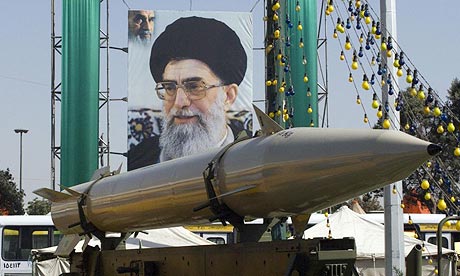
In a Financial Times piece critical of both President Obama and his neocon adversaries, Philip Stephens takes a sobering look at a potentially nuclear Iran. An excerpt:

“At West Point, Mr Obama insisted that the US remains the indispensable nation. This is true as far it goes – American military might is unmatched and there are not many serious conflicts one can imagine being settled without US engagement. But if Afghanistan, Iraq, Libya and Syria prove anything it is that it is also the insufficient superpower.

Republican critics will doubtless step up the charge that Mr Obama is not tough enough against adversaries. Yet those same critics have elevated tax cuts above defence spending in the sequestration process to cut the budget deficit. Bluff posturing comes cheap, but America is not in the mood to fight more wars.

The US approach to Iran’s nuclear programme has measured up to the facts of the new order. The uncomfortable truth, denied by Washington hawks, is that if the regime in Tehran is determined to acquire a nuclear weapon there is not much anyone else, including the indispensable nation, can do about it. The international community can raise the cost of such a programme with sanctions. It could delay it by starting another Middle East war. But if Iran wants the bomb it can get it.

Things may yet come to war, but the only real hope of a nuclear-free Iran lies in persuading its leaders they have more to gain without the bomb.”


Tags: ,

Those dubious domestic missions, the Wars on Drugs and Crime and Terrorism, have preyed on American fears, allowing for the militarization and emboldening of police forces, which, when unloosed in a racially divided society, leads to a body count and heartbreak, as we’ve seen in Ferguson. At such times, when it seems a continued open season on black males, when prosecutors and police officers try to keep their stories straight but end up sounding crooked, when a dunderhead like Don Lemon is allowed to glibly speak his dangerous ignorance into the camera, it’s incumbent upon good people to address the obvious. From “Officer Darren Wilson’s Story Is Unbelievable. Literally.” by Ezra Klein does at Vox:

“There are inconsistencies in Wilson’s story. He estimates that Brown ran 20-30 feet away from the car and then charged another 10 feet back towards Wilson. But we know Brown died 150 feet away from the car.

There are also consistencies. St Louis prosecutor Robert McCulloch said that Brown’s DNA was found inside Wilson’s car, suggesting there was a physical altercation inside the vehicle. We know shots were fired from inside the car. We know Brown’s bullet wounds show he was only hit from the front, never from the back.

But the larger question is, in a sense, simpler: Why?

Why did Michael Brown, an 18-year-old kid headed to college, refuse to move from the middle of the street to the sidewalk? Why would he curse out a police officer? Why would he attack a police officer? Why would he dare a police officer to shoot him? Why would he charge a police officer holding a gun? Why would he put his hand in his waistband while charging, even though he was unarmed?

None of this fits with what we know of Michael Brown. Brown wasn’t a hardened felon. He didn’t have a death wish. And while he might have been stoned, this isn’t how stoned people act. The toxicology report did not indicate he was on PCP or something that would’ve led to suicidal aggression.

Which doesn’t mean Wilson is a liar. Unbelievable things happen every day. The fact that his story raises more questions than it answers doesn’t mean it isn’t true.

But the point of a trial would have been to try to answer these questions. We would have either found out if everything we thought we knew about Brown was wrong, or if Wilson’s story was flawed in important ways. But now we’re not going to get that chance. We’re just left with Wilson’s unbelievable story.”

Tags: , , ,

Putin the profligate, who’s led Russia in frittering away two vital decades, when the country could have remade and modernized itself with Soviet Era oil money before the supply dwindled and prices collapsed, is well chronicled. Putin the plunderer, the plutocrat, the Kremlin kleptocrat, has also been profiled, but not nearly as often, as retribution for bringing such trespasses to light is heavy. From Rajan Menon’s New York Times book review of Putin’s Kleptocracy by Karen Dawisha: 

“He may cop to being an authoritarian (he boasts of building a strong state), a nationalist (he wears a cross, preaches patriotism and praises the Orthodox Church) and an empire builder (he brags about retaking Crimea and is unapologetic about seeking a sphere of influence). But the accusation that he’s a common crook, or even an uncommon one, is different — and a charge he doesn’t treat lightly. That’s why Russian reporters avoid it, especially as political controls have tightened, and why Dawisha’s original publisher, Cambridge University Press, declined to print the book on the advice of its lawyers worried about the possibility of legal action.

The true tragedy is that corruption, state-sponsored, energy-driven and totaling hundreds of billions annually, has mortgaged Russia’s future. Freedom has withered. Money for the investments urgently needed to make Russia innovative and prosperous has been diverted to enrich a few.

Alas, that’s what kleptocracies do.”

Tags: , ,

Foxconn is investing massively in one million robots, hoping to remove from its factories much of the pesky human element, that thing which has caused it so much consternation, and other corporations which have relied on cheap Asian labor are following suit. What are the ramifications for the individual laborer and the global economy? From Sam Becker at Business Cheat Sheet:

“You can’t really blame companies like Nike or Foxconn for what they’re doing — after all, they’re businesses, and their job is to turn a profit for shareholders and the company’s owners. That’s why they exist. They do not exist to supply jobs. However, the jobs that big companies like these do add to the economy are immensely important to the integrity of society as a whole.

So what happens when they start to disappear? Obviously, these disappearing positions will have a giant economic effect on developing nations, particularly countries that have been used for cheap labor over the past few decades. Many of the world’s struggling nations that depend on large influxes of capital investment and jobs from American and European companies are going to face some tough situations as automation continues to spread, as they have built their economic backbone as popular choices for companies looking to outsource.

It looks like the other shoe is about to drop, and they will now experience the same situation many Americans were faced with a decade or two before them. The question is, what will the ultimate fallout from that be? We’re talking about the possibility of tens of millions, if not hundreds of millions of workers losing their jobs over the next two decades, if things continue to pick up.

While we have always heard of a future in which robots would be handling most of the labor, it’s hard to think that most people pictured it in the way that things seem to be heading. Sure, automated work forces will be handling many of the world’s tasks in a relatively short amount of time, ushering in a new era of prosperity and leisure for the masses. The problem is that that prosperity hasn’t been shared, and many of the world’s poor and middle classes will end up scrambling to make ends meet as a result.

It’s unclear what the endgame of this dramatic shift from human labor to automation will be, but it’s clear that we are in the early stages of it. What policymakers and economists will need to do is to figure out how the vast majority of the planet’s masses will care for themselves if there is suddenly a huge shortage of work and opportunity.

Tags:

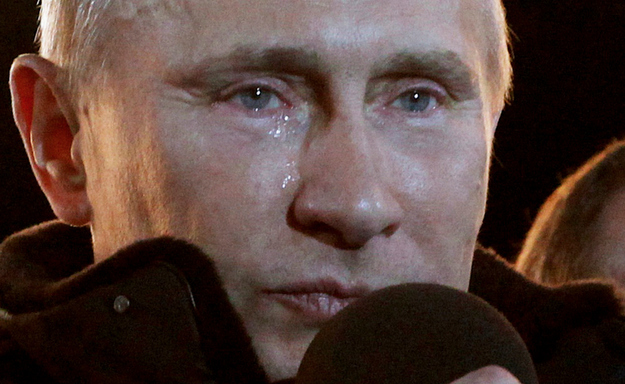
Vladimir Putin is a twentieth-century figure trapped in the wrong age, a man out of time, seemingly making shit up as he goes along, and now he’s really stepped in it, though because of his absolute rule there have been thus far no consequences for him, just for the country. From the Economist:

“MALINA, a trendy restaurant in a city south of Moscow, was empty on a recent Thursday evening. ‘A crisis,” the manager explained nervously. Some meat and fish dishes were missing. ‘Sanctions,’ he added with a sigh. The signs of a country in the economic doldrums are visible in Moscow, too. Tour operators are going out of business; shops and small businesses are up for sale; LED displays outside bureaux de change send spirits sinking.

Russia’s economy is teetering on the verge of recession. The central bank says it expects the next two years to bring no growth. Inflation is on the rise. The rouble has lost 30% of its value since the start of the year, and with it the faith of the country’s businessmen. Banks have been cut off from Western capital markets, and the price of oil—Russia’s most important export commodity—has fallen hard. Consumption, the main driver of growth in the previous decade, is slumping. Money and people are leaving the country.

This is not the mid-1980s, when a collapse in the oil price paved the way for perestroika and the eventual collapse of the Soviet Union. Nor is it 1998, when the country defaulted on its debts. While the overall mood is clearly depressed, it is a long way from panic. Russia’s total foreign debt is just 35% of GDP; it has a private sector which can be surprisingly agile and adaptable and is contributing some growth by substituting things made at home for imported goods; most importantly, it has a floating exchange rate that mitigates some of the oil-price shock.

But the oil-backed consumption-led economy which has provided nearly 15 years of growth (it took a stumble in 2008-09, during the global financial crisis) has hit the buffers.”

Tags:

« Older entries § Newer entries »