
Excerpts

You are currently browsing the archive for the Excerpts category.

Wanna hang? (image courtesy of Chris 73.)

I found this old print article in the February 3, 1853 issue of the Brooklyn Daily Eagle. Like all great stories, it contains a hanging, witchcraft and a pair of pants. The two men who were hanged, William Saul and John Howlett, were river pirates convicted of murdering a watchmen on the deck of a vessel. An excerpt from “Witchcraft–High Price of Old Pants”:

“We had supposed that witches, witchcraft and all things appertaining thereto, except spiritual rappings, were quietly resting in their graves for the last century. But it appears we are mistaken. A curious proof that such superstitions are not altogether exploded, occurred in relation to Saul and Howlett, who were executed a few days back.

A Dutchman who was to be present at the execution, was applied to by another Dutchman to procure him a small piece from the clothes in which the malefactors were to be hanged, and for which he promised to pay a liberal price. The man to whom the application was made, asked the applicant what inducement he had to procure pieces of the malefactors’ dress. ‘I want it,’ replied he, ‘to witch people.’

A day or two after the execution, the man who wanted to ‘witch people’ applied to his friend for what he had bespoken from him, but the latter had forgotten to procure it and instead of delivering the real article according to contract, he cut two strips from an old pair of pants and received $10 for them, and no doubt they were just as good as the genuine article.”

Tags: ,

When Peter Lorre is born, I'm going to look like him.

The first person to ever use the term “magazine” for a periodical was Londoner Edward Cave, who used the word in 1731 for The Gentleman’s Magazine. A wide-ranging periodical that focused some of its space on reports from the American colonies, it was also the first place of employment for Samuel Johnson. Cave edited under the name Sylvanus Urban and put together a journal that had reprinted articles from other publications and original pieces. He died in 1754, but the magazine continued publishing until 1907.

I’m sure Cave was happy in that great beyond when an 1825 issue, ran an inscrutable piece entitled “Gigantic Organic Remains.” An excerpt:

“We lately mentioned that the bones of a nondescript animal, of an immense size, and larger than any bones that have hitherto been noticed by any naturalists, had been discovered about twenty miles from New Orleans, in the alluvial ground formed by the Mississippi River and the lakes, and but a short distance from the sea. It now appears that these giant remains had been disinterred by Mr. W. Schofield, of New Orleans, who spent about a year in this arduous undertaking. A fragment of a cranium is said to measure twenty-two feet in length; in its broadest part four feet high, and perhaps nine inches thick, and it is said to weigh 1,200lbs. The largest extremity of this bone is said to answer to the human scapula; it tapers off to a point and retains a flatness to the termination. From these facts, it is conferred that the bone constituted a fin or a fender. One of its edges, from alternate exposures to the tide and atmosphere has become spongy or porous, but, generally, it is in a perfect state of ossification.”

Tags: , ,

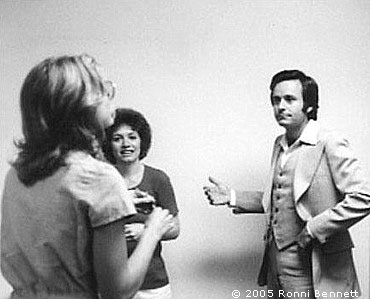
Siegel once asked Marlo Thomas if people thought she was "bitchy." She was understandably not very amused. (Image by Ronni Bennett.)

Back before American media was engulfed in its faux-reality mania, in which emotionally damaged recruits are encouraged to act out every last pathology to pump up the ratings, TV host Stanley Siegel and his questionable taste and utter neuroses were considered controversial. During the 1970s, his raucous live morning show on the local ABC affiliate made his name as famous in New York as any politician, athlete or Broadway star.

Siegel invited his therapist to psychoanalyze him each week on the air, he allowed a wasted Truman Capote to sit down as a guest when he was clearly in no condition to do so and he angered a good number of politicos and entertainers with his brash questions. He was the anti-Brokaw, and it worked wonderfully well for a while.

In the 1977 New York magazine article,Give Us a Kiss, Stanley,” which was written by the journalist and playwright Jonathan Reynolds, Siegel was analyzed a little bit more. These days the talking head appears to be attempting to get some sort of travel show off the ground, but Reynolds’ piece captures Siegel at the height of his entertaining narcissism. An excerpt:

“Every day, Siegel wallows guiltlessly in his own persona, exulting in the dust, high jinx and cobwebs he reveals. He is funny, frightened, confused, weepy, sexual, evangelistic, and overbearing right in front of everybody’s eyes. In terms of emotional exhibitionism, Stanley Siegel makes Jack Paar look like Thomas Pynchon.

In the nearly two years he has been on WABC-TV at 9am, he has sextupled the ratings of his dreary predecessors, increased WABC’s rate card from $35 to $100 for every 30-second spot sold, knocked the venerable Not for Women Only and mega-venerable Concentration out of their time slots, and gained a host of admirers from Robert Evans to Eleanor Holmes Norton.

People tune in to the Stanley Siegel Show to see how Stanley feels–for if there is one predictable element in the program, it is that it will always be clear just how Stanley feels.”

Tags: , ,

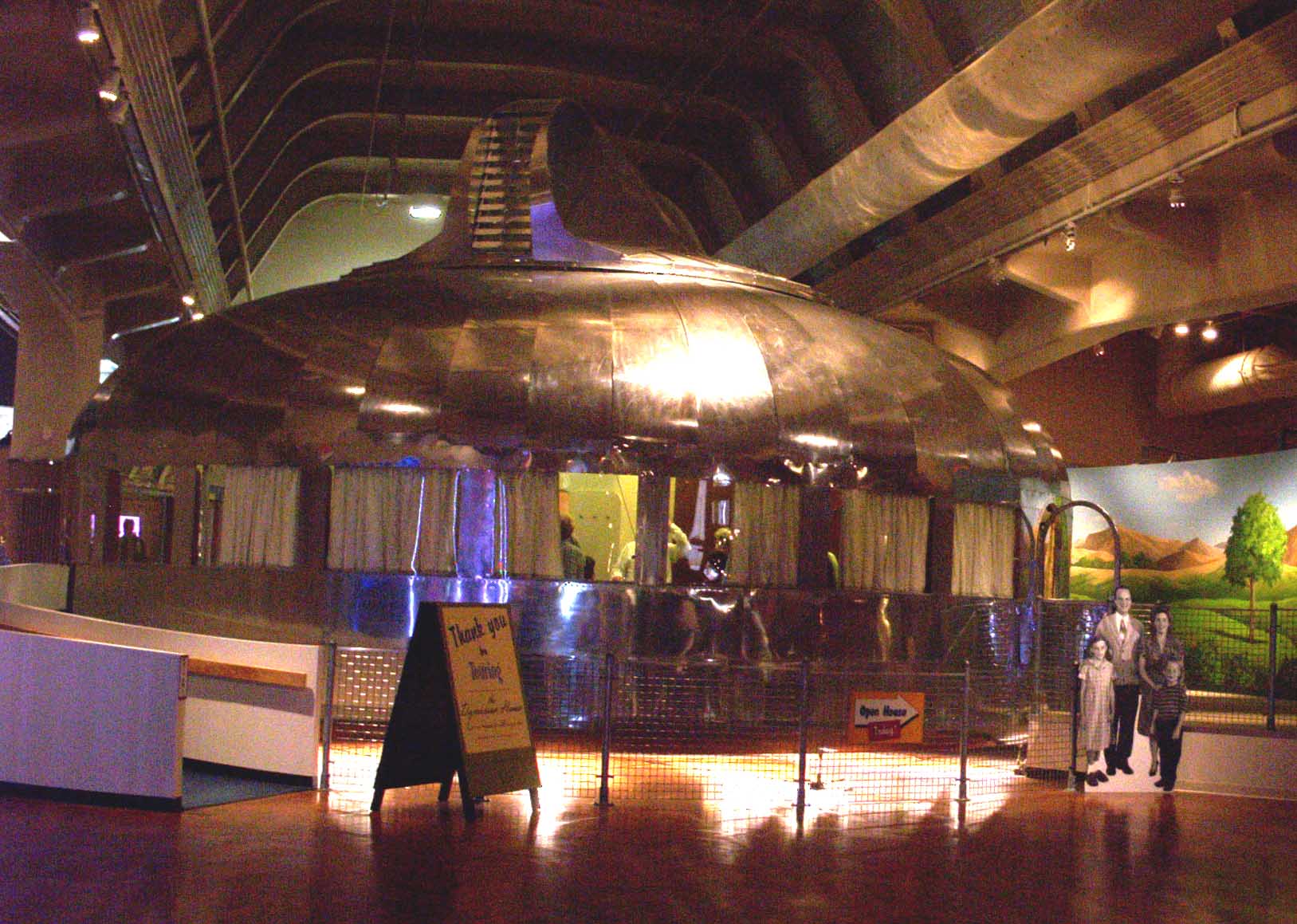
A Dymaxion House on display at the Henry Ford Museum in Michigan. (Image courtesy of rmhermen.)

Even though architect Buckminster Fuller has long been revered as a visionary theorist, not many of his designs, including several iterations of his pre-fab, space-age autonomous building, the Dymaxion House, ever caught on. In fact, no Dymaxion was ever built according to Fuller’s specifications and inhabited, even though it was energy efficient, had a waterless bathroom and was designed to withstand any climate.

But his futuristic house designs were taken seriously in a 1946 Life articleFuller House,” which was subtitled “Newest answer to housing shortage is round, shiny, hangs on a mast and is made in an airplane factory.” An excerpt from the article:

“Unveiled last week was the most startling solution yet offered for the U.S. housing shortage. It was a round aluminum structure, 36 feet in diameter. At its center was a mast, anchored in the ground. From it radiated cables on which walls and floors were hung. Around the outside ran a plastic window. On the roof ran a streamlined, revolving ventilator. The inside had four wedge-shaped rooms, two baths, range, dishwasher, refrigerator, garbage-disposal unit, three revolving closets and three electric bureaus.

Some called it a house, others a machine. Designed by Buckminster Fuller, it was made by Beech Aircraft Corporation, Wichita, Kansas, which expects to be producing it in volume by next January. The house is a descendant of Fuller’s 1927 Dymaxion House, but, unlike its ancestor, is eminently practical. Included in the hoped for selling price of $6500 are all appliances plus shipping and erection charges anywhere in the U.S.”

Tags:

I laugh because I just thought of a new and ingenious means of psychological torture.

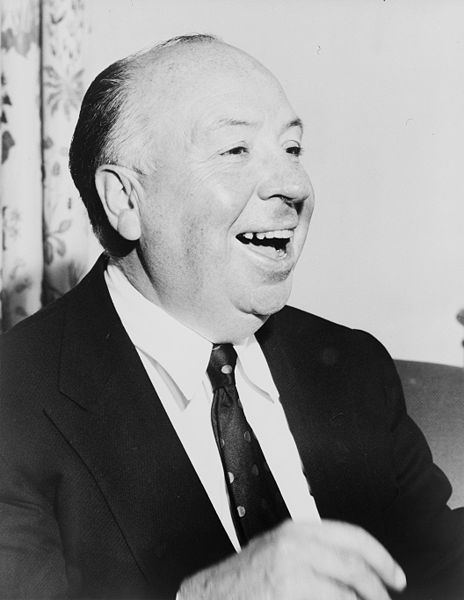
For years, I lazily accepted the notion that director Alfred Hitchcock was underrated by the media as merely a purveyor of spine-tingling melodrama, someone thought of as an entertainer of the masses but not an artist. I assumed that the campaigning of his greatest admirer, Francois Truffaut, helped revise the opinion of Hitch as someone worthy of high praise.

There may be some truth to that, but people definitely knew how great Hitchcock was long before the ’60s. Case in point is a 1939 article in Life magazine, “Alfred Hichcock: England’s Biggest and Best Director Goes to Hollywood.” The piece looks at the esteemed English director’s move to California to begin a brilliant second act to his career.

The article was written by Geoffrey T. Hellman, who was best known as a legendary New Yorker writer but also simultaneously served as associate editor at Life for a couple of years in the ’30s. Hellman’s papers are housed at NYU. An excerpt from the colorful piece, which looks at how Hitchcock’s devious need to cause discomfort carried over from the big screen into his personal life:

“In private life, Hitchcock’s astringent outlook enables him to take an enormous, if deadpan, satisfaction in the distress of his friends and acquaintances, especially in situations induced by himself. Although his flair for practical jokes has suffered a setback in Hollywood, where the novelty of his surroundings and the constant sun seem to have cramped his style, he is beginning to feel more at home, and judging from his past record it is only a question of time until he gives Louie B. Mayer the hot foot. He once offered an English property man a pound for the privilege of handcuffing him overnight, and just before snapping on the manacles gave the victim a drink into which he had slipped a strong laxative. Hitchcock has a sense of values and gave the fellow a 100% bonus the following morning because of the unusual humor of the circumstances.”

Tags: , ,

No, I don't have gold in my ear. Please stop asking me that.

Before I reluctantly return Oriana Fallaci’s out-of-print 1976 book, Interview with History, to my shelves, I bring you one more excerpt. I’ve previously presented segments of her tête-à-têtes with Henry Kissinger and Indira Gandhi, and now we look at her meeting with Golda Meir, who was then Israel’s Prime Minister.

Even though Fallaci differed politically with Meir on crucial issues, the journalist acknowledged a sort of love for the politician, who physically resembled her mother. The interview actually took place twice because the first set of microcassettes were stolen from Fallaci’s Jerusalem hotel room. (Fallaci believed that Muammar al-Qaddafi was behind the thievery.) An excerpt from the women’s exchange on the topic of feminism:

“Oriana Fallaci: Shall we talk about the woman Ben-Gurion called ‘the ablest man in my cabinet?’

Golda Meir: That’s one of the legends that have grown up around me. It’s also a legend I’ve always found irritating, though men use it as a great compliment. Is it? I wouldn’t say so. Because what does it really mean? That it’s better to be a man than a woman, a principle on which I don’t agree at all. So here’s what I’d like to say to those who make me such a compliment. And what if Ben-Gurion had said, ‘The men in my cabinet are as able as a woman’? Men always feel so superior. I’ll never forget what happened at a congress of my party in New York in the 1930s. I made a speech and in the audience there was a writer friend of mine. An honest person, a man of great culture and refinement. When it was over he came up to me and exclaimed, ‘Congratulations! You’ve made a wonderful speech! And to think you’re only a woman!’ That’s just what he said in such a spontaneous, instinctive way. It’s a good thing I have a sense of humor….

Oriana Fallaci: The Women’s Liberation Movement will like that, Mrs. Meir.

Golda Meir: Do you mean those crazy women who burn their bras and go around all disheveled and hate men? They’re crazy. Crazy. But how can one accept such crazy women who think that it’s a misfortune to get pregnant and a disaster to bring children into the world? And when it’s the greatest privilege we women have over men.”

Tags: ,

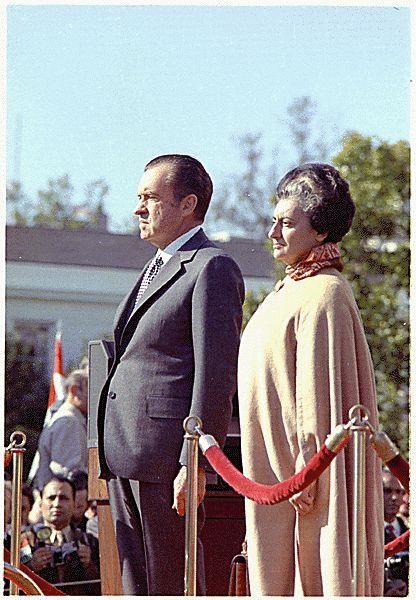
Nixon and Gandhi, together in 1971, despised one another. He referred to her behind the scenes as an “old witch.”


I brought you an excerpt of Oriana Fallaci’s spellbinding 1972 session with Henry Kissinger from the journalist’s great out-of-print book, Interview with History. I’m returning for passage of Fallaci’s 1972 Q&A with Indira Gandhi, one of the most complex and thorniest political leaders of that era.

By the time Fallaci had published her book in 1976, she had renounced her admiration for Gandhi, who had been India’s tough-as-nails Prime Minister and a feminist icon. In 1975, Gandhi, rather than resign as Prime Minister after being convicted of election fraud, declared the Indian version of martial law, had her political opponents imprisoned and repealed many of the citizens’ freedoms. She had, in effect, become a dictator.

Fallaci wrote a new introduction to the four-year-old interview that expressed bitter disappointment in the fallen idol. (“I didn’t hide my regret and shame at having portrayed her in the past as a woman to love and respect.”) Here’s a portentous excerpt from the interview that was conducted in New Delhi:

Oriana Fallaci:

Mrs. Gandhi, I have so many questions to ask you, both personal and political. The personal ones, however, I’ll leave for later–once I’ve understood why many people are afraid of you and call you cold, indeed icy, hard…

Indira Gandhi:

They say that because I’m sincere. Even too sincere. And because I don’t waste time with flowery small talk, as people do in India, where the first half hour is spent in compliments: ‘How are you, how are your children, how are your grandchildren and so forth.’ I refuse to indulge in small talk. And compliments, if at all, I save for after the job is done. But in India people can’t stomach this attitude of mine, and when I say, ‘Hurry up, let’s get to the point,’ they feel hurt. And think I’m cold, indeed, icy, hard. Then there’s another reason, one that goes with my frankness: I don’t put on an act. I don’t know how to put on an act; I always show myself for what I am, in whatever mood I’m in. If I’m happy, I look happy; if I’m angry, I show it. Without worrying about how others may react. When one has had a life as difficult as mine, one doesn’t worry about how others will react.•

Tags: , ,

Of course, I look like crap. Do you know how much opium I've taken?

The Manchester-born author and intellectual Thomas De Quincey is most famous for his 1821 drug tell-all, Confessions of an English Opium-Eater. Like all people with a drug addiction, his life was not a happy one. The odd and depressive De Quincey had begun using opium at age 19 while he was in college. He was persuaded to later write about his lifelong addiction and the resulting book was a great success. But the writer was bad with money and remained half a step out of the debtor’s prison for a good part of his adult life. He died in 1859. An excerpt from the book from the section “The Pains of Opium”:

“It will occur to you often to ask, why did I not release myself from the horrors of opium by leaving it off or diminishing it? To this I must answer briefly: it might be supposed that I yielded to the fascinations of opium too easily; it cannot be supposed that any man can be charmed by its terrors. The reader may be sure, therefore, that I made attempts innumerable to reduce the quantity. I add, that those who witnessed the agonies of those attempts, and not myself, were the first to beg me to desist. But could not have I reduced it a drop a day, or, by adding water, have bisected or trisected a drop? A thousand drops bisected would thus have taken nearly six years to reduce, and that way would certainly not have answered. But this is a common mistake of those who know nothing of opium experimentally; I appeal to those who do, whether it is not always found that down to a certain point it can be reduced with ease and even pleasure, but that after that point further reduction causes intense suffering.”

Tags:

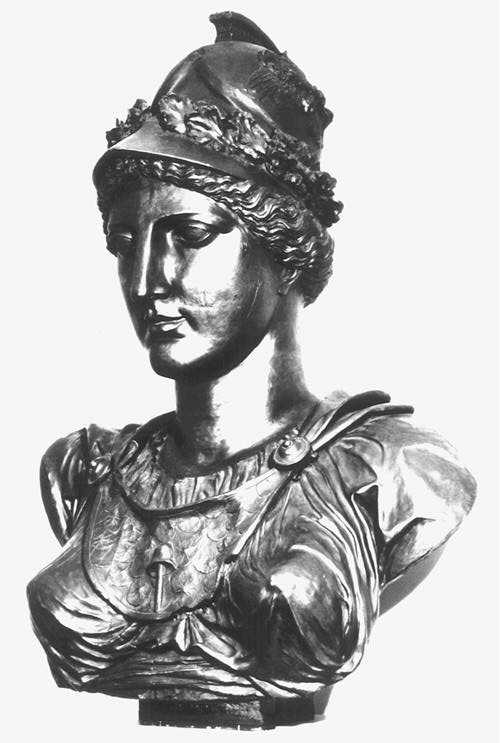
Minerva: Totally into wisdom and check out that great rack. Not too shabby.

Came across this strange article in a 1953 issue of Life magazine. “Classic Boom: Minerva’s Temple in Guatemala is Blown Up for Baseball Fans” chronicles a Central American temple being exploded to extend the stands of a baseball stadium. Minerva was the Roman equivalent of the Greek goddess Athena, so she was quite the A-list deity. Baseball is still played in Guatemala City today at the Enrique “Trapo” Torrebiarte Stadium–same site?–but I don’t believe there are any current MLB players from Guatemala. The opening of the article:

“Fierce Don Manuel Estrada Cabrera, dictator of Guatemala from 1898 to 1920, was a man of many quirks. To get elected president he used to draft all males into the army on election day, decorate them with campaign buttons and march them into the polls to vote for him. To encourage education he built temples to Minerva, Goddess of Learning, and called out the citizenry to hold fiestas around the shrines. In due time Don Manuel was forced out of office by an angry electorate which had come into possession of a few cannons. But his monuments remained. A baseball park grew up near the one in Guatemala City and as the game grew more popular more room was needed for grandstands. So one day last month Minerva’s temple came tumbling down, victim of ‘beisbol’ and large charges of dynamite.”

Tags: , ,

The late journalist Oriana Fallaci had a dubious final chapter to her life when in the wake of 9/11, she lived in fear a Muslim planet. But in her younger days, she was one of the greatest interrogators in all of journalism. It’s not likely in this self-conscious age that many of today’s bigwigs would suffer her substance and style, but it’s not like too many interviewers are even trying.

In 1972, as the war in Vietnam raged, Secretary of State Henry Kissinger sat down for an interview with Fallaci and regretted it almost immediately, ultimately dubbing it “the single most disastrous conversation I have ever had with any member of the press.” The piece was published in the New Republic and anthologized in Interview with History. Here’s an excerpt:

Oriana Fallaci:

And what do you have to say about the war in Vietnam, Dr. Kissinger? You’ve never been against the war in Vietnam, it seems to me.

Henry Kissinger:

How could I have been? Not even before holding the position I have today…No, I’ve never been against the war in Vietnam.

Oriana Fallaci:

But don’t you find that [Arthur] Schlesinger is right when he says that the war in Vietnam has succeeded only in proving that a million Americans with all their technology have been incapable of defeating poorly armed men dressed in black pajamas?

Henry Kissinger:

That’s another question. If it is a question about whether the war in Vietnam was necessary, a just war, rather than…Judgments of that kind depend on the position that one takes when the country is already involved in the war and the only thing left is to conceive a way to get out of it. After all, my role, our role, has been to reduce more and more the degree to which America is involved in the war, so as then to end the war. In the final analysis, history will say who did more: those who operated by criticizing and nothing else, or we who tried to reduce the war and then ended it. Yes, the verdict is up to history. When a country is involved in a war, it’s not enough to say it most be ended. It must be ended in accordance with some principle. And this is quite different from saying that it was right to enter the war.

Oriana Fallaci

But don’t you find, Dr. Kissinger, that it’s been a useless war?

Henry Kissinger:

On this I can agree.•


Fallaci was among Dick Cavett’s guests on January 22, 1973 when news broke that former President Lyndon Johnson had died.


Tags: ,

Barefoot Isadora performs during her 1915-1918 American tour in this Arnold Genthe photograph.

In his U.S.A. Trilogy, modernist master John Dos Passos incorporated all manner of experimentation and ephemera, including idiosyncratic biography. One of the towering figures of early twentieth-century America he wrote about was the great dancer Isadora Duncan. An excerpt from his writing about Duncan’s hand-to-mouth upbringing with her mother and siblings (all punctuation and spellings are Dos Passos’):

“she bore a daughter whom she named after herself Isadora

The break with Mr. Duncan and the discovery of his duplicity turned Mrs. Duncan into a bigoted feminist and an atheist, a passionate follower of Bob Ingersol’s lectures and writing, for God read Nature; for duty beauty, and only man is vile.

Mrs. Duncan had a hard struggle to raise her children in the love of beauty and hatred of corsets and conventions and manmade laws. She gave pianolessons, she did embroidery and knitted scarves and mittens.
The Duncans were always in debt.

The rent was always due.

Isadora’s earliest memories were of wheedling grocers and butchers and landlords and selling little things her mother had made from door-to-door.

helping handvalises out of back windows when they had to jump their bills at one shabbygenteel boardinghouse after another in the outskirts of Oakland and San Francisco.

The little Duncans and their mother were a clan; it was the Duncans against a rude and sordid world. The Duncans weren’t Catholics anymore or Presbyterians or Quakers or Baptists; they were Atheists.”

Tags: , , ,

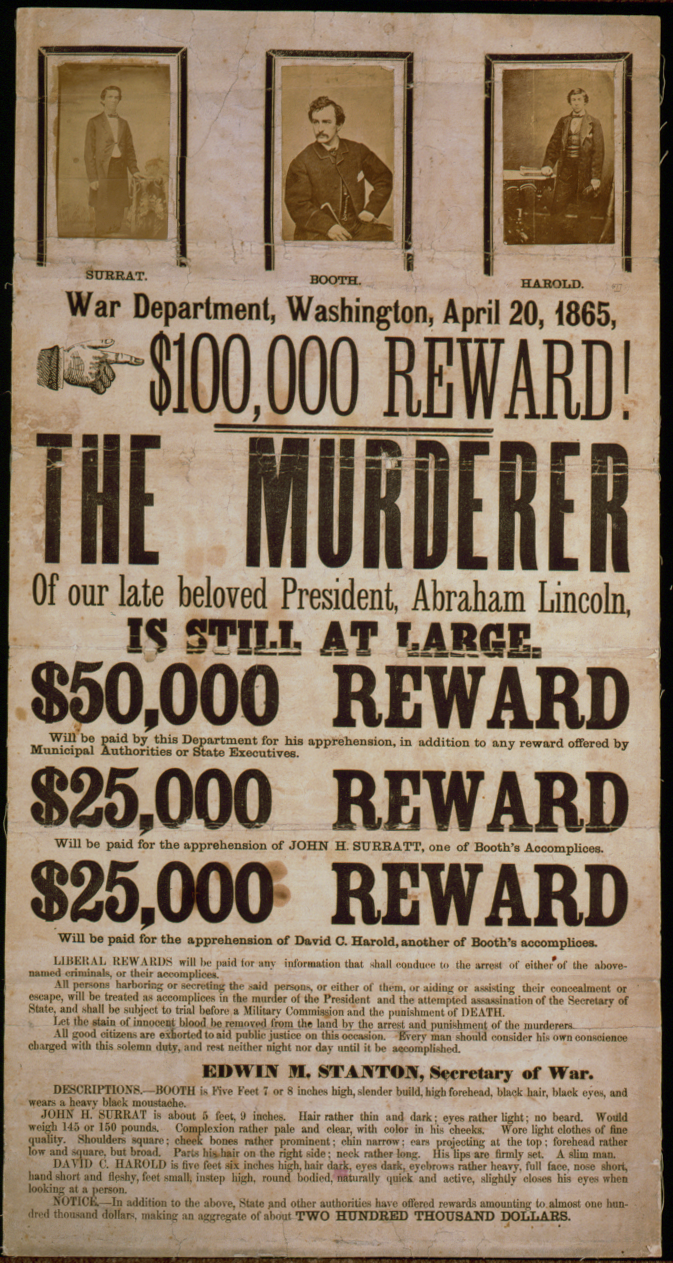
America has suffered numerous shocks to the system in its history, but the assassination of President Abraham Lincoln on April 12, 1865 is still probably as calamitous as any. I came across the “Wanted” poster for Lincoln’s assassin John Wilkes Booth, which was circulated in wake of the shocking crime at Ford’s Theatre, when Booth and his accomplices were still at large. “Wanted For The Murder of our late beloved President, Abraham Lincoln,” the poster declares, offering large sums of money for information leading to capture. An excerpt from the more poetic potions of the poster

“Let the stain of innocent blood be removed from the land by the arrest and punishment of the murderers. All good citizens are exhorted to aid public justice on this occasion. Every man should consider his own conscience charged with this solemn duty, and rest neither night nor day until it is accomplished.”

Booth was fatally wounded two weeks later by U.S. soldiers on a Virginia farm.


Tags: , ,

The British airship R-100 docked in Quebec, Canada, in 1930.

Nine  years prior to the 1937 Hindenburg disaster, Popular Science ran a breathless article about the advent of commercial dirigibles, as England and Germany raced to be the first to launch a successful transatlantic flight with passengers. In 1928, the balloons were planned to hold roughly 100 ticket buyers and the price from New York to London was going to be $400. That transatlantic trip was scheduled to take 38 hours to complete. Pictured is the English airship R-100, which the article thought was the favorite in the transatlantic race. It had beds, baths with showers, saloons, an area on deck for dancing and refreshment tables. The only note of caution about this potentially dangerous new mode of transportation–quickly dismissed–comes late in the article. An excerpt:

“To be sure, this history must consider the disaster of the American-built and operated Navy dirigible Shenandoah, broken in two by a storm over Ohio in 1925 and destroyed with the loss of fourteen men. And the fate before that of the German-built, French-operated military dirigible Diamude, lost in the storm over the Mediterranean. And that of the Italian-built, American-operated Roma, military dirigible, which, forced down by rudder trouble, struck a high tension cord and burned when the hydrogen in its gas bags exploded. There have been costly errors in construction and operation of the first great ships. But the builders have profited by all these mistakes. Each disaster has taught a new lesson.”

The German airship, the L7-127, which is given less attention in this piece, won the race with its first commercial passenger transatlantic flight on October 11, 1928. In November 1931, after the disaster of fellow British airship R-101, the R-100 was discontinued. It was flattened and sold for scrap.

Tags:

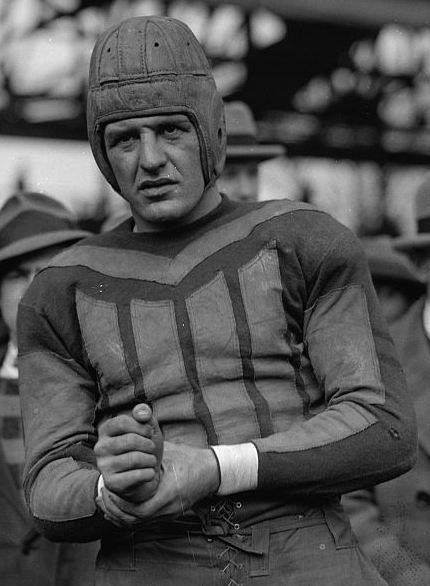
I question the wisdom of this new contraption called the "forward pass."

The Wonderlic Personnel Test is a 12-minute, 50-question exam that is supposed to measure a person’s ability to learn and solve problems. It has become most well known for its association with the NFL, as college football players looking to enter the league are administered the test. It’s not exactly a perfect determinant of a player’s ability, as Dan Marino famously scored very poorly and became one of the greatest QBs in NFL history. (It should be noted that the average score of an offensive tackle is equal to that of a journalist.)

This seems like a new-fangled type of athletic measurement that would never have flown during the sport’s earlier days, but that’s not true. I came across a 1931 Popular Science article that examines how the University of Illinois used a battery of physical and psychological tests to try to find a quarterback who would be as great as the legendary Red Grange. An excerpt from the beginning of “Illinois Seeks New Red Grange by Electric Tests”:

“At the University of Illinois, experts in a pioneer psychological laboratory are seeking a new ‘Red’ Grange by means of flashing colored lights, whirling electronically connected disks, and reels of super-speed films.

The successor to the ‘Galloping Ghost’ of Illinois football teams of a few seasons ago will be picked from gridiron candidates who run the gauntlet of strange electrical testing machines that rate their muscular coordination, nerve control and mental alertness. Even before the athletes don their cleated shoes and leather helmets for the first scrimmage, the coaches thus know the rating of each in the qualities that make for stellar performance in the heat of pigskin battles.

Electrified gameboards, covered with rows of tiny lights like those on Christmas trees, duplicate in running flashes various football players. The candidate records what he would do at each crisis in the play while judges note the time he takes to decide and the correctness of his decision.”

Tags:

These days, Joe Namath boldly predicts he will be first on line at the early-bird buffet.

As the New York Jets prepare for a shot at only the second Super Bowl appearance in their tortured history, I looked up the first-ever appearance of the name “Joe Namath” in Sports Illustrated. Joe Willie is, of course, the most famous Jet ever and is still one of the best-known sports figures in America. During his playing days, he was the most outspoken athlete this side of Muhammad Ali. He predicted the underdog Jets would win Super Bowl 3 and then quarterbacked them to victory. He parlayed the subsequent fame into everything from pantyhose commercials to sitcoms. Most of it was godawful, but he smiled his way through it the way only a legend can.

The first mention of Namath in SI occurred on September 23, 1963 when the Beaver Falls, Pennsylvania, QB was a sophomore for Coach Bear Bryant at Alabama. Even then he wasn’t exactly lacking in confidence. Here is an excerpt:

“Namath already is the only Yankee on the Alabama team. He came to Tuscaloosa from Beaver Falls, Pa., for two unshakable reasons: he ‘wanted to play football in the South’ and he wanted to play football for Bear Bryant. Known in high school as the ‘Hungarian Howitzer,’ he had offers of football scholarships from 52 colleges, and a Chicago Cubs baseball scout was talking in terms of a ‘$50,000 bonus.’ Once in the South, the talented Namath told Alabama reporters as a freshman that it was ‘nice’ that Bryant had varsity quarterback Jack Hurlbut coming back because ‘I might get hurt.’

The following spring, true to his word, he won the starting job, and one day as he huddled with his cast of upperclassmen he piped: ‘Fellows, this is an option play. But I think old Joe’s going to run with it. Let’s see some blocking. Coach Bryant don’t want to get me hurt.'”

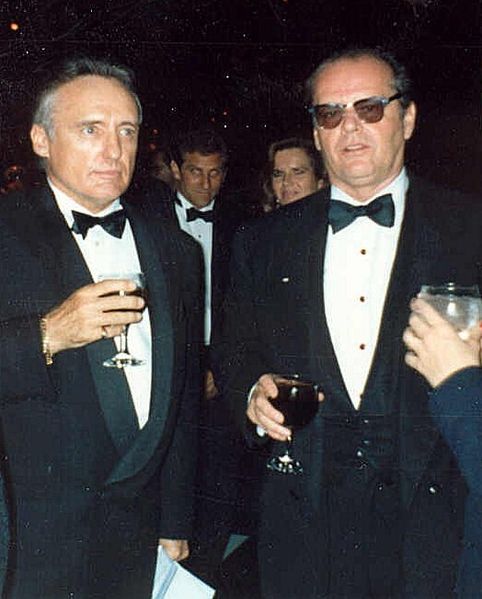
Hopper and "Easy Rider" cohort Jack Nicholson at the 1990 Academy Awards.

Filing for divorce from what’s described as your deathbed might seem like an odd thing to do, but it likely doesn’t even rank very high on the list of the most unusual things Dennis Hopper has done in his life. In 1970, the actor-director-artist did something that’s present somewhere on that list: He decided to use the good will from his 1969 surprise hit Easy Rider (which cost $350,000 and raked in tens of millions) and head to the backlands of Peru on Universal’s dime to make an almost indescribable film (ultimately titled The Last Movie), which would become one of the most tortured productions in Hollywood studio history. It had only a brief release and nearly ended Hopper’s career. Well, that and the drug abuse. The artist never fully recovered from the debacle of The Last Movie until his brilliantly perverse turn in David Lynch’s Blue Velvet in 1986.

Luckily, Life magazine dispatched the excellent reporter Brad Darrach to profile Hopper during the volatile production. The resulting article is called The Easy Rider Runs Wild in the Andes. An excerpt from the beginning of the article:

“Peru has painfully learned to live with earthquakes, avalanches, tidal waves, jaguars and poisonous snakes. But Dennis Hopper was something else. When the director of Easy Rider arrived in Lima several months ago, a reporter from La Prensa asked his opinion of marijuana (illegal in Peru) and ‘homosexualism.’ Taking a long reflective pull on an odd-looking cigarette, Dennis said he thought everybody should ‘do his thing’ and allowed that he himself had lived with a lesbian and found it ‘groovy.’ No remotely comparable statement had ever appeared in a Peruvian newspaper. The clergy screamed, the ruling junta’s colonels howled. Within 24 hours the government had denounced the article and issued a decree repealing freedom of the press.

Dennis Hopper was undisturbed. Furor trails him like a pet anaconda. At 34, he is known as a sullen renegade who talks revolution, settles arguments with karate, goes to bed in groups and has taken trips on everything you can swallow or shoot.”

Tags: ,

Port-au-Prince before the devastating earthquake.

The terrible devastation of the recent earthquake in Haiti has that island nation on all our minds. I found a 65-year-old article called “Haitian Painting” from Life magazine on Google Books. It tells the story of American DeWitt Peters encouraging an art scene to grow in Port-au-Prince. The piece has a strong whiff of condescension (art existed in Haiti long before the 1940s), but Peters sounds like he was a good soul. An excerpt:

“Haiti’s artistic boom started in 1943 when an enthusiastic American artist named DeWitt Peters took a U.S. government-supported job in Port-au-Prince as a teacher of English. Impressed by the talent with which Haitian Negroes decorated the walls of their palm-thatched huts and cafes, Peters wangled the use of an old residence in Port-au-Prince, christened it Centre d’Art and, under the sponsorship of the Haitian government and the U.S. State Department, started to hold public exhibitions of native art. The artists were almost all untrained and, at first, a little bit shy. Peters tactfully lured them into the Centre, bought their paintings for a few dollars, gave them paint and brushes and very little advice. By the time he was through, Haiti was the proud possessor of a school of native primitive painting and the paintings were bringing in as much as $350 each.”

Tags:

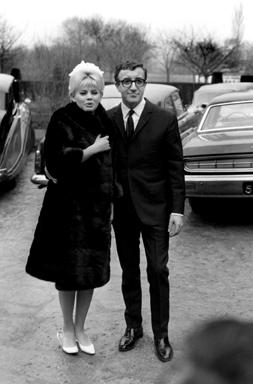
Sellers, with wife Britt Ekland, in 1964, the year of the article.

It might seem odd to find the late, great protean actor Peter Sellers in the pages of a science journal, but he was a perfect subject for the Popular Science piece, Wiring People for Life,” in 1964 because of his heart problems. The actor, known to have serious drug issues, had a series of heart attacks the previous year at age 38. The Popular Science article focused on Sellers being treated with a then-experimental external pacemaker for his severe coronary problems. The piece is subtitled: “Today, miracle electronic devices keep thousands of damaged bodies going. Tomorrow, they may help the paralyzed to walk.”

Pacemakers have never allowed the paralyzed to walk, but technology advanced and Sellers eventually received an internal pacemaker that allowed him two more decades of life. An excerpt:

“Last April film funnyman Peter Sellers lay critically ill in Los Angeles’ Cedar of Lebanon Hospital, his heart weakened and wobbly after a crushing coronary attack. Doctors held no hope for his recovery, but they began hooking up a new medical machine–an external heart ‘pacemaker.’

Fastening two leads on Sellers’ chest with small suction cups, a cardiologist started electrical impulses flowing to the star’s fluttery chest. These helped guide and steady its beat–but the 38-year-old British actor’s condition worsened. Still, the doctors continued to use the pacemaker. Then, slowly, Sellers began to recover.

His heart became steadier and stronger…the pacemaker was used less often…finally not at all. But the leads never left Sellers’ chest for three more days. Then he was taken off the critical list and the machine was disconnected. The pacemaker had once more worked a near-miracle.”

Tags: ,

A screen shot from "Rhapsody in Blue" (1945).

Long before Oprah ruled the airwaves, the jazz and classical pianist and singer Hazel Scott was the first woman of color to have her own TV show, which aired in 1950 on the DuMont network. Scott’s show was quickly cancelled, likely because of her outspoken opposition to McCarthyism and segregation. The entertainer was married to Congressman Adam Clayton Powell, Jr., but she was her own strong-willed person. In 1960, she wrote an article for Ebony magazine, explaining why she had spent the past three years living in Paris, during which time she was seriously ill and rumored to be estranged from her husband. An excerpt:

“I learned a lot in Paris about people and about myself. One does not look into the face of death, as I have, and come away worrying about pettiness and cattiness and gossip and conforming. It seems every time I am near death, someone or something is asking me over and over: How stupid can you get? How many changes will you need before you find out what’s important? This last time, when I spent a month or so in bed, I got the message. I am not likely to ever forget it. Love is important. Love. Some people go their whole lives without learning that very simple lesson. My three years out of America were three years of much needed rest not from work but from racial tension.”

Scott and Powell eventually divorced. She passed away from pancreatic cancer in New York on October 2, 1981.

Tags: , , ,

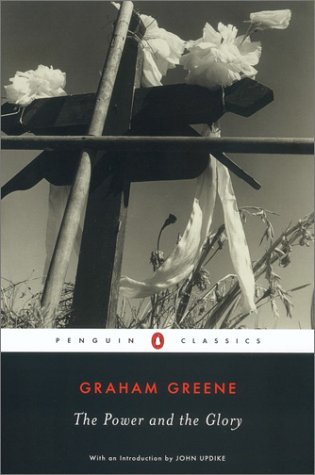
The Power and the Glory made Time's 100 Greatest Novels list.

The Paris Review site has an interesting 1955 interview with Graham Greene (download the full version). This Q&A reveals that while the author had the rare gift to write critically acclaimed work that was also widely popular, he really wanted to try his hand at other things. An excerpt:

Interviewer: Did you always want to be a writer?

Greene: No, I wanted to be a businessman and all sorts of other things; I wanted to prove to myself that I could do something else.

Interviewer: Then the thing that you could always do was write?

Greene: Yes, I suppose it was.

Interviewer: What happened to your business career?

Greene: Initially it lasted for a fortnight. They were a firm, I remember, of tobacco merchants. I was to go up to Leeds to learn the business and then go abroad. I couldn’t stand my companion. He was an insufferable bore. We would play double noughts and crosses and he always won. What finally got me was when he said, “We’ll be able to play this on the way out, won’t we?” I resigned immediately.

Tags:

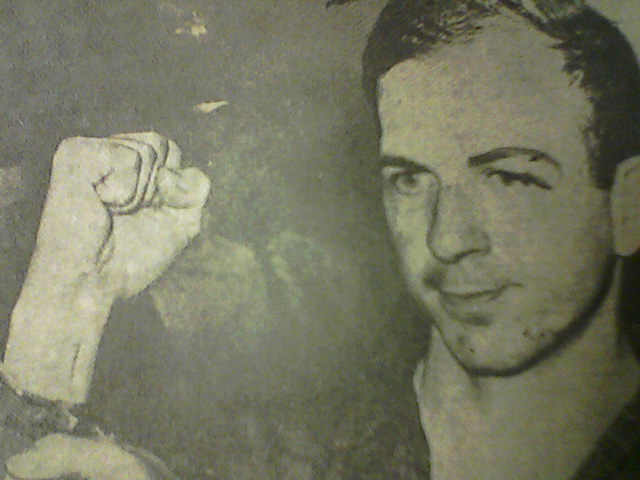
Lee Harvey Oswald shackled and clenched after his arrest in Dallas.

Briefly got my hands on a yellowing copy of the Long Island Press from November 22, 1963, the day after President John F. Kennedy was assassinated. The Press (which cost 5 cents) bore the headline: “Marxist Held As JFK Assassin; Johnson Meets With Rusk, Ike.”

The opening paragraph of the UPI story read: “Lee Harvey Oswald, an avowed Marxist and a Fidel Castro sympathizer, was charged today with the assassination of President Kennedy. Manacled, his face cut and bruised, his manner sullen, the 24-year-old political misfit and Marine reject was booked on a murder charge and jailed without bond. ‘This is ridiculous,’ Oswald said.”

The story unsurprisingly dominated nearly every section of the paper, from local (“Long Islanders React: He Was My Friend”) to sports (“AFL Erases Sunday Slate”). A few pre-packaged elements of the paper were untouched by the tragic events of the day. There was  an ad for the Jack Lemmon romantic comedy Under the Yum-Yum Tree, playing at the Prudential Drive-In. In the classifieds, you could rent  a 2 1/2 to 4 bedroom apartment for $109 in Jamaica, Queens; and a 2-story split colonial on Long Island cost $13,490. The Help Wanted ads were still openly sexist, with “Help Wanted–Male” clearly marked at the top of most of the advertisements.

The Long Island Press published for 156 years, going out of business in 1977.

Tags: , , ,

Not Rosie O'Donnell.

The New York Times Sunday Magazine published its wonderful annual “The Lives They Lived” issue last weekend and Nicholas Davidoff wrote a perfect send-off to the late, briefly great Detroit Tigers pitcher Mark “The Bird” Fidrych. It’s hard to explain the appeal the gangly, eccentric Fidrych held for children of that era. He was athlete, Muppet and rock star all at once. He was the awkward kid who grew to greatness without losing his awkwardness. Because of injuries, his career was sadly brief; because of an accident, his life tragically so. From the article:

“We had sensed how well he understood childhood. I was not the only self-conscious adolescent who on a sad day decided to tell a baseball about it. Seeing an adult acting like a boy also made the promise of growing up seem attractive. That a man could behave strangely and be applauded led you to think that eccentricity might be a virtue.

Any great athlete’s career represents a life span in miniature, an early lesson in mortality. Fidrych’s allotted days were as evanescent as his baseball career. Last spring, at 54, while he was repairing his dump truck, his shirt got caught in the drive shaft and he suffocated. There is something particularly brutal about the pitcher who publicly played with dirt being killed by the vehicle he used to carry it, as there is about a man who died young twice.”

Read the full piece.

Tags: ,

I got my designer jeans on, ladies. Let's go boogie at Studio 54.

During a grungier era in New York, Rolling Stone published an issue dedicated to the city. The October 6, 1977 edition bore a cover with a Warhol silkscreen treatment of pioneering female politician Bella Abzug. (It was Abzug who first said “You have to be a little crazy to live in New York.”) Writers fixated on Abzug’s hats the way they do with Hilary’s pantsuits. With female politicians, it always seems to be about the clothes.

There’s an interesting article titled “Elliot Murphy’s New York,” in which the singer-songwriter, novelist and journalist lists some of his favorite places of the moment. Murphy was raised in the city by the family that owned Aquashow. a water ballet arena that was located on the former World’s Fair grounds. During Murphy’s childhood, big-band concerts by Duke Ellington, Count Basie and others took place there.

One of Murphy’s favorite places of the moment was Fiorucci, a designer clothes outlet right near Bloomingdale’s that sold skintight jeans suitable for Studio 54 to Madonna, Cher, Marc Jacobs, etc. (It closed in 1984.) Murphy writes: “I have seen 50-year-old women walk into Fiorucci and ask one of the dancing salesmen (disco music is omnipresent) what is the latest thing. I have seen these same women walk out in gold láme hot pants. When you buy jeans at Fiorucci they fit them as tight as they can. I think this is a form of Italian birth control. Fiorucci clothing is usually very well-made though with the way fashion changes these days, by the time it makes it through the third wash it’s out of style anyway.”

Tags: , , , , , , ,

Like Detroit (sadly,) but more ancient.

Pompeii: Like Detroit, but ancient.

Archaeologists believe they may have discovered the lost city of Atlantis, so it seems appropriate to excerpt Robert Silverberg’s out-of-print 1962 book, Lost Cities and Vanished Civilizations. (Pictured is a 1974 paperback version that cost 95 cents at the time.) Silverberg has enjoyed great success as a science-fiction writer, and this quote about Pompeii sounds very sci-fi but is very real:

“Pompeii was a busy city and a happy one. It died suddenly in a terrible rain of fire and ashes. The tragedy struck on the 24th of August, A.D. 79. Mount Vesuvius, which had slumbered quietly for centuries, exploded with savage violence. Death struck on a hot summer afternoon. Tons of hot ashes fell on Pompeii, smothering it, hiding it from sight. For three years the sun did not break through the cloud of volcanic ash that filled the sky. And when the eruption ended, Pompeii was buried deep. A thriving city had perished in a single day. Centuries passed…Pompeii was forgotten. Then, 1,500 years later, it was discovered again.”

Tags: , ,

Carson had his own clothing line, which was sold by Sears in 1984-1985.

Carson had his own clothing line, which was sold by Sears in 1984-1985.

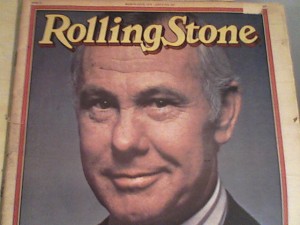
Rolling Stone still had a paper cover in 1979  and resembled the average alt-weekly in its materials and design. Janet Maslin gave a favorable review to Elvis Costello’s new album, Armed Forces. And Graham Nash was “making a concerted effort to stop nuclear power.” (Thanks for handling that one, Graham.) Johnny Carson had another 13 years to go in his reign as the “King of Late Night.” He touched on one of the reasons for his enduring popularity:

“I like to work with elderly people and children. I don’t know why I respect older people. I like working with kids. Maybe it’s the vulnerability of them. There’s a charm about older people that sometimes is childlike, and I enjoy them, first of all, because they can say anything they want to, which is just great. Age gives you a leg up on what you can say because you don’t have to account to anybody. You’ve lived and learned your right to sound off. They’ll just say. ‘Oh, well, screw that. I don’t like that, that’s a lot of shit.’ And they lay it right out.”


Tags: , , ,

« Older entries § Newer entries »